• 검색 결과가 없습니다.

A Study on Soil Characteristics of Paddy Fields with Re-established Soils

N/A
N/A
Protected

Academic year: 2021

Share "A Study on Soil Characteristics of Paddy Fields with Re-established Soils"

Copied!
11
0
0

로드 중.... (전체 텍스트 보기)

전체 글

(1)

A Study on Soil Characteristics of Paddy Fields with Re-established Soils

Yeon-Kyu Sonn, Yong-Hee Moon

1

, Yong-Seon Zhang*, Kang-Ho Jung, Hye-Rae Cho, Byung-Keun Hyun, Kook-Sik Shin, and Kyeong-Hwa Han

Division of Soil and Fertilizer, National Academy of Agricultural Science, Wanju, Korea

1

Land Management & Urban Research Division, Korea Research Institute for Human Settlements, 254 Simindaero, Dongan-gu, Anyang-si, Gyeonggi-do, 431-712, Korea

(Received: June 8 2015, Revised: June 24 2015, Accepted: June 24 2015)

Six study sites in Gumi, Goryeong in Gyeongbuk province and Naju in Jeonnam province were selected to investigate soil properties of poorly drained horizons in paddy soils. The horizons were re-established layers which were parent material layers originated from fluvial deposits. Topsoil layers were differentiated from piled parent materials while soil structure of the topsoil layer was massive with striated microstructure.

Compaction at soil re-establishment and a lack of structure and aggregate development in these soils may cause the limitation of vertical water movement and result in poorly drained horizons. Soil samples were taken from paddy fields with top soils of sandy loam, silt loam and silty clay loam and re-established soils of coarse and fine texture. The samples were taken from each horizon for the analyses of soil chemical and mineral properties. Soils with re-established soils of coarse texture had greater amounts of sands from top soil texture distributions, while soils with fine texture had greater amounts of silts. Chemical properties of top soils were analyzed from rice cultivated soils at the time of re-establishments and one year after the re-establishments.

The coarse texture of the re-established horizons decreased in EC values from 0.23 to 0.11 (dS m -1 ), available phosphate values from 112 to 54 (mg kg -1 ), and exchangeable Ca values from 6.6 to 4.9 (cmol c kg -1 ). On the other hand, soils with fine texture showed decrease only in pH and exchangeable Ca values. Especially, organic matter and available phosphate contents showed heterogeneous distributions from each horizon. This result may be caused by mixture of plough layer and subsurface layer during and consolidation. Hydraulic conductivity values were low at the boundaries of top soil and parent material layers except SL/coarse soil.

Soil microstructure was massive structure without soil clods or pores and showed striated structure. Therefore, re-established paddy fields with fluvial deposits as parent material layers showed limited vertical movements of soil water because of occurrence of compacted layers and less-development of soil clods and aggregates.

Key words: Pan, Bt, Micro-morphology, Structure

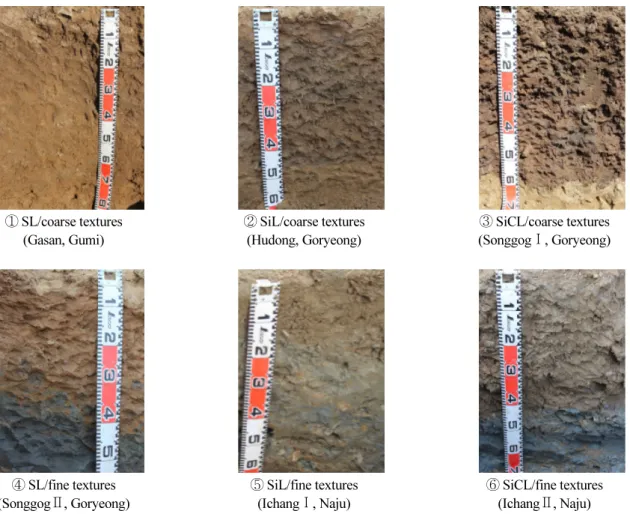
① SL/coarse textures (Gasan, Gumi)

② SiL/coarse textures (Hudong, Goryeong)

③ SiCL/coarse textures (SonggogⅠ,

Goryeong)

④ SL/fine textures (SonggogⅡ,

Goryeong)

⑤ SiL/fine textures (IchangⅠ, Naju)

⑥ SiCL/fine textures (IchangⅡ, Naju)

Hydraulic conductivity of surface soils of various anthropogenic soil types.

1)

*Corresponding author : Phone: +82632382431, Fax: +82632383822, E-mail: [email protected]

§
Acknowledgement: This project was supported by National Academy of Agricultural Science (PJ008620012015).

(2)

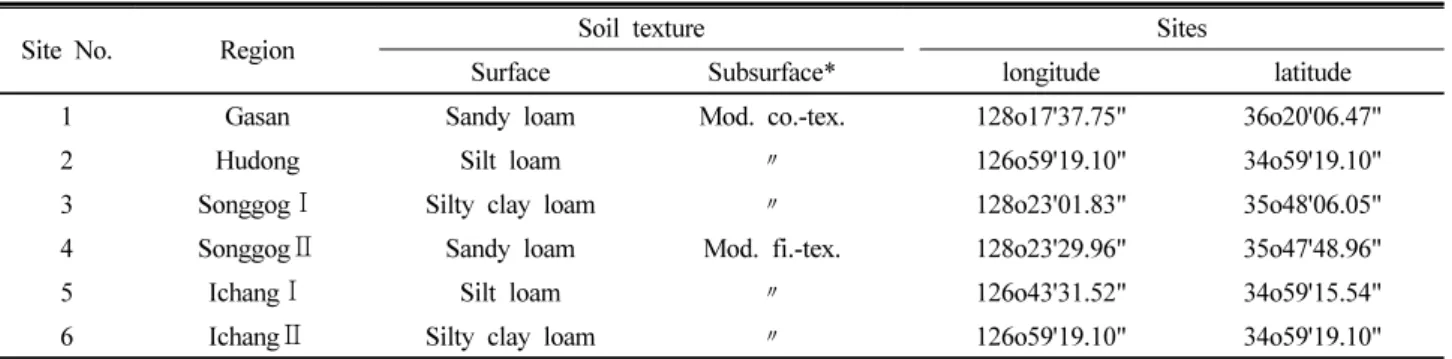
Table 1. Soil texture and site information of re-established layers.

Site No. Region Soil texture Sites

Surface Subsurface* longitude latitude

1 Gasan Sandy loam Mod. co.-tex. 128o17'37.75" 36o20'06.47"

2 Hudong Silt loam 〃 126o59'19.10" 34o59'19.10"

3 Songgog Ⅰ Silty clay loam 〃 128o23'01.83" 35o48'06.05"

4 Songgog Ⅱ Sandy loam Mod. fi.-tex. 128o23'29.96" 35o47'48.96"

5 Ichang Ⅰ Silt loam 〃 126o43'31.52" 34o59'15.54"

6 Ichang Ⅱ Silty clay loam 〃 126o59'19.10" 34o59'19.10"

* Subsurface soil texture are general terms that group of soil texture classes in soil taxonomy.

Introduction

토양의 생성에 관여하는 생물인자의 영향은 주로 식생에 의해 지배되고 인간 또는 동물의 영향은 극히 제한적이었 다. 최근 인간의 활동이 증가함에 따라 농경지를 포함한 지 표면의 교란은 세계 많은 지역에서 일어나고 있다. 이와 같 이 짧은 시간에 급속히 변화하는 것을 이차적 환경변화라 하고 이런 변화를 통해 생성된 토양 즉 자연의 힘보다 인간 의 활동이 더 크게 영향을 받아 생성된 토양을 “인위토양 (Anthrosols)” 혹은 “인위생성토 (Anthropogenic soils)”라 칭한다.

우리나라 농업도 하천이나 강물에 의하여 상부에서 운반 된 물질이 범람하여 연안의 낮은 땅에 퇴적되어 이루어진 평탄지에서 발달되었다. 하성평탄지는 약 만년 이내의 시기 인 제4기 신층인 충적세 (Holocene)의 퇴적물에 의하여 형 성되었고 (Gile, 1979), 하천 범람에 의하여 형성된 지형일 지라도 4기 고층인 홍적세 (Pleistocene, 200만년〜1만 년 전)에 형성되어 (Ponti, 1985) 하성평탄지보다 약간 높은 위 치에 형성된 홍적 모재의 대지인 홍적대지와는 구분되고 있 다. 하성평탄지에 분포하는 토양들은 토양 생성연대가 짧기 때문에 일반적으로 토양발달 정도가 적으나 일반적으로 비 옥하고 물의 공급이 쉬워 관개농업에 알맞고 대규모의 기계 화 작업도 용이하므로 논 농업 뿐만 아니라 다용도로 이용 되고 있다.

소하천변이나 큰 강변을 따라 경사가 완만하게 전개된 평탄지는 농업적으로 큰 비중을 차지하고 특히 우리나라 4 대강인 한강, 낙동강, 금강 및 영산강 유역에 넓게 분포하고 있다. 하성평탄지에 발달된 토양은 물의 속도에 따라 토양 생성이 다르며 물의 유속이 완만해지고 물의 용적이 줄어들 면 토립이 퇴적하여 토양이 생성되는데, 그 순서는 돌, 자 갈, 모래 등 조립질로부터 육안으로 식별하기 어려운 점토 등 세립질 순이고 하천상류는 사양질계 토양이 분포하고 하 류는 미사질계 토양이 분포되고 있다.

우리나라의 하천 주변은 제방을 축조하여 자연범람을 경 감하는 수방시설이 잘 발달되어 있으나 하천은 상류에서 유

입되는 토사가 퇴적되어 하상이 높아지고 있는 실정이다.

하상에 퇴적된 토사를 준설해 하천 인근의 저지대 농경지에 성토하여 농지의 바닥을 높여 재조성해 농업생산 기반시설 이 개량됨으로써 농지의 이용률 향상을 위한 4대강 농경지 리모델링 사업이 140개 지구 7,727 ha 정부주도로 시행되어 2011년에 준공하였다.

농경지 리모델링 토양과 같이 표토뿐만 아니라 심토까지 도 교란된 토양에서는 입자분포가 원래의 토양특성을 반영 한다 하더라도 표토의 교란과 준설토의 성토 등의 인위적인 작업은 용적밀도, 투수계수 등의 작물생산에 중요한 물리성 이 변화될 가능성이 매우 높으나 아직 이에 대한 연구는 미 미한 편이다 (Lee et al., 2002).

따라서 본 연구는 4대강 농경지 리모델링 사업지구를 중 심으로 대규모 인위적 생성토양의 물빠짐, 밀도변화 등 이 화학적 특성을 구명하여 토양생산성 향상을 위한 대책을 수 립코자 수행하였다.

Materials and Methods

조사토양 위치와 특성 성토재 및 원 토양의 특성이

상이한 리모델링 농경지 대표지역의 위치와 표·심토의 토성 과 위치정보는 Table 1.과 같다.

2012년 농경지 리모델링 사업은 원래토양의 표토 (0~50cm)를 굴취해 다른 곳에 적치하였다가 그 자리에 하 천 퇴적물을 메우기를 한 다음 원래토양을 표토에 처리하는 방법이었다. 모재층 즉, 하천 준설토의 2개 토성에 따라 표 토 (되 메우기 흙) 토성 3종류의 대표지점을 선정하여 조사 용 시료를 채취하였다. 조사지점은 주로 낙동강 중류와 영 상강 하류를 중심으로 전정하였다. 제1지점~제4지점은 낙 동강 중류에 위치하였으며 가산2지구는 경북 구미시 도개 면 가산리, 후동지구는 경북 고령군 우곡면 포리, 송곡지구

Ⅰ,Ⅱ는 경북 고령군 다산면 송곡리, 에 위치하며, 제5지점

과 제6지점은 영산강 하류인 전남 나주시 이창동에서 채취

하여 분석하였고 시료채취와 동시에 토양단면의 형태적 특

성을 토양조사 편람에 준해 조사하였다.

(3)

토양 이화학적 특성 농경지 리모델링 후 표토와 심토의 특성이 서로 다른 지점을 엄선한 다음 준설토 즉, 심토와 표 토 (되 메우기 흙)를 채취하여 음건한 후 Soil Survey Laboratory Methods Manual (USDA, 2004)와 토양 및 식물 체 분석법 (NIAST, 2000)에 준해 토양의 이화학성을 분석 하였다. 토성은 피펫법으로 입경을 분석하여 미 농무성 기 준의 삼각도표법 (USDA법)에 의하여 분류하였다. 수리전도 는 정수위법으로 토양 깊이별로 3인치 Core로 채취한 후, Core를 Porous plate가 깔린 Core지지대에 원래의 상하배 열로 고정시키고, 정수위 수조와 porous plate 밑에 연결하 여 공기를 뺀 물을 서서히 올려 토양의 2~3 cm 위로 올라 오도록 하였다. 공기가 제거되면 하단의 사이폰을 떼어 위 로 연결하여 수조의 물을 통과시시켰다. 일정시간에 대한 투수량을 4~5일간 계속 측정하여 최대치 근처의 3~5개를 평균으로 수리전도도를 측정하였다.

토양 중의 Eh는 포장에서 직접 근권부위 토심 5 cm에서 백금전극 (Pt/Ag/AgCl 전극, Orion 678BN)을 토양에 삽입 후 2시간 후에 측정하였다. 모든 측정치에 +199 mV을 보정 하였다. pH는 풍건한 토양을 증류수와 1:5로 혼합하여 30분 간 진탕한 현탁액을 Ion analyzer를 이용하여 측정하였고, 전기전도도 (Electrical Conductivity, EC)는 토양과 증류수 를 1:5의 비율로 혼합하여 30분간 진탕한 후 Conductivity Meter로 측정한 값에 희석배수 5를 곱하여 분석하였다. 유기 물 함량은 Tyurin법으로 분석하였고, 유효인산은 Lancaster 법으로 분광광도계를 이용하여 분석하였다. 치환성 양이온 (K, Ca, Mg)은 5 g의 토양시료에 50 ml의 1N-Ammoniumacetate (pH 7.0)를 가하여 30분간 진탕하여 No.2 여지로 여과 후 원자방출분광광도계 (ICP)를 이용하여 분석하였다. 양이온 치환용량 (CEC)은 Mechanical Vacuum Extractor (Centurion International, Inc., Lincoln, NE Model 24)를 이용하여, 풍건토양 5 g에 50 ml의 1N-Ammonium acetate (pH 7.0) 를 가하여 치환성 양이온들을 NH

4

를 세척한 후 증류하여 정 량하였다.

성토재와 표토의 경계면의 미세형태를 관찰하기 위하여 현 지 토양단면 조사 및 점토집적층 (Bt) 코어시료 채취 후 건조 기 내에서 40℃로 1주일 정도 시료를 건조시키고 Polyester 수지를 토양입단에 가하여 진공펌프로 8시간 동안 토양공 극을 포화시켰다. 수지로 포화된 시료를 경화시키기 위하여 실온에서 6주, 40℃ 건조기 내에서 1주일 동안 열처리를 실 시하였다. 경화가 끝난 시료는 절단기를 이용하여 두께 1 cm, 가로 세로가 각각 2 cm, 3 cm 정도 크기로 자른 후 절 단한 한면을 연마하고 연마된 토양편 위에 에폭시 접착제를 얇게 바른 후 유리 슬라이드에 접착하여 3∼4일간 실온에 서 고화시켰다. 접착제 경화가 끝난 시료는 절단기를 이용 하여 두께 1 mm 정도로 암석을 절단하고 토양편을 유리판 위에서 연마제를 이용하여 토양편 중에 함유된 석영의 간섭

색이 순백색일 때까지 연마하여 박편의 두께는 30 ㎛이하 가 되도록 하였다. 박편을 세척ㆍ건조 후 Polyester 수지로 커버글라스를 접착시키고, 편광현미경을 이용하여 개방니 콜과 직교니콜 상태하에서의 토양 미세형태학적 특성은 Stoops and Eswaran (1986)의 기술방법에 따랐다.

Results and Discussion

하천 준설물을 모재층으로 성토한 논토양에서 배수불량 층의 특성을 구명하기 위하여 표토가 사양토 (SL), 미사질 양토 (SiL), 미사질식양토 (SiCL)이고, 성토재가 조립질과 세립질인 토양을 경북 구미, 경북 고령, 전남 나주지역의 6 개소를 대상으로 조사한 단면형태는 Fig. 1.과 같으며 토양 단면의 형태적 특성은 Table 2.와 같았다.

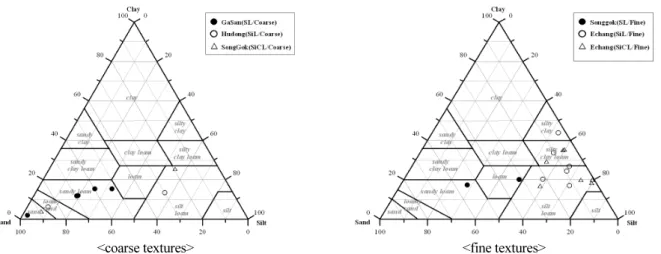
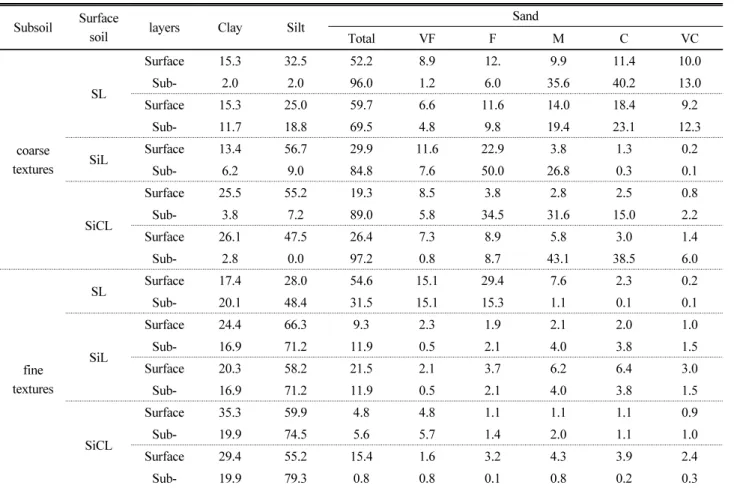
6개 유형별 토양입자의 입경분포는 Fig. 2와 같았으며, 조사대상지의 토양층위별 토성은 Table 3와 같았다. 조립질 토양에서의 평균값은 모래 19.1%, 미사 43.4%, 점토 37.5%

이었으며, 세립질 토양에서의 평균값은 모래 25.4%, 미사 53.5%, 점토 21.1%이었다. 조립질이 성토재로 조성된 토양 의 표토가 세립질인 토양보다 상대적으로 모래함량이 많은 입자분포를 나타내었다.

하천 퇴적물의 토성속별로 표토의 토성분포를 토양삼각 도표에서 살펴보면, 성토층이 조립질인 토양은 모래의 함량 범위가 넓으며, 세립질인 토양은 미사가 많은 토양이었다.

소하천변이나 큰 강변을 따라 경사가 완만하게 전개된 평탄지 (경사 2% 미만)를 하성평탄지라 하고 농업적으로 큰 비중을 차지하는 토양이다. 특히 4대강인 한강, 낙동강, 금 강 및 영산강 유역에 넓게 분포하고 있다. 하성평탄지에 전 개된 토양은 물의 속도에 따라 토양생성이 다르며 물의 유 속이 완만해지고 물의 용적이 줄어들면 토립물이 퇴적하여 토양이 생성되는데, 그 순서는 돌, 자갈, 모래, 미사 및 점 토 등 조립질로부터 육안으로 식별하기 어려운 세립질 순이 었다.

그러므로 하천상류는 사양질계 토양이 분포하고 하류는 미사질계 토양이 분포하고 있었다 (Berg, 1984).

성토재 토성속 및 표토 토성별로 구분된 6개 유형의 토양 을 대상으로 수리전도도를 측정한 결과는 Fig. 3과 같았다.

SL/조립질인 토양에서 표토 0.2 cm/hr로 느리지만, 표토와

성토 경계지점 0.8 cm/hr, 하천 준설토가 성토된 심토에서

는 3.0 cm/hr 이상이었다. SiL/조립질과 SiCL/조립질 토양

은 표토에서 느림에서 약간 느린 투수등급이었다가 표토와

성토층의 경계지점에서 0.1 cm/hr이하로 매우 느린 투수등

급을 보였다. SL/세립질 토양은 표토에서 7.0 cm/hr 이상

매우 빠른 투수등급을 보이다가 표토와 성토 경계지점에서

는 느림, 성토층에서는 매우 느림으로 표토에서 성토로 갈

수록 투수속도가 감소하였다. 한편, SiL/세립질과 SiCL/세

(4)

① SL/coarse textures (Gasan, Gumi)

② SiL/coarse textures (Hudong, Goryeong)

③ SiCL/coarse textures (SonggogⅠ, Goryeong)

④ SL/fine textures (Songgog Ⅱ, Goryeong)

⑤ SiL/fine textures (Ichang Ⅰ, Naju)

⑥ SiCL/fine textures (Ichang Ⅱ, Naju) Fig. 1. Morphological characteristics of soil profile about various anthropogenic soils.

Table 2. Morphological characteristics on soil profiles at each sites.

Site No. Layers Soil depth (cm) Soil color Soil texture

1

^A1 0-15 Dark grayish brown (10YR 4/2) loam

^C1 15-85 Dark grayish brown (10YR 4/2) silt loam

2^C2 +85 Strong brown (7.5YR 5/6) coarse sand

2

^Ap 0-19 Dark grayish brown (10YR 4/2) silt loam

^C1 19-56 Dark grayish brown (10YR 4/2) silt loam

2^C2 +56 Brown (10YR 4/3) loamy sand

3

^Ap 0-16 Dark brown(7.5YR 3/4) silty clay loam

^C1 16-62 Dark brown(7.5YR 3/4) silty clay loam

2^C2 +62 Light yellowish brown (10YR 6/4) gravelly sand

4

^Ap 0-12 Brown (7.5YR 4/3) sandy loam

^C1 12-42 Brown (10YR 4/3) sandy loam

2^C2 +42 Dark grayish brown (10YR 4/2) silt loam

5

^Ap 0-18 Yellowish brown (10YR 5/4) silt loam

^C1 18-35 Yellowish brown (10YR 5/4) silt loam

2^C2 35-61 Yellowish brown (10YR 5/4) silt loam

3^C3 +61 Yellowish brown (10YR 4/4) silt loam

6

^Ap 0-13 Dark yellowish brown (10YR 4/4) silty clay loam

^C1 13-43 Dark yellowish brown (10YR 4/4) silty clay loam

2^C2 +43 Dark grayish brown (2.5Y 4/2) silt loam

(5)

<coarse textures> <fine textures>

Fig. 2. Particle distribution on surface soils of various anthropogenic soil types.

① SL/coarse textures (Gasan, Gumi)

② SiL/coarse textures (Hudong, Goryeong)

③ SiCL/coarse textures (SonggogⅠ, Goryeong)

④ SL/fine textures (Songgog Ⅱ, Goryeong)

⑤ SiL/fine textures (Ichang Ⅰ, Naju)

⑥ SiCL/fine textures (Ichang Ⅱ, Naju) Fig. 3. Hydraulic conductivity of surface soils of various anthropogenic soil types.

립질 토양은 표토, 표토와 성토 경계지점에서는 느림에서 약간느림이었고 성토층에서는 약간 느림에서 보통으로 표 토에서 성토로 갈수록 투수속도가 증가하였다 (Box, 1991).

토양층위별 수리전도를 살펴보면, SL/조립질인 유형의 지점을 제외하고 성토와 기존토양 복토 경계층에서 수리전 도도 값이 낮은 결과를 나타내었다. 심토 압밀층의 발생과 토성의 급변은 경계층에서 물의 흐름이 방해를 받아 토양수

분의 수직이동 방해로 토양이 환원상태로 변할 뿐만 아니라 토심이 얕은 지점에 발생하면 뿌리의 생육과 지하수의 이용 에 장해를 초래할 것으로 예상되었다 (Doh et al., 1994;

Yun et al., 2011; Han et al., 2009).

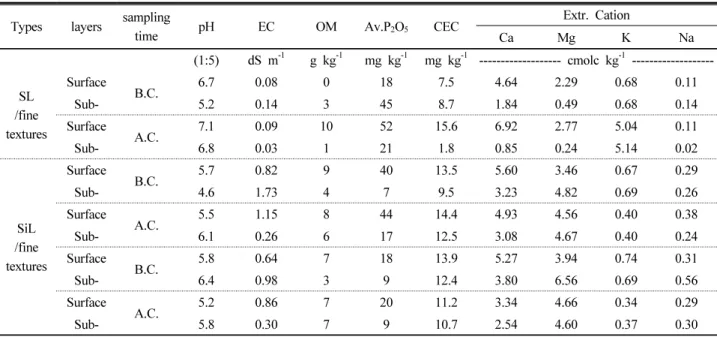
조립 및 세립질의 하천 퇴적물로 성토된 논토양에서 표

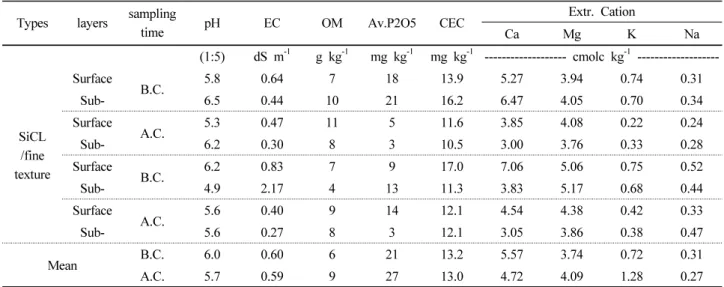
토의 토성별 토양 화학성은 Table 4, 5와 같았다. 대상 농경

지 전체 pH (1:5) 6.4, EC 0.38 dS m

-1

, 유기물 7 g kg

-1

, 유

(6)

Table 3. Particle distribution on subsurface dredged soils of various anthropogenic soil types. (Unit: wt, %)

Subsoil Surface

soil layers Clay Silt Sand

Total VF F M C VC

coarse textures

SL

Surface 15.3 32.5 52.2 8.9 12. 9.9 11.4 10.0

Sub- 2.0 2.0 96.0 1.2 6.0 35.6 40.2 13.0

Surface 15.3 25.0 59.7 6.6 11.6 14.0 18.4 9.2

Sub- 11.7 18.8 69.5 4.8 9.8 19.4 23.1 12.3

SiL Surface 13.4 56.7 29.9 11.6 22.9 3.8 1.3 0.2

Sub- 6.2 9.0 84.8 7.6 50.0 26.8 0.3 0.1

SiCL

Surface 25.5 55.2 19.3 8.5 3.8 2.8 2.5 0.8

Sub- 3.8 7.2 89.0 5.8 34.5 31.6 15.0 2.2

Surface 26.1 47.5 26.4 7.3 8.9 5.8 3.0 1.4

Sub- 2.8 0.0 97.2 0.8 8.7 43.1 38.5 6.0

fine textures

SL Surface 17.4 28.0 54.6 15.1 29.4 7.6 2.3 0.2

Sub- 20.1 48.4 31.5 15.1 15.3 1.1 0.1 0.1

SiL

Surface 24.4 66.3 9.3 2.3 1.9 2.1 2.0 1.0

Sub- 16.9 71.2 11.9 0.5 2.1 4.0 3.8 1.5

Surface 20.3 58.2 21.5 2.1 3.7 6.2 6.4 3.0

Sub- 16.9 71.2 11.9 0.5 2.1 4.0 3.8 1.5

SiCL

Surface 35.3 59.9 4.8 4.8 1.1 1.1 1.1 0.9

Sub- 19.9 74.5 5.6 5.7 1.4 2.0 1.1 1.0

Surface 29.4 55.2 15.4 1.6 3.2 4.3 3.9 2.4

Sub- 19.9 79.3 0.8 0.8 0.1 0.8 0.2 0.3

* VF: Very Fine (0.1-0.05mm), F: Fine (0.25-0.1mm), M: Middle (0.5-0.25mm), C: Coarse (1.0-0.5mm), VC: Very Coarse (2.0-1.0mm)

효인산 53 mg kg

-1

, 치환성 양이온 중 Ca 5.43 cmol

c

kg

-1

, Mg 3.06 cmol

c

kg

-1

, K 1.93 cmol

c

kg

-1

, Na 0.21 cmol

c

kg

-1

이었으며, 성토 당시와 성토 후 1년 동안 벼를 재배한 표토 의 화학적 특성을 살펴보면, 성토층의 토성속이 조립질인 토양에서 EC가 0.23dS m

-1

에서 0.11로 유효인산은 112 mg kg

-1

에서 54로, 치환성 Ca 는 6.6 cmol

c

kg

-1

에서 4.9로 감 소한 반면에 세립질 토양에서는 pH와 치환성 Ca 만이 감소 하는 것으로 나타났다. 특히 유기물과 유효인산의 함량이 층위별로 불균일하게 분포양상을 보이는데 이는 정지정리 등 토층이 교란될 때 경작층과 심토층의 혼합에서 기인하는 것으로 생각되었다.

토양화학성을 수도생육을 위한 적정범위와 비교해 보면, 치환성 칼륨 및 칼슘의 적정범위 (NIAST, 2006)는 각각 0.25∼0.30 cmol

c

kg

-1

, 5.0∼6.0 cmol

c

kg

-1

보다 높게 나 타났으나 토양 유기물과 인산의 집중적인 관리가 필요한 것 으로 나타났다.

토양 유기물 함량은 7 g kg

-1

으로 적정한 유기물함량은 25-30 g kg

-1

(NIAST, 2006)인 점을 미루어 보아 퇴비 및 볏짚, 우분 등 농산부산물의 토양환원에 의한 유기물 증진 노력이 요구된다. 유효인산 함량은 53 mg kg

-1

이하로 2000 년 우리나라 논토양 유효인산 평균 함량 141 mg kg

-1

보다

크게 낮아 인산의 증비가 필요할 것으로 생각된다.

성토층과 표토층의 경계지점에서의 미세형태학적 구조를 구명하기 위하여 박편을 제작한 후 편광현미경 직교니콜상 태에서 관찰한 형태는 Fig. 4와 같았다. 토양박편에서 큰 입 자들은 벽개의 발달이 없고 교차니콜하에서 회색 또는 백색 간접색을 나타내는 석영과 교차니콜하에서 검고 흰 줄무늬 가 반복되는 장석이 관찰되었다 (Zhang et al., 2006). 석영 과 장석 입자들 사이에는 미사 크기 이하의 회색 또는 적갈 색 물질이 기질을 채우고 있었다 (Buol and Hole, 1959).

미세형태학적 토양구조를 살펴보면, 모든 대상 토양에서 토괴나 공극이 형성되지 않은 무구조 (massive structure) 를 나타내고 있었다. 따라서 조사된 토양은 성토 및 표토의 복토로 아직 토양발달이 거의 없는 토양으로 판단되었다 (Dijkerman et al., 1967; Chesworth, 1973).

토양의 조립질과 세립질 입자의 조성 형태에 따른 복굴

절 현상 (b-fabric)을 살펴보면, 크게 2가지 형태로 분류할

수 있었다. 사양토 (SL)/조립질 토양 (가산지구), 미사질식

양토 (SiCL)/조립질 토양 (송곡지구)과 사양토 (SL)/세립질

토양 (송곡지구)은 후동지구는 세립질 물질이 석영이나 장

석입자사이에서 평형 또는 거의 평형하게 평형호상 (平衡縞

狀; Parallel striated b-fabric)을 이루고 있었다 (Jeong

(7)

Table 4. The chemical properties on subsurface soils of dredged coarse textured sediments.

Types layers sampling

time pH EC OM Av.P

2

O

5

CEC Extr. Cation

Ca Mg K Na

(1:5) dS m

-1

g kg

-1

mg kg

-1

mg kg

-1

--- cmolc kg

-1

---

SL /coarse textures

Surface

B.C.* 6.9 0.19 3 159 8.0 5.14 1.81 0.75 0.10

Sub- 6.8 0.06 0 19 1.4 0.91 0.22 0.75 0.02

Surface

A.C. 6.9 0.12 5 71 7.3 3.82 1.94 4.92 0.10

Sub- 6.7 0.02 2 3 1.5 0.73 0.24 4.94 0.01

Surface

B.C. 6.9 0.23 4 290 7.3 4.53 1.49 0.70 0.09

Sub- 6.8 0.21 3 11 4.9 3.16 1.06 0.73 0.07

Surface

A.C. 7.2 0.11 5 78 7.5 4.00 2.14 4.99 0.10

Sub- 7.2 0.05 1 11 1.6 0.83 0.62 5.12 0.04

SiL /coarse textures

Surface

B.C. 6.9 0.28 10 59 8.0 5.40 1.64 0.63 0.12

Sub- 6.9 0.16 4 47 4.4 2.83 0.72 0.73 0.04

Surface

A.C. 6.6 0.16 4 62 8.6 5.44 1.52 5.03 0.16

Sub- 6.3 0.05 3 40 4.1 2.53 0.78 5.09 0.03

SiCL /coarse textures

Surface

B.C. 6.7 0.22 7 25 13.7 8.90 2.91 0.69 0.15

Sub- 6.5 0.11 0 17 2.9 2.02 0.49 0.65 0.04

Surface

A.C. 7.6 0.06 4 31 7.9 4.90 3.06 5.05 0.11

Sub- 6.5 0.07 5 42 6.5 3.62 1.22 5.15 0.08

Surface

B.C. 6.7 0.22 7 25 13.7 8.90 2.91 0.69 0.15

Sub- 6.5 0.11 0 17 2.9 2.02 0.49 0.65 0.04

Surface

A.C. 6.8 0.08 6 26 11.2 6.12 2.71 5.08 0.13

Sub- 6.7 0.06 4 32 8.2 4.06 1.91 5.15 0.08

Mean B.C. 6.8 0.23 6 112 10.1 6.57 2.15 0.69 0.12

A.C. 7.0 0.11 5 54 9.8 4.86 2.27 5.01 0.12

* B.C.: Before cultivation, A.C.: After cultivation

Table 5. The chemical properties on subsurface soils of dredged fine textured sediments. (continued)

Types layers sampling

time pH EC OM Av.P

2

O

5

CEC Extr. Cation

Ca Mg K Na

(1:5) dS m

-1

g kg

-1

mg kg

-1

mg kg

-1

--- cmolc kg

-1

---

SL /fine textures

Surface

B.C. 6.7 0.08 0 18 7.5 4.64 2.29 0.68 0.11

Sub- 5.2 0.14 3 45 8.7 1.84 0.49 0.68 0.14

Surface

A.C. 7.1 0.09 10 52 15.6 6.92 2.77 5.04 0.11

Sub- 6.8 0.03 1 21 1.8 0.85 0.24 5.14 0.02

SiL /fine textures

Surface

B.C. 5.7 0.82 9 40 13.5 5.60 3.46 0.67 0.29

Sub- 4.6 1.73 4 7 9.5 3.23 4.82 0.69 0.26

Surface

A.C. 5.5 1.15 8 44 14.4 4.93 4.56 0.40 0.38

Sub- 6.1 0.26 6 17 12.5 3.08 4.67 0.40 0.24

Surface

B.C. 5.8 0.64 7 18 13.9 5.27 3.94 0.74 0.31

Sub- 6.4 0.98 3 9 12.4 3.80 6.56 0.69 0.56

Surface

A.C. 5.2 0.86 7 20 11.2 3.34 4.66 0.34 0.29

Sub- 5.8 0.30 7 9 10.7 2.54 4.60 0.37 0.30

(8)

Table 5. The chemical properties on subsurface soils of dredged fine textured sediments. (continued)

Types layers sampling

time pH EC OM Av.P2O5 CEC Extr. Cation

Ca Mg K Na

(1:5) dS m

-1

g kg

-1

mg kg

-1

mg kg

-1

--- cmolc kg

-1

---

SiCL /fine texture

Surface

B.C. 5.8 0.64 7 18 13.9 5.27 3.94 0.74 0.31

Sub- 6.5 0.44 10 21 16.2 6.47 4.05 0.70 0.34

Surface

A.C. 5.3 0.47 11 5 11.6 3.85 4.08 0.22 0.24

Sub- 6.2 0.30 8 3 10.5 3.00 3.76 0.33 0.28

Surface

B.C. 6.2 0.83 7 9 17.0 7.06 5.06 0.75 0.52

Sub- 4.9 2.17 4 13 11.3 3.83 5.17 0.68 0.44

Surface

A.C. 5.6 0.40 9 14 12.1 4.54 4.38 0.42 0.33

Sub- 5.6 0.27 8 3 12.1 3.05 3.86 0.38 0.47

Mean B.C. 6.0 0.60 6 21 13.2 5.57 3.74 0.72 0.31

A.C. 5.7 0.59 9 27 13.0 4.72 4.09 1.28 0.27

* B.C.: Before cultivation, A.C.: After cultivation

① SL/coarse textures (Gasan, Gumi)

② SiL/coarse textures (Hudong, Goryeong)

③ SiCL/coarse textures (SonggogⅠ, Goryeong)

④ SL/fine textures (Songgog Ⅱ, Goryeong)

⑤ SiL/fine textures (Ichang Ⅰ, Naju)

⑥ SiCL/fine textures (Ichang Ⅱ, Naju) Fig. 4. Photo of soil flakes between dredged soil and surface soils (Horizontal axis 100 ㎛ in the picture).

and Kim, 1993). 미사질양토 (SiL)/조립질 토양 (후동지구), 미사질양토 (SiL)/세립질 토양 (이창지구 I) 및 미사질식양 토 (SiCL)/세립질 토양 (이창지구 II)에서는 세립질 물질이 입단을 형성하며 조립질 물질이 주변에 배향하는 입자포위 호상 (粒子包囲縞狀; Granostriated b-fabric)이었다.

조사된 모든 토양의 복굴절현상은 토양의 수축 팽창에

의한 반상 (斑狀; speckled)을 나타나지 않고 (Reheis, 1990),

압력을 받았을 때 나타나는 호상 (縞狀;striated)의 형태를

띠고 있어 하천 준설토 성토 후 원래 토양을 복토하는 과정

에서 다져져 (Beutler and Centurion, 2008; Hamza and

(9)

Anderson, 2003; 2005; Han et al., 2009) 토양수분 이동이 제한적임을 파악할 수 있었다.

References

Berg. R.C. 1984. The origin and earllly genesis of clay bands in youthful sandy soils along Lake Michigan. U.S.A.

Geoderma. 32:45-62.

Beutler, A.N. and J.F. Centurion. 2008. Soil compaction by machine traffic and least limiting water range related to soybean yield. Pesq. agropec. bras., Brasia. 43(11):1591-1600.

Box, J.E. Jr. 1991. The effect of waterlogging on rooting intermittent flooding on germination and seeding growth of cotton. American Soc. Agri. Eng. 14:567-570.

Buol, S.W. and F.D. Hole. 1959. Some characteristics of clay skins on peds in the B horizon of a Gray-Brown Podzolic soil.

Soil Sci. Soc. Am. Proc. 23:239-241.

Chesworth. W. 1973. The parent material effect and the genesis of soils. Geoderma 10:215-225.

Dijkerman, J.C., M.G. Cline, and G.W. Olson. 1967. Properties and genesis of textural subsoil lamellae. Soil Sci. 104:7-16.

Doh, D.H., S.J. Kim, S.K. Jin, and R.C. Jo. 1994. A study on variation of the soil physical characteristics of multiutilized paddy field by the introduction of subsurface drainage facility.

Journal of Life Science. 1:87-96.

Gile, L.H. 1979. Holocene soils in eolian sediments of Bailey, County Texas. Soil Sci. Soc. Am. Proc. 43:994-1003.

Hamza, M.A. and W.K. Anderson. 2003. Responses of soil properties and grain yields to deep ripping and gypsum application in a compacted loamy sand soil contrasted with a sandy clay loam soil in Western Australia. Aust. J. Agric. Res.

54(3):273-282.

Hamza, M.A. and W.K. Anderson. 2005. Soil compaction in cropping systems. A review of the nature, causes and possible solutions. Soil Tillage Res. 82(2):121-145.

Han, K.H., I.Y. Kim, S.W. Hwang, H.J. Cho, S.S. Kang, S.O.

Hur, D.S. Oh, G.S. Lee, and H.S. Lee. 2009. Research for physical characteristics on soil compaction. NIAST Report.

519-534. (In Korean)

Jeong, G.Y. and S.J. Kim. 1993. Boxwork fabric of halloysite-rich kaolin formed by weathering of anorthite in Sancheong area, Korea. Clays and Clay Minerals, 41:56-65.

Lee, C.K., Y.K.Sonn, J.H.Sung, I.G. Jung, S.C. Kim, W.P. Park, and W.K. Park. 2002. Geostatistical analysis of spatial variability for field information in paddy field. Kor. J. Intl.

Agri. 14(2):127-138.

NIAST. 2000. Soil and plant analysis. (In Korean)

NIAST. 2006. Fertilizer recommendation for crops (revision).

National Institute of Agricultural Science and Technology, RDA, Suwon, Korea.

Ponti, D.J. 1985. The quarternary alluvial sequence of the Antelope Valley, Califomia. Geol. Soc. Am. Spec. Pap.

203:79-96.

Reheis, M.C. 1990. Influence of climate and eolian dust on the major-element chemistry and clay mineralogy of soils in the northern Bighom Basin, U.S.A. Catena 17:219-248.

Stoops, G. and H. Eswaran. 1986. Soil micromorphology. Van Nostrand Rheinhold soil science series. Van Nostrand Reinhold. 345 p.

USDA, NRCS. 2004. Soil survey laboratory methods manual.

Soil Survey Investigation Report No. 42. Version 4.0.

USDA-NRCS, Washington.

Yun, E.S., K.Y. Jung, K.D. Park, Y.K. Sonn, C.Y. Park, J.B.

Hwang, and M.H. Nam. 2011. Compaction characteristics of multi-cropping paddy soils in south-eastern part of Korea.

Korean J. Soil Sci. Fert. 44(5):688-695.

Zhang, Y.S., Y.K. Sonn, S.J. Jung, G.J. Lee, M.S. Kim, S.K.

Kim, J.Y. Lee, and I. H. Pyun. 2006. Clay mineral composition of the soils derived from residuum and colluvium. Korean J.

Soil Sci. Fert. 39(5): 246-329.

(10)

[부록] 토양 단면 조사 성적

표토 사양토 (SL)/조립질 성토 토양 (경북 구미시 옥성면 가산리, 가산지구)은 낙동강과 접한 하성평탄지의 하성충적 층을 모재로 하는 토양으로 하천에 인접되어 있어 조립질 토양이고, 경사는 2∼15%의 범위로, 토양층위별 단면 특성 은 다음과 같았다.

^A1 0-15cm. Dark grayish brown (10YR 4/2) loam;

structureless; moderately sticky and moderately plastic; common very fine to fine roots; few very fine pores; gradual wavy boundary.

^C1 15-85cm. Dark grayish brown (10YR 4/2) silt loam; many very coarse to extremely coarse distinct diffuse dark gray (5Y 4/1), common fine to extremely coarse faint diffuse very dark grayish brown (2.5Y 3/2) and reddish yellow (2.5Y 6/6) mottles; structureless; very sticky and very plastic;

few very fine roots; few very fine pores; gradual wavy boundary.

2^C2 +85cm. Strong brown (7.5YR 5/6) coarse sand;

structureless; non sticky and non plastic; no roots and pores.

표토 미사질양토 (SiL)/조립질 성토 토양 (경북 고령군 우곡면 포리, 후동지구)은 곡간지이며, 모재는 회색혈암에 서 유래된 충적-붕적층이며, 토양배수는 약간양호이고, 표 토는 주로 식양토와 미사질양토로 92%를 차지하고 있었으 며, 심토는 사양토와 양질사토이고 경사는 0~2%로 토양층 위별 단면 특성은 다음과 같았다.

^Ap 0-19cm. Dark grayish brown (10YR 4/2) silt loam;

common coarse faint dark yellowish brown (10YR 4/4) mottles; structureless (massive); friable, slightly sticky and slightly plastic; many very fine to fine rice roots; abrupt smooth boundary.

^C1 19-56cm. Dark grayish brown (10YR 4/2) silt loam; many coarse distinct dark yellowish brown (10YR 4/4) mottles; structureless (massive); friable, slightly sticky and slightly plastic; common very fine to fine rice roots; abrupt wavy boundary.

2^C2 +56cm. Brown (10YR 4/3) loamy sand; structureless (single grain); loose, non sticky and non plastic;

no roots

표토 미사질식양토 (SiCL) / 조립질 성토 토양 (경북 고

령군 다산면 송곡리, 송곡지구)은 곡간지와 하성평탄지에 접하는 곳으로 토성은 미사식양질이고, 경사는 0∼15%의 범위이고 토양배수는 약간불량이었으며, 토양 모재는 하성 충적층과 회색혈암에서 유래된 충적-붕적층으로, 토양층위 별 단면 특성은 다음과 같았다.

^Ap 0-16cm. Dark brown(7.5YR 3/4) silty clay loam;

common coarse distinct dark strong brown (7.5YR 4/6) mottles; structureless (massive); friable, moderately sticky and moderately plastic; many very fine to fine rice roots; abrupt smooth boundary.

^C1 16-62cm. Dark brown (7.5YR 3/4) silty clay loam;

many coarse distinct dark strong brown (7.5YR 4/6) mottles; structureless (massive); firm, moderately sticky and moderately plastic; few very fine to fine rice roots; abrupt wavy boundary.

2^C2 +62cm. Light yellowish brown (10YR 6/4) gravelly sand; structureless (single grain); loose, non sticky and non plastic; no roots; about 13% gravels.

표토 사양토 (SL) / 세립질 성토 토양 (경북 고령군 다산 면 송곡리, 송곡지구)은 낙동강과 접하는 곳으로 토성은 사 양토이고, 경사는 0~15%의 범위이고 토양배수는 약간불량 이었으며, 토양 모재는 하성충적층과 회색혈암으로, 토양층 위별 단면 특성은 다음과 같았다.

^Ap 0-12cm. Brown (7.5YR 4/3) sandy loam; common coarse faint yellowish brown (10YR 5/4) mottles;

structureless (massive); friable, slightly sticky and slightly plastic; many very fine to fine rice roots; abrupt smooth boundary.

^C1 12-42cm. Brown (10YR 4/3) sandy loam; common coarse faint yellowish brown (10YR 5/4) mottles;

structureless (massive); friable, slightly sticky and slightly plastic; common very fine to fine rice roots; abrupt broken boundary.

2^C2 +42cm. Dark grayish brown (10YR 4/2) silt loam;

common coarse distinct yellowish brown (10YR 5/4) mottles; structureless (massive); friable, slightly sticky and moderately plastic; no root.

표토 미사질양토 (SiL) / 세립질 성토 토양 (전남 나주시

이창동, 이창지구)은 하성충적층을 모재로 미사질양토이며

토양배수는 약간양호인 토양으로 매우약한경사를 이루며

토양층위별 단면 특성은 다음과 같았다.

(11)

^Ap 0-18cm. Yellowish brown (10YR 5/4) silt loam;

common fine to medium prominent grayish brown (2.5Y 5/2) mottles; structureless (massive); friable, slightly sticky and slightly plastic; many very fine to fine rice roots; abrupt smooth boundary.

^C1 18-35cm. Yellowish brown(10YR 5/4) silt loam;

many coarse prominent grayish brown (2.5Y 5/2) mottles; structureless (massive); friable, slightly sticky and slightly plastic; common very fine to fine rice roots; diffuse broken boundary.

2^C2 35-61cm. Yellowish brown (10YR 5/4) and grayish brown (2.5Y 5/2) silt loam; light olive brown (2.5Y 5/3) crushed color; structureless (massive);

friable, slightly sticky and slightly plastic; few very roots; diffuse broken boundary.

3^C3 +61cm. Yellowish brown (10YR 4/4) silt loam;

common coarse faint brown (10YR 4/3) mottles;

structureless (massive); friable, slightly sticky and moderately plastic; no root.

표토 미사질식양토 (SiCL) / 세립질 성토 토양 (전남 나 주시 이창동, 이창지구)은 하성평탄지에 위치하고 하성충적 층을 모재로 한 토양으로 미사질식양토이며 토양배수는 약 간불량인 토양으로 매우약한경사를 이루며 토양층위별 단 면 특성은 다음과 같았다.

^Ap 0-13cm. Dark yellowish brown (10YR 4/4) silty clay loam; many medium prominent grayish brown (2.5Y 5/2) mottles; structureless (massive); friable, moderately sticky and moderately plastic; many very fine to fine rice roots; abrupt smooth boundary.

^C1 13-43cm. Dark yellowish brown (10YR 4/4) silty clay loam; common medium distinct grayish brown (2.5Y 5/2) mottles; structureless (massive); firm, moderately sticky and moderately plastic; common very fine to fine rice roots; abrupt wavy boundary.

2^C2 +43cm. Dark grayish brown (2.5Y 4/2) silt loam;

common coarse distinct brown (10YR 4/3) mottles;

structureless (massive); friable, lightly sticky

and moderately plastic; no root.

수치

Table 1. Soil texture and site information of re-established layers.
Table 2. Morphological characteristics on soil profiles at each sites.
Fig. 2. Particle distribution on surface soils of various anthropogenic soil types.
Table 3. Particle distribution on subsurface dredged soils of various anthropogenic soil types
+3

참조

관련 문서

- 캘리포니아 공무원연기금(CalPERS)의 관계투자(relationship investing)를 선 례로 하는 shareholder activism의 일환으로 미국에서는 기관투자가의 적극 적인

본 연구원에서는 공개채용 서류접수와 관련하여 귀하의 개인정보를 아래와 같이 수집·이용하고자 합니다. 수집된 개인정보는 채용업무

멘토링 과정에서는 많은 어려움이 발생하기 때문에 초지일관 자신 감과참을성을 가지고 끈질기게 멘토링에 참여하는 것이 필요하다. 계획된 멘토링에 진지하고 헌신적으로

Characteristics of Fuel Cell Charge Transport Resistance.. 차원석

그 외 사회 전반에 적용되는 광의의 플랫폼 - 공용플랫폼/ 디자인 플랫폼/ 브랜드 플랫폼 등. 플랫폼은 공용하고 차량의 스타일 등을 결정하는

■ 인접 플랫폼이나 신규 플랫폼을 상시 모니터링 하여 자사의 플랫폼 전략에 반영할 필요 있음. 외부 환경과 기업 상황에 맞는

이렇게 작동을 하게 하려면 각 예제 폼들을 자식 윈 도우로 설정해야 하는데 그 방법으로는 다음과 같이 자식으로 생성될 폼 들의 속성을

*단어 사이의 공통성과