• 검색 결과가 없습니다.

Characterization of Melanin-concentrating Hormone from Olive Flounder (Paralichthys olivaceus)

N/A
N/A
Protected

Academic year: 2021

Share "Characterization of Melanin-concentrating Hormone from Olive Flounder (Paralichthys olivaceus)"

Copied!
9
0
0

로드 중.... (전체 텍스트 보기)

전체 글

(1)

Characterization of Melanin-concentrating Hormone from Olive Flounder (Paralichthys olivaceus)

In Young Chung

1

, Jeong Min Jeon

2

and Young Hwan Song

1

*

1

Department of Microbiology, Pukyong National University, Busan 46041, Korea

2

Department of marine Biology, Pukyong National University, Busan 46041, Korea

Received December 29, 2017 /Revised January 12, 2018 /Accepted January 15, 2018

The melanin-concentrating hormone (MCH), a cyclic hypothalamic peptide composed of 17 amino acids, was initially identified in chum salmon (Oncorhynchus keta) as a regulator of pigmentation.

Mammalian MCHs are cyclic hypothalamic peptides composed of 19 amino acids that regulate food intake and energy homeostasis. The present study examined not only MCH expression of different tissues but also the melanohore aggregation and intracellular Ca

2+

influx of fMCH and the other MCH. Real-time qPCR showed that MCH expressed specially in the brain, gonad, and ovary, and ex- pression of MCH was observed during the developmental stages. In the application of synthetic fMCH and both types of synthetic fMCH, dN-fMCH and dC-fMCH, scale melanophore induced sig- nificant changes in aggregation activity with various concentrations of MCH. Also, compared to hMCH and sMCH, fMCH exhibited a 36~99.85% increase in relative potency (%), whereas aggregation of dN-fMCH and dC-fMCH remained in a high concentration. However, dispersion was induced rap- idly according to be low concentration of dN-fMCH and dC-fMCH. We show that fMCH and its deri- vates were bound human MCHR1 and rat MCHR expressed in HEK293T cells with nano-molar affin- ity and are likely to be ligand-induced to mobilize intracellular Ca

2+

. These results may provide new ligands for binding assay with MCHew ligands, as a structure similar to the mammalian MCH struc- ture was discovered in fish. Once the fMCH receptor system is in place, it can be compared to the MCH system of mammals in terms of MCH function.

Key words : Fluorescent imaging plate reader, melanin-concentrating hormone, melanin-concentrating hormone receptor, Paralichthys olivaceus, quantitative real-time PCR

*Corresponding author

Tel : +82-51-629-5614, Fax : +82-51-629-5619 E-mail : [email protected]

This is an Open-Access article distributed under the terms of the Creative Commons Attribution Non-Commercial License (http://creativecommons.org/licenses/by-nc/3.0) which permits unrestricted non-commercial use, distribution, and reproduction in any medium, provided the original work is properly cited.

Journal of Life Science 2018 Vol. 28. No. 3. 284~292 DOI : https://doi.org/10.5352/JLS.2018.28.3.284

Introduction

Melanin-concentrating hormone (MCH) is a cyclic peptide succeeded in isolating and first characterized in teleosts as a neuropeptide hormone, which involved in aggregation of melanophore in the skin [35]. MCH isolated from the pitui- tary of chum salmon, Oncorhynchus keta is composed of 17 amino acids (aa), and later the primary structure of MCH has been discovered in coho salmon, O. kisutch [27], chinook salmon, O. tshawytscha [24], tilapia, Oreochromis mossambicus [14], rainbow trout, O. mykiss [6], bonito, Katsuwonus pelamis [19], and recently barfin flounder, Verasper moseri [36] in teleosts. These MCHs showed identical sequences and struc- ture to amino acids, and the only difference which is ob-

served from barfin flounder MCH (Fig. 1) is one variation which has Asn instead of Thr at the N-terminal region.

Compared with fish, the sequences and structure of mam- malian MCH with consisting of 19 aa also has been con- firmed from mice [9], rats [26], and human [28]. Mammalian MCH peptides has an identical cyclic structure and se- quence, and as these have two additional and four sub- stitutive amino acids relative to chum salmon MCH, sub- sequent study of mammalian MCH show that these peptides has been well conserved from vertebrate evolution [25].

MCH peptide with expression and posttranslational

cleavage of preproMCH gene encoding MCH has a principal

function that regulates the skin color for background adapta-

tion and modulates the release of Adrenocorticotro hormone

(ACTH), melanin-stimulating hormone (MSH), and somato-

lactin [5, 7, 14]. Recently, fish MCH plays a role in the regu-

lation of feeding behavior, unlike in rodents, showing that

its anorexigenic function is induced by inhibited food intake

[30]. These results indicate that the anorexigenic action of

MCH with having orexigenic function in the mammals is

(2)

Table 1. MCHs and its derivates synthesized and experimented for FLIPR assay and melanophore aggregation test

Peptide name Sequence Source

fMCH sMCH hMCH dN-fMCH dC-fMCH

H-DTDFN MLRCM IGRVY RPCWE SSNIP-OH H-DTMRC MVGRV YRPCW EV-OH H-DFDML RCMLG RVYRP CWQV-OH H-DFNML RCMIG RVYRP CWESS NIP-OH H-DTDFN MLRCM IGRVY RPCWE S-OH

[25aa]

[17aa]

[19aa]

[23aa]

[21aa]

AF236090 0910249A AAA63214 AF236090-modifed AF236090-modifed (All peptides were synthesized from Peptron, Korea)

mediated by the alpha-MSH signaling pathway. The facts which come to reveal from the mammals MCH is which mammals MCH has the roles as regulation of food intake [1, 11, 13, 22, 29, 30, 33] and exhibits additional regulation functions as behavior of stress, reproduction, grooming, lo- comotion, and aggression [4, 12, 23, 32].

MCH as orexigenic neuropeptide in mammals mediated signals via a G-protein coupled receptor (MCHR), and two types of MCHR (MCHR1 and MCHR2) was identified until currently. MCHR1 in subtypes was confirmed by the reverse pharmacology study with facts that the natural ligand of the orphan SLC-1 receptor was MCH in mammals [3, 10, 31, 34]. MCHR2 was confirmed in a human genomic sequence with MCHR1 data [17]. Two subtypes of Fish MCHR also have been identified from zebrafish and fugu in whole ge- nome shotgun database, and zebrafish has MCHR1 to be composed of two kind types (MCHR1a and MCHR1b) [21].

Recently, MCHR1 and MCHR2 from the barfin flounder, Verasper moseri was identified, and the results that MCHR2 mediates the effect of MCH to control body color for back- ground adaption in the barfin flounder was known in addi- tion to expression feature of MCHR1 [35].

In view of the functions and characterizations relationship between MCH and MCH receptor, It would be of interest to investigate the effects of MCH on melanophore ag- gregation, signal pathway via MCHR mediation, and the dis- covery of new ligand for MCH receptor. Consequently, from present work, in order to confirm fMCH characterization us- ing information of the MCH clone first identified from brain cDNA library of Olive flounder, Paralichthys olivaceus in a previous study [16], We compared first amino acid diver- sity between Olive flounder MCH (fMCH) peptide and dif- ferent fishes and mammals MCH. Second, Real time qPCR for specific expression of MCH was carried out in various tissues of Olive flounder and embryonic samples of devel- opmental stages. Third, we investigate that melanophore ag- gregation of fMCH in a Olive flounder scales using synthetic fMCH, hMCH, sMCH, and fMCH derivates (dN-fMCH;

N-terminal deletion, dC-fMCH; C-terminal deletion), and fi- nally, in order to prove using capability as a new ligand of fMCH and to measure the degree of fMCH action, we examined intracellular Ca

2+

mobilization test by fMCH and different MCHs in human MCHR1/HEK-293T cell and rat MCHR/HEK293T cell with FLIPR (Fluorometric Imaging Plate Reader) assay system.

Materials and Methods

MCH Peptide

25 aa fMCH derived from MCH precursor protein of Olive flounder, salmon MCH (sMCH), human MCH (hMCH), and fMCH derivates as dN-fMCH of 23 aa that the two amino acids were eliminated in amino-terminus and dC-fMCH of 21 aa that the four amino acids were eliminated in carboxyl- terminus were synthesized and its quality was checked by a high-performance liquid chromatography (SHIMADZU, Japan). These synthetic fMCH peptide and derivates used in experiments were purchased from the Peptron (Daejeon, korea). Synthetic MCHs were dissolved in 50% DMSO, and stored at -70℃ until used in FLIPR experiment and pigmen- tation assay (Table 1).

Quantitative real-time PCR analysis

Total RNA of olive flounder with about 150 g was ex-

tracted from each 15 tissues (gonad, tail fin, fin, intestine,

spleen, heart, skin, stomach, eye, brain, gill, ovary, muscle,

kidney and liver) of 100 mg and tissues extraction were

ground using mortar and pestle by mixing in liquid nitro-

gen, and tissues powders disrupted by adding Buffer RLT

Plus. After that, the lysates were placed to gDNA Eliminator

spin column for removal of extra genomic DNA, and flow-

through harvested through the procedure were mixed with

70% ethanol and bound to RNeasy spin column. The rest

procedure of washing and total RNA elution were carried

out according to the manufacturer’s instructions of RNeasy

®

Plus Mini kit (Qiagen, Valencia, CA).

(3)

Random hexamer (Bioneer, korea)-primed cDNA was synthesized from each total RNA, and synthesis was carried out using superscript

TM

II RNase H

-

reverse transcriptase (Invitrogen, USA) in a reaction mixture containing 100 pmole of random Hexamer (Bioneer) and using 100 ng of total RNA (as measured by the nanodrop, USA) in a final volume of 20 ul, and All reactions were run at 42℃ for 60 min and then inactivated at 75℃ for 10 min according to the manufacturer’s instructions.

The mRNA levels of MCH in the 15 tissues of Olive flounder were evaluated by Quantitative real time-PCR.

These Amplification of qPCR were performed using equal amounts of 80 ng Random hexamer (Bioneer, korea)-primed cDNA as template, a set of forward/reverse primers (1 μM each), QuantiTect™ SYBR® Green PCR kit(Qiagen). The PCR reactions were performed in an DNA Engine Opticon 2 Real-Time PCR Detection System (Bio-rad) at 95℃ for 15 min and then 45 cycles of 95℃ for 15 sec, 64℃ for 20 sec, 72℃ for 25 sec based on mchRQ-F, mchRQ-R primers of the Table 1, and The thermocycling protocol for melting curve was extended by heating PCR reaction samples from 65℃

to 95℃ in 0.2℃ increments with a dwell time at each temper- ature of 1 sec. Real time qPCR of total cDNA in each of the samples was made using a PCR approach specific for cDNA coding for fMCH precursor protein which produced a 331bp PCR product with primer combination, mchRQ-F primer (forward) 5`-ATG GCC TGA GTT CCT TAC TGG GTG ACG-3’and mchRQ-R primer (reverse) 5`-CCA GCA GGG TCG GTA CAC TCG TCC TAT-3’at the PCR condition mentioned above [28].

Melanophore aggregation test with fMCH and MCHs Olive flounder (Paralichthys olivaceus) was bought from a local fisheries products market (Busan, korea). For bioassay of MCH, skins were removed from the dorsal surface of Olive flounder of about 150 g, and were harvested by scrap- ing firmly with knife. The skins were then fully soaked in Tyrode Ringer solution containing 0.1 mM phentolamine sal- ine and kept the room temperature throughout the assay.

After 30 min pre-incubation period at 20℃, the melanin granules of melanophores on the skins become fully dis- persed, and then, serial diluted MCH (1 μM - 2 pM) was added into it and incubated in 30 min for aggregation test of melanophores. Melanophores were photographed by a digital camera (PowerShot A620, Canon, Japan) under phase-contrast microscopy (ITM-400, Nikon, Japan), and the

size of concentrated melanophores in photographs was esti- mated using a freeware program, Scion Image (Scion Corporation, ML, USA), and aggregation degree was meas- ured by relative area of melanophores in each MCH.

Stable cell line

The Stable cell lines which were used in the following FLIPR experiments were obtained from Dr. Olivier Civelli (Department of Pharmacology, University of California, Irvine, California 92612). HEK293T cell lines which human MCHR1 gene are been expressed stably, and HEK293T cell line which rat MCHR gene is been expressed stably were experimented in the dose esponse reactions of Ca

2+

intra- cellular influx.

Measurement of intracellular Ca

2+

concentration hMCHR1/HEK293T cell, hMCHR2/HEK293T cell and ratMCHR/HEK293T cell were cultivated until 80-90% con- fluence and about 90,000 cells per well were inoculated in lysine-coated 96 well FLIPR plate and Those were cultivated for 18 hr at 37℃. Supernatant was discarded and The cells were loaded with Fluo-4 dye (Molecular probe) in standard buffer solution (130 mM NaCl, 2 mM CaCl

2

, 5 mM KCl, 10 mM glucose, 0.45 mM KH

2

PO

4

, 0.4 mM Na

2

HPO

4

, 8 mM MgSO

4

, 4.2 mM NaHCO

3

, 20 mM HEPES and 10 mM probe- necid) with 0.1% fetal bovine serum for 1 hr at 37℃, then washed with a standard buffer solution. In 96 well plate, hMCH, sMCH, fMCH and fMCH derivative was added at different concentration and Drug Plate were completed. And measurement of Ca

2+

influx changes was obtained from FLIPR system (Fluorometric Imaging Plate Reader; Molecular Devices) in 96-well plates at 488 nm for 210 sec.

Statistical analysis

The EC

50

values for MCH were obtained from sigmoidal fits using a nonlinear curve-fitting program (Prism version 4.0, GraphPad Software, La Jolla, CA, USA). Melanophore aggregation assay were performed in ten replicates and Ca

2+

influx changes with MCHs in the HEK293T cell lines were performed in triplicate. These data were expressed through- out sigmoidal dose-response using 95% confidence intervals.

Specially, the equation of melanophore aggregation is Sig- moidal dose-response as Y is Bottom + (Top-Bottom)/

(1+10^((LogEC

50

-X))). Also, fMCH expression data was ex-

pressed with mean ± standard deviation (n=3)

(4)

Fig. 1. Comparison of amino acid sequences of fish and mammals MCHs. The two cysteine residues are line to form a cyclic structure with disulfide bonds. Residues which differ from fish MCH sequence are underlined. sMCH, salmon/tilapia MCH; bMCH, barfin flounder MCH; hMCH, rat/mouse/human MCH; fMCH, Olive flounder MCH.

A B

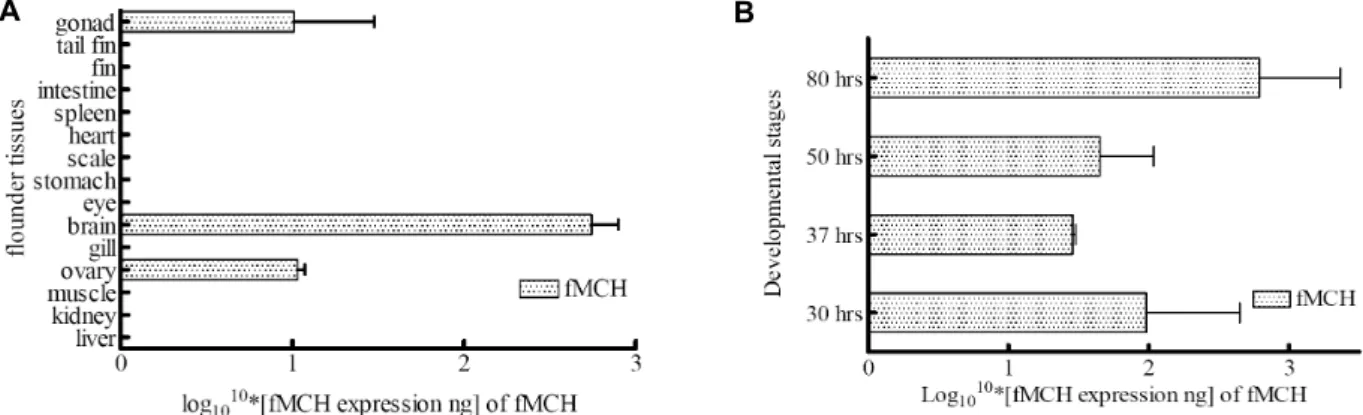
Fig. 2. Quantitative real-time PCR analysis of fMCH transcripts in different tissues and in developmental stages. 14 tissues (A) and samples (B) of multiple time zone after fertilization was used in a quantitative real-time PCR and amplified with primers specific for fMCH gene. fMCH expression quantity was calculated with replaced at value of log

1010

*[fMCH expression (ng)].

The level of fMCH with fMCH expression amount was represented with mean ± standard deviation (n=3).

Results

Diversity of fMCH and its derivates, sMCH, hMCH and barfin flounder MCH

Olive flounder MCH (fMCH) which was confirmed ini- tially from previous paper [16] was revealed to contain ma- ture form of hormone with 25 amino acid residues. The fish MCH and mammals MCH compared with fMCH, which be- comes known already was had the identical cyclic structure, but were showing wide difference from amino acid sequence (Fig. 1). A comparative structural analysis was revealed that fMCH had a relatively high identity of 78% to mammals MCH, compared with the fish which was kept 70% identity, and identity between fMCH and barfin flounder MCH also put out 70%, and was similar to other fishes. And then, fMCH of the cyclic structure which almost agrees to different MCH will be functional characteristic in the melanophore

aggregation and Ca

2+

mobilization, and may be important to novel MCH in the following experiment.

Tissue and developmental expression of MCH in Olive flounder

In order to confirm the presence of MCH, Real-time qPCR was performed with cDNA samples prepared from the total RNA of the respective tissues and various developmental stages after fertilization (Fig. 2). The expression level of fMCH with replaced at value of log

1010

*[fMCH expression (ng)] in various tissues of Olive flounder showed that it was expressed specifically only in the brain, gonad, and ovary but not in other tissues to be test (Fig. 2A). especially, ex- pression level of fMCH was significantly 2 more times (2.74±

0.15) greater in the brain tissue than in gonad (1.00±0.46)

and ovary tissues (1.03±0.04), and no difference almost was

observed in the expression levels of fMCH between the ova-

(5)

Table 2. Concentrations of MCH peptides causing half maximal aggregation of scale melanophores of the Olive flound- er, and in vitro relative potencies as compared to fMCH

Substance EC

50

Relative potency

fMCH [25aa]

sMCH [17aa]

hMCH [19aa]

dN-fMCH [23aa]

dC-fMCH [21aa]

0.16 nM 0.25 nM 54 nM 19 nM 103 nM

1.00 0.64 0.0029 0.0084 0.0015 A

B

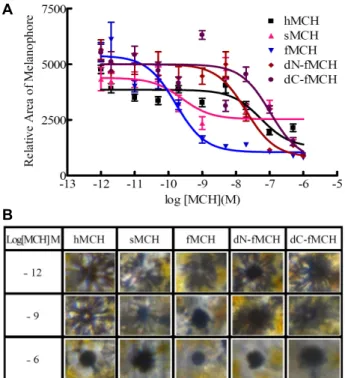
Fig. 3. Sigmoidal dose-response curve denoting melanin con- centrating activity of MCHs in vitro on scale melano- phore of the Olive flounder (A) and effect of MCHs of many concentrations (10

-6

M to 10

-12

M) on Olive flound- er melanophore (B). Each curve represents nonlinear re- gression (curve fit) to 95% confidence band, and re- sponse concentration of MCHs to melanophore are from 1 μM to 2 pM. Each value is the mean ± standard devia- tion, aggregation response of Olive flounder scale (N=10) to the various MCHs.

ry and gonad. fMCH expression in the developmental stages of the fertilized flounder eggs were observed from 30 hr after fertilization to 80 hr after fertilization, even though fMCH expression was not observed from fertilization time to 30 hr after fertilization time, and the expression quantity of fMCH which when from 37 hr (1.46±0.02) went in 80 hr (2.79±0.59) increased progressively.

Melanophore aggregation test

Melanophore in vitro dose responses to various concen- trations (1 μM–2 pM) of MCHs were measured from the Olive flounder (Paralichthys olivaceus) scale in order to con- firm relative aggregation activity of fMCH (Fig. 3). In the scale melanophores showed full dispersion after immedi- ately removal from the Olive flounder, when high concen- tration of 1 μM MCHs correspond to 10

-6

M was added in scale, those were fully aggregated increased with the MCHs except sMCH (Fig. 3A), and also photograph showing effect

of MCHs was relatively weak aggregation activity in a sMCH (Fig. 3B). Aggregation activity from MCHs where in- creased progressively put out a serious difference. When fMCH of 10

-6

-10

-9

M was applied to the scale preparation, degree of aggregation was continued and maintained from concentration of wide phase. fMCH derivate with N-termi- nal (dN-fMCH) and C-terminal deletions (dC-fMCH), and hMCH revealed which melanophores resulted in almost dis- persion in compliance with the concentration which in- creased with 10

-7

M, although dN-fMCH, dC-fMCH and hMCH led to rapid aggregation at a high concentration of 10

-6

M. EC

50

values exhibiting concentration of MCHs caus- ing half maximal aggregation of scale melanophores was lowest from fMCH of 0.16nM concentration, moreover as this result, the relative potency ranking of the MCHs was as follows: fMCH > sMCH > dN-fMCH > hMCH > dC- MCH, fMCH proved most responsive to the melanophore of Olive flounder (Table 2).

These results suggest the fact that fMCH aggregation ac- tivity was highest from the melanophore of Olive flounder as a result of EC

50

value and relative potency of MCHs (Table 2), and fMCH will come to new counterpart that regu- lates skin coloration in fish.

Ca

2+

mobilization

To confirm if the ligand function of neuropeptide by intra-

cellular Ca

2+

mobilization as well as the aggregation effect

of fMCH is mediated by MCH receptor, The binding charac-

teristics by intracellular Ca

2+

influx of fMCH and the other

MCHs were carried out with HEK293T cells stably express-

ing human MCH-R1 and rat MCH-R. fMCH and the other

MCHs induced Ca

2+

influx in the hMCH-R1/HEK293T cells,

and the MCHs concentration to induce a half-maximum re-

sponse (EC

50

) were 4.7~10.0 nM, indicating which MCHs are

an affinity ligand for human MCH-R1 (Fig. 4A). Especially,

fMCH, which has the lowest degree of EC

50

, activated effec-

(6)

A B

Fig. 4. Dose Response Curve of the intracellular Ca

2+

influx evoked in human MCHR1/HEK293T cell line with MCHs (A) and in rat MCHR/HEK293T cell line with MCHs. All incubation were done in triplicate and data were represented with nonlinear regression (curve fit) to 95% confidence band.

tively human MCHR1 with an EC

50

of 4.7 nM compared to hMCH. Moreover, because the fMCH was having the struc- ture which is nearer in the hMCH than sMCH, fMCH togeth- er with hMCH will become as the different new ligand. ex- periments of MCHs dose responded to rat MCHR showed results similar to hMCHR1/HEK293T cells test, that fMCH, dN-fMCH, and dC-fMCH are ligand having relatively high potency than hMCH and sMCH as induced a high dose re- sponse (Fig. 4 B). dN-fMCH and dC-fMCH were confirmed by more affinitive MCH than hMCH for rat MCHR with EC

50

of 2.0~1.5 nM.

These result suggest that fMCH is likely to be an endoge- nous ligand for human MCHR1 and rat MCHR because this peptide led to a relative high potency of 48% than hMCH responsed to hMCHR1 and to a relative high potency of 33

% than hMCH responsed to rat MCHR, and dN-fMCH and dC-fMCH had a possibility with the candidate of a potent agonist for human MCH-R1 and rat MCHR.

Discussion

Amino acid sequence of fMCH described in previous study was longer in Olive flounder than in a different fishes and mammals. fMCH had eight additional and five sub- stitutive amino acids (Fig. 1) compared with fishes and had six additional and four substitutive amino acids compared with mammals, but sequence inside a cyclic structure formed by a disulfide bond was identical to fishes and mam- mals except on replacement. One of them in the cyclic struc- ture, Ile

11

in Olive flounder and Val

7

in fishes and Leu

9

in mammals, was a physicochemically conservative replace- ment. Excepts the fact that sequence size is long region

which are essential for binding to the receptor is identically compose of as Arg

4

residue in the N-terminal sequence and Trp

11

residue in the C-terminal sequence, then this is more conserved in the different MCH region. The other four addi- tional amino acids located in outside N-terminal sequence and C-terminal sequence compared to fishes MCH do not accurately revealed those functions, but it is likely that the rest region of fMCH may have the function which is not become known until now.

In Olive flounder, fMCH expression in level of mRNA is very unique, and fMCH is only expressed specifically in brain, gonad and ovary. This showed that fMCH expression appeared similar to salmon MCH [27, 28] and tilapia MCH study [14], then these reports are the same as there is ex- pressed at the pituitary and hypothalamus of brain. fMCH expression in gonad and ovary, which showed weak ex- pression than brain tissue, has very doubtful point, but in compliance with report [15], MCH neurones are detectable only in reproductively mature animal as the telencephalon, suggesting a potential role in reproduction and/or behavior, then fMCH expression also will be possible specifically in gonad and ovary as well as brain like mammals MCH.

The identity of structure was made to demand an experi-

ment, and aggregation activity of fMCH in scale melanophor

of Olive flounder is advanced and getting the answer which

is clear. The administration of fMCH, hMCH, sMCH, dN-

MCH and dC-MCH induced melanophore aggregation in a

dose dependent manner (Fig. 3A, Fig. 3B). This result, which

the fMCH peptide showed the highest potency of ag-

gregation activity in the Olive flounder scale and revealed

the lowest EC

50

value (Table 2, 0.16 nM), are comparable

to others. EC

50

as the potency of aggregation activity of MCH

(7)

varies in various teleost fish with value between 30 pM and 1 nM [23, 35, 36]. This result suggests that fMCH will be worth of neuropeptide first identified in the Olive flounder, even though the range of EC

50

value might be explained by the trivial and technical difference in the bioassays used.

Derivates of fMCH, which lack the N- and C- terminal re- gion changed in native fMCH have reported to have dimin- ished aggregation activity (when tested on melanophore, al- though they were able to induce virtually complete ag- gregation in a high concentration (10

-6

M, Fig. 3B). But deri- vates activity in Ca

2+

influx test with FLIPR assay system show obvious similarity in their native fMCH and is recog- nized as new ligand enough in activation of MCH-receptor

MCH and its receptors play an important part in the com- plex network involving peripheral and central signals regu- lating food intake and energy expenditure [18]. In intra- cellular Ca

2+

influx of fMCH, dN-fMCH and dC-fMCH, al- though fMCH EC

50

shows the value which is relative to sMCH and hMCH, there shows higher value. Furthermore, these activate the rat MCHR that there is not rat MCHR2 ,as well as ligand activating human MCHR1, fMCH could be accomplish a role human and rat MCH receptor and the other function. This may suggest that fMCH and derivates functions not only melanopre aggregation but also food in- take showing in mammals.

In conclusion, we suggest that first fMCH structure was more similar to mammals than fishes during the diversity analysis between and fishes MCH and mammals MCH, fur- thermore fMCH amino acid sequence conserved with MCHs of existing. Second, specific expression of MCH mRNA was observed in the different tissues, gonad and ovary, excepts brain. This result show that there is indicating variety of fMCH expression as rodent MCH expression profile. Third, our data exhibit the new type of MCH possible involved with melanophore aggregation activity, and peptide that there is a value which will research in fishes identified from Olive flounder, Paralichthys olivaceus. Finally, we conclude that nanomolar concentrations of fMCH activate human MCHR1 and rat MCHR related to signaling pathway system, and that could be as higher degree of ligand compared to other MCHs.

Acknowledgement

This work was supported by a Research Grant of Pukyong National University (2016Year).

References

1. Abbott, Caroline, R., Adam, R. K., Alison, M. W., Michela, R., Kevin, G. M., Leighton, J. S., Jeannie, F. T., Mohammad, A. G., Caroline, J. S. and Stephen, R. B. 2003. Identification of hypothalamic nuclei involved in the orexigenic effect of melanin-concentrating hormone. Endocrinology 144, 3943-3949.

2. Audinot, V., Beauverger, P., Lahaye, C., Suply, T., Rodriquez, M., Ouvry, C. and Lamamy, V., et al. 2001. Structure-activity relationship studies of melanin-concentrating hormone (MCH)-related peptide ligands at SLC-1, the human MCH receptor. J. Biol. Chem. 276, 13554-13562.

3. Bächner, D., Kreienkamp, H., Weise, C., Buck, F. and Richter, D. 1999. Identification of melanin concentrating hor- mone (MCH) as the natural ligand for the orphan somatos- tatin-like receptor 1 (SLC-1). FEBS Lett. 457, 522-524.

4. Baker, B. I. 1994. Melanin-concentrating hormone updated:

functional considerations. Trends Endocrinol. Metab. 90, 120- 126.

5. Baker, B. I., Eberle, A. N., Baumann, J, B., Siegrist, W. and Girard, J. 1985. Effect of melanin-concentrating hormone on pigment and adrenal cells in vitro. Peptides 6, 1125-1130.

6. Baker, B., Andrew, L., Len, H. and Stafford, L. 1995. Cloning and expression of melanin-concentrating hormone genes in the rainbow trout brain. Neuroendocrinology 61, 67-76.

7. Balm, P. H. M. and Diet, G. 1998. The melanin-concentrating hormone system in fish. Ann. N. Y. Acad. Sci. 839, 205-209.

8. Bittencourt, J. C., Presse, F., Arias, C., Peto, C., Vaughan, J., Nahon, J. L., Vale, W. and Sawchenko, P. E. 1992. The melanin-concentrating hormone system of the rat brain: an immuno- and hybridization histochemical characterization.

J. Comp. Neurol. 319, 218-245.

9. Cardinaud, B., Fleur D. T., Jacques, D., Jean, A. B. and Jean, L. N. 2004. Comparative analysis of melanin-concentrating hormone structure and activity in aishes and mammals.

Peptides 25, 1623-1632.

10. Della-Zuana, O., Presse, F., Ortola, C., Duhault, J., Nahon, J. L. and Levens, N. 2002. Acute and chronic administration of melanin-concentrating hormone enhances food intake and body weight in wistar and Sprague-Dawley rats. Int.

J. Obes. Relat. Metab. Disord. 26, 1289-1295.

11. Gonzalez, M. I., Vaziri, S. and Wilson, C. A. 1996. Behavioral effects of alpha-MSH and MCH after central administration in the female rat. Peptides 17, 171-177.

12. Griffond, B. and Baker, B. I. 2002. Cell and molecular cell biology of melanin-concentrating hormone. Int. Rev. Cytol.

213, 233-277.

13. Groneveld, D., Eckhardt, E. R. M., Coenen, A. J. M., Martens, G. J. M., Balm, P. H. M. and Wendelaar Bonga, S. E. 1995. Expression of tilapia prepro- melanin-concentrat- ing hormone mRNA in hypothalamic and neurohypo- physial Cells. J. Mol. Endocrinol. 14, 199-207.

14. Gröneveld, D., Balm, P. H. M. and Sjoerd, E. W. B. 1996.

Melanin-concentrating hormone gene-related peptide stim-

ulates ACTH, but Not α-MSH, release from the tilapia

pituitary. J. Endocrinol. 148, R1-4.

(8)

15. Gröneveld, D., Balm, P. H. and Wendelaar Bonga, S. E. 1995.

Biphasic effect of MCH on α-MSH release from the tilapia (Oreochromis mossambicus) pituitary. Peptides 16, 945-949.

16. Jeon, J. M. and Song, Y. H. 2003. Cloning of melanin concen- trating hormone cDNA gene from olive flounder (Paralichthys olivaceus). J. Kor. Fishe. Soc. 36, 442-448.

17. Hiroyuki, I., Kawazoe, I. and Kawauchi, H. 1985. Fish mela- nin-concentrating hormone disperses melanin in amphibian melanophores. Gen. Comp. Endocrinol. 58, 486-490.

18. Kawauchi, H. 2006. Functions of melanin-concentrating hor- mone in fish. J. Exp. Zool. Part A Comp. Exp. Biol. 305, 751- 760.

19. Kawauchi, H. and Baker, B. I. 2004. Melanin-concentrating hormone signaling systems in fish. Peptides 25, 1577-1584.

20. Lakaye, B., Bernard, C., Sophie, H. and Thierry, G. 2009.

Melanin-concentrating hormone and immune function. Pep- tides 30, 2076-2080.

21. Ludwig, D. S., Nicholas, A. T., Jason, W. M., Rohit, K., Efi, K., Joel, E., Bradford, L., Jeffrey, S. F. and Eleftheria, M. F.

2001. Melanin-concentrating hormone overexpression in transgenic mice leads to obesity and insulin resistance. J.

Clin. Invest. 107, 379-386.

22. Masao, O., Wada, C., Oikawa, I., Kawazoe, I. and Kawauchi, H. 1988. Structures of two kinds of mRNA encoding the chum salmon melanin-concentrating hormone. Gene 71, 433- 38.

23. Minth, C. D., Qiu, H., Akil, H., Watson, S. J. and Dixon, J. E. 1989. Two precursors of melanin-concentrating hor- mone: DNA sequence analysis and in situ immunochemical localization. Proc. Natl. Acad. Sci. USA. 86, 4292-4296.

24. Mizusawa, K., Kawashima, Y., Sunuma, T., Hamamoto, A., Kobayashi, Y., Kodera, Y., Saito, Y. and Takahashi, A. 2015.

Involvement of melanin-concentrating hormone 2 in back- ground color adaptation of barfin flounder, Verasper moseri.

Gen. Comp. Endocrinol. 214, 140-148.

25. Nahon, J. L., Presse, F., Bittencourt, J. C., Sawchenko, P. E.

and Vale, W. 1989. The rat melanin-concentrating hormone messenger ribonucleic acid encodes multiple putative neuropeptides coexpressed in the dorsolateral hypothalamus.

Endocrinology 125, 2056-65.

26. Nahon, J. L. and Presset, F., et al. 1991. Identification of a single melanin-concentrating hormone messenger ribonu- cleic acid in coho salmon: structural relatedness with 7SL ribonucleic acid. J. Neuroendocrinol. 3, 173-183.

27. Parker, J. A. and Bloom, S. R. 2012. Hypothalamic neuro- peptides and the regulation of appetite. Neuropharmacology 63, 18-80.

28. Qu, D., David, S. L., Steen, G., Megan, P., Pelleymounter, M. A., Cullen, M. J., Mathes, W. F., Przypek, J., Kanarek,

R. and Maratos-Flier, E. 1996. A Role for melanin-concen- trating hormone in the central regulation of feeding behav- iour. Nature 380, 243-247.

29. Rossi, M., Choi, S. J., O’Shea, D., Miyoshi, T., Ghatei, M.

A. and Bloom, S. R. 1997. Melanin-concentrating hormone acutely stimulates feeding, but chronic administration has no effect on body weight. Endocrinology 138, 351-355.

30. Saito, Y., Nothacker, H. P., Wang, Z., Lin, S. H., Leslie, F.

and Civelli, O. 1999. Molecular characterization of the mela- nin-concentrating hormone receptor. Nature 400, 265-269.

31. Sanchez, M., Baker, B. I. and Celis, M. 1997. Melanin-concen- trating hormone (MCH) antagonizes the effects of α-MSH and neuropeptide E-I on grooming and locomotor activities in the rat. Peptides 18, 393-396.

32. Shimada, M., Nicholas, A. T., Bradford, B. L., Jeffrey, S. F.

and Eleftheria, M. F. 1998. Mice lacking melanin-concentrat- ing hormone are hypophagic and lean. Nature 396, 670-679.

33. Shimomura, Y., Masaaki, M., Tsukasa, S., Yoshihiro, I., Michiko, A., Tsutomu, K., Haruo, O., Osamu, N., Yasuhiro, S. and Masahiko, F. 1999. Isolation and identification of mel- anin-concentrating hormone as the wndogenous ligand of the SLC-1 receptor. Biochem. Biophys. Res. Commun. 261, 622- 626.

34. Takahashi, A., Takayoshi, K., Yuki, K. and Takeshi, Y., et al. 2007. The melanin-concentrating hormone receptor 2 (MCH-R2) mediates the effect of MCH to control body color for background adaptation in the barfin flounder. Gen.

Comp. Endocrinol. 151, 210-219.

35. Takahashi, A., Tsuchiya, K., Yamanome, T., Masafumi, A., Akikazu, Y., Kunio, Y. and Kawauchi, H. 2004. Possible in- volvement of melanin-concentrating hormone in food intake in a teleost fish, barfin flounder. Peptides 25, 1613-1622.

36. Tritos, N. A., Vicent, D., Gillette, J., Ludwig, D. S., Flier, E. S. and Maratos-Flier, E. 1998. Functional interactions be- tween melanin-concentrating hormone, neuropeptide Y, and anorectic neuropeptides in the rat hypothalamus. Diabetes 47, 1687-1692.

37. Vaughan, J. M., Fischer, W. H., Hoeger, C., Rivier, J. and Vale, W. 1989. Characterization of melanin-concentrating hormone from rat hypothalamus. Endocrinology 125, 1660- 1665.

38. Yang, Y. 2011. Structure, function and regulation of the mel- anocortin receptors. Eur. J. Pharmacol. 660, 125-130.

39. Zheng, H., Patterson, L. M., Morrison, C., Banfield, B. W.,

Randall, J. A., Browning, K. N., Travagli, R. A. and Ber-

thoud, H. R. 2005. Melanin concentrating hormone in-

nervation of caudal brainstem areas involved in gastro-

intestinal functions and energy balance. Neuroscience 135,

611-625.

(9)

초록:양식넙치 멜라닌 농축 호르몬의 특성

정인영

1

․전정민

2

․송영환

1

*

(

1

국립부경대학교 미생물학과,

2

국립부경대학교 자원생물학과)

멜라닌 농축 호르몬(melanin-concentrating hormone, MCH)은 17개의 아미노산으로 구성된 환형의 시상하부 펩티드로 색소 침착의 조절인자로서 연어에서 처음 분리되었다. 포유동물의 MCH는 19개의 아미노산으로 구성되 어 있으며 섭식 및 에너지 항상성을 조절하는데 관여한다. 본 연구에서는 양식넙치의 다양한 조직에서 MCH 유전 자의 발현 분포, 멜라닌 함유 세포의 집적, 포유동물 MCH 수용체와 양식넙치 MCH의 상호작용을 조사하였다.

Real-time qPCR을 이용하여 뇌, 정소, 난소에서 MCH 유전자의 발현이 나타나는 것을 확인하였고, 수정 후 발달

단계에서도 MCH 유전자의 발현을 확인할 수 있었다. 합성된 연어 sMCH, 포유류 hMCH, 양식넙치 fMCH,

dN-fMCH, dC-fMCH를 양식 넙치의 표피에 처리했을 때 다양한 농도에 따라 멜라닌 함유 세포의 집적이 다양하

게 나타났다. 연어 sMCH, 포유류 hMCH에 비해 양식넙치 fMCH의 멜라닌 함유세포의 집적도가 36~99.85%로

비역가를 나타났으나 양식넙치 dN-fMCH, dC-fMCH를 처리한 경우 양식넙치 fMCH에 비해 높은 농도에서 집적

이 나타나고 짧은 시간에 분산되었다. 또한, 인간 MCH 수용체와 쥐 MCH 수용체가 발현된 포유동물의 세포주에

양식넙치 fMCH를 처리하여 각 수용체와 결합하는 것을 확인하였다. 이러한 결과는 어류에서 발현되는 MCH가

포유동물의 MCH와 유사한 구조를 가지고 있어 MCH 수용체에 대한 새로운 리간드로서 제공될 수 있으며, 향후

어류의 MCH 수용체에 확대 적용할 수 있을 것이다.

수치

Table  1.  MCHs  and  its  derivates  synthesized  and  experimented  for  FLIPR  assay  and  melanophore  aggregation  test
Fig.  2.  Quantitative  real-time  PCR  analysis  of  fMCH  transcripts  in  different  tissues  and  in  developmental  stages
Table  2.  Concentrations  of  MCH  peptides  causing  half  maximal  aggregation  of  scale  melanophores  of  the  Olive   flound-er,  and  in  vitro  relative  potencies  as  compared  to  fMCH
Fig.  4.  Dose  Response  Curve  of  the  intracellular  Ca 2+   influx  evoked  in  human  MCHR1/HEK293T  cell  line  with  MCHs  (A)  and  in  rat  MCHR/HEK293T  cell  line  with  MCHs

참조

관련 문서

in internal organs (kidney, intestine, spleen, brain and liver) from non-emaciated (farm-A) or emaciated (farm-B and farm-C) olive flounder Paralichthys olivaceus

These results suggest that circulating miR-122 might be used as a sensitive indicator as well as GOT and GOT levels in evaluat- ing liver injury in olive

Detection of RSIV (red sea bream iridovirus), VHS (viral heamorrhagic septiceamia) virus, and VNN (viral nervous necrosis) virus in infected olive flounder tissues by

In the present study, polyclonal antiserum against olive flounder (Paralichthys olivaceus) IgM heavy chain was generated by intramuscular immuniza- tion of rabbit with

Hispopathologic characterization of viral pathogens in cultured olive flounder, Paralichthys olivaceus, using in-situ hybridization methods, Journal of Fish Pathology

In the present study, isoeugenol as new anesthetic in marine fish, especially olive flounder, was examined to know the efficacy and proper concentration.. In acute toxicity test,

In the present study, to evaluate the effect of immunosuppression on MABV bur- den in fish, fingerlings of olive flounder naturally infected with MABV were injected

Optimum feed- ing rate for growing olive flounder (317 g) Paralichthys olivaceus fed practical extruded pellets at optimum water temperature (21-24℃). Evaluation