Introduction
Aquabirnaviruses belong to the family Birnavi- ridae which is characterized by an unenveloped, icosahedral capsid approximately 60 nm in dia- meter, containing a bisegmented, double-strand- ed RNA genome. The type species of genus Aqua- birnavirus is infectious pancreatic necrosis virus (IPNV), a causative agent of an acute, contagious disease in salmonid fishes. Since yellowtail ascit- es virus (YTAV) had been reported from yellow- tail, Seriola quinqueradiana, in Japan (Sorima- chi and Hara, 1985), YTAV-like aquabirnavi- ruses were isolated from various marine fishes, mollusks and crustaceans (Reno, 1999). These aquabirnaviruses from marine organisms differ antigenically and genomically from IPNV and hence have been referred to as marine birnavirus (MABV) distinguish it from IPNV (Hosono et al., 1994, 1996; Zhang and Suzuki, 2003).
It has been known that MABV can infect vari- ous fish species without clinical signs with rela-
tively low virus titers in the infected fish (Isshiki et al., 2001). Through broad survey of MABV in marine fish, Isshiki et al. (2004) concluded that flatfish including olive flounder would be the main reservoirs of MABV throughout the year and might be responsible for establishing the infection cycle in aquaculture environments.
Recently, it has been reported that olive floun- der coinfected with MABV and pathogenic bac- teria showed higher mortality than fish inde- pendently infected with a single pathogen (Pak- ingking et al. 2003; Oh et al., 2006). Similarly, Chou et al. (1994, 1998) reported that MABV in hard clam (Meretrix lusoria) became highly viru- lent by exposure to temperature stress or heavy metal. However, little information is available about the effect of immunosuppression caused by coinfected bacteria or stress on the burden of MABV in hosts. In the present study, to evaluate the effect of immunosuppression on MABV bur- den in fish, fingerlings of olive flounder naturally infected with MABV were injected with dexame- thasone, a potential immunosuppressing agent, and the change in MABV titer was analyzed using real time PCR and semi-quantitative RT-
Effects of Dexamethasone on the Burden of Marine Birnavirus (MABV) in Olive Flounder, Paralichthys olivaceus
Se Ryun Kwon and Yoon Kwon Nam1,* Department of Aquatic Life Medicine,
1Department of Aquaculture, Pukyong National University, Busan 608-737, Korea
The effect of dexamethasone injection on the burden of marine birnavirus (MABV) in asymptomatically infected olive flounder (Paralichthys olivaceus) fingerlings was investigated. In real time PCR analysis, the threshold cycle (Ct) value of the fish injected with dexamethasone was significantly lower than that of the fish in the PBS-injected and no-handling groups. The higher amplification of the MABV gene in the dexamethasone-injected group than the 2 control groups was confirmed also by semi-quantitative RT-PCR. The results indicate an increase of MABV burden in olive flounder fingerlings after a single injection with dexamethasone.
Key words : marine birnavirus, dexamethasone, viral titer, olive flounder
*Corresponding author: [email protected]
─
─ 88 ──
PCR.
Materials and Methods
1. Fish and experimental regime
Fingerlings of olive flounder, Paralichthys oli- vaceus (mean body weight about 8 g), were ob- tained from a culture facility located in southern coastal area of Korea. The fish were naturally infected with MABV which was confirmed by nested reverse transcriptase polymerase chain reaction (RT-PCR). Fish were divided into 3 groups of 10 fish in a 100 L tank, and each group was separated by small net-pens. Fish were accli- mated 2 weeks prior to initiating the experi- ments, and the water temperature was main- tained at 17~18�C throughout the experiment.
No handling stress was imposed on the fish in group I. Fish in group II were intraperitoneally injected with 50µL phosphate buffer saline (PBS), while fish in group III were injected with dexamethasone at a dose of 10µg/g body weight in 50µL PBS. After 25 days of the injection, fish were dissected and removed spleen to evaluate MABV burden.
2. Detection of MABV by nested reverse transcriptase polymerase chain reaction (RT-PCR)
Total RNA was extracted from spleen using TRIzol reagent (Invitrogen), according to the manufacturer’s recommendations. Concentration and purity of the extracted RNA was measured spectrophotometrically at 260 and 280 nm. First strand cDNA was synthesized from 1µg of total RNA using recombinant reverse transcriptase (Promega) and random hexamer primers (1.25 mM; Promega). Reaction volume was 20µL. RT reaction was carried out at 42�C for 1 h, and the RTase was inactivated by heating the reaction at 95�C for 10 min. One µL of cDNA was directly used as a template for PCR amplification inclu- ding 10 pmoles of each primer, dNTP mix, and 0.5 U of Taq DNA polymerase (TaKaRa). The primers used for MABV detection were forward (5′-ATGAACACAACAAAGGCAACCG-3′) and reverse (5′-TGGCCCAGGAGTC CATTA-3′). PCR was performed with 30 cycles of denaturation at 95�C for 30 s, annealing at 55�C for 1 min, and extension at 72�C for 1.5 min using an automat-
ed thermal cycler (iCycler, BioRad). In nested PCR, 1µL of the first PCR product and the nest PCR primer set (forward 5′-GCCGACATCGTC- AACTCCAC-3′ and reverse 5′-GACAGGATCAT- CTTGGCATA-3′) were used for amplification.
The PCR product was separated on 0.7% agarose gel and visualized by ethidium bromide staining.
3. Real-time polymerase chain reaction and semi-quantitative RT-PCR
One set of primers of MABV (F 5′-ATTCCGG- ACGACATAACAG-3′ and R 5′-CAGGGAAGCA- GACAAGAAG-3′) were redesigned to amplify a 103 bp fragment corresponding to the region en- coding the VP2 site of MABV. For normalizing the MABV RNA, a 123 bp fragment of olive floun- der 18S rRNA was amplified as an internal con- trol using two oligonucleotide primers (F 5′-AG- TTGCTGCAGTTAAAAAGC-3′ and R 5′-ACTC- AGCTAAGAGCATCGAG-3′). PCR was perform- ed using the MyiQTM Single-Color Real-Time PCR Detection System (Bio-Rad). Each reaction had a volume of 20µL including 10µL of reaction mixture containing 2×SYBR Green I Mix (Bio- Rad), 0.5µM of each primer, 1µL of cDNA and 8 µL of distilled water. An initial denaturation step at 95�C for 3 min was followed by 40 cycles of 95�C for 30 s, 55�C for 30 s, 72�C for 30 s. Fluore- scence unit was measured after each elongation step to calculate the average threshold cycles of both target and control genes. At the last ampli- fication cycle, dissociation curves were monitored within 55 to 95�C to examine the specificity of PCR amplification.
In addition to the real time PCR detection, end point semi-quantitative RT-PCR was carried out to confirm the result. MABV segment was am- plified with 31 cycles of 95�C for 30 s, 55�C for 30 s and 72�C for 30 s, while 18S ribosomal RNA gene with 20 cycles of 95�C for 30 s, 55�C for 30 s and 72�C for 30 s. Primer pairs were same as de- scribed above. The amplified products were se- parated by electrophoresis on a 1% agarose gel.
Et-Br stained bands were analyzed with image analysis software (Quantity-One, BioRad) impl- emented in Gel Doc XR system (BioRad).
4. Statistical analysis
Statistical analysis was performed using the Student’s t-test, and significant differences were determined at P⁄0.05.
Results and Discussion
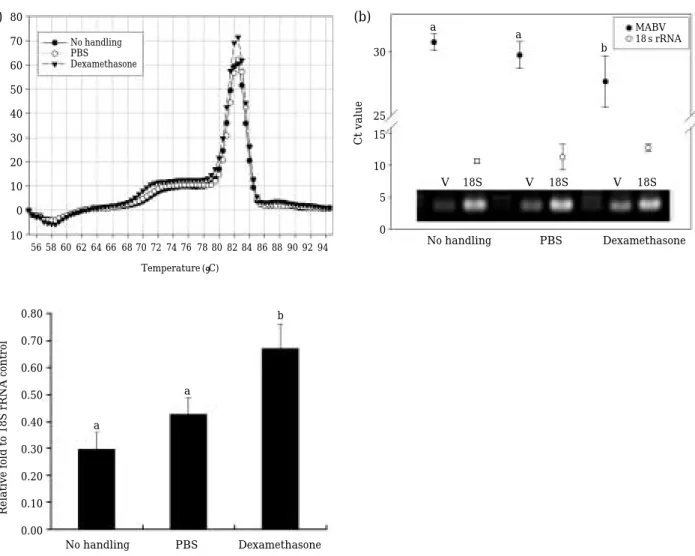
In real time PCR, the PCR amplification was readily successful in all groups as evidenced by the specific dissociation curve showing the same melting point (Fig. 1a). The average Ct values in the amplification of control 18S rRNA was rela- tively steady-state among treatments (Fig. 1b).
However, the Ct value in MABV RNA from the fish injected with dexamethasone was signifi- cantly lower than that from the fish belonging to either PBS-injected or no-handling groups (Fig.
1b). The higher amount of MABV RNA in the dexamethasone-injected group compared to the 2 control groups was also confirmed by semi-quan- titative RT-PCR (Fig. 1b). Based on the normali- zation against 18S rRNA bands, the estimated fold increase of MABV RNA in dexamethasone- injected group was more than 2 fold relative to the no handling control group (Fig. 1c).
Administration of glucocorticoids has various immunosuppressive effects on mammals (Gould- ing and Flower, 1997) and fish (Balm, 1997), and the suppressed immune response could lead to increased viral titers. The present results indi-
80 70 60 50 40 30 20 10 0 -10
0.80 0.70 0.60 0.50 0.40 0.30 0.20 0.10 0.00
Relative fold to 18S rRNA control
30
25 15
10
5
0 a
a
a
b
a
b
MABV 18 s rRNA
V 18S V 18S V 18S
No handling PBS Dexamethasone
No handling PBS Dexamethasone
Ct value
56 58 60 62 64 66 68 70 72 74 76 78 80 82 84 86 88 90 92 94 Temperature (�C)
No handling PBS Dexamethasone
-dF(RFU)/dT
Fig. 1. Real-time and semi-quantitative RT-PCR analyses to show the effect of dexamethasone injection on the MABV burden in the spleen of asymptomatically infected olive flounders. (a) Dissociation curves to show the specific PCR amplification of MABV RNA segments. (b) Average threshold cycles (Ct) of real-time PCR assays with RNA from dexamethasone-injected fish or two control groups (no handling and PBS-injected groups). A representative end- point RT-PCR gel is also shown (V for MABV and 18S for olive flounder 18S rRNA control). (c) Band intensity (INT/mm2) of MABV-PCR amplifications normalized against 18S rRNA bands amplified as an internal control.
Dexamethasone-injected group showed the significantly strong signal than two control groups (no handling and PBS-injected). T bars indicate standard deviations based on three replicate examinations. Histograms with same letters did not differ at P⁄0.05.
(a) (b)
(c)
cate an increase of MABV titer in olive flounder fingerlings after a single i.p. injection with dexa- methasone at 10µg/g body weight of fish. Simi- larly, van Nieuwstadt et al. (2001) reported that shedding of eel herpesvirus Herpesvirus anguil- lae (HVA) was much increased by dexametha- sone treatment.
Although the synergistic effect of MABV and coinfected pathogenic bacteria in mortality of olive flounder has been reported (Pakingking et al., 2003; Oh et al., 2006), the mechanism of the increased mortality is unknown. Further studies -1) whether the present increased MABV titer by dexamethasone injection reflect the process un- der natural stresses including coinfection with other pathogens and 2) whether the increased MABV particles are related to virulence or defec- tive interfering particles-should be conducted.
Acknowledgements
This study was supported by a grant from the Ministry of Maritime Affairs and Fisheries, Re- public of Korea.
References
Balm, P.H.M. 1997. Immune-endocrine interactions. In
“Fish Stress and Health in Aquaculture” (Iwama GK, Pickering AD and Schreck CB, Eds.), pp. 195~221.
Cambridge Univ. Press, Cambridge.
Chou, H.Y., H.J. Li and C.F. Lo. 1994. Pathogenicity of a birnavirus to hard clam (Meretrix lusoria) and effect of temperature stress on its virulence. Fish Pathol., 29 : 171~175.
Chou, H.Y., S.J. Chang, H.Y. Lee and Y.C. Chiou. 1998.
Preliminary evidence for the effect of heavy metal cations on the susceptibility of hard clam (Meretrix lusoria) to clam birnavirus infection. Fish Pathol., 33 : 213~219.
Goulding, N.J. and R.J. Flower. 1997. Glucocorticoids and the immune system. In “Stress, Stress Hormones and the Immune System” (Buckingham JC, Gillies GE and Cowell AM, Eds.), pp. 337~356. Wiley, New York.
Hosono, N., S. Suzuki and R. Kusuda. 1994. Evidence for relatedness of Japanese isolate of birnaviruses from marine fish to IPNV. J. Fish Dis., 17 : 433~437.
Hosono, N., S. Suzuki and R. Kusuda. 1996. Genogrouping of birnaviruses isolated from marine fish: a comparison of VP2/NS junction regions on genome segment A. J.
Fish Dis., 19 : 295~302.
Isshiki, T., T. Nagano and S. Suzuki. 2001. Infectivity of aquabirnavirus strains to various marine fish species.
Dis. Aquat. Org., 46 : 109~114.
Isshiki, T., T. Nagano, K. Kanehira and S. Suzuki. 2004.
Distribution of marine birnavirus in cultured marine fish species from Kagawa Prefecture, Japan. J. Fish Dis., 27 : 89~98.
Oh, M.J., W.S. Kim, S.I. Kitamura, H.K. Lee, B.W. Son, T.S. Jung and S.J. Jung. 2006. Change of pathogenicity in olive flounder Paralichthys olivaceus by co-infection of Vibrio harveyi, Edwardsiella tarda and marine birnavirus. Aquaculture, 257 : 156~160.
Pakingking Jr. R., R. Takano, T. Nishizawa, K. Mori, Y.
Lida, M. Arimoto and K. Muroga. 2003. Experimental coinfection with aquabirnavirus and viral hemorrha- geic septicemia virus (VHSV), Edwardsiella tarda or Streptococcus iniae in Japanese flounder Paralichthys olivaceus. Fish Pathol., 38 : 15~21.
Reno, P.W. 1999. Infectious pancreatic necrosis and asso- ciated aquatic birnaviruses. CAB INTERNATIONAL, Fish Diseases and Disorders, Vol. 3: Viral, Bacterial and Fungal Infections (Woo PTK and Bruno DW, Eds), pp. 1~55.
Sorimachi, M. and T. Hara. 1985. Characteristics and pa- thogenicity of a virus isolated from yellowtail finger- lings showing ascites. Fish Pathol., 19 : 231~238. (in Japanese with English abstract) van Nieuwstadt, A.P., S.G. Dijkstra and O.L.M. Haenen. 2001. Persistence of herpesvirus of eel Herpesvirus anguillae in farmed Euro- pean eel Anguilla anguilla. Dis. Aquat. Org., 45 : 103~
107.
Zhang, C.X. and S. Suzuki. 2003. Comparison of the RNA polymerase genes of marine birnavirus strains and other birnaviruses. Arch. Virol., 148 : 745~758.
Received : March 30, 2007 Accepted : May 21, 2007
Dexamethasone 투여가 넙치(Paralichthys olivaceus)의marine birnavirus (MABV) 감염강도에 미치는 영향
권 세 련∙남 윤 권1,*
부경대학교 수산생명의학과, 1부경대학교 양식학과
Marine birnavirus (MABV)에 무증상적으로 감염된 넙치(Paralichthys olivaceus) 치어에 면역 억제제의 일종인 Dexamathasone을 투여하였을 때 MABV의 감염강도에 영향을 미치는가를 조 사하였다. Real time PCR 분석결과 dexamethasone을 투여한 그룹이 생리식염수를 주사한 그룹 및 no handling 그룹에 비해 유의적으로 낮은 Ct 값을 나타냈으며, 또한 semi-quantitative RT- PCR 분석결과에 있어서도 dexamethasone을 주사한 그룹이 대조구 그룹들에 비해 MABV 유전 자가 유의적으로 높게 증폭되는 것으로 나타났다. 이러한 결과로부터 dexamethasone 투여가 넙 치 치어에 감염된 MABV의 복제를 증가시킴을 확인하였다.