Kor J Fish Aquat Sci 47(6),810-817,2014 한수지 47(6), 810-817, 2014
Original Article
810
Copyright © 2014 The Korean Society of Fisheries and Aquatic Science pISSN:0374-8111, eISSN:2287-8815
서 론
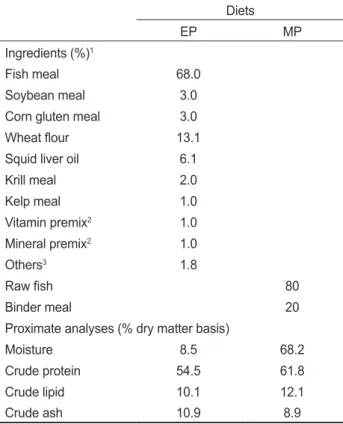
우리나라넙치양식에는배합사료(extruded pellet, EP)와습 사료(moist pellet, MP)가혼용되어사용되고있으며, 2013년
전체넙치사료사용량인 225,331톤에서 91% 이상을습사료
가차지하고있는실정이다(Statistics Korea, 2014). 주로치어 기에는배합사료를사용하고 100-300 g 크기에서습사료로전 환을하기때문이다. 이렇게습사료로전환하는것은여러이유 가있지만, 가장큰원인은습사료가배합사료보다성장이빠르 다고인식하기때문이다. 따라서성장이습사료에뒤지지않는 고효율배합사료의개발및현장비교실험이수행되어야한다. 넙치의적합한배합사료설계및개발에기초가되는필수영
양소요구량및대사연구는단백질요구량연구(Kim et al.,
2002), 단백질/에너지비율연구(Kim et al., 2004) 및필수아미 노산요구량및대사연구(Alam et al., 2002; Kim et al., 2013) 등이수행되었고, 기호성및면역력증강을위한다양한사료 첨가제평가에관한연구(Kim et al., 2006c; Kim et al., 2009;
Kim et al., 2010; Kim et al., 2011a; Kim et al., 2012; Kim et
al., 2013) 및다양한원료의이용성및소화율평가에관한연
구들이수행되었다(Choi et al., 2004; Pham et al., 2007; Ye et
al., 2011). 이러한연구를바탕으로고효율배합사료개발을위
해다양한실험용배합사료를제조하여실제양식현장에서사 용하고있는습사료및상업용배합사료와비교실험이수행되 었다(Kim et al., 2005; Cho et al., 2005; Lee et al., 2005; Kim
배합사료 및 습사료 공급에 따른 넙치(Paralichthys olivaceus)의 성장 및 어체성분 비교
김강웅·이진혁·배기민·김경덕·이봉주·한현섭·김성삼*
국립수산과학원 사료연구센터
Comparison of Extruded and Moist Pellets for Whole-body Proximate Composition and Growth Performance of Olive Flounder
Paralichthys olivaceus
Kang-Woong Kim, Jin-Hyuck Lee, Ki-Min Bae, Kyoung-Duck Kim, Bong-Joo Lee, Hyon-Sob Han and Sung-Sam Kim*
Aquafeed Research Center, National Fisheries Research and Development Institute, Pohang 791-923, Korea
Two consecutive feeding trials were conducted to evaluate the effects of extruded pellet (EP) and raw fish-based moist pellet (MP) in the juvenile (experiment I) and sub-adult (experiment II) stages of olive flounder, Paralichthys olivaceus. The fish were distributed randomly to three aquarium tanks, as a group of 1,200 fish (initial mean weight 13.5±1.76 g) in experiment I, and as a group of 390 fish (initial mean weight 385±15.3 g) in experiment II. In ex- periment I, the weight gain, specific growth rate, feed efficiency, protein efficiency ratio, and survival of fish fed EP were all significantly higher than those of fish fed MP. In experiment II, no significant differences were observed in weight gain, specific growth rate and survival between the EP and MP groups. However, the feed efficiency and protein efficiency ratios of fish fed EP were significantly higher than those of fish fed MP. The results of this study indicate that EP could be developed to replace MP for market size production of olive flounder without any adverse effects on the growth performance. The dietary formulation used in this study could be used as an appropriate feed for olive flounder.
Key words: Olive flounder, Moist pellet, Extruded pellet, Formulation, Feed
This is an Open Access article distributed under the terms of the Creative Commons Attribution Non-Commercial Licens (http://creativecommons.org/licenses/by-nc/3.0/)which permits unrestricted non-commercial use, distribution, and reproduction in any medium, provided the original work is properly cited.
http://dx.doi.org/10.5657/KFAS.2014.0810 Kor J Fish Aquat Sci 47(6) 810-817, December 2014
Received 10 November 2014; Revised 27 November 2014; Accepted 9 December 2014
*Corresponding author: Tel: +82. 54. 230. 3631 Fax: +82. 54. 232. 3697 E-mail address: [email protected]
et al., 2006a, 2006b; Kim et al., 2008; An et al., 2011). 이러한 연구는배합사료의품질을향상시킬수있는기초연구로활용 될수있으며, 양식현장에서어업인이직접배합사료와습사료 를비교함으로써배합사료의품질수준을파악할수있다. 본연 구는습사료를대체할수있는고효율실용배합사료개발을위 해영양소요구량및사료원료이용성연구결과를바탕으로실
험사료를설계및제조하여넙치평균체중 13.5 g의치어에서
상품크기인 1 kg 이상까지장기간에걸쳐배합사료와습사료의 성장을비교하였다.
재료 및 방법 실험사료
본실험에사용된실험사료의조성은 Table 1 에나타내었다. 본실험에사용된배합사료는넙치의영양요구량및실용배합 사료효과시험연구결과를참고하여설계하였다. 단백질원으 로북양어분, 대두박, 콘글루텐밀및크릴밀을사용하였고, 지질 원으로어유, 탄수화물원으로소맥분을사용하였다. 이외에사
료첨가제인켈프밀, 효모, 항산화제, 콜린, 효소및레시틴등을 사용하였다. 배합사료는원료를혼합한후익스트루더(Bühler,
Swiss)를이용하여압출성형하였으며사료크기는직경 3-15
mm로사료회사에서제조하였다. 습사료는냉동고등어, 메가 리, 곤쟁이및잡어등과분말사료를 8:2의비율로혼합하여제 조하였다.
실험어 및 사육관리
두실험에사용된넙치는경남거제에위치한육종연구센터 에서경북포항시양식사료연구센터로운반하여예비사육하 였으며, 실험사료에적응시키기위해실험시작전넙치용상품 사료를 2주간공급하였다. 예비사육후, 넙치가성장함에따라 배치및선별을고려하여실험 I 과실험 II 의사육시험을실 시하였다. 실험 I 은평균무게 13.5±1.76 g (mean±SD)인넙 치치어 2,400마리(배합사료실험구 1,200마리, 습사료실험구 1,200마리)를 FRP 원형수조(10톤, 지름 3.5 m, 면적 9.6 m2)에 각배합사료및습사료실험구로나누어실험구당 3반복으로무 작위배치하였다. 각실험수조는유수식사육장치로유수량은 시간당 15회전되도록하였으며, 성장함에따라시간당 18회전 으로조절하였다. 실험기간동안수온은 9.4-25.0℃ 범위였으 며, 평균수온은 15.9±5.12℃로자연수온에의존하였고, 월별 수온결과는 Fig. 1에나타내었다. 사료공급량은어체중의 0.1- 3.5%를 1일 2-3회공급하였으며, 사육기간은 8개월(2007년 8 월 13일-2008년 3월 10일)이었다.
실험 II 는평균무게 385±15.3 g (mean±SD)인미성기넙치 780마리(배합사료실험구 390마리, 습사료실험구 390마리)를 FRP 원형수조(10톤, 지름 3.5 m, 면적 9.6 m2)에각습사료및 배합사료실험구로나누어수조당암수성비를 7:3 비율(암컷넙 치 91 마리, 수컷넙치 39마리)로동일하게조절하여실험구당 3 반복으로배치하였다. 각실험수조는유수식사육장치로유수
량은시간당 18-24회전으로조절하였다. 실험기간동안수온은
12-26℃ 범위였으며, 평균수온은 18.7±4.0℃로 자연수온에
Table 1. Ingredients and nutrient contents of the experimental diets Diets
EP MP
Ingredients (%)1
Fish meal 68.0
Soybean meal 3.0
Corn gluten meal 3.0
Wheat flour 13.1
Squid liver oil 6.1
Krill meal 2.0
Kelp meal 1.0
Vitamin premix2 1.0
Mineral premix2 1.0
Others3 1.8
Raw fish 80
Binder meal 20
Proximate analyses (% dry matter basis)
Moisture 8.5 68.2
Crude protein 54.5 61.8
Crude lipid 10.1 12.1
Crude ash 10.9 8.9
1Provided by Suhyup Feed Co., Kyong-Nam, Korea. 2Premix (mg/
kg) : KI 250, MnSO4․H2O 2800, ZnSO4․H2O 2350, vitamin K 225, biotin (2%) 3500, niacin 4850, calcium pantothenate 11000, folic acid 2000, vitamin B1 1500, vitamin B2 2000, vitamin B6 2000 and vitamin C 50000. 3Anti-oxidant, glucan, gelatin, betaine,
choline, wheat flour, lecthin and enzyme. Fig. 1. Monthly changes of the water temperature for the experi- ment I and II.
26 23
21.2 22.7
ExperimentⅠ ExperimentⅡ
18.8
13.9 12.2
10.9 10.3
11.8 14.1
15.2 18.7
19.3 22.9
23.7
20 21.4
17 14 11
8 Aug Sep Oct Nov Dec Jan Feb Mar Month
Temperature (℃)
Apr May Jun Jul Aug Sep Oct
384.9 384.9
406.3 391.3
478.7 450.7
580.3 555.3
694.3 687.0
822.0 829.9
1001.3 1010.2
1154.2 1144.9 1,400
1,100
800
500
200 Mar Moist pellet Extruded pellet
Month
Weight gain (g/fish)
Apr May Jun Jul Aug Sep Oct
13.513.5 75.2
66.5 153.9
116.8 236.9
174.6 191.6 291.6
342.0
211.7 364.7
197.0 371.1
192.6 400
300
200
100
0 Aug
Moist pellet Extruded pellet
Month
Weight gain (g/fish)
Sep Oct Nov Dec Jan Feb Mar
김강웅ㆍ이진혁ㆍ배기민ㆍ김경덕ㆍ이봉주ㆍ한현섭ㆍ김성삼 812
의존하였고, 월별수온결과는 Fig. 1에나타내었다. 사료공급량 은어체중의 0.1-2.5%를 1일 1-2회공급하였으며, 사육기간은 7개월(2008년 3월 13일-2008년 10월 20일)이었다.
어체 측정 및 성분분석
어체측정항목과분석방법은실험 I 과실험 II 의사육실험
이동일하며, 한달에한번씩각수조별수용된실험어의 30-50
마리를수조당 3회씩평균무게로측정하였다. 성장률을측정하 기위하여 24시간절식시킨후 MS-222 (100 ppm)로마취시켜 전체무게를측정하였다. 실험종료후성장률(weight gain), 사 료효율(feed efficiency), 일간성장률(specific growth rate), 단 백질이용효율(protein efficiency ratio), 일간사료섭취율(daily feed intake) 및생존율(survival)을측정하였다. 최종무게측정 후, 실험사료와실험어의등근육및전어체의일반성분분석을 위해각수조에서 5마리씩무작위로채취하였다. 일반성분분
석은 AOAC (AOAC, 2000) 방법에따라수분은상압가열건조
법(135℃, 2시간), 조단백질은 Kjeldahl 질소정량법(N×6.25), 조회분은직접회화법(550℃, 4시간)으로분석하였다. 조지방 은 Soxhlet 추출법으로분석하였다(Soxtec system 1046, Taca- tor AB, Sweden).
통계처리
모든 자료의통계처리는 J.M.P program version 9.1.3 sta- tistical software (SAS Institute, 2004)를이용하여 One-way ANOVA test를실시한후, 최소유의차검정(LSD, Least Sig- nificant Difference)을 실시하여 평균간의 유의성(P<0.05)을 평가하였다.
결과 및 고찰
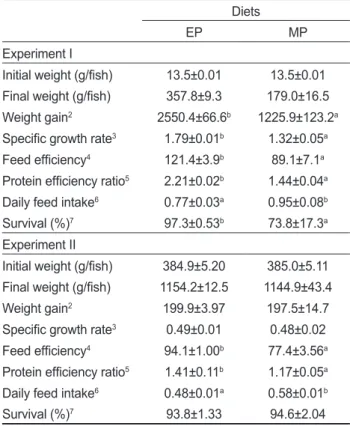
여름철부터겨울철까지(2007년 8월 13일-2008년 3월 10일) 치어기넙치(13.5 g)를대상으로배합사료(extruded pellet, EP) 및습사료(moist pellet, MP)를공급하여 7개월동안사육한실 험 I 과겨울철부터여름철까지(2008년 3월 13일-2008년 10 월 20일) 미성어기넙치(385 g)를대상으로 7개월동안사육 한실험 Ⅱ의성장결과는 Table 2에나타내었다. 실험 I 의치어
기넙치는배합사료실험구가초기무게 13.5 g에서 357.8 g으
로성장하였으나, 습사료실험구는초기무게 13.5 g에서 179 g 으로성장하였다. 성장률과일간성장률, 사료효율, 단백질이용 효율및생존율에서배합사료실험구가습사료실험구보다유
의적으로높은성장을보였으며(P<0.05), 최종측정한치어기
넙치의성장률은배합사료실험구가 2550.4%, 습사료실험구
가 1225.9%로배합사료를공급한넙치가습사료를공급한넙
치보다유의적으로높았다. 본실험결과와유사하게다른연 구에서도치어기넙치에게배합사료를공급할경우습사료보 다높은성장결과를보였다(Lee et al., 1999). 반대로 Kim et al. (2014a)의연구에서는제주도넙치양식장에서 51 g 넙치를
약 7개월간상업용시판배합사료와습사료를공급하여비교 한결과, 습사료와배합사료실험구의최종무게가각각 736 g
및 655 g으로습사료가배합사료보다높은성장률을보였다.
Cho et al. (2005)의연구에서는치어기넙치를배합사료와습
사료로장기간사육한결과, 성장에서유의적인차이를보이지 않았으며, Lee et al. (2005)의연구에서도치어기넙치를대상 으로배합사료와습사료를비교한결과배합사료와습사료가 대등한성장결과를보였다. 이처럼여러연구에서서로다른결 과를보인것은실험어류의종묘, 실험환경(수온, 밀도, 용존산 소등), 사료의성분및조성등의차이와사료공급량, 공급방 법, 공급횟수및사육관리방법등여러가지요인이복합적으 로영향을미쳤을것으로판단된다. 본연구에서배합사료가습 사료보다유의적으로높은성장률을보인것은위에서언급한 여러가지복합적인영향과더불어실험기간중습사료실험구
Table 2. Growth performance of olive flounder Paralichthys oliva- ceus fed extruded pellet (EP) and moist pellet (MP) 1
Diets
EP MP
Experiment I
Initial weight (g/fish) 13.5±0.01 13.5±0.01 Final weight (g/fish) 357.8±9.3 179.0±16.5 Weight gain2 2550.4±66.6b 1225.9±123.2a Specific growth rate3 1.79±0.01b 1.32±0.05a Feed efficiency4 121.4±3.9b 89.1±7.1a Protein efficiency ratio5 2.21±0.02b 1.44±0.04a Daily feed intake6 0.77±0.03a 0.95±0.08b Survival (%)7 97.3±0.53b 73.8±17.3a Experiment II
Initial weight (g/fish) 384.9±5.20 385.0±5.11 Final weight (g/fish) 1154.2±12.5 1144.9±43.4
Weight gain2 199.9±3.97 197.5±14.7
Specific growth rate3 0.49±0.01 0.48±0.02 Feed efficiency4 94.1±1.00b 77.4±3.56a Protein efficiency ratio5 1.41±0.11b 1.17±0.05a Daily feed intake6 0.48±0.01a 0.58±0.01b
Survival (%)7 93.8±1.33 94.6±2.04
1Values are means from triplicate groups of fish where the values in each row with different superscripts are significantly different (P<0.05). 2Weight gain (%) = (final weight - initial weight) × 100 / initial weight. 3Specific growth rate (%) = (loge final wt. - loge initial wt.)/ days. 4Feed efficiency (%) = wet weight gain (g) × 100 / dry feed intake (g). 5Protein efficiency ratio = wet weight gain / protein intake. 6Daily feed intake (%) = Total dry feed intake × 100/{(initial total wt. + final total wt. + dead fish wt.)/2} × days fed. 7Survival (%) =Number of fish at end of experiment / Number of fish stocked × 100.
배합사료와 습사료 급여에 의한 넙치의 성장 813
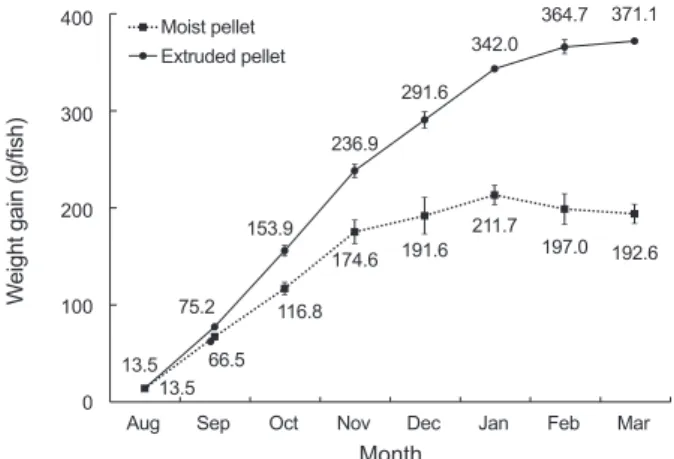
에서수온이가장높은 9월에질병이발생하여 10월까지꾸준 히폐사가발생하여생존율이유의적으로감소하였기때문으로 판단된다. 실험 I 과 II 의전체실험기간동안의월별수온변화 는 Fig. 1에서보여주고있다. Cho et al. (2009)의실험에따르 면치어기넙치를사육하는데수온이높은시기인 7월에서 10 월사이에배합사료를공급한실험구보다습사료를공급한실 험구에서병원체검출이높게나타났다고보고하였으며, 본실 험에서넙치의폐사가발생했던기간과유사한것을알수있었 다. 여름철부터겨울철까지배합사료와습사료를공급한치어 기넙치의월별성장결과는 Fig. 2에나타내었다. 치어기넙치 의월별성장은 8월에서 11월사이에치어기넙치가성장하기
좋은적정수온(19.1℃±3.86)으로먹이섭취가원활하여배합
사료를공급한실험구는실험이시작된 8월부터 11월까지 13.5
g에서 236.9 g으로성장하였으며, 습사료를 공급한실험구는
13.5 g에서 174.6 g으로성장하였다. 하지만 12월에들어서면
서수온이급감하여 3월까지낮은수온(11.4℃±0.79)을유지
하여월별성장률이감소하는것을볼수있었다. 12월에서 3월 까지배합사료를공급한넙치의월별성장은 291.6 g, 342.0 g, 364.7 g, 371.1 g으로서서히성장하는것을볼수있었으며, 습
사료를공급한실험구의월별성장은 12월에서 1월까지 191.6
g, 211.7 g으로서서히성장을하다가 2월에서 3월부터는 197.0
g, 192.6 g으로오히려어체중이감소하는것을볼수있었다.
실험 II 의미성어기넙치는초기무게 385 g에실험을시작하
여최종무게는각각 EP 실험구가 1154 g, MP 실험구가 1145 g 으로유의적인차이를보이지않았다. 성장률, 일간성장률및생
존율에서유의적인차이가없었으며(P>0.05), 최종측정한미
성어기넙치의성장률은배합사료실험구가 199.9%, 습사료실
험구가 197.5%로배합사료실험구와습사료실험구모두유사
한성장결과를보였다. Kim et al. (2006a)의연구에서는평균
체중 329 g의넙치를 8개월간배합사료와습사료를공급하여
비교한결과배합사료가습사료에비해높은성장결과를보였
다. 하지만 Kim et al (2008)의연구에서는미성어기넙치를배
합사료와습사료로 32주간사육하여 1 kg 이상사육하였을때,
성장및비만도에서유의적인차이가없고본연구결과와비슷 하게두실험구간에차이를보이지않았다. 겨울철부터여름철 까지배합사료와습사료를공급한미성어기넙치의월별성장 결과를 Fig. 3에나타내었다. 실험이시작된 3월(11.8℃)부터 9
월(23.7℃)까지수온이상승하면서월별성장이점점증가하는
경향을보였다. 배합사료를공급한넙치실험구의월별성장은 3월부터측정하여 9월까지 385.0 g, 406.3 g, 478.7 g, 580.3 g, 694.3 g, 822.0 g, 1001.3 g 순으로큰폭으로성장하였다. 습사 료를공급한미성어기넙치역시월별성장은 3월부터측정하 여 9월까지 384.9 g, 391.3 g, 450.7 g, 555.3 g, 687.0 g, 829.9 g, 1010.2 g 순으로큰폭으로성장하였다. 하지만 10월경에수 온(21.4℃)이 9월에비해 2.3℃ 하락하면서성장폭이작아지 게되는데배합사료를공급한넙치시험구가 1154.2 g, 습사료 를공급한넙치실험구가 1144.9 g으로 8월에서 9월사이에월 별로성장한것에비해작은폭으로성장하였다.
넙치양식의 경우, 치어기에는배합사료를 사용하지만 100-
300 g 크기에서대부분사양가들이습사료로전환을한다. 그
이유로미성어기부터는배합사료가습사료에비해성장률및 비만도가떨어지기때문이라고한다. 하지만본연구에서영양 소요구량을고려하여제작한배합사료실험구의성장률은습 사료실험구와차이를보이지않았다. 이와비슷하게미성어기 넙치를대상으로배합사료를공급할경우습사료를대체할수 있다는연구결과가보고되었다(Kim et al., 2009). 사료효율과 단백질이용효율결과, 치어기넙치에서는배합사료실험구가 습사료실험구보다유의적으로높게나타났으며(P<0.05), 미 성어기넙치역시배합사료실험구가습사료실험구보다유의
적으로높게나타났다(P<0.05). 반대로일간사료섭취율에서는
치어기및미성어기에습사료실험구가배합사료실험구와비 교하여유의적으로높은결과를보였다(P<0.05). 본실험결과
Fig. 2. Monthly changes of the weight gain for juvenile olive founder Paralichthys olivaceus fed the experimental diets in ex- periment I.
26
23 21.2
22.7
ExperimentⅠ ExperimentⅡ
18.8
13.9 12.2
10.9 10.3
11.8 14.1
15.2 18.7
19.3 22.9
23.7
20 21.4
17 14 11
8 Aug Sep Oct Nov Dec Jan Feb Mar Month
Temperature (℃)
Apr May Jun Jul Aug Sep Oct
384.9 384.9
406.3 391.3
478.7 450.7
580.3 555.3
694.3 687.0
822.0 829.9
1001.3 1010.2
1154.2 1144.9 1,400
1,100
800
500
200 Mar Moist pellet Extruded pellet
Month
Weight gain (g/fish)
Apr May Jun Jul Aug Sep Oct
13.513.5 75.2
66.5 153.9
116.8 236.9
174.6 191.6 291.6
342.0
211.7 364.7
197.0 371.1
192.6 400
300
200
100
0 Aug
Moist pellet Extruded pellet
Month
Weight gain (g/fish)
Sep Oct Nov Dec Jan Feb Mar
Fig. 3. Monthly changes of the weight gain for sub-adult olive founder Paralichthys olivaceus fed the experimental diets in ex- periment II.
21.2 18.8
13.9 12.2
10.9 10.3
11.8 14.1
15.2 18.7
19.3 21.4 20
17 14 11
8 Aug Sep Oct Nov Dec Jan Feb Mar Month
Temperature (℃
Apr May Jun Jul Aug Sep Oct
384.9 384.9
406.3 391.3
478.7 450.7
580.3 555.3
694.3 687.0
822.0 829.9
1001.3 1010.2
1154.2 1144.9 1,400
1,100
800
500
200 Mar Moist pellet Extruded pellet
Month
Weight gain (g/fish)
Apr May Jun Jul Aug Sep Oct
13.513.5 75.2
66.5 153.9
116.8 236.9
174.6 191.6 291.6
342.0
211.7 364.7
197.0 371.1
192.6 400
300
200
100
0 Aug
Moist pellet Extruded pellet
Month
Weight gain (g/fish)
Sep Oct Nov Dec Jan Feb Mar
김강웅ㆍ이진혁ㆍ배기민ㆍ김경덕ㆍ이봉주ㆍ한현섭ㆍ김성삼 814
사료효율과단백질이용효율이배합사료실험구에서높게나타 난것은습사료가수분함량이높고점결력이떨어져배합사료 에비해사료가수중으로유실되는량이높기때문에사료효율 과단백질이용효율이낮아진것이라고생각되며, 이러한결과 는많은연구들에서보고되었다(Kim et al., 2006a, 2006b; Kim et al., 2008; Kim et al., 2014a). 따라서습사료의사용은사료 의유실로인한수질오염을일으킬뿐만이아니라넙치의사료 효율과단백질이용효율을감소시킬수있기때문에배합사료의 전환은양식장의환경과넙치의성장에도움이될것으로사료 된다. 또한수분이많은습사료의특성상만복으로공급한다하 더라도실제섭취된영양소함량이배합사료에비해낮아사료 효율과단백질이용효율이낮아질수있다고판단되며, 이것은 대상어류가먹이섭취후포만감을가진다하더라도사료내수 분의함량에따라영양소섭취량이줄어들어사료효율과단백 질이용효율이낮아진다는연구들과일치한다(Lee et al., 1999;
Kim et al., 2006; Kim et al., 2011b). 일간사료섭취율에서습사 료를공급한실험구가배합사료를공급한실험구에비해유의 하게높은값을보이는것은수분이많은습사료내에너지함량 이배합사료에비해낮기때문이라판단되며, 어류를대상으로 연구한결과사료내에너지함량이감소할수록사료섭취량이 증가하는것을알수있다(Lee et al., 1999). 치어기및미성어 기넙치의월별성장은배합사료및습사료실험구모두사육수 온에많은영향을받는것을관찰할수있었으며, 사육수온의저 하에따라습사료를공급한넙치가배합사료를공급한넙치보 다성장이더떨어지게되는것을관찰할수있었다. 특히겨울 철에치어기넙치에게습사료를공급한실험구에서큰성장저 하를관찰할수있었고, 이러한결과는수온변화에따른넙치의 먹이섭취량의변화때문인것으로판단된다. 이전실험결과수 온이낮아지게되면소화효소의활성및대사율이감소하여사 료섭취량이적어지고, 수온이상승하면대사활동의증가로사 료섭취량이증가한다고보고되었다(Kim et al., 2005; Kim et
al., 2010). 위와같은결과를통해수온이낮아지는겨울철에넙
치의사료섭취량이적어지게되면수분의함량이높아섭취한 사료량에비해영양소와에너지함량이낮은습사료를섭취한 넙치의성장이배합사료를공급한넙치에비해떨어진다고판 단된다. 수온의변화에따른넙치의사료섭취량및사료공급량 의차이는많은연구를통해밝혀졌다(Kim et al., 2007; Choi et al., 2008 Kim et al., 2014b; Kim et al., 2014c; Lee et al., 2014;
Oh et al., 2014). Kim et al. (2011b)의연구에서치어기넙치의
겨울철배합사료공급량은어체중의 1.97%, 여름철에는어체
중의 4.83%라고보고되었으며, 미성어기넙치역시수온변화
에따라공급량이달라진다고보고되었다(Kim et al., 2010). 따 라서치어기및미성어기넙치에대한월별성장결과는수온의 변화에따라성장이달라지는것을확인하였으며, 특히고수온 기의여름철과저수온기의겨울철에는습사료를공급하는것보 다배합사료를공급하는것이성장과어병보호차원에서효과
적이라고판단된다.
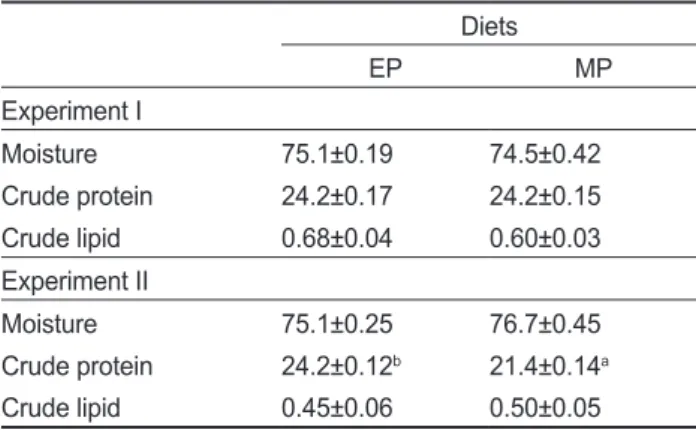
실험 I 과 II 의치어기및미성어기넙치전어체에대한일반 성분분석결과는 Table 3에나타내었다. 실험 Ⅰ의치어기넙치 에대한전어체일반성분분석결과에서는수분, 조지방및조
회분에서두실험구간에유의적인차이가없었으나(P>0.05),
조단백질함량에서는배합사료실험구가습사료실험구보다 유의적으로높은값을보였다(P<0.05). 실험 Ⅱ의미성어기넙 치에 대한전어체일반성분 분석결과에서는수분, 조단백질 및조회분함량에서두실험구간에유의적인차이가없었으
나(P>0.05), 조지방함량에서는배합사료실험구가습사료실
험구보다유의적으로높은값을보였다(P<0.05). 실험 I 과 II 의치어기및미성어기넙치등근육에대한일반성분분석결과
는 Table 4에나타내었다. 치어기넙치등근육에서일반성분을
Table 3. Proximate composition (%) of whole body for olive floun- der Paralichthys olivaceus fed the extruded pellet (EP) and moist pellet (MP)1
Diets
EP MP
Experiment I
Moisture 70.0±2.35 74.8±1.21
Crude protein 19.0±0.05b 17.7±0.15a
Crude lipid 6.5±0.02 6.7±0.05
Crude ash 3.4±0.03 3.7±0.11
Experiment II
Moisture 69.1±1.21 71.7±1.35
Crude protein 18.4±0.05 18.8±0.03
Crude lipid 7.5±0.02b 5.6±0.08a
Crude ash 3.4±0.08 3.0±0.06
1Values are means from triplicate groups of fish where the values in each row with different superscripts are significantly different (P<0.05).
Table 4. Proximate composition (%) of dorsal muscle for olive flounder Paralichthys olivaceus fed the extruded pellet (EP) and moist pellet (MP)1
Diets
EP MP
Experiment I
Moisture 75.1±0.19 74.5±0.42
Crude protein 24.2±0.17 24.2±0.15
Crude lipid 0.68±0.04 0.60±0.03
Experiment II
Moisture 75.1±0.25 76.7±0.45
Crude protein 24.2±0.12b 21.4±0.14a
Crude lipid 0.45±0.06 0.50±0.05