183
Generation of polyclonal antiserum to olive flounder (Paralichthys olivaceus) immunoglobulin by immunization of rabbit with
plasmids containing heavy chain gene of olive flounder immunoglobulin
Se Ryun Kwon, Chun Soo Kim, Eun Hye Lee and Ki Hong Kim Department of Aquatic Life Medicine, Pukyong National University,
Busan 608-737, Korea
In fish vaccinology, the secondary antibodies against fish immunoglobulins (Igs) are necessary to mea- sure specific humoral immune responses in immunized fish. In the present study, polyclonal antiserum against olive flounder (Paralichthys olivaceus) IgM heavy chain was generated by intramuscular immuniza- tion of rabbit with Escherichia coli/eukaryotic shuttle vector containing open reading frame (ORF) of olive flounder IgM heavy chain. Western blot analysis demonstrated the specific activity of the rabbit antiserum with reduced olive flounder serum H chain at dilutions up to 1:1000. Titer of immunized rabbit serum against olive flounder serum was significantly higher than that of pre-immunized rabbit serum when deter- mined by ELISA.
Key Words: Genetic immunization, Polyclonal antiserum, Olive flounder, Immunoglobulin
Introduction
In fish vaccinology, the secondary antibodies against fish immunoglobulins (Igs) are necessary to measure specific humoral immune responses in immunized fish. In order to develop antibodies against fish Igs, highly purified fish Igs extracted from sera are needed. Although purification and quantification of Ig from the serum of several fish species have been performed by specific antigen/antibody reactions (Sanchez et al., 1991;
Buchmann et al., 1992; Kofod et al., 1994; Palen- zuela et al., 1996; Bryant et al., 1999; Swain et al., 2004), lectin-binding (mannan binding protein) (Nevens et al., 1992; Cobb et al., 1998) and bacteri- al cell wall proteins (staphylococcal protein A)
(Estevez et al., 1993a,b; Kanlis et al., 1995;
Scapigliati et al., 1996, 1997; Morrison and Nowak, 2001), the extraction efficiency and purity were highly variable according to fish species.
The in vivo synthesis of antigen by DNA-based immunization is a potential alternative to immu- nization with purified antigen. Immunization by plasmid DNA has many advantages including the purity, ease of production, stability of episomal DNA, and the possibility to use only a given part of the gene. Recently, Timmusk et al. (2003) had reported the generation of monoclonal antibodies against trout two isoforms of the Ig light chain pro- teins (L1 and L2) of rainbow trout (Oncorhynchus mykiss) by genetic immunization.
In the present study, we have generated rabbit
Corresponding Author : Ki Hong Kim, Tel : 051-620-6145, Fax : 051-628-7430, E-mail : [email protected]
183
antibody against immunoglobulin of olive flounder (Paralichthys olivaceus) by immunization with Escherichia coli/eukaryotic shuttle vector contain- ing open reading frame (ORF) of olive flounder IgM heavy chain. The applicability of antibody pro- duced by genetic immunization was assessed using Western blot and ELISA.
Materials and Methods
Generation of DNA constructs
Total RNA was extracted from healthy Japanese flounder (Paralichthys olivaceus) spleen using TRI- ZOL (Invitrogen, CA, USA). The purified total RNA was reverse transcribed into cDNA using the AMV reverse transcriptase first-stand cDNA syn- thesis kit (Promega, WI, USA). The open reading frame (ORF) of P. olivaceus immunoglobulin heavy chain (Ig-hc) was amplified by polymerase chain reaction (PCR) from the cDNA using primers complimentary to the N-terminal (GAATTCG- GCACGAGACCATAAACCAT; bolds represent EcoR I site) and C-terminal (GTCGA- CAATAGCATCTACTGGGCCTT) ends of the coding sequence (GeneBank accession number, AF226284). PCR was performed with an initial denaturation step of 3 min at 95 , and then 30 cycles were run as follows: 30 s of denaturation at 95 , 30 s of annealing at 55 , and 7 min of exten- sion at 72 . The reacted products were elec- trophoresed on a 0.7% agarose gel. The PCR prod- uct was subcloned into pGEM-T easy vector (Promega) and the amplified product was ligated into the shuttle vector, pcDNA3.1 (Invitrogen). The DNA construct was subjected to DNA sequencing to verify that the olive flounder Ig-hc DNA sequence was in frame with the coding sequence of the vector. Transformed Escherischia coli colonies were amplified in LB containing 50 / ampi-
cillin and the plasmid DNA constructs were puri- fied by alkaline lysis method.
Immunization
A male 4-month-old New Zealand white rabbit was injected with 500 of the constructed plas- mids in a total volume of 0.3 ml phosphate buffered saline (PBS) into the cervical muscle and boosted 4 times with 2 weeks intervals with the same proce- dure of the primary immunization. Blood was sam- pled via the ear vein prior to the first inoculation and each boosting. After 2 weeks of the last boost- ing, the rabbit was euthanized and bled out.
Immunoblotting
Serum of olive flounder was solublized in SDS- PAGE loading buffer (2% SDS, 14.4 mM -mer- captoethanol, 25% glycerol, 0.1% bromophenol blue, 60 mM Tris-HCl, pH 6.8), boiled for 5 min and fractionated on a 10% SDS-PAGE gel. Proteins were transferred to nitrocellulose membrane. The membrane was blocked with blocking solution (3%
Bovine serum albumin in TBS; 150 mM NaCl, 10 mM Tris-HCl, pH 7.5) for 2 h at room temperature (RT), washed with TTBS (0.05% Tween 20 in TBS, pH 7.5) and incubated with a diluted rabbit serum (1:500 or 1:1000) for 2 h at RT. The membranes were washed three times with TTBS and incubated with alkaline phophatase conjugated mouse anti- rabbit IgG (1:2000, Santa Cruz Biotechnology Inc., CA, USA) for 2 h at RT. After washing off unbound secondary antibody, the specific antigen-bound antibody was visualized with NBT-BCIP substrate buffer (Sigma Co., St Louis, MO, USA).
ELISA
96-well ELISA plate (Corning, NY, USA) was coated with olive flounder serum (150 protein/well) in PBS (pH 7.2) for 2 h at 60 . The
plate was washed with PBST (0.1% Tween 20 in PBS) and blocked with blocking buffer (2% BSA in PBS) for 1 h at 37 . After three times washing with PBST, 2-fold serially diluted immunized and pre-immunized rabbit sera (initial dilution titer, 1:50) were applied into the ELISA plate and incu- bated for 30 min at 37 . The plate was then washed with PBST and incubated with alkaline phophatase conjugated mouse anti-rabbit IgG (1:1000, Santa Cruz Biotechnology Inc.) for 30 min at 37 . The plate was washed with PBST and developed with p-nitrophenyl phosphate (p-NPP, Sigma) substrate solution for 30 min in the dark chamber. The developed colour was measured at 415 nm in a microplate reader (Bio-Rad laborato- ries, Hercules, CA, USA). An unpaired Student’s t- test was used to compare the means of immunised and pre-immunised rabbit sera.
Results
Olive flounder IgM heavy chain gene ORF was amplified from total RNA of spleens by RT-PCR (Fig. 1), and was confirmed by comparison of the sequences with previously reported sequences (the sequence data are not shown).
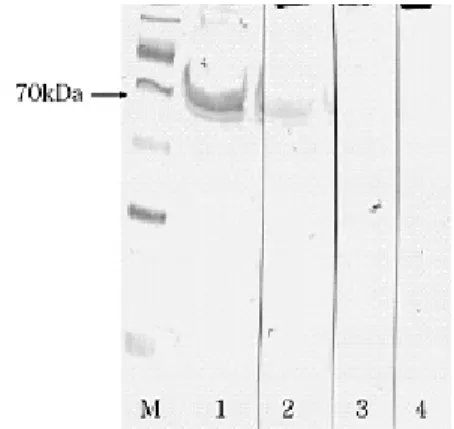
Western blot analyses demonstrated the specific activity of the rabbit antiserum with reduced olive flounder serum H chain at dilutions up to 1:1000 (Fig. 2). Pre-immunized rabbit serum was negative to reduced olive flounder serum.
Titer of immunized rabbit serum against olive flounder serum was significantly higher than that of Fig. 1. Amplication of the mRNA of olive flounder (Par-
alichthys olivaceus) IgM heavy chain by RT-PCR (Lane 1).
Lane M, 100 bp ladder (Bioneer Corp., Daejeon, Korea).
Fig. 2. Western blot analysis of rabbit anti-olive flounder IgM heavy chain serum against olive flounder serum. Lane M, TriChromRanger prestained protein marker (Pierce, Rockford. IL, USA); Lane 1 and 2, rabbit serum produced by intramuscular injection of plasmids containing olive flounder IgM heavy chain ORF at dilution 1:500 and 1:1000, respectively; Lane 3 and 4, pre-immune rabbit serum at dilution 1:500 and 1:1000, respectively.
Fig. 3. Titration of rabbit anti-olive flounder IgM heavy chain serum in an ELISA using olive flounder serum as the coating antigen (mean standard error, n=4).
pre-immunized rabbit serum when determined by ELISA (Fig. 3).
Discussion
In the present study, polyclonal antibody against olive flounder IgM heavy chain was generated by intramuscular immunization of rabbit with plasmid containing olive flounder IgM heavy chain gene.
The role of skeletal muscle in antigen production and antigen presentation to the immune system after intramuscular genetic immunization has been debated (Torres et al., 1997; Klinman et al., 1998;
Corr et al., 1999; Stan et al., 2001). Generally, to produce antibodies against T-dependent antigens, helper T cell must recognize epitopes presented on the MHC II of antigen presenting cells (APCs) such as dendritic cell, macrophage or B cell. Although, in this study, the mechanism of Ab production in rab- bit by genetic immunization was not investigated, rabbit antiserum produced by genetic immunization with olive flounder Ig heavy chain gene was applic- able to Western blotting, suggesting presentation of olive flounder Ig epitopes on the MHC II of rabbit APCs by intramuscular genetic immunization.
One problem generally encountered in genetic immunization was the relatively low immunogenic- ity of plasmid DNA vaccines compared to their pro- tein counterparts (Zhu et al., 2001). Recently, sever- al approaches have been used to improve the immunogenicity of DNA vaccines (Barouch et al., 2000; Widera et al., 2000; Scheerlinck, 2001;
Bagley et al., 2003). In the present study, although the ELISA titers of the rabbit serum produced by genetic immunization of olive flounder IgM heavy chain were significantly higher than those of pre- immunized rabbit serum, the titers were not high as in protein immunization, suggesting requirement of further improvements in vector construction to
enhance specific humoral immune responses.
Acknowledgements
This study was supported by a grant (B-2005-01) from Marine Bioprocess Research Center of the Marine Bio 21 Center funded by the Ministry of Maritime Affairs & Fisheries, Republic of Korea.
References
Bagley, K. C., Shata, M. T., Onyabe, D. Y., DeVico, A. L., Fouts, T. R., Lewis, G. K. and Hone, D.M.: Immunogenicity of DNA vaccines that direct the coincident expression of the 120 kDa glycoprotein of human immunode- ficiency virus and the catalytic domain of cholera toxin. Vaccine, 21: 3335-3341, 2003.
Barouch, D. H., Santra, S. and Schmitz, J. E.: Con- trol of viremia and prevention of clinical AIDS in rhesus monkeys by cytokine-aug- mented DNA vaccination. Science, 290:
486-491, 2000.
Bryant, M. S., Lee, R. P., Lester, R. J. G. and Whit- tington, R. J.: Anti-immunoglobulin antisera used in an ELISA to detect antibodies in bar- ramundi Lates calcarifer to Cryptocaryon irritans. Dis. Aquat. Org., 36: 21-28, 1999.
Buchmann, K., Ostergaard, L. and Glamann, J.:
Affinity purification of antigen-specific serum immunoglobulin from the European eel (Anguilla anguilla). Scand. J. Immunol., 36: 89-97, 1992.
Cobb, C. S., Levy, M. G. and Noga, E. J.: Acquired immunity to amylodiniosis is associated with an antibody response. Dis. Aquat. Org., 34: 125-133, 1998.
Corr, M., von Damm, A., Lee, D. J. and Tighe, H.:
In vivo priming by DNA injection occurs predominantly by antigen transfer. J.
Immunol., 163: 4721-4727, 1999.
Estevez, J., Leiro, J., Sanmartin, M. L. and Ubiera, F. M.: Isolation and partial characterisation of turbot (Scophthalmus maximus) immunoglobulins. Comp. Biochem. Physi- ol., 105A: 275-281, 1993a.
Estevez, J., Sanchez, C., Dominguez, J., Leiro, J., Sanmartin, M. L. and Ubiera, F. M.: Protein- A binding characteristics of rainbow trout (Oncorhynchus mykiss) immunoglobulins.
Comp. Biochem. Physiol., 106B: 173-180, 1993b.
Kanlis, G., Suzuki, Y., Tauchi, M., Numata, T., Shi- rojo, Y. and Takashima, F.: Immunoglobulin in oocytes, fertilised eggs, and yolk sac lar- vae of red sea bream. Fish. Sci., 61: 787- 790, 1995.
Klinman, D. M., Sechler, J. M., Conover, J., Gu, M.
and Rosenberg, A. S.: Contribution of cells at the site of DNA vaccination to the genera- tion of antigen-specific immunity and mem- ory. J. Immunol., 160: 2388-2392, 1998.
Kofod, H., Pedersen, K., Larsen, J. L. and Buch- mann, K.: Purification and characterization of IgM-like immunoglobulin from turbot (Scophthalmus maximus L.). Acta Vet.
Scand., 35: 1-10, 1994.
Morrison, R. N. and Nowak, B.F.: Affinity purifica- tion and partial characterisation of systemic immunoglobulin of the snapper (Pagrus auratus). Aquaculture, 201: 1-17, 2001.
Nevens, J. R., Mallia, A. K., Wendt, M. W. and Smith, P. K.: Affnity chromatographic purification of immunoglobulin M utilising immobilised mannan binding protein. J.
Chromatography, 597: 247-256, 1992.
Palenzuela, O., Sitja-Bobadilla, A. and Alvarez-Pel-
litero, P.: Isolation and partial characterisa- tion of serum immunoglobulins from sea bass (Dicentrarchus labrax L.) and gilthead sea bream (Sparus aurata L.). Fish Shellfish Immunol., 6: 81-95, 1996.
Sanchez, C., Coll, J. and Dominguez, J.: One-step purification of the major rainbow trout immunoglobulin. Vet. Immunol. Immuno- pathol., 27: 383-391, 1991.
Scapigliati, G., Romano, N., Picchetti, S., Mazzini, M., Mastrolia, L., Scalia, D. and Abelli, L.:
Monoclonal antibodies against sea bass Dicentrarchus labrax (L.) immunoglobu- lins: immunolocalisation of immunoglobu- lin-bearing cells and applicability in immunoassays. Fish Shellfish Immunol., 6:
383-401, 1996.
Scapigliati, G., Chausson, F., Cooper, E. L., Scalia, D. and Mazzini, M.: Qualitative and quanti- tative analysis of serum immunoglobulins of four Antarctic fish species. Polar Biol., 18:
209-213, 1997.
Scheerlinck, J. P. Y.: Genetic adjuvants for DNA vaccines. Vaccine, 19: 2647-2656, 2001.
Stan, A. C., Casares, S., Brumeanu, T. -D., Klin- man, D. M. and Bona, C. A.: CpG motifs of DNA vaccines induce the expression of the chemokines and MHC class II molecules on myocytes. Eur. J. Immunol., 31: 301-310, 2001.
Swain, T., Mohanty, J. and Sahu, A. K.: One step purification and partial characterisation of serum immunoglobulin from Asiatic catfish (Clarias batrachus L.). Fish Shellfish Immunol., 17: 397-401, 2004.
Timmusk, S., Jansson, E. and Pilström, L.: The gen- eration of monoclonal antibodies by genetic immunisation: antibodies against trout TCR and IgL isotypes. Fish Shellfish Immunol.,
14: 187-206, 2003.
Torres, C. A. T., Awasaki, A., Barber, B. H. and Robinson, H. L.: Differential dependence on target site tissue for gene gun and intramus- cular DNA immunizations. J. Immunol., 158: 4529-4532, 1997.
Widera, G., Austin, M. and Rabussay, D.: Increased DNA vaccine delivery and immunogenicity by electroporation in vivo. J. Immunol., 164:
4635-4640, 2000.
Zhu, D., Rice, J., Savelyeva, N. and Stevenson, F.
K.: DNA fusion vaccines against B-cell tumors. Trends Mol. Med., 7: 566-572, 2001.
Manuscript Received : June 28, 2006 Revision Accepted : July 20, 2006 Responsible Editorial Member : Sung-Ju Jung (Chonnam Univ.)