蒲公英 추출물의 마우스 단회 경구투여 독성 실험
구자환․김세란․이진원․박미연*․최해윤․김종대 대구한의대학교 한의과대학 폐계내과학교실
Mouse Single Oral Dose Toxicity Test of Taraxaci Herba Aqueous Extracts
Ja Hwan Gu, Se Ran Kim, Jin Won Lee, Mee Yeon Park*, Hae Yun Choi, Jong Dae Kim Department of Internal Medicine, College of Oriental Medicine, Daeguhaany University
The object of this study was to obtain acute information (single oral dose toxicity) ofTaraxaci Herba(Dried total parts of Taraxacum platycarpum. H.Dahlstedt (Compositae)), has been traditionally used in Korean medicine for treating various inflammatory diseases. In order to observe the 50% lethal dose (LD 50), approximate lethal dosage (ALD) and target organs, test articles were once orally administered to female and male ICR mice at dose levels of 2,000, 1,000, 500 ㎎/㎏ according to the recommendation of Korea Food and Drug Administration Guidelines. The mortality and changes on body weight, clinical signs and gross observation were monitored during 14 days after single oral treatment of Taraxaci Herba aqueous extracts according to KFDA Guidelines with organ weights and histopathological observations of 12 types of principle organs. After single oral treatment of Taraxaci Herba aqueous extracts, we could not find any mortality and toxicological evidences up to 2,000 ㎎/㎏ treated group, the limited dosages in rodents at body and organ weights, clinical signs, gross and histopathological observations. Except for slight soft feces, which were detected in male mice treated with 2,000 ㎎/㎏ of Taraxaci Herba aqueous extracts at 1 day after end of treatment. The results obtained in this study suggest that the LD 50 and ALD of Taraxaci Herba aqueous extracts in both female and male mice after single oral treatment were considered as over 2,000 ㎎/㎏
because no mortalities were detected up to 2000 ㎎/㎏ that was the highest dose recommended by KFDA and OECD.
However, it also observed that the possibility of digestive disorders, like diarrhea when administered over 2,000 ㎎/㎏
ofTaraxaci Herba aqueous extracts in the present study, but these possibilities of digestive disorders can be disregard in clinical use because they ate transient in the highest dosages male only.
Key words : Taraxaci Herba, single oral dose toxicity, mouse
* 교신저자 : 박미연, 대구시 수성구 상동 165, 대구한방병원 폐계내과학교실
․E-mail : [email protected], ․Tel : 010-8575-9481
․접수 : 2011/04/25 ․수정 : 2011/05/30 ․채택 : 2011/06/10
서\ 론
蒲公英(Taraxaci Herba; TH)은 국화과 (Compositae)에 속한 다년생 초본인 민들레 (Taraxacumplatycarpum. H.Dahlstedt) 와 동속근연 식물의 全草를 건조 것으로 봄과 여름에 꽃이 피기 전 이나 후에 채취한 것을 이용하는 약재로 性은 寒하고, 味는 苦甘 하며, 淸熱解毒, 消癰散結 등의 효능이 있어 消炎, 利尿, 殺菌 작 용을 나타내어 疔瘡腫毒, 乳癰, 瘰癧, 目赤, 肺癰, 腸癰, 濕熱黃疸,
熱淋澁痛을 치료하는데 사용되어 왔다1,2).
근래에 들어 안전성이 확보되지 않은 식품 및 의약품이 오․남용되고 있어 독성 및 부작용이 늘어나게 됨으로써 이에 대한 철저한 규제 및 관리가 요구되고 있다3). 그리하여 한약 자 체 단미제의 독성 평가가 진행되어 黃連4), 丹參4), 竹瀝5), 麻黃6,7),
猪苓7), 半夏8), 人蔘9,10), 玉竹11), 金銀花12), 발효 옻 추출물13) 등에
서 독성 연구가 수행되어져 왔다.
그러나 항염증 약물로 다양한 질환에 널리 사용되어 온 蒲 公英의 독성학적 측면에 대한 보고는 전혀 없기에 저자는 蒲公 英의 일반적인 독성시험 중 현재 의약품 등의 독성시험기준24)에 명시되어 있는 마우스 경구 단회투여독성 시험을 수행하여 유의 한 결과를 얻어 보고하고자 한다.
재료 및 방법
1. 재료 1) 약재
본 실험에 사용된 蒲公英은 약업사 (옴니허브, Korea)에서 매 입한 것을 현미경하에서 관능검사를 실시하여 선정, 사용하였다.
2) 蒲公英 추출
선정된 蒲公英 100 g을 취하여 정제수 2,000 ㎖로 80℃에서 3시간 동안 3번 가열 추출한 후, 흡인 여과한 여과액을 rotary vacuum evaporator (Buchi Rotavapor R144, Buchi Labortechnik AG, Switzland)로 감압․농축하여 점조성의 추출물을 얻은 다음 programmable freeze dryer (Labconco Freezone1, Labconco Corp., MO, USA)를 사용하여 동결 건조시켜 총 19.90 g (수율 약 19.90%)의 진갈색의 물 추출물을 얻어 실험에 사용하였다. 물 추출한 蒲公英 동결 건조물은 -20℃의 냉장고에 보관 후 실험에 사용하였으며, 본 실험에서 사용한 용매인 증류수에 100 ㎎/㎖
의 농도까지 비교적 잘 용해되었다.
2. 마우스 경구 단회투여독성 실험 1) 실험동물 및 사양관리
암수 각 20마리의 ICR 마우스 (6-wk old upon receipt, SLC, Japan)를 9일간의 순화과정을 거쳐 실험에 사용하였으며, 순화과 정 및 실험 전 기간 동안 온도 (20-25℃)와 습도 (30-35%)가 조절 된 사육실에서 마우스용 polycarbonate 사육 상자에 5마리씩 수 용하여 사육하였고, 명암 주기 (light: dark cycle)는 12시간 주기 로 조절하였으며, 사료 (Samyang, Korea)와 음수는 자유롭게 공 급하였다. 모든 실험동물은 투여일 및 최종 부검일 18시간 전 절 식을 실시하였으며, picric acid로 개체를 식별하였다.
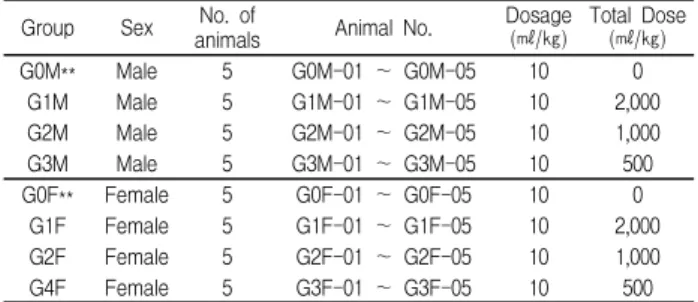
Table 1. Experimental Design Used in Single Dose Toxicity Test Group Sex No. of
animals Animal No. Dosage
(㎖/㎏) Total Dose (㎖/㎏)
G0M** Male 5 G0M-01 ~ G0M-05 10 0
G1M Male 5 G1M-01 ~ G1M-05 10 2,000
G2M Male 5 G2M-01 ~ G2M-05 10 1,000
G3M Male 5 G3M-01 ~ G3M-05 10 500
G0F** Female 5 G0F-01 ~ G0F-05 10 0
G1F Female 5 G1F-01 ~ G1F-05 10 2,000
G2F Female 5 G2F-01 ~ G2F-05 10 1,000
G4F Female 5 G3F-01 ~ G3F-05 10 500
** ; Vehicle control; distilled water 20 ㎖/㎏ as vehicle in this study; All test articles in vehicle were once orally dosed in a volume of 20 ㎖/㎏, dissolved in distilled water.
2) 군 분리 및 약물의 투여
실험동물은 군당 5마리씩 Table 1에 기록한 8그룹으로 구분 하여 한국식품의약품 안전청 기준14)과 OECD 실험기준15)에 의거 하여, 설치류 최고 한계투여용량인 2,000 ㎎/㎏을 최고 용량으로 설정하였으며, 공비 2로 1,000 및 500 ㎎/㎏을 중간 및 저용량 투 여군으로 설정하였다. 또한 암수 각각에 대한 매체 대조군을 추 가 하였다. 모든 투여군에서는 蒲公英 추출물을 멸균 증류수에 용해시켜 20 ㎖/㎏의 용량으로 overnight 절식 후 존데가 부착된 1 ㎖ 주사기를 이용하여 경구 투여하였다. 식이와 음수에 따른
약물의 흡수 변화를 최소화하기 위해, 투여 후 대략 3시간 동안 사료와 음수 공급을 제한하였다.
3) 임상증상의 관찰
모든 실험동물의 임상증상을 투여 전후에 각각 functional observational battery test16,17)를 기초하여 동물의 행동, 자극에 대한 반응성, 각성도 및 경계성, 자세 및 보행 이상 등에 관한 일 반증상을 관찰, 기록하였으며, 투여일 이후에도 하루에 최소한 2 번씩 모든 실험동물의 임상증상을 관찰, 기록하였다.
4) 체중의 측정
모든 실험동물의 체중을 투여 전 1일, 투여직전, 투여 후 1, 2, 7, 13 및 14일에 각각 측정하였으며, 실험 시작 시 개체 차이에 따른 체중의 변화를 최소화하기 위하여, 투여일 부터 투여 후 7 일, 투여 후 7일부터 13일 및 투여일 부터 투여 후 13일간의 체중 증가량을 각각의 체중을 이용하여 산출하였다.
5) 육안부검
투여 14일 후 모든 실험동물은 overnight 절식을 실시하였으 며, ethyl ether (덕산공업주식회사, Korea) 마취하에 부검을 실시 하고, 폐, 심장, 신장, 비장, 고환, 간, 췌장, 부고환 (Epididymis), 슬와 임파절 (Popliteal lymph node), 난소, 뇌 및 자궁 등 12개의 주요 장기를 위주로 이상 육안소견을 각각 관찰, 기록하였다.
6) 장기중량의 측정
모든 실험동물은 육안부검 소견을 관찰 기록한 후 폐, 심장, 좌측 신장, 비장, 좌측 고환, 간, 췌장 비장엽 (Pancreas-splenic lobes), 좌측 부고환, 좌측 슬와 임파절 , 좌측 난소, 뇌 및 자궁에 대한 절대 중량을 각각 측정하였으며, 체중의 변화에 수반된 이 차적 변화를 최소화하기 위해 체중에 대한 각각의 장기 절대중 량의 비율인 상대 중량을 산출하였다.
7) 조직병리학적 관찰
폐, 심장, 좌측 신장, 비장, 좌측 고환, 간, 췌장 비장엽, 좌측 부고환, 좌측 슬와 임파절, 좌측 난소, 뇌 및 자궁 등의 12개 주요 장기의 일부 조직을 10% 중성포르말린에 18시간 이상 고정시킨 다음, 탈수를 거쳐 파라핀 포매 후 4 ㎛의 절편을 제작하였다. 이 후 hematoxylin & eosin 염색을 실시하고, 광학현미경 하에서 이 상 유무를 관찰, 기록하였다.
3. 통계 처리
모든 수치는 평균 ± 표준편차로 표시하였으며, 다중비교검 증을 이용하여 통계처리를 실시하였고, 분산동질성을 Levene test를 실시하여 검증하였다. 등분산일 경우, one way ANOVA test를 실시한 다음 Scheffe test로 사후 검증을 실시하여 군간의 유의성을 측정하였다. 비등분산일 경우에는 비모수 검증인 Kruskal-Wallis H test를 실시하여 유의성이 인정된 경우에는, Mann-Whitney U-Wilcoxon Rank Sum W를 실시하여 군간의 유의성을 검증하였다. 단회 투여독성시험의 경우, 반수치사량 및 95% 신뢰한계 (confidence limits)를 Probit 방법으로 측정하였으 며, 임상 증상과 육안부검 및 조직병리학적 소견은 각각 그 정도 에 따라 0 (normal), 1+ (slight), 2+ (moderate) 및 3+ (severe)로 구분하였다. 통계처리 및 Probit 방법은 SPSS for Windows
Table 5. Changes on the Absolute Organ Weights Observed in Male Mice of Single Dose Toxicity Testa Group
IDb
Principal Organs Lung Heart Thymus Kidney L Adrenal
gland L Spleen Testis L Liver Pancreas S Brain Epididymis
L Lymph
node Lc G0M 0.192±0.016 0.173±0.019 0.037±0.018 0.279±0.026 0.002±0.001 0.139±0.032 0.124±0.028 1.561±0.134 0.170±0.009 0.465±0.026 0.045±0.010 0.014±0.014 G1M 0.192±0.015 0.178±0.012 0.033±0.012 0.280±0.048 0.002±0.001 0.117±0.030 0.127±0.006 1.480±0.181 0.162±0.021 0.469±0.006 0.044±0.004 0.009±0.005 G2M 0.189±0.010 0.163±0.019 0.049±0.006 0.285±0.034 0.003±0.002 0.102±0.015 0.118±0.025 1.558±0.087 0.167±0.014 0.462±0.011 0.044±0.008 0.006±0.004 G3M 0.192±0.006 0.171±0.012 0.043±0.018 0.281±0.033 0.001±0.001 0.110±0.036 0.118±0.008 1.568±0.158 0.170±0.015 0.479±0.020 0.044±0.004 0.013±0.002 a ; Values are expressed as mean ± S. D. of five mice, g, b ; Group ID was listed in Table 1, L ; left side, S ; splenic lobe, c ; Popliteal lymph node.
Table 6. Changes on the Absolute Organ Weights Observed in Female Mice of Single Dose Toxicity Testa Group
IDb
Principal Organs Lung Heart Thymus Kidney L Adrenal
gland L Spleen Ovary L Liver Pancreas S Brain Uterus Lymph node Lc G0M 0.197±0.016 0.148±0.016 0.065±0.013 0.185±0.015 0.004±0.002 0.132±0.016 0.020±0.006 1.279±0.137 0.159±0.024 0.482±0.030 0.164±0.061 0.008±0.005 G1M 0.190±0.019 0.147±0.012 0.055±0.011 0.190±0.020 0.003±0.002 0.122±0.027 0.021±0.003 1.305±0.086 0.168±0.018 0.475±0.020 0.227±0.067 0.009±0.005 G2M 0.183±0.025 0.143±0.020 0.049±0.018 0.180±0.010 0.003±0.001 0.128±0.055 0.023±0.007 1.192±0.214 0.153±0.020 0.462±0.025 0.189±0.063 0.011±0.005 G3M 0.178±0.014 0.145±0.010 0.057±0.029 0.187±0.014 0.003±0.002 0.137±0.052 0.027±0.007 1.369±0.229 0.162±0.011 0.472±0.015 0.186±0.057 0.011±0.003 a ; Values are expressed as mean ± S. D. of five mice, g, b ; Group ID was listed in Table 1, L ; left side, S ; splenic lobe, c ; Popliteal lymph node.
Table 7. Changes on the Relative Organ Weights Observed in Male Mice of Single Dose Toxicity Testa Group
IDb
Principal Organs Lung Heart Thymus Kidney L Adrenal
gland L Spleen Testis L Liver Pancreas S Brain Epididymis
L Lymph
node Lc G0M 0.572±0.032 0.516±0.048 0.108±0.048 0.831±0.075 0.005±0.002 0.412±0.082 0.369±0.077 4.645±0.162 0.508±0.056 1.389±0.109 0.134±0.027 0.040±0.041 G1M 0.562±0.021 0.522±0.009 0.096±0.030 0.816±0.112 0.006±0.002 0.339±0.077 0.374±0.023 4.323±0.316 0.474±0.058 1.377±0.086 0.130±0.008 0.026±0.014 G2M 0.531±0.023 0.459±0.042 0.137±0.014 0.799±0.069 0.008±0.006 0.285±0.032 0.330±0.055 4.383±0.213 0.470±0.056 1.302±0.062 0.123±0.016 0.018±0.011 G3M 0.540±0.019 0.418±0.028 0.121±0.046 0.791±0.082 0.004±0.003 0.307±0.089 0.334±0.036 4.418±0.448 0.479±0.036 1.353±0.102 0.124±0.013 0.036±0.004 a ; Values are expressed as mean ± S. D. of five mice, g, b ; Group ID was listed in Table 1, L ; left side, S, splenic lobe, c ; Popliteal lymph node.
(Release 14.0K, SPSS Inc., USA)를 이용하여 평가하였으며, p-value가 0.05 이하인 경우 통계적 유의성을 인정하였다.
결 과
1. 마우스 경구 단회 투여독성 실험 1) 사망률
蒲公英 추출물 투여와 관련 있는 사망례는 실험 전 기간 동 안 관찰되지 않았으며, 모든 실험동물 (5/5; 100%)에서 최종부검 을 실시하였다(Table 2).
Table 2. Mortalities Observed in Female and Male Mice of Single Dose Toxicity Testa
Group IDb Day after dosing Total**
0c 1 2 3 4 5 6 7 8 9 10 11 12 13
G0M 0 0 0 0 0 0 0 0 0 0 0 0 0 0 0/5(0%)
G1M 0 0 0 0 0 0 0 0 0 0 0 0 0 0 0/5(0%)
G2M 0 0 0 0 0 0 0 0 0 0 0 0 0 0 0/5(0%)
G3M 0 0 0 0 0 0 0 0 0 0 0 0 0 0 0/5(0%)
G0F 0 0 0 0 0 0 0 0 0 0 0 0 0 0 0/5(0%)
G1F 0 0 0 0 0 0 0 0 0 0 0 0 0 0 0/5(0%)
G2F 0 0 0 0 0 0 0 0 0 0 0 0 0 0 0/5(0%)
G3F 0 0 0 0 0 0 0 0 0 0 0 0 0 0 0/5(0%)
a ; number of died animals, b ; Group ID was listed in Table 1, c ; Dosing day, **;
total mortalities during 14 days of observation periods – died animals/total observed animals (n = 5) (percentages)
2) 임상증상
경미한 설사 소견이 蒲公英 추출물 2,000 ㎎/㎏ 수컷 투여군 에 국한되어 관찰되었으며 이들 설사 소견은 투여 2일 후부터 정상으로 회복되었다. 이 외 蒲公英 추출물 투여와 관련된 임상
증상은 실험 전 기간 동안 인정되지 않았다(Table 3).
3) 체중의 변화
1000 ㎎/㎏ 암컷 투여군에서 투여일에서 투여 후 7일 동안 의 체중 증가량이 암컷 매체 대조군에 비해 유의성 있는(p<0.01) 감소를 나타내었다. 이 외 蒲公英 추출물 투여와 관련된 체중 및 체중 증가량의 변화는 인정되지 않았다(Fig. 2, 3, Table 4).
Table 3. Clinical Signs Observed in Female and Male Mice of Single Dose Toxicity Testa
Group IDb Clinical signs Group IDb Clinical signs
Normal Diarrhea Normal Diarrhea
G0M 5/5 (100%) 0/5 (0%) G0F 5/5 (100%) 0/5 (0%) G1M 3/5 (60%) 2/5 (40%) G1F 5/5 (100%) 0/5 (0%) G2M 5/5 (100%) 0/5 (0%) G2F 5/5 (100%) 0/5 (0%) G3M 5/5 (100%) 0/5 (0%) G3F 5/5 (100%) 0/5 (0%) a ; Observed animals/total observed animals of five mice (percentages), b ; Group ID was listed in Table 1.
Table 4. Body Weight Gains in Female and Male Mice of Single Dose Toxicity Testa
Group IDb Interval
Day 0c- 7 Day 7 - 13 Day 0 -13
G0M 7.38±1.02 1.20±1.39 2.90±1.44
G1M 6.80±0.88 1.38±1.33 2.92±1.71
G2M 7.66±0.97 2.24±1.18 4.48±0.67
G3M 8.80±0.60 2.10±1.02 5.14±0.94
G0F 7.06±0.91 0.54±1.44 3.74±0.68
G1F 5.56±1.25 2.58±2.49 3.48±1.48
G2F 5.02±0.98* 2.50±3.18 2.54±2.61
G3F 7.36±4.54 1.26±5.88 4.28±2.61
a ; Values are expressed as mean ± S. D. of five mice, g, b ; Group ID was listed in Table 1, c ; Day of dosing after overnight fasted, * ; p<0.01 as compared with female vehicle control by MW test.
Table 8. Changes on the Relative Organ Weights Observed in Female Mice of Single Dose Toxicity Testa Group
IDb
Principal Organs Lung Heart Thymus Kidney L Adrenal
gland L Spleen Ovary L Liver Pancreas S Brain Uterus Lymph node Lc G0M 0.663±0.059 0.498±0.039 0.220±0.046 0.623±0.047 0.012±0.006 0.446±0.052 0.068±0.019 4.309±0.433 0.535±0.071 1.624±0.065 0.555±0.225 0.027±0.015 G1M 0.648±0.043 0.500±0.027 0.187±0.030 0.646±0.056 0.011±0.007 0.413±0.080 0.071±0.010 4.453±0.261 0.572±0.051 1.625±0.105 0.766±0.192 0.031±0.015 G2M 0.659±0.042 0.515±0.057 0.174±0.060 0.653±0.076 0.010±0.004 0.449±0.147 0.083±0.025 4.265±0.405 0.551±0.064 1.678±0.213 0.702±0.285 0.039±0.015 G3M 0.586±0.038 0.478±0.015 0.182±0.073 0.618±0.049 0.009±0.006 0.443±0.126 0.088±0.021 4.486±0.324 0.536±0.049 1.560±0.096 0.605±0.152 0.037±0.010 a ; Values are expressed as mean ± S. D. of five mice, g, b ; Group ID was listed in Table 1, L ; left side, S ; splenic lobe, c ; Popliteal lymph node.
Table 9. Necropsy Findings Observed Male Mice of Single Dose Toxicity Testa
Group IDb MALE
G0M G1M G2M G3M
Lung Normal
Congestion 4/5 1/5 4/5
1/5 4/5 1/5 4/5
1/5
Heart Normal 5/5 5/5 5/5 5/5
Thymus Normal
Atrophy 3/5
2/5 4/5 1/5 5/5
0/5 4/5 1/5
Kidney Normal 5/5 5/5 5/5 5/5
Adrenal gland Normal 5/5 5/5 5/5 5/5
Spleen Normal
Atrophy Hypertrophy
3/51/5 1/5
3/52/5 0/5
3/51/5 1/5
3/51/5 1/5
Testis Normal 5/5 5/5 5/5 5/5
Liver Normal 5/5 5/5 5/5 5/5
Pancreas Normal 5/5 5/5 5/5 5/5
Brain Normal 5/5 5/5 5/5 5/5
Epididymis Normal 5/5 5/5 5/5 5/5
Lymph nodec Normal
Hypertrophy 2/5 3/5 3/5
2/5 4/5 1/5 2/5
3/5
Others Normal 5/5 5/5 5/5 5/5
a ; Observed animals/total observed animals of five mice b ; Group ID was listed in Table 1, c ; Bilateral popliteal lymph node.
Table 10. Necropsy Findings Observed Female Mice of Single Dose Toxicity Testa
Group IDb FEMALE
G0F G1F G2F G3F
Lung Normal
Congestion 3/5
2/5 4/5
1/5 4/5
1/5 4/5
1/5
Heart Normal 5/5 5/5 5/5 5/5
Thymus Normal
Atrophy 4/5
1/5 5/5
0/5 4/5
1/5 4/5
0/5
Kidney Normal 5/5 5/5 5/5 5/5
Adrenal gland Normal 5/5 5/5 5/5 5/5
Spleen Normal Atrophy 3/5
2/5 5/5
0/5 4/5
1/5 4/5
1/5
Ovary Normal 5/5 5/5 5/5 5/5
Liver Normal
AF* 4/5
1/5 5/5
0/5 5/5
0/5 5/5
0/5
Pancreas Normal 5/5 5/5 5/5 5/5
Brain Normal 5/5 5/5 5/5 5/5
Uterus Normal Edematous 2/5
3/5 1/5
4/5 2/5
3/5 2/5
3/5 Lymph nodec Normal
Hypertrophy 4/5
1/5 4/5
1/5 3/5
2/5 3/5
2/5
Others Normal 5/5 5/5 5/5 5/5
a ; Observed animals/total observed animals of five mice, b ; Group ID was listed in Table 1, c ; Bilateral popliteal lymph node, * ; Atypical white foci.
4) 장기중량의 변화
각각의 동일 성별 매체 대조군에 비해 의미 있는 장기중량
의 변화는 모든 蒲公英 추출물 투여군에서 인정되지 않았다 (Table 5-8).
5) 부검소견
경미하거나, 중등도의 폐 충․출혈, 가슴샘 위축, 비장 위 축․종대,슬와 임파절 종대, 간의 비정형성 백색 반점 및 자궁 부 종 소견이 암수 매체 대조군을 포함한 모든 실험군에 걸쳐 산발 적으로 관찰되었다.
이외에, 蒲公英 추출물 투여와 관련된 의미 있는 육안 부검 소견은 인정되지 않았다(Table 9, 10).
6) 조직병리학적 소견
경미한 폐 충․출혈 - 폐포 벽의 비후와 염증세포 및 적혈구 축적(Fig. 1), 가슴샘 피질 임파구 감소(Fig. 2), 간의 국소 염증 세 포 침윤․국소 괴사(Fig. 3), 슬와 임파절 임파구 과형성(Fig. 4) 및 비장 적색 수질내 임파구 과형성(Fig. 5) 소견이 암수 매체 대 조군을 포함한 모든 실험군에 걸쳐 산발적으로 관찰되었으며, 수 컷 1,000 ㎎/㎏ 투여군에 국한되어 경미한 간의 급성 세포 종창 (Fig. 3) 소견이 1례 (1/5; 20%) 인정되었으며, 암컷 500 ㎎/㎏ 투 여군에 국한되어 경미한 가슴샘 충혈(Fig. 2) 소견이 1례 (1/5;
20%) 인정된 이외에 蒲公英 추출물 투여와 관련된 조직병리학적 소견은 인정되지 않았다(Table 11, 12).
Table 11. Histopathological Findings Observed Male Mice of Single Dose Toxicity Testa
Group IDb MALE
G0M G1M G2M G3M
Lung Normal
Congestion 4/5 1/5 4/5
1/5 4/5 1/5 4/5
1/5
Heart Normal 5/5 5/5 5/5 5/5
Thymus Normal
DE† 4/5
1/5 4/5 1/5 5/5
0/5 5/5 0/5
Kidney Normal 5/5 5/5 5/5 5/5
Adrenal gland Normal 5/5 5/5 5/5 5/5
Spleen Normal 5/5 5/5 5/5 5/5
Testis Normal 5/5 5/5 5/5 5/5
Liver Normal
AC†IF†
4/51/5 0/5
5/50/5 0/5
4/50/5 1/5
5/51/5 0/5
Pancreas Normal 5/5 5/5 5/5 5/5
Brain Normal 5/5 5/5 5/5 5/5
Epididymis Normal 5/5 5/5 5/5 5/5
Lymph nodec Normal
HP† 3/5
2/5 3/5 2/5 5/5
0/5 5/5 0/5 a ; Observed animals/total observed animals of five mice, b ; Group ID was listed in Table 1, c ; Bilateral popliteal lymph node, † ; DE ; decreases of lymphoid cells in the red pulp, IF ; focal inflammatory cell infiltration, AC; acute cellular swelling, HP;
hyperplasia of lymphoid cells.
Table 12. Histopathological Findings Observed Female Mice of Single Dose Toxicity Testa
Group IDb FEMALE
G0F G1F G2F G3F
Lung Normal
Congestion 3/5 2/5 4/5
1/5 4/5 1/5 4/5
1/5
Heart Normal 5/5 5/5 5/5 5/5
Thymus Normal
CongestionDE†
5/50/5 0/5
5/50/5 0/5
4/51/5 0/5
4/51/5 1/5
Kidney Normal 5/5 5/5 5/5 5/5
Adrenal gland Normal 5/5 5/5 5/5 5/5
Spleen Normal
HP† 3/5
2/5 5/5 0/5 4/5
1/5 5/5 0/5
Ovary Normal 5/5 5/5 5/5 5/5
Liver Normal
FN†IF†
3/52/5 1/5
5/50/5 0/5
5/50/5 0/5
4/51/5 0/5
Pancreas Normal 5/5 5/5 5/5 5/5
Brain Normal 5/5 5/5 5/5 5/5
Uterus Normal 5/5 5/5 5/5 5/5
Lymph nodec Normal
HP† 5/5
0/5 5/5 0/5 4/5
1/5 5/5 0/5 a ; Observed animals/total observed animals of five mice, b ; Group ID was listed in Table 1, c ; Bilateral popliteal lymph node, † ; DE ; decreases of lymphoid cells in the red pulp, HP; hyperplasia of lymphoid cells, IF; focal inflammatory cell infiltration, FN; focal necrosis.
Vehicle control male 01(G0M-01)
Congestion 1+ Vehicle control female 03(G0F-03) Congestion 1+
THe 2,000 ㎎/㎏ male
05(G1M-05) Congestion 1+
THe 2,000 ㎎/㎏ female 02(G1F-02) Congestion 1+
THe 1,000 ㎎/㎏ male
02(G2M-02) Congestion 1+
THe 1,000 ㎎/㎏ female 02(G2F-02) Congestion 1+
THe 500 ㎎/㎏ male 01(G3M-01)
Congestion 1+ THe 500 ㎎/㎏ female 02(G3F-02) Congestion 1+
Fig. 1. Histopathological changes detected on the lung after single oral treatment ofTaraxaci Herba aqueous extracts. Note that slight (1+) lung focal congestional spots – thickening of alveolar lung inflammatory cell infiltration with/without focal hemorrhages were randomly detected throughout the all experimental groups tested regardless of genders including both genders of vehicle controls as sporadic findings not THe treatment related toxicological signs; A, alveolar sac-respiratory
bronchiole; B, bronchiole. All Hematoxylin & Eosin stain; Scale bars = 160 µm.
Vehicle control male 05(G0M-05)
DE 1+ THe 2,000 ㎎/㎏ male 04(G1M-04)
DE 1+
THe 1,000 ㎎/㎏ female 03(G2F-03)
DE 1+
THe 500 ㎎/㎏ female 04(G3F-04) DE-Congestion 1+
Fig. 2. Histopathological changes detected in the thymus after single oral treatment ofTaraxaci Herba aqueous extracts.Note that slight (1+) decreases of lymphoid cells in the thymic cortex (as seen vacuoles or loosening) were restrictly detected one mouse (1/5; 20%) of male vehicle control, male 2,000 ㎎/㎏, female 1,000 ㎎/㎏ and 500 ㎎/㎏ treated groups, as sporadic findings not THe treatment related toxicological signs. In addition, one mouse (1/5; 20%) in female 500 ㎎/㎏ treated group shows slight congestion as sporadic findings; C, cortex, M, medullary. All Hematoxylin &
Eosin stain; Scale bars = 160 µm
Vehicle control male 03(G0M-03)
IF 1+ Vehicle control female 03(G0F-03)
IF 1+
Vehicle control female 03(G0F-03)
IF-FN 1+ THe 1,000 ㎎/㎏ male 03(G2F-03)
AC 1+
THe 500 ㎎/㎏ male 02(G3M-02)
IF 1+ THe 500 ㎎/㎏ female 01(G3M-01)
IF 1+
Fig. 3. Histopathological changes detected as focal inflammatory cell infiltrations (IF) and necrosis (FN) in the liver after single oral treatment of Taraxaci Herba aqueous extracts Note that slight (1+) IF and FN were randomly detected throughout the all experimental groups tested regardless of genders including both genders of vehicle controls as sporadic findings not THe treatment related toxicological signs. In addition, one mouse (1/5; 20%) in male 1,000 ㎎/㎏ treated group shows slight acute cellular swelling(AC) as sporadic findings; C, central vein. All
Hematoxylin & Eosin stain; Scale bars = 160 µm
Vehicle control male 02(G0M-02)
HP 1+ THe 2,000 ㎎/㎏ male 01(G0M-01)
HP 1+
THe 1,000 ㎎/㎏ female 01(G2F-01)
HP 1+
Fig. 4. Histopathological changes detected on the popliteal lymph node after single oral treatment of Taraxaci Herba aqueous extracts.
Note that slight (1+) hyperplasia of lymphoid cells (HP; secondary follicles) were restrictly detected two (2/5; 40%) mice of male vehicle control and male 2,000 ㎎/㎏ treated groups, respectively treated with one mouse (1/5; 20%) in 1,000 ㎎/㎏ treated female group as sporadic findings not THe treatment related toxicological signs. They did not showed any dose - dependencies; All Hematoxylin & Eosin stain; Scale bars = 160 µm.
Vehicle control female 02(G0F-02) HP 1+
THe 1,000 ㎎/㎏ female
01(G2F-01) HP 1+
Fig. 5. Histopathological changes detected on the spleen after single oral treatment of Taraxaci Herba aqueous extractsNote that slight (1+) hyperplasia of lymphoid cells (HP) in the red pulp were restrictly detected one (1/5; 20%) or two mice of female vehicle control and female 1,000 ㎎/㎏ treated groups, respectively as sporadic findings not THe treatment related toxicological signs; All Hematoxylin & Eosin stain; Scale bars = 160 µm.
고 찰
최근 중국산 한약재의 수입과 대량 생산에 따른 농약 등의 오염에 의한 독성문제가 심각한 사회문제로 대두됨에 따라 오랫 동안 사용되어 온 한약재 역시 독성으로부터 완전히 벗어나지 못하게 되었다. 그리하여 최근 한약 자체에 대한 독성에 대한 문 제가 폭넓게 제기되어 왔으나18,19) 한약이 오래 전부터 사용되어 왔고 장기복용 약물이기 때문에 실험의 진행이 매우 어렵고 동 물의 생체 내에서 약물의 동태를 파악하기 어려워 잔류 가능성 이 있는 잠재적인 독성 평가는 거의 이루어 지지 않고 있어 안전 성과 품질관리에 대한 검토가 필요한 실정이다. 따라서 서양의학 에서 말하는 의약품의 독성평가에 준하여 한약재 및 한의학의 처 방을 적용하여 안전성 평가가 이루어져야 할 것으로 생각된다3,20) 현재까지 蒲公英 추출물 및 蒲公英 유래 성분, 특히 Taraxin 의 약리효과에 대한 많은 연구가 진행 되었고 이외에도 taraxerol, caffeic acid, flavoxanthin, taraxacin, taraxasterol, choline, inulin,
pectin, desacetylmatricarin, achillin 및 leucodin 등이 함유되어
1,2)항알러지 효과21), 혈액응고 억제 효과22), 항염효과23), 자궁내막 증 치료효과24), 면역증강 효과25), 항암효과26), 항바이러스 효과27), 항당뇨 효과28), 화상 치료 효과29), 항균효과30), 관절염 치료효과
31), 카드뮴 중독 치료 효과32), 진통 효과33)및 항산화 효과34) 등이 비교적 잘 알려져 있으나, 독성학적 측면에 대한 보고는 가장 기 본적인 설치류 단회 투여 독성에 대한 보고조차 없다.
따라서 본 연구에서는 항염증 약물로 다양한 질환에 널리 사용되어 온, 蒲公英의 일반적인 독성시험 중 현재 한국식품의약 품 안전청의 의약품 등의 독성시험기준14)에 명시되어 있는 마우 스 경구 단회투여독성 시험을 실시하여, 장기투여 독성 시험과 생식․발생독성 시험을 위시한 특수 독성시험에 대한 기초자료 를 제공하고자 하였다.
현재 한국식품의약품 안전청 기준14) 및 OECD 기준15)에 따 르면, 설치류에서 투여한계 농도를 2,000 ㎎/㎏ 또는 최대 용해 농도로 규정하고 있고, 투여 용량은 용액의 경우 20 ㎖/㎏, 현탁 액인 경우 10 ㎖/㎏을 넘지 못하게 규정하고 있다. 본 실험에서 사용한 蒲公英 추출물은 멸균 증류수에 100 ㎎/㎖까지 비교적 잘 용해되어, 멸균 증류수에 100 ㎎/㎖의 농도까지 용해시켜 20
㎖/㎏의 용량 즉, 2,000 ㎎/㎏을 최고 농도로 투여하였다.
또한 경구 단회투여독성 시험에서는 반수치사율, 개략적 치 사량, 최대 내성 용량 및 표적장기를 산출하기 위하여, 한국식품 의약품 안전청 고시14)에 따라 蒲公英 추출물 2,000, 1,000 및 500
㎎/㎏을 단회 경구 투여한 다음 14일간 체중 및 임상증상을 관 찰하였으며, 14일 후 최종 부검을 통하여 12개의 주요 장기에 대 한 장기 중량의 측정, 육안 부검 및 조직병리학적 검사를 각각 실시하였다.
본 실험의 결과, 단회 투여 독성 시험에서 설치류 최대 한계 투여 용량인 2,000 ㎎/㎏까지 蒲公英 추출물 투여와 관련된 사망 례가 인정되지 않았으며, 蒲公英 추출물 2,000 ㎎/㎏ 수컷 투여 군에서 투여 후 1일에 인정된 경미한 설사 소견과 1,000 ㎎/㎏
암컷 투여군에서 인정된 투여일에서 투여 후 7일 동안의 증체량 이 암컷 매체 대조군에 비해 유의성 있는(p<0.01) 감소를 제외하 고, 蒲公英 추출물 투여와 관련된 임상증상, 체중, 체중증가량 및 장기 중량의 변화는 인정되지 않았다.
또한, 육안 부검시 경미하거나, 중등도의 폐 충․출혈, 가슴 샘 위축, 비장 위축․종대, 슬와 임파절 종대, 간의 비정형성 백 색 반점 및 자궁 부종 소견이 암수 매체 대조군을 포함한 모든 실험군에 걸쳐 산발적으로 인정되었고, 최종 부검 후 조직병리학 적 검사에서도, 경미한 폐 충․출혈, 가슴샘 피질 임파구 감소, 간의 국소 염증 세포 침윤․국소 괴사, 슬와 임파절 임파구 과형 성 및 비장 적색 수질내 임파구 과형성 소견이 암수 매체 대조군 을 포함한 모든 실험군에 걸쳐 산발적으로 관찰되었으며, 수컷 1,000 ㎎/㎏ 투여군에 국한되어 경미한 간의 급성 세포 종창 소 견이 1례 (1/5; 20%) 인정되었으며, 암컷 500 ㎎/㎏ 투여군에 국 한되어 경미한 가슴샘 충혈 소견이 1례 (1/5; 20%) 인정된 이외 에 蒲公英 추출물 투여와 관련된 육안 부검 및 조직병리학적 소 견은 인정되지 않았다.
본 실험에 사용한 실험동물의 체중 및 장기 중량은 동일한 주령의 마우스들의 정상 범주에 포함되어 관찰되었으며35,36), 蒲 公英 추출물 1,000 ㎎/㎏ 암컷 투여군에서 인정된 투여일에서 투 여 후 7일 동안의 체중 증가량의 유의성 있는(p<0.01) 감소 역시 용량 의존성이 인정되지 않아, 포공영 추출물 투여와 관련 있는 독성으로 간주하기 어렵다고 생각한다. 그리고 2,000 ㎎/㎏ 수컷 투여군에서 인정된 경미한 설사 소견은 蒲公英 추출물 투여와 관련된 독성증상으로 판단되며, 2,000 ㎎/㎏ 이상의 蒲公英 추출 물 투여는 설사와 같은 위장관 장애를 초래할 수 있을 것으로 판 단되나, 그 정도가 경미하고, 일시적으로 인정되어 임상 사용에 는 별 다른 문제가 없을 것으로 판단된다.
육안 부검시 인정된 경미 하거나, 중등도의 폐 충․출혈, 가슴 샘 위축, 비장 위축․종대, 슬와 임파절 종대, 간의 비정형성 백색 반점 및 자궁 부종 소견들과 조직병리학적 검사시 인정된 경미한 폐 충․출혈, 가슴샘 피질 임파구 감소, 간의 국소 염증 세포 침 윤․국소 괴사, 슬와 임파절 임파구 과형성, 비장 적색 수질내 임 파구 과형성 소견은 암수 매체 대조군을 포함한 모든 실험군에 걸 쳐 산발적으로 관찰되었으며, 용량 의존성이 전혀 인정되지 않아, 蒲公英 추출물 투여와 관련 없는 우발적 병소로 판단된다. 이들 병소들은 정상 마우스에서 드물게 인정되는 소견으로 알려져 있
고37,38), 특히 자궁은 estrus cycle에 따라 쉽게 변화할 수 있어39,40),
자궁 부종은 estrus cycle에 따른 이차적 변화로 판단된다.
또한 수컷 1,000 ㎎/㎏ 투여군의 경미한 간의 급성 세포 종 창 소견과 암컷 500 ㎎/㎏ 투여군의 경미한 가슴샘 충혈 소견 역 시 용량 의존성이 인정되지 않아, 蒲公英 추출물 투여와 관련된 독성 증상은 아닌 것으로 판단되며, 이들 소견 역시 정상 마우스 에서 드물게 인정되는 소견이다37,38). 한편 암컷 매체 대조군의 육 안 부검 소견으로 인정된 간의 비정형성 백색 반점 소견은 조직 병리학적 검사에서 국소 괴사를 동반한 염증세포 침윤 소견으로 인정되었다.
US Environmental Protection Agency OPPTS 870.100에 따 르면 일반적으로 반수 치사량이 5000∼15000 ㎎/㎏인 물질을 무 독성 물질로, 500∼5,000 ㎎/㎏을 비교적 저독성 (Class III) 물질 로 규정하고 있으나, 한국식품의약품 안전청 고시 제 2005-60호
14) 및 OECD 기준15)에 따르면, 설치류에서 투여한계 농도를 2,000 ㎎/㎏으로 제한하고 있다. 따라서 본 실험의 마우스 단회 경구투여 독성실험에서 蒲公英 추출물의 반수치사량 및 개략적 치사량은 각각 2,000 ㎎/㎏이상으로 관찰되었으며, 설치류에서 투여한계 농도인 2,000 ㎎/㎏까지 蒲公英 추출물 투여와 관련된 독성증상은 인정되지 않았다.
결 론
蒲公英 추출물의 마우스 경구단회투여 독성 실험한 결과 다 음과 같은 결과를 얻었다.
蒲公英 추출물 투여와 관련 있는 사망례는 실험 전 기간 동 안 관찰되지 않았다. 蒲公英 추출물 투여와 관련된 임상증상에서 2,000 ㎎/㎏ 수컷 투여군에만 경미한 설사 소견이 관찰되었다.
蒲公英 추출물 투여와 관련된 체중 및 체중 증가량의 변화에서 1000 ㎎/㎏ 암컷 투여군에서만 체중 증가량이 암컷 매체 대조군 에 비해 유의성 있는(p<0.01) 감소를 나타내었다. 蒲公英 추출물 투여와 관련된 의미 있는 장기중량의 변화는 관찰되지 않았다.
蒲公英 추출물 투여와 관련된 의미 있는 육안 부검소견은 관찰 되지 않았다. 蒲公英 추출물 투여와 관련된 조직병리학적 소견에 서 1,000 ㎎/㎏ 수컷 투여군에 국한되어 경미한 간의 급성 세포 종창 소견이 1례 관찰되었고, 500 ㎎/㎏ 암컷 투여군에서 1례의 경미한 가슴샘 충혈 소견만 관찰되었다.
참고문헌
1. 김인락, 김호철, 국윤범, 박성주, 박용기, 박지하 외 12인. 本 草學. 서울, 圖書出版 永林社, pp 243-245, 2007.
2. 김동현, 김형민, 류종훈, 엄재영, 김상찬, 양재하 외 3인. 한방 약리학. 서울, 신일상사, pp 225-227, 2006.
3. 경희대학교 약학대학. 건강기능식품의 기능성평가 체계 구축 에 대한 연구. 서울, 식품의약품안전청, 2002.
4. 이미경, 이준석, 곽승준, 김지명, 강태석, 이제현 외 4인. 황련 과 단삼의 독성평가를 위한 성분분석 및 안정성 시험. 생약 학회지 40(3):184-189, 2009.
5. 장인규, 홍남두. 죽력 (竹瀝)의 독성시험 및 약효학적 연구.
대한한방내과학회지 2: 83-101, 1985.
6. Theoharides, T.C. Sudden death of a healthy college student related to ephedrine toxicity from a mahuang-containing drink. J. Clin Psychopharmacol 17: 437-439, 1997.
7. 뉴엔티퐁타오, 트란만홍, 토다오쿵, 허정임, 곽승준, 김지명 외 7인. 마황, 상륙 및 저령의 독성평가를 위한 성분분석 및 안정성 시험. 생약학회지 41(2):141-146, 2010.
8. Lee, J.E., Kim, H.J., Choi, E.K., Chai, H.Y., Yun, Y.W., Kim, D.J. Four-week repeated-dose toxicity study on Pinellia Extract. Korean J. Lab. Anim. Sci 19: 127-141, 2003.
9. Kitts, D., Hu, C. Efficacy and safety of ginseng. Public Health Nutr 3: 473-485, 2000.
10. 이혜정. 종류별 인삼수침엑기스의 독성 연구. 대한침구학회 지 10: 167-173, 1993.
11. Chen, H., Feng, R., Guo, Y., Sun, L., Zhou, Y., Jiang, J.
Toxicity studies of Rhizoma Polygonati Odorati. J Ethnopharmacol 74: 221-224, 2001.
12. 유효정, 박미연, 최해윤, 김종대. 金銀花 추출물의 마우스 단회 경구 투여 독성실험. 대한한방내과학회지 31(3):539-553, 2010.
13. 최명진, 이승진, 장승희, Md Ahsanur Reza, 홍주헌, 정희경, 박승춘. 발효 옻 추출물의 생리활성 및 단회 경구 투여 독성 시험. 대한수의학회지 50(3):187-195, 2010.
14. 한국식품의약품안전청. 의약품 등의 독성시험기준. 서울, 한 국식품의약품안전청 고시 제 2005-60호, 2005.
15. Organization for Economic C0-Operation and Development (Ed.). OECD guideline(423) for the testing of chemicals-acute
oral toxicity-acute toxic class method. 2001.
16. Irwin, S. Comprehensive observational assessment: Ia. A systematic, quantitative procedure for assessing the behavioral and physiologic state of the mouse.
Psychopharmacologia 13: 222-257, 1968.
17. Dourish, C.T. Effects of drugs on spontaneous motor activity. In: Experimental Psychopharmacology. Greenshaw AJ. and Dourish, CT. (Eds). Clifton:Humana Press, pp 325-334, 1987.
18. 장인수, 양창섭, 이선동, 한창호. 최근 독성 문제가 제기된 한 약에 대한 오해와 실제. 대한한방내과학회지 pp 67-75, 2007.
19. 이은, 박병욱, 허금정, 고 흥. 한약과 민간약물의 독성 및 부 작용에 대한 고찰. 대한한방내과학회지 23(2):222-227, 2002.
20. 경희대학교 약학대학. 건강기능식품의 기능성평가 체계 구축 에 대한 연구. 서울, 식품의약품안전청, 2002.
21. Cheong, H., Choi, E.J., Yoo, G.S., Kim, K.M., Ryu, S.Y.
Desacetylmatricarin, an anti-allergic component from Taraxaum platycarpum. Planta Med 64: 577-578, 1998.
22. Yun, S.I., Cho, H.R., Choi, H.S. Anticoagulant from Taraxacum platycarpum. Biosci Biotechnol Biochem 66:
1859-1864, 2002.
23. 함대현, 서봉준, 한동오, 박재현, 정은택, 이혜정 외 2인. 급성 염증유발 동물모델에서 포공영의 염증억제 효과. 동의생리 병리학회지 22: 810-814, 2008.
24. 임은미, 박준식, 이 은. 포공영 추출물이 자궁내막증 유발 백 서에 미치는 영향. 대한한방부인과학회지 19: 69-82, 2006.
25. Jeong, J.Y., Chung, Y.B., Lee, C.C., Park, S.W., Lee, C.K.
Studies on immunopotentiating activities of antitumor polysaccharide from aerial parts of Taraxacum platycarpum. Arch Pharm Res 14: 68-72, 1991.
26. Koo, H.N., Hong, S.H., Song, B.K., Kim, C.H., Yoo, Y.H., Kim, H.M. Taraxacum officinale induces cytotoxicity through TNF-alpha and IL-1alpha secretion in Hep G2 cells. Life Sci 74: 1149-1157, 2004.
27. Sohn, S., Bang, D., Lee, S.I., Kim, Y.A., Lee, E.S., Ha, J.Y.
Combined treatment with colchicine and Herba Taraxaci (Tarazacum mongolicum Hand.-Mazz.)attenuates Behcet's disease-like symptoms in mice and influences the expressions of cytokines. Int Immunopharmacol 3: 713-721, 2003.
28. Petlevski, R., Hadzija, M., Slijepcevic, M., Juretic, D. Effect of 'antidiabetis' herbal preparation on serum glucose and
fructosamine in NOD mice. J Ethnopharmacol 75: 181-184, 2001.
29. Wang, G.D., Zhang, Y.M., Xiong, X.Y. Clinical and experimental study of burns treated locally with Chinese herbs. Zhong Xi Yi Jie He Za Zhi 11: 709, 727-729, 1991.
30. 홍석진, 최유진, 임회순, 손재범, 정성숙. 금은화와 포공영 추 출물이 첨가된 치약의 치면세균막 및 치은염에 미치는 영향.
대한구강보건학회지 25: 347-355, 2001.
31. 하지용. 포공영 약침이 Rat의 Adjuvant 관절염에 미치는 영 향. 대한약침학회지 2: 135-152, 1999.
32. 박재수, 이종섭, 이기남. 포공영 전탕액을 이용한 카드뮴 독 성 해독 효과연구. 대한예방한의학회지 1: 76-84, 1997.
33. 김석근, 송호준. 포공영 열수추출물이 진통, 항염작용에 미치 는 영향. 대한한의학회지 13: 152-161, 1992.
34. Hu, C., Kitts, D.D. Antioxidant, prooxidant, and cytotoxic activities of solvent-fractionated dandelion (Taraxacum officinale) flower extracts in vitro. J Agric Food Chem 51:
301-310, 2003.
35. Plata, E. J., Murphy, W.H. Growth and hematologic properties of the BALB/wm strain of inbred mice. Lab Anim Sci 22:
712-720, 1972.
36. Yamaguchi, C., Fujita, S., Obara, T., Ueda, T. Effects of room temperature on reproduction, body weight and organ weights, food and water intakes, and hematology in mice. Exp Anim 32: 1-11, 1983.
37. Lee, J.H., Yang, K.J., Shin, H.D., Park, B.R., Son, C.W., Jang, H.J. 외 3인. Single subcutaneous dose toxicity of Polycan®, a β-glucan originated from Aureobasidium in mice. Lab Anim Res 21: 299-305, 2005.
38. Lee, H.S., Lee, I.G., Ku, S.K. Single oral dose toxicity study of water extracts of Picrorrhiza Rhizoma in mice. J Toxicol Pub Health 22: 117-126, 2006.
39. Banks, W.J. Female reproductive system. In: Banks WJ (Ed).
Applied veterinary histology, 2nd ed., Williams & Wilkins:
Baltimore, pp 506-526, 1986.
40. Pineda, M.H. Female reproductive system. In: McDonald LE and Pineda MH (Eds). Veterinary endocrinology and reproduction, Lea & Febiger: Philadelphia, pp 303-354, 1989.
41. U.S. Environmental Protection Agency. Health Effects Test Guidelines OPPTS 870.100, Acute Toxicity Testing Background. US EPA August, Washington, USA, 1998.