Single Oral Dose Toxicity Study
of Aqueous Extracts of Binso-san in ICR Mice
Kyung Park, Dae Jun Kim, Joon Seok Byun*
Department of Internal Medicine, College of Oriental Medicine, Daegu Haany University
Although BinSo-San(BSS), a mixed herbal formula consisted of 11 types of medicinal herbs and have been used as anti-inflammatory agent, In the present study, the acute toxicity (single oral dose toxicity) of lyophilized BSS aqueous extracts was monitored in male and female mice after oral administration according to Korea Food and Drug Administration (KFDA) Guidelines (2005-60, 2005). In order to observe the 50% lethal dose (LD50), approximate lethal dosage (ALD), maximum tolerance dosage (MTD) and target organs, test articles were once orally administered to female and male ICR mice at dose levels of 2000, 1000, 500, 250 and 0 (control) mg/kg (body wt.) according to the recommendation of KFDA Guidelines (2005-60, 2005). The mortality and changes on body weight, clinical signs and gross observation were monitored during 14 days after dosing according to KFDA Guidelines (2005-60, 2005) with organ weight and histopathology of 12 types of principle organs. We could not find any mortality, clinical signs and changes in the body weights except for dose-independent increases of body weight and gains restricted in 1000 mg/kg of BSS extracts-dosing female group. Hypertrophic changes of lymphoid organs–thymus, spleen and popliteal lymph nodes were detectedat postmortem observation with BSS extracts dose-dependent increases of lymphoid organ weights, and hyperplasia of lymphoid cells in these all three lymphoid organs at histopathological observations. These changes are considered as results of pharmacological effects of BSS extracts or their components, immunomodulating effects, not toxicological signs. In addition, some sporadic accidental findings such as congestion spots, cyst formation in kidney, atrophy of thymus and spleen with depletion of lymphoid cells, and edematous changes of uterus with desquamation of uterus mucosa as estrus cycles were detected throughout the whole experimental groups including both male and female vehicle controls. The significant (p<0.01) increases of absolute weights of kidney and pancreas detected in BSS extracts 1000 mg/kg-treated female group are considered as secondary changes from increases of body weights. The results obtained in this study suggest that the BSS extract is non-toxic in mice and is therefore likely to be safe for clinical use. The LD50 and ALD of BSS aqueous extracts in both female and male mice were considered as over 2000 mg/kg because no mortalities were detected upto 2000 mg/kg that was the highest dose recommended by KFDA and OECD. In addition, the MTD of BSS extracts was also considered as over 2000 mg/kg because no BSS extracts-treatment related toxicological signs were detected at histopathological observation except for BSS or their component-related pharmacological effects, the immunomodulating effects detected in the present study.
Key words : binso-san, toxicity, KFDA guidelines
* To whom correspondence should be addressed at : Joon-Seok Byun, Daegu Oriental Medical Hospital of Daegu Hanny University, 165 Sang-dong, Suseong-gu, Daegu, Korea.
․E-mail : [email protected], ․Tel : 053-770-2113
․Received : 2009/11/02 ․Revised : 2009/12/08 ․Accepted : 2010/01/14
Introduction
As increase of the concern in the functional food and well being in life, the demands and consumption of functional food originated form natural sources are increased1). Medicinal plants play a key role in health care in men and many plants are claimed to possess anti-arthritic activity2). However, the
toxicological aspects about these functional foods of natural origin has been neglected because of the reasons that they has been used as various purpose for long times. Therefore, it is considered that more detail and systemic toxicological studies should be tested for control the abuse and potential toxicities even if they have been used as traditional folk medicine.
In addition, Binso-san(BSS) also showed analgesic, sedative, antipyretic and anti-inflammatory actions3). There is no report dealing the toxicological aspects of BSS, even if there are many reports of the basic single dose toxicities in rodents.
The objective of the present study, therefore, was to obtain the primary safety information about lyophilized
aqueous extract BSS, a mixed herbal formula consisted of 11 types of herbal medicines, and further to clarify its safety for clinical use. In order to observe the 50% lethal dose(LD50), approximate lethal dosage(ALD), maximum tolerance dosage(MTD) and target organs, test articles were once orally administered to female and male ICR(Institute for Cancer Research) mice at dose levels of 2000, 1000, 500, 250 and 0(control)mg/kg(body wt.) according to the recommendation of KFDA Guidelines4). The mortality and changes on body weight, clinical signs and gross observation were monitored for 14 days after dosing according to KFDA Guidelines4) with organ weight and histopathology of 12 types of principal organs.
Materials and Methods
1. Animals and Husbandry
Each of twenty-five female and male ICR mice(6 wk old upon receipt, SLC, Japan) was used after acclimatization for 7 days. Animals were allocated five per polycarbonate cage in a temperature(20~25℃) and humidity(30~35%) controlled room. Light : dark cycle was 12hrs : 12hrs and feed(Samyang, Korea) and water were supplied free to access. All animals were overnight fasted(about 18hrs) before dosing and terminal necropsy. Animals were marked by picric acid.
2. Test article and Formulation
BSS was a mixed formulated Traditional medicine consisted of tractylodis Rhizoma(8 g), Cyperi Rhizoma(4 g), Perilla Folium(4 g), Fraxini Cortex(4 g), Chaenomelis Fructus(4 g), Arecae Semen(4 g), Ostericii Rhizoma(4 g), Achyranthis Bidentatae Radix(4 g), Glycyrrhizae Radix(4 g) and Allii Radix(1 g), Zingiberis Rhizoma Recen(1 g). Aqueous extracts BSS(Yield 15.29%) was prepared by routine methods using rotary vacuum evaporator(Lab. Camp, Korea) and programmable freeze dryer(IlShin Lab., Korea) from 11 types of BSS herbal components listed in Table 1, which were purchased from Cho-Heung Pharmaceutical Ind. Co.(Daegu, Korea) after confirm the morphology under voucher. From 400 g(10 folds of each 11 type of component) of BSS, 61.16 g of lyophilized aqueous powder of BSS extracts were acquired and used in this study. Powders of lyophilized BSS extract are deep brown powders. The extracted aqueous powders were stored in a refrigerator at -20℃ to protect from light and degeneration. The appearance of BSS aqueous-extracts in vehicle is clear deep brown solution in distilled water(DW) and it is well soluble upto 100 mg/ml concentration levels.
The test article was single orally administered at a dosage volume of 20 ml/kg using DW as vehicle.
Table 1. Composition of Binso-san Used in This Study
Herbs Scientific Names Korean Amounts(g) Atractylodis Rhizoma Atractylodes japonica
KOIDZ 창 출 8
Cyperi Rhizoma Cyperus rotundus LINNE 향부자 4 Perilla Folium Perilla frutescens(L.)BRITT 소 엽 4 Fraxini Cortex Fraxinus
rhynchophyllaHANCE 진 피 4 Chaenomelis Fructus Chaenomeles sinensis
KOEHNE 목 과 4
Arecae Semen Areca catechu LINNE 빈 랑 4
Ostericii Rhizoma Ostericum koreanum
Maxim KITAGAWA 강 활 4
Achyranthis Bidentatae
Radix Achyranthes bidentata BL 우 슬 4 Glycyrrhizae Radix Glycyrrhiza uralensis FISCH 감 초 2 Allii Radix Allium fistulosum LINNE 총 백 1 Zingiberis Rhizoma Recen Zingiber officinale ROSC 생 강 1
Total 11 types 40
3. Groupings and Dosing
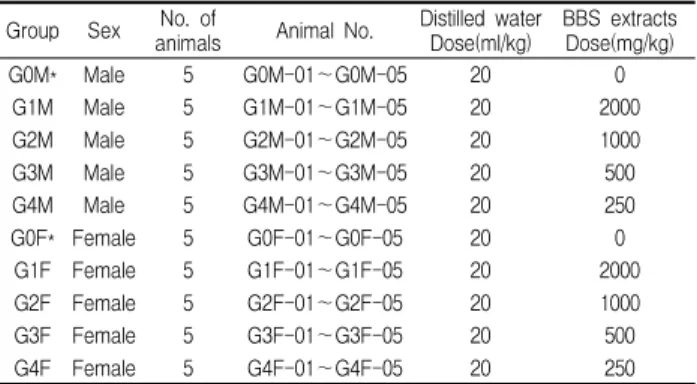
The animals were distributed into 10 groups 5 mice per group upon receipt. The highest dosage level was selected as 2000 mg/kg according to the recommendation of KFDA Guidelines4) and OECD Guidelines5,6). Therefore, the fixed dosage level was 2000, 1000, 500 and 250 mg/kg was selected using common ratio 2. In addition, a vehicle control group was added as listed in Table 2. Animal was once orally dosed using a sonde attached to a syringe of 1 ml after overnight fasting(about 18hrs, water was not restricted). Feed and water were restricted further for about 3hrs after dosing.
Table 2. Experimental Design Used in This Study Group Sex No. of
animals Animal No. Distilled water
Dose(ml/kg) BBS extracts Dose(mg/kg)
G0M* Male 5 G0M-01~G0M-05 20 0
G1M Male 5 G1M-01~G1M-05 20 2000
G2M Male 5 G2M-01~G2M-05 20 1000
G3M Male 5 G3M-01~G3M-05 20 500
G4M Male 5 G4M-01~G4M-05 20 250
G0F* Female 5 G0F-01~G0F-05 20 0
G1F Female 5 G1F-01~G1F-05 20 2000
G2F Female 5 G2F-01~G2F-05 20 1000
G3F Female 5 G3F-01~G3F-05 20 500
G4F Female 5 G4F-01~G4F-05 20 250
*Vehicle control; distilled water 20 ml/kg as vehicle in this study 4. Observation of Clinical Signs
All abnormal clinical signs and behaviors were recorded before and after dosing at least twice a day (morning(AM 10:00) and afternoon(PM 5:00)) based on the functional observational battery test7,8).
5. Changes of Body Weights
Body weights were measured at the day of dosing(Day 0) immediately before treatment, 1, 2, 7, 13 and 14 days after dosing. In addition, to reduce the erratum originated from
individual body weight differences of animals at initial dosing, body weight gains during Day 0~Day 7, Day 7~Day 13 and Day 0~Day 14 were also calculated based on measured body weight at each points.
6. Organ Weight
The absolute organ weight was measured and then relative organ weight(% of body weight) was calculated for the following organs of all experimental animals when they were sacrificed.
Measured organs : Lung, Heart, Kidney(left), Spleen, Testis(left), Liver, Pancreas(splenic lobes), Epididymis(left), Popliteal lymph node(left), Ovary(left), Brain, and Uterus.
7. Necropsy
All unscheduled died animals were grossly observed immediately after finding them and all survived animals were subjected to terminal necropsy. Animals were asphyxiated by ethyl ether(Ducsan pure chemical Co., Ltd., Korea) and gross necropsy was performed in all animals at 14 days after administration following overnight fasting(about 18hrs, water was not restricted).
Specific organs grossly observed : Lung, Heart, Kidney, Spleen, Testis, Liver, Pancreas, Epididymis, Popliteal lymph node, Ovary, Brain and Uterus.
8. Histopathology
Principal organs listed below were sampled at terminal necropsy, and fixed in 10% neutral buffered formalin. After 18hrs of fixation, paraffin embedding was conducted and 3~4
㎛ sections were prepared by routine histological methods.
Representative sections of each specified organ was stained with Hematoxylin & eosin for light microscopical examination.
Specific organs sampled : Lung, Heart, Kidney(left), Spleen, Testis(left), Liver, Pancreas(splenic lobes), Epididymis(left), Popliteal lymph node(left), Ovary(left), Brain and Uterus.
9. Statistical Analyses
Multiple comparison tests for different dose groups were conducted. Variance homogeneity was examined using the Levene test. If the Levene test indicated no significant deviations from variance homogeneity, the obtained data were analyzed by one way ANOVA test followed by Tukey HSD test to determine which pairs of group comparison were significantly different. In case of significant deviations from variance homogeneity were observed at Levene test, a non-parametric comparison test, the Mann-Whitney
U-Wilcoxon Rank Sum W test was conducted to determine the specific pairs of group comparison, which are significantly different. LD50 and 95% confidence limits were calculated by Probit method. Statistical analyses were conducted using SPSS for Windows(Release 6.1.3., SPSS Inc., USA) and a P value of less than 0.05 was considered to be a significant difference. In addition, degree of clinical signs, gross and histopathological findings were subdivided into 3 degrees: 3+ Severe, 2+
moderate, 1+ slight.
Results
1. Mortalities
No unscheduled or BSS aqueous-extract treat related mortalities were detected in all dose levels tested in this study.
At terminal, all of animals(5/5; 100%) were survived in all dose levels tested including vehicle control.
2. Clinical Signs
In this study, no BSS aqueous-extracts treatment related abnormal clinical signs were observed during observation periods regardless of male and female mice.
3. Changes on Body Weights and Gains
No meaningful changes on body weight and gains were detected in all dosing groups(Table 3).
Table 3. Body Weight Gains in Female and Male Mice After Once Orally Dose of BSS Aqueous-Extract
Group ID* Interval
Day 0**~Day 7 Day 7~Day 13 Day 0~Day 14
Male
G0M 4.42±1.89 3.72±0.36 5.10±1.81
G1M 4.88±0.65 3.88±0.48 5.18±0.59
G2M 4.36±1.04 3.56±1.11 4.86±1.59
G3M 4.18±1.58 3.72±1.25 4.92±1.72
G4M 4.14±1.48 3.92±0.43 4.62±1.34
Female
G0F 4.78±1.26 1.64±0.87 4.36±0.72
G1F 4.44±1.06 1.80±0.41 4.32±0.72
G2F 6.36±0.36 2.34±0.65 6.58±0.37
G3F 4.94±0.86 1.58±0.40 4.32±1.38
G4F 4.02±1.39 2.00±0.69 3.62±2.06
*Group ID was listed in Table 2; **Day of dosing.
4. Changes on the Organ Weight
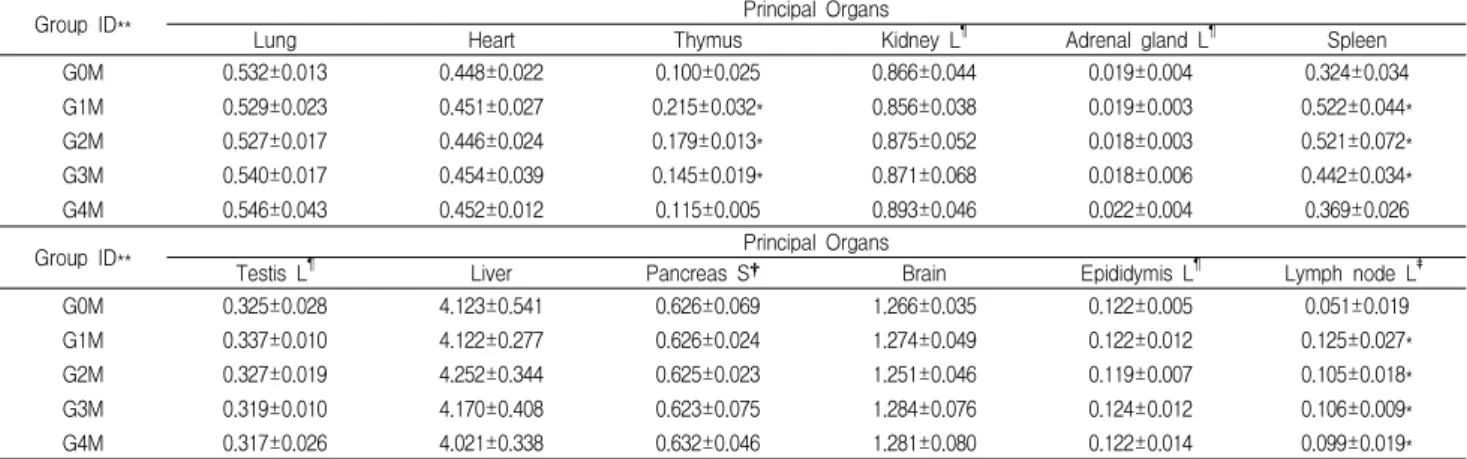
No meaningful changes on the absolute and relative organ weight of 12 principal organs were observed in all dosing groups(Table 4-7).
5. Necropsy Findings
No meaningful changes on the gross findings of 12 principal organs were observed in all dosing groups tested
comparing to that of vehicle control except for hypertrophy of lymphatic organs, thymus, spleen and popliteal lymph nodes and some accidental findings such as congestion spots of lung, atrophy of thymus and spleen, cyst in kidney. Accidental findings detected in the present study were randomly detected
Table 4. Changes on the Absolute Organ Weights Observed in Male Mice After Once Orally Dose of BSS Aqueous-Extract
Group ID¶ Principal Organs
Lung Heart Thymus Kidney L† Adrenal gland L† Spleen
G0M 0.196±0.005 0.166±0.008 0.037±0.009 0.320±0.017 0.007±0.002 0.120±0.012
G1M 0.195±0.006 0.166±0.007 0.076±0.014** 0.321±0.022 0.007±0.002 0.200±0.018**
G2M 0.195±0.005 0.166±0.011 0.064±0.007** 0.318±0.018 0.007±0.001 0.186±0.031**
G3M 0.196±0.016 0.167±0.006 0.051±0.006* 0.314±0.016 0.007±0.002 0.157±0.020**
G4M 0.202±0.013 0.167±0.004 0.042±0.002 0.322±0.019 0.008±0.002 0.134±0.009
Group ID¶ Principal Organs
Testis L† Liver Pancreas S‡ Brain Epididymis L† Lymph node L∮
G0M 0.120±0.010 1.522±0.189 0.231±0.027 0.468±0.014 0.045±0.001 0.019±0.007
G1M 0.122±0.005 1.512±0.073 0.230±0.011 0.467±0.009 0.045±0.004 0.046±0.010**
G2M 0.118±0.009 1.561±0.122 0.233±0.010 0.462±0.015 0.045±0.004 0.039±0.006**
G3M 0.118±0.010 1.519±0.055 0.227±0.018 0.463±0.027 0.044±0.003 0.038±0.003**
G4M 0.119±0.009 1.474±0.143 0.227±0.013 0.474±0.026 0.044±0.004 0.035±0.008*
*p<0.05 compared to that of vehicle control(G0M); **p<0.01 compared to that of vehicle control(G0M); ¶Group ID was listed in Table 2.; †L is left sides; ‡S is splenic lobes; ∮L is Popliteal lymph node.
Table 5. Changes on the Absolute Organ Weights Observed in Female Mice After Once Orally Dose of BSS Aqueous-Extract
Group ID¶ Principal Organs
Lung Heart Thymus Kidney L† Adrenal gland L† Spleen
G0F 0.174±0.008 0.143±0.010 0.076±0.015 0.198±0.016 0.009±0.002 0.130±0.013
G1F 0.175±0.010 0.142±0.006 0.116±0.008** 0.194±0.011 0.009±0.002 0.171±0.018**
G2F 0.175±0.012 0.148±0.003 0.104±0.009** 0.220±0.006* 0.008±0.003 0.163±0.014**
G3F 0.176±0.010 0.144±0.004 0.103±0.013** 0.196±0.025 0.008±0.001 0.155±0.009
G4F 0.174±0.008 0.140±0.008 0.085±0.010 0.196±0.011 0.008±0.002 0.143±0.010
Group ID¶ Principal Organs
Ovary L† Liver Pancreas S‡ Brain Uterus Lymph node L∮
G0F 0.035±0.010 1.262±0.127 0.187±0.027 0.464±0.024 0.213±0.090 0.020±0.003
G1F 0.031±0.009 1.279±0.143 0.185±0.011 0.466±0.015 0.176±0.041 0.066±0.014**
G2F 0.045±0.012 1.363±0.144 0.230±0.015** 0.476±0.016 0.298±0.040 0.053±0.016**
G3F 0.036±0.008 1.290±0.055 0.188±0.013 0.463±0.018 0.225±0.104 0.042±0.004*
G4F 0.034±0.013 1.264±0.112 0.189±0.010 0.463±0.020 0.197±0.102 0.040±0.005*
*p<0.05 compared to that of vehicle control(G0F); **p<0.01 compared to that of vehicle control(G0F); ¶Group ID was listed in Table 2.; †L is left sides; ‡S is splenic lobes; ∮L is Popliteal lymph node.
Table 6. Changes on the Relative Organ Weights Observed in Male Mice After Once Orally Dose of BSS Aqueous-Extract
Group ID** Principal Organs
Lung Heart Thymus Kidney L¶ Adrenal gland L¶ Spleen
G0M 0.532±0.013 0.448±0.022 0.100±0.025 0.866±0.044 0.019±0.004 0.324±0.034
G1M 0.529±0.023 0.451±0.027 0.215±0.032* 0.856±0.038 0.019±0.003 0.522±0.044*
G2M 0.527±0.017 0.446±0.024 0.179±0.013* 0.875±0.052 0.018±0.003 0.521±0.072*
G3M 0.540±0.017 0.454±0.039 0.145±0.019* 0.871±0.068 0.018±0.006 0.442±0.034*
G4M 0.546±0.043 0.452±0.012 0.115±0.005 0.893±0.046 0.022±0.004 0.369±0.026
Group ID** Principal Organs
Testis L¶ Liver Pancreas S† Brain Epididymis L¶ Lymph node L‡
G0M 0.325±0.028 4.123±0.541 0.626±0.069 1.266±0.035 0.122±0.005 0.051±0.019
G1M 0.337±0.010 4.122±0.277 0.626±0.024 1.274±0.049 0.122±0.012 0.125±0.027*
G2M 0.327±0.019 4.252±0.344 0.625±0.023 1.251±0.046 0.119±0.007 0.105±0.018*
G3M 0.319±0.010 4.170±0.408 0.623±0.075 1.284±0.076 0.124±0.012 0.106±0.009*
G4M 0.317±0.026 4.021±0.338 0.632±0.046 1.281±0.080 0.122±0.014 0.099±0.019*
*p<0.01 compared to that of vehicle control(G0M); **Group ID was listed in Table 2.; ¶L is left sides; †S is splenic lobes; ‡L is Popliteal lymph node.
throughout the whole experimental groups including vehicle controls and most of these sporadic gross findings did not show dose-dependent frequencies encountered. The severities and frequencies of lymphoid organ hypertrophies showed clear BSS aqueous-extracts dose-dependencies(Table 8-9).
Table 7. Changes on the Relative Organ Weights Observed in Female Mice After Once Orally Dose of BSS Aqueous-Extract
Group ID¶ Principal Organs
Lung Heart Thymus Kidney L† Adrenal gland L† Spleen
G0F 0.587±0.028 0.481±0.029 0.255±0.047 0.665±0.044 0.030±0.006 0.437±0.042
G1F 0.575±0.023 0.475±0.018 0.393±0.027** 0.658±0.012 0.031±0.004 0.579±0.051**
G2F 0.540±0.050 0.461±0.010 0.328±0.025* 0.683±0.029 0.027±0.010 0.509±0.045
G3F 0.601±0.069 0.495±0.030 0.352±0.022** 0.656±0.104 0.027±0.003 0.527±0.038*
G4F 0.596±0.055 0.482±0.033 0.296±0.040 0.665±0.059 0.030±0.006 0.497±0.036
Group ID¶ Principal Organs
Ovary L† Liver Pancreas S‡ Brain Uterus Lymph node L∮
G0F 0.119±0.036 4.265±0.589 0.632±0.097 1.562±0.094 0.725±0.324 0.069±0.010
G1F 0.110±0.021 4.265±0.575 0.622±0.047 1.541±0.068 0.599±0.127 0.209±0.036**
G2F 0.139±0.035 4.237±0.475 0.716±0.050 1.478±0.062 0.904±0.114 0.171±0.043**
G3F 0.122±0.032 4.396±0.376 0.647±0.057 1.556±0.104 0.845±0.343 0.146±0.018**
G4F 0.106±0.038 4.301±0.579 0.637±0.032 1.588±0.155 0.721±0.332 0.139±0.011**
*p<0.05 compared to that of vehicle control(G0F); **p<0.01 compared to that of vehicle control(G0F); ¶Group ID was listed in Table 2.; †L is left sides; ‡S is splenic lobes; ∮L is Popliteal lymph node.
Table 8. Necropsy Findings Observed in Male Mice After Once Orally Dose of BSS Aqueous-Extract*
Group ID** Male
G0M G1M G2M G3M G4M
Lung Normal 3/5 4/5 4/5 4/5 5/5
Congestion 2/5 1/5 1/5 1/5 0/5
Heart Normal 5/5 5/5 5/5 5/5 5/5
Thymus
Normal 4/5 0/5 0/5 0/5 3/5
Atrophy 1/5 0/5 0/5 0/5 0/5
Hypertrophy 0/5 5/5 5/5 5/5 2/5
Kidney Normal 4/5 5/5 5/5 4/5 5/5
Cyst 1/5 0/5 0/5 1/5 0/5
Adrenal gland Normal 5/5 5/5 5/5 5/5 5/5
Spleen
Normal 4/5 0/5 2/5 2/5 4/5
Atrophy 1/5 0/5 0/5 0/5 0/5
Hypertrophy 0/5 5/5 3/5 3/5 1/5
Testis Normal 5/5 5/5 5/5 5/5 5/5
Liver Normal 5/5 5/5 5/5 5/5 5/5
Pancreas Normal 5/5 5/5 5/5 5/5 5/5
Brain Normal 5/5 5/5 5/5 5/5 5/5
Epididymis Normal 5/5 5/5 5/5 5/5 5/5
Lymph node¶ Normal 4/5 0/5 0/5 0/5 0/5
Hypertrophy 1/5 5/5 5/5 5/5 5/5
*Observed animals/total observed animals(n=5); **Group ID was listed in Table 2.; ¶Bilateral popliteal lymph node.
Table 9. Necropsy Findings Observed in Female Mice After Once Orally Dose of BSS Aqueous-Extract*
Group ID** Female
G0F G1F G2F G3F G4F
Lung Normal 3/5 3/5 3/5 3/5 3/5
Congestion 2/5 2/5 2/5 2/5 2/5
Heart Normal 5/5 5/5 5/5 5/5 5/5
5/5 0/5 0/5 0/5 3/5
Thymus Normal
0/5 5/5 5/5 5/5 2/5
Hypertrophy
5/5 5/5 5/5 5/5 4/5
Kidney Normal
0/5 0/5 0/5 0/5 1/5
Cyst
5/5 5/5 5/5 5/5 5/5
Adrenal gland Normal
4/5 0/5 0/5 0/5 3/5
Spleen
Normal
1/5 0/5 0/5 0/5 0/5
Atrophy
0/5 5/5 5/5 5/5 2/5
Hypertrophy
5/5 5/5 5/5 5/5 5/5
Ovary Normal
5/5 5/5 5/5 5/5 5/5
Liver Normal
5/5 5/5 5/5 5/5 5/5
Pancreas Normal
5/5 5/5 5/5 5/5 5/5
Brain Normal
2/5 3/5 0/5 2/5 3/5
Uterus Normal
3/5 2/5 5/5 3/5 2/5
Edema
5/5 0/5 0/5 0/5 0/5
Lymph node¶ Normal
0/5 5/5 5/5 5/5 5/5
Hypertrophy
*Observed animals/total observed animals(n=5); **Group ID was listed in Table 2.; ¶Bilateral popliteal lymph node.
Table 10. Histopathological Findings Observed in Male Mice After Once Orally Dose of BSS Aqueous-Extract*
Group ID** Male
G0M G1M G2M G3M G4M
Lung Normal 4/5 4/5 4/5 4/5 4/5
Congestion 1/5 1/5 1/5 1/5 1/5
Heart Normal 5/5 5/5 5/5 5/5 5/5
Thymus
Normal 4/5 0/5 0/5 0/5 3/5
DP¶in cortex 1/5 0/5 0/5 0/5 0/5 HP¶in cortex 0/5 5/5 5/5 5/5 2/5
Kidney Normal 4/5 5/5 5/5 4/5 5/5
Cyst 1/5 0/5 0/5 1/5 0/5
Adrenal gland left Normal 5/5 5/5 5/5 5/5 5/5 Spleen
Normal 4/5 0/5 2/5 2/5 4/5
DP¶in red pulps 1/5 0/5 0/5 0/5 0/5 HP¶in red pulps 0/5 5/5 3/5 3/5 1/5
Testis left Normal 5/5 5/5 5/5 5/5 5/5
Liver Normal 5/5 5/5 5/5 5/5 5/5
Pancreas splenic Normal 5/5 5/5 5/5 5/5 5/5
Brain Normal 5/5 5/5 5/5 5/5 5/5
Epididymis left Normal 5/5 5/5 5/5 5/5 5/5
Lymph node† Normal 4/5 0/5 0/5 0/5 0/5
HP¶in cortex 1/5 5/5 5/5 5/5 5/5
*Observed animals/total observed animals(n=5); **Group ID was listed in Table 2.;
¶Abbreviation of lesions DP: depletion of lymphoid cells, HP: Hyperplasia of lymphoid cells; †Left popliteal lymph node.
Table 11. Histopathological Findings Observed in Female Mice After Once Orally Dose of BSS Aqueous-Extract*
Group ID** Female
G0F G1F G2F G3F G4F
Lung Normal 4/5 4/5 4/5 4/5 3/5
Congestion 1/5 1/5 1/5 1/5 2/5
Heart Normal 5/5 5/5 5/5 5/5 5/5
Thymus Normal 5/5 0/5 0/5 0/5 3/5
HP¶in cortex 0/5 5/5 5/5 5/5 2/5
Kidney Normal 5/5 5/5 5/5 5/5 4/5
Cyst 0/5 0/5 0/5 0/5 1/5
Adrenal gland left Normal 5/5 5/5 5/5 5/5 5/5 Spleen
Normal 4/5 0/5 0/5 0/5 3/5
DP¶in red pulps 1/5 0/5 0/5 0/5 0/5 HP¶in red pulps 0/5 5/5 5/5 5/5 2/5
Ovary left Normal 5/5 5/5 5/5 5/5 5/5
Liver Normal 5/5 5/5 5/5 5/5 5/5
Pancreas splenic Normal 5/5 5/5 5/5 5/5 5/5
Brain Normal 5/5 5/5 5/5 5/5 5/5
Uterus Normal 2/5 3/5 5/5 2/5 3/5
DM¶ 3/5 2/5 0/5 3/5 2/5
Lymph node† Normal 5/5 0/5 0/5 0/5 0/5
HP¶in cortex 0/5 5/5 5/5 5/5 5/5
*Observed animals/total observed animals(n=5); **Group ID was listed in Table 2.;
¶Abbreviation of lesions DP: depletion of lymphoid cells, HP: Hyperplasia of lymphoid cells, DM: desquamation of mucosa; †Left popliteal lymph node.
6. Histopathological Findings
No meaningful changes on the histopathological findings of 12 principal organs were observed in all dosing groups tested comparing to that of vehicle control except for hyperplasia of lymphoid cells in all three lymphoid organs, thymus, spleen and popliteal lymph nodes and some sporadic accidental findings such as hypertrophy of lung alveolus wall, congestion, depletion of lymphoid cells in the cortex of thymus, cyst formation in kidney, depletion of lymphoid cells
in the red pulps of spleen, desquamation of uterus mucosa.
Sporadic accidental findings were randomly detected throughout the whole experimental groups including vehicle controls, and most of these sporadic histopathological findings did not show dose-dependent frequencies encountered. The severities and frequencies of hyperplasia of lymphoid cells in all three lymphoid organs showed clear BSS aqueous-extracts dose-dependencies(Table 10-11).
Discussion
In the present study, we investigated the acute toxicity of single oral dose with lyophilized aqueous extract BSS, a mixed herbal formula consisted of 11 types of herbal medicines to female and male mice as a part of the safety test. In order to observe the LD50, ALD, MTD and target organs, test articles were once orally administered to female and male ICR mice at dose levels of 2000, 1000, 500, 250 and 0(control)mg/kg(body wt.) according to the recommendation of KFDA Guidelines4). The mortality and changes on body weight, clinical signs and gross observation were monitored for 14 days after dosing according to KFDA Guidelines4) with organ weight and histopathology of 12 types of principal organs.
Since Binso-san was commented in 'Yan's Prescriptions for Rescuing Lives(嚴氏濟生方)' of Yan Yonghe(嚴用和), the physician in the era of Song Emperor(宋代), many physicians have adopted it to treat beriberi disease. In this study, the prescription of Binso-san was according to 'Treasured Mirror of Eastern Medicine(東醫寶鑑)9), of Heo Joon(許浚) and it was also based on the book 'Introduction to Medicine(醫學入門)10), of Li Chan(李梴). The medicine was from Hyangso-san(香蘇 散), but was added Arecae Semen, Ostericii Rhizoma, Achyranthis Bidentatae Radix, Chaenomelis Fructus and was eliminated erilla Folium. Generally Hyangso-san is aimed for curing wind-cold dampness(風寒濕), qi stagnation(氣滯) and at the same time it can remove wind and dampness(風濕) by Atractylodis Rhizoma, Ostericii Rhizoma. With Achyranthis Bidentatae Radix, Chaenomelis Fructus, it can treat lower energizer weakness(下元虛弱) and Arecae Semen, Chaenomelis Fructus works on asthmatic chest discomfort. So that's why this medicine is common prescription for the lower limbs disease11).
Traditional herbal medicine, Binso-san(BSS) consists of 11 types of medicinal herbs-Atractylodis Rhizoma(Atractylodes japonica KOIDZ), Cyperi Rhizoma(Cyperus rotundus LINNE), Perilla Folium(Perilla frutescens(L.) BRITT), Fraxini Cortex(Fraxinus rhynchophylla HANCE), Chaenomelis Fructus(Chaenomeles sinensis KOEHNE), Arecae Semen(Areca
catechu LINNE), Ostericii Rhizoma(Ostericum koreanum Maxim KITAGAWA), Achyranthis Bidentatae Radix(Achyranthes bidentata BL), Glycyrrhizae Radix(Glycyrrhiza uralensis FISCH), Allii Radix(Allium fistulosum LINNE), Zingiberis Rhizoma Recen(Zingiber officinale ROSC), and has been used as anti-inflammatory agent including various arthritis. Various pharmacological effects of individual herbal components of BSS have been numerously studied. Among them, triterpene one components of Cyperi Rhizoma inhibited carragenin-induced acute inflammation12), luteolin in Perilla Folium has been showed anti-inflammatory activities13), rosmarinic acid and apigenin diglucuronide in Perilla Folium showed anti-allergic activities14), hesperidin in Fraxini Cortex inhibits histamine-induced inflammation15), glucosides extracted from Chaenomelis Fructus inhibited various inflammatory cytokines in collagen16) and Freund's complete adjuvant(FCA)17) induced arthritis, crude extracts or phenethyl ferulate and falcarinidiol18) and notopterol19) in Ostericii Rhizoma has been showed anti-inflammatory activities, Achyranthis Bidentatae Radix extracts have anti-inflammatory activities20), 18α-glycyrrhetinic acid in Glycyrrhizae Radix also showed anti-inflammatory effects21), and Zingiberis Rhizoma Recen extracts inhibited prostaglandin biosynthesis and showed anti-inflammatory activities22).
As the results, we could not find any mortality, clinical signs and changes in the body weights except for dose-independent increases of body weight and gains restricted in 1000 mg/kg of BSS extracts-dosing female group.
Hypertrophic changes of lymphoid organs thymus, spleen and popliteal lymph nodes were detected at postmortem observation with BSS extracts dose-dependent increases of lymphoid organ weights, and hyperplasia of lymphoid cells in these all three lymphoid organs at histopathological observations. These changes are considered as results of pharmacological effects of BSS extracts or their components, immunomodulating effects, not toxicological signs. In addition, some sporadic accidental findings such as congestion spots, cyst formation in kidney, atrophy of thymus and spleen with depletion of lymphoid cells, and edematous changes of uterus with desquamation of uterus mucosa as estrus cycles were detected throughout the whole experimental groups including both male and female vehicle controls. The significant(p<0.01) increases of absolute weights of kidney and pancreas detected in BSS extracts 1000 mg/kg-treated female group are considered as secondary changes from increases of body weights.
A significant(p<0.05) increases of body weight and increase trends in body weight gains during all three detecting
points detected in 1000 mg/kg of BSS aqueous-extracts dosing female group was considered as not meaningful changes, because no changes were detected in same dose of female group and they did not show any dose-dependencies. In addition, the body weight detected in this group was also well corresponded to the body weight ranges of same aged normal mice as previously23,24).
In KFDA Guidelines4) and OECD Guidelines5,6), the recommended highest dose of test materials was 2000 mg/kg or the maximum solubility, and they also recommended that in case of acute toxicity in mice, the dosage volume was below 20 ml/kg. In the present study, the highest dose of BSS aqueous-extracts was selected as 2000 mg/kg because BSS aqueous-extracts have been used as folk medicine and ingredients of medicinal food for a long time and no revealed toxicological data were available, and dosed in a volume of 20 ml/kg, base on the recommendation of KFDA Guidelines4)and OECD Guidelines5,6).
Hypertrophic changes of lymphoid organs thymus, spleen and popliteal lymph nodes detected at postmortem observation with BSS extracts dose-dependent increases of lymphoid organ weights, and hyperplasia of lymphoid cells at histopathological observations, were considered as a result of enhancement of immune system, not toxicological signs related to the BSS aqueous-extracts dosing. In generally, the hyperplasia of lymphoid cells and follicles was observed after agents having the enhance effects on the immune systems25), and among 11 types of BSS components, Achyranthis Bidentatae Radixhas been showed immune enhancement in animals26-29). Enhanced animals their immune system showed increases of the weights of spleen or lymphatic organs30,31).
Significant(p<0.01) increases of absolute weights of kidney and pancreas detected in BSS aqueous-extract 1000 mg/kg-dosing female group were also considered as not BSS aqueous-extracts treatment related changes because they did not show dose-dependency with no changes on the histopathological profiles, and these changes were considered as secondary changes from body weight increase detected in this group only. The relative weights of these organs were not changed as compared with that of vehicle control.
Congestion spots of lung, atrophy of thymus and spleen, cyst in kidney detected as gross findings, and hypertrophy of lung alveolus wall as congestion, depletion of lymphoid cells in the cortex of thymus, cyst formation in kidney, depletion of lymphoid cells in the red pulps of spleen, desquamation of uterus mucosa detected as histopathological findings were considered as accidental findings and they were not considered as BSS aqueous-extracts treatment related abnormal gross or
histopathological findings because they were restricted in some individual animals and most of them, also observed in male and female vehicle controls. In addition, most of them were rarely observed in normal mice24,32).
Although the Hodge and Sterner33) classified non toxic materials by LD50 5000~15000 mg/kg and US Environmental Protection Agency34) classified relatively low toxic(Class III) materials by LD50500~5000 mg/kg, recent Notified Guidelines by KFDA Guidelines4)and OECD Guidelines5,6)recommend that the highest oral dose of test materials is 2000 mg/kg. The LD50
and ALD in mice after single oral dose of BSS aqueous-extracts were detected over 2000 mg/kg in both male and female in the present study. Therefore, oral gavage of BSS aqueous-extracts caused no serious toxic effect to the male and female mice upto 2000 mg/kg the highest dosage tested in this study.
Conclusion
The results obtained in this study suggest that the BSS extract is non-toxic in mice and is therefore likely to be safe for clinical use. The LD50and ALD of BSS aqueous-extracts in both female and male mice were considered as over 2000 mg/kg because no mortalities were detected upto 2000 mg/kg that was the highest dose recommended by KFDA and OECD.
In addition, the MTD of BSS extracts was also considered as over 2000 mg/kg because no BSS extracts-treatment related toxicological signs were detected at histopathological observation except for BSS or their component-related pharmacological effects, the immunomodulating effects detected in the present study.
References
1. Lee, J.E., Kim, H.J., Choi, E.K., Chai, H.Y., Yun, Y.W., Kim, D.J., Nam, S.Y., Lee, B.J., Ahn, B.W., Kang, H.G., Kim, Y.B.
Four-week repeated-dose toxicity study on Pinellia Extract.
Korean J Lab Anim Sci. 19: 127-141, 2003.
2. Ramprasath, V.R., Shanthi, P., Sachdanandam, P.
Evaluation of antioxidant effect of Semecarpus anacardium Linn. nut extract on the components of immune system in adjuvant arthritis. Vascul Pharmacol. 42: 179-186, 2005.
3. Park, W.D., Ahn, D.K. Study on the analgesic and anti-inflammatory effects of "Bingso-San "and "
Kamibingso-San ". Korean J Pharmacog. 14: 24-29, 1983.
4. Korea Food and Drug Administration. Testing Guidelines for Safety Evaluation of Drugs(Notification No. 2005-2060, issued by the Korea Food and Drug Administration on October 21, 2005), 2005.
5. Organization for Economic Co-Operation and Development (Ed.). OECD guideline(401) for testing of chemicals, acute oral toxicity(deleted 2002). 1987.
6. Organization for Economic Co-Operation and Development (Ed.). OECD guideline(423) for testing of chemicals acute oral toxicity-acute toxic class method. 2001.
7. Irwin, S. Comprehensive observational assessment: Ia. A systemic, quantitative procedure for assessing the behavioral and physiological state of the mouse.
Psychopharmacology 13: 222-257, 1968.
8. Dourish, C.T. Effects of drugs on spontaneous motor activity. In Experimental Psychopharmacology(Greenshaw AJ and Dourish CT, Eds). Humana Press, Clifton. pp 325-334, 1987.
9. Heo Jun. The Presious Mirror of Oriental Medicine. Seoul, Beobin culture Co. pp 778-780, 1999.
10. Li Chan. Elementary Course for Medicine. Seoul, Namsandang, p 392, 1988.
11. Yun Gil Yeong. Clinical Prescriptionology in Oriental Medicine. Seoul, Hanseong Co, p 155, 2002.
12. Zhu, Y.P. Chinese Materia Medica Chemistry, Pharmacology and Applications. Harwood Academic Publisher. The Netherlands, pp 384-386, 1988.
13. Ueda, H., Yamazaki, C., Yamazaki, M. Luteolin as an anti-inflammatory and anti-allergic constituent of Perilla frutescens. Biol Pharm Bull. 25: 1197-1202, 2002.
14. Makino, T., Furuta, A., Fujii, H., Nakagawa, T., Wakushima, H., Saito, K., Kano, Y. Effect of oral treatment of Perilla frutescens and its constituents on type-I allergy in mice. Biol Pharm Bull. 24: 1206-1209, 2001.
15. Lee, N.K., Choi, S.H., Park, S.H., Park, E.K., Kim, D.H.
Antiallergic activity of hesperidin is activated by intestinal microflora. Pharmacology 71: 174-180, 2004.
16. Chen, Q., Wei, W. Effects and mechanisms of glucosides of Chaenomeles speciosa on collagen-induced arthritis in rats.
Int Immunopharmacol. 3: 593-608, 2003.
17. Dai, M., Wei, W., Shen, Y.X., Zheng, Y.Q. Glucosides of Chaenomeles speciosa remit rat adjuvant arthritis by inhibiting synoviocyte activities. Acta Pharmacol Sin. 24:
1161-1166, 2003.
18. Zschocke, S., Lehner, M., Bauer, R. 5-Lipoxygenase and cyclooxygenase inhibitory active constituents from Qianghuo(Notopterygium incisum). Planta Med. 63:
203-206, 1997.
19. Okuyama, E., Nishimura, S., Ohmori, S., Ozaki, Y., Satake, M., Yamazaki, M. Analgesic component of Notopterygium incisum Ting. Chem Pharm Bull(Tokyo), 41: 926-929, 1993.
20. Lu, T., Mao, C., Zhang, L., Xu, W. The research on
analgesic and anti-inflammatory action of different processed products of Achyranthes bidentata. Zhong Yao Cai. 20: 507-509, 1997.
21. Amagaya, S., Sugishita, E., Ogihara, Y., Ogawa, S., Okada, K., Aizawa, T. Comparative studies of the stereoisomers of glycyrrhetinic acid on anti-inflammatory activities. J Pharmacobiodyn. 7: 923-928, 1984.
22. Kiuchi, F., Shibuya, M., Sankawa, U. Inhibitors of prostaglandin biosynthesis from ginger. Chem Pharm Bull(Tokyo), 30: 754-757, 1982.
23. Plata, E.J., Murphy, W.H. Growth and haematologic properties of the BALB/wm strain of inbred mice. Lab Anim Sci. 22: 712-720, 1972.
24. Yamaguchi, C., Fujita, S., Obara, T., Ueda, T. Effects of room temperature on reproduction, body weight and organ weights, food and water intakes, and hematology in mice. Exp Anim. 32: 1-11, 1983.
25. Lee, J.H., Yang, K.J., Shin, H.D., Park, B.R., Son, C.W., Jang, H.J., Park, D.C., Lee, H.S., Ku, S.K. Single subcutaneous dose toxicity of Polycan®, a β-Glucan originated from Aureobasidium in mice. Lab Anim Res. 21: 299-305, 2005.
26. Xiang, D.B., Li, X.Y. Antitumor activity and immuno-potentiating actions of Achyranthes bidentata polysaccharides. Zhongguo Yao Li Xue Bao. a14: 556-561, 1993.
27. Xiang, D.B., Li, X.Y. Effects of Achyranthes bidentata
polysaccharides on interleukin-1 and tumor necrosis factor-alpha production from mouse peritoneal macrophages. Zhongguo Yao Li Xue Bao. b14: 332-336, 1993.
28. Yu, S., Zhang, Y. Effect of Achyranthes bidentata polysaccharides(ABP) on antitumor activity and immune function of S180-bearing mice. Zhonghua Zhong Liu Za Zhi. 17: 275-278, 1995.
29. Li, Z.K., Li, D.D. The immunomodulatory effect of Achyranthes bidentata polysaccharides. Yao Xue Xue Bao.
32: 881-887, 1997.
30. Klein, H.O., Kreysch, H.G., Coerper, C., Voigt, P., Ruff, I.
Preclinical and early clinical trial with mafosfamide as immune modulator. Methods Find Exp Clin Pharmacol. pp 9627-9640, 1987.
31. Iqbal, M.P., Sultana, F., Mehboobali, N., Pervez, S. Folinic acid protects against suppression of growth by methotrexate in mice. Biopharm Drug Dispos. 22: 169-178, 2001.
32. Lee, H.S., Lee, I.G., Ku, S.K. Single oral dose toxicity study of water extracts of Picrorrhiza Rhizoma in mice. J Toxicol Pub Health. 22: 117-126, 2006.
33. Hodge, H.C., Sterner, J.H. Tabulation of toxicity classes.
Am Ind Hyg Q. 10: 93, 1949.
34. U.S. Environmental Protection Agency. Health Effects Test Guidelines OPPTS 870.100, Acute Toxicity Testing Background. US EPA August, Washington, USA, 1998.