․Correspondence to : Kyung-min Baek 136, Sincheondong-ro, Suseong-gu, Daegu, Korea
Dept. of Oriental Internal Medicine, Daegu Hanny University, Daegu Oriental Hospital TEL: 053-770-2133
E-mail: [email protected]
․이 논문은 2014년도 대구한의대학 대학원 한의학 석사학위 논문임.
Mouse Single Oral Dose Toxicity Test of Chongmyung-tang Aqueous Extracts
Ha-yeon Hwang, Woo-seok Jang, Kyung-min Baek
Dept. of Oriental Internal Medicine, Daegu Hanny University, Daegu Oriental Hospital
Mouse Single Oral Dose Toxicity Test of Chongmyung-tang Aqueous Extracts
Ha-yeon Hwang, Woo-seok Jang, Kyung-min Baek
Dept. of Oriental Internal Medicine, Daegu Hanny University, Daegu Oriental Hospital
ABSTRACT
Objectives & Methods :
The objective of this study was to evaluate the single oral dose toxicity of Chongmyung-tang (CMT) in ICR mice. Korean traditional herbal prescription CMT has traditionally been used as a neuroprotective for treatment of learning disability and memory improvement. CMT, lyophilized aqueous extracts (yield=9.7%) were administered to female and male mice with oral dose of 2,000, 1,000 and 500 mg/kg (body weight) according to the recommendation of Korea Food and Drug Administration (KFDA) Guidelines. Animals were monitored for mortality, changes in body weight, clinical signs and gross observation during 14 days after administration upon necropsy; organ weight and histopathology of 14 principle organs were examined.
Results :
We could not find any CMT extracts treatment related mortalities, clinical signs, changes in body and organ weight, or gross and histopathological observations against 14 principle organs up to 2,000 mg/kg in both female and male mice, except for some accidental sporadic findings which did not show any obvious dose-relations and most of which also demonstrated in both the female and male vehicle control mice in this experiments.
Conclusions :
Based on the results of this experiment, the 50% lethal dose (LD
50) and approximate lethal dose (ALD) of CMT extracts after single oral treatment in female and male mice can be considered to be over 2,000 mg/kg, and is likely to be safe in humans.
Key words :
Chongmyung-tang, toxicity, mouse single oral dose toxicity
Ⅰ. Introduction
Chongmyung-tang (CMT) is a multi-herbal formula that has been used for the treatment of learning
and memory improvement
1. It has been used to treat forgetfulness from Zhongxingxianfang (種杏仙方) by Gongtingxian (龔廷賢), and it comprises of three kinds of herbs, Polygalae Radix, Acori gramineri Rhizoma, Hoelen cum Radix, same amount
2.
It has been demonstrated that CMT inhibits
TNF-α production by reducing TNF-α mRNA
expression
3and CMT has a neuroprotective effect
against kainic acid-induced neurotoxicities
4. Especially,
several preclinical studies have been demonstrated
that CMT has a potential to be effective agent to prevent and treat dementia
5because CMT suppressed the expression of IL-1β, IL-6, TNF-α, NOS-Ⅱ, COX-2 mRNA, production of IL-1β, IL-6, TNF-α, NO, ROS and increased the expression of IL-10, TGF-β1 mRNA in BV2 microglial cell line
1,6-8. Especially, Lee et al
1,8showed that CMT is useful for the improvement in cognition by controlling cholinergic marker enzyme activity, the antioxidant defense system and by inhibition of cholinesterases (ChEs) and promotion of antioxidant activity in AD. However, there are no detail reports dealing with the toxicological aspects of CMT, even basic single oral dose toxicity in rodents, upon our knowledge.
The objective of the present study, therefore, was to obtain the primary safety information about CMT, a famous traditional Korean polyherbal formula has been used for neuroprotective agents, aqueous extracts (yield=9.7%), and further clarify its safety for clinical use. In order to observe the 50%
lethal dose (LD
50) and approximate lethal dosage (ALD), test articles were once orally administered to female and male mice at dose levels of 2,000, 1,000 and 500 mg/kg (body weight) according to the recommendation of KFDA Guidelines
9. The mortality, changes in body weight, clinical signs and gross observation were monitored during 14 days after oral administration of CMT lyophilized aqueous extracts with organ weight and histopathological changes of principle organs.
Ⅱ. Materials & Methods
1. Animals and Husbandry
Each of twenty female and male SPF/VAF outbred CrljOri:CD1 (ICR) mice (6-wk old upon receipt, OrientBio, Sungnam, Korea) were used after
acclimatization for 10 days. Animals were allocated by five per polycarbonate cage in a temperature (20-25 ℃) and humidity (30-35%) controlled room.
Light : dark cycle was 12hours : 12hours and feed (Samyang, Korea) and water was supplied free to access. All animals were overnight fasted (about 18hours) before administration and terminal necropsy.
Animals were marked by picric acid. All animals were treated in accordance with the national regulations of the usage and welfare of laboratory animals, and approved by the Institutional Animal Care and Use Committee in Daegu Haany University (Gyeongsan, Gyeongbuk, Korea).
2. Test Article and Formulation
Individual 3 kinds of herbs consisting of CMT (Polygalae Radix, Acori gramineri Rhizoma and Hoelen cum Radix) were purchased from Jecheon Hanbang Yakcho (Jecheon, Korea) after confirming the morphology under microscopy. The 1:1:1 mixture of prepared 3 types of herbs (total 36 g) was boiled in 1 L of distilled water for 3 hours, 3 times at 80 ℃ and filtrated. The filtrate was decompressed using a rotary vacuum evaporator rotary (Buchi Rotavapor R144, Buchi Labortechnik AG, Switzland) and lyophilized in a programmable freeze dryer (Labconco Freezone1, Labconco Corp., MO, USA), respectively.
Total acquired CMT extracts were 3.49 g (yield 9.7%). Brown colored CMT extracts were stored in a refrigerator at 4 ℃ to protect from light and degeneration, and it is well soluble upto 100 mg/mL concentration levels in distilled water, used as vehicle as clear light brown solution in this experiment.
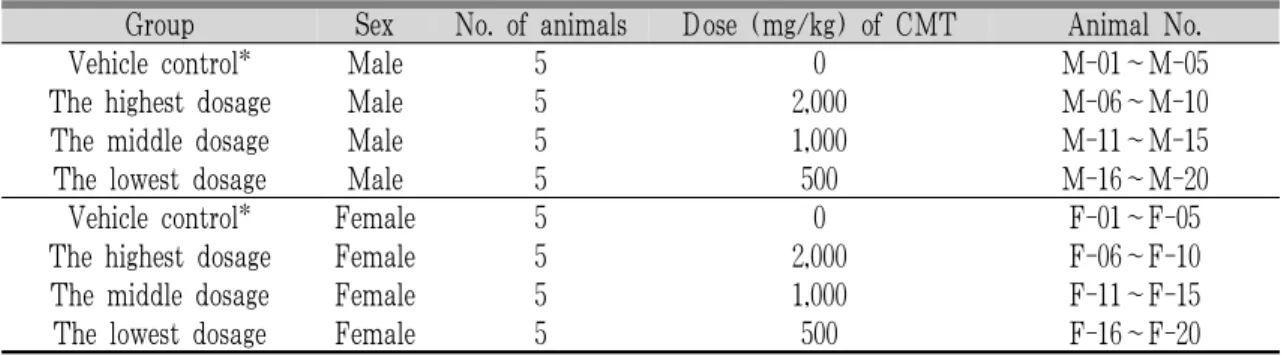
The test article was single orally administered at
a dosage volume of 20 mL/kg using distilled water
as vehicle at 2,000, 1,000 and 500 mg/kg dose levels
(Table 1).
3. Groupings and Administration
The animals were distributed into 8 groups, each group was allocated 5 mice per group upon receipt. The highest dosage level was selected as 2,000 mg/kg according to the recommended by KFDA Guidelines
7and OECD Guidelines (#423)
10, the limited dosages in rodents oral gavage, and
1,000 and 500 mg/kg was selected using common ratio 2. In addition, a vehicle control group was added (Table 1). Animal was once orally administered using a sonde attached to a syringe of 1 mL after overnight fasting (about 18 hours, water was not restricted). Feed and water were restricted further for about 3 hours after administration.
Group Sex No. of animals Dose (mg/kg) of CMT Animal No.
Vehicle control* Male 5 0 M-01~M-05
The highest dosage Male 5 2,000 M-06~M-10
The middle dosage Male 5 1,000 M-11~M-15
The lowest dosage Male 5 500 M-16~M-20
Vehicle control* Female 5 0 F-01~F-05
The highest dosage Female 5 2,000 F-06~F-10
The middle dosage Female 5 1,000 F-11~F-15
The lowest dosage Female 5 500 F-16~F-20
CMT : Chongmyung-tang
Table 1. Experimental Design Used in This Study – Mouse Single Oral Dose Toxicity Test of CMT Lyophilized Aqueous Extracts.
4. Observation of Clinical Signs
All abnormal clinical signs were recorded before and after dosing at least twice a day and afternoon based on the functional observational battery test
11. 5. Measurement of Body weight
Body weight were measured at the day of administration, oral gavage (Day 0) immediately before treatment, 1, 2, 7, 13 and 14 days after dosing. In addition, to reduce the differences from individual body weight of animals at initial of this experiment, the body weight gains during Day 0~Day 7, Day 7~Day 13 and Day 0~Day 13 was also calculated based on measured body weight at each points. Here Day 0 means the day of administration, just immediately before administration.
6. Necropsy
All unscheduled died animals were grossly observed immediately after finding them and all survived animals were subjected to terminal necropsy.
Animals were asphyxiated by ethyl ether (Ducsan pure chemical Co., Ltd., Korea) and gross necropsy was performed in all animals at Day 14 after overnight fasting (about 18 hours, water was not restricted). Specific organs grossly observed were lung, heart, thymus, adrenal gland, kidney, spleen, testis, liver, pancreas, epididymis, submandibular lymph node, ovary, brain, and uterus.
7. Measurement of Organ Weight
The absolute organ weight was measured and
then relative organ weight (% of body weight)
was calculated for the following organs of all
experimental animals when they were sacrificed.
Measured organs were lung, heart, thymus, kidney (left), spleen, adrenal gland (left), testis (left), liver, pancreas (splenic lobes), epididymis (left), submandibular lymph node (left), ovary (left), brain and uterus.
8. Histopathological changes
Principle organs listed below were sampled at terminal necropsy, and fixed in 10% NBF (neutral buffered formalin). After 18 hours of fixation, paraffin embedding was conducted and 3~4 μm sections were prepared by routine histological methods.
Representative sections of each specified organs were stained with hematoxylin & eosin for light microscopical examination according to previous established methods
12-15. Specific organs sampled were lung, heart, thymus, kidney (left), spleen, adrenal gland (left), testis (left), liver, pancreas (splenic lobes), epididymis (left), submandibular lymph node (left), ovary (left), brain, and uterus.
9. Statistical Analyses
All numerical data are presented as mean±SD of five mice, and multiple comparison tests for the different dose groups were conducted. Homogeneity of variance was examined using the Levene test
16. If the Levene test indicated no significant deviations from variance homogeneity, the obtain data were analyzed using a one way ANOVA test followed by least-significant differences multi-comparison (LSD) test to determine which pairs of group comparisons were significantly different. In the case where significant deviations from variance homogeneity were observed in the Levene test, a non-parametric comparison test, Kruskal-Wallis H test, were used. When a significant difference is observed in the Kruskal-Wallis H test, the Mann-
Whitney U (MW) test, was used to determine the specific pairs of group comparison that were significantly different
17. Statistical analyses were conducted using SPSS for Windows release 14.0K, (SPSS Inc., Chicago, IL, USA), and P-values<0.05 were considered significantly different. In addition, degree of clinical signs, gross and histopathological findings were subdivided into 3 degrees: 3+ severe, 2+ moderate, 1+ slight.
Ⅲ. Results
1. Mortalities
There were no unscheduled or CMT extract-treat related mortalities detected in all dose groups tested in this study, and accordingly all of animals (5/5;
100%) including both female, male and vehicle control mice were subjected to the terminal necropsy at 14 days after end of treatment in this study.
2. Clinical Signs
There were no CMT extracts treatment related to abnormal clinical signs observed during 14 days regardless of male or female mice.
3. Changes in Body weight
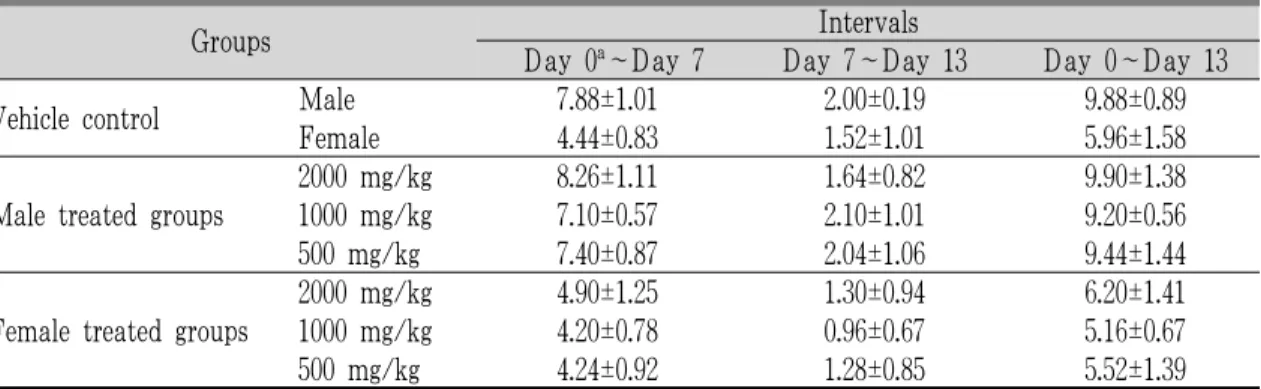
There were no significant changes in body weight detected in all dose groups tested in the present study as compared with equal gender of vehicle control mice, respectively (Table 2).
4. Changes in the Organ Weight
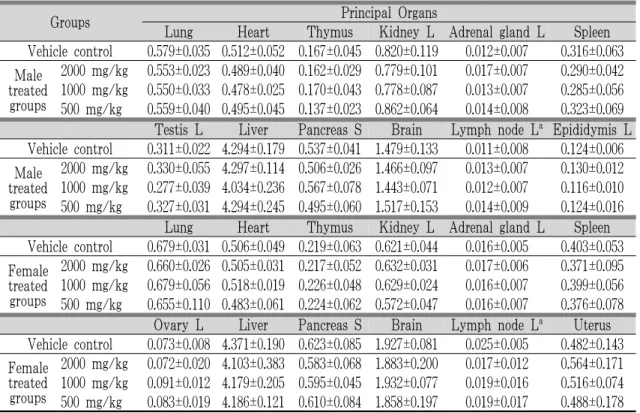
There were no meaningful changes in the absolute
and relative organ weight of 14 principle organs
observed in all CMT extracts treated female and
male mice as compared with each equal gender of
vehicle control, respectively (Table 3, 4).
Groups Intervals
Day 0
a~Day 7 Day 7~Day 13 Day 0~Day 13
Vehicle control Male 7.88±1.01 2.00±0.19 9.88±0.89
Female 4.44±0.83 1.52±1.01 5.96±1.58
Male treated groups
2000 mg/kg 8.26±1.11 1.64±0.82 9.90±1.38
1000 mg/kg 7.10±0.57 2.10±1.01 9.20±0.56
500 mg/kg 7.40±0.87 2.04±1.06 9.44±1.44
Female treated groups
2000 mg/kg 4.90±1.25 1.30±0.94 6.20±1.41
1000 mg/kg 4.20±0.78 0.96±0.67 5.16±0.67
500 mg/kg 4.24±0.92 1.28±0.85 5.52±1.39
Values are expressed as mean ± SD g of five mice.
CMT : Chongmyung-tang
a Day of treatment after overnight fasted
Table 2. Body Weight Changes in Female and Male Mice after Single Oral Treatment of CMT Lyophilized Aqueous Extracts.
Groups Principal organs
Lung Heart Thymus Kidney L Adrenal gland L Spleen Vehicle control 0.184±0.012 0.163±0.013 0.053±0.013 0.261±0.043 0.004±0.002 0.100±0.019
Male treated groups
2000 mg/kg 0.180±0.013 0.159±0.014 0.052±0.008 0.253±0.039 0.006±0.003 0.094±0.012 1000 mg/kg 0.182±0.011 0.158±0.010 0.056±0.014 0.257±0.031 0.004±0.002 0.094±0.017 500 mg/kg 0.178±0.008 0.158±0.014 0.043±0.005 0.276±0.025 0.005±0.003 0.103±0.017 Testis L Liver Pancreas S Brain Lymph node L
aEpididymis L Vehicle control 0.099±0.009 1.367±0.055 0.171±0.017 0.470±0.022 0.004±0.002 0.040±0.002
Male treated groups
2000 mg/kg 0.107±0.015 1.398±0.108 0.165±0.017 0.475±0.017 0.004±0.002 0.042±0.004 1000 mg/kg 0.091±0.012 1.333±0.091 0.187±0.025 0.477±0.029 0.004±0.002 0.038±0.004 500 mg/kg 0.105±0.011 1.374±0.104 0.158±0.020 0.483±0.026 0.004±0.003 0.039±0.002
Lung Heart Thymus Kidney L Adrenal gland L Spleen Vehicle control 0.169±0.011 0.125±0.005 0.055±0.018 0.154±0.004 0.004±0.001 0.100±0.015
Female treated groups
2000 mg/kg 0.166±0.013 0.126±0.007 0.055±0.017 0.159±0.010 0.004±0.002 0.095±0.031 1000 mg/kg 0.166±0.011 0.127±0.004 0.055±0.010 0.154±0.006 0.004±0.002 0.097±0.012 500 mg/kg 0.162±0.014 0.120±0.008 0.056±0.017 0.143±0.016 0.004±0.002 0.093±0.017
Ovary L Liver Pancreas S Brain Lymph node L
aUterus Vehicle control 0.018±0.002 1.087±0.071 0.154±0.011 0.479±0.019 0.006±0.001 0.118±0.027
Female treated groups
2000 mg/kg 0.018±0.006 1.039±0.190 0.148±0.027 0.470±0.013 0.004±0.003 0.141±0.041 1000 mg/kg 0.022±0.004 1.024±0.074 0.146±0.009 0.473±0.011 0.005±0.004 0.126±0.017 500 mg/kg 0.021±0.004 1.046±0.110 0.151±0.015 0.461±0.028 0.005±0.005 0.120±0.039
Values are expressed as mean ± SD of five mice, g.CMT : Chongmyung-tang L : left sides, S : splenic lobes
a Submandibular lymph node
Table 3. Changes in the Absolute Organ Weight Observed in Male and Female Mice after Single Oral
Treatment of CMT Lyophilized Aqueous Extracts.
Groups Principal Organs
Lung Heart Thymus Kidney L Adrenal gland L Spleen Vehicle control 0.579±0.035 0.512±0.052 0.167±0.045 0.820±0.119 0.012±0.007 0.316±0.063 Male
treated groups
2000 mg/kg 0.553±0.023 0.489±0.040 0.162±0.029 0.779±0.101 0.017±0.007 0.290±0.042 1000 mg/kg 0.550±0.033 0.478±0.025 0.170±0.043 0.778±0.087 0.013±0.007 0.285±0.056 500 mg/kg 0.559±0.040 0.495±0.045 0.137±0.023 0.862±0.064 0.014±0.008 0.323±0.069 Testis L Liver Pancreas S Brain Lymph node L
aEpididymis L Vehicle control 0.311±0.022 4.294±0.179 0.537±0.041 1.479±0.133 0.011±0.008 0.124±0.006 Male
treated groups
2000 mg/kg 0.330±0.055 4.297±0.114 0.506±0.026 1.466±0.097 0.013±0.007 0.130±0.012 1000 mg/kg 0.277±0.039 4.034±0.236 0.567±0.078 1.443±0.071 0.012±0.007 0.116±0.010 500 mg/kg 0.327±0.031 4.294±0.245 0.495±0.060 1.517±0.153 0.014±0.009 0.124±0.016
Lung Heart Thymus Kidney L Adrenal gland L Spleen Vehicle control 0.679±0.031 0.506±0.049 0.219±0.063 0.621±0.044 0.016±0.005 0.403±0.053 Female
treated groups
2000 mg/kg 0.660±0.026 0.505±0.031 0.217±0.052 0.632±0.031 0.017±0.006 0.371±0.095 1000 mg/kg 0.679±0.056 0.518±0.019 0.226±0.048 0.629±0.024 0.016±0.007 0.399±0.056 500 mg/kg 0.655±0.110 0.483±0.061 0.224±0.062 0.572±0.047 0.016±0.007 0.376±0.078
Ovary L Liver Pancreas S Brain Lymph node L
aUterus Vehicle control 0.073±0.008 4.371±0.190 0.623±0.085 1.927±0.081 0.025±0.005 0.482±0.143 Female
treated groups
2000 mg/kg 0.072±0.020 4.103±0.383 0.583±0.068 1.883±0.200 0.017±0.012 0.564±0.171 1000 mg/kg 0.091±0.012 4.179±0.205 0.595±0.045 1.932±0.077 0.019±0.016 0.516±0.074 500 mg/kg 0.083±0.019 4.186±0.121 0.610±0.084 1.858±0.197 0.019±0.017 0.488±0.178
Values are expressed as mean ± SD of five mice, % of body weight.CMT : Chongmyung-tang L : left sides, S : splenic lobes
a Submandibular lymph node
Table 4. Changes in the Relative Organ Weight Observed in Male and Female Mice after Single Oral Treatment of CMT Lyophilized Aqueous Extracts.
5. Necropsy Findings
There were no gross findings related with CMT extracts treatment in this study as compared with equal gender of vehicle control, except for some sporadic accidental findings such as slight (1+) congestion spots of lung, atrophy of thymus, spleen
atrophy or hypertrophy, submandibular lymph node
hypertrophy and edematous changes of uterus
sporadically detected throughout all experimental
groups tested in this study including both gender
of vehicle control, respectively (Table 5).
Groups Organs
-Findings
Vehicle control
Male treated groups (mg/kg)
Groups Organs
-Findings
Vehicle control
Female treated groups (mg/kg)
2000 1000 500 2000 1000 500
Lung Normal 4/5 4/5 5/5 4/5
Lung Normal 4/5 5/5 4/5 4/5
Congestion 1/5 1/5 0/5 1/5 Congestion 1/5 0/5 1/5 1/5
Heart Normal 5/5 5/5 5/5 5/5 Heart Normal 5/5 5/5 5/5 5/5
Thymus Normal 4/5 5/5 4/5 4/5
Thymus Normal 4/5 5/5 5/5 4/5
Atrophy 1/5 0/5 1/5 1/5 Atrophy 1/5 0/5 0/5 1/5
Kidney Normal 5/5 5/5 5/5 5/5 Kidney Normal 5/5 5/5 5/5 5/5
Adrenal gland Normal 5/5 5/5 5/5 5/5 Adrenal gland Normal 5/5 5/5 5/5 5/5
Spleen Normal 4/5 4/5 4/5 4/5
Spleen Normal 4/5 3/5 5/5 4/5
Hypertrophy 1/5 2/5 0/5 1/5
Atrophy 1/5 1/5 1/5 1/5
Testis Normal 5/5 5/5 5/5 5/5 Ovary Normal 5/5 5/5 5/5 5/5
Liver Normal 5/5 5/5 5/5 5/5 Liver Normal 5/5 5/5 5/5 5/5
Pancreas Normal 5/5 5/5 5/5 5/5 Pancreas Normal 5/5 5/5 5/5 5/5
Brain Normal 5/5 5/5 5/5 5/5 Brain Normal 5/5 5/5 5/5 5/5
Epididymis Normal 5/5 5/5 5/5 5/5 Uterus Normal 3/5 2/5 3/5 4/5
Edema 2/5 3/5 2/5 1/5
Lymph node
aNormal 4/5 5/5 4/5 5/5
Lymph node
aNormal 3/5 4/5 3/5 5/5 Hypertrophy 2/5 1/5 2/5 0/5 Hypertrophy 1/5 0/5 1/5 0/5
Others Normal 5/5 5/5 5/5 5/5 Others Normal 5/5 5/5 5/5 5/5
Values are expressed as observed animals/total observed animals of five mice.
CMT : Chongmyung-tang
a Bilateral submandibular lymph nodes.
Table 5. Necropsy Findings Observed in Male and Female Mice after Single Oral Treatment of CMT lyophilized aqueous extracts. Gross Findings at Sacrifice (Day 14).
6. Histopathological Findings
Threre were no microscopic findings related with CMT extracts treatment in this study at histopathological inspections as compared with equal gender of vehicle control, except for some sporadic accidental findings such as slight (1+) hypertrophy of lung alveolus wall with focal hemorrhage, hyperplasia of lymphoid
cells in the red pulp or decreases of white pulp
lymphoid cells in spleen, focal inflammatory cell
infiltration in the liver and diffused lymphoid cell
hyperplasia of submandibular lymph nodes were
sporadically detected throughout all experimental
groups tested in the present study including both
gender vehicle controls, respectively (Table 6).
Groups Organs
-Findings
Vehicle control
Male treated groups (mg/kg)
Groups Organs
-Findings
Vehicle control
Female treated groups (mg/kg)
2000 1000 500 2000 1000 500
Lung Normal 4/5 4/5 4/5 4/5
Lung Normal 4/5 5/5 4/5 4/5
Congestion 1/5 0/5 1/5 1/5 Congestion 1/5 1/5 1/5 1/5
Heart Normal 5/5 5/5 5/5 5/5 Heart Normal 5/5 5/5 5/5 5/5
Thymus Normal 5/5 5/5 5/5 5/5 Thymus Normal 5/5 5/5 5/5 5/5
Kidney Normal 5/5 5/5 5/5 5/5 Kidney Normal 5/5 5/5 5/5 5/5
Adrenal gland Normal 5/5 5/5 5/5 5/5 Adrenal gland Normal 5/5 5/5 5/5 5/5 Spleen
Normal 3/5 4/5 4/5 3/5
Spleen Normal 3/5 3/5 4/5 4/5
rHP
†1/5 1/5 1/5 1/5
rHP
†2/5 2/5 1/5 1/5
wDE
†1/5 0/5 0/5 1/5
Testis Normal 5/5 5/5 5/5 5/5 Ovary Normal 5/5 5/5 5/5 5/5
Liver Normal 5/5 5/5 4/5 5/5
Liver Normal 4/5 5/5 5/5 5/5
IF
†0/5 0/5 1/5 0/5 IF
†1/5 0/5 0/5 0/5
Pancreas Normal 5/5 5/5 5/5 5/5 Pancreas Normal 5/5 5/5 5/5 5/5
Brain Normal 5/5 5/5 5/5 5/5 Brain Normal 5/5 5/5 5/5 5/5
Epididymis Normal 5/5 5/5 5/5 5/5 Uterus Normal 5/5 5/5 5/5 5/5
Lymph node
aNormal 4/5 5/5 4/5 5/5
Lymph node
aNormal 3/5 3/5 4/5 5/5
HP
†2/5 2/5 1/5 0/5
HP
†1/5 0/5 1/5 0/5
Values are expressed as observed animals/total observed animals of five mice.
CMT : Chongmyung-tang
a Bilateral submandibular lymph nodes
†rHP : hyperplasia of lymphoid cells in the splenic red pulps, wDE : decreases of white pulp lymphoid cells, IF : focal inflammatory cell infiltration, HP : diffused hyperplasia of lymphoid cells
Table 6. Histopathological Findings Observed in Male and Female Mice after Single Oral Treatment of CMT Lyophilized Aqueous Extracts. Microscopical findings at sacrifice (Day 14).
Ⅳ. Discussion
CMT has been traditionally used for treatment of learning and memory improvement as a famous neuroprotective Korean traditional herbal prescription
1and it has been well-documented that CMT has a potential to be an effective agent to prevent and treat Alzheimer’s disease by controlling cholinergic marker enzyme activity and the antioxidant defense system
1,6-8. CMT is consisted of three kinds of herbs;
Polygalae Radix (Polygala tenuifolia Willd), Acori gramineri Rhizoma (Acorus gramineus Soland) and
Hoelen cum Radix (Poria cocos Wolf) and each of herbs
have various active ingredients. Polygalae Radix has
onjisaponin A-G, progenegenin, 3,4,5-trimethoxycinnamic
acid, polygalaxanthones, 1-carbobutoxy-β-carboline,
N9-formylharman, 1-carboethoxy-β-carboline, 1-
carbomethoxy-β-carboline, perlolyrine, harman, norharman
and some fatty acids including 87% oleic acid
18-20.
Acori Gramineri Rhizoma has α, β and γ-asarone,
sekisone, eugenol, caryophyllene and benzoic acid
phenylmethyl esyer
21,22. Hoelen cum Radix contains
β-1,3-glucan, pachyman, pachymic acid, polyporenic
acid, tumulosic acid, eburicoic acid, pinicolic acid,
ergosterol, lecithin, asnine, histidine and choline
23.
Although favorable effects of ChEs inhibiters on the Alzheimer have been suggested
24,25, but controversially, they also showed severe toxicities
26,27and have been used as insecticidal agent
25-27. Since the possibilities also suggested that CMT can be acted as ChEs inhibitors
1,8, the potent toxicity of CMT should be tested. However, there are no detailed toxicological assessment of CMT extracts has been trials even if mouse single oral dose toxicity test upon our knowledge. In the present study, therefore, single oral dose toxicity test of CMT lyophilized aqueous extracts (yield=9.7%) was conducted in mice to obtain the primary safety information and for further clarifies their safety for clinical use.
In KFDA Guidelines
7, the recommended highest dose of test materials were 2,000 mg/kg or the maximum solubility, and they also recommended that in case of single dose toxicity in mouse, the dosage volume were below 20 mL/kg
28. In the present study, the highest dosage was selected as 2,000 mg/kg in a volume of 20 mL/kg, the recommended oral dose volume in mice
28and the limited highest dosages recommended by KFDA Guidelines
7, and 1,000 and 500 mg/kg are selected using common ratio 2. In addition, each female and male vehicle control groups were added according to the KFDA Guidelines
7. Test material was orally administered using distilled water as vehicle in this study.
As results of this experiment, we could not find any CMT extracts treatment related mortalities, clinical signs, changes in the body and organ weight, gross and histopathological observations against 14 principle organs up to 2,000 mg/kg in both female and male mice, except for some accidental sporadic findings which did not show any obvious dose-relations and most of them also demonstrated in the both female and male vehicle
control mice in this experiments.
All animals including treated by 2,000 mg/kg female and male mice used in this study shows normal body weight and organ weight ranged in age-matched reference mice
29,30. In addition, there were no CMT extracts treatment related clinical signs also noticed in this study, upto 2,000 mg/kg in the both female and male mice, respectively.
The slight congestion spots of lung, atrophy of thymus, spleen atrophy or hypertrophy, submandibular lymph node hypertrophy and edematous changes of uterus detected in the present study as gross findings, and hypertrophy of lung alveolus wall with focal hemorrhage, hyperplasia of lymphoid cells in the red pulp or decreases of white pulp lymphoid cells in spleen, focal inflammatory cell infiltration in the liver and diffused lymphoid cell hyperplasia of submandibular lymph nodes detected as histopathological findings. But they were considered as accidental findings not toxicological signs related to the CMT extracts treatment because they were sporadically detected throughout most of all experimental groups tested in the present study including both genders of vehicle control. Especially, the edematous changes in uterus were considered as secondary changes from different physiological estrus cycles
31,32. In addition, most of them were also generally observed in normal mice
12-15.
Because there were no mortalities related with
CMT extracts treatment up to 2,000 mg/kg in
both male and female mice in the present study,
the LD
50and ALD of CMT extracts after single
oral treatment in female and male mice were
considered over 2,000 mg/kg, and is likely to be
safe in humans.
Ⅴ. Conclusion
1. There were no mortalities related with CMT extracts treatment.
2. There were no clinical signs, changes in the body and organ weight, or gross necropsy findings except for several accidental sporadic findings which did not show any obvious dose-relations.
3. There were no histopathological observations from 14 principle organs related to CMT extracts treatment.
Therefore, the LD
50and ALD of CMT extracts
after single oral treatment in female and male
mice were considered over 2,000 mg/kg, CMT
extracts is likely to be safe in humans.
聰明湯 熱水 추출물의 마우스 단회 경구투여 독성 실험
황하연, 장우석, 백경민
대구한의대학교 부속 대구한방병원 심계내과학교실
초 록
목적 및 방법 :
본 연구에서는 한의학에서 전통적으로 신경보호 약물로 사용되어온 총명탕 물 추출물의 급성 독성증상
을 관찰하기 위하여 한국식품의약품안전청 고시 제 2009-116호에 따라 암수 ICR마우스 단회 경구투여 독성 실험을 실시하였 다. 반수치사량, 개략적치사량, 표적장기 등을 관찰하기 위하여, 수율 9.70% 총명탕 물 추출물 2,000, 1,000 및 500 mg/kg을 암 수 마우스에 단회 경구 투여하고, 투여 후 14일 동안의 임상증상, 사망례, 체중 및 증체량의 변화 및 부검소견을 관찰하였으며, 투여 14일 후 14개 주요 실질 장기에 대한 중량 및 조직병리학적 관찰을 실시하였다. 또한 별도의 암수 매체 대조군을 두어 그 결과를 비교하였다.
결 과 :
본 실험의 결과, 설치류 최대 한계투여 용량인 2,000 mg/kg까지 총명탕 물 추출물 투여와 관련된 사망례가 인정되 지 않았으며, 암수 매체 대조군을 포함하여, 모든 실험군에 걸쳐 산발적으로 관찰된 일부 우발적인 육안부검 및 조직병리학적 소견을 제외하고, 총명탕 물 추출물 투여와 관련된 임상증상, 체중 및 장기 중량의 변화, 14개 주요장기에 대한 육안부검 및 조 직병리학적 소견이 인정되지 않았다.
결 론 :
따라서 마우스 단회 경구투여 독성실험에서 총명탕 물 추출물의 반수치사량 및 개략적 치사량은 각각 설치류 투
여 한계용량인 2,000 mg/kg 이상으로 관찰되어, 매우 안전한 약물로 판단되며, 임상사용에는 별 다른 문제를 일으키지는 않을 것으로 판단된다.
중심단어 :