Single Oral Dose Toxicity Study of Water Extracts of Polygalae Radix in ICR Mice
Byung Hoon Kang, Sae Kwang Ku
1, Bu Il Seo, Seong Soo Roh, Soo Jin Park
1, Ji Ha Park*
Department of Herbology, College of Korean Medicine, Daegu Haany University 1 : Department of Anatomy and Histology, College of Korean Medicine, Daegu Haany University
The objective of this study was to evaluate the single oral dose toxicity of Polygalae Radix (PR) in male and female mice. PR extract (yield = 18.6%) was administered to ICR mice as an oral dose of 2,000, 1,000 and 500 mg/kg (body weight) according to the recommendation of Korea Food and Drug Administration (KFDA) Guidelines (2009-116, 2009). Animals were monitored for the mortality and the changes in body weight, clinical signs and gross observation during 14 days after dosing. Upon necropsy, organ weight and histopathology of 14 principal organs were examined.
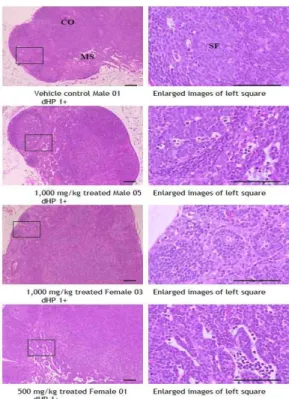
It was observed that there were no mortalities, clinical signs, changes on the body and organ weights, gross and histopathological observations against 14 principal organs related to PR extract up to 2,000 mg/kg. Therefore, 50%
lethal dose (LD
50) and approximate LD of PR aqueous extracts after single oral treatment in female and male mice were considered over 2000 mg/kg the limited dosages recommended by KFDA Guidelines, respectively.
Key words : Polygalae Radix, Single oral dose toxicity, Mouse, Histopathology
* To whom correspondence should be addressed at : Ji-Ha Park, Department of Herbology, College of Oriental Medicine, Daegu Haany University, Gyeongsan 712-715, Korea
․E-mail : [email protected], ․Tel : 053-770-2263
․Received : 2013/07/11 ․Revised : 2013/07/25 ․Accepted : 2013/07/29
Introduction
As increase of the concern in the functional food and well being in life, the demands and consumption of functional food originated from natural sources are increased
1). However, the toxicological aspects about these natural origin-functional foods have been neglected because of the reasons that they have been used as various purposes for long times
2). Therefore, it is considered that more detail and systemic toxicological studies should be tested for control the abuse and potential toxicities even if they have been used as traditional folk medicine.
Polygalae Radix (PR) is a dried root of Polygala tenuifolia Wild (Family: Polygalaceae), and has been traditionally used as neuroprotective agent in Korea
3,4). Active components of PR or crude PR extract itself have been showed favorable neuroprotective effects in various animal models as inhibitory effects of toxin-induced neuronal death
4-6), antidepressant
7,8), cognitive-enhancing
9-11), anti-neuropsychiatric stress
12,13), anxiolytic and sedative-hypnotic
14, 15), sociopsychological
16), and neural stem cell proliferative
17)effects. In addition, PR extracts also have been
showed anti-inflammatory
3), immunomodulatory
18)and antioxidant
19)effects, but the use of PR in a patient has digestive disorders, traditionally prohibited because overdose of PR extracts can be induced mild nausea and vomit
20), and the occupational asthma and rhinitis related to the hypersensitivity of PR extracts also have been reported
21). However, no detailed experimental toxicological assessment of PR has been reported even if mouse single oral dose toxicity test.
The objective of the present study, therefore, was to obtain the primary safety information about PR aqueous extracts, and further clarifies their safety for clinical use. In order to observe the 50% lethal dose (LD
50), approximate LD, test articles were once orally administered to female and male mice at dose levels of 2,000, 1,000 and 500 mg/kg (body wt.) according to the recommendation of KFDA Guidelines
22). The mortality and changes on body weight, clinical signs and gross observation were monitored during 14 days after oral administration of PR extracts with organ weights and histopathology of principal organs.
Materials and Methods
1. Experimental Animals
Each of thirty female and male ICR mice (6-wk old upon receipt, SLC, Japan) was used after acclimatization for 13 days.
Animals were allocated five per polycarbonate cage in a
temperature (20-25℃) and humidity (45-50%) controlled room.
Light : dark cycle was 12hrs : 12hrs, and feed (Samyang, Korea) and water were supplied free to access. All animals were overnight fasted before dosing and terminal necropsy.
Animals were marked by picric acid. This study was carried out according to the guidelines of the Animal Ethical Committee, The University of Daegu Haany University (Gyeongsan, Korea).
2. Preparation and administration of PR aqueous extracts Aqueous PR extracts (yield = 18.6%) were prepared by routine methods using rotary vacuum evaporator (Buchi Rotavapor R-144, Switzerland) and programmable freeze dryer (Freezone 1; Labconco Corp., MO, USA) from dried root of Polygala tenuifolia Wild produced around Shandong, China, which were purchased from Ominiherb (Korea) after confirm the morphology under microscopy. In the present study, prepared herbs were boiled at 80℃, 3 hrs and then, evaporated and lysophilized. Powders of PR extracts are light brown powder. PR extracts were stored in a refrigerator at -20℃ to protect from light and degeneration, and it is well soluble up to 200 mg/ml concentration levels in distilled water used as vehicle as clear light brown solution. The test article was single orally administered at a dosage volume of 20 ml/kg using distilled water as vehicle at 2,000, 1,000 and 500 mg/kg dose levels.
3. Abnormal behavior, clinical sign and body weight All abnormal clinical signs and behaviors were recorded before and after dosing at least twice a day based on the functional observational battery test
23,24). Body weights were measured on the day of dosing (Day 0) prior to treatment, 1, 2, 7, 13 and 14 days after dosing. In addition, to reduce the differences from individual body weight differences of animals at treatment, body weight gains during Day 0 ~ Day 7, Day 7
~ Day 13 and Day 0 ~ Day 14 was also calculated based on measured body weight at each point.
4. Necropsy
All unscheduled died animals were grossly observed immediately after finding them and all survived animals were subjected to terminal necropsy. Animals were asphyxiated by carbon dioxide and gross necropsy was performed in all animals at Day 14 after overnight fasting (about 18 h, water was not restricted).
5. Organ weight measurements and sampling
The absolute organ weight was measured and then relative organ weight (% for body weight) was calculated. The
following organs were collected for histopathological observation. Measured and sampled organs: lung, heart, thymus, left kidney, left adrenal gland, spleen, left testis or ovary, liver, splenic lobe of pancreas, brain, left epididymis or total uterus and left submandibular lymph node.
6. Histopathology
Samples were fixed in 10% neutral buffered formalin.
After 18 hrs of fixation, paraffin embedding was conducted and 4 m sections were prepared by routine histological methods. Representative sections of each specified organs were stained with hematoxylin-eosin for light microscopical examination.
7. Statistical analyses
Multiple comparison tests for different dose groups were conducted. Variance homogeneity was examined using the Levene test
25). If the Levene test indicated no significant deviations from variance homogeneity, the obtain data were analyzed by one way ANOVA test followed by Scheffe test to determine which pairs of group comparison were significantly different. In case of significant deviations from variance homogeneity were observed at Levene test, a non-parametric comparison test, the Mann-Whitney U (MW) test was conducted to determine the specific pairs of group comparison, which are significantly different
26). LD50 and 95% confidence limits were calculated by Probit method. Statistical analyses were conducted using SPSS for Windows (Release 14.0K, SPSS Inc., USA) and a p-value of less than 0.05 was considered to be a significant difference. In addition, degree of clinical signs, gross and histopathological findings were subdivided into 3 degrees: 3+ Severe, 2+ moderate, 1+ slight, according to the previous reports
2,27).
Results
1. Mortalities
No unscheduled or PR extracts-treatment related mortalities were detected in all dose levels tested in this study.
At termination, all of animals (5/5; 100%) were survived in all dose levels tested including vehicle control.
2. Clinical signs
In this study, no PR extracts treatment related abnormal clinical signs were observed during observation periods regardless of male and female mice, respectively.
3. Changes on body weights and gains
Table 2. Changes on the absolute organ weights after oral treatment of PR extracts D o se
(m g /kg )
O rg a n s: M a le Lu n g H e a rt T h y m u s K id n e y L A d re n a l
g la n d L S p le e n T e stis L Live r P a n c re a s S B ra in E p id id y m is L
Ly m p h n o d e L
a0 0 .1 8 6 ± 0 .0 1 8 0 .1 5 8 ± 0 .0 1 6 0 .0 4 5 ± 0 .0 1 7 0 .2 9 0 ± 0 .0 2 8 0 .0 0 3 ± 0 .0 0 1 0 .1 0 0 ± 0 .0 1 8 0 .1 2 0 ± 0 .0 1 1 1 .4 3 6 ± 0 .0 8 5 0 .1 6 4 ± 0 .0 2 8 0 .4 7 7 ± 0 .0 1 5 0 .0 4 9 ± 0 .0 0 7 0 .0 0 3 ± 0 .0 0 2 2 ,0 00 0 .2 0 0 ± 0 .0 1 7 0 .1 6 5 ± 0 .0 1 4 0 .0 4 5 ± 0 .0 0 7 0 .3 0 8 ± 0 .0 1 9 0 .0 0 2 ± 0 .0 0 1 0 .1 0 3 ± 0 .0 1 8 0 .1 1 4 ± 0 .0 2 2 1 .4 7 5 ± 0 .1 1 1 0 .1 7 0 ± 0 .0 0 8 0 .4 8 1 ± 0 .0 2 6 0 .0 4 9 ± 0 .0 0 5 0 .0 0 4 ± 0 .0 0 2 1 ,0 00 0 .1 8 7 ± 0 .0 1 8 0 .1 6 6 ± 0 .0 1 5 0 .0 5 8 ± 0 .0 1 7 0 .2 7 8 ± 0 .0 3 8 0 .0 0 2 ± 0 .0 0 1 0 .1 0 6 ± 0 .0 2 6 0 .1 0 8 ± 0 .0 1 4 1 .5 0 1 ± 0 .1 5 9 0 .1 6 2 ± 0 .0 2 1 0 .4 8 4 ± 0 .0 2 2 0 .0 4 3 ± 0 .0 0 5 0 .0 0 3 ± 0 .0 0 3 50 0 0 .1 9 5 ± 0 .0 1 7 0 .1 6 1 ± 0 .0 1 1 0 .0 4 3 ± 0 .0 0 8 0 .2 7 7 ± 0 .0 2 4 0 .0 0 2 ± 0 .0 0 2 0 .1 3 0 ± 0 .0 4 5 0 .1 1 9 ± 0 .0 1 3 1 .5 0 7 ± 0 .1 2 3 0 .1 5 4 ± 0 .0 0 9 0 .4 7 1 ± 0 .0 1 4 0 .0 4 8 ± 0 .0 0 7 0 .0 0 2 ± 0 .0 0 1
D o se (m g /kg )
O rg a n s: F e m a le Lu n g H e a rt T h y m u s K id n e y L A d re n a l
g la n d L S p le e n O v a ry L Live r P a n c re a s S B ra in U te ru s Ly m p h n o d e L
a0 0 .1 6 1 ± 0 .0 0 3 0 .1 3 1 ± 0 .0 1 2 0 .0 5 5 ± 0 .0 0 7 0 .1 8 0 ± 0 .0 1 6 0 .0 0 3 ± 0 .0 0 2 0 .0 9 8 ± 0 .0 0 8 0 .0 2 2 ± 0 .0 0 6 1 .0 9 6 ± 0 .0 9 0 0 .1 6 0 ± 0 .0 1 8 0 .4 6 6 ± 0 .0 2 4 0 .1 5 0 ± 0 .0 2 5 0 .0 0 7 ± 0 .0 0 3 2 ,0 00 0 .1 5 8 ± 0 .0 1 0 0 .1 2 0 ± 0 .0 1 2 0 .0 4 8 ± 0 .0 1 3 0 .1 7 0 ± 0 .0 1 4 0 .0 0 3 ± 0 .0 0 1 0 .1 0 7 ± 0 .0 1 5 0 .0 2 1 ± 0 .0 0 5 1 .1 3 1 ± 0 .1 5 4 0 .1 4 7 ± 0 .0 2 5 0 .4 5 7 ± 0 .0 2 6 0 .1 5 6 ± 0 .0 2 5 0 .0 0 4 ± 0 .0 0 3 1 ,0 00 0 .1 7 0 ± 0 .0 1 3 0 .1 2 9 ± 0 .0 1 1 0 .0 6 2 ± 0 .0 1 8 0 .1 7 9 ± 0 .0 1 3 0 .0 0 6 ± 0 .0 0 2 0 .1 3 1 ± 0 .0 2 5 0 .0 2 4 ± 0 .0 0 4 1 .2 2 8 ± 0 .1 5 4 0 .1 7 2 ± 0 .0 1 5 0 .4 5 9 ± 0 .0 1 6 0 .1 8 6 ± 0 .0 8 2 0 .0 0 6 ± 0 .0 0 5 50 0 0 .1 7 7 ± 0 .0 1 6 0 .1 2 7 ± 0 .0 0 6 0 .0 8 6 ± 0 .0 1 9 0 .1 8 1 ± 0 .0 1 0 0 .0 0 5 ± 0 .0 0 2 0 .1 1 0 ± 0 .0 3 2 0 .0 2 0 ± 0 .0 0 5 1 .1 4 0 ± 0 .0 7 2 0 .1 7 4 ± 0 .0 1 2 0 .4 5 8 ± 0 .0 1 4 0 .1 4 1 ± 0 .0 3 1 0 .0 0 6 ± 0 .0 0 5 Values are expressed as mean±SD, g of five mice. PR, Polygalae Radix. L, left sides. S, splenic lobes.
aSubmandibular lymph node.
No significant changes in body weight were detected compared to that of vehicle control in all dose levels tested except for significant (p<0.05) decrease of body weight gains during Day 0 ~ Day 7 detected in PR extracts 500 mg/kg treated male mice as compared with male vehicle control mice (Table 1, Fig. 1 and 2).
Table 1. Body weight gains after oral treatment of PR extracts
G ro u p In te rva ls
D a y 0a ~ D a y 7 D a y 7 ~ D a y 13 D a y 0 ~ D a y 1 4b M a le
V e h icle co n tro l 7 .62 ± 1 .62 1.2 8 ± 0.5 1 8 .90 ± 1 .62
2 ,0 00 m g /kg 7 .18 ± 1 .52 1.5 2 ± 1.2 7 8 .70 ± 2 .15
1 ,0 00 m g /kg 7 .16 ± 0 .74 2.8 8 ± 1.1 2 10 .0 4± 1 .7 4
50 0 m g /kg 4 .74 ± 0 .96 * 1.5 6 ± 1.0 3 6 .30 ± 1 .72
F e m a le
V e h icle co n tro l 4 .38 ± 0 .67 1.2 2 ± 1.8 2 5 .60 ± 1 .97
2 ,0 00 m g /kg 4 .58 ± 1 .34 1.5 4 ± 1.8 2 6 .12 ± 2 .70
1 ,0 00 m g /kg 4 .16 ± 1 .98 2.3 4 ± 1.3 0 6 .50 ± 1 .94
50 0 m g /kg 5 .66 ± 1 .74 1.6 0 ± 0.3 0 7 .26 ± 1 .63
Values are expressed as mean±SD, g of five mice.
aDay of treatment after overnight fasted.
bDay of sacrifice after overnight fasted. PR, Polygalae Radix. *p<0.05 as compared with vehicle control by MW test
Days after administeration
before 0 1 2 7 13 sacrifice
Body weights (g)
22 24 26 28 30 32 34 36 38
Female vehicle control
PR aqueous extracts 2,000 mg/kg treated female mice PR aqueous extracts 1,000 mg/kg treated female mice PR aqueous extracts 500 mg/kg treated female mice
Fig. 1. Changes on the body weights during 14 Days of observation in male mice after single oral treatment of PR extracts. No significant changes on body weights were detected in all PR extract treated male groups as compared with male vehicle control, respectively. Values are expressed as mean±SD of five mice. PR, Polygalae Radix. All mice were overnight fasted; before means 1 day before injection day. 0 means just before injection.
4. Changes on the organ weight
No meaningful changes on the absolute and relative organ
weight of principal organs were observed in all PR extracts treated female and male mice as compared with each equal gender of vehicle control, respectively(Table 2, 3).
Days after administeration
before 0 1 2 7 13 sacrifice
Body weights (g)
22 24 26 28 30 32 34 36 38
Female vehicle control
PR aqueous extracts 2,000 mg/kg treated female mice PR aqueous extracts 1,000 mg/kg treated female mice PR aqueous extracts 500 mg/kg treated female mice