| Abstract |
3)
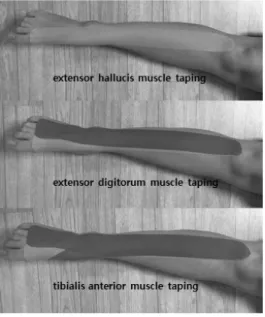
Purpose: The purpose of this study was both to examine the effects of proprioceptive neuromuscular facilitation (PNF) lower leg taping and treadmill training on the gait and balance abilities of patients with hemiplegia resulting from a stroke and to provide a taping method based on the PNF concept.
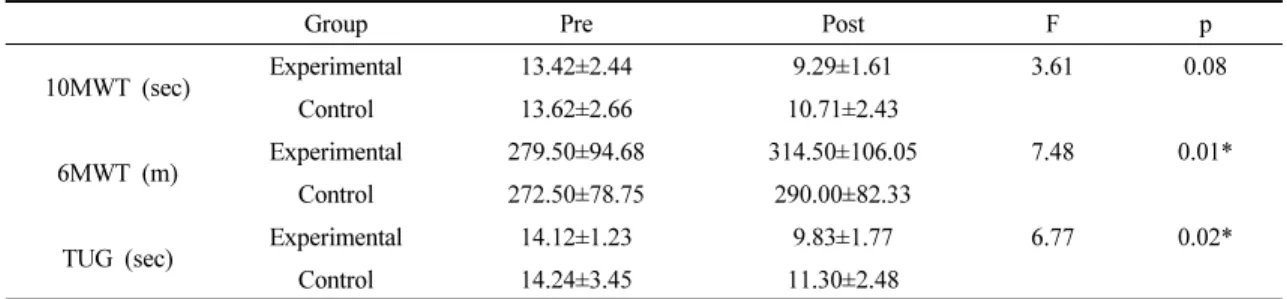
Methods: Twenty patients with hemiplegia resulting from a stroke were randomly and equally assigned to a control group (n=10), which received treadmill training, and to an experimental group (n=10), which received PNF lower leg taping and treadmill training. The intervention was conducted five times per week for six weeks. In order to measure changes in the gait ability of the subjects, a 10-meter walking test (10MWT) and a 6-minute walking test (6MWT) were conducted, and in order to measure changes in the subjects’ balance ability, a timed up and go test (TUG) was performed. In order to compare differences within each group before and after the intervention, a paired-t test was carried out, and in order to compare differences between the two groups, the analysis of covariance was utilized. All statistical significance levels were set at α=0.05.
Results: There were significant differences before and after the intervention within both groups in changes of 10MWT, 6MWT, and TUG (p<0.01). Regarding differences between the two groups, the experimental group underwent more effective changes than the control group in 6MWT and TUG (p<0.05).
Conclusion: This study applied PNF lower leg taping and treadmill training to patients with hemiplegia resulting from a stroke, and this resulted in improvement in the subjects’ gait and balance abilities. Taping and treadmill training based on the PNF concept is considered to be usefully applied as one of the programs to improve hemiplegic patients’ gait and balance abilities.
†Corresponding Author : Beom-Ryong Kim ([email protected])
Original Article Open Access
고유수용성신경근촉진법 아래다리 테이핑적용과 트레드밀 훈련이 뇌졸중 환자의 보행능력과 균형능력에 미치는 영향