• 검색 결과가 없습니다.

The Effects of Abdominal Strength Training Using Proprioceptive Neuromuscular Facilitation on the Balance Ability and Pain of Patients with Chronic Lower Back Pain

N/A
N/A
Protected

Academic year: 2021

Share "The Effects of Abdominal Strength Training Using Proprioceptive Neuromuscular Facilitation on the Balance Ability and Pain of Patients with Chronic Lower Back Pain"

Copied!
8
0
0

로드 중.... (전체 텍스트 보기)

전체 글

(1)

| Abstract |

Purpose: This study attempts to identify the effects of abdominal strength training using proprioceptive neuromuscular facilitation (PNF) on the balance ability and pain level of patients with chronic lower back pain.

Methods: A total of 30 patients with chronic lower back pain were randomly divided into either experimental group Ⅰ (n=10), who received abdominal strength training using PNF, experimental group Ⅱ (n=10), who received abdominal strengthening training, or the control group (n=10), who received conventional physiotherapy. The interventions were applied three times a week for six weeks. We measured Berg’s balance scale (BBS) in order to investigate the change in balance ability, while we measured the visible analogue scale (VAS) to determine the severity of pain. We conducted a paired t-test to compare the within-group change before and after the intervention. For the comparison of the between-group difference, we used a one-way ANOVA test. Tukey’s test was used as a post hoc test. The statistical significance level was set at α=0.05 for all the variables.

Results: Experimental group Ⅰ and experimental group Ⅱ showed a significant within-group change in BBS (p<0.01). A statistically significant between-group difference was observed in terms of the change in BBS (p<0.01). According to the results of the post hoc Tukey test, experimental group Ⅰ and experimental group Ⅱ showed a more effective change in BBS than the control group. Experimental group Ⅰ, experimental group Ⅱ, and the control group all showed a significant within-group change in the VAS (p<0.01). There was a statistically significant between-group difference in terms of the change in the VAS (p<0.01).

According to the results of the post hoc Tukey test, the change in the VAS was more effective in experimental group Ⅰ than in experimental group Ⅱ and the control group.

†Corresponding Author : Beom-Ryong Kim ([email protected])

Original Article Open Access

고유수용성신경근촉진법 복부강화훈련이 만성허리통증환자의 균형능력과 통증에 미치는 영향
김창헌⋅김범룡

1)

대자인병원 재활센터

The Effects of Abdominal Strength Training Using Proprioceptive Neuromuscular Facilitation on the Balance Ability and Pain of Patients with Chronic Lower Back Pain

Chang-Heon Kim⋅Beom-Ryong Kim Department of Physical Therapy, Design Hospital Received: February 4, 2017 / Revised: February 15, 2017 / Accepted: February 16, 2017

ⓒ 2017 Journal of Korea Proprioceptive Neuromuscular Facilitation Association

This is an Open Access article distributed under the terms of the Creative Commons Attribution Non-Commercial License

(http://creativecommons.org/licenses/by-nc/3.0) which permits unrestricted non-commercial use, distribution, and reproduction

in any medium, provided the original work is properly cited.

(2)

Conclusion: In this study, the application of abdominal strength training using PNF for subjects who complained of chronic lower back pain proved effective in improving their balance ability and reducing pain. We therefore believe that this training method could be applied as a useful program for patients with chronic lower back pain.

Key Words: Balance ability, Lower back pain, PNF, VAS

Ⅰ. 서 론

허리통증 (low back pain)은 전체 인구의 80%가 일생 중 한번 이상은 경험하게 된다(O’Sullivan, 2000). 이 중에 완전히 회복되지 않고, 12주 이상이 되어도 통증 이 지속되는 경우를 만성허리통증(chronic low back pain)이라 한다(Hides et al., 1996). 통증이 만성화되면 허리부위의 안정성과 가동성이 감소되고, 근력 및 협 응력의 저하, 고유수용기의 변화로 다양한 신체기능 의 손상이 발생한다(Koumantakis et al., 2005).

허리통증의 주된 원인은 자세와 근육의 불균형임 을 감안할 때 (Hyoung, 2008) 근본적인 허리통증 관리 를 위해서는 바른 자세유지와 균형능력을 향상 시킬 수 있는 훈련프로그램이 병행되어야 한다(Jeon, 2013).

균형은 기저면(base of support, BOS)과 안정성의 제한 (limits of stability, LOS) 내에 중력중심(center of gravity, COG)을 유지하는 신체의 능력이다(Nichols et al., 1996). 균형을 유지하기 위해서는 말초신경계와 중추 신경계의 상호작용은 필수적이다. 말초신경계는 통증 과 온도에 대한 고유수용감각을 제공하는 체성감각, 환경변화의 정보를 제공하는 시각, 머리와 신체위치 에 대한 정보를 제공하는 전정계로 구성된다(Alexander

& LaPier, 1998). 중추신경계는 말초적 요소로부터 입 력된 정보를 통합하여 몸통의 위치와 자세조절을 하 기에 가장 적절한 근육의 반응을 선택하는 것이다 (McCollum et al., 1996). 이와 같이 허리통증은 단순히 통증만을 문제점으로 나타나지 않기 때문에 훈련의 가장 중요한 목표는 균형능력 회복과 신체기능 향상 이다. 균형능력 회복과 신체기능 향상은 일상생활과 사회활동에 참여할 수 있는 기본적인 요소이며 자연

스럽게 이차적으로 통증을 감소시킬 수 있다 (Rantanen, 2001).

임상에서는 허리통증을 위해 많이 사용하고 있는 훈련방법은 슬링(sling)을 이용하여 요부의 근력을 강 화시키는 훈련 (Lee & Cho, 2016), 근력강화와 걷기훈 련(Lee & Kang, 2016), 중심근육 안정화훈련(Shamsi et al., 2016)을 시행하고 있으며, 허리통증과 관련된 다양한 연구를 살펴보면 복부근육의 약화가 허리통증 과 깊은 관련성을 보고하고 있다(Lee et al., 2001;

Nourbakhsh & Arab, 2002). 또한, 복부근육의 약화는 골반전만경사와 허리부분의 전만을 증가시켜 허리통 증을 유발할 수 있으며 (Rone-Adams, 2004), 복부강화훈련 의 필요성을 시사한다 . 복부강화훈련으로 다양한 자세에서 척추에 높은 부하를 줄이고 , 손상을 예방할 수 있는 중립 자세에서 등척성과 등장성 운동을 시행 할 수 있는 고유수용성신경근촉진법(proprioceptor neuromuscular facilitation, PNF)은 이 추천되고 있다(Bong et al., 2016).

이와 같이 허리부위 안정화를 이용한 훈련과 PNF

을 활용한 복근강화훈련을 통하여 근력 강화를 시키

고 통증에 효과적이라는 연구들이 발표되고 있지만,

만성허리통증환자들에게 두 가지 유형의 훈련을 적용

하여 어떠한 유형의 훈련프로그램이 허리통증환자의

균형능력 향상과 통증 감소에 효과가 있는지를 비교

한 연구가 미비한 실정이다. 따라서 본 연구에서는

만성허리통증환자들에게 허리부위 안정화 및 근력향

상과 통증감소를 위하여 전통적인 물리치료와 병행하

여 일반적으로 많이 시행 되고 있는 복부근육에 초점

을 맞춘 허리부위 안정화훈련과 고유수용성신경근촉

진법훈련이 균형능력 향상과 통증 감소에 미치는 효

과를 알아보고자 한다.

(3)

Type Training

Method Goals

Position Pattern Technique

Warm-up Supine, Side

lying, Prone Stretching, range of motion RI, HR 10 minutes

Prevention of injury, decreased of pain

PNF abdominal strengthening

training

Hook lying Bilateral asymmetrical lower

extremity RS, SR

8∼15th / 3set /30 minutes

Abdominal muscle facilitation and

strengthening Supine Flexion adduction external rotation

lower extremity RI, CI Supine Bilateral asymmetrical lower

extremity RI, CI

Supine Extension adduction internal

rotation upper extremity RI, CI Supine Bilateral symmetrical upper

extremity RI, CI

Supine Chopping RI, CI

Side lying Flexion adduction external rotation

lower extremity RI, CI Side lying Bilateral asymmetrical lower

extremity RI, CI

Prone elbow Neck flexion RI, CI

Sitting Bilateral asymmetrical lower

extremity RI, CI

Sitting Chopping RI, CI

Sitting Trunk flexion RI, CI

Cool-down Supine, Side

lying, Prone Stretching, range of motion RI, HR 10 minutes

Prevention of injury, decreased of pain RI: rhythmic initiation

CI: combination of isotonics RS: rhythmic stabilization SR: stabilizing reversal HR: hold-relax CR: contract-relax.

Table 2. PNF abdominal strengthening training program

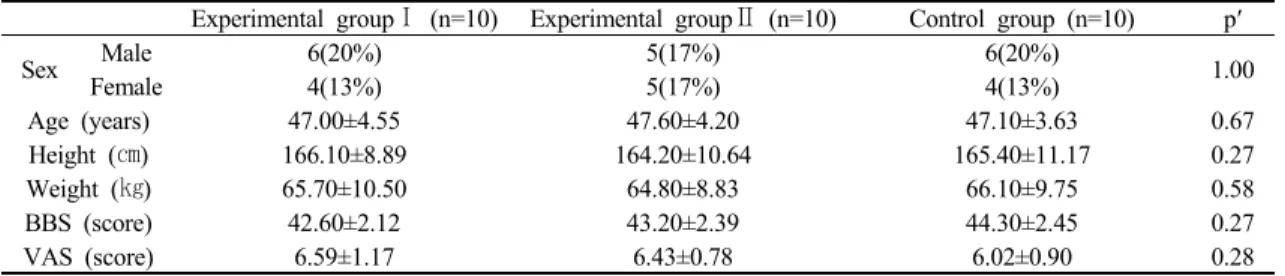
Experimental groupⅠ (n=10) Experimental groupⅡ (n=10) Control group (n=10) p′

Sex Male 6(20%) 5(17%) 6(20%)

Female 4(13%) 5(17%) 4(13%) 1.00

Age (years) 47.00±4.55 47.60±4.20 47.10±3.63 0.67

Height (㎝) 166.10±8.89 164.20±10.64 165.40±11.17 0.27

Weight (㎏) 65.70±10.50 64.80±8.83 66.10±9.75 0.58

BBS (score) 42.60±2.12 43.20±2.39 44.30±2.45 0.27

VAS (score) 6.59±1.17 6.43±0.78 6.02±0.90 0.28

Values are presented as mean±standard deviation

′Shapiro-wilk

BBS: Berg’s balance scale VAS: visual analogue scale

Experimental groupⅠ: PNF abdominal training Experimental groupⅡ: abdominal training.

Table 1. General characteristics of study subjects

(n=30)

(4)

Ⅱ. 연구 방법

1. 연구 대상

연구 대상자는 2016년 11월부터 2016년 12월까지 J시 소재 D병원 외래환자로 12주 이상 허리통증을 호소한 40∼55세 연령범위의 만성허리통증환자로, 급 성통증이나 지속적으로 심한통증을 가진 자, 척추분 리증이나 전방전위증이 있는 자, 신경학적으로 감각 이상이나 근육마비가 있는 자, 정신적인 문제나 이해 력이 부족하여 운동수행 능력이 어려운 자는 연구대 상에서 제외하였으며, 본 연구의 목적을 이해하고 연 구에 참여하기로 동의한 30명을 대상으로 하였다. 이 들을 각각 PNF 복부강화훈련을 실시한 실험군Ⅰ (n=10)과 복부강화훈련을 실시한 실험군Ⅱ(n=10) 및 전통적 물리치료를 실시한 대조군(n=10)으로 무작위 배정하였다(Table 1).

2. 실험 방법

1) PNF 복부강화훈련 프로그램

PNF 복부강화훈련은 복부근육의 촉진과 강화를 위 하여 다양한 자세에서 환자의 수준에 맞게 패턴과 기 법을 활용하여 훈련하였다 . 세트 간에는 15∼20초 정 도의 휴식을 취하게 하고 , 빠르게 다음 훈련으로 넘어 가게 하였다. 준비운동 10분, 본 운동 30분, 정리운동 10분 총 50분으로 구성, 주 3회 6주간 시행하였다 (Table 2).

2) 복부강화훈련 프로그램

복부강화훈련은 복부근육의 강화를 위하여 다양한 방법으로 환자의 수준에 맞게 훈련하였다. PNF 복부 강화훈련 군과 동일하게 세트 간에는 15∼20초 정도 의 휴식을 취하게 하고, 빠르게 다음 훈련으로 넘어가 게 하였다. 준비운동 10분, 본 운동 30분, 정리운동 10분 총 50분으로 구성, 주 3회 6주간 시행하였다 (Table 3).

Type Training

Method Goals

Position Pattern Technique

Warm-up Supine, Side

lying, Prone Stretching, Range of motion Static, Passive

10 minutes

Prevention of injury, decreased of pain

Abdominal strengthening

training

Hook lying Drawing-in maneuver Isometric

8∼15th / 3set / 30 minutes

Abdominal muscle strengthening

Hook lying Curl up Isotonic

Hook lying Oblique curl up Isotonic

Hook lying Bicycle Isotonic

Hook lying Knee up crunch Isotonic

Supine Jackknife Isotonic

Hook lying Knee up cross Isotonic

Hook lying Heel touch Isotonic

Hook lying Knee touch Isotonic

Supine Legs lower Isotonic

Side lying Side plank Isometric

Prone elbow Plank Isometric

Cool-down Supine, Side

lying, Prone Stretching, Range of motion Static, Passive

10 minutes

Prevention of injury,

decreased of pain

Table 3. Abdominal strengthening training program

(5)

3) 전통적 물리치료

전통적 물리치료는 만성허리통증환자에게 보편적 으로 실시하는 치료방법으로 하였다. 온습포(80℃, 20 분), 간섭파 전기 자극치료(2000∼2500㎐, 20분), 초음 파 치료(0.8∼1㎒, 10분)를 실시하였다. 총 50분으로 구성, 주 3회 6주간 시행하였다.

4) 측정 항목 및 방법

(1) 균형능력의 측정

균형능력을 측정하기 위해 버그균형척도(Berg’s balance scale, BBS)를 이용하여 평가하였다. BBS는 14개의 항목으로 앉기, 서기, 자세 변화의 3개의 영역 을 최소 0점에서 최대 4점으로 적용되어 총점은 56점 으로 높은 점수를 기록할수록 높은 균형능력을 평가 받는다. 검사 재검사 간 신뢰도는 r=0.97∼0.99이다 (Berg et al., 1995).

(2) 통증의 측정

통증의 정도를 측정하기 위해 시각적 상사척도 (visible analogue scale, VAS)를 이용하여 대상자가 직 접 체크하는 방식을 택하였다 . 통증이 전혀 없는 상태 는 0, 통증이 최대로 있는 상태는 10으로 하여 10개의 구간이 표시된 종이 위에 직접 체크하도록 하였다.

검사 재검사 간 신뢰도는 r=0.96이다(Lingjaerde &

Føreland, 1998).

3. 자료 처리

본 연구를 위한 자료처리 방법은 Window용 통계프 로그램 SPSS/PC Statistics 18.0 software (SPSS Inc, Chicago, USA)을 이용하여 통계 처리하였다. 연구 대 상자의 일반적인 특성을 Shapiro-wilk로 정규성 검정 을 하였고 , PNF 복부강화훈련에 따른 훈련 전과 후의 집단 내 균형능력과 통증에 변화를 비교하기 위하여 대응표본 t-검정(paired t-test)을 실시하였으며, PNF 복 Experimental

groupⅠ

Experimental groupⅡ

Control

group F p′ post-hoc″

Pre-test 42.60±2.12 43.20±2.39 44.30±2.45

125.85 0.00* E Ⅰ ⋅E Ⅱ > C Post-test 54.70±0.95 54.80±0.92 45.10±2.38

t -18.41 -15.82 -0.97

p 0.00* 0.00* 0.36

Values are presented as mean±standard deviation

′one-way ANOVA

″Tukey

*p<0.01.

Table 4. The comparison of changes in BBS within and between group

Experimental groupⅠ

Experimental groupⅡ

Control

group F p′ post-hoc″

Pre-test 6.59±1.17 6.43±0.78 6.02±0.90

73.10 0.00* E Ⅰ > E Ⅱ ⋅C

Post-test 1.06±0.49 3.64±0.64 4.32±0.75

t 13.66 9.93 7.54

p 0.00* 0.00* 0.00*

Values are presented as mean±standard deviation

′one-way ANOVA

″Tukey

*p<0.01.

Table 5. The comparison of changes in VAS within and between group

(6)

부강화훈련에 따른 일원배치분산분석 (one-way ANOVA) 으로 검정하였다 . 사후검정으로는 Tukey를 실시하였으 며 , 모든 통계학적 유의수준은 α=0.05로 설정하였다.

Ⅲ. 연구 결과

1. 균형능력 변화 비교

집단 내 균형능력(BBS)의 변화는 실험군Ⅰ에서 통 계학적으로 유의한 차이가 있었으며(p<0.01), 실험군

Ⅱ에서 유의한 차이가 있었고(p<0.01), 대조군에서는 유의한 차이가 없었다 . 집단 간 균형능력(BBS)의 변화 에서 통계학적으로 유의한 차이가 있었고(p<0.01), 집 단 간 균형능력(BBS)에 따른 Tukey 사후검정 결과, 실험군Ⅰ와 실험군Ⅱ이 대조군 보다 균형능력(BBS) 의 변화가 더욱 효과적으로 나타났다(Table 4).

2. 통증 변화 비교

집단 내 통증 (VAS)의 변화는 실험군Ⅰ에서 통계학 적으로 유의한 차이가 있었으며(p<0.01), 실험군Ⅱ에 서 유의한 차이가 있었고(p<0.01), 대조군에서도 유의 한 차이가 있었다 (p<0.01). 집단 간 통증(VAS)의 변화 에서 통계학적으로 유의한 차이가 있었고(p<0.01), 집 단 간 통증 (VAS)에 따른 Tukey 사후검정 결과, 실험군

Ⅰ이 실험군Ⅱ와 대조군 보다 통증(VAS)의 변화가 더욱 효과적으로 나타났다(Table 5).

Ⅳ. 고 찰

PNF은 팔과 다리를 이용하여 누운 자세, 옆으로 누운 자세, 앉은 자세, 선 자세 등에서 척추에 높은 부하를 줄이고 , 손상을 예방할 수 있는 중립자세에서 복부근육에 간접적으로 등척성과 등장성 운동을 시행 할 수 있다. 이와 같은 PNF의 장점을 활용한 복부강화 훈련이 균형능력(BBS)과 통증(VAS)에 미치는 영향에 대하여 다음과 같이 논의를 하고자 한다.

Kim 등(2011)은 20대 초반의 만성허리통증환자 34 명을 대상으로 5주 동안 10회 허리안정화훈련을 실시 한 결과 동적과 정적 균형능력에 향상된 결과를 보였 고 , Park과 Kim (2012)은 20∼40대 연령범위의 만성허 리통증환자 35명을 대상으로 8주 동안 24회 허리안정 화훈련을 실시한 결과 균형능력에 향상을 보였으며, Jeon (2013)은 만성허리통증을 호소하는 노인환자 34 명을 대상으로 6주 동안 18회 PNF 훈련을 실시한 결과 동적과 정적 균형능력에 향상을 보였다. 본 연구에서 도 6주 동안 18회 실시한 PNF 복부강화훈련(실험군

Ⅰ )과 복부강화훈련(실험군Ⅱ)에서 BBS가 훈련 전과 후에 유의한 향상을 보였다 . 또한 집단 간 비교에서는 대조군에 비해 실험군Ⅰ과 실험군Ⅱ에서 유의한 차이 를 보여 선행연구과 같은 결과를 도출하였다 . 하지만 Lee 등(2012)은 만성허리통증을 가진 생산직 근로자 40명을 대상으로 PNF 훈련군과 짐볼 훈련군으로 무작 위 배정하여 6주 동안 24회 훈련한 결과 두 훈련군에서 정적균형이 훈련 전과 후 유의한 향상을 보였고, 집단 간 비교에서는 훈련 8회, 16회에는 PNF 훈련군과 짐볼 훈련군 간에 유의한 차이가 없었지만 훈련 24회 때부 터 짐볼 훈련군에 비해 PNF 훈련군에서 유의한 향상 을 보였다. 본 연구에서도 훈련이 더 진행되었다면 PNF를 활용한 실험군Ⅰ에서 더욱 향상된 결과를 도출 했을 것으로 사료되며, 이러한 결과는 반복된 복부강 화훈련이 배곧은근, 배바깥빗근, 배속빗근, 배가로근 의 수축력과 근력이 운동조절과 학습에 의해 증가되 어(Bong et al., 2016) 균형능력 향상에 영향을 미치는 것으로 생각된다.

Park 등(2010)은 30대 만성허리통증환자 28명을 대

상으로 8주 동안 24회 근력과 안정화훈련을 실시한

결과 VAS의 감소에 향상된 결과를 보였고, Lee와 Park

(2010)은 35∼50세 여성 허리통증환자 20명을 대상으

로 8주 동안 24회 몸통안정화훈련을 실시한 결과 VAS

의 감소에 향상된 결과를 보였으며, Kang과 Park

(2013)은 허리통증환자 14명을 대상으로 8주 동안 24

회 PNF의 압축(approximation)활용한 몸통안정화훈련

을 실시한 결과 훈련 전과 후에 VAS가 유의한 향상을

(7)

보였다. 본 연구에서도 6주 동안 18회 실시한 실험군Ⅰ 과 실험군Ⅱ 및 대조군 모두에서 VAS가 훈련 전과 후에 유의한 향상을 보였다. 또한 집단 간 비교에서는 대조군과 실험군Ⅱ에 비해 실험군Ⅰ에서 유의한 차이 를 보였다. Bong 등(2016)은 만성허리통증환자 14명을 대상으로 6주 동안 30회 PNF 복부강화훈련을 실시한 결과 VAS의 감소에 향상된 결과를 보였으며, 본 연구 의 훈련방법을 지지해준다. 이와 같은 결과는 복부강 화훈련이 심부 안정근육을 강화시키고 복부근육의 기 능 회복에 영향을 미침으로써 골반전만경사와 허리부 분의 전만 감소로 인해 척추에 가해지는 부하를 줄여주 어 통증이 경감된 것으로 사료된다 (Bong et al., 2016).

본 연구의 PNF 복부강화훈련은 몸통안정성에 기여 하는 복부근육의 강화는 균형능력을 향상시키는데 효 과적이었고, 구심성과 등척성 및 편심성 수축으로 인 해 복부근육의 근력향상은 몸통안정성이 향상되는 요 소로 작용되어 허리통증을 완화시키고, 반복되는 재 발을 막고, 허리통증 예방을 하는데 매우 중요한 요소 임을 확인하였다. 이러한 결과를 바탕으로 향후에도 임상에서 PNF을 활용한 복부근육을 강화시키기 위한 다양한 연구가 필요할 것으로 사료된다.

Ⅴ. 결 론

본 연구는 만성허리통증을 호소하는 대상자에게 고유수용성신경근촉진법을 이용한 복부강화훈련과 일반적 복부강화훈련을 적용한 결과 대조군에 비하여 균형능력 향상과 통증 감소에 효과가 있었다. 특히 집단 간 비교에서는 대조군과 일반적 복부강화훈련에 비해 PNF 복부강화훈련에서 통증 감소에 향상이 있었 다 . 따라서 만성허리통증환자에게 일반적으로 적용되 는 복부강화훈련도 좋지만 더 효과적인 통증 감소를 고려한다면 PNF 복부강화훈련을 유용하게 적용할 수 있을 것으로 여겨진다.

Reference

Alexander KM, LaPier TL. Differences in static balance and weight distribution between normal subjects and subjects with chronic unilateral low back pain. Journal of Orthopaedic and Sports Physical Therapy.

1998;28(6):378-383.

Berg K, Wood-Dauphinee S, Williams JI. The balance scale:

reliability assessment with elderly residents and patients with an acute stroke. Scandinavian Journal of Rehabilitation Medicine. 1995;27(1):27-36.

Bong SY, Kim YJ, Kang MG, et al. Effects of proprioceptive neuromuscular facilitation exercise on forced expiratory volume at one second, pain, and functional disability index of chronic low back pain patients.

PNF and Movement. 2016;14(3):185-193.

Hides JA, Richardson CA, Jull GA. Multifidus muscle recovery is not automatic after resolution of acute, first-episode low back pain. Spine. 1996;21(23):2763-2769.

Hyoung HK. Effects of a strengthening program for lower back in older women with chronic low back pain.

Journal of Korean Academy of Nursing. 2008;38(6):

902-913.

Jeon JK. The effects of combination patterns exercise of proprioceptive neuromuscular facilitation on balance in chronic low back pain elderly patients. Journal of Digital Convergence. 2013;11(4):361-368.

Kang TW, Park YS. Effect of sling exercise with PNF basic procedure for pain and balance ability of patients with chronic low back pain. Journal of the Korean Proprioceptive Neuromuscular Facilitation Association.

2013;11(1):1-6.

Kim GY, Ahn CS, Kim SS. The effects of 3-dimensional

lumbar stabilization exercise have an effect on the

improvement of pain and static or dynamic balance

ability in 20’s age group with low back pain. Journal

of the Korean Society of Physical Medicine. 2011;6

(8)

(2):235-246.

Koumantakis GA, Watson PJ, Oldham JA. Trunk muscle stabilization training plus general exercise versus general exercise only: randomized controlled trial of patients with recurrent low back pain. Physical Therapy Journal. 2005;85(3):209-225.

Lee CW, Kim JS, Lee IS. The effects of combination patterns of proprioceptive neuromuscular facilitation and ball exercise on pain and balance in chronic low back pain patients. Journal of the Korean Society of Physical Medicine. 2012;7(1):1-9.

Lee JS, Kang SJ. The effects of strength exercise and walking on lumbar function, pain level, and body composition in chronic back pain patients. Journal of Exercise Rehabilitation. 2016;12(5):463-470.

Lee KK, Park JY. The effects of elastic band, Swiss ball, lumbar stabilizing exercise on weight distribution, lumbar strength and pain degree in middle-aged women with chronic lower back. The Korea Journal of Sports Science. 2010;19(3):1155-1165.

Lee P, Helewa A, Goldsmith CH, et al. Low back pain: prevalence and risk factors in an industrial setting. The Journal of Rheumatology. 2001;28(2):346-351.

Lee SB, Cho WJ. The effect of sling exercise on sagittal lumbosacral angle and intervertebral disc area of chronic low back pain patients. Journal of Exercise Rehabilitation. 2016;12(5):471-475.

Lingjaerde O, Føreland AR. Direct assessment of improvement in winter depression with a visual analogue scale:

high reliability and validity. Psychiatry Research.

1998;81(3):387-392.

McCollum G, Shupert CL, Nashner LM. Organizing sensory information for postural control in altered sensory environments. Journal of Theoretical Biology. 1996;

180(3):257-270.

Nichols DS, Miller L, Colby LA, et al. Sitting balance: its relation to function in individuals with hemiparesis.

Archives of Physical Medicine and Rehabilitation.

1996;77(9):865-869.

Nourbakhsh MR, Arab AM. Relationship between mechanical factors and incidence of low back pain. The Journal of orthopaedic and sports physical therapy. 2002;32 (9):447-460.

O’Sullivan PB. Lumbar segmental ‘instability’: clinical presentation and specific stabilizing exercise management. Manual Therapy. 2000;5(1):2-12.

Park JK, Kim KW. The analysis of stabilization exercise on lumbar extension strength, balance ability in adult female of chronic back pain patients. The Korea Journal of Sports Science. 2012;21(1):1129-1138.

Park JY, Lim DC, Lee KK. The effects of complex treatment of weight training and core exercise on center of pressure, lumbar strength and pain control in middle-aged women with chronic lower back. The Korea Journal of Sports Science. 2010;19(4):1159- 1171.

Rantanen P. Physical measurements and questionnaires as diagnostic tools in chronic low back pain. Journal of Rehabilitation Medicine. 2001;33(1):31-35.

Rone-Adams SA, Shamus E, Hileman M. Physical therapists evaluation of the trunk flexors in patients with low back pain. The Internet Journal of Allied Health Sciences and Practice. 2004;2(2):1-9.

Shamsi MB, Rezaei M, Zamanlou M, et al. Does core stability exercise improve lumbopelvic stability (through endurance tests) more than general exercise in chronic low back pain? A quasi-randomized controlled trial.

Physiotherapy Theory and Practice. 2016;32(3):

171-178.

수치

Table 2. PNF abdominal strengthening training program
Table 5. The comparison of changes in VAS within and between group

참조

관련 문서

Background: The purpose of this study is on finding the effects of the lumbar stabilization exercise applied with the proprioceptive neuromuscular facilitation technique (PNF) to

Abstract The study attempted to systematically and comprehensively analyze individual studies in which proprioceptive neuromuscular facilitation (PNF) was performed with

Effects of proprioceptive neuromuscular facilitation-based abdominal muscle strengthening training on pulmonary function, pain, and functional disability index in chronic

Purpose: This study investigated the effects of proprioceptive neuromuscular facilitation (PNF) exercise on the range of motion (ROM), pain, and functional activity of

Purpose: This case report examines the influence of proprioceptive neuromuscular facilitation (PNF) combined with a dynamic neuromuscular stabilization approach on balance

Purpose: The purpose of this study was to examine the effects of proprioceptive neuromuscular facilitation (PNF) wrist taping, after the application of a rhythmic

Purpose: This study aimed to examine the effects of proprioceptive neuromuscular facilitation (PNF) lower extremity patterns combined with elastic bands applied to

Purpose: The current study seeks to identify the effect of neck muscle strengthening exercise using proprioceptive neuromuscular facilitation (PNF) on the swallowing
