• 검색 결과가 없습니다.

Effect of Rhythmic Stabilization Technique, before Proprioceptive Neuromuscular Facilitation Wrist Taping, on Grip Strength and Pain in Wrist Pain Patients

N/A
N/A
Protected

Academic year: 2021

Share "Effect of Rhythmic Stabilization Technique, before Proprioceptive Neuromuscular Facilitation Wrist Taping, on Grip Strength and Pain in Wrist Pain Patients"

Copied!
8
0
0

로드 중.... (전체 텍스트 보기)

전체 글

(1)

| Abstract |

5)

Purpose: The purpose of this study was to examine the effects of proprioceptive neuromuscular facilitation (PNF) wrist taping, after the application of a rhythmic stabilization (RS) technique, on the decrease of pain and the increase of grip strength in physical therapists who complained of wrist pain and to provide basic data on interventions for wrist pain patients.

Methods: The subjects were 15 peoples in their 20s who complained of pain with a visual analogue scale (VAS) at five points or higher due to overuse of their wrists. They were randomly assigned to a control group, to which PNF wrist taping was applied after stretching (n=7), or to an experimental group (n=8), to which PNF wrist taping was applied after application of the RS technique of PNF. The experiment was conducted for four weeks, five times per week. VAS was measured in order to measure pain decrease, and grip strength (GS) was measured using a dynamometer. In order to compare within-group differences before and after the intervention, a paired t-test was performed, and in order to compare differences between the two groups, the analysis of covariance (ANCOVA) was used. All statistically significant levels were set at α=0.05.

Results: There were significant differences in changes of VAS and GS within each group before and after the intervention (p<0.01), but there was no significant difference between the two groups.

Conclusion: This study applied PNF wrist taping after the application of stretching or PNF RS to patients who complained of pain beyond a sense of discomfort; these interventions resulted in a decrease in pain and an increase in the grip strength of the subjects. Taping and therapeutic techniques using PNF are considered to be usefully applied as one of the programs to improve wrist pain patients’ pain and grip strength.

†Corresponding Author : Beom-Ryong Kim ([email protected])

Original Article Open Access

고유수용성신경근촉진법 손목테이핑 처치 전 율동적 안정 기법이 손목통증환자의 통증과 악력에 미치는 영향
김창헌⋅김범룡

⋅강미경 대자인병원 재활센터

Effect of Rhythmic Stabilization Technique,

before Proprioceptive Neuromuscular Facilitation Wrist Taping, on Grip Strength and Pain in Wrist Pain Patients

Chang-Heon Kim⋅Beom-Ryong Kim

⋅Mi-Gyeong Kang Department of Physical Therapy, Design Hospital Received: June 20, 2016 / Revised: August 4, 2016 / Accepted: August 7, 2016

ⓒ 2016 Journal of Korea Proprioceptive Neuromuscular Facilitation Association

This is an Open Access article distributed under the terms of the Creative Commons Attribution Non-Commercial License

(http://creativecommons.org/licenses/by-nc/3.0) which permits unrestricted non-commercial use, distribution, and reproduction

in any medium, provided the original work is properly cited.

(2)

Key Words: Grip strength, PNF taping, Rhythmic stabilization, VAS, Wrist pain

Ⅰ. 서 론

작업관련 근골격계 질환(work related musculoskeletal disorder, WMSDs)은 근골격계 부담 작업을 통해서 발 생하는 질환으로 올바르지 못한 자세, 불충분한 휴식, 과도한 힘 등으로 근육, 뼈, 관절, 신경 등에 손상이 누적되어 목, 어깨, 팔꿈치, 손목, 허리, 골반, 무릎, 발목 등에 통증을 호소하는 것을 말한다(Lee et al, 2015). Yong 등(2010)의 연구에 의하면 물리치료사들 의 물리치료업무로 인해 통증이 발생되는 경우는 80.1% 로, 발생 부위는 허리 17.6%, 어깨 17.1%, 손목 13.2% 순이었으며, 업무수행 중 가장 어려움을 주는 통증 부위는 허리 30.1%, 어깨 29.3%, 손목 12.0% 순으 로 보고하였다. 이와 같이 물리치료사는 손을 많이 사용하는 직업상 손목에 대한 통증은 허리와 어깨 다 음으로 많이 호소하고 있다. 또한, Rempel 등(1992)은 손의 반복된 사용으로 인한 손상으로 통증을 호소하 는 경우는 전체 직업의 50% 이상을 차지한다고 보고 하였으며, 누적된 손상 발생의 과정을 분석한 결과 잘못된 작업자세와 반복적인 동작수행을 통증의 발생 요인으로 보았다.

고유수용성신경근촉진법(proprioceptive neuromuscular facilitation, PNF)은 근육, 건(힘줄), 관절 내의 고유수용 기를 자극하여 기능을 향상시키며(Klein et al, 2002), 근력과 유연성 및 균형능력을 증가시키고(Lee & Kim, 2013; Kim & Kim, 2013), 신체기능 및 운동기능을 향상 시키는 기법으로(Kim et al, 2011; Lee et al, 2008) 뇌졸 중과 같은 중추신경계 질환뿐만 아니라 근육, 뼈, 관절 의 근골격계 질환의 치료에 널리 사용되고 있다 (Gabriel et al, 2006; Kofotolis & Kellis, 2006; McMullen

& Uhl, 2000;). PNF에서 사용되는 촉진원리 중 패턴 (pattern) 의 연장된 자세(elongated position)는 촉진시키 고자 하는 근육의 운동성을 증가시키는 방법으로, 연 장된 자세는 근육을 늘려서 붙이는 테이핑 부착 방법

과 유사하다고 생각되며, 연장된 자세에서 테이핑을 부착한다면 근육의 운동성을 더 기능적으로 촉진시키 는 방법이라 생각된다. 따라서 PNF 손목테이핑이라는 이름을 붙여서 손목통증환자에게 처치하고자 한다. 또 한 PNF 치료기법(techniques) 중 율동적 안정(rhythmic stabilization, RS) 기법은 대항근 반전(reversal of antagonists) 기법의 하나로 Sherrington의 연속 유발 원 리를 기초한 기법으로 관절의 불안정성으로 인해 발 생되는 통증을 감소시키기 위한 목적으로 사용된다 (Adler er al, 2008).

테이핑과 관련된 선행연구를 살펴보면 Lee 등 (2010)은 엄지(thumb)의 손목손허리관절(metacarpo phalangeal)에 손상 받은 환자를 대상으로 테이핑 적용 이 통증감소와 근력을 향상시킬 수 있다고 하였으며, Ro (2010)는 65세 이상 노인들을 대상으로 어깨관절에 테이핑을 적용한 결과 어깨관절 통증과 가동범위 및 손의 민첩성을 개선시킬 수 있다고 하였고, Park과 Kim (2012) 은 가쪽위관절염(lateral epicondylitis)을 가 진 성인 여성을 대상으로 테이핑을 적용한 결과 악력 과 근활성도에 향상을 얻었다. 이와 같이 테이핑 적용 은 통증을 감소시키며, 관절의 가동범위와 근력 및 근활성도 향상에 긍정적인 방법으로 보고되고 있다.

그러므로 손목의 통증과 악력의 저하로 업무수행에 어려움을 겪는 물리치료사들을 위하여 손목에 테이핑 을 중재적인 방법으로 이용될 수 있으며, 지금까지 손목통증에 적용한 선행 연구는 미비한 상태이며, 특 히 PNF를 활용한 테이핑 방법은 전무한 실정이다.

따라서 본 연구에서는 PNF의 RS기법 적용 후에

PNF 손목테이핑 적용이 손목에 통증을 호소하는 물리

치료사들을 위하여 통증감소와 악력증진에 어떠한 영

향을 미치는지 알아보고, 손목통증환자에 대한 중재

의 기초자료를 제공하는데 본 연구에 목적이 있다.

(3)

Ⅱ. 연구 방법

1. 연구 대상

본 연구는 2016년 5월 2일부터 5월 27일까지 4주 동안 전라북도 J시 소재 D병원 재활센터 물리치료사 들 중 손목의 과 사용으로 인해 시각적 상사척도 (visible analogue scale, VAS)가 5점 이상(불편감을 넘 어선 통증) 통증을 호소하는 20대 성인남녀 15명을 대상으로 본 연구에 대한 충분한 설명을 듣고 적극적 으로 참여 하기를 동의한 환자를 대상으로 하였다.

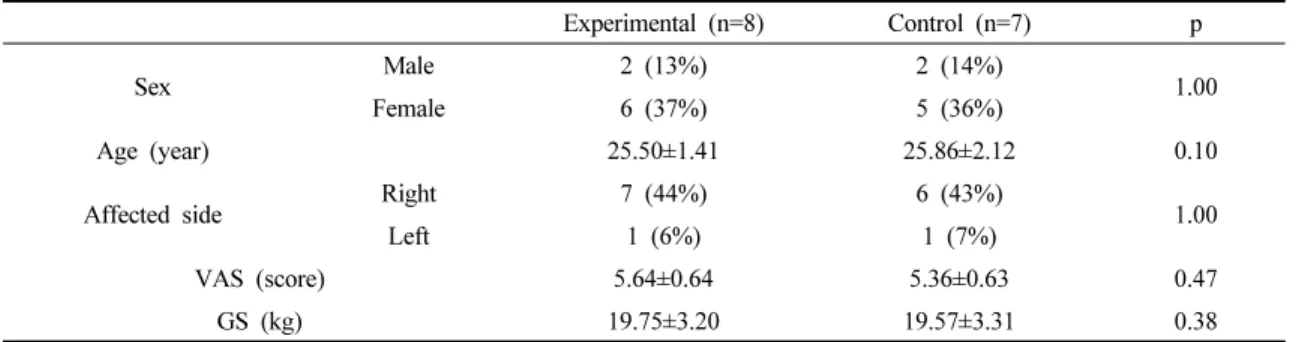
연구 대상자들에게 각각 스트레칭 적용 후에 PNF 손 목테이핑을 적용한 대조군(n=7)과 PNF의 RS 기법 적 용 후에 PNF 손목테이핑을 적용한 실험군(n=8)으로 무작위 배정하였다. 연구 대상자의 일반적 특성은 다 음과 같다(Table 1).

2. 연구 방법

1) PNF 의 RS 기법

PNF의 RS 기법은 대상자가 치료용 테이블에 바르 게 누운 상태(supine)에서 실시하였다. 대상자가 어깨 관절 90도 굽힘, 위팔중립, 팔꿉관절 폄, 아래팔중립, 손목중립상태에서 치료사가 대상자의 환측 손목에 대 각선 2방향에 대해서 RS 기법을 실시하였다. 손목에 대한 RS 기법은 대각선 1방향 1회 수행 10초소요, 5회 반복하여 휴식 시간 포함 최대 5분으로 구성, 주 5회

4주간 시행하였다.

2) 스트레칭

스트레칭은 대상자가 치료용 테이블에 바르게 누운 상태에서 실시하였다. 대상자가 어깨관절 90도 굽힘, 위팔중립, 팔꿉관절 폄, 아래팔중립, 손목중립상태에 서 치료사가 대상자의 환측 손목에 굽힘과 폄에 대해서 스트레칭을 실시하였다. 손목에 대한 스트레칭은 굽힘 과 폄 1회 수행 20초소요, 5회 반복하여 휴식 시간 포함 최대 5분으로 구성, 주 5회 4주간 시행하였다.

3) PNF 손목테이핑

PNF 손목테이핑은 대상자의 신체적 특성에 따라 아래팔의 직경이 다르지만 약 60∼80cm 길이의 탄성 테이프(Benefact tape, NIPPON SIGMAX, Japan)를 사 용하여 상지의 extension-adduction-internal rotation과 flexion-abduction-external rotation 패턴, flexion-adduction- external rotation 과 extension-abduction-internal rotation 패턴의 연장된 자세에서 손목 폄근과 손목 굽힘근에 대해 정지(insertion)에서 기시(origin)까지 부착시켰고, 약 15cm 길이의 탄성 테이프를 사용하여 엄지손가락 의 코담배갑 옆 3cm에서 시작하여 손목을 한 바퀴 감아서 부착시켰다(Fig. 1).

Experimental (n=8) Control (n=7) p

Sex Male 2 (13%) 2 (14%)

Female 6 (37%) 5 (36%) 1.00

Age (year) 25.50±1.41 25.86±2.12 0.10

Affected side Right 7 (44%) 6 (43%)

Left 1 (6%) 1 (7%) 1.00

VAS (score) 5.64±0.64 5.36±0.63 0.47

GS (kg) 19.75±3.20 19.57±3.31 0.38

Values are presented as mean±standard deviation VAS : visible analogue scale

GS : grip strength.

Table 1. General characteristics of study subjects (n=15)

(4)

Fig. 1. PNF wrist tapping.

3. 측정 방법

1) 통증의 측정

통증 감소 변화 측정은 시각적 상사척도(visual analogue scale, VAS)를 이용하여 대상자로 하여금 직접 체크하는 방식을 선택하였는데 통증이 최대로 있는 상태는 10, 통증이 전혀 없는 상태는 0으로 하여 10개의 구간이 표시된 종이 위에 직접 체크하도록 하였다. 검 사 재검사 간 신뢰도는 r=0.96이다(Sindhu et al, 2011).

2) 악력의 측정

악력(grip strength, GS) 측정을 위하여 악력계(Jamar Hydraulic Hand Dynamometer, Preston, USA)를 사용하 여 측정하였다. 최대근력을 객관적으로 측정하기 위

해 팔걸이가 없는 의자에 앉은 자세에서 어깨관절을 모음하고 중립으로 돌림 된 상태에서 팔꿈관절을 90 도 굽힘 시키고 손목관절을 중립한 자세에서 측정하 였다(Fess & Moran, 1981). 검사 재검사 간 신뢰도는 r=0.98 이다(Savva et al, 2014). 측정은 통증이 발생되지 않는 범위 내에서 5초간 쥐는 측정을 총 3회를 측정하 여 평균값을 기록하였다.

4. 자료 처리

본 연구를 위한 자료처리 방법은 Window용 SPSS 18.0을 이용하여 통계 처리하였다. 연구대상자의 일반 적인 특성을 백분율과 Shapiro-wilk로 정규성 검정을 하였고, PNF의 RS 기법 적용 후에 PNF 손목테이핑에 따른 중재 전과 후의 집단 내 통증과 악력에 변화를 비교하기 위하여 대응표본 t-검정(paired t-test)을 실시 하였으며, 실험군과 대조군의 집단 간의 차이를 비교 하기 위해 공분산분석(ANCOVA)으로 검정하였다. 모 든 통계학적 유의수준은 α=0.05로 설정하였다.

Ⅲ. 연구 결과

1. 집단 내 통증과 악력 변화 비교

집단 내 통증(VAS)의 변화는 실험군에서 유의한 차이가 있었고(p<0.01), 대조군에서도 유의한 차이가 있었다(p<0.01). 악력(GS)의 변화에서도 실험군에서 유의한 차이가 있었고(p<0.01), 대조군에서도 유의한 차이가 있었다(p<0.05)(Table 2).

Group Pre Post t p

VAS Experimental 5.64±0.64 1.69±0.96 10.69 0.00**

Control 5.36±0.63 2.37±0.57 7.22 0.00**

GS (kg) Experimental 19.75±3.20 23.13±4.82 -4.97 0.00**

Control 19.57±3.31 21.71±4.31 -3.20 0.02*

Values are presented as mean±standard deviation VAS : visual analogue scale

GS : grip strength

*p<0.05, **p<0.01

Table 2. Change of VAS and GS in group

(5)

2. 집단 간 통증과 악력 변화 비교

집단 간 통증(VAS)의 변화에서는 실험군과 대조군 사이에서 유의한 차이가 없었고, 악력(GS)의 집단 간 변화에서도 실험군과 대조군사이에서 유의한 차이가 없었다(Table 3).

Ⅳ. 고 찰

본 연구에서는 물리치료사들 중 불편감을 넘어선 통증을 호소하는 20대 성인남녀 15명을 대상으로 스 트레칭 적용 후에 PNF 손목테이핑을 적용한 대조군 7 명과 PNF의 RS 기법 적용 후에 PNF 손목테이핑을 적용한 실험군 8명으로 구분하여, 주 5회 4주간 중재 후 통증(VAS)와 악력(GS)에 어떠한 영향을 미치는지 논의하고자 한다.

관절의 과도한 사용은 스트레스의 증가와 뼈, 인대, 근육, 건 및 신경의 손상을 일으키며, 관절의 안정성 감소와 함께 통증을 유발시킨다(Park et al, 2010). PNF 의 RS 기법은 움직일 때 통증이 발생하거나 관절의 불안정성 및 대항근군의 약증으로 관절의 안정성과 균형이 감소되었을 때 관절에 운동이 일어나지 않게 등척성 수축을 이용하여 대항근 방향으로 교차성 저 항을 가하는 방법이다(Adler er al, 2008). Koo 등(2004) 은 오십견(frozen shoulder)을 진단 받은 환자 19명을 대상으로 PNF의 RS 기법을 적용한 결과 가동범위 증 가와 통증감소를 보였다. 본 연구에서도 PNF의 RS 기법 적용 후에 PNF 손목테이핑을 적용한 실험군에서

통증의 감소를 보였다. 이러한 경과는 PNF의 RS 기법 에 의해 손목 대항근군의 약증감소와 안정성 및 근력 이 향상되어 통증의 감소를 보인 것으로 사료된다.

Lee 등(2008)은 손목터널증후군(carpal tunnel syndrome) 을 진단 받은 30∼60세 사이의 환자 30명을 대상으로 테이핑 처치군, 초음파 처치군, AMCT (activator methods chiropractic technique) 처치군으로 배정하여 2주간 주 3 회 중재한 결과 VAS는 모든 처치군에서 중재 전후 유의한 향상을 보였으며, Lee 등(2010)은 엄지(thumb) 의 손목손허리관절(metacarpo phalangeal)에 손상 받은 20 ∼50세 사이의 환자 28명을 대상으로 테이핑을 2주 간 주 3회 중재한 결과 VAS에서 중재 전후와 집단 간 비교에서 모두 유의한 향상을 보였고, Ro (2010)는 어깨관절에 통증을 가지고 있는 65세 이상의 노인들 40명을 대상으로 테이핑을 4주간 주 3회 중재한 결과 VAS 에서 중재 전후 유의한 향상을 보였다. 본 연구에 서는 스트레칭 적용 후에 PNF 손목테이핑을 적용한 대조군과 PNF의 RS 기법 적용 후에 PNF 손목테이핑 을 적용한 실험군 모두에서 VAS는 중재 전보다 중재 후에 유의하게 개선되었다(p<0.01). 그러나 집단 간 비교에서는 대조군에 비해 PNF의 RS 기법 적용 후에 PNF 손목테이핑을 적용한 실험군에서 VAS에서 유의 한 차이를 보이지 않았다. 이러한 결과는 본 연구의 PNF 손목테이핑 방법이 4방향의 팔 패턴의 연장된 자세에서 손목폄근과 손목굽힘근에 대해 정지에서 기 시까지 부착이 손목폄근과 손목굽힘근들이 정상위치 로 돌아왔을 때 테이프를 부착시킨 근육에 물결(wave) 이 발생하여 피부와 근육사이의 공간을 증가시켜 혈

Group Pre Post F p

VAS Experimental 5.64±0.64 1.69±0.96 2.68 0.13

Control 5.36±0.63 2.37±0.57

GS (kg) Experimental 19.75±3.20 23.13±4.82 2.11 0.17

Control 19.57±3.31 21.71±4.31

Values are presented as mean±standard deviation VAS : visual analogue scale

GS : grip strength

*p<0.05

Table 3. Change of VAS and GS between experimental group and control group

(6)

액과 림프액 등 순환이 향상되고(Lee et al, 2004), 근육 에 물결 발생은 근힘줄이음부(myotendinal junction)에 장력을 발생시켜, 근육의 이완에 도움을 주어 통증 감소에 영향을 미친 것으로 사료 된다. 또한, Seo 등 (2012) 은 안쪽위관절염(medial epicondylitis)을 진단받 은 환자 20명을 대상으로 테이핑을 2주간 주 3회 중재 한 결과 VAS에서 중재 전후와 집단 간 비교에서 모두 유의한 향상을 보였고, Yang 등(2013) 가쪽위관절염을 진단 받은 30∼60세 환자 20명을 대상으로 테이핑을 3주간 주 3회 중재한 결과 VAS에서 중재 전후 유의한 향상을 보였으며 테이핑은 통증을 감소시켜 기능적 활동을 개선시키는데 적절하다고 하였으며, 본 연구 를 뒷받침해 준다.

Kim 등(2008)은 가쪽위관절염을 진단 받은 30∼60 세 환자 30명을 대상으로 테이핑 처치군, AMCT 처치 군, 복합 처치군으로 배정하여 2주간 주 3회 중재한 결과 GS는 모든 처치군에서 중재 전후 유의한 향상을 보였고, Lee 등(2011)은 정상성인 남성 6명을 대상 손 목폄근과 굽힘근에 테이핑 처치 후 GS를 측정한 결과 유의한 향상을 보이지 않았다. 하지만, 본 연구에서는 스트레칭 적용 후에 PNF 손목테이핑을 적용한 대조군 과 PNF의 RS 기법 적용 후에 PNF 손목테이핑을 적용 한 실험군 모두에서 GS는 중재 전보다 중재 후에 유의 하게 개선되었다(p<0.01). 그러나 집단 간 비교에서는 대조군에 비해 PNF의 RS 기법 적용 후에 PNF 손목테 이핑을 적용한 실험군에서 GS에서 유의한 차이를 보 이지 않았지만, Lee 등(2011)의 연구와 상반된 결과를 보였다. 이러한 결과는 대상자의 차이로 본 연구의 대상자는 손목의 통증으로 인해서 GS를 정확하게 수 행하지 못했지만 중재가 진행됨에 따라 통증이 감소 되어 GS를 정확하게 수행하게 되어 유의한 향상을 보인 것으로 사료된다. Park과 Kim (2012)은 가쪽위관 절염을 진단 받은 50∼60세 환자 22명을 대상으로 테 이핑 적용 유무에 따른 GS를 측정한 결과 유의한 향상 을 보였으며, 본 연구와 적용부위는 다르지만 지지하 는 결과를 보였으며, 테이핑 적용이 불편감과 통증을 줄여주어 근육활동을 원활하게 해서 근력이 향상되었

다고 보고하였다(Park & Kim, 2012).

본 연구에서는 대조군과 실험군 모두 중재 전후 향상된 결과를 얻어 PNF 손목테이핑 방법을 지지해주 는 결과라 사료되며, 집단 간 비교에서는 대조군에 비에 실험군에서 VAS는 평균 약 0.5점(p=0.13)의 차이 가 있고, GS는 평균 약 1kg차이(p=0.17)를 보여 대상자 수가 늘어난다면 대조군에 비해 PNF의 RS 기법 적용 후에 PNF 손목테이핑을 적용한 실험군에서 유의한 차이를 보일 수 있을 것으로 사료된다.

이와 같이 PNF의 RS 기법 적용 후에 PNF 손목테이 핑은 통증감소와 악력증진에 효과가 있음을 확인할 수 있었다. 그러므로 손목의 과 사용으로 손목통증을 호소하는 대상자들을 대상으로 PNF의 RS 기법 적용 후에 PNF 손목테이핑을 적용한다면 통증감소와 악력 증진에 긍정적인 영향을 미칠 것으로 사료다. 또한, PNF 패턴시작의 연장자세는 테이핑 부착과 유사한 신장된 자세로 증상별 다양한 패턴에 대한 테이핑 적 용에 대한 연구가 필요하며, 물리치료사를 대상으로 연구를 진행하여 모든 손목통증환자들에게 일반화하 여 해석하기에는 어려움이 있다. 향후 연구에서는 중 재의 효과를 충분히 증명하기 위해 대상자의 수를 늘 려 검증 연구가 필요하다고 사료된다.

Ⅴ. 결 론

본 연구는 물리치료사들 중 손목에 과 사용으로

인해 불편감을 넘어선 통증을 호소하는 대상자에게

스트레칭 또는 PNF의 RS 기법 적용 후에 PNF 손목테

이핑을 적용한 결과 통증감소와 악력증진에 효과가

있었으며, PNF를 이용한 테이핑과 치료기법은 손목통

증환자의 통증감소와 악력을 증진시키는 프로그램의

하나로 유용하게 적용할 수 있을 것으로 여겨진다.

(7)

References

Adler SS, Beckers D, Buck M. PNF in practice: Illustrated guide. 3rd ed. Heidelberg. Springer. 2008.

Fess EE, Moran C. Clinical assessment recommendations.

Indianapolis. American Society of Hand therapists Monograph. 1981.

Gabriel DA, Kamen G, Frost G. Neural adaptations to resistive exercise: mechanisms and recommendations for training practices. Sports Medicine. 2006;36(2):

133-149.

Kim EY, Ma SY, Gong WT. The effects of taping, AMCT, combination treatment on the pain and grip strength in patient with lateral epicondylitis. The Korean Society of Physical Medicine. 2008;3(2):103-112.

Kim JY, Park JH, Choi WJ. The effects of proprioceptive neuromuscular facilitation integrative pattern with elastic band training and weight training on isokinetic strength and balance in softball players. International Journal of Coaching Science. 2011;13(1):243-249.

Kim SH, Kim DH. The effects of PNF exercise on body functions and fall efficacy of elderly women. The Korean Journal of Physical Education. 2013;52(2):495-512.

Klein DA, Stone WJ, Phillips WT, et al. PNF training and physical function in assisted living older adults.

Journal of aging and physical activity. 2002;10(4):

476-488.

Kofotolis N, Kellis E. Effects of two 4-week proprioceptive neuromuscular facilitation programs on muscle endurance, flexibility, and functional performance in women with chronic low back pain. Physical Therapy.

2006;86(7):1001-1012.

Koo SW, Chae JR, Kim HJ. Effects of the upper extremity pattern and rhythmic stabilization technique of PNF on the ROM and VAS in Frozen shoulder patients.

The Korean Journal of Physical Education. 2004;

43(3):623-631.

Lee DH, Kang B, Choi S, et al. Change in musculoskeletal pain in patients with work-related musculoskeletal disorder after tailored rehabilitation education: A one-year follow-up survey. Annals of Rehabilitation Medicine. 2015;39(5):726-734.

Lee DH, Ma SR, Kim EY. Effects of pain and power grip after apply taping, ultrasound, AMCT treatment to carpal tunnel syndrom patients. Journal of Korean Society for Hygienic Sciences. 2008;14(1):7-18.

Lee DK, Kim YN. The effects of proprioceptive neuromuscular facilitation lower extremity pattern on muscular strength and flexibility in an aquatic environment.

The Journal of Korean Society of Physical Therapy.

2013;25(2)49-55.

Lee HS, Lim IS, Kim JH, et al. The effects of muscle function of isokinetic exercise and serve speed in tennis player an PNF and thera-band training during 8 weeks. The Korean Journal of Physical Education. 2008;47(4):

485-492.

Lee JG, Lee DG, Yun JH. Musculoskeletal disorders and the clinical practice of taping. Busan. Shinjiseowon. 2004.

Lee MH, Kim EC, Lee SY, et al. The effects of taping on metacarpophalangeal disorders of the thumb. The Journal of Korean Society of Physical Therapy.

2010;22(1):33-38.

Lee YS, Lee JH, Lee JH. Effect of forearm kinesio taping on maximal grip strength and muscle activation in healthy adults. The Korean Society of Sports Science.

2011;20(3):1713-1721.

McMullen J, Uhl TL. A kinetic chain approach for shoulder rehabilitation. Journal of Athletic Training. 2000;

35(3):329-337.

Park CH, Kwak YS, Kim TU. Triathlon-related overuse injury

and medical issues. Journal of Life Science. 2010;

(8)

20(2):314-320.

Park JH, Kim K. Initial effects of the non-elastic taping technique on grip strength and EMG in female with lateral epicondylalgia. The Korean Society of Physical Medicine. 2012;7(4):525-532.

Rempel DM, Harrison RJ, Barnhart S. Work-related cumulative trauma disorders of the upper extremity. The Journal of the American Medical Association. 1992;267(6):

838-842.

Ro HL. Effects of taping therapy and passive range of motion exercises on shoulder joint, hand dexterity in the elderly. Journal of Academia Industrial Technology.

2010;11(7):2468-2474.

Savva C, Giakas G, Efstathiou M, et al. Test-retest reliability of handgrip strength measurement using a hydraulic hand dynamometer in patients with cervical radiculopathy. Journal of Manipulative and

Physiological Therapeutics. 2014;37(3):206-210.

Seo YG, Kim KC, Lee JH, et al. The effects of taping on the pain in patient with medial epicondylitis. Journal of the Korean Proprioceptive Neuromuscular Facilitation Association. 2012;10(4):57-63.

Sindhu BS, Shechtman O, Tuckey L. Validity, reliability, and responsiveness of a digital version of the visual analog scale. Journal of Hand Therapy. 2011;24(4):356-363.

Yang SH, Park HS, Sin YI. The effects of MWM taping and diamond taping on the pain, grip strength and functional activity in patients with lateral epicondylitis.

Korea Academy of Orthepedic Manual Physical Therapy. 2013;19(2):47-54.

Yong JH, Yi CH, Kwon OY, et al. Work-related musculoskeletal pain and job stress in physical therapists. Korean Research Society of Physical Therapy. 2010;17(1):

53-61.

수치

Table 1. General characteristics of study subjects (n=15)
Table 2. Change of VAS and GS in group
Table 3. Change of VAS and GS between experimental group and control group

참조

관련 문서

Purpose: This study investigated the effects of proprioceptive neuromuscular facilitation (PNF) respiratory muscle strengthening exercise on the pulmonary function,

Purpose: This study attempts to identify the effects of abdominal strength training using proprioceptive neuromuscular facilitation (PNF) on the balance ability and pain

Purpose: This study attempts to identify the effects of stretching and core exercise using proprioceptive neuromuscular facilitation (PNF) on the pain and functional

Purpose: The purpose of this study was to examine the effects of resistant gait training with proprioceptive neuromuscular facilitation (PNF) on the walking and balancing

Purpose: The purpose of the present study was to examine the effects of the simultaneous application of the combination of isotonics (CI) in proprioceptive

Purpose: The current study (case report) seeks to examine the effects of a proprioceptive neuromuscular facilitation (PNF) exercise program on the upper extremity

Conclusion :This study suggests that balance training with RS and CI of Proprioceptive Neuromuscular Facilitation improved balance in patients with hemiplegia.. Key

Purpose The purpose of this study was to study the effect of rectus abdominal muscle contraction by proprioceptive neuromuscular facilitation trunk stabilization training

