• 검색 결과가 없습니다.

Effect of Jeonbuk Tri-Pull Taping and Proprioceptive Neuromuscular Facilitation Exercise on Shoulder Active Range of Motion, Pain, Subluxation, Upper Extremity Function and Activities of Daily Living in Patients with Stroke -A Case Study-

N/A
N/A
Protected

Academic year: 2021

Share "Effect of Jeonbuk Tri-Pull Taping and Proprioceptive Neuromuscular Facilitation Exercise on Shoulder Active Range of Motion, Pain, Subluxation, Upper Extremity Function and Activities of Daily Living in Patients with Stroke -A Case Study-"

Copied!
9
0
0

로드 중.... (전체 텍스트 보기)

전체 글

(1)

| Abstract |

Purpose: This study aims to determine the effect of Jeonbuk tri-pull taping and proprioceptive neuromuscular facilitation (PNF) exercise on the shoulder’s active range of motion, pain, subluxation, upper extremity function, and activities of daily living in patients with stroke.

Methods: In this study, Jeonbuk tri-pull taping and PNF exercise were applied to three patients with stroke and subluxation.

The tape was removed and new tape applied for two days every Monday, Wednesday, and Friday over six consecutive weeks.

PNF exercise was applied five times a week for six weeks. To measure the range of motion, a smart phone clinometer application was used, and the degree of pain was measured using a visual analogue scale (VAS). A jig measuring method was employed to measure the distance of subluxation. The Fugl-Meyer Assessment (FMA) was used to evaluate arm function, and the modified Barthel Index (MBI) was employed to evaluate the activities of daily living.

Results: The shoulder’s active range of motion was improved in the patients compared to the range of pre-tests, and the pain and subluxation distance were reduced compared to those of pre-tests. Arm function and activities of daily living were increased compared to those of pre-tests.

†Corresponding Author : Tae-Woo Kang ([email protected]) PNF and Movement, 2019; 17(2): 167-175

https://doi.org/10.21598/JKPNFA.2019.17.2.167

Print ISSN: 2508-6227 Online ISSN: 2508-6472

Case Study Open Access

Jeonbuk Tri-Pull Taping과 고유수용성신경근촉진법 운동이 뇌졸중 환자의 어깨관절 가동범위, 통증, 아탈구, 팔 기능 및 일상생활수행능력에 미치는 영향

-사례연구-

김범룡⋅강태우

1†1)

대자인병원 재활센터,

1

우석대학교 보건복지대학 물리치료학과

Effect of Jeonbuk Tri-Pull Taping and Proprioceptive Neuromuscular Facilitation Exercise on Shoulder Active Range of Motion, Pain, Subluxation, Upper Extremity Function

and Activities of Daily Living in Patients with Stroke

-A Case Study-

Beom-Ryong Kim⋅Tae-Woo Kang

1†

Department of Physical Therapy, Design Hospital

1
Department of Physical Therapy, College of Health and Welfare, Woosuk University

Received: January 6, 2019 / Revised: February 4, 2019 / Accepted: February 18, 2019

ⓒ 2019 Journal of Korea Proprioceptive Neuromuscular Facilitation Association

This is an Open Access article distributed under the terms of the Creative Commons Attribution Non-Commercial License

(http://creativecommons.org/licenses/by-nc/3.0) which permits unrestricted non-commercial use, distribution, and reproduction

in any medium, provided the original work is properly cited.

(2)

ԹԾՀ ք ՘ՖՎԨթնլԨՕշվխյխնռԨ՞շմԶԨԹԿԴԨՖշԶԨԺ

Conclusion: The study results verified that Jeonbuk tri-pull taping and PNF exercise are useful when applied to patients with subluxation and stroke.

Key Words: Jeonbuk tri-pull taping, Proprioceptive neuromuscular facilitation (PNF), Stroke, Subluxation

Ⅰ. 서 론

뇌졸중 환자에서 어깨관절 아탈구는 흔하게 발생 되는 합병증 중의 하나로 유병률은 80%이며(Arya et al., 2018), 어깨관절의 근육, 인대, 관절낭, 신경 및 혈관 에 이차적인 합병증을 일으키는 중요한 원인으로 어 깨관절 가동범위의 제한과 통증으로 뇌졸중의 신경학 적 회복의 지연을 초래한다 (Jang et al., 2016; Kalichman

& Ratmansky, 2011). 이로 인해 어깨관절 아탈구는 뇌 졸중 환자의 팔을 이용한 일상생활수행을 제한하고 떨어뜨려 재활치료의 목표 달성을 어렵게 한다 . 따라 서 뇌졸중 환자의 어깨관절 아탈구에 대한 적극적인 예방과 통증감소가 재활치료과정에서 중요한 요소로 인식되고 있다.

어깨관절 아탈구의 예방과 통증감소를 위한 방법 으로는 팔걸이(sling)가 활용되고 있으나 그 효과를 결 정하는 것에는 많은 논쟁의 여지가 있다(Dajpratham et al., 2006; van Bladel et al., 2017). 그러나 어깨관절 테이핑 방법은 뇌졸중 환자의 아탈구된 어깨관절을 보호해 줌으로써 어깨관절 아탈구를 예방하고 통증을 감소시키는 방법의 하나로 활용되어지고 있다 (Peterson, 2004; Walsh, 2001). 이와 관련된 뇌졸중 환자 의 어깨관절 테이핑에 대한 연구들을 살펴보면 , Kim 등(2009)은 척추기립근(erector spinae), 등세모근 (trapezius), 가시위근(supraspinatus), 앞톱니근(serratus anterior) 및 어깨세모근(deltoid)에 탄성테이프를 적용 하여 팔 기능과 근력에 향상을 보였고 , Lee 등(2009)은 어깨세모근, 가시위근 및 가시아래근(infraspinatus)에 탄성테이프를 적용하여 아탈구로 발생한 통증 감소에 효과적이라 하였으며, Kang과 Kim (2012)은 등세모근, 어깨세모근, 부리위팔근(coracobrachialis), 어깨 올림

근(levator scapula), 가시위근 및 가시아래근에 탄성테

이프를 적용하여 관절가동범위 , 통증, 근력 및 신체활

동에 향상을 보였다. 이와 같이 탄성테이프를 적용한

연구들의 공통점은 어깨관절에 안정성을 위해 어깨

의 시너지 패턴(Brunnstrom, 1970)에 반대되는 뒤당

김(retraction), 올림(elevation) 및 가쪽돌림(external

rotation)의 움직임을 담당하는 근육에 테이핑을 적용

하여 팔 기능의 변화를 관찰하였다. 또한, 테이핑의

종류에 따른 차이를 알아보기 위해 Kwon 등(2010)은

어깨관절 아탈구에 대해 탄성테이프와 비탄성테이프

를 각각 적용한 결과 탄성과 비탄성테이핑 모두 아탈

구 거리와 통증감소를 보고하였다. 특히, 비탄성테이

핑이 탄성테이핑 보다 더욱 효과적인 결과를 보고하

였고, 이후 비탄성테이핑에 대한 연구들이 보고되었

다. Hayner (2012)은 아탈구를 가진 뇌졸중 환자에게

비탄성테이핑으로 California tri-pull taping을 소개하였

고, Pandian 등(2013)은 California tri-pull taping을 아탈

구가 있는 뇌졸중 환자에게 적용하여 아탈구 거리 감

소 , 통증감소, 팔 기능에 향상을 보고하였으며, 점차적

으로 California tri-pull taping의 효과에 대한 연구들이

보고되고 있다(Chatterjee et al., 2015; Chatterjee et al.,

2016). 그러나 아탈구가 있는 뇌졸중 환자에게 탄성테

이프와 비탄성테이프를 결합하여 적용한 연구는 부족

한 실정이며, 본 연구의 Jeonbuk tri-pull taping은 비탄

성테이핑을 이용한 California tri-pull taping을 수정하

여 어깨세모근과 가쪽돌림근에 대하여 피부표면에 탄

성테이프를 부착하여 근육의 기능을 정상화하여 2차

손상을 예방하고, 림프액, 조직액, 혈액 등의 순환을

돕고, 통증을 감소 및 관절의 정렬을 위하여 부착하였

으며 (Ko, 2000), 그 위에 비탄성테이프를 부착하여 탄

성테이프를 보강하고, 인대나 관절낭 같은 비수축성

(3)

ՒխշնժսճԨ՜պձԵ՘սմմԨ՜թոձնկ৺Ԩ৞␞἖⎧ḯ῞঻ૺ⨇⛂ᦓԨ⎲თ⑲Ԩ໊╶☏Ԩ㍖⒎⑖Ԩ⊲୦৾┆Ԩࣾთᦒ␂ԴԨ⺳⚛ԴԨ≂ⷆ੪ԴԨ〒ԨମྣԨᤍغ ք ԹԾՁ

조직의 역할을 대신하며, 고유감각 기능의 향상목적 으로 부착하였다(Macdonald, 2007). 이와 같은 목적으 로 테이핑 방법을 고안하였고, 지역 이름을 담아 Jeonbuk tri-pull taping이라 명하였다.

본 연구에서 선택한 운동방법은 대상자의 근육, 건(힘줄), 인대, 관절 내의 고유수용기를 자극하여 기능을 향상시킬 수 있는 고유수용성신경근촉진법 (proprioceptive neuromuscular facilitation, PNF)이 있으 며(Klein et al., 2002), 관절의 안정성을 증가시켜 통증 감소와 근력을 증가시키고(Kim et al., 2016), 다양한 자세와 기법을 통해서 관절 가동범위를 증가시킬 수 있으며(Song et al., 2017), 이러한 신체기능의 향상을 통해 신체활동을 향상시키는 방법으로(Kim & Lee, 2017; Bong et al., 2016; Jeong & Kim, 2017) 근골격계 환자뿐만 아니라(Kim & Kim, 2017) 뇌졸중과 같은 중추신경계 환자에게 널이 사용되고 있다(Song &

Kim, 2015; Jeong et al., 2016).

따라서 본 연구의 목적은 어깨관절 아탈구가 있는 뇌졸중 환자에게 탄성과 비탄성을 결합한 어깨관절 테이핑과 PNF운동이 어깨관절 가동범위, 통증, 아탈 구 거리 , 팔 기능 및 일상생활수행능력에 미치는 영향 을 알아보자 하였다.

Ⅱ. 증례 보고

1. 연구 대상자

본 연구는 전라북도 전주에 소재하고 있는 D병원에 서 뇌졸중으로 재활치료를 받고 있는 편마비 환자 3명 을 대상자로 하였다 . 대상자는 본 연구의 내용을 충분 히 이해하고 자발적으로 연구 절차에 맞게 참여할 것 을 동의한 자로 하였다. 선정기준은 발병 12개월 미만 으로 뇌졸중으로 의학적인 진단을 받은 자, 지그 측정 기(Jig measuring method) 검사 시 마비측 어깨관절 아 탈구 간격이 9.5 mm 이상인 자, 어깨관절 굽힘근과 벌림근의 근력이 도수근력검사 시 Poor- 이상∼Fair-

이하인 자 , 독립적 앉기가 20분 이상 가능한 자, 마비측 팔꿉관절(elbow joint) 경직의 등급 MAS (modified Ashworth scale)가 G1+ 이하인 자, 한국형 간이정신상 태 검사 (mini-mental state examination-Korean, MMSE-K) 점수가 24점 이상인 자, 어깨관절에 정형외과적 질환 이 없는 자로 하였다.

2. 검사 및 측정

대상자의 어깨관절 가동범위, 통증, 아탈구 거리, 팔 기능 및 일상생활수행능력에 대해 검사 및 측정을 실시하였다.

어깨관절 가동범위를 측정하기 위해 스마트폰 클리 노미터 어플리케이션 (smartphone clinometer application) 을 이용하여 측정하였다. 어깨뼈봉우리를 기준으로 하여 손상 측의 어깨관절에서 몸쪽을 0゚로 하고 먼쪽 을 180゚로 하여 어깨관절의 벌림과 굽힘 시 관절 각도 를 측정하였다 . 한 부위 당 3회 반복 측정하여 평균값 을 기록하였다. 측정자간 신뢰도는 r=0.80∼0.89으로 어깨관절 가동범위를 측정하기에 적절한 도구이다 (Werner et al., 2014).

편마비 환자의 어깨관절부위 통증 수준을 평가하 기 위해 주관적 통증 정도로 시각적상사척도(visual analog scale, VAS)를 이용하여 통증 수준을 평가하였 다 . VAS는 환자가 경험하고 있는 통증의 범위를 시각 적인 형태로 나타낸 방법으로 환자가 주관적으로 느 끼는 통증의 정도를 0에서 10로 나누어 0은 통증의 자각증상이 전혀 없는 상태이며, 10은 참을 수 없을 정도의 극심한 통증이 발생되는 상태로 하였다. VAS 는 측정자내 신뢰도는 r=1.00이고, 측정자간 신뢰도는 r=0.99이다(Wagner et al., 2007).

편마비 환자의 어깨관절 아탈구 거리를 측정하기 위하여 지그 측정기를 사용하였다 . 지그 측정기는 어 깨관절 아탈구 거리를 측정하기 위해 만든L자 모양의 막대자와 이동할 수 있는 가동자로 구성되어 있다.

측정방법은 아탈구가 발생된 손상 측 팔을 이완한 상

태로 늘어지게 놓고 손상 측 어깨뼈봉우리를 펜으로

(4)

ԹԿԸ ք ՘ՖՎԨթնլԨՕշվխյխնռԨ՞շմԶԨԹԿԴԨՖշԶԨԺ

표시한 후, 팔꿉관절을 수동적으로 90。굽힘 시킨 상 태에서 팔꿈치머리에서 20cm 위쪽지점을 펜으로 표 시를 하였다. 그 다음 막대자는 어깨뼈봉우리에 위치 시키고 가동자의 끝부분은 펜으로 표시한 지점에 대 고 그 길이를 측정하였다 . 지그 측정은 측정자내 신뢰 도는 r=0.89, 측정자간 신뢰도는 r=0.74이다(Hayes &

Sullivan, 1989).

팔 기능 평가를 위해 퓨글마이어 평가척도 (Fugl-Meyer assessment, FMA)를 사용하였다. 뇌졸중 환자의 기능 적 회복정도를 양적으로 평가하는 도구로써 운동기 능 , 균형, 감각, 관절가동범위 등 6가지 항목으로 구성 되어 있으며 , 이 중 운동기능평가는 팔 66점, 다리 34점 으로 구성되어 있다. 평가도구의 점수 척도는 수행 불가능 0점, 부분적 수행 가능 1점, 완전수행 가능 2점 으로 총 3점 척도로 되어 있으며, 점수가 높을수록 기능이 좋은 것을 의미한다. 본 연구에서는 팔 운동 기능을 평가하기 위해 사용하였으며, 어깨와 팔꿈치, 손목관절과 손의 반사 , 수의적 움직임, 팔 협응력 등의 검사를 실시하였다. 이에 대한 측정자내 신뢰도는 r=0.99, 측정자간 신뢰도는 r=0.98∼0.99이다(Gladstone et al., 2002).

일상생활수행능력 평가를 위해 수정된바델지수 (modified Barthel index, MBI)를 사용하였다. MBI는 질환을 가진 성인의 수행능력의 변화와 독립적인 능 력을 평가하기 위하여 사용된다. 10가지의 일상생활 영역으로 신변처리 7개 항목과 이동 3개 항목을 평가 하는 5점 척도로 총점은 100점을 만점으로 1∼24점은 완전 의존성, 25∼49점은 최대 의존성, 50∼74점은 중 등도 의존성, 75∼90점은 약간 의존성, 91∼99점은 최 소 의존성, 100점은 완전 독립성을 나타낸다. 측정자 간 신뢰도r=0.95, 측정자내 신뢰도 r=0.89이다(Shah et al., 1989).

3. 중재방법

테이핑 방법은 Hayner (2012)가 소개한 California tri-pull taping을 수정하여 비탄성테이프(Battlewin C

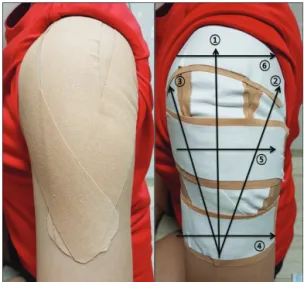
tape, NICHIBAN, Japan)와 탄성테이프(Benefact tape, NIPPON SIGMAX, Japan)을 이용하여 테이핑을 적용 하였다. 이 방법을 Jeonbuk tri-pull taping으로 명하였다 (Fig. 1). Jeonbuk tri-pull taping을 적용하는 순서는 대상 자가 팔을 옆으로 한 후 중립위치에 앉은 상태에서 팔꿉관절을 테이블 위에 편안히 올려놓고, 아탈구가 정복된 상태를 만든다 . 그리고 탄성테이프를 중간 어깨 세모근 기시부위에서 붙이기 시작하여 어깨뼈봉우리 까지 테이프를 붙인다 . 두 번째 테이프는 뒤 어깨세모 근에서, 세 번째 테이프는 뒤 어깨세모근에서 붙이는 방법을 이용하였다. 다음으로 비탄성테이프를 압박을 견고하게 가해주며 부착하였다. 다시 3장의 테이프를 어깨세모근의 기시부위 , 중간부위 및 어깨뼈봉우리부 위에 가쪽돌림 방향으로 테이프를 부착하였다 . 테이핑 적용은 매주 월 , 수, 금요일에 부착하여 2일간 계속 부착해 놓도록 하여 6주간 적용하였다. 연구대상자에 대한 탄성과 비탄성테이프의 부착은 관련 연수과정을 이수한 5년차 이상의 물리치료사에 의해 수행되었다.

뇌졸중 환자를 위한 어깨 아탈구에 대한 PNF운동 은 약 10분간 적용하였다. PNF운동은 팔꿉관절로 지 지한 상태에서 옆으로 앉은 자세(side sitting on elbow) 와 팔꿉관절로 지지한 상태로 엎드린 자세(prone on elbow)에서 치료사는 어깨뼈에 손을 올려놓고 “나의

Fig. 1. Jeonbuk tri-pull taping.

(5)

ՒխշնժսճԨ՜պձԵ՘սմմԨ՜թոձնկ৺Ԩ৞␞἖⎧ḯ῞঻ૺ⨇⛂ᦓԨ⎲თ⑲Ԩ໊╶☏Ԩ㍖⒎⑖Ԩ⊲୦৾┆Ԩࣾთᦒ␂ԴԨ⺳⚛ԴԨ≂ⷆ੪ԴԨ〒ԨମྣԨᤍغ ք ԹԿԹ

손에 대항해서 미세요.” 라는 구두지시를 이용하여 어깨관절에 안정성의 증가를 목적으로 안정적 반전 (stabilizing reversal) 기법을 적용하였다. 각각의 자세 에 대한 중재는 30초유지, 30초 휴식으로 하여 5세트를 수행하였다. PNF운동은 주 5회 6주간 적용하였다.

Ⅲ. 연구 결과

1. 연구대상자의 일반적인 특성

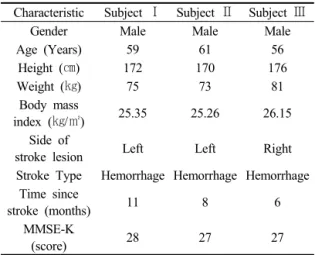
대상자의 일반적인 특성은 다음과 같다(Table 1).

2. 어깨관절 가동범위, 통증, 아탈구 거리, 팔의 기능, 일상생활수행능력의 변화

대상자들은 어깨관절 가동범위 사전 검사와 비교 하여 증가하였고, 통증과 아탈구 거리는 사전 검사와 비교하여 감소되었으며 , 팔의 기능과 일상생활수행능 력 역시 사전 검사와 비교하여 증가하였다(Table 2).

Ⅳ. 고 찰

본 연구는 아탈구를 가진 뇌졸중 환자를 대상으로 Jeonbuk tri-pull taping 방법이 어깨관절 가동범위, 통 증 , 아탈구 거리, 팔 기능 및 일상생활수행능력에 미치 는 효과를 규명하기 위해 시도하였다.

Brunnstrom (1970)은 뇌졸중 환자에서 나타나는 팔 다리의 움직임 패턴과 강직의 결합에 의한 고정화된 움직임을 시너지 패턴으로 설명하였고, 각 팔다리의 시너지 패턴은 팔에서 굽힘, 다리에서는 폄 경향이 강하다고 보고하였다. 반대로 뇌졸중 이후에 발생하 게 되는 근육약화의 양상은 몇몇 연구자들에 의해 보 고되어지고 있다. 팔에서 주로 약해지는 근육들은 손 가락의 폄근 , 손목 폄근, 팔꿈치 폄근, 어깨의 가쪽돌림 근 , 벌림근 및 폄근으로 이러한 근육의 약화는 다양한 기능들과 밀접하게 연관되어 있다(de Kroon et al.,

AROM VAS SD FMA MBI

Flexion Abduction

Subject Ⅰ

Pre-test 130.1 100.9 5.4 11.5 12 62

Post-test 148.5 119.2 3.5 7.4 19 70

Difference 18.4 18.3 1.9 4.1 7 8

Subject Ⅱ

Pre-test 142.7 106.2 4.9 11.7 13 66

Post-test 153.1 117.7 3.4 7.7 22 74

Difference 10.4 11.5 1.5 4 9 8

Subject Ⅲ

Pre-test 125.8 104.5 5.8 9.9 14 66

Post-test 138.1 112.9 3.9 6.8 23 74

Difference 12.3 8.4 1.9 3.1 9 8

Difference mean 13.70±4.18 12.73±5.06 1.77±0.23 3.73±0.55 8.33±1.15 8.00 AROM: active range of motion, VAS: visual analog scale, SD: subluxation distance, FMA: Fugl-Meyer assessment, MBI: modified Barthel index.

Table 2. The changes of pre-test and post-test of subject Characteristic Subject Ⅰ Subject Ⅱ Subject Ⅲ

Gender Male Male Male

Age (Years) 59 61 56

Height (㎝) 172 170 176

Weight (㎏) 75 73 81

Body mass

index (㎏/㎡) 25.35 25.26 26.15 Side of

stroke lesion Left Left Right Stroke Type Hemorrhage Hemorrhage Hemorrhage

Time since

stroke (months) 11 8 6

MMSE-K

(score) 28 27 27

MMSE-K: mini mental state examination-Korea.

Table 1. General characteristics of subjects

(6)

ԹԿԺ ք ՘ՖՎԨթնլԨՕշվխյխնռԨ՞շմԶԨԹԿԴԨՖշԶԨԺ

2005). Calliet (1991)은 뇌졸중 이후 초기 이완성 마비 에 의하여 위팔뼈의 머리가 아래쪽으로 움직이는 것 을 방지하는 가시위근과 어깨세모근 등이 제 역할을 하지 못하고, 어깨뼈 또한 회전하여 어깨뼈의 관절오 목이 아래쪽을 향하게 되어 아탈구가 발생하기 쉬워 진다고 하였다. de Kroon 등(2005)이 보고한 어깨의 가쪽돌림근과 벌림근 및 폄근의 약화가 아탈구와 관 련성이 있음을 알 수 있다. 본 연구에 중재방법으로 활용된 Jeonbuk tri-pull taping은 탄성테이프와 비탄성 테이프를 이용하여 어깨의 벌림과 폄의 역할을 하지 못하는 어깨세모근의 중간, 뒤, 앞 섬유에 테이프를 부착하였으며, 가시위근의 역할인 가쪽돌림 방향으로 테이프를 부착하였다. 이와 같은 테이프의 부착으로 피부와 근육에 감각자극을 지속적으로 발생시켜 근육 활동(muscle activity)을 증가시키고(Lee & Lim, 2013), 고유수용성 감각을 향상시키므로 (Choi et al., 2013) 어 깨관절에 안정화에 도움을 주게 되어(Faghri et al., 1994) 6주간 중재를 진행한 결과 능동 굽힘은 평균 13.70±4.18도 증가, 능동 벌림은 평균 12.73±5.06도 증 가, 어깨관절 통증은 평균 1.77±0.23점의 감소, 어깨관 절 아탈구 거리는 평균 3.73±0.55 mm의 감소를 보였 다. 관절가동범위, 통증 및 아탈구 거리와 같은 신체 구조와 기능의 향상으로 신체활동 및 참여를 이끌어 낼 수 있는 팔 기능이 평균 8.33±1.15점의 향상, 일상생 활수행능력이 평균 8.00점의 향상을 보인 것으로 사료 된다. Lee 등(2009)은 어깨세모근과 가쪽돌림근에 탄 성테이프를 적용하여 어깨통증의 감소를 보였으며, Kim과 Kim (2015)은 어깨세모근과 허리네모근에 탄 성테이프를 적용하여 팔 기능에 향상을 보였고, Huang 등(2016)은 어깨세모근과 가시위근에 탄성테이프를 적용하여 관절가동범위, 통증, 경직, 팔 기능에 향상을 얻었으며, 본 연구에서 어깨세모근과 가쪽돌림근의 역할 위해 적용한 Jeonbuk tri-pull taping방법을 지지해 준다.

본 연구에서 PNF운동은 팔꿉관절로 지지한 상태에 서 옆으로 앉은 자세와 팔꿉관절로 지지한 상태로 엎 드린 자세에서 어깨관절에 안정성의 증가를 목적으로

안정적 반전기법을 적용하였다. PNF운동 자세를 살펴 보면 , Krause 등(2018)의 연구에서 팔꿈관절로 지지한 상태에서 옆으로 앉은 자세는 어깨관절을 강화시킬 수 있는 자세 중 하나로 가시위근을 활성화 시킬 수 있으며, Ju와 Yoo (2015)은 팔꿉관절로 지지한 상태로 엎드린 자세는 어깨세모근의 활성도를 높일 수 있다 고 보고 하였다 . 가시위근과 어깨세모근의 약화는 아 탈구를 유발하는 원인으로(Calliet, 1991) 본 연구의 PNF운동 자세는 선행연구를 비춰볼 때 가시위근과 어깨세모근의 활성도를 높여 아탈구를 감소시킬 수 있는 자세로 사료된다 . 또한, PNF운동은 다양한 자세에 서 도수접촉 (manual contact), 구두명령(verbal command) 및 시각(vision)과 같은 외수용기(exteroceptive)와 신장 (stretch), 견인(traction), 압축(approximation) 및 저항 (resistance)와 같은 고유수용기를 자극하여 대상자가 원하는 신체기능과 활동을 이끌어 낼 수 있는 방법으 로(Adler et al., 2016) 대상자의 어깨관절에 안정성을 제공할 수 있는 자세에서 다양한 방법으로 외수용기 와 고유수용기를 자극하여 어깨관절에 안정성의 증가 로 어깨관절 가동범위 , 통증, 아탈구 거리, 팔의 기능 및 일상생활수행능력에 변화를 얻은 것으로 사료된 다 . 또한, 운동과 함께 안정적 반전기법을 적용하였는 데 , 이 기법은 주동근과 길항근의 교대 또는 동시 수축 을 유도하여 자세의 안정성을 이끌어 낼 수 있는 방법 으로 (Adler et al., 2016) Kim 등(2018)은 손목 불안정성 으로 손목통증을 호소하는 대상자에게 안정적 반전기 법과 테이핑을 적용하여 손목통증과 악력에 향상을 보였고, 안정적 반전기법은 적용부위의 근력과 안정 성을 높일 수 있다고 하였다 (Kang & Ham, 2014). 이와 같이 안정적 반전기법이 어깨 관절에 적용되면서 어 깨 주변근육의 근력과 안정성이 향상되어 이러한 결 과를 보인 것으로 사료 된다.

본 연구의 Jeonbuk tri-pull taping과 함께 적용한 PNF

운동은 아탈구가 있는 뇌졸중 환자의 어깨관절 가동

범위 , 통증, 아탈구 거리, 팔 기능 및 일상생활수행능력

을 향상시키는데 효과적이었다. 본 연구는 대상자가

3명으로 모든 아탈구가 있는 뇌졸중 환자에게 일반화

(7)

ՒխշնժսճԨ՜պձԵ՘սմմԨ՜թոձնկ৺Ԩ৞␞἖⎧ḯ῞঻ૺ⨇⛂ᦓԨ⎲თ⑲Ԩ໊╶☏Ԩ㍖⒎⑖Ԩ⊲୦৾┆Ԩࣾთᦒ␂ԴԨ⺳⚛ԴԨ≂ⷆ੪ԴԨ〒ԨମྣԨᤍغ ք ԹԿԻ

할 수는 없지만 앞으로의 연구에서 대상자 수를 늘리 고 다른 방법과 비교하여 연구를 진행하면 더 의미 있는 결과를 얻을 것으로 사료된다.

Ⅴ. 결 론

본 연구는 아탈구가 있는 뇌졸중 환자를 대상으로 Jeonbuk tri-pull taping과 고유수용성신경근촉진법운 동이 어깨관절 가동범위 증가, 통증 감소, 아탈구 거리 감소, 팔 기능 및 일상생활수행능력 향상에 효과가 있었다. 따라서 뇌졸중 환자에게 적용되는 중추신경 계발달치료도 좋지만 테이핑을 접목하여 중재를 진행 한다면 더욱 효과적인 결과를 얻을 것으로 여겨진다.

References

Adler SS, Beckers D, Buck M. PNF in practice: an illustrated guide, 4th ed. Heidelberg. Springer. 2016.

Arya KN, Pandian S, Puri V. Rehabilitation methods for reducing shoulder subluxation in post-stroke hemiparesis: a systematic review. Topics in Stroke Rehabilitation.

2018;25(1):68-81.

Bong SN, Kim YJ, Kang MG, et al. Effects of proprioceptive neuromuscular facilitation exercise on forced expiratory volume at one second, pain, and functional disability index of chronic low back pain patients.

PNF and Movement. 2016;14(3):185-193.

Brunnstrom S. Movement therapy in hemiplegia: a neurophysiological approach. New York. Harper &

Row. 1970.

Calliet R. Shoulder pain. Philadelphia. FA Davis Co. 1991.

Chatterjee S, Arumugam N, Midha D, et al. Effect of California tri-pull taping method on shoulder subluxation, pain, active range of motion and upper limb functional recovery after stroke: a pretest post test design.

American Journal of Psychiatry and Neuroscience.

2015;3(5):98-103.

Chatterjee S, Hayner KA, Arumugam N, et al. The California tri-pull taping method in the treatment of shoulder subluxation sfter stroke: a randomized clinical trial.

North American Journal of Medicine and Science.

2016;8(4):175-182.

Choi YK, Nam CW, Lee JH, et al. The effects of taping prior to PNF treatment on lower extremity proprioception of hemiplegic patients. Journal of Physical Therapy Science. 2013;25(9):1119-1122.

Dajpratham P, Sura P, Lektrakul N, et al. Efficacy of shoulder slings in shoulder subluxation of stroke patients.

Journal of the Medical Association of Thailand.

2006;89(12):2050-2055.

de Kroon JR, Ijzerman MJ, Chae J, et al. Relation between stimulation characteristics and clinical outcome in studies using electrical stimulation to improve motor control of the upper extremity in stroke. Journal of Rehabilitation Medicine. 2005;37(2):65-74.

Faghri PD, Rodgers MM, Glaser RM, et al. The effects of functional electrical stimulation on shoulder subluxation, arm function recovery, and shoulder pain in hemiplegic stroke patients. Archives of Physical Medicine and Rehabilitation. 1994;75(1):73-79.

Gladstone DJ, Danells CJ, Black SE. The fugl-meyer assessment of motor recovery after stroke: a critical review of its measurement properties. Neurorehabilitation and Neural Repair. 2002;16(3):232-240.

Hayes KW, Sullivan JE. Reliability of a new device used to measure shoulder subluxation. Physical Therapy.

1989;69(9):762-767.

Hayner KA. Effectiveness of the California tri-pull taping method for shoulder subluxation poststroke: a single-subject ABA design. American Journal of Occupational Therapy. 2012;66(6):727-736.

Huang YC, Leong CP, Wang L, et al. Effect of kinesiology

(8)

ԹԿԼ ք ՘ՖՎԨթնլԨՕշվխյխնռԨ՞շմԶԨԹԿԴԨՖշԶԨԺ

taping on hemiplegic shoulder pain and functional outcomes in subacute stroke patients: a randomized controlled study. European Journal of Physical and Rehabilitation Medicine. 2016;52(6):774-781.

Jang SH, Yi JH, Chang CH, et al. Prediction of motor outcome by shoulder subluxation at early stage of stroke.

Medicine. 2016;95(32):4525.

Jeong WM, Kim BR, Kang MG. Effect of treadmill training and proprioceptive neuromuscular facilitation lower leg taping on balance and gait ability in stroke patients.

PNF and Movement. 2016;14(2):83-91.

Jeong WM, Kim BR. The effects of proprioceptive neuromuscular facilitation exercise on the pain and functional disability index of patients with chronic lower back pain. PNF and Movement. 2017;15(2):

195-200.

Ju SK, Yoo WG. Electromyography activity of the deltoid muscle of the weight-bearing side during shoulder flexion in various weight-bearing positions. Journal of Physical Therapy Science. 2015;27(10):3285-3286.

Kalichman L, Ratmansky M. Underlying pathology and associated factors of hemiplegic shoulder pain.

American Journal of Physical Medicine and Rehabilitation. 2011;90(9):768-780.

Kang SJ, Kim IS. Effects of a taping therapy on shoulder range of motion and pain, physical function and depression of stroke patients with hemiplegia. Korean Journal of Adult Nursing. 2012;24(3):294-304.

Kang TW, Ham KH. Effect of trunk stability exercises with stabilizing reversal and rhythmic stabilization of PNF for muscle strength and balance ability in stroke patients. Journal of Korea Proprioceptive Neuromuscular Facilitation Association. 2014;12(2):

63-69.

Kim BR, Lee HJ. Effects of proprioceptive neuromuscular facilitation-based abdominal muscle strengthening training on pulmonary function, pain, and functional

disability index in chronic low back pain patients.

Journal of Exercise Rehabilitation. 2017;13(4):

486-490.

Kim BR, Yi DH, Yim JE. Effect of stabilizing reversal technique of proprioceptive neuromuscular facilitation and taping convergence on wrist pain and grip strength.

Journal of the Korea Convergence Society.

2018;9(7):117-124.

Kim CH, Kim BR, Kang MG. Effect of rhythmic stabilization technique, before proprioceptive neuromuscular facilitation wrist taping, on grip strength and pain in wrist pain patients. Journal of Korea Proprioceptive Neuromuscular Facilitation Association. 2016;14(2):

105-112.

Kim CH, Kim BR. The effects of abdominal strength training using proprioceptive neuromuscular facilitation on the balance ability and pain of patients with chronic lower back pain. PNF and Movement. 2017;15(2):

141-148.

Kim EB, Kim YD. Effects of kinesiology taping on the upper-extremity function and activities of daily living in patients with hemiplegia. Journal of Physical Therapy Science. 2015;27(5):1455-1457.

Kim MK, Ji SK, Jun HJ, et al. The effect of modified CIMT combined with kinesio-taping on upper limb function in hemiplegic patients. Journal of the Korean Society of Physical Medicine. 2009;4(3):183-192.

Klein DA, Stone WJ, Phillips WT, et al. PNF training and physical function in assisted-living older adults.

Journal of Aging and Physical Activity. 2002;10(4):

476-488.

Ko DI. Algiswiun kinesio taping yobeob. Seoul. Pureussub.

2000.

Krause DA, Dueffert LG, Postma JL, et al. Influence of body position on shoulder and trunk muscle activation during resisted isometric shoulder external rotation.

Sports Health. 2018;10(4):355-360.

(9)

ՒխշնժսճԨ՜պձԵ՘սմմԨ՜թոձնկ৺Ԩ৞␞἖⎧ḯ῞঻ૺ⨇⛂ᦓԨ⎲თ⑲Ԩ໊╶☏Ԩ㍖⒎⑖Ԩ⊲୦৾┆Ԩࣾთᦒ␂ԴԨ⺳⚛ԴԨ≂ⷆ੪ԴԨ〒ԨମྣԨᤍغ ք ԹԿԽ

Kwon OS, Kim SY, Oh DW, et al. Effects of non-stretchable and stretchable tapes used for strapping shoulder subluxations in stroke patients. Korean Journal of Health Promotion. 2010;10(3):139-146.

Lee JN, Lim CG. Effects of scapular taping on muscle activity, pain, range of motion and proprioception in subacute stroke patients. Journal of the Korea Academia- Industrial cooperation Society. 2013;14(11):5689-5697.

Lee JH, Jeong HJ, Sim YJ, et al. The effect of strapping on hemiplegic shoulder subluxation: a pilot study.

Brain & Neurorehabilitation. 2009;2(1):78-84.

Macdonald R. Taping techniques principles and practice, 2nd ed. New York. Elsevier. 2007.

Pandian JD, Kaur P, Arora R, et al. Shoulder taping reduces injury and pain in stroke patients randomized controlled trial. Neurology. 2013;80(6):528-532.

Peterson C. The use of electrical stimulation and taping to address shoulder subluxation for a patient with central cord syndrome. Physical Therapy. 2004;84(7):

634-643.

Shah S, Vanclay F, Cooper B. Improving the sensitivity of the Barthel index for stroke rehabilitation. Journal of Clinical Epidemiology. 1989;42(8):703-709.

Song MS, Kim BR. Application of proprioceptive neuromuscular facilitation to improve upper extremity function and activity of daily living in stroke patients:

a case report. Journal of Korea Proprioceptive Neuromuscular Facilitation Association. 2015;13(3):

155-162.

Song MS, Kim BR, Kim CH, et al. A case report of a proprioceptive neuromuscular facilitation intervention strategy applied with an ICF tool in a patient with anterior cruciate ligament reconstruction. PNF and Movement. 2017;15(1):1-11.

van Bladel A, Lambrecht G, Oostra KM, et al. A randomized controlled trial on the immediate and long-term effects of arm slings on shoulder subluxation in stroke patients. European Journal of Physical and Rehabilitation Medicine. 2017;53(3):400-409.

Wagner DR, Tatsugawa K, Parker D, et al. Reliability and utility of a visual analog scale for the assessment of acute mountain sickness. High Altitude Medicine and Biology. 2007;8(1):27-31.

Walsh K. Management of shoulder pain in patients with stroke.

Postgraduate Medical Journal. 2001;77(912):

645-649.

Werner BC, Holzgrefe RE, Griffin JW, et al. Validation of an innovative method of shoulder range-of-motion measurement using a smartphone clinometer application. Journal of Shoulder and Elbow Surgery.

2014;23(11):e275-e282.

수치

Fig. 1. Jeonbuk tri-pull taping.
Table 2. The changes of pre-test and post-test of subjectCharacteristicSubject  ⅠSubject  ⅡSubject  Ⅲ

참조

관련 문서

Background: The purpose of this study is on finding the effects of the lumbar stabilization exercise applied with the proprioceptive neuromuscular facilitation technique (PNF) to

Effect of Proprioceptive Neuromuscular Facilitation Stretching on Pain, Hip Joint Range of Motion, and Functional Disability in Patients with Chronic Low Back Pain.. Beomryong Kim

Purpose: This study attempts to identify the effects of stretching and core exercise using proprioceptive neuromuscular facilitation (PNF) on the pain and functional

Purpose: This study seeks to determine the effect of a lower extremity strengthening exercise that uses proprioceptive neuromuscular facilitation (PNF) on the gait and

Purpose: This study investigates how abdominal muscular exercise based on proprioceptive neuromuscular facilitation (PNF) can affect chronic low back pain patients in terms

Purpose: The current study aims to identify the effects of proprioceptive neuromuscular facilitation (PNF) on pain and grip strength in patients with cervical

Purpose: The current study seeks to identify the effect of neck muscle strengthening exercise using proprioceptive neuromuscular facilitation (PNF) on the swallowing

Conclusion: Proprioceptive neuromuscular facilitation exercises have confirmed that lower extremity function improves after exercise interventions in chronic stroke