| Abstract |
Purpose: We sought to examine whether using the rhythmic stabilization (RS) technique before proprioceptive neuromuscular facilitation (PNF) wrist taping affected pain and grip strength in patients with wrist pain to provide a basis for the application of PNF taping.
Methods: The study consisted of 41 badminton enthusiasts (aged 20–40 years) who reported discomfort and pain due to overuse of their wrists. The subjects were randomly assigned to an experimental group (n=20) or a control group (n=21). In the experimental group, PNF wrist taping was applied after application of the PNF RS technique, and PNF wrist taping was applied after stretching in the control group. The tape was applied five times a week for 3 weeks. Pain was measured using the visual analog scale (VAS).
Grip strength was measured using a dynamometer. The paired t-test was performed to compare grip strength and pain within the groups before and after the intervention. Covariance analysis was conducted to compare differences between the experimental group and control group. The level of significance was set as α=0.05.
Results: Within-group changes in grip strength and VAS were significantly different in the control group and experimental group (p<0.01). Grip strength and VAS showed more improvement in the experimental group than in the control group (p<0.01).
Conclusion: PNF wrist taping after stretching and the PNF RS technique both significantly reduced pain and improved grip strength in club badminton players with wrist pain. These improvements were significantly greater in the experimental group in which the PNF RS technique was applied. The results suggest that PNF may be considered useful to improve grip strength and reduce wrist pain.
Key Words: Grip strength, Proprioceptive neuromuscular facilitation (PNF), Visible analogue scale (VAS), Wrist pain
†Corresponding Author : Beom-Ryong Kim ([email protected])
Original Article Open Access
The Effect of Proprioceptive Neuromuscular Facilitation Wrist Taping and Rhythmic Stabilization Technique on Pain and Grip Strength
in Badminton Players with Wrist Pain
Myung-Soo Song⋅Jeong-Il Kang
11⋅Beom-Ryong Kim
2†1)Dr. Song’s Rehabilitation Institute of Science and Academy
1
Department of Physical Therapy, Sehan University
2
Department of Physical Therapy, Design Hospital
Received: January 4, 2018 / Revised: February 20, 2018 / Accepted: February 21, 2018
ⓒ 2018 Journal of Korea Proprioceptive Neuromuscular Facilitation Association
This is an Open Access article distributed under the terms of the Creative Commons Attribution Non-Commercial License
(http://creativecommons.org/licenses/by-nc/3.0) which permits unrestricted non-commercial use, distribution, and reproduction
in any medium, provided the original work is properly cited.
Ⅰ. Introduction
Musculoskeletal disorders involve pain or impaired function in the body’s movement system due to cumulative damage to bones, joints, or nerves caused by excessive force, insufficient rest, or incorrect posture (Lee et al., 2015). A study by Kang (2014) involving 143 badminton players reported musculoskeletal disorders in the ankle in 41 (28.7%) subjects, in the shoulder in 28 (19.6%) subjects, and in the upper extremity (elbow and wrist) in 24 (16.8%) subjects. Moreover, in an investigation into sports injuries in 300 badminton enthusiasts, Yang (2011) reported musculoskeletal disorders in the ankle in 29.7%, in the upper extremity (the elbow and wrist) in 24.4%, in the shoulder in 19.6%, and in the lumbar spine in 11.5%
of subjects. This shows that a large number of badminton players experience wrist and shoulder pain, which may be related to the use of the racket, as well as ankle pain.
Proprioceptive neuromuscular facilitation (PNF) is aimed at improving the ability of muscles and tendons to stimulate receptors in the joints (Klein et al., 2002), and has been shown to increase muscle strength, flexibility, and balance ability (Lee & Kim, 2013), and to improve body function and motor function (Akbulut
& Agopyan, 2015; Rhyu et al., 2015). PNF has been widely used in the treatment of musculoskeletal disorders and central nervous system disorders such as stroke (Alaca et al., 2015; Kim et al., 2015). The basic procedures used in PNF aim to increase movement by combining motions moving more than one joint at a time, in order to facilitate the recruitment of additional muscle fibers. PNF is thought to work via a mechanism similar to the sports taping method, through the static stretch reflex and the inverse stretch reflex. Therefore, attaching sports taping in combination with PNF may improve the function of both methods. In addition, rhythmic stabilization (RS), a PNF technique, is used to reduce pain caused by instability
of the joint through principles based on Sherrington’s continuous-induced reversal of antagonists technique (Adler er al., 2008).
Referring to previous research related to sports taping, Song et al. (2016) found that sports taping application for patients with lateral epicondylitis can improve strength and reduce pain. Park and Kim (2012) found a resulting improvement in grip strength and muscle activity when sports taping was applied to women with lateral epicondylitis, and Kim et al. (2016) showed reduced pain and improvement of grip strength when sports taping was applied to patients with wrist pain.
Thus, sports taping can be applied to reduce pain, improve joint range of motion, and improve power and muscle activity. Therefore, sports taping the wrist in patients who have difficulty in activities may be used as a therapeutic method to decrease pain and increase grip strength in the wrist. So far, however, previous studies applied to wrist pain are incomplete. In particular, research involving sports taping utilizing PNF is nonexistent.
In this study, we applied PNF RS technique before wrist taping, to learn how this affects pain and grip strength in patients who complain of pain in the wrist when compared to wrist taping applied after simple stretching exercises. This aims to provide a research basis for PNF taping.
Ⅱ. Research Methods 1. Study subjects
The subjects of this study were 41 adult members of
H & S badminton club, J City, aged between 20 and
40 years, with pain scores of more than 5 on the visual
analogue scale (VAS) due to overuse of the wrist. It was
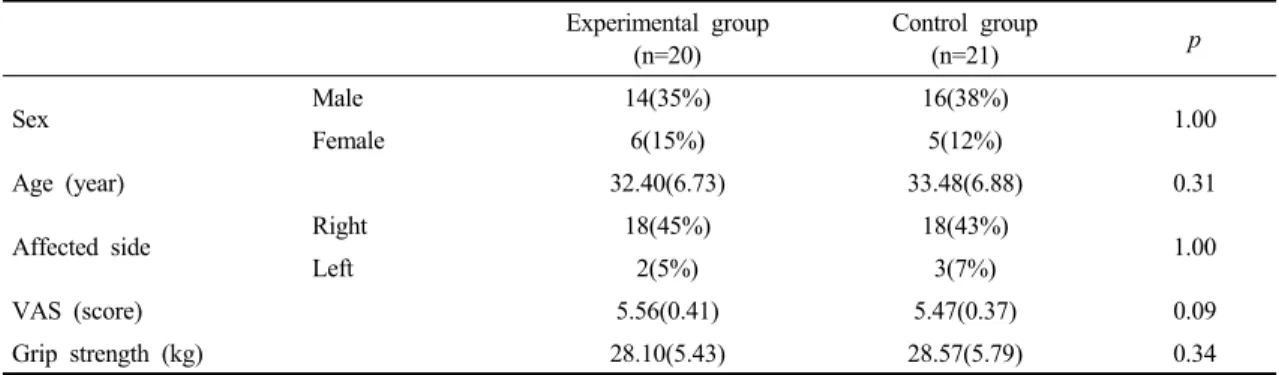
performed over 3 weeks, from April to May 2016. Subjects voluntarily participated after receiving a full description of this study. Subjects were randomly assigned to the experimental group (n=20), applying the PNF wrist taping after the application of PNF RS technique, and the control group (n=21) applying the PNF wrist taping after the application of stretching. The general characteristics of the study subjects are as follows (Table 1).
2. Research Methods 1) PNF wrist taping
PNF wrist taping was performed using an elastic tape (Benefact tape, NIPPON SIGMAX, Japan), with length between 60 and 80 cm, depending on the diameter of the forearm. The tape was attached to the wrist extensors and flexors whilst in an elongated position (shoulder extension-adduction-internal rotation-wrist radial flexion with finger flexion and flexion-abduction-external rotation-wrist ulnar extension with finger extension pattern, shoulder flexion-adduction-external rotation-wrist ulnar flexion with finger flexion and extension-abduction-internal rotation-wrist radial extension with finger extension pattern). An elastic tape of length 15cm was attached to the wrist, starting from the anatomical snuffbox 3cm from
the base of the thumb (Fig. 1).
Fig. 1. PNF wrist taping.
2) PNF RS technique
The RS technique method of PNF was performed in the experimental group whilst positioned supine on a table.
The therapist carried out RS techniques in two directions diagonally for the affected wrist (shoulder joint at 90°
flexion, elbow extended, forearm neutral, and wrist neutral). The RS techniques for the wrist were performed five times per week (composed of five repeated sets for up to five minutes including breaks; 10 seconds for each
Experimental group (n=20)
Control group
(n=21) p
Sex Male 14(35%) 16(38%)
Female 6(15%) 5(12%) 1.00
Age (year) 32.40(6.73) 33.48(6.88) 0.31
Affected side Right 18(45%) 18(43%)
Left 2(5%) 3(7%) 1.00
VAS (score) 5.56(0.41) 5.47(0.37) 0.09
Grip strength (kg) 28.10(5.43) 28.57(5.79) 0.34
Values are presented as mean (standard deviation) VAS : visible analogue scale.
Table 1. General characteristics of the study subjects (n=41)
diagonal direction) for three weeks.
3) Stretching
For the control group, stretches were performed in a supine position on a table. The therapist carried out flexion and extension stretching on the affected wrist (shoulder joint at 90° flexion, elbow extended, forearm neutral, and wrist neutral). Stretching was performed five times per week (composed of five repeated sets for up to five minutes including breaks; 20 seconds for each flexion and extension) for three weeks.
3. Measurements 1) Measurement of pain
Pain was assessed using a VAS (0–10 cm; 0 means no pain, 10 means severe pain). The examination and retest cross-reliability was r=0.96 (Sindhu et al., 2011).
2) Measurement of grip strength
Grip strength was measured using a dynamometer (Jamar Hydraulic Hand Dynamometer, Preston, USA). For maximum strength and to increase objectivity, this was measured a sitting position (internal rotation of the shoulder, pronation of the forearm, 90° flexion of the elbow
and slight shoulder abduction to allow for the dynamometer handles to fit between the hand and body) in a chair without armrests (Fess & Moran, 1981). The examination and retest cross reliability was r=0.98 (Savva et al., 2014). The measurement was the mean value of 3 measurements gripping for 5seconds without causing pain.
4. Data analysis
The statistical analysis was performed using SPSS for Windows version 18(SPSS Inc., Chicago, IL, USA). The Shapiro-Wilk test was used to check the normal distribution of data. The paired t-test was performed to compare differences in grip strength and pain within the groups before and after intervention. The analysis of covariance test was performed in order to compare the differences between the experimental group and control group. The level of significance was set at α=0.05.
Ⅲ. Results
1. Within-group changes in pain and grip strength
Within-group changes in VAS were significantly different in both the experimental group (p<0.01) and the control group (p<0.01). Within-group changes in grip
Group Pre Post t p
VAS Experimental 5.56(0.41) 1.45(0.75) 20.96 0.00*
Control 5.47(0.37) 2.15(0.54) 21.37 0.00*
Grip strength (kg) Experimental 28.10(5.43) 35.10(7.01) -10.41 0.00*
Control 28.57(5.79) 32.33(6.94) -7.96 0.00*
Values are presented as mean (standard deviation) VAS : visual analogue scale
*p<0.01.
Table 2. Within-group changes in pain and grip strength
strength were also significantly different in the experimental group (p<0.01) and in the control group (p<0.01) (Table 2).
2. Changes in pain and grip strength between the experimental group and the control group
There was more reduction in the VAS in the experimental group than in the control group (p<0.01).
grip strength also improved significantly more in the experimental group than in the control group (p<0.01) (Table 3).
Ⅳ. Discussion
This study examined the treatment of wrist pain in 41 badminton club enthusiasts aged between 20-40 years with discomfort and pain due to overuse of the wrist.
Subjects were divided into the control group (21 subjects) in whom PNF wrist taping was applied after stretching and the experimental group (20 subjects) in whom PNF wrist taping was applied after PNF RS technique. We examined how these treatment affected the VAS and grip strength after performing the intervention 5 times a week for 3 weeks.
Taping of the flexor muscle group and extensor muscle group in patients with wrist pain seems to act as an element
of tactile stimulus, indirectly stimulating the skin receptor in the wrist, promoting stability, and help the muscle contraction function through compression of taping. Wrist pain due to excessive use of the wrist can cause stress of the overly used muscle and decreased stability of the joint (Park et al., 2010). Stretching can promote increase of myotendinal junction of the cooperating muscles accompanying the wrist joint (Appell, 1990), and this increase can further promote contraction of the muscle, which seems to be the cause of increased muscle strength.
PNF RS technique can improve stability and reduce pain through simultaneous contraction of the antagonist and agonist muscles of weakened antagonist muscle groups or unstable of wrist joint (Adler et al., 2008). Thus, the purpose of this the present study was to compare the difference in PNF RS technique and stretching based on the purpose. PNF RS technique allows the patient to withstand the force applied by the therapist and gradually increase the resistance. During the intervention, the resistance differed depending on the therapist, and this difference among therapists can be reduced if a scale is used to measure the resistance.
Ro (2010) showed a significant improvement in the VAS after 3 interventions of sports taping per week for 4 weeks in 40 subjects aged over 65 years with pain in the shoulder joint. Kim et al. (2016) showed a significant improvement in the VAS before and after treatment, after applying sports taping to 15 patients, aged
Experimental Control F p
VAS Pre 5.56(0.41) 5.47(0.37)
11.02 0.00*
Post 1.45(0.75) 2.15(0.54)
Grip strength (kg) Pre 28.10(5.43) 28.57(5.79)
18.29 0.00*
Post 35.10(7.01) 32.33(6.94)
Values are presented as mean (standard deviation) VAS : visual analogue scale
*p<0.01.
Table 3. Changes in pain and grip strength between the experimental group and the control group