| Abstract |
Purpose: The current study (case report) seeks to examine the effects of a proprioceptive neuromuscular facilitation (PNF) exercise program on the upper extremity function and activities of daily living (ADLs) in a stroke patient.
Methods: The subject was a 42 year-old woman diagnosed with right-sided hemiplegia due to stroke. Exercise therapy was provided for 50 minutes per day (5-minute warm-up, 40-minute exercise, 5-minute wrap-up) three times per week for a four-week period. The manual function test (MFT) was used to evaluate upper extremity functions. The modified Barthel index (MBI) was utilized to measure ADL.
Results: After intervention using various PNF program, the MFT score increased from 23 to 26 and the MBI score increased from 62 to 66.
Conclusion: After the application of the PNF program, the MFT and MBI scores increased. As compensative movement of the upper extremities declined, the movement of the upper extremities became faster and softer.
Key Words: ADL, PNF, Upper Extremity Function
†Coressponding Author : Beom-Ryong Kim ([email protected])
Journal of Korea Proprioceptive Neuromuscular Facilitation Association, 2015; 13(3): 155-162 Print ISSN: 1598-933X
Case Report Open Access
뇌졸중 환자의 상지 기능과 일상생활수행능력 향상을 위한 고유수용성신경근촉진법 적용: 증례보고
송명수⋅김범룡†5) 원광대학교 물리치료과
Application of Proprioceptive Neuromuscular Facilitation to Improve Upper Extremity Function and Activity of Daily Living in Stroke Patients
:A Case Report
Myung-Soo Song⋅Beom-Ryong Kim†
Department of Physical Therapy, Wonkwang Health Science University Received: July 10, 2015 / Revised: July 30, 2015 / Accepted: August 02, 2015
ⓒ 2015 Journal of Korea Proprioceptive Neuromuscular Facilitation Association
This is an Open Access article distributed under the terms of the Creative Commons Attribution Non-Commercial License (http://creativecommons.org/licenses/by-nc/3.0) which permits unrestricted non-commercial use, distribution, and reproduction in any medium, provided the original work is properly cited.
Ⅰ. 서 론
뇌졸중은 손상된 부위와 정도에 따라 편마비, 운동 장애, 감각장애, 지각장애, 인지장애, 언어장애, 연하 장애 등 다양한 문제점을 보인다(Nyberg & Gustafson, 1995). 뇌졸중으로 인한 편마비 환자들은 69% 이상이 마비측 상지에서 기능적인 운동장애를 겪고 있으며, 하지에 비해서 상지에서 현저한 운동장애를 보인다 (Luke et al, 2004). 이것은 뇌 영역 대부분이 상지관련 영역이 존재하며, 상지의 운동기능을 담당하는 영역 에 산소와 영양분을 공급하는 중대뇌동맥의 혈관손상 이 전체 뇌졸중 환자의 75%을 차지하기 때문에 일상 생활수행능력에 필수적인 상지기능에 제한이 심각하 게 발생한다(Langhorne et al, 2009). 하지는 양쪽을 사 용하여야 기능적인 동작이 가능하므로 회복 초기부터 기능적인 걷기가 가능하지만 상지는 한쪽만으로도 기 능적인 동작이 가능하여 마비측 상지 보다는 비마비 측 상지에 많이 의존하게 되어 기능회복에 제한을 가 져온다(Langhorne et al, 2009).
상지의 기능은 뻗기, 집기와 같은 기능적인 움직임 을 동반한 개인위생, 식사하기, 옷을 입고 벗기 등 편마 비 환자의 삶의 질과 일상생활동작 수행에 있어서 기 능적인 독립을 이루기 위한 중요한 요소로 다른 보조 수단을 활용해야 하는 편마비 환자의 상실감은 다른 무엇보다도 크다고 할 수 있으며(Kim et al, 2010), 상지 기능의 손상은 편마비환자들의 기능회복과 많은 연관 성을 가지고 있다.
상지 기능의 회복을 위해서는 근위부의 회복과 쥐 기(Grasp), 조작하기(Manipulation)같은 미세한 원위부 의 회복이 필요하며(Han et al, 2009), 편마비 환자의 상지 기능을 향상시키기 위해서는 실제 환경과 과제 를 반복적으로 연습하고 훈련하는 것이 효과적이다 (Liepert et al, 2000). 편마비 환자에게 적용한 마비측의 집중적인 움직임의 반복은 상지 근육 동원 영역이 유 의하게 확대되고 상지관련 뇌 영역이 동원되어 6개월 후에도 지속적인 효과가 유지된다(Liepert et al, 1998).
고 유 수 용 성 신 경 근 촉 진 법( p r o p r i o c e p t i v e
neuromuscular facilitation, PNF)는 고유수용성 감각을 촉진하여 신경근육을 활성화시키는 방법으로 촉진을 위 한 기본적인 기법(basic procedures), 치료기법(techniques), 철학(philosophy)을 이용하여 환자의 기능을 향상시킨 다(Alder et al, 2000). 최근의 고유수용성신경근촉진법 이 상지기능과 일상생활수행능력에 미치는 연구를 살 펴보면, Bang 등(2013)은 PNF를 이용한 과제지향훈련 이 만성뇌졸중환자의 상지기능과 일상생활수행능력 을 증가시켰다고 하였고, Lee(2011)은 PNF을 간접적 적인 치료방법이 동결견 환자의 관절가동범위 증가와 통증감소에 효과적인 중재 방법이라고 하였다.
본 연구(증례보고)는 편마비 환자의 상지기능을 향 상시키고, 일상생활동작 수행능력을 향상시키기 위한 고유수용성신경근촉진법 운동프로그램을 제시하고 운동 후 환자의 상지기능과 일상생활동작 수행능력의 변화를 알아보고자 한다.
Ⅱ. 연구 방법
1. 환자의 병력과 특성
대상자는 42세 여성으로 2013년 12월 25일 J시 소재 대학병원에서 뇌졸중으로 우측 편마비를 진단받았다. 2015년 1월 6일 J시 소재 D병원에 포괄적인 재활치료 를 위하여 입원하였다. 일반적인 물리치료는 하지운 동에 중점을 두어 신경계 운동치료, 보행훈련, 작업치 료를 주5회 하루 1회 실시되었다. 대상자는 연구 과정
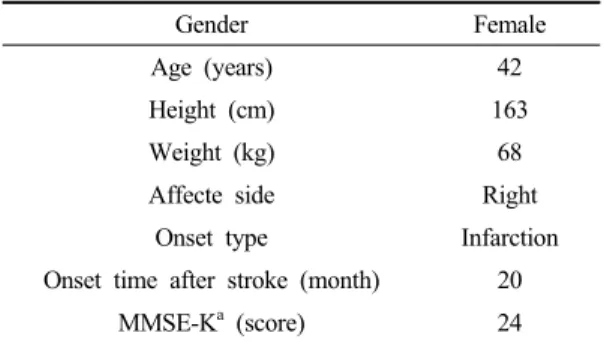
Gender Female
Age (years) 42
Height (cm) 163
Weight (kg) 68
Affecte side Right
Onset type Infarction
Onset time after stroke (month) 20
MMSE-Ka (score) 24
aMMSE-K: Mini Mental State Examination-Korea.
Table 1. General Characteristics of subject
໊╶☏Ԩ㍖⒎Ԩᶿ⚾Ԩମྣ৺Ԩ⑺ᶿᷛ㍚㊇ྣᔣԨ㊣ᶿ⑂Ԩ␂㉚Ԩ␞⎧ḯ῞ૺ⨇⛂ᦓԨ⓿⎧ | 157
에 대하여 충분한 설명을 들은 후 연구 동의서에 서명 하였다. 대상자는 우측 상지의 마비로 인하여 우측 어깨 쳐짐, 손의 힘이 빠진 느낌으로 인하여 식사하기 나 개인위생에 있어 불편하다고 호소하였다. 대상자 의 일반적 특징은 Table 1와 같다.
2. 평가 방법
1) 상지기능 평가
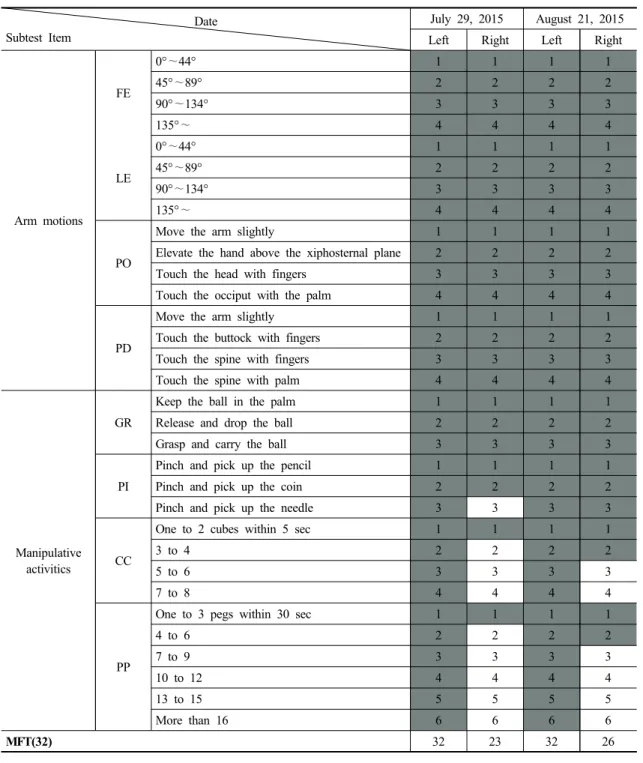
뇌졸중 상지기능 평가(Manual Function Test, MFT) 는 일본 동북대학 의학부 연구소에서 개발되어 뇌졸 중 환자의 상지기능 및 동작능력을 측정하기 위해 개 발된 검사 도구 이다. MFT는 3개 영역으로 상지운동 4항목, 장악력 2항목, 손가락 조작 2항목 총 8항목으로 구성되어 있으며 각 하위 검사가 가능할 시 1점, 불가 능할 시 0점으로 처리하여 전 항목의 총계를 구하며 총점은 32점이다. MFT의 검사자간 신뢰도는 환측 r=0.99, 건측 r=0.84이다(Nakamura & Moriyama, 2000).
2) 일상생활수행능력 평가
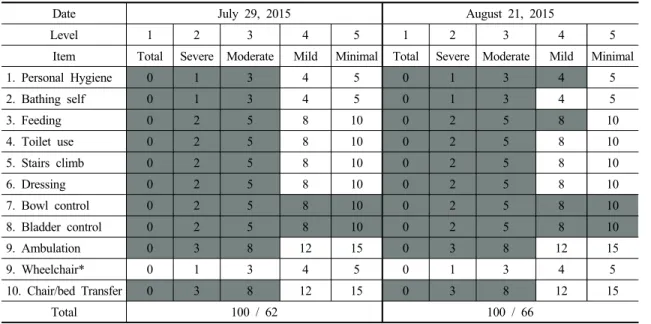
수정된 바델지수(Modified Barthel Index, MBI)는 질 환을 가진 성인의 독립적인 능력과 수행능력의 호전 변화를 평가하기 위하여 사용된다. 10가지의 일상생 활 영역으로 신변처리동작 7개항목과 이동능력 3개 항목을 평가하는 5점 척도로 총점은 100점을 만점으 로 1∼24점은 완전 의존성, 25∼49점은 최대 의존성, 50∼74점은 중등도 의존성, 75∼90점은 약간 의존성, 91∼99점은 최소 의존성, 100점은 완전 독립성을 나타 낸다. 검사 재검사 신뢰도 r=0.89, 검사자간 신뢰도 r=0.95이다(Shah et al, 1989).
3. 운동 방법
운동치료는 치료사가 철학, 기본적인 기법, 치료기 법을 이용한 고유수용성신경근촉진법을 이용하여 하 루 50분(준비운동 5분, 본 운동 40분, 정리운동 5분) 주 3회 4주간 시행하였다. 운동의 강도는 저항을 통해 서 원하는 동작을 최대로 끌어낼 수 있는 정도로 1-2주
는 10∼12회 각각 2세트, 3-4주는 12∼15회 각각3세트 를 점증적으로 증가시키는 점진성 원리(progressive)을 활용하여 실시하였다. 본 연구의 운동프로그램은 상 지기능을 향상시키고, 일상생활동작 수행능력 향상에 중점을 두었으며, 준비운동과 정리운동을 제외한 본 운동은 일상생활동작 수행에 근접한 환경을 제공하기 위해 무게중심이 높고, 지지 기저면이 좁은 앉은 자세 에서 실시하였다. 준비운동과 정리운동은 어깨뼈 주 의 근육들의 이완과 운동 전에는 운동의 개시를 촉진 시키기 위해서, 운동 후에는 협응력과 운동감각을 증 진시키기 위해서 마비측 어깨에 Scapula patterns을 Sideling에서 Rhythmic Initiation을 실시하였다. 본 운동 은 상지의 기능적 동작에 의해서 수행되는 개인위생, 식사하기, 옷 입기, 용변처리에 중점을 두어 실시하였 다. 개인위생은 마비측상지에 Flexion-adduction- external rotation with elbow flexion와 Extension- abduction-internal rotation with elbow extension에 Dynamic Reversal 적용하여 양치하기와 세수하기 동 작의 부드러운 반전을 증가시켰으며, 동작에 대한 지 구력을 증가시켰다. Flexion-adduction-external rotation with elbow flexion에 Stabilizing Reversal 적용하여 화장 하기 동작에서 필요한 안정성을 증가시켰다. Flexion- abduction-external rotation with elbow flexion에 Combination of Isotonic 적용하여 감소된 능동적 빗질 하기의 범위를 증가시켰다. Flexion-abduction-external rotation with elbow flexion에 Stabilizing Reversal 적용하여 머리손질동작에서 필요한 안정성을 증가시켰다. 식사 하기에서는 마비측상지에 Flexion-adduction- external rotation with elbow flexion과 Extension- adduction- internal rotation with elbow extension에 Combination of Isotonic 적용하여 숟가락질과 포크질 동작의 협응된 능동적 조절을 증가시켰다. 옷 입기에서는 마비측상 지의 도움을 증가시키기 위해서 Flexion-abduction- external rotation with elbow extension과 Extension- abduction-internal rotation with elbow flexion에 Combination of Isotonic 적용하여 티셔츠와 바지 입는 동작에 비마비측 상지와 마비측상지의 협응 작용을 얻
고자 하였다. 용변처리 마비측상지(오른쪽)에 Extension- adduction-internal rotation with elbow extension에 Stabilizing Reversal 적용하여 화장실에서 필요한 화장 지 접기와 용변처리를 위하여 주동근과 길항근 사이 에 협응력 수축을 얻고자 하였다. 고유수용성신경근 촉진법 운동프로그램은 Table 2와 같다.
Ⅲ. 연구결과
주 3회 4주간 치료 후 상지기능 평가(MFT)은 손가 락 조작에서 입방체 옮기기(CC) 1점, Pegboard(PP) 1점 증가하여 총점이 23점에서 26점으로 증가하였으며, 일상생활수행능력 평가(MBI)는 개인위생에서 1점, 식
사하기에서 3점 증가하여 총점이 62점에서 66으로 증 가하였다(Table 3)(Table 4).
Ⅳ. 고 찰
본 연구는 뇌졸중 환자를 대상으로 고유수용성신 경근촉진법의 상지 운동을 실시하였을 때 상지기능과 일상생활수행능력에 미치는 영향을 알아보고 뇌졸중 환자의 기능을 향상시킬 수 있는 치료 접근법을 제시 하기 위해 실시되었다.
최근 뇌졸중 환자들의 치료 접근법으로 상지의 기 능적 활동 능력 향상을 위해 고유수용성신경근촉진법 이 효과가 있다는 연구가 보고되고 있다. Bang 등
Component Program Activity Goal Time Frequency
Warm-up (Scapula patterns)
Anterior elevation, Posterior depression Posterior elevation, Anterior depression (sideling, Rhythmic Initiation)
5
Exercise 3 (Upper extremity patterns)
Fl’-add’-ext’ rotation with elbow flexion Ext’-abd’-int’ rotation with elbow extension (Sitting, Dynamic Reversal)
Personal Hygiene (teeth, face)
40 Fl’-add’-ext’ rotation with elbow flexion
(Sitting, Stabilizing Reversal)
Personal Hygiene (makeup) Fl’-abd’-ext’ rotation with elbow flexion
(sitting, Combination of Isotonic)
Personal Hygiene (comb)
Fl’-abd’-ext’ rotation with elbow flexion (sitting, Stabilizing Reversal)
Personal Hygiene (hair)
Fl’-add’-ext’ rotation with elbow flexion (Sitting, Combination of Isotonic)
Feeding (spoon) Ext’-add’-int’ rotation with elbow extension
(Sitting, Combination of Isotonic)
Feeding (fork) Fl’-abd’-ext’ rotation with elbow extension
(Sitting, Combination of Isotonic)
Dressing (tee shirt) Ext’-abd’-int’ rotation with elbow flexion
(Sitting, Combination of Isotonic)
Dressing (pants) Ext’-add’-int’ rotation with elbow extension
(Sitting, Stabilizing Reversal) Toilet Cool-down
(Scapula patterns)
Anterior elevation, Posterior depression Posterior elevation, Anterior depression (sideling, Rhythmic Initiation)
5 Table 2. Proprioceptive neuromuscular facilitation exercise program
໊╶☏Ԩ㍖⒎Ԩᶿ⚾Ԩମྣ৺Ԩ⑺ᶿᷛ㍚㊇ྣᔣԨ㊣ᶿ⑂Ԩ␂㉚Ԩ␞⎧ḯ῞ૺ⨇⛂ᦓԨ⓿⎧ | 159
(2013)의 연구에서 PNF를 이용한 과제지향훈련이 뇌 졸중 환자의 상지기능과 일상생활수행능력에 유의한 향상을 보였다고 보고하였다. Lee(2011)의 연구에서
도 동결견 환자를 대상으로 PNF의 간접적인 치료가 거울 닦는 동작인 상지의 기능에 향상을 보였다고 보 고하였다. 따라서 위에 언급한 선행 연구를 바탕으로 Date
Subtest Item
July 29, 2015 August 21, 2015
Left Right Left Right
Arm motions FE
0°∼44° 1 1 1 1
45°∼89° 2 2 2 2
90°∼134° 3 3 3 3
135°∼ 4 4 4 4
LE
0°∼44° 1 1 1 1
45°∼89° 2 2 2 2
90°∼134° 3 3 3 3
135°∼ 4 4 4 4
PO
Move the arm slightly 1 1 1 1
Elevate the hand above the xiphosternal plane 2 2 2 2
Touch the head with fingers 3 3 3 3
Touch the occiput with the palm 4 4 4 4
PD
Move the arm slightly 1 1 1 1
Touch the buttock with fingers 2 2 2 2
Touch the spine with fingers 3 3 3 3
Touch the spine with palm 4 4 4 4
Manipulative activitics
GR
Keep the ball in the palm 1 1 1 1
Release and drop the ball 2 2 2 2
Grasp and carry the ball 3 3 3 3
PI
Pinch and pick up the pencil 1 1 1 1
Pinch and pick up the coin 2 2 2 2
Pinch and pick up the needle 3 3 3 3
CC
One to 2 cubes within 5 sec 1 1 1 1
3 to 4 2 2 2 2
5 to 6 3 3 3 3
7 to 8 4 4 4 4
PP
One to 3 pegs within 30 sec 1 1 1 1
4 to 6 2 2 2 2
7 to 9 3 3 3 3
10 to 12 4 4 4 4
13 to 15 5 5 5 5
More than 16 6 6 6 6
MFT(32) 32 23 32 26
Table 3. Change of manual function test in subject
고유수용성신경근촉진법의 상지 운동이 상지 기능과 일상생활수행능력에 미치는 효과에 대해서 알아보고 자 하였다.
연구 결과 운동 후 상지 기능과 일상동작수행능력 에 향상된 것을 볼 수 있었다. 상지 기능을 좀 더 자세 히 살펴보기 위하여 MFT 평가를 사용하였으며 연구 결과 운동 전 23점에서 26점으로 향상되었다. Kim과 Oh(2014)은 만성 뇌졸중 환자에게 IT 기반 근전도 바 이오피드백훈련을 적용한 실험군에서 MFT 점수가 실 험 전보다 실험 후에 유의하게 개선되었고 집단 간 비교에서도 대조군에 비해 실험군에서 유의한 향상을 보였다. Ma와 Jung(2015)은 뇌졸중으로 진단 받고 발 병 후 6개월이 경과한 편마비 환자를 대상으로 과제 지향적 상지운동을 실시한 결과 MFT이 증진되었다고 보고하였으며, Cha 등(2012)은 뇌졸중 환자에게 신경 가동화기법을 실시한 실험군에서 유의한 차이가 있었 다. 또한, Song 등(2011)은 뇌졸중으로 유병기간이 6개 월 이상 2년 미만 환자를 대상으로 가상현실 훈련군과 대조군으로 무작위 배정하여 실시한 결과 두 군 모두 MFT 점수에서 유의한 향상이 있었으며 특히 가상현 실 훈련군에서 더 큰 향상을 보였다. 이와 같은 연구
결과들은 본 연구와 운동방법과 차이는 있었지만 결 과는 일치하였다. 이러한 결과는 상지에 대한 감각 자극이 실제에 가까운 동작을 만드는데 도움이 되었 으며, 다양한 촉각자극과 압박을 통한 감각정보가 움 직임 조절에 기여하고 이런 감각들은 다시 적절한 운 동출력을 할 수 있도록 도와주어(Johansson et al, 1990), 증가된 운동시간과 일상생활동작수행에 필요한 상지 의 패턴의 직접적인 반복훈련이 기능적인 상지의 움 직임에 기여하여 상지기능 향상에 영향이 미친 것으 로 생각된다.
일반적으로 편마비 환자들은 하지의 사용빈도가 높아 보행능력은 어느 정도 기능적인 향상을 보이지 만, 상지 기능은 비마비측 상지의 사용빈도가 높아지 고, 회복과정에서 굽힘근의 공동 운동이 손가락과 손 목 폄근의 운동 방해로 수의적인 운동 조절과 미세운 동을 방해하여 하지보다 기능적 향상이 느리며 일상 생활수행을 어렵게 만드는 요인이 된다(Nelles et al, 2001).
그러므로 상지 기능의 회복은 일상생활수행능력의 향상에 결정적인 영향을 미칠 수 있다.
따라서 본 연구에서는 MFT 평가와 함께 MBI 평가
Date July 29, 2015 August 21, 2015
Level 1 2 3 4 5 1 2 3 4 5
Item Total Severe Moderate Mild Minimal Total Severe Moderate Mild Minimal
1. Personal Hygiene 0 1 3 4 5 0 1 3 4 5
2. Bathing self 0 1 3 4 5 0 1 3 4 5
3. Feeding 0 2 5 8 10 0 2 5 8 10
4. Toilet use 0 2 5 8 10 0 2 5 8 10
5. Stairs climb 0 2 5 8 10 0 2 5 8 10
6. Dressing 0 2 5 8 10 0 2 5 8 10
7. Bowl control 0 2 5 8 10 0 2 5 8 10
8. Bladder control 0 2 5 8 10 0 2 5 8 10
9. Ambulation 0 3 8 12 15 0 3 8 12 15
9. Wheelchair* 0 1 3 4 5 0 1 3 4 5
10. Chair/bed Transfer 0 3 8 12 15 0 3 8 12 15
Total 100 / 62 100 / 66
Table 4. Change of modified barthel index in subject
໊╶☏Ԩ㍖⒎Ԩᶿ⚾Ԩମྣ৺Ԩ⑺ᶿᷛ㍚㊇ྣᔣԨ㊣ᶿ⑂Ԩ␂㉚Ԩ␞⎧ḯ῞ૺ⨇⛂ᦓԨ⓿⎧ | 161
를 실시하였다. 연구 결과 운동전 62점에서 운동 후 66으로 증가하였다. Bang 등(2013)은 아급성 뇌졸중 환자를 대상으로 상상훈련을 실시한 상상 훈련군에서 MBI 점수가 유의하게 개선되었고 집단 간 비교에서도 대조군에 비해 상상 훈련군이 유의한 향상을 보였다.
Ko 등(2014)은 뇌졸중 환자를 대상으로 동작관찰 훈련을 실시한 결과 훈련 전과 훈련 후 비교에서 MBI 점수가 유의한 향상을 보였으며 본 연구와 선행 연구에 서 운동 방법에 차이는 있지만 결과는 일치 하였다. 이것은 Bolton 등(2004)의 연구처럼 반복적인 기능적 동작은 대뇌피질의 운동 영역 내 지속적인 운동과 감각 의 적절한 통합을 유도하며, 능동적인 근 활성화를 위 한 인지기능의 참여가 마비측 상지의 운동 기능 회복과 일상생활수행능력을 향상시키는데 영향을 미친다고 하였다. 따라서 본 연구의 고유수용성신경근촉진법의 반복적 운동 학습이 효과적임을 확인 할 수 있다.
본 연구의 제한점은 연구대상자가 한명으로 연구 결과를 모든 편마비 환자에게 일반화시키는데 어려움 이 있다. 그러나 고유수용성신경근촉진법을 통하여 대상자의 상지 기능과 일상생활수행능력의 향상된 결 과를 나타냄으로서 증례보고지만 고유수용성신경근 촉진법의 효과가 있음을 확인하였다. 따라서 향후에 는 제한점을 보완하여 고유수용성신경근촉진법을 이 용한 연구가 이루어져야 할 것이다.
Ⅴ. 결 론
본 연구는 고유수용성신경근촉진법을 통한 어깨뼈 와 상지 운동이 뇌졸중 환자의 상지 기능과 일상생활 수행능력에 미치는 영향을 알아보고자 하였다. 대상 자는 운동이 진행됨에 따라 상지 기능과 일상생활수 행능력 점수가 증가하였고 상지의 보상적 움직임이 감소되어 상지의 움직임이 빠르고 부드러워졌다. 보 다 많은 대상자와 고유수용성신경근촉진법을 활용한 운동의 효과를 일반화하기 위한 추후 연구가 필요할 것이다.
References
Alder S, Becker D, Buck M. PNF in practice, 2nd ed. Berlin.
Springer Verlag. 2000.
Bang DH, Jeong WM, Bong SN. The effects of task-oriented training using the PNF in upper arm function and activities of daily living with chronic stroke patients.
Journal of Korea Proprioceptive Neuromuscular Facilitation Association. 2013;11(2):41-48.
Bang DH, So YJ, Cho HS. Imagery training effects of upper limb function and activities of daily living in subacute stroke patients. The Journal of Digital Policy &
Management. 2013;11(8):235-242.
Bolton DA, Cauraugh JH, Hausenblas HA. Electromyogram- triggered neuromuscular stimulation and stroke motor recovery of arm/hand functions: a meta-analysis.
Journal of the Neurological Sciences. 2004;
223(2):121-127.
Cha HG, Oh DW, Cho HS, et al. Effects of upper limb neurodynamic mobilization on upper limb function in patient with post-stroke hemiparesis. Journal of Special Education & Rehabilitation Science.
2012;51(1):313-326.
Han SH, Choi YW, Kam KY. Effects of EMG biofeedback training on the hand functions of stroke patients.
The Journal of Korean Society of Occupational Therapy. 2009;17(4):13-24.
Hobart JC, Thompson AJ. The five item Barthel index. Journal of Neurology, Neurosurgery & Psychiatry. 2001;
71(2):225-230.
Johansson E, Lynöe N, Sandlund M. The ethics of clinical training must patients cooperate. Lakartidningen.
1990;87(14):1168-1170.
Kim JH, Oh MH. IT based EMG biofeedback training on the effects of upper extremity function in chronic stroke patients. The Journal of the Korea institute of electronic communication sciences. 2014;9(1):
41-49.
Kim K, Kim JS, Oh DW. Clinical effectiveness of lower extremity and upper extremity performances on mental practice for adult with post stroke hemiplegia: a systematic review. Journal of Special Education &
Rehabilitation Science. 2010;49(4):201-220.
Ko HE, Park JJ, Lee KJ, et al. The effect of action-observational physical training based on mirror neuron system on upper extremity function and activities of daily living in stroke patient. The Journal of the Korea institute of electronic communication sciences. 2014;9(1):
123-130.
Langhorne P, Coupar F, Pollock A. Motor recovery after stroke:
a systematic review. The Lancet Neurology. 2009;8(8):
741-754.
Lee BK. The effect of PNF indirect treatment to clean up the mirror for frozen shoulder patient: a case report.
Journal of the Korean Proprioceptive Neuromuscular Facilitation Association. 2011;9(2):39-44.
Liepert J, Classen J, Cohen LG, Hallett M. Task-dependent changes of intracortical inhibition. Experimental Brain Research. 1998;118(3):421-426.
Liepert J, Hamzei F, Weiller C. Motor cortex disinhibition of the unaffected hemisphere after acute stroke. Muscle
& Nerve. 2000;23(11):1761-1763.
Luke C, Dodd KJ, Brock K. Outcomes of the Bobath concept
on upper limb recovery following stroke. Clinical Rehabilitation. 2004;18(8):888-898.
Ma SR, Jung SM. The effect of the task-oriented upper extremity motor task on upper extremity function and activities of daily living performance in the stroke patient.
Journal of the Korea Entertainment Industry Association. 2015;9(1):227-234.
Nakamura R, Moriyama S. Manual function test and functional occupational therapy for stroke patients. National rehabilitation center for the disabled Japan. 2000.
Nelles G, Jentzen W, Jueptner M, Müller S, Diener HC. Arm training induced brain plasticity in stroke studied with serial positron emission tomography.
Neuroimage. 2001;13(6):1146-1154.
Nyberg L, Gustafson Y. Patient falls in stroke rehabilitation.
A challenge to rehabilitation strategies. Stroke.
1995;26(5):838-842.
Shah S, Vanclay F, Cooper B. Improving the sensitivity of the Barthel Index for stroke rehabilitation. Journal of Clinical Epidemiology. 1989;42(8):703-709.
Song CH, Seo SM, Lee KJ, et al. Video game-based exercise for upper-extremity function, strentgth, visual perception of stroke patients. Journal of Special Education & Rehabilitation Science. 2011;50(1):
155-180.