3)| Abstract |
Purpose: This study aimed to examine the effects of proprioceptive neuromuscular facilitation (PNF) lower extremity patterns combined with elastic bands applied to stroke patients diagnosed with hemiplegia through self-training using the non-paralyzed side approach and the paralyzed side approach, and to investigate the differences in the effects.
Methods: Nine chronic stroke patients who were being treated not more than twice a week at H, K, R, and C hospitals located in Gangwon-do, performed self-training for 16 minutes, two times per day for four weeks between August and October 2015.
The subjects’ balance ability was measured using the Tetrax stability index, the weight distribution index, the Berg Balance Scale (BBS), and the Timed Up and Go (TUG) test before the experiment and four weeks later. Among the statistical methods, paired t-tests were conducted for intra-group comparison of the measurements taken before and after the experiment, and independent t-tests were conducted for inter-group comparison of the ex post facto values. The statistical significance level was set to 0.05.
Results: When the lower extremity patterns were applied to the non-paralyzed side group and the paralyzed side group, significant intra-group differences were observed for the Tetrax stability index, the weight distribution index, the Berg Balance Scale (BBS), and Timed Up and Go (TUG) tests (p<0.05); however, the inter-group comparisons showed no significant differences.
Conclusion: The non-paralyzed side approach was found to be easy for patients to participate in and it also affected the patients’
paralyzed side. Although the paralyzed side approach produced good exercise effects in a short period of time, it could result in adverse effects, such as a decrease in motivation and self-confidence. Therefore, these approaches are considered to be more effective when they are selectively applied depending on the purpose of the intervention and the degree of a patient’s’ participation.
Key Words: Non-paralyzed side approach, Paralyzed side approach, Balance, Stroke
†Coressponding Author : Young-Min Lee ([email protected])
Original Article Open Access
비 마비 측과 마비 측에 적용한 탄력밴드를 결합한
고유수용성 신경근 촉진법 하지패턴이 만성 뇌졸중 환자의 균형에 미치는 영향
이영민†⋅함민식1⋅김택수2
한림대학교춘천성심병원 물리치료실, 1속초의료원 물리치료실, 2리온 재활의학과 물리치료실
Effect of Non-paralyzed side and Paralyzed side of Elastic Band Combined with Proprioceptive Neuromuscular Facilitation Lower Extremity Patterns on Balance in Chronic Stroke Patients
Young-Min Lee†⋅Min-Sik Ham1⋅Taek-Soo Kim2
Department of Physical Therapy, Hallym University Chuncheon Sacred Heart Hospital
1Department of Physical Therapy, Sokcho Medical Hospital
2Department of Physical Therapy, Le-on Clinics
Received: November 26, 2015 / Revised: December 05, 2015 / Accepted: December 06, 2015
ⓒ 2015 Journal of Korea Proprioceptive Neuromuscular Facilitation Association
This is an Open Access article distributed under the terms of the Creative Commons Attribution Non-Commercial License (http://creativecommons.org/licenses/by-nc/3.0) which permits unrestricted non-commercial use, distribution, and reproduction in any medium, provided the original work is properly cited.
Ⅰ. 서 론
뇌졸중이란 뇌혈관의 허혈성 또는 출혈성 원인으 로 대뇌 기능이 소실되어 다양한 증상이 동반되는 질 환이다(Peurala et al, 2007). 뇌졸중환자는 뇌손상 부위 와 정도에 따라 운동, 감각장애 그리고 언어, 인지 등에 손상을 주게 되어 불안, 우울, 좌절과 같은 정서적 장애 를 복합적으로 동반하며, 일상생활에 많은 장애를 나 타낸다(Gwon & Lee, 2003). 또한 움직임의 감소로 인 하여 비대칭적인 자세가 특징적으로 나타나게 되며, 이러한 비대칭적 자세로 인하여 신체의 중심이 비마 비측 다리로 편중되어 신체가 비대칭적인 형태로 변 형되게 하고, 선 자세에서의 균형조절을 어렵게 만들 어, 결국에는 평형반응(equilibrium reaction)에도 영향 을 주어 자세조절능력에 문제를 초래하게 한다(Ikai et al, 2003). 이러한 뇌졸중 환자의 균형능력 소실로 인해 발생할 수 있는 문제점으로 자세 흔들림의 증가, 마비된 다리에서의 체중지지 감소, 그리고 낙상 위험 증가의 결과를 가져오게 된다(Pohl & Mehrholz, 2006).
일반적으로 균형 또는 자세의 안정성은 정적인 동 작을 유지시키고 원하는 동작을 안전하게 수행하기 위해 지지면 내에 신체 중심을 유지하는 것을 의미한 다. 이러한 균형능력은 기능적인 행동을 위해 필수적 인 것으로 앉기, 일어서기, 걷기 등에서 작용하고 (Yavuzer et al, 2006), 균형을 유지하고 조절하기 위한 고유수용성 감각, 시각, 전정 감각 등의 상호 작용이 조화를 이루어야 한다(Chen et al, 2008). 하지만, 뇌졸 중 환자의 65 %는 촉각과 고유수용성감각의 상실을 경험하며, 주로 근 긴장도 저하로 인한 고유수용성감 각 손상이 원인이 된다(Kerrigan et al, 2001). 뇌졸중환 자의 균형에 대한 문제점들을 해결하기 위한 방법으 로는 주로 환측 하지로 체중지지를 많이 하게 함으로 써 균형 문제를 해결하고 있으며, 고유수용성 신경근 촉진 기법, Bobath 개념을 이용한 방법, 신경 발달 촉진 기술과 같은 운동치료와 과 적 운동 등이 사용되기도 한다(Eser et al, 2008; Salbach et al, 2004).
그중 고유수용성 신경근 촉진법은 특정 근육군의
강화 또는 이완을 위해 고유수용기를 자극하므로써 기능 향상을 가져올 수 있으며 운동의 정상 패턴이나 자세 유지, 균형능력과 보행능력의 회복을 위해 뇌졸 중 환자에게 적용되고 있다(Hall & Brady, 1999). 특히 치료적 목적으로 저항을 사용할 때 한쪽 사지의 강화 훈련이 반대쪽 사지의 동일 근육군에 강화가 일어나 는 교차훈련처럼 방산(irradiation)현상을 유발할 수 있 다고 하였다(Voss et al, 1985). 또한 고유수용성 신경근 촉진법은 탄력밴드를 결합하여 여러 방향에서 저항운 동이 가능하게 적용할 수 있으며 결합된 탄력밴드는 크기와 색깔에 따라 저항의 범위를 다르게 적용할 수 있기 때문에 운동부하의 강도를 점차적으로 증가시킬 수도 있다(Hughes et al, 1999; Mikesky et al, 1994).
따라서 본 연구에서는 만성 뇌졸중환자에게 탄력 밴드를 결합한 고유수용성 신경근 촉진법 하지패턴을 비 마비 측 접근방법과 마비 측 접근방법으로 적용하 였을 때 균형의 유지 시 어떠한 효과를 발휘하는지 알아보고자 하였다.
Ⅱ. 연구 방법
1. 연구 대상
연구 대상자는 강원도에 위치한 H대학병원과 K대 학병원과 C병원 그리고, R의원에 뇌졸중으로 진단 받 고 주 2회 이하 통원치료를 하는 뇌졸중 환자 9명을 임의로 선정하였고 실험에 참여하기 전, 환자와 보호 자에게 본 연구의 목적을 설명하고 자발적으로 참여 에 동의하였다.
대상자의 선정 기준은 다음과 같다: 뇌졸중 진단 후 12개월 이상 경과하고 18개월 미만인 자, 소뇌와 안뜰기관 질환, 양 다리에 신경학적 손상, 선 자세 균형 에 영향을 주는 근골격계 손상, 시각 및 청각 장애가 없는 자, 약식정신상태검사(MMSE-K)의 점수가 23점 이상인 자.
2. 측정 방법 및 도구
1) 안정성지수와 체중분포지수 : 안정성지수와 체 중분포지수는 Tetrax Portable Multiple System (Tetrax, Tetrax Ltd, Israel)을 사용하였다(Kohen-Raz, 1991). 실 험자가 힘 측정판(force Plate)에 발을 위치시키고 섰을 때 힘 측정 판에 주어지는 압력에 대한 데이터는 증폭 및 필터링을 거친 후 컴퓨터로 전달되며, Tetrax 소포 트웨어 프로그램을 통해 분석된다. 균형능력의 측정 항목으로 안정성지수(stability index)를 측정하였으며 수집한 데이터는 체중에 대한 백분율(%)로 기록하였 다. 균형능력 측정은 눈 뜨고(eyes open), 바로선 자세 (standing position)와 스폰지 위에서 눈 뜨고(eyes open) 바로선 자세(standing position)에서 지지대를 잡지 않 고, 차렷 자세로 3번씩 측정하였으며, 3번 측정한 평균 값을 분석에 이용하였다. 이 측정 장비의 검사자내 신뢰도는 r = .88, 검사자간 신뢰도는 r = .95로 보고되 었다(Kohen-Raz, 1991).
2) 버그 균형 척도(Berg Balance Scale : BBS) : 버그 균형 척도는 1989년 berg 등에 의해 노인들의 낙상 위험도를 평가하기 위한 목적으로 개발되었다. 앉기, 서기, 자세변화의 3개 영역을 14개의 항목으로 평가하 며, 최소0점에서 최고 4점으로 총 56점이 만점이다.
점수가 높을수록 균형능력이 좋은 것이다. 14개의 항 목은 앉아서 일어서기, 지지 없이 서있기, 지지 없이 앉아 있기, 일어선 자세에서 앉기, 의자에서 의자로 이동하기, 눈 감고 서있기, 발 모아 서있기, 앞으로 손 뻗기, 물건 집어 들기, 좌우로 뒤돌아보기, 360도 돌기, 한발 교대로 발판에 올려놓기, 한 발을 앞에 붙여 놓고 서기 한발로 서기로 구성이 된다(Berg et al, 1992;
Bogle & Newton, 1969).
3) 일어나 걸어가기 검사(Timed Up and Go : TUG) : 기능적 운동성(functional mobility) 을 측정하기 위하여 일어나 걸어가기 검사를 실시하였다. 이 검사는 검사 자간 신뢰도가 r=.98, 검사자내 신뢰도는 r=.99로 높은
신뢰도를 보이고 있다. 46 ㎝ 높이의 팔걸이가 있는 의자에 앉은 자세에서 일어나 3 m를 왕복하여 돌아와 다시 앉는 시간을 측정하였다. 평상 시 착용하던 신발 을 사용하고 다른 사람의 도움을 받지 않았으며, 측정 치는 3회 반복하여 평균값을 구하였다. 1명의 물리치 료사는 검사 시 낙상을 대비해 환자의 근처에서 대기 하였다(Podsiadlo & Richardson, 1991).
3. 실험 절차
탄력밴드의 점진적 저항은 두 집단에 모두 적용하 였고 초기 2주에서는 빨간색의 탄력밴드를 사용하였 고, 후기 2주에서는 초록색의 탄력밴드를 사용하였으 며 색깔에 따른 저항 강도는 Page 등(2000)의 연구를 참고하였다. 중재는 자가 훈련 프로그램으로 하였으 며 비 마비 측 접근방법 집단에는 비 마비 측 엉덩 관절의 굽힘-벌림-안쪽돌림과 무릎관절의 굽힘 패턴 을 적용하였으며 마비 측 접근방법 집단에는 마비 측 엉덩 관절의 폄-벌림-안쪽돌림과 무릎 관절의 폄 패턴 을 적용하였으며 바로 누운 자세에서 3분간 실시, 1분 의 휴식시간을 2회 반복하였고 선 자세에서도 동일한 패턴으로 2회 반복하였으며 매일, 4주간 실시하였 다.(Table 1). 자가 훈련을 1회 3분간 실시할 때는 속도 와 횟수에 상관없이 개인의 능력에 맞게 실시할 수 있도록 하였다.
중재 전 안정성지수, 체중분포지수, 버그균형척도, 일어나 걸어가기 검사를 측정하였으며, 4주간의 중재 후 재 측정하였다.
4. 자료 분석
본 연구에서 수집된 자료는 WINDOW용 PASW ver.
18.0 프로그램을 이용하여 대상자의 일반적 특성은 기술통계로 하였으며, 실험 전과 후의 차이에 대한 결과를 대응표본 짝비교(Paired t-test)로 분석하였고 각 집단 간의 사후 값을 비교하기 위하여 독립표본 짝비교(Independent t-test)을 실시하였으며 통계적 유 의수준은 0.05로 하였다.
Ⅲ. 연구 결과
1. 연구대상자의 일반적 특성
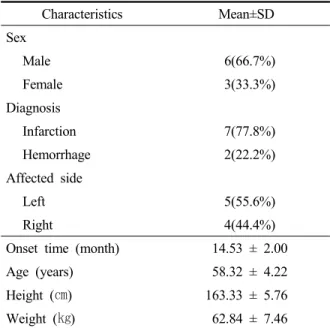
본 연구에 참가한 참가자들은 뇌졸중 진단을 받은 환자 9명으로 성별은 남자 6명(66.7%), 여자 3명(33.3%)
이었으며, 진단명은 뇌경색 7명(77.8%), 뇌출혈 2명 (22.2%)이었으며. 마비 부위는 좌측 마비 5명(55.6%), 우측 마비 4명(44.4%)이었으며, 유병 기간은 14.53 ± 2.00개월이었으며, 연령은 58.32 ± 4.22세이었으며, 신 장은 163.33 ± 5.76㎝이었으며, 체중은 62.84 ± 7.46㎏으 로 나타났다(Table 2).
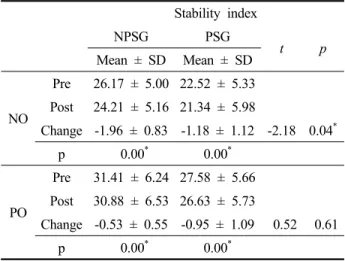
2. 자가 훈련 전⋅후의 안정성 지수의 비교 4주간 실시한 자가 훈련에서 TETRAX의 안정성 지 수에 대한 실험 전⋅후 비교 결과는 비 마비 측 접근방법 집단의 눈 뜨고 선 자세(NO)에서는 실험 전 26.17 ± 5.00에서 실험 후 24.21 ± 5.16으로 감소하여 유의한 차이를 있었으며(p<0.05), 스폰지 위에서 눈 뜨고 선 자세(PO)에서는 실험 전 31.41 ± 6.24에서 실험 후 30.88 ± 6.52로 감소하여 유의한 차이가 있었다 (p<0.05). 마비 측 접근방법 집단에서 눈 뜨고 선 자세 (NO)에서는 실험 전 22.52 ± 5.33에서 실험 후 21.34
± 5.98로 감소하여 유의한 차이가 있었으며(p<0.05), 스폰지 위에서 눈 뜨고 선 자세(PO)에서는 실험 전 27.58 ± 5.66에서 실험 후 26.63 ± 5.73으로 감소하여
Characteristics Mean±SD
Sex
Male 6(66.7%)
Female 3(33.3%)
Diagnosis
Infarction 7(77.8%)
Hemorrhage 2(22.2%)
Affected side
Left 5(55.6%)
Right 4(44.4%)
Onset time (month) 14.53 ± 2.00
Age (years) 58.32 ± 4.22
Height (㎝) 163.33 ± 5.76
Weight (㎏) 62.84 ± 7.46
Table 2. General characteristics of subjects
(n=9)
Period Composition Training methods Time Rest
0∼4 weeks
Supine position
Non-paralyzed side hip flexion, abduction, internal rotation with
knee flexion pattern 3m 1m
Non-paralyzed side hip flexion, abduction, internal rotation with
knee flexion pattern 3m 1m
Standing position
Non-paralyzed side hip flexion, abduction, internal rotation with
knee flexion pattern 3m 1m
Non-paralyzed side hip flexion, abduction, internal rotation with
knee flexion pattern 3m 1m
0∼4 weeks
Supine position
Paralyzed side hip extension, abduction, internal rotation with knee
extension pattern 3m 1m
Paralyzed side hip extension, abduction, internal rotation with knee
extension pattern 3m 1m
Standing position
Paralyzed side hip extension, abduction, internal rotation with knee
extension pattern 3m 1m
Paralyzed side hip extension, abduction, internal rotation with knee
extension pattern 3m 1m
m: minute.
Table 1. Program for self training.
유의한 차이가 있었다(p<.05). 집단 간 비교에서는 눈 뜨고 선 자세(NO)에서만 유의한 차이가 있었다 (p<0.05) (Table 3).
Stability index
NPSG PSG
t p
Mean ± SD Mean ± SD
NO
Pre 26.17 ± 5.00 22.52 ± 5.33 Post 24.21 ± 5.16 21.34 ± 5.98
Change -1.96 ± 0.83 -1.18 ± 1.12 -2.18 0.04*
p 0.00* 0.00*
PO
Pre 31.41 ± 6.24 27.58 ± 5.66 Post 30.88 ± 6.53 26.63 ± 5.73
Change -0.53 ± 0.55 -0.95 ± 1.09 0.52 0.61
p 0.00* 0.00*
*p<0.05 NO: Normal Open, PO: Pillow Open, PSG: Paralyzed side groups,
NPSG:Non-paralyzed side groups.
Table 3. Comparison of Stability index among the two groups.
(n=9)
3. 자가 훈련 전⋅후의 체중분포 지수의 비교 4주간 실시한 자가 훈련에서 TETRAX의 체중분포 지수에 대한 실험 전⋅후 비교 결과는 비 마비 측 접근방 법 집단의 눈 뜨고 선 자세(NO)에서는 실험 전 7.30 ± 2.14에서 실험 후 6.72 ± 1.34로 감소하여 유의한 차이가 있었으며(p<0.05), 스폰지 위에서 눈 뜨고 선 자세(PO) 에서는 실험 전 8.27 ± 3.63에서 실험 후 7.90 ± 2.98로 감소하여 유의한 차이가 없었다. 마비 측 접근방법 집단에서 눈 뜨고 선 자세(NO)에서는 실험 전 6.62 ± 1.62에서 실험 후 6.22 ± 1.37로 감소하여 유의한 차이 가 있었으며(p<0.05), 스폰지 위에서 눈 뜨고 선 자세 (PO)에서는 실험 전 5.94 ± 2.55에서 실험 후 6.05 ± 2.17로 증가하여 유의한 차이가 없었다. 집단 간 비교 에서는 눈 뜨고 선 자세(NO)에서 통계적으로 유의한 차이가 있었고 스폰지 위에서 눈 뜨고 선 자세(PO)에 서는 통계적으로 유의한 차이가 없었다(Table 4).
Weight distribution index
NPSG PSG
t p
Mean ± SD Mean ± SD
NO
Pre 7.30 ± 2.14 6.62 ± 1.62 Post 6.72 ± 1.34 6.22 ± 1.37
Change -0.58 ± 1.00 -0.40 ± 0.63 -1.32 0.20
p 0.04* 0.03*
PO
Pre 8.27 ± 3.63 5.94 ± 2.55 Post 7.90 ± 2.98 6.05 ± 2.17
Change -0.37 ± 1.00 -0.11 ± 0.62 -1.19 0.07
p 0.16 0.50
*p<0.05 NO: Normal Open, PO: Pillow Open, PSG: Paralyzed side groups,
NPSG:Non-paralyzed side groups.
Table 4. Comparison of Weight distribution index among the two groups.
(n=9)
4. 자가 훈련 전⋅후의 버그균형척도의 비교 4주간 실시한 자가 훈련에서 Berg 균형척도의 실험 전⋅후 비교 결과는 비 마비 측 접근방법 집단에서 실험 전 42.33 ± 1.35에서 실험 후 43.27 ± 1.03으로 증가하여 유의한 차이가 있었고(p<0.05), 마비 측 접근 방법 집단에서 43.00 ± 2.04에서 43.73 ± 1.67로 증가하 여 유의한 차이가 있었다(p<0.05). 집단 간 비교에서는 통계적으로 유의한 차이가 없었다(Table 5).
Berg balance scale
NPSG PSG
t p
Mean ± SD Mean ± SD
BBS
Pre 42.33 ± 1.35 43.00 ± 2.04 Post 43.27 ± 1.03 43.73 ± 1.67
Change 0.94 ± 0.08 0.73 ± 0.70 0.73 0.47
p 0.00* 0.00*
*p<0.05 BBS: Berg balance scale, PSG: Paralyzed side groups, NPSG: Non-paralyzed side groups.
Table 5. Comparison of Berg balance scale among the two groups.
(n=9)
5. 자가 훈련 전⋅후의 일어나 걸어가기 검사의 비교 4주간 실시한 자가 훈련에서 일어나 걸어가기 검사 의 실험 전⋅후 비교 결과는 비 마비 측 접근방법 집단 에서 실험 전 19.91 ± 2.33에서 실험 후 18.98 ± 2.02로 증가하여 유의한 차이가 있었고(p<0.05), 마비 측 접근 방법 집단에서 19.15 ± 3.26에서 18.14 ± 3.15로 증가하 여 유의한 차이가 있었다(p<0.05). 집단 간 비교에서는 통계적으로 유의한 차이가 없었다(Table 6).
Timed Up & Go test
NPSG PSG
t p
Mean ± SD Mean ± SD
TUG
Pre 19.91 ± 2.33 19.15 ± 3.26 Post 18.98 ± 2.02 18.14 ± 3.15
Change -0.93 ± 1.15 -1.01 ± 0.80 0.09 0.93
p 0.00* 0.00*
*p<0.05 TUG: Timed Up & Go test, PSG: Paralyzed side groups, NPSG: Non-paralyzed side groups.
Table 6. Comparison of Timed Up & Go test among the two groups.
(n=9)
Ⅳ. 고 찰
본 연구는 편마비로 진단받은 뇌졸중 환자를 대상 으로 자가 훈련을 통해 탄력밴드를 결합한 PNF의 하 지패턴을 비 마비 측 접근방법과 마비 측 접근방법을 사용하여 균형에 미치는 영향을 알아보고자 하였다.
연구 대상자는 4주간의 자가 훈련을 실시한 후 균형을 알아보기 위한 안정성 지수, 체중분포지수, 버그 균형 척도, 일어나 걸어가기 검사를 비교하였다.
본 연구에서 비 마비 측에 적용한 접근법의 자가 훈련으로 균형을 알아보기 위한 안정성 지수, 체중분 포지수, 버그 균형척도, 일어나 걸어가기 검사의 향상 을 보였다. 이러한 결과는 Woo 등(2002)의 연구에서 편마비 한자의 비 마비 측에 적용한 고유수용성 신경 근 촉진법이 마비 측의 근 긴장도를 감소시키고 마비
측 엉덩 관절의 능동외전 범위가 증가하는 양상을 보 였다고 하였고 Choi 등(2010)은 편마비 환자를 대상으 로 네 가지의 고유수용성 신경근 촉진법 상지패턴이 실시한 결과 체중지지에 효과적인 영향을 주었다고 하였다. 또 Pink(1981)의 상지에 고유수용성 신경근 촉진법의 두 가지 패턴을 사용하는 동안 반대측 상지 의 근육들에서도 전기적 활동이 나타났다고 보고한 것과 일치한다. Adler 등(2000)이 제시한 것처럼 동작 에 대한 저항이 방산을 일으키고, 이에 퍼짐 현상이 마비 측에 영향을 준 것으로 생각되면 고유수용성 신 경근 촉진법은 강한 신체 부위에 저항을 적용해 약화 된 부위의 근 수축력을 촉진시키는 방법으로 사용되 고 있다.
마비 측에 적용한 접근법의 자가 훈련으로 균형을 알아보기 위한 안정성 지수, 체중분포지수, 버그 균형 척도, 일어나 걸어가기 검사의 향상을 보였다. 이러한 결과는 Kim(2013)의 연구에서 편마비환자의 마비 측 하지에 굽힘과 폄 패턴을 적용하였을 때 균형 수행력 이 증진되었다고 보고한 것과 일치하며 Kim(2008)은 고유수용성 신경근 촉진법의 하지 패턴 운동은 균형 능력과 보행등의 능력을 향상시키려는 목적으로 발과 발목관절 부분의 근육을 훈련시킬 때 임상에서 많이 사용되고 있다고 하였다. 두 집단 사이에는 눈 뜨고 선 자세(NO)의 안정성지수에서만 유의한 차이가 있었 고 체중분포지수, 버그 균형척도, 일어나 걸어가기 검 사에서는 유의한 차이가 없었다. 하지만 대상 선정 조건에 충족하는 일부의 환자만을 대상으로 하였으므 로 모든 뇌졸중으로 인한 편마비 환자에게 일반화하 기는 어려우며 연구대상자의 수를 늘려 검증 연구가 필요하다고 사료된다.
Ⅴ. 결 론
본 연구는 편마비로 진단받은 뇌졸중 환자를 대상 으로 자가 훈련을 통해 탄력밴드를 결합한 PNF의 하 지패턴을 비 마비 측 접근방법과 마비 측 접근방법을
적용하여 균형에 미치는 영향을 알아보기 위하여 실 시하였으며, 자가 훈련을 1회 16분, 1일 2회, 매일 4주 간 실시한 후, 균형에 미치는 영향을 알아보았다. 마비 측 접근 방법은 운동 효과를 단기간에 이끌어 내기 좋은 방법이기는 하나 대부분의 뇌졸중 환자들은 수 의적 움직임이 어렵기 때문에 오히려 동기부여 감소 와 자신감 저하 등 부정적인 영향을 가져올 수 있다.
비 마비 측 접근 방법은 비 마비 측을 이용한 훈련이기 때문에 환자가 쉽게 참여할 수 있고 반대 측까지 영향 을 주는 것을 확인하였다. 따라서 중재목적과 환자의 참여 정도에 따라 선택적으로 적용하면 더욱 효과적 일 것으로 사료된다.
References
Alder S, Beckers D, Buck M. PNF in practice, 2nd ed. Berlin.
Springer Verlag. 2000.
Berg KO, Mak BE, Williams JI, et al. Clinical and laboratory measures of postural balance in an elderly population.
Archives of Physical Medicine and Rehabilitation.
1992;73(11):1073-1080.
Bogle LD, Newton RA. Use of the berg balance test to predict falls in elderly persons. Physical Therapy. 1969;
76(6):576-583.
Chen CK, Hong WH, Chu NK, et al. Effects of an anterior ankle-foot orthosis on postural stability in stroke patients with hemiplegia. American Journal of Physical Medicine & Rehabilitation. 2008;87(10):
815-820.
Choi WJ, Kim YK, Son KH. The effects of elastic band combined with proprioceptive neuromuscular facilitation upper extremity patterns on body alignment and weight support in patients with hemiplegia. Journal of the Korean Society of Physical Medicine. 2010;5(1):113- 123.
Eser F, Yanvuzer G, Karakus D, et al. The effect of balance
training on motor recovery and ambulation after stroke: a randomized controlled trial. European Journal of Physical and Rehabilitation Medicine.
2008;44(1):19-25.
Gwon HC, Lee SR. The cognitive function of patients with stroke impact on activities of daily living. Physical Therapy Korea. 2003;10(3):41-51.
Hall CM, Brady LT. Therapeutic Exercise. Philadelphia.
Lippincott Williams & Wilkins. 1999.
Hughes CJ, Hurd K, Jones A, et al. Resistance properties of thera-band tubing duing shoulder abduction exercise. Journal of Orthopaedic and Sports Physical Therapy. 1999;29(7):413-420.
Ikai T, Kamikubo T, Takehara I, et al. Dynamic postural control in patients with hemiparesis. American Journal of Physical Medicine and Rehabilitation. 2003;82(6):
463-469.
Kerrigan DC, Karvosky ME, Riley PO. Spastic paretic stiff-legged gait: joint kinetic. American Journal of Physical Medicine & Rehabilitation. 2001;0(4):
244-249.
Kim HG. The effect of proprioceptive exercise program on balance performance in hemiplegic patients. Journal of the Korean Proprioceptive Neuromuscular Facilitation Association. 2013;11(1):07-16.
Kim JH. The kinematic analysis of the knee joint. Journal of the Korean Proprioceptive Neuromuscular Facilitation Association. 2008;6(1):53-60.
Kohen-Raz R. Application of tetra-ataxiametric posturography in clinical and developmental diagnosis. Perceptual and motor skills. 1991;73(2):635-656.
Mikesky AE, Topp R, Wigglesworth JK, et al. Effecacyof a home-based training program for older adults using elastic tubing. European Journal of Applied Physiology and Occupational Physiology. 1994;
69(4):316-320.
Page P, Labbe A, Topp R. Clinical force production of thera-band
elastic bands. Journal of Orthopaedic and Sports Physical Therapy. 2000;30(1):47-48
Peurala SH, Könönen P, Pitkänen K, et al. Postural instability in patients with chronic stroke. Restorative Neurology and Neuroscience. 2007;25(2):101-108.
Pink MY. Contralateral effects of upper extremity proprioceptive neuromuscular facilitation patterns.
Physical Therapy. 1981;61(8):1158-62.
Podsiadlo D, Richardson S. The timed “Up & Go”: A test of basic functional mobility for frail elderly persons.
Journal of the American Geriatrics Society. 1991;
39(22):142-148.
Pohl M, Mehrholz J. Immediate effects of an individually designed functional ankle- foot orthosis on stance and gait in hemiparetic patients. Clinical Rehabilitation.
2006;20(4):324-330.
Salbach NM, Mayo NE, Wood-Dauphinee S, et al. A task-orientated intervention enchances walking distance and speed in the first year post stroke: a randomized controlled trial. Clinical Rehabilitation.
2004;18(5):509-519.
Voss D, Ionta M, Meyers B. Preprioceptive neuromuscular facilitation: patterns and technique, 3rd ed.
Philadelphia. Lippincott Williams & Wilkins. 1985.
Woo YK, Cho G H, Yoo EY. Effect of pnf applied to the unaffected side on muscle tone of affected side in patients with hemiplegia. Physical Therapy Korea.
2002;9(2):157-168.
Yavuzer G, Eser F, Karakus D, et al. The effects of balance training on gait late after: A randomized controlled trial. Clinical Rehabilitation. 2006;20(11):960-969.