• 검색 결과가 없습니다.

Effects of Proprioceptive Neuromuscular Facilitation Program Combined with Dynamic Neuromuscular Stabilization Approach on Balance in Patient with Cerebellum Atrophy -Case Report-

N/A
N/A
Protected

Academic year: 2021

Share "Effects of Proprioceptive Neuromuscular Facilitation Program Combined with Dynamic Neuromuscular Stabilization Approach on Balance in Patient with Cerebellum Atrophy -Case Report-"

Copied!
8
0
0

로드 중.... (전체 텍스트 보기)

전체 글

(1)

| Abstract |

Purpose: This case report examines the influence of proprioceptive neuromuscular facilitation (PNF) combined with a dynamic neuromuscular stabilization approach on balance in patients with cerebellar atrophy.

Methods: The target subject of this case report was a 34-year-old woman who was informed of the purpose of this research and voluntarily agreed to participate in it. The case report conformed to research ethics based on the Helsinki Declaration. The target subject was confirmed to have cerebellar atrophy from an unknown cause in 2009 and was diagnosed with slight ataxia.

At that time, she could carry out daily activities without physical therapy. On May 19, 2015, she suffered both a subdural hemorrhage (SDH) and subarachnoid hemorrhage (SAH) in a traffic accident. She was urgently moved to the emergency room and managed by nonsurgical treatment, and then, the cerebellar atrophy and ataxia gradually deteriorated. To evaluate the patient’s balance capacity before and after intervention, the trunk impairment scale (TIS), trunk impairment scale (OLST) during eye-closing/opening, timed up and go test (TUG), and visual analogue scale (VAS) were conducted. The PNF intervention program was executed for 30 min, four times a week, for three weeks.

Results: The TIS and OLST during eye-closing/opening were improved by as much as a point, by 8.15 s and 6.21 s, respectively, after applying the PNF program. TUG and VAS decreased by 1.33 s and 3 points, respectively, after intervention. According to the result, the OLST during eye-closing/opening and VAS improved remarkably in comparison with those before intervention.

†Corresponding Author : Du-Jin Park([email protected])

PNF and Movement, 2016; 14(3): 237-244

https://doi.org/10.21598/JKPNFA.2016.14.3.237

Print ISSN: 2508-6227 Online ISSN: 2508-6472

Case study Open Access

동적 신경근 안정화 접근법과 결합한 PNF 중재 프로그램이 소뇌 위축 환자의 균형에 미치는 영향

-사례보고-

나은진⋅문상현⋅김은경⋅박두진

1†9)

드림병원 물리치료실,

1

가야대학교 물리치료과

Effects of Proprioceptive Neuromuscular Facilitation Program Combined with Dynamic Neuromuscular Stabilization Approach on Balance in Patient with Cerebellum Atrophy

-Case Report-

Eun-Jin Na⋅Sang-Hyun Moon⋅Eun-Kyung Kim⋅Du-Jin Park

1†

Department of Physical Therapy, Dream Hospital

1
Department of Physical Therapy, College of Health Sciences, Kaya University

Received: November 14, 2016 / Revised: November 22, 2016 / Accepted: November 22, 2016

ⓒ 2016 Journal of Korea Proprioceptive Neuromuscular Facilitation Association

This is an Open Access article distributed under the terms of the Creative Commons Attribution Non-Commercial License

(http://creativecommons.org/licenses/by-nc/3.0) which permits unrestricted non-commercial use, distribution, and reproduction

in any medium, provided the original work is properly cited.

(2)

ԺԻՀ ք ՘ՖՎԨթնլԨՕշվխյխնռԨ┚ԹԼઊԨ┚Ի㌶

Conclusion: As the final result of the case report, PNF intervention combined with DNSA more effectively improved the static balance capacity, such as the OLST during eye-closing/opening and VAS, compared to the dynamic balance capacity. In addition, the intervention duration and period of the exercise program are recommended to be more than 1 h a day for four weeks considering the learning ability of a patient with cerebellar atrophy.

Key Words: Dynamic neuromuscular stabilization approach, PNF, Cerebellum atrophy

Ⅰ. 서 론

균형과 보행 능력은 일상생활을 영위하기 위한 필수 적인 운동 능력이다. 대부분의 신경계 질환 환자들이 균형과 보행 능력에 문제를 지니고 있지만 , 그 중에서도 소뇌 손상 환자는 자세 제어와 보행에 더 많은 문제를 야기한다. 이는 비정상적인 균형과 보행 장애로 나타나 는 대표적인 증상인 조화운동못함증 (ataxia)에 의한 것이 다 . 이외에도 소뇌 손상은 근육긴장감소증(hypotonia), 평 형장애 (dysequilibrium), 의도떨림(intention tremor), 거리 측정장애 (dysmetria), 근육협동장애(dyssynergia) 등의 증 상으로 나타난다 (Kim et al., 2015).

소뇌 손상으로 발생되는 다양한 증상은 인해 뇌졸중 과 파킨슨 등의 다른 신경계 질환에 비해 낙상 발생율을 증가시키고 (Fonteyn et al., 2013), 낙상 시 더 큰 손상과 부상을 초래한다(van de Warrenberg et al., 2005). 소뇌 손상 환자에게는 낙상에 대한 위험을 감소시키면서 균형 과 보행 능력을 개선하기 위한 선행적 자세 조절의 핵심 이 될 수 있는 몸통의 안정화가 무엇보다 중요하다 . 몸통 안정화를 촉진시킬 수 있는 다양한 치료법들이 임상에서 사용되어지고 있으며, 최근에는 인간의 운동 발달 단계 에 따라 내재적 척추 안정화 근육을 활성화시킬 수 있는 동적 신경근 안정화 접근법 (dynamic neuromuscular stabilization approach, DNSA)이 주목받고 있다. DNSA는 주로 운동 선수들의 부상 예방과 재활을 위한 치료 방법 이며 , 인간의 발달 자세에 따라 적절한 호흡 패턴과 복부 내압력 (intra-abdominal pressure) 조절하는데 중점을 두고 있다(Frank et al., 2012).

고유수용성신경근촉진법 (proprioceptive neuromuscular facilitation, PNF)에서도 호흡 중재를 통해 가로막 (diaphragm)을 비롯한 복부 근육을 강화시키면서 심폐 능력, 몸통 및 어깨의 운동성까지 개선시킬 수 있다.

특히 , 호흡 중재 시 PNF의 등장성수축결합(combination of isotonics, CI) 기법을 사용하는 것이 매우 효과적이 라고 하였다(Adler et al., 2008). 그리고 다른 신경계 질환에 비해 소뇌 손상 질환에 대한 재활운동의 지침 은 매우 부족한 실정이며(Song & Park, 2015), 호흡 중재를 바탕으로 한 연구는 거의 없다 . 이에 본 사례보 고는 동적 신경근 안정화 접근법과 결합하여 CI기법을 기반으로 한 PNF 중재 프로그램이 소뇌 위축 환자의 균형에 미치는 영향을 알아보고자 실시하였다.

Ⅱ. 연구 방법

1. 연구 대상

본 사례보고의 대상자는 34세의 여성으로 연구의

진행 과정과 목적에 대한 충분한 설명을 듣고 , 자발적

으로 동의하였다. 본 사례보고는 헬싱키 선언으로 바

탕으로 연구 윤리를 준수하여 진행하였다. 사례보고

대상자는 2009년 원인불명으로 소뇌 위축(cerebellar

atrophy) 판명을 받아 경미한 조화운동못함증이 진단

을 받았다. 물리치료 없이도 스스로 일상생활활동이

가능하였다. 2015년 5월 19일 교통사고로 인해 경질막

밑출혈(subdural hemorrhage, SDH)과 거미막밑출혈

(subarachnoid hemorrhage, SAH)이 동시에 발생하였다.

(3)

თ⓿Ԩ῞঻ૺԨ≆┓㍒Ԩ┏ૺᦓ৺Ԩম㉧㉚Ԩ՘ՖՎԨ☏⒪Ԩ㈂ᕚ૶ᒦ⑲ԨẊ໊Ԩ␂⪓Ԩ㍖⒎⑖Ԩ૞㌓⋎Ԩ᣶⭖ྒԨ⋿㊣ ք ԺԻՁ

긴급히 응급실로 후송된 후, 비수술적 관리를 받았다.

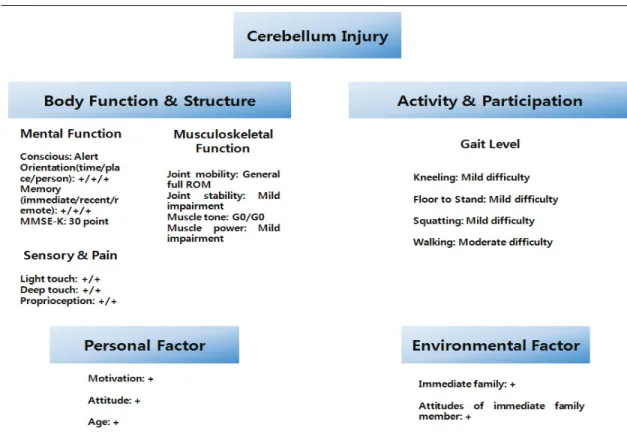
교통사고 이후, 소뇌 위축이 더욱 진행되었으며, 조 화운동못함증의 증상도 더욱 악화되었다. 그리하여 물리치료를 받기 위해 2015년 10월 2일에 서울 송파 구에 소재한 D 재활요양병원으로 내원하였다. 직업 은 가정 주부였으며, 슬하에 1남 1녀의 자식을 두고 있다. 대상자의 주호소는 보행을 하는 동안 낙상에 대한 두려움이다 . 대상자에 대한 구체적인 정보는 아래 와 같다(Fig. 1).

2. DNSA와 결합한 PNF 중재 프로그램

본 사례보고의 대상자는 1일 30분씩, 1주일에 4번씩 총 3주에 걸쳐 DNSA와 결합한 PNF 중재 프로그램을 실시하였다. PNF 중재 프로그램에서는 PNF의 기본 철학을 바탕으로 호흡 중재 시 효과적인 CI기법을 주 로 사용하였다(Adler et al., 2008). 모든 중재는 DNSA 의 운동발달 자세에 따라 적용되었으며, Fitts와 Posner (1967)의 운동학습 단계에 따라 실시하였다. 구체적인

운동 중재 방안은 Table 1과 같다.

3. 측정 도구 및 방법

1) 신체 기능과 구조 손상에 대한 평가

(1) 몸통손상평가(trunk impairment scale, TIS) 뇌졸중 환자의 몸통 능력을 평가하기 위한 목적으 로 고안되었으며 , 평가 항목에는 정적 및 동적 앉은 자세 균형과 앉은 자세에서의 몸통의 협응력 평가로 구성되어 있다 . 이외에도 다발성 경화증, 파킨슨 질환 을 가진 환자의 몸통 능력을 평가하기 위해서도 사용 되고 있다(Verheyden et al., 2006; Verheyden et al., 2007). 뇌졸중 환자에 대한 TIS의 측정자간, 측정자내 신뢰도는 0.96-0.99이다(Verheyden et al., 2004).

Fig. 1. The rehabilitation problem-solving form (RPS-Form) applied to a patient with cerebellum atrophy.

(4)

ԺԼԸ ք ՘ՖՎԨթնլԨՕշվխյխնռԨ┚ԹԼઊԨ┚Ի㌶

Training Protocol Time

Position: Supine

Breathing: Diaphragm, Intercostal and Abdominal area Pattern : Lower extrimity bilateral pattern

Technique: Stabilizing reversal

3min

Position: Sidelying Breathing: Intercostal area

Pattern: Shoulder flexion /abduction /external rotation (for trunk elongation)

3min

Rest time 2min

Position: Hooklying Breathing: sternum area

Pattern: Shoulder symmetrical pattern and lower extrimity bilateral pattern

3min

Position: Obilique sit position

Breathing: Intercostal and abdominal area

Pattern: Shoulder asymmetrical reciprocal pattern with thera-bend Technique : Combination of isotonic

3min

Rest time 2min

Position: Oblique sit position transitioning towards a quadruped position Breathing: Intercostal area

Pattern : Shoulder asymmetical reciprocal pattern Technique : Combination of isotonic

3min

Position: Side sitting Breathing: Sternum area

Pattern : Trunk flexion / extension Shoulder asymmetrical reciprocal Pelvic anterior elevation

Technique : Combination of isotonic

3min

Table 1. Protocol for PNF program combined with DNSA

(5)

თ⓿Ԩ῞঻ૺԨ≆┓㍒Ԩ┏ૺᦓ৺Ԩম㉧㉚Ԩ՘ՖՎԨ☏⒪Ԩ㈂ᕚ૶ᒦ⑲ԨẊ໊Ԩ␂⪓Ԩ㍖⒎⑖Ԩ૞㌓⋎Ԩ᣶⭖ྒԨ⋿㊣ ք ԺԼԹ

(2) 한발서기검사(one leg standing test, OLST) 정적인 균형 능력을 평가하기 위하여 한발 서기 검사를 실시하였다 . 대상자는 중재 전, 중재 후에 폐안 과 개안 시 각각 두 번에 걸쳐 우세한 발을 이용하여 OLST를 수행하였다. 이 평가 도구의 측정자내 신뢰도 는 0.89이다(Kristensen et al., 2014)

2) 활동 제한에 대한 평가

(1) 의자에서 일어나 걷기(timed up and go test, TUG) 의자에서 일어나 걷기는 46cm 높이의 팔걸이가 있 는 의자를 편평한 바닥에 놓고 , 편안하게 앉은 상태에 서 평가자의 “시작” 구호에 따라 의자에서 일어나서 3m 떨어진 지점의 반환점을 돌아 다시 의자에 앉을 때까지 소요된 시간을 측정하는 방법이다. 본 사례보 고에서는 2회에 걸쳐 측정하여 평균값을 사용하였다.

이 평가 도구는 측정자간 , 측정자내 신뢰도는 0.98- 0.99이다(Podisadle & Richardson, 1991).

(2) 시각적 상사척도(visual analogue scale, VAS) 보행 시 통증 변화를 측정하기 위해 시각적 상사척 도를 사용하였다 . 이 평가 도구의 측정자간, 측정자내 신뢰도는 0.60-0.77이다(Boonstra et al., 2008).

4. 자료 처리

DNSA와 결합한 PNF 중재 프로그램의 효과를 분석 하기 위하여, 중재 전과 후의 평가 결과를 변화율로 분석하였다. 변화율의 공식은 다음과 같다.

변화율 = (중재 후 결과-중재 전 결과) / 중재 전 결과 X 100

Training Protocol Time

Rest time 2min

Position: Sitting

Breathing: Abdominal area

Pattern : Shoulder symmetrical pattern with thera-bend Technique : Combination of isotonic

3min

Position: Standing Breathing: Abdominal area

Pattern : Shoulder symmetrical pattern with thera-bend Technique : Combination of isotonic

3min

Home Exercise

Position: Modified sidelying, Sitting, Standing

Pattern: Shoulder asymmetrical reciprocal pattern with therabend and Shoulder symmetrical pattern with thera-bend

15min

(6)

ԺԼԺ ք ՘ՖՎԨթնլԨՕշվխյխնռԨ┚ԹԼઊԨ┚Ի㌶

Ⅲ. 연구 결과

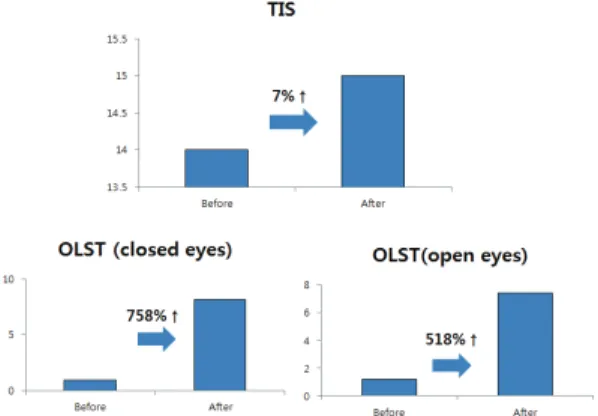
1. 신체 기능과 구조 손상에 대한 평가 변화 PNF 중재 프로그램 전 TIS 14점, 폐안 시 OLST는 0.95초, 개안 시 OLST는 1.20초였다. 중재 후, TIS는 15점으로 1점 개선되었으며, 페안 시 OLST는 8.15초 증가하였고 , 개안 시 OLST는 7.41로 6.21초가 증가하였 다 . 변화율 결과를 살펴보면, TIS는 약 7%, 폐안 시 OLST는 758%, 개안 시 518% 정도 개선을 보였다(Fig. 2).

Fig. 2. Changes of TIS and OLST in closed or open eyes.

2. 활동 제한에 대한 평가 변화

PNF 중재 프로그램 전 TUG는 19.23초, VAS 7점이 었다. 중재 후, TUG는 17.79초, VAS는 4점이었다. 변 화율 결과를 살펴보면 , TUG는 약 8%, VAS 43%정도의 개선을 보였다(Fig. 3).

Ⅳ. 고 찰

조화운동못함증을 동반한 소뇌 손상 환자들의 재 활에 있어서 무엇보다 중요한 것은 균형과 보행 능력 의 회복이다(Ilg & Timmann, 2013). 균형과 보행 능력 을 개선시키기 위해서 몸통의 안정화가 필수적이다.

가로막과 배가로근(transversus abdominis)은 몸통 안정 화뿐만 아니라 호흡에도 기여한다 . 특히, 다양한 과제 를 수행하는 동안 행해지는 호흡에서는 가로막과 배 가로근의 협응적인 동심성 수축과 편심성 수축이 매 우 중요하며 , 이러한 두 근육의 긴장성(tonic) 활동으로 인해 정상적인 호흡이 지속되는 것이다(Richardson et al., 2004). 소뇌 손상 환자의 일반적인 특징에는 의도 떨림 (intention tremor)이 있으며, 과제를 수행하는 동안 의도떨림으로 인해 호흡 패턴이 불규칙해지면서 복부 내압력 조절에 문제가 발생하여 몸통의 안정성이 감 소하는 경향을 보인다 . 이에 본 사례보고는 호흡 중재 를 기본으로 한 PNF 중재 프로그램을 DNSA와 결합하 여 그 효과를 규명하기 위해 실시하였다.

본 사례보고의 결과, TIS는 중재 전에 비해 중재 후 개선을 되었지만 , 약 7%정도의 개선만을 보였다. 최근 소뇌 손상 관련 선행 연구에서는 중재 시간과 기간을 최소 하루 1시간, 4주 이상을 적용하였다(Ilg et al., 2010;

Ilg et al., 2012; Miyai et al., 2012). 그 결과, 선행 연구에 서는 정적⋅동적 균형의 안정성이 유의하게 향상되었 음을 보고하였다 . Song과 Park (2015) 역시 1시간 이상 의 중재 시간으로 주당 5회 이상, 장기간의 걸쳐 중재를 권장하였다. 소뇌 손상 이후 학습효과가 상대적으로

Fig. 3. Changes of TUG and VAS.

(7)

თ⓿Ԩ῞঻ૺԨ≆┓㍒Ԩ┏ૺᦓ৺Ԩম㉧㉚Ԩ՘ՖՎԨ☏⒪Ԩ㈂ᕚ૶ᒦ⑲ԨẊ໊Ԩ␂⪓Ԩ㍖⒎⑖Ԩ૞㌓⋎Ԩ᣶⭖ྒԨ⋿㊣ ք ԺԼԻ

낮아 회복이 느린 특성을 감안하여 볼 때 (Schwabe et al., 2004), 본 사례보고의 짧은 중재 기간은 정적⋅동적 몸통의 안정성과 협응 능력을 평가할 수 있는 TIS의 결과에 긍정적인 영향을 미치는데 제한적이었다.

본 사례보고 결과 , 폐안 및 개안 시 OLST에서 현저 한 개선을 보였다 . 이는 지속적인 균형 수행을 위해서 는 호흡이 중요하며, 호흡 중재에 초점을 PNF 프로그 램이 소뇌 손상 환자의 의도떨림과 호흡 패턴을 회복 시켜 지속적인 균형 수행에 긍정적인 영향을 미친 것 으로 생각된다 . 몸통 안정화와 관련된 운동을 실시하 는 동안 정상적인 호흡보다는 호흡을 정지시켜 실시 하는 경우가 많다. 가로막이 몸통 안정화에 중요한 역할을 수행하는 근육임에도 불구하고, 그 작용을 제 한하는 것이다 . 본 사례보고에서는 몸통 안정화를 실 시하는 동안 호흡 조절을 강조하였다. 몸통 안정화 훈련을 하는 동안 호흡 패턴을 정상화한다면, 가로막 뿐만 아니라 배가로근의 긴장성 역할을 지속시켜 자 세 조절에도 큰 기여를 할 것으로 생각된다 . 소뇌 손상 의 기능 회복을 위한 대부분의 중재 프로그램은 균형 훈련, 협응 훈련, 트레드밀 훈련 위주로 구성되어 있기 때문에(Ilg et al., 2010; Ilg et al., 2012; Miyai et al., 2012), 본 사례보고의 결과를 바탕으로 호흡 중재에 대한 관심이 높아지길 기대한다.

TUG의 결과를 살펴보면, 대상자가 느끼는 회복 정 도보다 평가 결과가 낮게 나타난다. 이는 대상자의 회복속도와 낙상에 대한 두려움 등을 고려하여 볼 때, 선 자세보다 난이도가 어려운 보행과 관련된 중재가 아직 적용되지 않았기 때문이라 생각된다. 그리고 VAS에서는 중재 전에 비해 중재 후 43%의 감소를 보였다. 이는 다양한 과제 수행 시 몸통의 안정성이 개선되어 낙상에 대한 공포와 두려움이 감소되어 시 각적 상사척도에 영향을 미친 것이라 생각된다.

Ⅴ. 결 론

본 사례보고의 결과를 종합하여 볼 때, DNSA와

결합한 PNF 중재 프로그램은 동적인 균형 능력의 개 선보다는 정적인 균형 능력인 폐안과 개안 시 한발서 기 , 통증 지수를 개선시키는데 효과적인 것으로 보인 다. 더하여 소뇌 손상 환자의 학습능력을 고려하여 볼 때 , 하루 1시간, 4주 이상의 중재 시간 및 중재 기간 으로 운동 프로그램을 적용하기를 권장한다.

References

Boonstra AM, Preuper HRS, Reneman MF, et al. Reliability and validity of the visual analogue scale for disability in patients with chronic musculoskeletal pain.

International journal of rehabilitation research.

2008;31(2):165-169.

Fitts PM, Posner MI. Human performance. Oxford. Brooks/

Cole. 1967.

Fonteyn EM, Keus SH, Verstappen CC, et al. Physiotherapy in degenerative cerebellar ataxias: utilisation, patient satisfaction, and professional expertise. Cerebellum.

2013;12(6):841-847.

Ilg W, Brötz D, Burkard S, et al. Long-term effects of coordinative training in degenerative cerebellar disease. Movement disorders. 2010;25(13):2239- 2246.

Ilg W, Schatton C, Schicks J, et al. Video game-based coordinative training improves ataxia in children with degenerative ataxia. Neurology. 2012;79(20):2056- 2260.

Ilg W, Timmann D. Gait ataxia-specific cerebellar influences and their rehabilitation. Movement disorders.

2013;28(11):1566-1575.

Kim JM, Gong MJ, Goo HM, et al. Neuroanatomy &

neurophysiology, 5th ed. Seoul. Jungdam Media.

2015.

Kristensen MT, Nielsen AØ, Topp UM, et al. Number of

test trials needed for performance stability and

(8)

ԺԼԼ ք ՘ՖՎԨթնլԨՕշվխյխնռԨ┚ԹԼઊԨ┚Ի㌶

interrater reliability of the one leg stand test in patients with a major non-traumatic lower limb amputation.

Gait posture. 2014;39(1):424-429.

Miyai I, Ito M, Hattori N, et al. Cerebellar ataxia rehabilitation trial in degenerative cerebellar diseases. Neurorehabilitation and neural repair. 2012;26 (5):515-522.

Podsiadlo D, Richardson S. The timed "Up & Go": a test of basic functional mobility for frail elderly persons.

Journal of the American geriatrics society. 1991;

39(2):142-148.

Richardson C, Hodges P, Hides J. Therapeutic exercise for lumbopelvic stabilization: a motor control approach for the treatment and prevention of low back pain, 2nd ed. Edinburgh. Churchill-Livingstone. 2004.

Schwabe A, Drepper J, Maschke M, et al. The role of the human cerebellum in short- and long-term habituation of postural responses. Gait posture. 2004;19(1):16-23.

Song YK, Park JH. Strategy and principle of rehabilitation for functional motor recovery in patients with cerebellar disease. Korean journal of adapted physical

activity. 2015;23(4):101-126.

Van de Warrenburg BP, Steijns JA, Munneke M, et al. Falls in degenerative cerebellar ataxias. Movement disorders. 2005;20(4):497-500.

Vaz DV, de Carvalho Schettino R, de Castro TRR, et al.

Treadmill training for ataxic patients: a single-subject experimental design. Clinical rehabilitation. 2008;

22(3):234-241.

Verheyden G, Nieuwboer A, Mertin J, et al. The trunk impairment scale: a new tool to measure motor impairment of the trunk after stroke. Clinical rehabilitation. 2004;18(3):326-334.

Verheyden G, Nuyens G, Nieuwboer A, et al. Reliability and validity of trunk assessment for people with multiple sclerosis. Physical therapy. 2006;86(1):66-76.

Verheyden G, Willems AM, Ooms L, et al. Validity of the trunk impairment scale as a measure of trunk performance in people with parkinson’s disease.

Archives of physical medicine and rehabilitation.

2007;88(10):1304-1308.

수치

Fig. 1. The rehabilitation problem-solving form (RPS-Form) applied to a patient with cerebellum atrophy.
Fig. 2. Changes of TIS and OLST in closed or open eyes.

참조

관련 문서

The Effects of proprioceptive neuromuscular facilitation (PNF) Pattern Exercise Using the Sprinter and the Skater on Balance and Gait Function in the Stroke

PURPOSE: This study examined the effects of both lower extremities proprioceptive neuromuscular facilitation training with functional electrical stimulation on the balance and

Purpose: The aim of the present study was to investigate the effects of proprioceptive neuromuscular facilitation (PNF) and taping interventions on balance ability,

Purpose: This study attempts to identify the effects of abdominal strength training using proprioceptive neuromuscular facilitation (PNF) on the balance ability and pain

This case report investigated how intervention with proprioceptive neuromuscular facilitation (PNF)-based physical therapy can affect the activities of Parkinson’s

Purpose: The purpose of this study was both to examine the effects of proprioceptive neuromuscular facilitation (PNF) lower leg taping and treadmill training on the gait

Conclusion :This study suggests that balance training with RS and CI of Proprioceptive Neuromuscular Facilitation improved balance in patients with hemiplegia.. Key

Purpose The purpose of this study was to study the effect of rectus abdominal muscle contraction by proprioceptive neuromuscular facilitation trunk stabilization training