• 검색 결과가 없습니다.

Effect of a Lower Extremity Strengthening Exercise Using Proprioceptive Neuromuscular Facilitation on the Gait and Balance Ability of a Stroke Patient -A Single Case Study-

N/A
N/A
Protected

Academic year: 2021

Share "Effect of a Lower Extremity Strengthening Exercise Using Proprioceptive Neuromuscular Facilitation on the Gait and Balance Ability of a Stroke Patient -A Single Case Study-"

Copied!
8
0
0

로드 중.... (전체 텍스트 보기)

전체 글

(1)

| Abstract |

Purpose: This study seeks to determine the effect of a lower extremity strengthening exercise that uses proprioceptive neuromuscular facilitation (PNF) on the gait and balance ability of a stroke patient.

Methods: In this case study, a lower extremity strengthening exercise that used PNF was performed by the subject for 30 minutes 4 times per week for a 4-week period alongside typical rehabilitation therapy. The lower extremity pattern used flexion-abduction-internal rotation with knee flexion, extension-abduction-internal rotation, bilateral leg extension pattern. The 10 m walk test and 6 minute walk test were used to assess gait ability. The Berg balance scale was used to assess balance ability.

Results: After the intervention, the time for the 10 m walk test decreased by 5.72 sec, the distance for the 6 minute walk test decreased by 20 meters, and the score on the Berg balance scale improved by 7 points, which indicates the effectiveness of this therapy for stroke patients.

Conclusion: The results of this study indicate that a lower extremity strengthening exercise using PNF can improve the gait ability and balance ability of stroke patients.

Key Words: PNF, Lower extremity, Gait, Balance

†Corresponding Author : Soon-Hyun Lee ([email protected])

Case study Open Access

PNF를 이용한 하지근력 강화운동이 뇌졸중 환자의 보행 및 균형 능력에 미치는 영향

-단일사례연구-

이순현 ⋅이용주

1)

국립교통재활병원 재활치료부

Effect of a Lower Extremity Strengthening Exercise Using Proprioceptive Neuromuscular Facilitation on the Gait and Balance Ability of a Stroke Patient
-A Single Case Study- Soon-Hyun Lee ⋅Yong-Ju Lee

Department of Physical Therapy, National Traffic Injury Rehabilitation Hopistal Received: November 17, 2016 / Revised: November 28, 2016 / Accepted: November 28, 2016

ⓒ 2017 Journal of Korea Proprioceptive Neuromuscular Facilitation Association

This is an Open Access article distributed under the terms of the Creative Commons Attribution Non-Commercial License

(http://creativecommons.org/licenses/by-nc/3.0) which permits unrestricted non-commercial use, distribution, and reproduction

in any medium, provided the original work is properly cited.

(2)

Ⅰ. 서 론

뇌졸중 환자에게 나타나는 임상적 양상은 매우 다 양하며 이러한 양상에 의해 균형과 보행에 문제를 초 래한다(Woolley, 2001). 특히 근력 약화(Lamontagne et al., 2002), 비대칭적인 보행 패턴(Woolley, 2001), 하지 기능 저하(Alexander et al., 2009), 보행장애(Kerrigan et al., 2000)가 나타난다. 이 중 보행장애는 재활에 있어 선행적으로 해결해야 할 과제로서(Mauritz, 2004), 보 행 장애의 요인으로는 마비측에 발생되는 근력약화나 강직 , 마비가 있다(Donnan et al., 2008). 마비측 상지의 굴곡 양상과 하지 신전근 약화는 보행 속도를 저하시 키는 요인이 되고(Alexander et al., 2009), 양측 하지의 비대칭적 보행 패턴이 비정상적 움직임과 강직에 의 해 발생하게 된다 (Pelton et al., 2010). 무릎 신전근 약화 와 고관절 신전근의 기능 저하로 발생하는 불안정한 체중지지는 보폭을 짧게 만드는데 , 이는 뇌졸중 환자 의 재활에 주된 목표가 된다(Lin et al., 2006). 또한 뇌졸중 환자에게 흔하게 볼 수 있는 비정상적 보행은 상당 기간 장애로 남고, 급성기의 30%는 손상 후 최초 입원기간 최소 3개월 동안은 거동이 불가능하다 (Wade et al., 1987).

균형 능력은 제한되어 있거나 안정적 지지면 위에 서 바른 자세를 유지하는 능력을 의미하는데(Tyson et al., 2006) 선 자세에서 균형을 유지하기 위해 필요한 근육은 보행에 사용되는 근육과 밀접한 상관관계에 있다 . 보행 속도는 균형 능력이 좋을 경우 더욱 빨라지 고 , 균형 능력이 저하되어 있을 경우 보행에 부정적인 영향을 미치게 된다(Ikai et al., 2003). 재활로 인해 보행 이 개선된 뇌졸중 환자에게서 균형 능력도 향상됨을 볼 수 있는데(Yavuzer et al., 2006), 뇌졸중 환자의 재활 프로그램에 있어 보다 효과적이고 기능적인 접근은 균형과 보행기능의 향상을 감안한 치료방법이다(Eser et al., 2008).

고유수용성신경근촉진법(PNF)은 고유수용성감각 을 자극하여 근육과 신경을 촉진시켜주어 기능적인 접근을 하는 방법으로 뇌졸중 및 다양한 질환에 적용

되고 있다(Adler et al., 2014). PNF의 패턴은 나선형과 대각선 방향으로 근수축을 유도하여 운동을 하는 방 법으로 스포츠 등 다양하게 활용되는데(Kofotolis &

Kellis, 2007), 이 중 PNF의 하지 패턴은 뇌졸중 환자에 게 다양한 자세에서 보행 능력 향상을 위해 적용되어 진다. 특히 마비측에 적용하는 굴곡 패턴과 신전 패턴 은 보행 주기의 각각 유각기와 입각기를 위해 적용하 는 직접적인 방법이고 비마비측의 굴곡 패턴을 적용 하여 방산효과를 통해 반대측 하지 신전근을 강화시 켜주어 보행 능력 향상에 효과적이다(Adler et al., 2014). 뇌졸중 환자의 기능회복을 위한 다양한 방법의 연구는 많았지만 단순 패턴을 적용한 방법 중 하지패 턴만을 적용한 연구는 부족하다. 따라서, 본 연구는 뇌졸중 환자에게 여러 자세에서 점진적으로 단순 하 지 패턴만을 적용한 결과를 알아봄으로서 임상에서 치료 중재시 도움을 주고자 하였다.

Ⅱ. 연구 방법

1. 연구 대상

본 연구는 경기도에 소재한 OO병원에서 보행 능력 에 저하가 있는 뇌졸중 환자 1명을 대상으로 하였다.

연구 방법에 대한 설명을 하였고, 대상자의 동의하에

연구를 진행하였다 . 연구 기간은 2016년 4월부터 2016

년 5월까지 진행하였다. 대상자의 일반적 특성은 다음

과 같다 (Table 1). 대상자는 고혈압 외에 과거력이 없는

분으로 재활에 있어 주된 문제로 보행 개선을 언급하

였고 가능한 빨리 업무 복귀를 희망하였다. 인지검사

는 MMSE-K 29점이고, 기능적 보행검사(functoinal gait

assessment, FGA)는 5점이며 하지 푸글마이어척도는

우측 32점, 좌측 14점이었다. 발목 저측 굴곡근의 경직

은 경직척도상(modified Ashworth scale, MAS) 2점이

며 , 마비측 근력은 고관절 신전근 Fair, 고관절 굴곡근

Fair, 무릎신전근 Poor, 발목 저측굴곡근 Poor이다.

(3)

Subject

1 Gender Male

2 Age (year) 50

3 Height (cm) 170

4 Weight (kg) 61

5 Type of stroke Infarction (Rt. ACA & MCA) 6 Peratic side Lt. hemiplegia

7 Duration (month) 14

8 MMSE-K a 29

9 TUG 113.2 sec

a Mini-Mental Status Examination-Korea Table 1. Characteristics of subject

2. 측정 방법 및 도구

본 연구에서 보행 능력의 변화를 알아보기 위해 10미터 보행 검사(10meters walk test)와 6분 보행검사 (6minutes walk test)를 사용하였고 균형 능력의 변화를 알아보기 위하여 버그균형척도(Berg balance scale, BBS)를 사용하였다.

1) 10미터 보행검사(10m walk test)

10m walk test는 보행 능력을 측정하는 도구로서, 시작과 끝지점 각 2미터씩을 포함한 14미터를 측정하 여 가속과 감속 시간을 감안하여 시작과 끝지점의 2미 터를 제외한 실제 10미터를 걷는 동안 소요되는 시간 을 측정하였다. 총 3회 반복측정하여 평균값을 기록하 였다(Walker et al., 2000). 이 검사도구는 측정자내 신 뢰도가 0.95로 신뢰도가 높은 도구이다(Wolf et al., 1999).

2) 6분 보행검사(6minutes walk test)

6minutes walk test는 보행 지구력을 측정하는 도구 로서 , 6분 동안 최대한 지속적으로 걷게하여 전체 보행 거리를 측정하는 방법으로 3회 반복하여 평균값을 기 록하였다. 이 검사도구는 측정자내 신뢰도가 r=0.91로 신뢰도가 높은 도구이다(Mossberg, 2003).

3) 버그균형척도(Berg balance scale, BBS) BBS는 동적균형 능력을 평가하는 도구로서, 총 14 개 항목으로 구성되어 있고 총 56점 만점으로 이루어 져있다. 각 항목은 5점 척도로 되어 있으며, 0점부터 4점으로 되어 있고 0점은 과제 수행불가, 4점은 독립적 수행 가능을 의미한다(Berg et al., 1995). 이 검사도구 는 측정자내, 측정자간 신뢰도가 각 r=0.99, r=0.98이다 (Berg et al., 1992).

3. 실험 방법

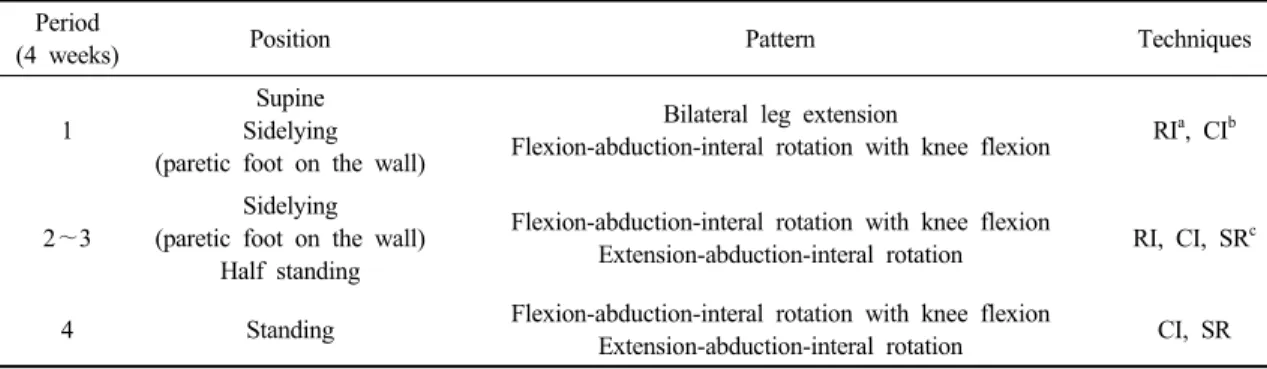
본 연구에서 실시한 PNF를 이용한 하지근력 강화운

동은 비 마비측 하지에 무릎굴곡을 동반한 굴곡 -외전-

내회전 패턴(flexion-abduction-interal rotation with knee

flexion)을 적용하여 마비측 하지 신전근 강화를 위해

실시하였고 마비측 하지 신전근 강화를 위해 마비측

하지에 신전-외전-내회전 패턴(extension-abduction-

interal rotation)을 실시하였다. 마지막으로 양측하지의

신전패턴(bilateral extension)은 하지 신전근 강화를 위

하여 실시하였다. 운동적용시간은 30분이었고 환자

상태에 따라 자세를 다양하게 변경하며 양측 하지에

교대로 적용하였다. 매 운동시간에 다양한 자세에서

실시하였는데, 1주에는 바로 누운 자세와 옆으로 누운

자세, 2주∼3주에는 테이블에 걸터앉은 자세에서 점

진적으로 선자세로, 4주에는 테이블에 손을 얹고 선

자세에서 실시하였다. 근력강화를 위하여 등장성혼합

기법을 사용하였으며 , 자세 변경 시 움직임을 알려주

고 안정성을 제공하기 위하여 율동적 개시와 안정적

반전 기법을 사용하였다. 마비측 하지를 벽에 대고

비마비측 하지의 굴곡 패턴을 적용하여 마비측 신전

근 강화를 위한 등장성 혼합기법을 사용하였고 마비

측 하지에 직접적으로 신전패턴을 적용하여 신전근

강화 운동을 하였다 . 안정적 반전 기법은 옆으로 누운

자세 , 테이블에 걸터앉은 자세, 선 자세에서 자세 변경

시 안정성 제공을 위하여 하지와 골반에 적용하였고

움직임의 이해를 돕기 위하여 율동적 개시를 적용하

였다(Table 2). 일반적인 물리치료는 입원 환자에게

적용하는 기구 운동 1시간, 중추신경발달치료 30분,

(4)

기능적 전기자극 40분을 실시하였다. 기구 운동은 스 텝퍼를 이용한 상하지 교대 운동을 실시하였고 중추 신경발달치료는 구르기와 같은 기능적 움직임 개선을 위하여 치료하였다. 또한, 기능적 전기자극치료는 발 목 배측 굴곡근과 무릎 신전근에 1일 2회 20분씩 실시 하였다.

4. 분석 방법

본 연구에서는 보행 및 균형 능력의 변화를 알아보 기 위하여 치료 전과 후를 평가하여 비교하였다.

Ⅲ. 결 과

1. 보행 능력의 변화

치료 전과 후의 보행 능력에 대한 변화는 다음과 같다(Table 3).

Pre-test Post-test Difference 10m walk test (sec) 24.72 19 -5.72 6minutes walk test (m) 154 174 +20 Table 3. The changes of Gait ability

2. 균형 능력의 변화

치료 전과 후의 균형 능력에 대한 변화는 다음과 같다(Table 4).

Pretest Posttest Difference

Sitting to Standing 4 4 -

Standing unsupported 4 4 -

Sitting unsupported 4 4 -

Stnading to Sitting 4 4 -

Transfers 4 4 -

Standing with eyes closed 4 4 - Standing with feet together 3 4 +1

Reaching forward with

outstretched arm 3 4 +1

Retrieving object from floor 4 4 -

Truning to look behind 3 4 +1

Turning 360 degrees 2 4 +2

Placing alternate foot

on stool 1 2 +1

Standing with one foot

in front 0 0 -

Standing on one foot 0 1 +1

Total 40/56 47/56 +7

Table 4. The changes of Balance ability Period

(4 weeks) Position Pattern Techniques

1

Supine Sidelying (paretic foot on the wall)

Bilateral leg extension

Flexion-abduction-interal rotation with knee flexion RI a , CI b

2∼3

Sidelying (paretic foot on the wall)

Half standing

Flexion-abduction-interal rotation with knee flexion

Extension-abduction-interal rotation RI, CI, SR c

4 Standing Flexion-abduction-interal rotation with knee flexion

Extension-abduction-interal rotation CI, SR

a Rhythmic Initiation

b Comination of Isotonics

c Stabilizing Reversal

Table 2. Strengthening exercise for Lower extremity

(5)

Ⅳ. 고 찰

본 연구는 PNF를 이용한 하지 근력강화운동이 뇌 졸중 환자의 보행 및 균형 능력에 미치는 영향을 알아 보고자 연구를 시행하였다. 10m walk test는 5.72초 단 축되었고 6minutes walk test는 20미터 증가하였으며 BBS는 7점 증진되어 훈련 전에 비해 보행 능력과 균형 능력 모두 향상된 것을 알 수 있었다.

보행의 속도 개선은 신경계 재활에서 아주 기초적 인 부분으로(Hesse et al., 2001) 보행속도는 임상적으 로 일상생활 수행에 있어 기능 회복 수준을 평가하는 하나의 방법이기 때문에 속도 향상을 위한 재활이 필 요하다(Kim & Eng, 2003). 본 연구에서는 보행에 중요 한 하지 근력 강화를 위해 PNF 하지 굴곡과 신전 패턴 을 사용하였다. 뇌졸중 환자의 보행 능력 향상을 위해 마비측 하지의 근력 향상 , 무릎 신전근과 고관절 신전 근 근력 강화가 필요하며(Werner et al., 2002), 더불어 유각기 시 발목의 배측 굴곡이 동반되어지면 더욱 기 능적인 보행이 가능하게 된다(Sabut et al., 2010). 본 연구의 결과에서 10m walk test는 실험 전 24. 72초에서 19초로 보행속도가 빨라졌고 6minutes walk test는 실 험 전 154m에서 174m로 20m 보행 거리가 증가하였다.

이는 Kim (2008)에 의한 하지 패턴이 무릎관절의 운동 성과 안정성 회복, 하지의 움직임, 체중지지 및 이동을 향상시킨다는 연구와 동일한 결과를 보였다. 마비측 하지에 직접 적용한 굴곡 패턴은 유각기 시 발목 배측 굴곡을 촉진시켜주고, 신전 패턴으로 입각기 시 필요 한 근력을 충분히 강화를 시켜주었기 때문에 보행 속 도가 향상되었을 것으로 생각된다. 또한 PNF의 등장 성 혼합은 근력강화를 위한 효과적인 테크닉으로써 본 연구에서도 충분한 근력 증가를 보여 보행 능력이 개선된 것으로 사료된다(Adler et al., 2014).

보행과 균형은 상호의존적 관계이므로 뇌졸중 환 자 재활에 있어 고려해야 할 우선 순위가 되고, 특히 균형 능력 향상은 보행 장애가 있는 환자에게 주된 치료 목표가 된다(Mauritz, 2004). 보행 능력이 향상된 환자군에서 균형도 개선됨을 알 수 있고 , 보행 시 주된

근육인 고관절 신전근, 무릎 신전근의 강화는 균형 능력을 향상시킨다 (Ikai et al., 2003). 또한, 골반의 움직 임 개선은 균형 능력 향상에 중요한데 (Yavuzer et al., 2006), 골반을 직접 움직이는 운동뿐만 하지를 이용한 간접적 골반 움직임 개선은 균형 능력 향상 및 보행에 도 긍정적 영향을 주게 된다(Combs et al., 2010). 마비 측 하지로의 체중지지에 문제가 발생하면 균형 능력 저하를 초래 하게 되고 , 입각기 시 체중 이동이 불가하 게 되어 결국 보행 속도 저하 및 불안정한 보행 양상을 보이게 된다. 이러한 균형 능력 저하의 향상을 위해 마비측 하지의 체중지지 및 이동 증진이 필요한데, 하지 신전근 강화는 뇌졸중 환자의 균형 회복에 주요 한 역할을 한다 (Yavuzer et al., 2006). 본 연구 결과에서 균형 능력을 평가하기 위해 실시한 BBS 검사에서 7점 증가하였다. 본 연구에서는 체중지지에 필요한 하지 근력 강화를 위해 PNF의 하지 패턴을 적용하였는데, BBS 항목 중 팔뻗기, 뒤쪽으로 돌아보기, 360도 돌기, 양발 교차대기 , 한발 앞으로 지지에서 향상되었다. 이 는 체중 이동 및 지지 능력이 향상되어야 하는 개선되 는 항목으로 본 연구에서 실시한 운동방법이 균형 능 력에 효과적인 운동임을 입증하고 있다.

PNF의 하지 굴곡 패턴과 신전 패턴은 골반의 움직 임을 유도하여 간접적으로 뇌졸중 환자의 기능 개선 에 효과적이다 . 특히 하지의 굴곡 패턴은 직접 적용 시 동측의 유각기를 촉진시켜주고, 간접 적용 시는 반대측의 입각기 향상에 효과적이다.(Adler et al., 2014). 그리고 하지 신전 패턴은 고관절 신전, 무릎관 절 신전, 발목관절 저측 굴곡의 혼합 패턴으로, 보행 시 입각기에 동원되는 근육을 강화시켜준다(Lee et al., 2015). 본 연구에서 균형 능력이 향상된 것도 적용한 하지 패턴 운동이 체중지지에 필요한 고관절 신전근 , 무릎 신전근 강화에 효과적이었음을 입증하고 있다.

하부체간의 운동이 자세조절능력을 향상시키고 자세

를 유지하는데 긍정적으로 작용하는데(Shanmugananthl

et al., 2015), 본 연구에서 적용한 하지 패턴이 하부

체간의 움직임을 촉진시키고, 이로 인한 향상된 자세

조절 능력에 의해 뇌졸중 환자의 보행 및 균형 능력이

(6)

개선되었다고 추정된다. 이는 골반에 적용한 고유수 용성신경근촉진법이 균형과 보행에 효과적인 연구 (Kumarl et al., 2012)에서 입증하고 있고 하지 패턴이 골반주위 근육을 수축하게 하여 균형 유지에 필요한 골반의 안정성 확보에 도움을 주어 균형에 긍정적인 영향을 주었다고 사료된다. 편마비 환자에게 하지 패 턴을 적용하여 균형 수행력이 증진하였다는 KIM 등 (2013)의 연구 결과도 본 연구를 입증하고 있다.

본 연구 대상자는 1명으로 제한적이었고 근력측정 도구를 사용하지 않아 근력 향상은 알아보지 못했다.

차후에는 광범위한 지역에서 많은 수의 환자를 대상 으로 연구할 필요가 있다. 단일 사례 연구로 한계가 있었으나 뇌졸중 환자의 보행 능력 및 균형 능력을 향상하기 위해 임상에서 PNF의 하지 패턴을 이용한 근력강화 운동을 적용할 수 있을 것으로 사료된다.

Ⅴ. 결 론

본 연구는 뇌졸중 환자 1명을 대상으로 고유수용성 신경근촉진법을 이용한 하지근력 강화운동을 적용하 였다. 치료 후 보행 능력과 균형 능력이 향상됨을 알 수 있었고 이는 뇌졸중 환자의 기능회복을 위해 임상 에서 사용할 수 있다고 사료된다.

References

Adler S, Beckers D, Buck M. PNF in practice: an illustrated guide, 4th ed. Heidelberg. Springer. 2014.

Alexander LD, Black SE, Patterson KK, et al. Association between gait asymmetry and brain lesion location in stroke patients. Stroke. 2009;40(2):537-544.

Berg KO, Maki BE, Williams JI, et al. Clinical and laboratory measures of postural balance in an elderly population.

Archives of Physical Medicine and Rehabilitation.

1992;73(11):1073-1080.

Berg K, Wood-Dauphinee S, Williams JI. The balance scale:

reliability assessment with elderly residents and patients with an acute stroke. Scandinavian Journal of Rehabilitation Medicine. 1995;27(1):27-36.

Combs SA, Dugan EL, Passmore M, et al. Balance, balance confidence, and health-related quality of life in persons with chronic stroke after body weight-supported treadmill training. Archives of Physical Medicine and Rehabilitation. 2001;91(12):1914-1919.

Donnan GA, Fisher M, Macleod M, et al. Stroke. Lancet.

2008;371(9624):1612-1623.

Eser F, Yavuzer G, Karakus D, et al. The effect of balance training on motor recovery and ambulation after stroke: a randomized controlled trial. European Journal of Physical Medicine and Rehabilitation.

2008;44(1):19-25.

Garland SJ, Willems DA, Ivanova TD, et al. Recovery of standing balance and functional mobility after stroke.

Archives of Physical Medicine and Rehabilitation.

2003;84(12):1753-1759.

Hesse S, Werner C, Paul T, et al. Influence of walking speed on lower limb muscle activity and energy consumption during treadmill walking of hemiparetic patients.

Archives of Physical Medicine and Rehabilitation.

2001;82(11):1547-1550.

Ikai T, Kamikubo T, Takehara I, et al. Dynamic postural control in patients with hemiparesis. American Journal of Physical Medicine and Rehabilitation. 2003;82(6):

463-469.

Kerrigan DC, Della Croce U, Marciello M, et al. A refined

view of the determinants of gait: significance of

heel rise. Archives of Physical Medicine and

Rehabilitation. 2000;81(8):1077-1080.

(7)

Kim CM, Eng JJ. The relationship of lower-extremity muscle torque to locomotor performance in people with stroke.

Physical Therapy. 2003;83(1):49-57.

Kim HG. The effect of proprioceptive exercise program on balance performance in hemiplegic patients. Journal of the Korean Proprioceptive Neuromuscular Facilitation Association. 2013;11(1):7-16.

Kim JH. Arthrokinetic analysis of knee joint. Journal of the Korean Proprioceptive Neuromuscular Facilitation Association. 2008;6(1):53-60.

Kofotolis N, Kellis E. Effects of two 4-week proprioceptive neuromuscular facilitation programs on muscle endurance, flexibility, and functional performance in women with chronic low back pain. Physical Therapy.

2006 Jul;86(7):1001-1012.

Kumarl S, Kumar A, Kaur J. Effect of PNF technique on gait parameters and functional mobility in hemiparetic patients. Journal of Exercise Science and Physiotherapy. 2012;8(2):67-73.

Lamontagne A, Malouin F, Richards CL, et al. Mechanisms of disturbed motor control in ankle weakness during gait after stroke. Gait Posture. 2002;15(3):244-255.

Lee YM, Ham MS, Ki TS. Effect of non-paralyzed side and paralyzed side of elastic band combined with proprioceptive neuromuscular facilitation lower extremity patterns on balance in chronic stroke patients. Journal of Korea Proprioceptive Neuromuscular Facilitation Association. 2015;

13(4):181-188.

Lin PY, Yang YR, Cheng SJ, et al.. The relation between ankle impairments and gait velocity and symmetry in people with stroke. Archives of Physical Medicine and Rehabilitation. 2006;87(4):562-568.

Mauritz KH. Gait training in hemiparetic stroke patients.

European Journal of Physical and Rehabilitation Medicine. 2004;40(3):165-178.

Mossberg KA. Reliability of a timed walk test in persons with acquired brain injury. American Journal of Physical Medicine & Rehabilitation. 2003;82(5):

385-390.

Pelton TA, Johannsen L, Huiya C, et al. Hemiparetic stepping to the beat: asymmetric response to metronome phase shift during treadmill gait. Neurorehabilitation and Neural Repair. 2010;24(5):428-434.

Sabut SK, Kumar R, Lenka PK, et al. Surface EMG analysis of tibialis anterior muscle in walking with FES in stroke subjects. Engineeraing in Medicine and Biology Society. 2010;5839-42.

Shanmugananthl E, Nagendran T, Dipika I, et al. A comparative study between the upper trunk and lower trunk proprioceptive neuromuscular facilitation techniques on improving postural control in hemiplegic patients.

Intenational Peer Reviewed Refereed Journal.

2015;2(8):51-64.

Tyson SF, Hanley M, Chillala J, et al. Balance disability after stroke. Physical Therapy. 2006;86(1):30-38.

Wade DT, Wood VA, Heller A, et al. Walking after stroke.

Measurement and recovery over the first 3 months.

Scandinavian Journal of Rehabilitation Medicine.

1987;19(1):25-30.

Walker C, Brouwer BJ, Culham EG. Use of visual feedback in retraining balance following acute stroke. Physical Therapy. 2000;80(9):886-895.

Werner C, Bardeleben A, Mauritz KH, et al. Treadmill training with partial body weight support and physiotherapy in stroke patients: a preliminary comparison.

European Journal of Neurology. 2002;9(6):639-644.

Wolf SL, Catlin PA, Gage K, et al. Establishing the reliability

(8)

and validity of measurements of walking time using the emory functional ambulation profile. Physical Therapy. 1999;79(12):1122-33.

Woolley SM. Characteristics of gait in hemiplegia. Topics in Stroke Rehabilitation. 2001;7(4):1-18.

Yavuzer G, Eser F, Karakus D, et al. The effects of balance training on gait late after stroke: a randomized controlled trial. Clinical Rehabilitaiton. 2006;

20(11):960-969.

수치

Table 4. The changes of Balance abilityPeriod

참조

관련 문서

The purpose of this study was to examine the effect of shadowing using English movies on listening and speaking skills, learning interest, and attitudes

The purpose of this study is to investigate the effect of the “problem solving and programming” area of ​​information subject on perception and

This study investigates the effect of complex exercise program activities using Motion-based games on high school students with developmental disabilities on

The purpose of this study was to investigate how the Da Vinci body board exercise program affects the body balance and physical stress of women with body imbalance.. For

The purpose and necessity of this study was to investigate the effect of the 8-week GX complex exercise program on the stress index, blood lipid and APG

In this study, two experiments were conducted to understand the effects of additional charge on the detailed growth mechanism of Alq 3 and to determine the effect of

The purpose of this study was to investigate the lower extremity muscle strength and student health of male middle school students. Twenty middle school

근래에 연구되는 격자형 모델은 각 경계범위에서 각기 다른 변수의 영향을 정확 하게 산출하지 못하고 있으나 , 수용모델링을 병행하는 경우 높은 정확도를 추정할