• 검색 결과가 없습니다.

Meta-analysis of the Effect of Proprioceptive Neuromuscular Facilitation Training on Gait Ability in Patients with Storke

N/A
N/A
Protected

Academic year: 2021

Share "Meta-analysis of the Effect of Proprioceptive Neuromuscular Facilitation Training on Gait Ability in Patients with Storke"

Copied!
8
0
0

로드 중.... (전체 텍스트 보기)

전체 글

(1)

JKSCI

Meta-analysis of the Effect of Proprioceptive Neuromuscular Facilitation Training on Gait Ability in Patients with Storke

1)

Young-Ju Jeun*

*Professor, Dept. of Health Administration, Chosun College of Science & Technology, Gwangju, Korea

[Abstract]

The purpose of this meta-analysis was to determine the efficacy of proprioceptive neuromuscular facilitation training on Gait. We included all randomized controlled trials assessing the efficacy of proprioceptive neuromuscular facilitation training on gait ability control in patients after stroke. This study was conducted according to the PRISMA guideline. CINAHL, PubMed and RISS were searched for studies published up to December 2020, and all randomized controlled trails assessing PNF intervention were included. This analysis included only randomized controlled trials. A total of 12 studies were selected from 1475 records obtained from the databases. The meta-analysis was performed using the R software. The overall intervention effect was moderate (standardized mean difference (SMD): 0.67, 95% confidence interval (CI): 0.50-0.84). Additionally, Gait rite (SMD: 0.69), 10m walking test (SMD: 0.59) had medium effect sizes. These findings indicate that PNF is an effective intervention for improving gait ability in patients stroke.

▸Key words: Gait, Meta-analysis, Proprioceptive neuromuscular facilitation, Stroke, Standardized mean difference

[요 약]

본 연구의 고유수용성신경근촉진법이 뇌졸중 환자의 균형에 미치는 효과를 알아보기 위한 메타 분석 연구이다 . 이 연구는 프리지마 가이드 라인에 의해 시행되었으며, 총 3개의 데이터베이스를 이용하여 2020년 12월까지 발행된 무작위 배정 연구로 한정하여 검색하였다. 데이터베이스에서 검색된 1475개의 연구 중 본 연구 선정기준에 부합된 12편의 연구를 선정하였다. 개별 연구들의 효과크기를 산출하기 위해 R 프로그램을 이용하였다. 고유수용성신경촉진법이 뇌졸중 환자의 보 행 능력에 미치는 전체 효과크기는 0.67으로 중간 정도 효과로 나타났다. 보행에 대한 하위변수에 대한 효과크기는 게이트 라이트 0.69, 10 미터 걷기 검사 0.59로 중간 정도의 효과크기로 나타났 다 . 이처럼 고유수용성신경근촉진법이 뇌졸중 환자의 보행 능력에 긍정적인 영향을 주었다.

▸주제어: 보행, 고유수용성신경근촉집법, 뇌졸중, 메타분석, 효과크기

∙First Author: Young-Ju Jeun, Corresponding Author: Young-Ju Jeun

*Young-Ju Jeun ([email protected]), Dept. of Health Administration, Chosun College of Science & Technology

∙Received: 2021. 06. 23, Revised: 2021. 08. 01, Accepted: 2021. 08. 02.

Copyright ⓒ 2021 The Korea Society of Computer and Information http://www.ksci.re.kr pISSN:1598-849X | eISSN:2383-9945
(2)

I. Introduction

뇌졸중은 각국의 공중 보건 문제이며 개발 도상국과 선진 국 모두에서 사망 및 장애의 주요 원인이다[1]. 뇌졸중 환자 는 종종 보행 장애로 인해 안정성이 떨어지고 낙상 위험이 증가하며 신경계 손상은 신경계 장애와 다양한 불안정을 유 발한다[2]. 보행 능력은 뇌졸중 환자의 기능적 독립성을 예 측하는 중요한 요소 중 하나이다[3]. 따라서 뇌졸중 환자의 삶의 질 향상을 위해서는 보행 능력을 향상 시키는 것이 중 요하다[4]. 뇌졸중 환자의 보행 능력을 회복시키기 위해 환 자 스스로 기능적인 활동에 참여하게 하여 운동 기능을 학습 을 하게 하는 다양한 중재 방법들이 제시되고 있다[5]. 그중 고유수용성신경근촉진법은 임상에서 뇌졸중 환자의 보행 능력을 증진 시키는 중재 방법으로 널리 사용되고 있다[5].

고 유 수 용 성 신 경 근 촉 진 법 ( p r o p r i o c e p t i v e neuromuscular facilitation, PNF)은 1940년대 허먼 카밧 박사와 마가렛 낫트가 소아마비 환자를 치료하면서 개발되 었다[6]. PNF 개념은 근골격계 및 신경계 재활 접근법으로 발전하였고[7], Voss는 PNF를 고유 수용성 감각의 자극을 통해 신경 근육 기전의 반응을 촉진 시키는 방법이라고 하였 다[8]. 또한 PNF는 적절한 저항을 이용하여 환자에게 최대 근력을 이끌어 내어, 뇌졸중 환자의 운동 수행 능력을 증진 시키는 치료적 중재 방법이다[9]. 이에 대한 선행연구로는 단계적으로 실시한 PNF가 편마비 환자의 보행 능력과 낙상 두려움을 회복하는 데 도움이 되었다고 보고 하였고[10], 다 른 연구에서는 PNF 패턴을 시행한 뇌졸중 환자의 균형 및 보행 능력이 향상되었다고 보고하였다[11]. 이처럼 뇌졸중 환자를 대상으로 최적의 방법으로 중재하기 위해서는 발행 된 연구를 바탕으로 통합적이고 정량적인 효과 비교가 필요 하다. 각각의 연구들의 효과를 통합적이고 계량적으로 분석 하는 연구 방법으로 메타분석이 시행되고 있다[12].

메타분석이란 같은 주제로 시행된 개별 연구들로부터 추 출된 결과들을 체계적이고 계량적으로 분석하는 통합적접 근 방법이다[13]. 수많은 연구자들은 한정된 대상자와 샘플 수를 가지고 연구의 결과를 도출하는데, 이에 반해 메타분석 은 연구 결과에만 치우치지 않고 체계적이고 과학적인 분석 을 통해 통합적인 결과를 효과크기로 도출할 수 있다[14].

따라서 본 연구에서는 PNF 중재가 뇌졸중 환자의 보행 에 미치는 효과를 알아보기 위해 메타분석 프로그램을 이 용하여 효과크기를 산출하여 효과를 검증하고자 한다. 이 를 통해 뇌졸중 환자들이 수행하는 PNF 중재에 대한 객관 적인 효과크기를 제시하여 근거 중심 중재에 대한 기초자 료를 제공하고자 한다.

II. Methods

1. Subjects

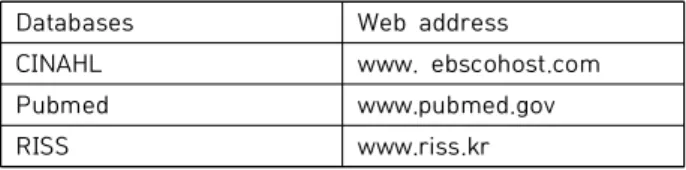
문헌 검색은 전자데이터 베이스 CINAHL, Pubmed 및 한국교육학술정보 (RISS)에서 2010년 1월 1일부터 2020년 12월 31일까지 발행한 연구를 대상으로 검색하였다<표 1>.

2. Procedures

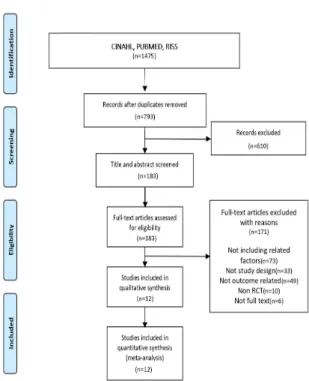
본 연구의 문헌 선정의 전 과정은 PRIMA의 체계적 흐 름도에 따라 실시하였다[15]. 연구의 선정기준은 연구대상 (뇌졸중 환자), 중재 방법 (PNF), 비교집단 (중재 또는 비 중재 방법), 연구 결과(보행) 및 연구 설계 (무작위 배정 임 상실험) 유형에 맞추어 정리하였다. 검색 주제어는 ‘뇌졸 중’, ‘고유수용성신경근촉진법’, ‘Stroke’, ‘PNF’ 및 ‘뇌졸 중 AND 고유수용성신경근촉진법’, ‘Stroke AND PNF’

등의 검색어를 각각의 데이터베이스에서 검색식을 바꾸고 혼합하여 검색하였다.

총 1475편이 검색되어 1차로 중복된 연구 682편을 제 외하였고, 2차로 연구 제목과 초록을 검토한 후 610편을 제외하였다. 또한 183편의 연구 중 본 연구와 관련되지 않 은 연구 73편, 본 연구의 종속변수인 보행과 관련되지 않 은 연구 49편, 본 연구의 연구 설계와 다른 연구 33편, 무 작위 연구가 아닌 10편, 전문을 구할 수 없는 연구 6편을 제외하고 12편을 메타분석에 포함될 연구로 최종 선정하 였다<그림 1>.

본 메타분석 연구에 최종 선정된 연구의 특성을 엑셀 프 로그램을 활용하여 출판연도, 저자, 연구 제목, 연구 대상 자 수, 보행에 관한 하위 척도(Gait rite, 10m walking test)의 평균과 표준편차를 추출하여 작성하였다.

Databases Web address

CINAHL www. ebscohost.com

Pubmed www.pubmed.gov

RISS www.riss.kr

Table 1. Searched databases

(3)

Fig. 1. PRISMA flow diagram

3. Data synthesis and analysis

최종 선정된 문헌 12편에 대한 개별 연구에 대한 질 평 가를 위해 R 패키지인 ‘Robvis’를 이용하여 무작위 연구 에 사용되는 RoB 2.0 도구를 도식화 하였다.

RoB 2.0 도구의 항목은 무작위 배정 과정에서 생기는 삐뚤림, 의도한 개입에서 이탈로 인한 비뚤림, 개입 결과 자료의 결측으로 인한 비뚤림, 개입 결과 측정의 비뚤림, 해당 연구가 미리 결정된 계획에 따라 자료의 은폐가 풀리 기 전에 분석 되었는지 여부를 판단하는 항목으로 구성되 어 있다[16]. 질 평가항목에 대해 높음(high), 일부 우려 (some concern), 낮음(low)으로 평가하였다. 또한 교정된 효과크기를 나타내는 Hedges’s 및 95% 신뢰구간도 산출 하였다. R 프로그램(The R Project for Statistical Computing version 4.0.5)의 meta 패키지를 활용하여 개별연구의 효과크기를 계산하고 분석하였다. 효과크기의 해석은 Cohen[17]은 0.2는 작은 효과크기, 0.2-0.8은 중 간 효과크기, 0.8 이상은 큰 효과크기라고 제시하였다.

4. Publication bias in studies

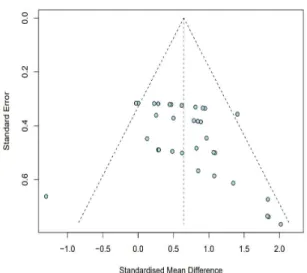
본 연구의 포함된 연구 결과의 타당성을 검증하기 위해 시각적인 방법은 깔때기 그림을 활용하여 깔때기 그림이 비대칭인지를 여부를 파악하여 출판 편의 분석을 실시하 였다. 출판 편의는 연구 결과의 방향이나 속성에 의하여 연구 결과가 출간되거나 출간되지 못하는 편의를 의미한 다[18].

III. Results

1. General characteristics of subjects

본 연구의 메타분석에 포함된 연구의 일반적 특성을 살 펴보면, 학회지 논문 8편 학위논문 4편이었다. 총 12편 중 종속변수인 보행에 대한 측정 척도는 Gait rite 연구는 7 편, 10m walking test에 관한 연구는 5편이었다. 메타분 석 연구에 포함된 실험군 152명, 대조군 154명이었고 구 체적인 연구의 일반적 특성은 아래와 같다<부록 1>.

2. Risk of bias in results

본 연구의 포함된 개별 연구 12편에 대한 질 평가 결과 는 녹색으로 나타난 2편은 편견 위험이 낮은 것으로 나타 났고, 노란색으로 나타난 10편은 편견 위험에 높지는 않지 만 일부 우려가 있다고 나타났다<그림 2>.

Fig. 2. Study of risk of bias

3. Results of individual studies and synthesis of results

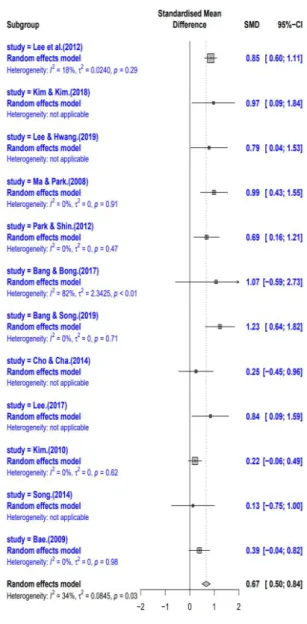
PNF 중재가 뇌졸중 환자에게 미치는 전체 효과크기는 g=0.67(95% confidence interval: 0.50-0.84)로 중간 효 과크기를 나타내며, 0을 포함하지 않아 통계적으로 유의한 차이가 있는 것으로 나타났다. 전체 효과크기의 이질성 검정 결과, 이질성은 Q값이 52.79이며, 같은 모집단의 효과에 기 초한 기대 분산 값 df는 35이며, 실제 분산의 비율을 나타내 는 I² 값은 33.1%로 이질성이 낮은 것으로 나타났다<표 2>.

PNF 중재에 대한 개별연구의 효과크기는 PNF의 목 패

턴[19] g=1.23으로 가장 큰 효과크기로 나타났고, PNF+저

(4)

항 보행훈련[20] g=1.07, PNF+기능적 전기자극[21]

g=0.99, PNF+트레드밀 훈련[22] g=0.97, PNF+보행훈련 [23] g=0.85 및 PNF+수중[24] g=0.84로 큰 효과크기로 나 타났다. 나머지 PNF 중재에 대한 개별 연구의 효과크기는 아래와 같다<그림 3>.

4. Effect size results gait scale

PNF 중재가 뇌졸중 환자에게 미치는 보행에 미치는 하 위 척도에 대해 분석한 결과, Gait rite와 관련된 연구는 7 편이며, 효과크기는 g=0.69로 중간 이상의 효과가 있다고 나타났다. 또한 10m walking test와 관련된 연구는 5편이 며, 효과크기는 g=0.59로 중간 이상의 효과가 있다고 나타 났다<그림 4>.

5. Results of publication bias

출간 편의가 없는 경우에는 개별연구의 효과크기를 가 운데에 두고 좌, 우 대칭을 이루게 나타나고, 출간 편의가 있는 경우에는 연구 대상자 수가 많은 연구에 비해 대부분 의 연구 대상자 수가 작은 연구들은 출간 편의 그래프의 오른쪽 아래에 모여있는 것으로 나타난다. 본 메타분석 연 구의 출간 편의 분석 결과는 개별연구의 효과크기를 가운 데에 두고 좌, 우 양쪽이 대부분 대칭으로 나타났으며, 이 는 출간 편의가 없는 것으로 판단할 수 있다<그림 5>.

K ES(g) 95% CI Q

(df) I²

LL UL

12 0.67 0.50 0.84 52.79

(35) 33.7

K:number of studies, ES:effect size, 95% CI: 95%

confidence interval, Q, I²: heterogeneity of effect size, df:expected variance

Table 2. Overall effect size results

Fig. 3. Effect size of individual studies

Fig. 4. Forest plots for gait variable effect size

(5)

Fig. 5. Funnel plot of publication bias

IV. Discussion

본 연구는 2010년도에서 2020년도까지 PNF 중재를 뇌 졸중 환자에게 적용하여 발행된 문헌을 가지고 최종 선정 된 12편의 문헌을 가지고 메타분석을 실시하였다.

뇌졸중 환자에게 PNF 중재가 보행에 어떠한 영향을 미치 는 지에 대한 개별 연구의 독립성을 가정하면서 다른 연구 집단에도 일반화를 전제로 하여 전체 효과크기를 추출하였 다. 이러한 PNF 중재의 관련성을 고려하여 보행에 관한 하 위변수로는 Gait rite, 10MWT로 하였다. 또한 연구의 이질 성에서 효과크기가 연구 간 서로 비슷한 경우에는 효과크기 의 실제 분산보다는 평균적인 효과크기를 중점으로 해석해 야 하므로[25], 본 연구에서는 이질성이 낮은 것으로 나타났 기 때문에 효과크기를 중심으로 분석을 시행하였다.

뇌졸중 환자를 대상으로 PNF 중재를 적용한 연구들을 분석한 결과, 전체 효과크기는 g=0.67로 통계적으로 유의 한 차이가 있었다(p<0.05). 이는 Cohen[17]이 제시한 기 준에 의하면 중간 효과크기로 이러한 결과는 PNF 중재가 뇌졸중 환자에게 긍정적인 영향을 준다는 것을 나타낸다.

이는 PNF 중재에서의 패턴을 통한 상, 하지의 교차적인 대각선 동작들이 뇌졸중 환자의 몸통까지 전달이 되어 신 장 수용기인 근방추를 활성화 시켜줌으로써, 보행 능력이 향상된 것으로 보인다. 이 결과는 PNF 중재가 뇌졸중 환 자의 보행 능력을 향상 시키는데 효과가 있다는 것이며, 선행연구와도 일치한다[26].

PNF에 대한 개별 연구들의 효과크기는 PNF의 목 패턴 이 가장 큰 효과크기로 나타났고, PNF+저항 보행훈련, PNF+기능적 전기자극, PNF+트레드밀 훈련, PNF+보행훈

련 및 PNF+수중에서의 중재가 큰 효과크기로 나타났다.

이에 대한 선행연구로는 수중에서 PNF 패턴 동작을 실시 한 실험군이 수중 밖에서 PNF를 시행한 대조군보다 뇌졸 중 환자의 보행 능력이 증진되었다고 보고 하였고, 본 연 구에서도 메타분석을 시행하여 효과크기가 0.84로 큰 효 과가 있다고 나타났다[24], 이는 PNF 패턴 중 대각선과 상 호 교대적인 움직임이 결합 된 상태에서 수중에서 발생하 는 저항이 팔, 다리 및 몸통까지 영향을 미쳐 근육의 활성 화와 몸통이 안정화가 되어 뇌졸중 환자의 보행 능력에 긍 정적인 영향을 미친것으로 보인다. 또 다른 연구에서는 트 레드밀에서의 PNF 패턴을 적용한 실험군이 트레드밀 훈 련만 시킨 대조군보다 보행 및 균형 능력이 향상 되었다고 하였고, 본 연구에서도 효과크기가 0.97로 나타나 트레드 밀에서의 PNF 중재가 뇌졸중 환자에게 효율적인 중재 방 법임을 확인하였다[22].

PNF 중재를 적용한 훈련이 보행에 관한 하위변수에 미 치는 결과, 보행 측정기의 효과크기는 0.69, 10 미터 보행 검사에 대한 효과크기가 0.59로 중간 이상의 효과크기가 있는 것으로 나타났다. 이들의 하위변수들은 임상에서 뇌 졸중 환자의 보행 능력을 측정하는 변수로 폭넓게 사용 되 어지고 있다.

이처럼 본 연구는 추후 뇌졸중 환자를 대상으로 연구 설 계 시 표준화된 가이드 라인을 제공하고, 연구자들이 쉽게 범할 오류를 최소화 하여, 후속연구에 도움을 줄 수 있을 것으로 보인다. 아직까지 뇌졸중 환자를 대상으로 PNF을 결합한 훈련의 효과를 분석한 무작위 배정 임상실험 연구 수가 적어 개별 연구들의 효과크기의 동질성과 이질성 검 증과 효과크기에 대한 확증적인 메타분석 결과를 얻기에 는 한계가 있었다. 따라서 뇌졸중 환자를 위한 다양한 훈 련 프로그램을 적용한 메타분석 연구들이 계속적으로 수 행되어야 할 것이다.

V. Conclusions

본 연구는 뇌졸중 환자에게 적용한 PNF 중재를 결합한

훈련에 대한 연구들의 효과크기를 산출하고 임상에서

PNF 중재를 결합한 훈련에 대한 기초자료를 제공하고자

하였다. 2010년 1월부터 2020년 12월 31일까지 발행된

연구를 가지고 체계적 문헌 고찰을 거쳐 총 12편을 최종

메타분석 논문으로 선정하였다. 선정된 연구에 가지고 메

타분석을 실시하여 효과크기는 cohen이 제시한 기준에

의하면 중간 정도의 효과가 있는 것으로 나타났다. 연구에

(6)

포함된 연구의 이질성은 낮았으며, 출간 편의 오류는 없는 것으로 나타났다.

본 연구 결과로 임상에서 연구자들이 뇌졸중 환자의 효 과적인 PNF 중재를 시행하는 가이드 라인으로 사용될 수 있을 것이다.

ACKNOWLEDGEMENT

This paper was supported by Research Funds of Chosun College of Science & Technology in 2020.(“이 논문은 2020년도 조선이공대학교 연구비의 지원을 받아 연구되었음”)

REFERENCES

[1] B. Norrving, and B. Kissela, “The global burden of stroke and need for a continuum of care”, Neurology, Vol. 80, No. 3, pp.

5-12. Jan. 2013. DOI: 10.1212/WNL.0b013e3182762397 [2] C. L. Bays, “Quality of life of stroke survivors: a research

synthesis”, Journal of Neuroscience Nursing, Vol. 33, No. 6, pp.

310-3016 Dec. 2001.

[3] R. Hariharasudhan, and J. Balamurugan, “Enhancing trunk stability in acute poststroke subjects using physioball exercise and proprioceptive neuromuscular facilitation technique: A pilot randomized controlled trial”, International Journal of Advanced Medical and Health Research, Vol, 3, No, 1, pp. 5-10, Jun. 2016.

DOI: 10.4103/2350-0298.184681

[4] E. L. Sims, J. M. Carland, F. J. Keefe, V. B. Kraus, F. Guilak, and D. Schmitt, “Sex differences in biomechanics associated with knee osteoarthritis”, Journal of women & aging, Vol. 21, No. 3, pp. 159-170, Jul. 2009. DOI: 10.1080/08952840903054856 [5] A. Chaturvedi, “Effect of proprioceptive neuromuscular facilitation

in functional recovery of patients with stroke–a review”, J Neurol Neurosci, Vol. 8, No. 5, pp. 220-222. 2017.

[6] M. E. Sandel, “Dr. Herman Kabat: Neuroscience in translation…

from bench to bedside”, PM & R, Vol 5, No. . 6, pp. 453-461, June. DOI: 10.1016/j.pmrj.2013.04.020

[7] F. Smedes, M. Heidmann, C. Schäfer, N. Fischer, and A. Stępień,

“The proprioceptive neuromuscular facilitation-concept; the state of the evidence, a narrative review”, Physical Therapy Reviews, Vol. 21, No. 1, pp. 17-31, Aug. 2016. DOI: 10.1080/10833196.

2016.1216764

[8] D. E. Voss, “Proprioceptive neuromuscular facilitation. Patterns and Techniques”, Harper & Row. 1985.

[9] S. Westwater-Wood, N. Adams, and R. Kerry, “The use of

proprioceptive neuromuscular facilitation in physiotherapy practice”, Physical Therapy Reviews, Vol. 15, No. 1, pp. 23-28, Jul. 2013. DOI: 10.1179/174328810X12647087218677 [10] Kim DK, Lee SH, and Oh DW, “The effect of stepwise PNF

pattern therapy in weight bearing positions on the balance and walking functions of a patient with subacute stroke”, PNF &

Movement, Vol. 16, No. 3, pp. 307-315, Dec. 2018. DOI: 10.

21598/JKPNFA.2018.16.3.307

[11] Choi YK, Nam CW, Lee JH, and Park YH, “The Effect of taping prior to PNF treatment on lower extremity proprioception of hemiplegic patients”, Journal of Physical Therapy Science, Vol.

25, No. 9, pp. 1119-1122, Apr. 2013. DOI: 10.1589/jpts.25.1119 [12] Hwang SD, “Meta-analysis using R”, Hakjisa. 2020.

[13] Hwang SD, and Shim SR, “Meta-analysis from forest plot to network meta-analysis”, Hannarae. 2018.

[14] N. Denson, and M. H. Seltzer, “Meta-analysis in higher education:

An illustrative example using hierarchical linear modeling”.

Research in Higher Education, Vol. 52, No. 3, pp. 215-244. Mar.

2011. DOI: 10.1007/a11162-010-9166-x

[15] D. A. Feldstein, “Clinician's guide to systematic reviews and meta-analyses”, WMJ: official publication of the State Medical Society of Wisconsin, Vol. 104, No. 3, pp. 25-29, Apr. 2005.

[16] L. V. Hedges, and I. Olkin, “Statistical methods for meta-analysis.

Academic Press. 1985.

[17] J. Cohen, “Statistical power analysis for the behavioral sciences”, NJ: Erlbaum. 1988.

[18] J. E. Hunter, and F. L. Schmidt, “Methods of meta-analysis:

Correcting error and bias in research finding”, Sage Publications.

2004.

[19] Bang DH, and Song MS, “The effect of neck pattern of PNF on balance and walking ability in patients with chronic stroke”, PNF & Movement, Vol. 17, No. 1, pp.47-56, Nov. 2018.

[20] Bang DH, and Bong SY, “The effects of resistant gait proprioceptive neuromuscular facilitation on the walking and balancing abilities of chronic stroke patients”, PNF &

Movement, Vol. 15, No. 1, pp.57-65, Feb. 2017. DOI; 10.2159 8/JKPNFA.2017.15.1.57

[21] Ma SY, Hwang YT, and Park RJ, “The effects of PNF and FES improvement of functional gait in patients with stroke”, Journal of Special Education & Rehabilitation Science, Vol. 47, No. 3, pp. 283-298, Sept. 2008.

[22] Kim CH, and Kim YN, “Effects proprioceptive neuromuscular facilitation and treadmill training on balance and walking ability of stroke patients”, The Journal of Korean Physical Therapy, Vol.

30, No. 3, June.. 2018. DOI: 10.18857/jkpt.2018.30.3.79 [23] Lee JH, Seo KC, and Lee SY, “Impact of PNF-based walking

exercise on a ramp on gait performance of stroke patients”, Journal of Physical Therapy Science, Vol. 24, No. 12, Jul. 2012.

[24] Lee DK, “Effects of aquatic proprioceptive neuromuscular

(7)

facilitation pattern exercise on physical functions and a psychological factor in chronic stroke patients”, Unpublish Doctor’s thesis, Daegu University, 2017.

[25] M. Borenstein, L. V. Hedges, J. P. T. Higgins, and H. R.

Rothstein, “Introduction to meta-analysis”, Wiley. 2009.

[26] Lee DK, and Hwang TH, “Effects of aquatic proprioceptive neuromuscular facilitation pattern exercise on balance, gait ability and depression in patients with chronic stroke”, Journal of Korea Physical therapy, Vol. 31, No. 4, pp. 236-241. Aug. 2019.

[27] Park JM and Shin YI, “The effect of lumbar stabilization exercise with proprioceptive neuromuscular facilization technique to balance and gait in chronic stroke patient”, Journal of Korean Academy of Orthopaedic Manual Physical Therapy, Vol. 18, No.

1, pp. 65-72. Sep. 2012.

[28] Cho HS and Cha HG, “Effect of trunk pattern exercise in proprioceptive neuromuscular facilization integrated transcranial direct current stimulation on function of lower extremity in stroke patients”, Journal of the Korea Academia-Industrial Cooperation Society, Vol. 15, No. 11, pp. 6767-6773. Nov. 2014. DOI: 10.57 62/KAIS.2014.15.11.6767

[29] Kim YH, “The effects of trunk stability exercise on the balance and gait in the patients with stroke”, Unpublish Master's degree, Daegu University, 2017.

[30] Song H, “The influence of combination of isotonics technique in proprioceptive neuromuscular facilitation on the balance and gait ability in patients with chronic stroke”, Unpublish master’s thesis, Nambu University, 2014.

[31] Bae WY, “The effects of proprioceptive neuromuscular facilitation of reduced base of support on balance and walking in the persons with stroke”, Unpublish Master's degree, Samyook University, 2009.

Authors

Young-Ju Jeun received the Ph.D. degrees in Law, Ph.D. Completion degrees in Public Health from Chosun University, Korea, in 2005, and 2008, and foreign researcher from Waseda University, Japan, in 2003-2005, and

NIU(IL), USA, in 2020 respectively. Dr. Jeun joined the faculty of the Department of Health Administration at Chosun College Science & Technology University, Gwangju, Korea, in 2008. He is currently a Professor in the Department of Health Administration at Chosun College Science &

Technology University , He is interested in Health policy,

law, Madical law, Insurance.

(8)

No Author (year)

Group Exercise program Outcome

Ex Con Type Duration

(week)

Session (count)

Length (min)

Gait (scale) 1 Bang & Song

(2019)[19] 7 7 PNF 4 20 20 Gait rite

2 Bang & Bong

(2017)[20] 6 6 PNF+resistant gait

training 4 20 30 Gait rite

3 Ma & Park

(2008)[21] 9 10 PNF+FES 8 40 30 Gait rite

4 Kim & Kim

(2018)[22] 12 11 PNF+treadmill

training 6 30 30 10m

walking test 5 Lee et al

(2012)[23] 20 20 PNF+walking

exercise 4 20 30 Gait rite

6 Lee

(2017)[24]] 15 15 PNF+aquatic 6 30 30 10m

walking test 7 Lee & Hwang

(2019)[26] 15 15 PNF+aquatic 6 30 30 10m

walking test 8 Park & Shin

(2012)[27] 15 15 PNF+lumbar

stabilization exercise

6 18 30 Gait rite

9 Cho & Cha

(2014)[28] 15 16

PNF+transcranial direct current

stimulation

6 18 20 10m

walking test

10 Kim

(2010)[29] 20 20

PNF+trunk stabilization

exercise 6 30 30 Gait rite

11 Song

(2014)[30] 10 10 PNF 4 12 30 10m

walking test

12 Bae

(2009)[31] 8 9 PNF 4 40 30 Gait rite

고유수용성신경근 촉진법이 뇌졸중 환자의 균형에 미치는 효과

Appendix 1. Characteristics of primary studies included in the analysis.

수치

Table  1.  Searched  databases
Fig.  1.  PRISMA  flow  diagram
Table  2.  Overall  effect  size  results
Fig.  5.  Funnel  plot  of  publication  bias IV.  Discussion 본 연구는 2010년도에서 2020년도까지 PNF 중재를 뇌 졸중  환자에게  적용하여  발행된  문헌을  가지고 최종  선정 된  12편의  문헌을  가지고  메타분석을  실시하였다

참조

관련 문서

Abstract The study attempted to systematically and comprehensively analyze individual studies in which proprioceptive neuromuscular facilitation (PNF) was performed with

KNDI: Korean version neck disability index, NSG: neck stabilization exercise group, PNSG: proprioceptive neuromuscular facilitation neck stabilization exercise

Purpose: This study examined changes in gait speed and stride length after an intervention involving simultaneous scapular and pelvic patterns of

Purpose: This study attempts to identify the effects of abdominal strength training using proprioceptive neuromuscular facilitation (PNF) on the balance ability and pain

Purpose: The purpose of this study was to examine the effects of proprioceptive neuromuscular facilitation (PNF) wrist taping, after the application of a rhythmic

Purpose: The current study seeks to identify the effect of neck muscle strengthening exercise using proprioceptive neuromuscular facilitation (PNF) on the swallowing

Conclusion: Proprioceptive neuromuscular facilitation exercises have confirmed that lower extremity function improves after exercise interventions in chronic stroke

Purpose The purpose of this study was to study the effect of rectus abdominal muscle contraction by proprioceptive neuromuscular facilitation trunk stabilization training