Ⅰ. 서 론
아동작업치료사는 감각통합에 어려움이 있는 아동에게 감 각통합치료를 하는데, 아동작업치료 중재영역 중 중요한 영 역이다. 국내의 감각통합치료는 주로 발달장애(지적 장애 및 자폐 범주성 장애)가 가장 많이 받는 서비스이다. 그 다음으 로 뇌손상 장애(뇌성마비 포함), 주의력결핍과잉행동장애의 순이다(Kim, 2015). 그 이외에도 진단을 받지 않은 아동들
중에서 감각통합문제가 있는 아동들도 상당히 많다(Kim, 2015). 통계청(Statics Korea)에 의하면 0~8세까지 국내 등록 장애유아는 4,092,860명이었고 10세 미만의 장애아동 중 가장 높은 빈도의 장애범주는 자폐성 장애(16.8%)이었다.
그 외 지적장애가 4.1%, 뇌병변장애가 2.3%(Statics Korea, 2015, 2016)로 감각통합치료 서비스가 장애유아의 재활에 중요한 부분임이 분명하다.
감각통합치료를 제공하는 작업치료사는 작업수행능력이 손상되었거나 손상가능성이 있는 아동에게 의미있는 작업에 대한감각통합치료학회지 제15권 2호
The Journal Korean Academy of Sensory Integration 2017 Vol. 15. No. 2
http://dx.doi.org/10.18064/JKASI.2017.15.2.001
아동작업치료사의 직무분석:
감각통합치료 중심으로
최정실*, 홍은경**
*충북보건과학대학교 작업치료과, **신성대학교 작업치료과
국문초록
목적 : 본 연구의 목적은 감각통합치료를 하는 아동작업치료사의 직무를 정의하고, 직무기술서를 도출하며 아동작업치료 사를 대상으로 각 책무별 과제와 과제요소의 중요도, 빈도, 난이도 인식도를 조사하는 것이었다.
연구방법 : 2017년 5월부터 9월까지 직무분석을 하였다. 1단계에서 직무분석을 위해 10명의 전문가로 구성된 DACUM 위원회를 조직하였고, 워크숍 및 메일을 통해 감각통합치료를 하는 아동작업치료사의 직무를 정의하고 직무기술서를 완성하였다. 2단계에서 141명의 아동작업치료사를 대상으로 완성된 직무기술서로 설문조사하여 과제와 과제요소의 중 요도, 빈도, 난이도를 알아보았다.
연구결과 : 직무의 정의는 ‘아동·청소년에게 작업치료서비스를 제공하여 일상생활 및 놀이를 포함한 작업수행과 사회참 여를 지원한다’이었다. 직무기술서를 통해 9개의 책무(상담, 평가, 치료계획, 치료, 기록, 교육, 자기개발, 관리, 행정), 28개의 과제, 169개의 과제요소가 도출되었다. 중요지수가 가장 높은 과제는 ‘안전유지하기’와 ‘치료실행하기’이 었고, 과제요소는 ‘아동과 도구, 주변의 안전 확보하기’, ‘안전한 환경 준비하기’이었다.
결론 : 본 연구의 결과는 감각통합치료를 하는 아동작업치료사의 직무범위를 정의하고, 관련 교육과정을 개발 및 개선하는 데 활용할 수 있을 것으로 보인다.
주제어 : 감각통합치료, 아동작업치료사, 직무분석
교신저자: 홍은경([email protected]) ∥* 이 연구는 2017년도 대한감각통합치료학회 연구 지원에 의해 이루어졌음.
참여할 수 있도록 돕는 전문가이다(National Broad for Certification in Occupational Therapy; NBCOT, 2008).
국내 작업치료분야에서 감각통합관련 연구는 주로 치료효과 를 알아보는 연구들이 많았다. 감각통합치료의 효과는 주로 운동과 시지각 영역에서 통계학적으로 긍정적인 결과를 보 였다(Park & Kong, 2015). 또한, 아동그룹 작업치료의 효 과를 알아본 체계적 고찰에서는 그룹감각통합치료가 가장 높 은 비율(40%)을 차지하였고 운동기능, 조절(adjustment), 사회성, 실행기능에서 통계학적으로 그룹간의 차이를 보였 다(Lee, Lee, Kim, & Kim, 2016). 그러나, 실제적인 감각 통합치료의 직무를 하고 있는 아동작업치료사에 대한 직무 분석에 대한 연구는 찾아보기 어려웠다.
일반적인 작업치료사의 직무분석결과는 책무(duty)에서 상담, 평가, 중재계획, 중재, 교육 및 관리, 자기계발로 나타 났고 작업(Task)에서 발달검사하기, 감각기능평가하기, 일 상생활평가하기, 발달기능 증진시키기, 감각기능 향상시키 기, 일상생활능력훈련하기 등으로 분석되었다(Lee et al., 2014). 이 결과는 아동, 성인, 노인 등의 각 특성을 충분히 반영하여 작업치료영역을 설명하는데 한계가 있었다. 감각 통합치료는 장애아동과 부모의 요구가 많은 치료분야이므로 아동작업치료사들이 감각통합치료를 사용하는 직무를 정확 하게 밝히는 것이 중요하다. 이러한 연구는 감각통합을 하는 아동작업치료사에게 자신의 직무를 원활하게 수행하기 위한 지표가 될 수 있고, 변화하는 사회적 요구에 따라 양질의 감 각통합치료를 제공하기 위한 기본 자료가 될 수 있을 것이다.
본 연구는 감각통합치료를 하는 아동작업치료사의 직무를 정의하고 임상현장에서 수행하고 있는 주요 책무와 과제, 과 제요소를 도출하고자 한다. 세부목적은 첫째, 감각통합치료 를 하는 아동작업치료사의 직무를 정의한다. 둘째, 감각통합 치료를 하는 아동작업치료사의 주요 책무와 과제, 과제요소 를 도출한다. 셋째, 감각통합치료를 하는 아동작업치료사의 주요 과제, 과제요소의 중요도, 난이도, 빈도를 알아본다.
Ⅱ. 연구방법
1. 연구대상
본 연구의 대상은 2단계로 구분하여 진행되었다(Figure 1).
1단계는 DACUM(Developing A Curriculum) 기법에 적합한 전문가 집단을 대상으로 하였다. 전문가 집단의 선정 조건은 7년 이상의 감각통합경력이 있는 임상가로서 병원, 연구소나 센터, 복지관 등에서 근무하고 있는 7명과 아동경 력이 있고 강의를 하고 있는 교수 1명으로 DACUM 위원회 를 구성하였다. 최종적으로 DACUM 위원회는 아동작업치 료사 7명, 교수 1명, 연구자 2명으로 하였다. 아동작업치료 사 및 교수의 평균 연령 37.6(32세~43세), 학력은 모두 학 사 이상이었고 평균 아동작업치료경력 14.3년, 감각통합치 료경력 13.8년이었다(Table 1).
1 Stage
Participants: DACUM(Developing A Curriculum) committee (7 clinicians, 1 professor, 2 researchers)
Objective: 1) Define the job of pediatric occupational therapist who performs sensory integration intervention
2) Extract the main duties, tasks and task elements of pediatric occupational therapist who performs sensory integration intervention
2 Stage Participants: 141 pediatric occupational therapists who perform sensory integration intervention Objective: Survey the criticality and frequency, difficulty of tasks and task elements
Figure 1. Participants and subject at each stage
Table 1. DACUM (Developing A Curriculum) committee Variable Affiliated agency
Career in sensory integration therapy and/or
education (year) Facilitator C University, Dept of occupational therapy, professor 21
Secretary J Center, occupational therapist 2
Committee member
S Hospital, occupational therapist 15 S Hospital, occupational therapist 15 Y Welfare center, occupational therapist 9 S Welfare center, occupational therapist 20
L Center, occupational therapist 11 S Center, occupational therapist 18 L Center, occupational therapist 11 S University, Dept of occupational therapy, professor 11
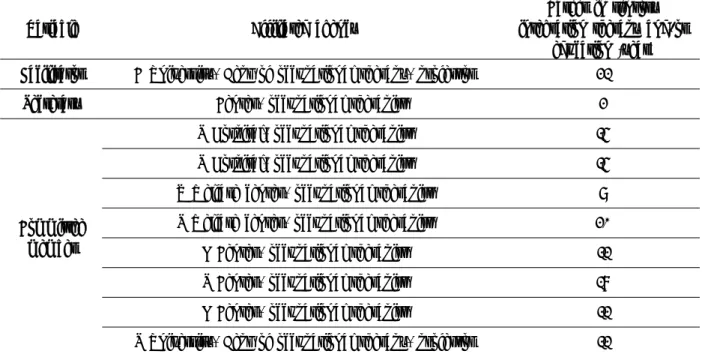
2단계는 현재 감각통합치료세팅에서 근무하고 있는 아동 작업치료사를 대상으로 설문지를 배포하였다. 대한감각통합 치료학회의 협조아래 아동작업치료사 총 141명이 대상이 되 었다. 남녀의 비율은 남자가 10.6%, 여자가 89.4%이었고, 평균 연령은 만 27세이었다. 근무지역은 경기도가 31.9%로 가장 많았고 서울이 28.4%로 다음 순이었다. 학력은 학사가 가장 많았고 아동작업치료 경력에서는 2~3년차가 48%, 감 각통합치료 경력은 1년차 이하가 61%로 가장 많았다. 근무 기관은 센터/연구소에서 가장 많이 근무하고 있고 근무형태 는 정규직이 72%를 차지하였다. 바우처 실시기관은 59.6%
로 나타났다(Table 2).
2. 연구과정
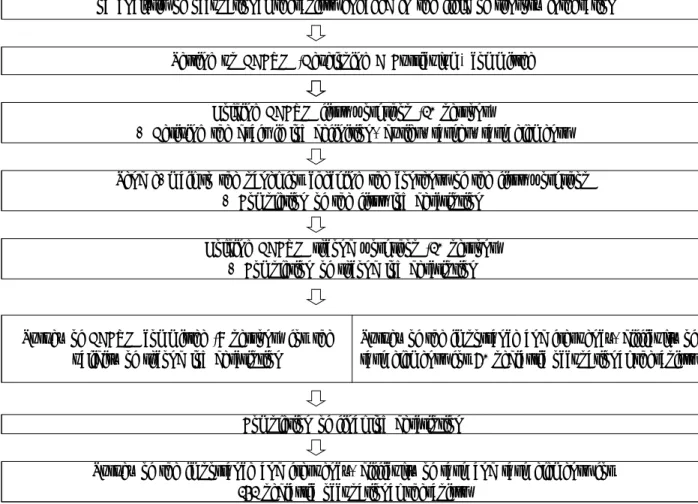
1단계는 2017년 5월부터 7월 30일까지 이루어졌다 (Figure 2). 감각통합치료를 하는 아동작업치료사의 직무분 석을 하기 위해 DACUM 기법을 사용하였다. DACUM 기법 은 특정한 직무에서 반드시 수행해야 하는 과제(Task)의 내 용을 적은 비용으로 단시간에 결정할 수 있는 방법으로 교육 과정개발 시 많이 사용한다(Norton, 1997).
직무분석을 위해 DACUM기법에 대한 패널 교육과 워크
숍을 두 차례 실시하였다. 먼저, 본 연구의 목적과 DACUM 기법에 대한 교육(2시간)을 10명의 DACUM위원회 패널들 에게 실시하였다. 감각통합치료를 하는 아동작업치료사의 직무를 정의하기 위해 각 패널들에게 자유롭게 자신의 생각 을 흰 종이위에 쓰라고 한 후, 직무분석 전문가가 다양한 직 무정의를 그대로 칠판에 보여주었으며 위원회 내의 합의과 정을 거쳤다. 패널들의 자신의 경험을 토대로 감각통합직무 관련 대상, 목적, 방법 등에 대한 추가 의견을 제시하였다.
토의 과정을 통해 최종적으로 정의된 직무는 직무의 특성을 반영하면서 일반도 이해하기 쉬운 용어로 수정·보완하여 정의하였다.
1차 직무기술서를 작성하기 위해 DACUM위원회 패널들 에게 브레인스토밍 방법을 이용하여 책무에 대한 의견을 수 렴하였다. 직무분석가는 그 의견을 포스트 잍에 기록하여 칠 판에 붙여 모든 패널들이 전체를 볼 수 있도록 제시하였다.
8시간의 토의과정을 통하여 큰 직무는 세분화하였고 작은 직 무는 큰 직무로 통합하는 과정을 거쳐서 최종적으로 도출된 각 책무에 대한 정의를 내렸다. 1차 워크숍에서 도출한 9개 책무에 대한 정의와 64개의 과제를 도출하였다. 1차 직무기 술서는 DACUM 위원회의 패널들에게 메일링을 하여 워크숍 에서 논의한 책무와 과제, 과제요소가 맞는지 확인절차를 거
Table 2. General characteristics of the participants (N=141)
Variable N %
Gender Male 15 10.6
Female 126 89.4
Age (year)* 27.97±5.31 22-46
Working area
Seoul 40 28.4
Gyeonggi-do 45 31.9
Chungcheong-do 25 17.7
Kangwon-do 1 0.7
Jella-do 6 4.3
Kyeongsang-do 22 15.6
Jeju-do 2 1.4
Education
Bachelor (3 years) 39 27.7
Bachelor (4 years) 84 59.6
Master 15 10.6
Doctor 1 7
Etc. 2 1.4
Career of occupational therapy (year)
≥1 46 32.6
2-3 48 34.0
4-5 11 7.8
6-10 26 18.4
≤11 10 7.1
Career of sensory integration
therapy
≥1 61 43.3
2-3 37 26.2
4-5 14 9.9
6-10 19 13.5
≤11 10 7.1
Working institution
Hospital (university, general) 9 6.4 Personal pediatric psychiatry 4 2.8
Rehabilitation hospital 18 12.8
Welfare center 17 12.1
Center/laboratories 79 56.0
Special education support office (school) 1 0.7 Special children's home nursery school 9 6.4
Etc. 4 2.8
Employment type
Full-time 72 51.1
Temporary worker-full time 27 19.1 Temporary worker-full time 37 26.2
Etc. 5 3.5
Sensory integration
setting
Yes 131 92.9
No 9 6.4
Etc. 1 0.7
Voucher Yes 84 59.6
No 57 40.4
* Mean±Standard deviation, Min-Max.
Job analysis of occupational therapists engaged in the field of sensory integration
Setting up DACUM (Developing A Curriculum) committee
Holding DACUM first workshop (10 persons)
- Deriving the draft if job definition, duties, taskes, task elements
Send e-mail to the panel for checking the contents of the first workshop - Completion of the first job description
Holding DACUM second workshop (10 persons) - Completion of second job description
Survey of DACUM committee (8 persons) for the validity of second job description
Survey of the importance and frequency, difficulty of task elements for 60 pediatric occupational therapists
Completion of final job description
Survey of the importance and frequency, difficulty of task and task elements for 141 pediatric occupational therapists
Figure 2. Research process
쳐서 2차 워크숍에서 총 9개의 책무, 34개의 과제, 201개의 과제요소로 2차 직무기술서를 완성하였다(부록 1).
2차 직무기술서를 바탕으로 DACUM 위원회의 8명의 패널 들에게 내용 타당도조사를 조사하였다. 수집된 자료는 내용 타당도 지수(Content Validity Index; CVI)를 이용하여 0.8이하인 과제요소는 삭제하였다. 삭제된 과제요소는 평가 수행하기(과제)의 인지기능평가하기(과제요소), 사례회의하 기(과제)의 사례대상선정하기(과제요소) 등이 있었는데, 이 것은 작업치료사가 아닌 타전문가가 실시하는 경우가 많았 다. 또한, 아동작업치료사의 근무 기관의 유형(병원, 센터나 연구소, 복지관)에 따라 60명의 아동작업치료사에게 과제요 소별 중요도(0점: 중요하지 않음~3점: 매우 중요함), 난이 도(0점: 매우 쉬움~3점: 매우 어려움), 빈도(0점: 전혀 수행 하지 않음~3점: 자주 수행함)를 조사하였다. 조사 결과 중요 도와 빈도가 낮은 과제요소는 연구자간의 토의를 통해 수정, 삭제의 과정을 거쳐 최종 직무기술서를 완성하였다. 따라서,
최종 직무기술서는 9개 책무, 28개 과제, 169개 과제요소로 구성되었다.
2단계는 감각통합치료세팅에서 근무하고 있는작업치료사 를 대상으로 2017년 7월부터 9월까지 설문조사하였다. 온라 인 자료수집은 대한감각통합치료의 회원 중 캠프, 분석과정, 평가과정에 참여하였던 작업치료사를 대상으로 메일로 조사 하였고, 오프라인 자료 수집은 대한감각통합치료학회의 교 육시 학회와 설문대상자들의 동의를 얻어서 조사하였다.
3. 연구도구
아동작업치료사에게 사용한 설문지의 내용은 개인적인 정 보 9문항(성별, 연령, 근무 기관의 지역, 최종 학력, 임상경 력, 근무하는 기관의 종류, 근무형태, 근무하는 기관의 감각 통합치료 세팅 유무, 바우처 서비스 제공유무)과 완성된 2차 직무기술서로 구성하였다. 직무기술서는 각각의 직무에 따
라 중요도, 난이도, 수행빈도를 4점 척도로 기재하게 하였 다. 중요도는 0점(중요하지 않음)~3점(매우 중요함), 난이 도는 0점(매우 쉬움)~3점(매우 어려움), 빈도는 0점( 전혀 수행하지 않음)~3점(자주 수행함)이었다.
4. 분석방법
수집된 자료는 SPSS 21.0과 엑셀을 사용하여 분석하였 다. 2단계의 아동작업치료사 일반적 특성은 SPSS의 기술통 계를 이용하였다. 1단계의 DACUM 위원의 일반적 특성, 직 무 중 과제와 과제요소별 평균과 중요지수는 엑셀을 사용하 였다. 중요지수는 중요도가 높은 항목이 수행빈도가 높은 항 목보다 가중치를 가질 수 있도록 (중요도×2)+빈도로 수식 화하였고, 중요도가 높은 수록 중요한 직무로 가정하고 분석 이 실시되었다(Lee et al, 2010).
Ⅲ. 연구결과
1. 감각통합치료를 하는 아동작업치료사의 직무정의
DACUM 위원회의 워크숍을 통해 도출된 감각통합치료를 하는 아동작업치료사의 직무의 정의는 ‘아동·청소년에게 작 업치료서비스를 제공하여 일상생활 및 놀이를 포함한 작업 수행과 사회참여를 지원한다’로 정의하였다.
2. 감각통합치료를 하는 아동작업치료사의 책무와 과제, 과제요소
감각통합치료를 하는 아동작업치료사의 직무는 9개의 책 무, 28개의 과제, 169개의 과제요소로 구성되었다. 책무는 상담, 평가, 치료계획, 치료, 기록, 교육, 자기개발, 관리, 행정이었다. ‘상담’ 책무에 4개의 과제, 33개의 과제요소로 구성되었고 ‘평가’ 책무에 3개의 과제, 22개의 과제요소로 구 성되어 있었다. ‘치료계획’ 책무에 3개의 과제, 18개의 과제 요소로 구성되었고, ‘치료’ 책무에 3개의 과제, 19개의 과제 요소로 구성되어있었다. ‘기록’ 책무에 4개의 과제, 20개의 과제요소로 구성되었고, ‘교육’ 책무에 2개의 과제, 9개 과제
요소로 구성되었다. ‘자기개발’ 책무에 2개의 과제, 11개의 과제요소가 구성되었고 ‘관리’ 책무에 2개의 과제, 9개의 과 제요소가 있었으며 ‘행정’ 책무에 7개의 과제, 37개의 과제요 소로 구성되었다.
3. 과제와 과제요소에 대한 중요도, 빈도, 난이도
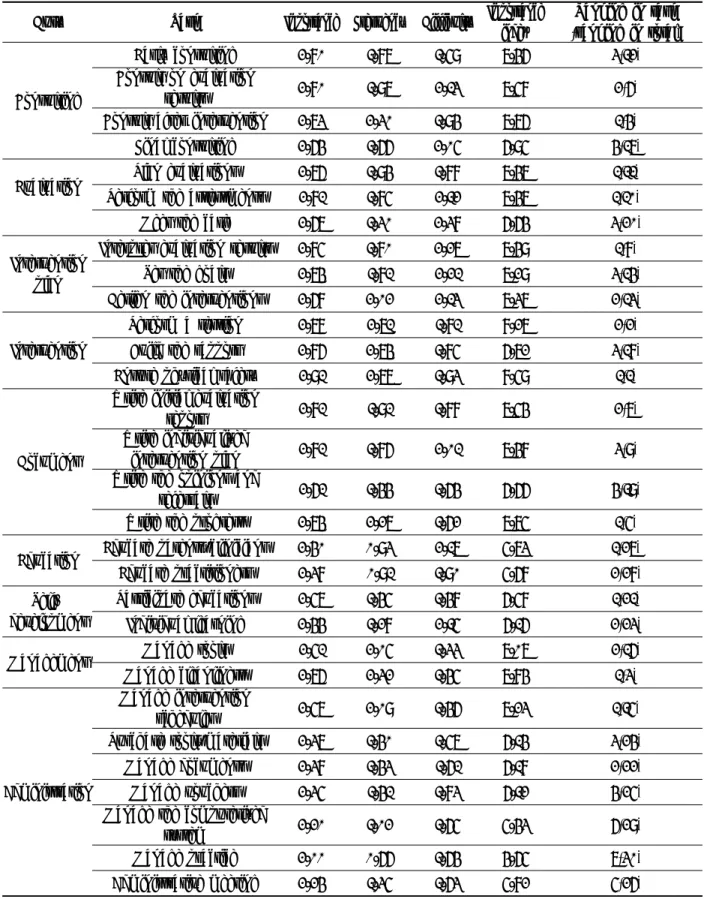
1) 과제별 중요도, 빈도, 난이도, 중요지수와 우선순위
9개의 책무 중 중요도가 가장 높은 것은 치료이었고 그 다음은 치료계획, 평가, 상담, 기록, 관리, 자기계발, 교육, 행정 순이었다. 책무 중 빈도가 가장 높은 것은 치료이었고, 그 다음은 관리, 상담, 치료계획, 기록, 평가, 자기계발, 행 정, 교육 순이었다. 책무 중 가장 어려운 것은 치료계획이었 고 그 다음으로 평가, 교육, 상담, 치료, 기록, 자기계발, 행 정, 관리 순이었다.
전체 과제 중 중요지수가 가장 높은 것은 치료의 ‘안전유 지하기’이었고 그 다음으로 ‘치료실행하기’, ‘청결관리하기’,
‘치료 후 상담하기’, ‘경과기록하기’ 순이었다. 상담의 책무 내에서 가장 중요지수가 높은 과제는 ‘치료 후 상담하기’이었 고, 가장 높은 빈도를 보이는 과제는 ‘치료 후 상담하기’이었 으며, 가장 난이도가 높은 과제는 ‘평가 결과 상담하기’이었 다. 평가의 책무 내에서 가장 중요지수가 높은 과제는 ‘평가 계획하기’, ‘평가수행하기’로 빈도가 가장 높은 과제는 ‘평가 계획하기’이었으며, 난이도가 높은 과제는 사례회의이었다.
치료계획의 책무 내에서 가장 중요지수가 높은 과제는 ‘평가 결과 해석하기’ 이었고, 빈도가 가장 높은 과제는 ‘치료방법 정하기’이었으며, 가장 난이도가 높은 과제는 ‘평가결과 해석 하기’이었다. 치료의 책무 내에서 가장 중요지수가 높은 과제 는 ‘안전유지하기’이었고, 가장 빈도와 난이도가 높은 과제는
‘안전유지하기’이었다. 기록의 책무 내에서 가장 중요지수와 빈도가 높은 과제는 ‘경과기록하기’이었고, 가장 난이도가 높 은 과제는 ‘개별화 치료계획서 작성하기’이었다. 교육의 책무 내에서 가장 중요지수, 빈도, 난이도가 높은 과제는 ‘대상자 교육하기’이었다. 자기계발의 책무 내에서 가장 중요지수와 빈도가 높은 과제는 ‘교육 참여하기’이었고, 난이도가 가장 높은 과제는 ‘개별학습하기’이었다. 관리의 책무 내에서 가장 중요지수, 빈도, 난이도가 높은 과제는 ‘청결 관리하기’이었
다. 행정의 책무 내에서 가장 중요지수와 빈도가 높은 과제 는 ‘치료일정 관리하기’이었고, 난이도가 높은 과제는 ‘바우 처 관리하기’이었다(Table 2).
2) 과제요소별 중요도, 빈도, 난이도, 중요지수와 우선순위
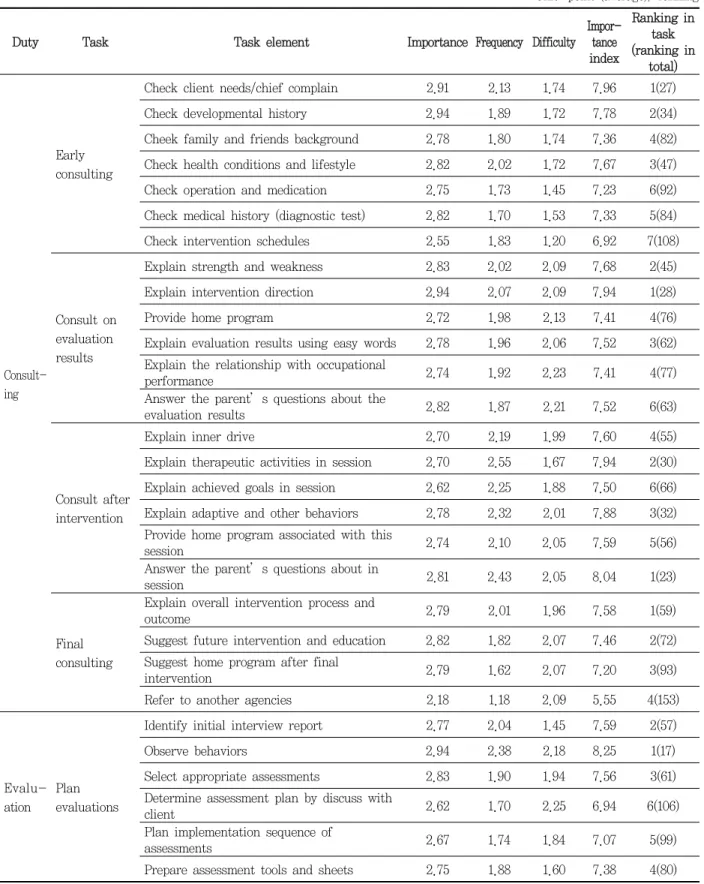
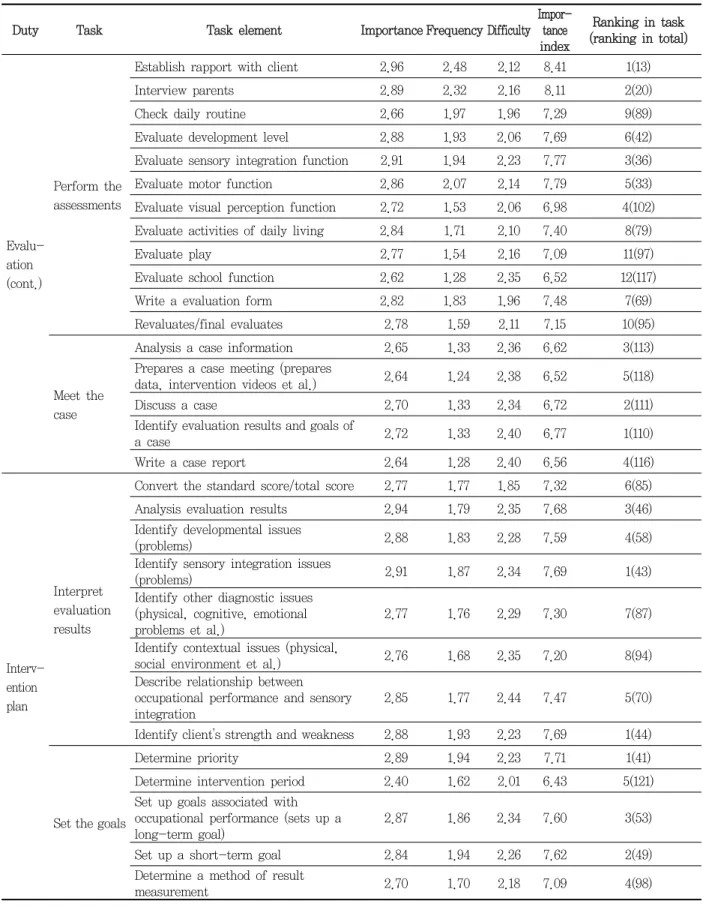
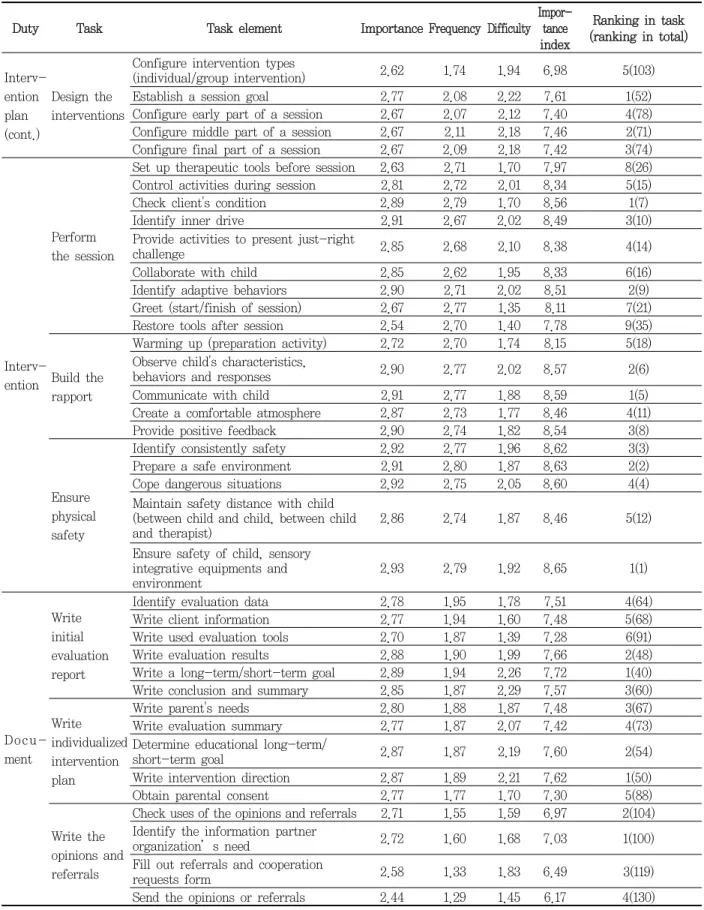
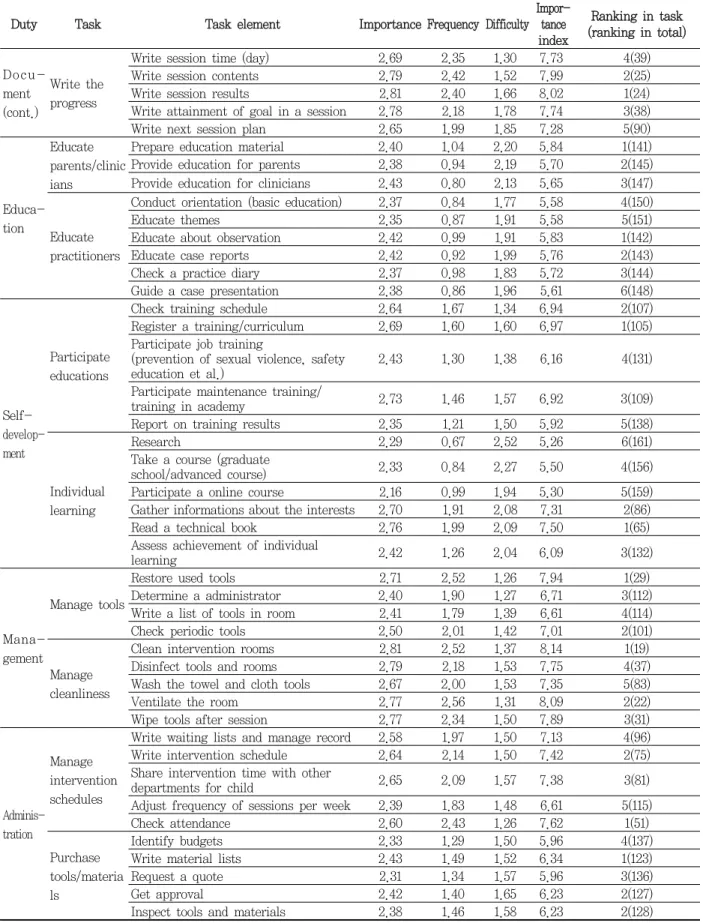
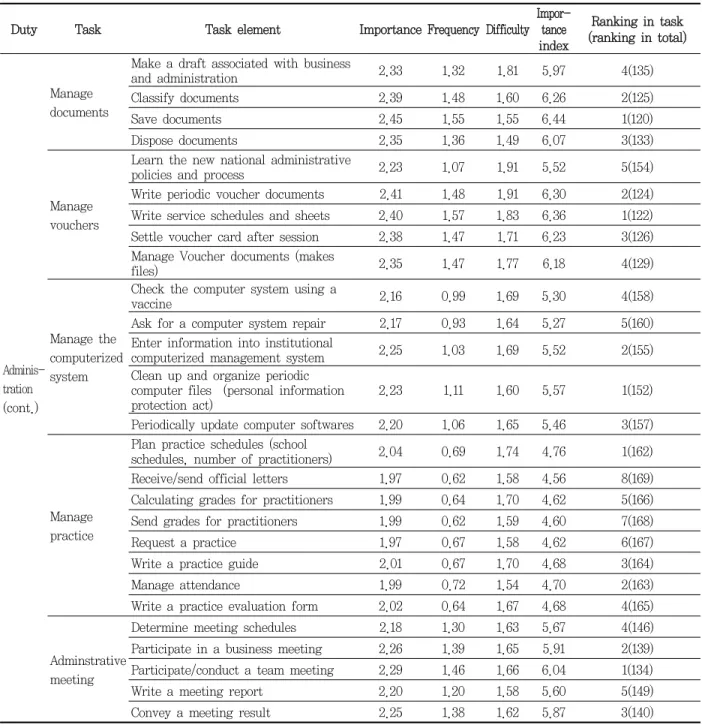
과제요소별 중요도, 빈도, 난이도, 중요지수를 조사한 결 과는 Table 3과 같다. 전체 과제요소에서 1, 2, 3, 4 순위(‘아 동과 도구, 주변의 안전 확보하기’, ‘안전한 환경 준비하기’,
‘지속적으로 안전 확인하기’, ‘위험상황 대처하기’)에 해당하 는 과제요소는 모두 ‘치료의 안전유지하기 과제’에 포함되어 있었다.
상담의 과제요소는 5.55~8.04의 중요지수를 나타냈고,
‘타 기관 의뢰하기’가 가장 낮았으며 ‘치료에 대한 보호자 질 문에 답하기’에서 가장 높은 점수를 나타냈다. 평가의 과제요 소는 6.52~8.41의 중요지수를 나타냈고, ‘학교 평가하기’와
‘사례회의 내용 준비하기’에서 가장 낮았으며 ‘아동과 라포 형 성하기’가 가장 높았다. 치료계획의 과제요소는 6.43~7.71 의 중요지수를 나타냈고, ‘치료(이용)기간 정하기’에서 가장 낮았으며 ‘우선순위 결정하기’에서 가장 높은 점수를 나타냈 다. 치료의 과제요소는 7.78~8.65의 중요지수를 나타냈고,
‘치료 후 도구 정리하기’에서 가장 낮았으며 ‘아동과 도구, 주 변의 안전 확보하기’에서 가장 높은 점수를 보였다. 기록의 과제요소는 6.17~8.02의 중요지수를 나타냈고, ‘발송하기’
에서 가장 낮은 점수를 보였고, ‘치료결과 작성하기’에서 가 장 높은 점수를 보였다. 교육의 과제요소는 5.58~5.84의 중 요지수를 보였고, ‘오리엔테이션(기본교육)하기’와 ‘주제별 교육하기’에서 가장 낮았으며 ‘교육자료 준비하기’에서 가장 높았다. 자기계발의 과제요소는 5.26~7.50의 중요지수를 보였고, ‘연구 활동하기’에서 가장 낮은 점수를 보였으며 전 문서적 읽기에서 가장 높은 점수를 보였다. 관리의 과제요소 는 6.61~8.14의 중요지수를 보였고, ‘도구목록 작성하기’에 서 가장 낮았으며 ‘치료공간 청소하기’에서 가장 높았다. 행 정의 과제요소는 5.27~7.62의 중요지수를 나타냈고, ‘전산 시스템 오류 시 신청하기’에서 가장 낮았으며 ‘출결체크하기’
에서 가장 높았다.
Ⅳ. 고찰
직무분석은 실무자가 실제로 수행하는 직무의 임무, 작업, 책임을 규명하고 구체화하는 과정이다(Ignatavicius &
Griffith, 1982). 2007년 보건복지부의 장애아동 재활치료 사업 신설(Kim et al., 2011), 2008년 장애인 등에 대한 특 수교육법(Ministry of Education, 2012), 2009년 정신보 건법, 2012년 장애아동복지지원법(발달재활서비스/바우처 제도) 개정으로 국내 아동작업치료의 환경은 빠르게 변화하 고 있다. 국내환경의 변화 및 서비스 대상자들의 의식변화 흐름에 맞추어 감각통합치료를 중심으로 치료하는 아동작업 치료사의 직무분석을 하였다.
본 연구의 대상자는 1, 2단계로 나누어 살펴볼 수 있다.
1단계는 감각통합치료를 하는 아동작업치료사의 직무분석을 하여 직무기술서를 완성하는 것이고 2단계는 현재 감각통합 치료를 하고 있는 아동작업치료사를 대상으로 직무에 따른 책무, 과제, 과제요소의 중요도, 빈도, 난이도를 살펴보는 것 이다. 1단계에서는 DACUM 방법을 사용하여 직무분석을 하 였다. DACUM 방법은 국내 작업치료사 직무분석 시 주로 사용한 방법으로 Korea Health Personnel Licensing Examination Institute(2000)에서 실시한 직무분석, Yong 등(2011)이 연구한 직부분석, Lee 등(2014)이 연구한 직무분석에서 사용하였다. 본 연구에서는 선행연구를 바탕 으로 DACUM의 기본원리에 따르기 위해 10명의 전문가로 구성된 DACUM 위원회를 구성하였다. 평균 감각통합치료 및 교육경력이 13.8년으로 충분히 감각통합치료 직무를 잘 파악할 수 있을 것으로 사료하였다. 직무분석을 위하여 모든 위원들은 DACUM 교육을 이수하였고, 진행자와 서기의 진 행으로 2회에 걸쳐 브레인스토밍 방식으로 토론을 하였다.
토론 시 책무, 과제, 과제요소에 대한 의견이 나오면 서기는 준비한 포스트 잍에 그 의견을 기록하여 관련 내용을 열거 및 분류하였다. 이를 통해 도출된 감각통합치료를 하는 아동 작업치료사의 직무 정의, 책무, 과제, 과제요소는 메일을 통 해 재검토 및 타당도를 검증하는 과정을 거쳤다. 각 과정은 DACUM 방법에 따라 체계적으로 이루어지도록 계획 및 실 행한 것이었다.
2단계에서는 141명의 아동작업치료사를 대상으로 설문조 사하였다. 아동작업치료사는 센터/연구소에서 가장 많이 치 료를 하는 것으로 나타났고 바우처 제도는 59.6%가 실시하 는 것으로 나타났다. 이는 Kim(2015)의 연구에서 국내 감각 통합치료 실태 조사와 유사하게 나타났다. 그녀의 연구에서 는 감각통합치료가 가장 많이 이루어지는 기관은 사설기관
Table 2. Importance, frequency, difficulty, importance index and ranking in task
Unit: point (average)/ ranking
Duty Task Importance Frequency Difficulty Importance index
Ranking in task (ranking in total)
Consulting
Early consulting 2.80 1.87 1.59 7.46 3(12) Consult on evaluation
results 2.80 1.97 2.13 7.58 2(6)
Consult after intervention 2.73 2.30 1.94 7.76 1(4) Final consulting 2.64 1.66 2.05 6.95 4(17) Evaluation Plan evaluations 2.76 1.94 1.88 7.47 1(11) Perform the assessments 2.81 1.85 2.12 7.47 1(10) Meet the case 2.67 1.30 2.38 6.64 3(20) Intervention
plan
Interpret evaluation results 2.85 1.80 2.27 7.49 1(8) Set the goals 2.74 1.81 2.21 7.29 3(14) Design the interventions 2.68 2.02 2.13 7.37 2(13)
Intervention
Perform a session 2.78 2.71 1.81 8.27 2(2) Build the rapport 2.86 2.74 1.85 6.72 3(18) Ensure physical safety 2.91 2.77 1.93 8.59 1(1)
Document
Write initial evaluation
report 2.81 1.91 1.88 7.54 2(7)
Write individualized
intervention plan 2.81 1.86 2.01 7.48 3(9) Write the opinions and
referrals 2.61 1.44 1.64 6.66 4(19)
Write the progress 2.74 2.27 1.62 7.75 1(5) Education Educate parents/clinicians 2.40 0.93 2.17 5.73 1(27)
Educate practitioners 2.38 0.91 1.90 5.68 2(28) Self-
development
Participate educations 2.57 1.45 1.48 6.58 1(21) Individual learning 2.44 1.28 2.15 6.16 2(23)
Management Manage tools 2.51 2.05 1.33 7.07 2(16)
Manage cleanliness 2.76 2.32 1.45 7.84 1(3)
Administration
Manage intervention
schedules 2.57 2.09 1.46 7.23 1(15)
Purchase tools/materials 2.37 1.40 1.57 6.14 3(24) Manage documents 2.38 1.43 1.61 6.18 2(22) Manage vouchers 2.35 1.41 1.83 6.12 4(25) Manage the computerized
system 2.20 1.02 1.65 5.43 6(29)
Manage practice 2.00 0.66 1.64 4.65 7(30) Administrative meeting 2.24 1.35 1.63 5.82 5(26)
Table 3. Importance, perform frequency, difficulty, importance index and ranking in task element
Unit: point (average)/ ranking
Duty Task Task element Importance Frequency Difficulty
Impor- tance index
Ranking in task (ranking in
total)
Consult- ing
Early consulting
Check client needs/chief complain 2.91 2.13 1.74 7.96 1(27)
Check developmental history 2.94 1.89 1.72 7.78 2(34)
Cheek family and friends background 2.78 1.80 1.74 7.36 4(82) Check health conditions and lifestyle 2.82 2.02 1.72 7.67 3(47) Check operation and medication 2.75 1.73 1.45 7.23 6(92) Check medical history (diagnostic test) 2.82 1.70 1.53 7.33 5(84) Check intervention schedules 2.55 1.83 1.20 6.92 7(108)
Consult on evaluation results
Explain strength and weakness 2.83 2.02 2.09 7.68 2(45) Explain intervention direction 2.94 2.07 2.09 7.94 1(28) Provide home program 2.72 1.98 2.13 7.41 4(76) Explain evaluation results using easy words 2.78 1.96 2.06 7.52 3(62) Explain the relationship with occupational
performance 2.74 1.92 2.23 7.41 4(77)
Answer the parent’s questions about the
evaluation results 2.82 1.87 2.21 7.52 6(63)
Consult after intervention
Explain inner drive 2.70 2.19 1.99 7.60 4(55) Explain therapeutic activities in session 2.70 2.55 1.67 7.94 2(30) Explain achieved goals in session 2.62 2.25 1.88 7.50 6(66) Explain adaptive and other behaviors 2.78 2.32 2.01 7.88 3(32) Provide home program associated with this
session 2.74 2.10 2.05 7.59 5(56)
Answer the parent’s questions about in
session 2.81 2.43 2.05 8.04 1(23)
Final consulting
Explain overall intervention process and
outcome 2.79 2.01 1.96 7.58 1(59)
Suggest future intervention and education 2.82 1.82 2.07 7.46 2(72) Suggest home program after final
intervention 2.79 1.62 2.07 7.20 3(93)
Refer to another agencies 2.18 1.18 2.09 5.55 4(153)
Evalu- ation
Plan evaluations
Identify initial interview report 2.77 2.04 1.45 7.59 2(57) Observe behaviors 2.94 2.38 2.18 8.25 1(17) Select appropriate assessments 2.83 1.90 1.94 7.56 3(61) Determine assessment plan by discuss with
client 2.62 1.70 2.25 6.94 6(106)
Plan implementation sequence of
assessments 2.67 1.74 1.84 7.07 5(99)
Prepare assessment tools and sheets 2.75 1.88 1.60 7.38 4(80)
Table 3. Importance, perform frequency, difficulty, importance index and ranking in task element (cont.) Unit: point (average)/ ranking
Duty Task Task element Importance Frequency Difficulty
Impor- tance index
Ranking in task (ranking in total)
Evalu- ation (cont.)
Perform the assessments
Establish rapport with client 2.96 2.48 2.12 8.41 1(13) Interview parents 2.89 2.32 2.16 8.11 2(20) Check daily routine 2.66 1.97 1.96 7.29 9(89) Evaluate development level 2.88 1.93 2.06 7.69 6(42) Evaluate sensory integration function 2.91 1.94 2.23 7.77 3(36) Evaluate motor function 2.86 2.07 2.14 7.79 5(33) Evaluate visual perception function 2.72 1.53 2.06 6.98 4(102) Evaluate activities of daily living 2.84 1.71 2.10 7.40 8(79) Evaluate play 2.77 1.54 2.16 7.09 11(97) Evaluate school function 2.62 1.28 2.35 6.52 12(117) Write a evaluation form 2.82 1.83 1.96 7.48 7(69) Revaluates/final evaluates 2.78 1.59 2.11 7.15 10(95)
Meet the case
Analysis a case information 2.65 1.33 2.36 6.62 3(113) Prepares a case meeting (prepares
data, intervention videos et al.) 2.64 1.24 2.38 6.52 5(118)
Discuss a case 2.70 1.33 2.34 6.72 2(111)
Identify evaluation results and goals of
a case 2.72 1.33 2.40 6.77 1(110)
Write a case report 2.64 1.28 2.40 6.56 4(116)
Interv- ention plan
Interpret evaluation results
Convert the standard score/total score 2.77 1.77 1.85 7.32 6(85) Analysis evaluation results 2.94 1.79 2.35 7.68 3(46) Identify developmental issues
(problems) 2.88 1.83 2.28 7.59 4(58)
Identify sensory integration issues
(problems) 2.91 1.87 2.34 7.69 1(43)
Identify other diagnostic issues (physical, cognitive, emotional problems et al.)
2.77 1.76 2.29 7.30 7(87)
Identify contextual issues (physical,
social environment et al.) 2.76 1.68 2.35 7.20 8(94) Describe relationship between
occupational performance and sensory integration
2.85 1.77 2.44 7.47 5(70)
Identify client's strength and weakness 2.88 1.93 2.23 7.69 1(44)
Set the goals
Determine priority 2.89 1.94 2.23 7.71 1(41) Determine intervention period 2.40 1.62 2.01 6.43 5(121) Set up goals associated with
occupational performance (sets up a long-term goal)
2.87 1.86 2.34 7.60 3(53)
Set up a short-term goal 2.84 1.94 2.26 7.62 2(49) Determine a method of result
measurement 2.70 1.70 2.18 7.09 4(98)
Table 3. Importance, perform frequency, difficulty, importance index and ranking in task element (cont.) Unit: point (average)/ ranking
Duty Task Task element Importance Frequency Difficulty
Impor- tance index
Ranking in task (ranking in total)
Interv- ention plan (cont.)
Design the interventions
Configure intervention types
(individual/group intervention) 2.62 1.74 1.94 6.98 5(103) Establish a session goal 2.77 2.08 2.22 7.61 1(52) Configure early part of a session 2.67 2.07 2.12 7.40 4(78) Configure middle part of a session 2.67 2.11 2.18 7.46 2(71) Configure final part of a session 2.67 2.09 2.18 7.42 3(74)
Interv- ention
Perform the session
Set up therapeutic tools before session 2.63 2.71 1.70 7.97 8(26) Control activities during session 2.81 2.72 2.01 8.34 5(15) Check client's condition 2.89 2.79 1.70 8.56 1(7) Identify inner drive 2.91 2.67 2.02 8.49 3(10) Provide activities to present just-right
challenge 2.85 2.68 2.10 8.38 4(14) Collaborate with child 2.85 2.62 1.95 8.33 6(16) Identify adaptive behaviors 2.90 2.71 2.02 8.51 2(9) Greet (start/finish of session) 2.67 2.77 1.35 8.11 7(21) Restore tools after session 2.54 2.70 1.40 7.78 9(35)
Build the rapport
Warming up (preparation activity) 2.72 2.70 1.74 8.15 5(18) Observe child's characteristics,
behaviors and responses 2.90 2.77 2.02 8.57 2(6)
Communicate with child 2.91 2.77 1.88 8.59 1(5) Create a comfortable atmosphere 2.87 2.73 1.77 8.46 4(11) Provide positive feedback 2.90 2.74 1.82 8.54 3(8)
Ensure physical safety
Identify consistently safety 2.92 2.77 1.96 8.62 3(3) Prepare a safe environment 2.91 2.80 1.87 8.63 2(2) Cope dangerous situations 2.92 2.75 2.05 8.60 4(4) Maintain safety distance with child
(between child and child, between child and therapist)
2.86 2.74 1.87 8.46 5(12)
Ensure safety of child, sensory integrative equipments and environment
2.93 2.79 1.92 8.65 1(1)
Docu- ment
Write initial evaluation report
Identify evaluation data 2.78 1.95 1.78 7.51 4(64) Write client information 2.77 1.94 1.60 7.48 5(68) Write used evaluation tools 2.70 1.87 1.39 7.28 6(91) Write evaluation results 2.88 1.90 1.99 7.66 2(48) Write a long-term/short-term goal 2.89 1.94 2.26 7.72 1(40) Write conclusion and summary 2.85 1.87 2.29 7.57 3(60) Write
individualized intervention plan
Write parent's needs 2.80 1.88 1.87 7.48 3(67)
Write evaluation summary 2.77 1.87 2.07 7.42 4(73)
Determine educational long-term/
short-term goal 2.87 1.87 2.19 7.60 2(54)
Write intervention direction 2.87 1.89 2.21 7.62 1(50)
Obtain parental consent 2.77 1.77 1.70 7.30 5(88)
Write the opinions and referrals
Check uses of the opinions and referrals 2.71 1.55 1.59 6.97 2(104) Identify the information partner
organization’s need 2.72 1.60 1.68 7.03 1(100)
Fill out referrals and cooperation
requests form 2.58 1.33 1.83 6.49 3(119)
Send the opinions or referrals 2.44 1.29 1.45 6.17 4(130)
Table 3. Importance, perform frequency, difficulty, importance index and ranking in task element (cont.) Unit: point (average)/ ranking
Duty Task Task element Importance Frequency Difficulty
Impor- tance index
Ranking in task (ranking in total)
Docu- ment (cont.)
Write the progress
Write session time (day) 2.69 2.35 1.30 7.73 4(39)
Write session contents 2.79 2.42 1.52 7.99 2(25) Write session results 2.81 2.40 1.66 8.02 1(24) Write attainment of goal in a session 2.78 2.18 1.78 7.74 3(38) Write next session plan 2.65 1.99 1.85 7.28 5(90)
Educa- tion
Educate parents/clinic ians
Prepare education material 2.40 1.04 2.20 5.84 1(141) Provide education for parents 2.38 0.94 2.19 5.70 2(145) Provide education for clinicians 2.43 0.80 2.13 5.65 3(147)
Educate practitioners
Conduct orientation (basic education) 2.37 0.84 1.77 5.58 4(150)
Educate themes 2.35 0.87 1.91 5.58 5(151)
Educate about observation 2.42 0.99 1.91 5.83 1(142) Educate case reports 2.42 0.92 1.99 5.76 2(143) Check a practice diary 2.37 0.98 1.83 5.72 3(144) Guide a case presentation 2.38 0.86 1.96 5.61 6(148)
Self- develop- ment
Participate educations
Check training schedule 2.64 1.67 1.34 6.94 2(107) Register a training/curriculum 2.69 1.60 1.60 6.97 1(105) Participate job training
(prevention of sexual violence, safety education et al.)
2.43 1.30 1.38 6.16 4(131)
Participate maintenance training/
training in academy 2.73 1.46 1.57 6.92 3(109)
Report on training results 2.35 1.21 1.50 5.92 5(138)
Individual learning
Research 2.29 0.67 2.52 5.26 6(161) Take a course (graduate
school/advanced course) 2.33 0.84 2.27 5.50 4(156)
Participate a online course 2.16 0.99 1.94 5.30 5(159) Gather informations about the interests 2.70 1.91 2.08 7.31 2(86) Read a technical book 2.76 1.99 2.09 7.50 1(65) Assess achievement of individual
learning 2.42 1.26 2.04 6.09 3(132)
Mana- gement
Manage tools
Restore used tools 2.71 2.52 1.26 7.94 1(29) Determine a administrator 2.40 1.90 1.27 6.71 3(112) Write a list of tools in room 2.41 1.79 1.39 6.61 4(114)
Check periodic tools 2.50 2.01 1.42 7.01 2(101)
Manage cleanliness
Clean intervention rooms 2.81 2.52 1.37 8.14 1(19) Disinfect tools and rooms 2.79 2.18 1.53 7.75 4(37) Wash the towel and cloth tools 2.67 2.00 1.53 7.35 5(83) Ventilate the room 2.77 2.56 1.31 8.09 2(22) Wipe tools after session 2.77 2.34 1.50 7.89 3(31)
Adminis- tration
Manage intervention schedules
Write waiting lists and manage record 2.58 1.97 1.50 7.13 4(96) Write intervention schedule 2.64 2.14 1.50 7.42 2(75) Share intervention time with other
departments for child 2.65 2.09 1.57 7.38 3(81)
Adjust frequency of sessions per week 2.39 1.83 1.48 6.61 5(115) Check attendance 2.60 2.43 1.26 7.62 1(51) Purchase
tools/materia ls
Identify budgets 2.33 1.29 1.50 5.96 4(137) Write material lists 2.43 1.49 1.52 6.34 1(123) Request a quote 2.31 1.34 1.57 5.96 3(136) Get approval 2.42 1.40 1.65 6.23 2(127) Inspect tools and materials 2.38 1.46 1.58 6.23 2(128)
Table 3. Importance, perform frequency, difficulty, importance index and ranking in task element (cont.) Unit: point (average)/ ranking
Duty Task Task element Importance Frequency Difficulty
Impor- tance index
Ranking in task (ranking in total)
Adminis- tration (cont.)
Manage documents
Make a draft associated with business
and administration 2.33 1.32 1.81 5.97 4(135)
Classify documents 2.39 1.48 1.60 6.26 2(125) Save documents 2.45 1.55 1.55 6.44 1(120) Dispose documents 2.35 1.36 1.49 6.07 3(133)
Manage vouchers
Learn the new national administrative
policies and process 2.23 1.07 1.91 5.52 5(154)
Write periodic voucher documents 2.41 1.48 1.91 6.30 2(124) Write service schedules and sheets 2.40 1.57 1.83 6.36 1(122) Settle voucher card after session 2.38 1.47 1.71 6.23 3(126) Manage Voucher documents (makes
files) 2.35 1.47 1.77 6.18 4(129)
Manage the computerized system
Check the computer system using a
vaccine 2.16 0.99 1.69 5.30 4(158)
Ask for a computer system repair 2.17 0.93 1.64 5.27 5(160) Enter information into institutional
computerized management system 2.25 1.03 1.69 5.52 2(155) Clean up and organize periodic
computer files (personal information
protection act) 2.23 1.11 1.60 5.57 1(152)
Periodically update computer softwares 2.20 1.06 1.65 5.46 3(157)
Manage practice
Plan practice schedules (school
schedules, number of practitioners) 2.04 0.69 1.74 4.76 1(162) Receive/send official letters 1.97 0.62 1.58 4.56 8(169) Calculating grades for practitioners 1.99 0.64 1.70 4.62 5(166) Send grades for practitioners 1.99 0.62 1.59 4.60 7(168) Request a practice 1.97 0.67 1.58 4.62 6(167) Write a practice guide 2.01 0.67 1.70 4.68 3(164) Manage attendance 1.99 0.72 1.54 4.70 2(163) Write a practice evaluation form 2.02 0.64 1.67 4.68 4(165)
Adminstrative meeting
Determine meeting schedules 2.18 1.30 1.63 5.67 4(146) Participate in a business meeting 2.26 1.39 1.65 5.91 2(139) Participate/conduct a team meeting 2.29 1.46 1.66 6.04 1(134) Write a meeting report 2.20 1.20 1.58 5.60 5(149) Convey a meeting result 2.25 1.38 1.62 5.87 3(140) (센터 등)으로 46.1%로 나타났고 그 다음으로 복지관 등의
사회시설이 22.0%, 병원(대학병원, 재활병원 등)이 18.1%
순으로 나타났다. 바우처 제도 운영기관은 53.9%로 바우처 제도 운영을 하지 않는 기관에 비해 많았고, 바우처 치료사 는 40.9%로 나타났다. 본 연구의 설문조사 대상자가 현 국 내 감각통합치료의 실태를 잘 반영된 직무분석 결과일 것으 로 사료된다.
감각통합치료를 하는 아동작업치료사의 직무분석 결과, 가장 중요하게 생각하는 과제는 ‘안전유지하기’와 ‘치료실행 하기’로 모두 치료 책무에 포함되어 있었다. 직무수행 빈도도
‘치료’ 책무에 포함되어 있는 2개의 과제 ‘치료실행하기’, ‘라 포 형성하기’, ‘안전유지하기’에서 높게 나타나 치료의 책무 는 중요하면서도 동시에 자주 수행하는 직무인 것이다. 난이 도가 높은 과제는 ‘사례회의하기’, ‘평가결과 해석하기’, ‘목표