Copyright ⓒ 2011, The Microbiological Society of Korea
호알칼리성 Bacillus pseudofirmus HS-54가 생산하는 알칼리성 Protease의 특성
방성호*·정인실*
한서대학교 생명과학과
Characterization of an Alkaline Protease from an Alkalophilic Bacillus pseudofirmus HS-54
Seong Ho Bang* and In-Sil Jeong*
Department of Biological Sciences, Hanseo University, Seosan 356-706, Republic of Korea (Received August 19, 2011 / Accepted September 5, 2011)
An alkalophilic bacterium producing alkaline protease was isolated from waste water and solar saltern sample and identified as Bacillus pseudofirmus HS-54 based on morphological, biochemical characteristics as well as 16S-rRNA gene sequencing. The HS-54 protease was purified to homo- geneity using ammonium sulfate precipitation, DEAE cellulose column chromatography, and sephadex G-100 gel filtration with a 4.0 purification fold. The molecular mass of the purified enzyme was estimated by SDS-PAGE to be 27 kDa. The optimal pH and temperature for the purified protease activity were 10.0 and 50°C, respectively. The purified enzyme was relatively stable at the pH range of 6.0-11.0 and at the temperature below 50°C. This enzyme was activated by Ca2+ and Mg2+ and inhibited by Hg2+, Cu2+, Zn2+, Al3+, Ag2+. And this enzyme was strongly inhibited by PMSF, suggesting that it belongs to the serine protease superfamily.
Keywords: Bacillus pseudofirmus HS-54, alkaline protease, purification, serine protease
미생물의 protease는 가수분해 효소 중 가장 중요하며 활발 한 연구가 이루어지고 있는 효소이다. 전 세계 효소판매량의 약 60%를 차지하고 있는 protease는 세제산업, 피혁가공, 식 품산업 등 각종 산업분야에 널리 응용되고 있다(11, 17, 22).
Protease는 활성부위에 존재하는 주요 기능기에 따라 serine protease, aspartic protease, cysteine protease, metallo protease 의 4종류로 구분하거나 효소 활성의 최적 pH에 따라 산성 protease, 중성 protease, 알칼리성 protease로 분류하기도 한 다. Protease는 동·식물과 세균, 곰팡이 등의 다양한 미생물에 서 생산되는데, 동물과 식물에서 유래한 protease는 다양한 산 업적 수요를 충당하기에 공급이 제한되어 있다(26). 그러므로 안정성과 생산성, 비용절감 등 경제적인 면이나 공업적 규모 의 활용 측면에서 많은 장점이 있는 미생물 유래의 protease를 생산하기 위하여 많은 연구가 진행되고 있다(11, 12, 28).
Bacillus 속 균주는 생육이 양호하고 다양한 특성을 가지고 있어서 유전자 및 효소에 대한 기초 연구와 산업적 연구가 폭
* For correspondence. (S.H. Bang) E-mail: [email protected];
Tel.: +82-41-660-1342; Fax: +82-41-668-3403 / (I.S. Jeong) E-mail:
[email protected]; Tel.: +82-41-660-1341; Fax: +82-41-668-3403
넓게 이루어지고 있으며, Bacillus 속에서 알칼리성 protease가 발견된 이후로 산업적 요구에 알맞은 고열, 넓은 pH, 다양한 농도의 염 등에서 높은 효소 활성과 안정성을 유지하는 효소 를 생산하는 균주의 탐색과 선별에 많은 연구가 시도되고 있 다(6, 11, 30). 상업적 응용을 목적으로 생산되고 있는 세균 유래의 protease는 대부분 알칼리성 protease이다. 알칼리성 protease에 관한 연구로는 Horikoshi (15)가 Bacillus sp.를 분 리하여 효소학적 특징을 발표한 이후, B. subtils, B. brevis, B.
stearothermophilus, B. cereus 등을 포함한 여러 Bacillus 속 균주들이 알려지고 있다(3, 4, 7).
본 연구에서는 충남 서북부 일대의 폐수 및 염전에서 호알 칼리성 세균을 분리하던 중, 알칼리 영역의 pH에서 높은 protease 활성을 나타내는 Bacillus 속 균주 HS-54를 분리·동 정하였고, HS-54가 생산하는 protease를 분리·정제하고 그 특 성을 확인하였다.
재료 및 방법 세균의 분리 및 동정
충남 서북부 일대의 축사 폐수 및 염전에서 채취한 시료를
멸균된 증류수로 희석하여 분리용 고체배지에 접종하여 균주 를 분리하였다. 호알칼리성이면서 protease를 생산하는 균주를 분리하기 위한 배지는 LB 고체배지를 기본으로 하여 pH를 10.0으로 조정하기 위해 멸균된 Na2CO3 (20%, w/v)를 첨가 하였고 protease 생성을 확인하기 위해 1.5% skim milk (w/v) 를 첨가한 것을 사용하였다. 알칼리성 protease 생산용 배지는 분리용 배지에서 한천을 제외한 액체배지를 사용하였다. 분리 용 고체배지에 희석된 시료를 도말하여 28°C에서 2일간 배양 한 후, 생육이 좋고 단일 집락 주변에 상대적으로 커다란 투명 환(clear zone)을 형성하는 균주들을 일차 선별하였다. 이들 중 상대적 활성이 강하고 생육정도가 우수한 균주들을 이차 선별하였고, 이차 선별된 균주들의 효소활성을 측정하여 가장 높은 알칼리성 protease를 생성하는 HS-54을 선별하였다.
HS-54의 동정을 위해 그람염색, 포자염색 및 주사 전자현 미경(JEOL, JSM-5600)을 이용하여 형태적 특성을 확인하였 고, 생리생화학적 특성을 확인하기 위하여 인돌생성 유무, MR-VP 시험, catalase와 oxidase 활성시험, citrate 이용 여부 시험, 탄소원 이용 여부 시험 등을 수행하였다. ㈜솔젠트에 의 뢰하여 16S rRNA 유전자 염기서열을 확인하였는데, 분리 세 균의 16S rRNA 유전자는 8F (5′-AGAGTTTGATCATGGCT CAG-3′)와 1492R (5′-GGTTACCTTGTTACGACTT-3′)을 primer로 이용하여 PCR을 수행해서 증폭하고 염기서열을 확 인했으며, 여러 균주들과의 상동성을 National Center for Biotechnology Information (NCBI)의 Basic Logical Alignment Search Tool (BLAST)를 통하여 확인하고, 분리균주를 동정 하였다.
효소 활성측정
알칼리성 protease의 활성은 Yanagida 등(32)의 방법을 변 형하여 측정하였다. 기질용액(0.6% Hammerstein casein 용액) 은 50 mM sodium bicarbonate buffer solution (pH 10.0) 100 ml에 casein 0.6 g을 녹이고, 5분간 중탕 가열하여 제조하였 다. 효소반응은 적절히 희석한 효소용액(120 μl)을 기질용액 (600 μl)과 혼합하여 28°에서 30분간 반응시켰다. 이후에 TCA 혼합용액(0.11 M trichloroacetic acid, 0.22 M sodium acetate, 0.33 M glacial acetic acid) 600 μl를 첨가하여 반응 을 중지시켰다. 효소 활성은 이 효소반응물을 30분 동안 실온 에서 방치한 뒤 원심분리(4°C, 12,000×g, 15 min)하여 상등액 을 취해 UV-spectrophotometer (SPECTRO UV-VIS RS)로 흡광도(A280)를 측정함으로써 결정하였다. 1 unit의 효소 활성 도는 위의 조건에서 1분 동안에 1 μg의 tyrosine에 해당하는 아미노산을 생성하는 효소의 양으로 하였다.
단백질의 농도는 Bradford의 방법(5)으로 bovine serum albumin (Bio-Rad)을 표준시료로 하여 측정하였다.
효소의 정제
효소의 정제를 위해 HS-54를 대량배양하여 얻은 조효소액 을 ammonium sulfate (30-80%)로 분별침전시키고 원심분리 하여 침전물을 회수하였다. 회수한 침전물은 탈염 후, 20 mM
phosphate buffer (pH 7.5)로 용해시키고 미리 평형화한 DEAE- cellulose column (1.5×20 cm)에 주입하여 NaCl 용액(0.05-0.5 M)을 이용한 농도구배법으로 용출한 후 활성성분을 회수하였 다. 활성성분의 효소액은 동일 완충액으로 평형화한 sephadex G-100 column (2.5×50 cm)에 통과하여 정제하였다.
전기영동
SDS-PAGE는 Laemmli의 방법(23)으로 acrylamide 함량은 10%로 하여 수행하였다. 전기영동 후, coomassie brilliant blue R 250으로 염색하였고, 탈색액(acetic acid 70 ml, methanol 930 ml, DW 1,000 ml)으로 탈색하여 관찰하였다. 분자량 측 정을 위한 표준단백질 시료는 Bio-Rad 사의 phosphorylase b (97.4 kDa), bovine serum albumin (66.2 kDa), ovalbumin (45 kDa), carbonic anhydrase (31 kDa), trypsin inhibitor (21.5 kDa), lysozyme (14.4 kDa)를 사용하였다.
효소의 특성
효소의 최적 pH 및 안정성: 정제한 효소의 최적 pH를 조 사하기 위하여 pH 5.0-6.0은 0.1 M citric acid-NaOH buffer, pH 7.0-9.0은 0.1 M Tris-HCl buffer, pH 10.0은 0.1 M NaHCO3-NaOH buffer, pH 11.0-12.0은 0.1 M Na2HPO4- NaOH buffer로 각각 pH별로 기질용액을 만들어 최적온도인 50°C에서 30분간 반응시켜 그 활성을 측정하였다. 또한 정제 한 효소의 pH 안정성을 조사하기 위하여 위 buffer들을 이용 하여 pH 5.0에서 12.0까지 각각의 pH를 조절하여 50°C에서 30분간 처리한 후 최적 pH인 10.0으로 조정한 후에 잔존활성 을 조사하였다.
효소의 최적온도 및 열안정성: 정제한 효소의 최적온도를 조사하기 위하여 반응액의 pH를 최적 pH인 10.0으로 하여 0°C-80°C까지 각 온도별로 30분간 효소 반응시킨 후 효소활 성을 측정하였다. 또한 정제한 효소의 열안정성을 조사하기 위하여 0°C에서 80°C까지 각 온도 별로 30분간 열처리한 후 최적온도인 50°C에서 기질과 반응시켜 그 잔존활성을 조사하 였다.
금속염의 영향: 정제한 효소의 활성에 미치는 금속염의 영 향을 조사하기 위하여 다음의 금속염[NaCl, KCl, CaCl2, FeCl3, MgSO4, CuSO4, HgCl2, MnSO4, ZnCl2, AlK(SO4), AgNO3, BaCl2]들을 최종농도가 1 mM과 5 mM이 되도록 각 각 첨가하여 50°C에서 30분간 효소를 처리한 후 효소의 활성 을 조사하였다.
단백질 분해효소 저해제의 영향: 정제한 효소의 활성에 영향을 주는 여러 가지 저해제의 효과를 조사하기 위하여 다음 의 저해제[PMSF; phenylmethanesulfonyl fluoride, SDS;
sodiumdodecyl sulfate, EDTA; ethlenediaminetetraacetic acid, EGTA; ethylene glycol-bis-(β-aminoethyl ether) N,N,N',N'- tetra-acetic acid, L-cysteine]들을 최종농도가 1 mM과 5 mM
Fig. 1. Scanning electron micrograph of the B. pseudofirmus HS-54 cultured on the isolation medium for 24 h.
Table 1. Purification procedures of the alkaline protease from B. pseudofirmus HS-54
Procedures Total activity
(U)
Total protein (mg)
Specific activity (U/mg)
Purification fold
Yield (%)
Culture broth 10,279,000 1,700 6,064 1 100
30-80%(NH4)2SO4 3,211,704 396 8,110 1.34 31.2
DEAE cellulose 1,102,572 108 10,209 1.68 10.7
Sephadex G-100 235,952 9 25,647 4.13 2.3
1 2
97,400 66.200
45,000
31,000
21,500 14,400
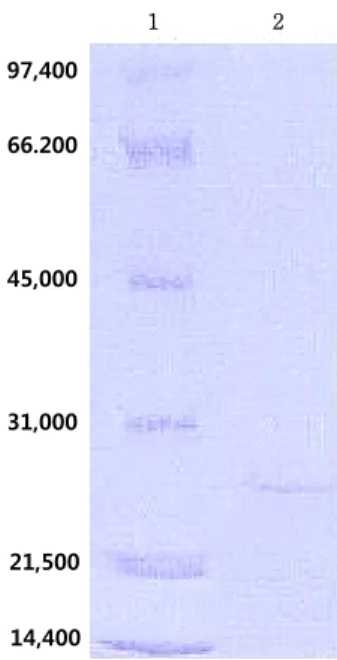
Fig. 2. SDS polyacrylamide gel electrophoresis of purified alkaline protease from B. pseudofirmus HS-54. Lanes: 1, molecular weight marker; 2, purified enzyme after sephadex G-100.
또는 0.5%가 되도록 각 저해제를 첨가하여 50°C에서 30분간 반응시킨 후 효소의 잔존활성을 조사하였다.
결과 및 고찰
세균의 분리 및 동정
HS-54는 간균이며 크기는 직경이 0.6 μm-0.9 μm, 길이 1.8 μm-2.0 μm이다(Fig. 1). 또한 HS-54는 그람 양성, 호기성 이고, 운동성이 있고 포자가 존재하였고, catalase 시험은 양 성, oxidase 시험은 음성, MR-VP 시험은 음성이었고, glucose, xylose, lactose, maltose, sucrose를 이용하여 산과 기체를 생 성하지 않았다. 이와 같이 HS-54의 형태적, 생화학적 특징들 은 Bacillus 속의 특징을 나타냈으며, 16S rRNA 유전자 서열 을 확인한 결과 HS-54는 Bacillus pseudofirmus (GenBank accession no. CP001878)와 99%의 유사성을 나타냈다(자료 미제시). 이상의 결과로 HS-54를 최종적으로 Bacillus pseudofirmus HS-54로 동정하였다.
효소의 정제
B. pseudofirmus HS-54 배양액에서 균체를 제거한 조효소 액을 ammonium sulfate (30-80%)로 침전시킨 단백질을 20 mM phosphate buffer (pH 7.5)에 녹여 DEAE cellulose column과 sephadex G-100 column에 주입하여 용출시켜 효소 를 정제하였다(자료 미제시). 이상의 정제과정을 요약하면 Table 1과 같으며 최종 수율은 2.3%였고 효소의 비활성은 약
4배 증가하였다.
정제한 단백질 분해효소의 단일성을 확인하기 위하여 SDS PAGE한 결과 단일 band를 얻었으며, 그 분자량은 표준 단백 질과 상대이동거리를 비교한 결과 약 27 kDa으로 측정되었다 (Fig. 2). 일반적으로 Bacillus 속에서 생성되는 알칼리성 protease 들의 분자량은 15-38 kDa인데(1, 10, 13, 16, 20, 27, 29, 31), HS-54의 알칼리성 protease도 이 범위내의 분자량을 지니고 있었다.
효소의 특성
효소의 최적 pH 및 pH 안정성: B. pseudofirmus HS-54 의 protease의 최적 활성 pH를 알아보기 위하여 pH (5.0-12.0) 별로 50°C에서 30분간 반응시켜 그 활성을 측정·비교하였다 (Fig. 3). 효소의 최적 활성 pH는 10.0 (100%)이었고, pH 11.0에서도 98%의 활성을 나타냈고 pH 9.0에서는 92%, pH 8.0에서는 86%의 활성을 나타냈지만, pH 8.0 이하에서는 활 성이 급격히 감소하는 것으로 판단할 때, HS-54가 생산하는 protease는 알칼리성 protease로 확인되었다. 또한 효소의 pH 에 대한 안정성을 조사하기 위하여 효소 반응액을 각 pH로
Fig. 3. Effects of pH on the protease activity and stability of B. pseudofirmus HS-54. Symbols: (■) protease acitivity;
(○) protease stability.
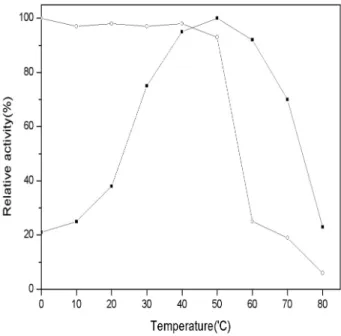
Fig. 4. Effects of temperature on the protease activity and stability of B. pseudofirmus HS-54. Symbols: (■) protease acitivity; (○) protease stability.
조절하여 50°C에서 30분간 처리한 후, 최적 pH인 10.0으로 조정하여 잔존활성을 측정한 결과, pH 7.0-11.0까지 비교적 안정하였고 pH 11.0 이상과 pH 7.0 미만에서는 효소활성이 급격히 감소하였다.
B. licheniformis NCIBM 6816에서 생산하는 subtilisin Carlsberg를 비롯한 Bacillus 속의 세균들이 생산하는 많은 알 칼리성 protease들의 최적 활성 pH는 8.0-10.0이다(10, 16, 27, 29). B. licheniformis NH1가 생산하는 알칼리성 proease는 pH 11.0에서도 높은 활성을 나타내는데(14), HS-54의 protease 도 pH 11.0에서 상대적으로 높은 활성을 나타냈다.
HS-54 protease의 pH에 대한 안정성은 pH 7.0-12.0에서 안정한 B. licheniformis NH1(13), pH 8.0-10.0에서 안정한 B.
subtilis PE-11(1), pH 8.0-11.0에서 안정한 B. subtilis VSG-4 (10) 등과 다르게 pH 7.0-11.0에서 안정하였다. 하지만 HS-54 의 protease는 pH 12.0에서 급격히 감소하였는데, 호염성호알 칼리성 세균에서 분리한 protease가 pH 12 이상에서 비교적 높은 안정성을 갖는 특징을 나타내는 것(8)으로 보아 환경에 고농도로 존재하는 염과 protease의 안정성이 서로 연관된 것 같다.
세제의 일반적인 pH가 9.0-12.0이므로 pH 10.0-11.0에서 최적 활성을 나타내고 pH 7.0-11.0에서 안정하게 활성을 유지 하는 HS-54의 알칼리성 protease는 세제용 효소로의 이용 가 능성이 높다고 판단된다.
효소의 최적 온도 및 열안정성: B. pseudofirmus HS-54가 생산하는 알칼리성 protease의 최적 반응온도를 조사하기 위 하여 반응액의 pH는 10.0으로 온도는 0°C에서 80°C까지 각
온도별로 30분간 효소 반응시킨 후, 그 활성을 조사한 결과 50°C에서 최적의 활성을 나타내었다. 또한 효소의 열에 대한 안정성을 알아보기 위하여 0°C에서 80°C까지 온도를 변화하 여 각각의 온도에서 30분간 열처리한 후 50°C에서 기질과 반 응시켜 그 잔존활성을 측정한 결과 10°C에서 50°C까지 안정 하였으나 60°C이상에서는 불안정하였다(Fig. 4). 즉, HS-54의 알칼리성 protease의 열안정성은 B. subtilis DM-04 (37°C-45°C) 보다는 높았고, B. subtilis VSG-4 (30°C-70°C), B. licheniformis NH1 (65°C-70°C) 보다는 낮았다(10, 14).
또한 HS-54가 생산하는 알칼리성 protease는 60°C 이상에서 효소활성이 급격히 감소되었지만, 20°C인 저온에서 최적온도 의 약 38% 정도의 활성을 보였으므로 우리나라를 비롯한 동 북아시아의 저온 세탁조건에 맞는 세제첨가용 효소로서의 이 용가능성이 높다고 판단된다.
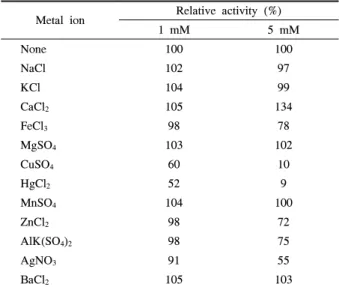
금속 이온의 영향: B. pseudofirmus HS-54에서 정제한 알 칼리성 protease의 활성에 미치는 다양한 금속이온(Na+, K+, Ca2+, Mg2+, Cu2+, Zn2+, Hg2+, Fe3+, Al3+ 등)의 영향을 조사하 기 위하여 최종 농도가 1 mM과 5 mM이 되도록 해당 금속이 온의 금속염을 첨가하여 50°C에서 30분간 효소를 전처리시킨 후 효소의 잔존 활성을 조사하였다(Table 2). Ca2+에 의해서는 활성이 증진(34%)되었고, Mg2+와 Ba2+ 등의 2가 양이온에 의 해서는 약간의 활성이 증진되었다. 또한 Mn2+와 1가 양이온인 Na+, K+는 효소 활성에 영향을 주지 않았지만, Hg2+, Cu2+, Zn2+, Al3+, Fe3+, Ag+ 등은 효소 활성을 억제하였다. Ca2+와 Mg2+의 protease 활성 증진 효과와 Cu2+, Zn2+, Hg2+ 등의 억 제효과에 대해서는 많은 연구 결과가 있었다(2, 18, 21, 24,
Table 2. Effects of metal ions on protease activity Metal ion Relative activity (%)
1 mM 5 mM
None 100 100
NaCl 102 97
KCl 104 99
CaCl2 105 134
FeCl3 98 78
MgSO4 103 102
CuSO4 60 10
HgCl2 52 9
MnSO4 104 100
ZnCl2 98 72
AlK(SO4)2 98 75
AgNO3 91 55
BaCl2 105 103
Metal ions were preincubated with the enzyme solution at 50°C for 30 min. Buffer system: 0.1 M NaHCO3-NaOH buffer (pH 10.0)
Table 3. Effects of inhibitors on protease activity Inhibitors Concentration Relative activity (%)
None 100.0
PMSF 1 mM 2.4
5 mM 1.9
SDS 0.5% 90.5
EDTA 1 mM 62.3
5 mM 32.0
EGTA 1 mM 78.1
5 mM 76.1
L-cysteine 1 mM 98.4
5 mM 97.1
All reagents were preincubated with the enzyme solution at 50°C for 30 min. Buffer system: 0.1 M NaHCO3-NaOH buffer (pH 10.0)
25, 27, 29). Ca2+와 Mg2+는 열에 대한 효소의 변성에 보호 작 용을 하여 고온에서 효소 구조에 안정성을 제공한다고 제안되 고 있다(9). 그러나 Cu2+, Zn2+, Hg2+ 등은 ligand와 결합하여 효소와 안정된 복합체를 형성하여 효소의 활성을 낮춘다고 알 려져 있다(29).
Protease 저해제의 영향: B. pseudofirmus HS-54의 알칼 리성 protease의 활성에 미치는 다양한 저해제의 영향을 조사 하였다(Table 3). HS-54의 알칼리성 protease는 PMSF에 의해 강한 저해작용을 받았다. 이 결과로 HS-54의 알칼리성 protease는 지금까지 연구된 거의 모든 알칼리성 protease와 마찬가지로 serine protease로 판단된다(1, 2, 18, 19, 20). 또 한 EDTA에 의해 효소활성이 50% 이상(5 mM에서) 감소되었 는데, 이는 이 효소가 금속이온을 보조인자로 요구한다는 것 을 나타낸다. 이는 EDTA에 대해 낮은 저해 효과(5 mM에서 20% 이하의 저해 효과)를 나타내는 다른 알칼리성 protease 보다는 세제 첨가물로의 이용에 약간의 단점으로 작용한다(1, 13, 18, 20).
적요
알칼리성 protease를 생산하는 호알칼리성 균주를 분리하여 Bacillus pseudofirmus HS-54로 동정하였고, HS-54가 생산하 는 알칼리성 protease를 ammonium sulfate 침전, DEAE cellulose chromatography, sephadex G-100 gel filtration을 통과시켜 정제하였는데, 정제된 protease의 분자량은 27 kDa 이었다. 정제된 효소의 반응최적 pH는 10.0이었고 pH 7.0-11.0에서 비교적 안정하였다. 또한 정제된 효소의 반응최 적 온도는 50°C이었고 10-55°C에서 안정하였다. 금속이온에 대한 영향은 Ca2+와 Mg2+ 등에 의해 효소활성이 촉진되었으
나, Hg2+, Zn2+, Cu2+, Al3+ 등에 의해서 효소활성이 저해되었 다. 본 효소는 PMSF에 의해 강하게 저해를 받는 것으로 보아 serine protease에 속하는 것으로 판단된다.
감사의 말
본 연구는 2010년도 한서대학교 교내연구비(101 이학 103) 에 의해 지원되었으며, 이에 감사드립니다.
참고문헌
1. Adinarayana, K., P. Ellaiah, and S.D. Prasad. 2003. Purification and partial characterization of thermostable serine alkaline protease from a newly isolated Bacillus subtilis PE-11. AAPS Pharm. Sci. Tech. 4, 1-9.
2. Arulmani, M., K. Aparanjini, K. Vasanthi, P. Arumugam, M.
Arivuchelvi, and P.T. Kalaichelvan. 2007. Purification and partial characterization of serine protease from thermostable alkaliphilic Bacillus laterosporus AK-1. World J. Microb. Technol. 23, 475-481.
3. Banerjee, U.C., R.K. Sani, W. Azmi, and R. Soni. 1999.
Thermostable alkaline protease from Bacillus brevis and its characterization as a laundry detergent additive. Process Bichem.
35, 213-219.
4. Banika, R.M. and M. Prakash. 2004. Laundry detergent compatibility of the alkaline protease from Bacillus cereus.
Microbiol. Res. 159, 135-140.
5. Bradford, M.M. 1976. A rapid and sensitive method for quantitation of microgram quantities of protein utilizing the principle of protein-dye binding. Anal. Biochem. 72, 248-254.
6. Chung, S.S., Y.U. Shin, H.J. Kim, G.H. Jin, and H.H. Lee.
2001. Transfomation of an alkaline protease over-producer, Vibrio mettschnikovii strain RH530, and improvement of plasmid stability by the par locus. J. Microbiol. Biotechnol. 11, 222-228.
7. Dhandapani, R. and R. Vijayaragvan. 1994. Production of thermophilic, extracellular alkaline protease by Bacillus steareothermophilus AP-4. J. Microbiol. Biotechnol. 10, 33-35.
8. Dodia, M.S., C.M. Rawal, H.G. Bhimani, R.H. Joshi, S.K.
Khare, and S.P. Singh. 2008. Purification and stability characteristics of an alkaline serine protease from a newly isolated Haloalkaliphilic bacterium sp. AH-6. J. Ind. Microbiol.
Biotechnol. 35, 121-131.
9. Donaghy, J.A. and A.M. Mckay. 1993. Production and properties of alkaline protease by Aurebasdum pullulans. J. Appl. Bacteriol.
60, 662-666.
10. Giri, S.S., V. Sukumaran, S.S. Sen, M. Oviya, B.N. Banu, and P.K. Jena. 2011. Purification and partial characterization of a detergent and oxidizing agent stable alkaline protease from a newly isolated Bacillus subtilis VSG-4 of tropical soil. J.
Microbiol. 49, 455-461.
11. Gupta, R., Q.K. Beg, and P. Rorenze. 2002. Bacterial alkaline proteases : molecular approaches and industrial applications.
Appl. Microbiol. Biotechnol. 59, 15-32.
12. Gupta, R., K. Gupta, R. Saxena, and S. Khan. 1999.
Bleach-stable alkaline protease from Bacillus sp. Biotechnol.
Lett. 21, 135-138.
13. Haddar, A., R. Agreibi, A. Bougatef, N. Hmide, A. Sellami- Kamoun, and M. Nasri. 2009. Two detergent stable alkaline serine-proteases from Bacillus mojavensis A21: purification, characterization and potential application as a laundry detergent.
Bioresour. Technol. 100, 3366-3373.
14. Hadi-Ali, N.E., R. Agrebi, B. Ghobel-Frikha, A. Sellami- Kamoun, S. Kanoun, and M. Nasri. 2007. Biochemical and molecular characterization of a detergent stable alkaline protease from a newly isolated B. licheniformis NH1. Enzyme Microb.
Technol. 40, 515-523.
15. Horikoshi, K. 1971. Production of alkaline enzymes by alkalophilic microorganisms, Part I, alkaline protease produced by Bacillus No. 221. Agric. Biol. Chem. 36, 1407-1414.
16. Horikoshi, K. 1990. Enzymes of alkalophiles, pp. 275-294.
Microbial Enzyme and Biotechnology, 2nd ed. MO : Elsevier Applied Science, Amsterdam, Netherlands.
17. Horikoshi, K. 1996. Alkalophiles : from an industrial point of view. FEMS Microbiol. 18, 259-270.
18. Jaouadi, B., S. Ellouz-Chaabouni, M. Rhimi, and S. Bejar. 2008.
Biochemical and molecular characterization of a detergent-stable serine alkaline protease from Bacillus pumilus CBS with high catalytic efficiency. Biochimie. 90, 1291-1305.
19. Joo, H.S., C.G. Kumar, C.G. Park, K.T. Kim, S.R. Paik, and C.S. Chang. 2002. Optimization of the production of an extracellular alkaline protease from Bacillus horokoshi. Process Biochem. 38, 155-159.
20. Kazan, D., A.A. Denizci, M.N.K. Oner, and A. Erarslan. 2005.
Purification and characterization of a serine alkaline protease
from Bacillus clausii GMBAE 42. J. Ind. Microbiol. Biotechnol.
32, 335-344.
21. Kembhavi, A.A., A. Kulkarni, and A. Pant. 1993. Salt-tolerant and thermostable alkaline protease from Bacillus subtilis NCIM No. 64. Appl. Biochem. Biotechnol. 38, 83-92.
22. Kumar, C.G. and H. Takagi. 1999. Microbial alkaline protease:
from a bioindustrial viewpoint. Biotechnol. Adv. 17, 561-594.
23. Laemmli, U.K. 1971. Cleavage of structural proteins during the assembly of the head of bacteriophage T4. Nature 227, 680-685.
24. Lee, S. and D.J. Jang. 2001. Progressive rearrangement of subtilisin Carlsberg into orderly and inflexible conformation with Ca2+ binding. Biophy. J. 81, 2972-2978.
25. Oberoi, R., Q.K. Beg, S. Puri, R.K. Saxeana, and R. Gupta.
2001. Characterization and wash performance analysis of an SDS-stable alkaline protease from a Bacillus sp. World J.
Microbiol. Biotechnol. 17, 493-497.
26. Panouille, M., J.F. Thibault, and E. Bonnin. 2006. Cellulase and protease preparations can extract pectins from various plant by product. J. Argric. Food Chem. 54, 8926-8935.
27. Patel, R.K., M.S. Dodia, R.H. Joshi, and S.P. Singh. 2006.
Purification and characterization of alkaline protease from a newly isolated haloalkaliphilic Bacillus sp. Process Biochem. 41, 2002-2009.
28. Rao, M.B., A.M. Tanksale, M.S. Ghatge, and V.V. Deshpande.
1998. Molecular and biotechnological aspects of microbial proteases. Microbiol. Mol. Biol. Rev. 62, 597-635.
29. Shah, K., K. Mody, J. Keshri, and B. Jha. 2010. Purification and characterization of a solvent, detergent and oxidizing agent tolerant protease from Bacillus cereus isolated from the Gulf of Khambhat. J. Mol. Catal. B: Enzym. DOI: 10.1016/j.molcatb.
2010.07.010.
30. Shin, Y.U., G.S. Lee, J.H. Jo, and H.Y. Lee. 2010. Strain development for the overproduction of alkaline protease from Vibrio metschnikovii by molecular evolution. Kor. J. Microbiol.
46, 383-388.
31. Uchida, H., D. Kondo, S. Yamashita, T. Tanaka, L.H. Tran, H.
Nagano, and T. Uwajima. 2004. Purification and properties of a protease produced by Bacillus subtilis CN2 isolated from a Vietnamese fish sauce. World J. Microbiol. Biotechnol. 20, 579-582.
32. Yanagida, N., T. Uozumi, and T. Beppu. 1986. Specific excretion of Serratia marcescens protease through the outer membrane of Escherichia coli. J. Bacteriol. 166, 937-944.