김치로부터 단백질 분해 효소활성이 우수한 Bacillus subtilis 균주의 분리
최찬영, 김명동*
강원대학교식품생명공학과
Received: November 25, 2016 / Revised: January 7, 2017 / Accepted: January 10, 2017
서 론
단백질분해효소는전체효소시장의약 60%를차지하고 있으며[1], 식품산업, 세제산업, 피혁산업, 환경산업등각종 분야에서광범위하게응용되고있다[1, 2]. 단백질분해효소 는동물이나식물로부터추출하기도하나, 미생물을이용하 여생산하는방법은안정성, 생산성, 비용절감등경제적으
로유리한장점이있다[3]. 또한미생물유래의단백질분해
효소는반응특성이다양하여반응조건에따라산성, 중성, 알칼리성으로구별되며, casein, keratin, gelatin, 혈전등을 분해할수있는것으로보고되었다[4−6].
단백질분해효소의생산에이용되는미생물로는고초균 (Bacillus sp.)을비롯한세균, 캔디다(Candida sp.)를포함 한효모, Aspergillus sp. 및 Rhizopus sp. 등의곰팡이를들 수있다[2, 7−9]. 이중세균은단백질분해효소를주로균
체외부로분비하며, 열안정성및상대적으로넓은 pH범위 에서활성을보유하여산업적으로널리사용되고있다[10].
고초균은 1971년에알칼리성단백질분해효소가발견된이
후알칼리반응조건에서활성과안정성이높은단백질분해 효소에대한연구가지속되고있다[11, 12]. B. subtilis, B.
brevis, B. stearothermophilus 및 B. cereus 등의균주에서 알칼리성단백질분해효소의생산이보고되었으며[1, 13−
15], 내열성, 내산성또는내알칼리성특성을지닌단백질분
해효소[2, 7, 16, 17], 내열성이우수한균주로부터정제한단 백질분해효소가 116−130℃에서효소활성을나타내는연 구결과등이보고된바있다[18, 19].
김치를비롯한전통발효식품에서분리된고초균의경우
대부분높은 NaCl 농도에서성장이가능한내염또는호염
성균이기때문에효소생산공정에이용할경우잡균의오염 을줄일수있는장점이있으며[19, 20], 김치에서분리된 B.
subtilis 균주의항균및항진균활성이보고된바있다[21].
일본의발효식품인낫토에서분리된 B. subtilis var. natto 에서높은섬유소용해성을갖는알칼리성단백질분해효 소를생산하는연구가진행되었으며[22], 국내에서도전통 Isolation of a Potent Protease Producing Bacillus subtilis from Kimchi
Chan-Yeong Choi and Myoung-Dong Kim*
Department of Food Science and Biotechnology, Kangwon National University, Chuncheon 24341, Republic of Korea
Microbial strains exhibiting proteolytic activity were isolated from kimchi, one of traditional fermented foods in Korea. Eight strains formed clear zones around their colonies when grown on TSA plates supple- mented with skim milk. MBE/L865 exhibited 2.6-fold higher protease activity than that of control strain (Bacillus subtilis KCTC13112). MBE/L865 was identified as B. subtilis and deposited in the Korean Collec- tion for Type Cultures under the accession number of KCCM43059. The optimum growth conditions for B.
subtilis KCCM43059 were determined to be 37℃ and pH 8. The strain showed maximum protease activity (429.37 ± 18.65 U/mg protein) at 60℃ and pH 6. Further, B. subtilis KCCM43059 had a higher salt (NaCl) tol- erance than that of the control strain.
Keywords: Bacillus subtilis, protease activity, salt tolerance, fermented foods, kimchi
*Corresponding author
Tel: +82-33-250-6458, Fax: +82-33-259-5565 E-mail: [email protected]
© 2017, The Korean Society for Microbiology and Biotechnology
장류로부터분리된 B. subtilis 균주에서단백질분해효소, 전분질분해효소, 섬유소분해효소, 지방질분해효소등 과같은효소들이생산되는것으로보고되었다[1, 23−25]. 최 근김치로부터섬유소분해및전분질분해효소활성을나
타내는 B. subtilis 균주에대한 연구결과가보고되었으나
[4, 26], 단백질분해효소에대한연구는상대적으로미비한
실정이다.
B. subtilis 균주는 GRAS (Generally Recognized As
Safe) 미생물로서이균주가생산하는단백질분해효소는
안전성이인정되어식품및의약산업에서널리이용되고있
다[27, 28]. 또한최근에구명된유전체정보등다른균주
에비하여생리적인정보가많이축적되어있는장점도있 다[13].
본연구는전통발효식품인김치로부터단백질분해효소
생산성이우수한 B. subtilis 균주를분리하고효소활성의특
성및균주의성장특성을조사하였다.
재료 및 방법
발효식품 수집 및 균주 분리
강원도(평창, 진부, 대관령, 양구, 삼척, 동해), 경상도(예천, 대구, 부산, 울산, 영덕, 울진), 제주및충남지역에서김치 를비롯한전통발효식품을수집하였다. 발효식품 1 g과 9 ml 의펩톤수(BD Diagnostic, USA)를혼합하여적정배수로희 석한 후 skim milk (1%, BD Diagnostic, USA)가 포함된 Tryptic Soy Agar (TSA; BD Diagnostic, USA) 평판배지에 도말하였다. 도말한배지는 37℃에서 24시간동안배양한후 투명환(clear zone)을형성하는균주 8점을확보하였다[1]. B.
subtilis KCTC13112 균주를 한국미생물자원센터(KCTC,
Korea)로부터분양받아대조구균주로사용하였다.
효소활성 측정
균주의효소활성을정량적으로평가하기위하여단일집
락을 TSB 배지에접종하여 37℃에서 24시간동안배양하였
다. 배양액을원심분리(15,115 × g, 5분)하여얻은상등액은 단백질농도및효소활성측정을위한조효소액으로사용하 였다. 단백질분해효소활성의정량적측정은 Cupp-Enyard 등의방법[29]을일부변형하여사용하였다. 인산염완충액 (50 mM, pH 7.5)에 casein (BD Diagnostic, USA)의농도가
0.65% (w/v)가되도록용해한것을기질용액으로사용하였
다. 1 ml의기질용액에 200 μl의조효소액을혼합하여 37℃ 에서 10분간반응한후, 1 ml의 110 mM trichloroacetic acid 를첨가하여반응을종료하였다. 반응액을원심분리(15,000
× g, 10분)한후 상등액 400 μl를 1 ml의 500 mM sodium carbonate (Sigma-Aldrich, USA), 200 μl의 folin & ciocalteu’s
phenol reagent (Sigma-Aldrich, USA)와혼합하여 37℃에
서 30분동안반응시켜 660 nm에서흡광도를측정하였다.
효소활성(1 unit)은반응조건에서 1분간 1 μmole의 tyrosine 을생성하는효소의양으로정의하였다[1].
반응조건에따른효소활성을비교하기위하여반응온도를 25−70℃범위로조정하였으며, 50 mM citric acid-sodium citrate buffer (pH 3.0), acetic acid-sodium acetate buffer (pH 4.0−5.0), phosphate buffer (pH 6.0−8.0), glycine-sodium hydroxide buffer (pH 9.0−10.0)로반응 pH를조절하여효소 활성을측정하였다[30]. 단백질농도는조효소액을적정농 도로 희석하여 bradford dye reagent (Bio-Rad, USA)와
반응한 후 595 nm에서 흡광도를 측정하였으며, bovine
serum albumin (BSA; Biosesang, Korea)을 표준물질로 사용하였다.
균주 동정
분리된균주를 5 ml의 TSB 배지에 접종하여 37℃에서
24시간배양한후 Sim과 Kim [36] 방법으로염색체 DNA를추 출하였다. 염색체 DNA를주형으로 27F(5'-AGAATTTGATCM TGGCTCAG-3')와 1492R(5'-GGTTACCTTGTTACGACTT- 3') 프라이머를이용하여중합효소연쇄반응을수행한후증
폭한 16S rRNA 유전자의 염기서열을 확보하였다[32].
BLAST (NCBI, USA)를이용하여기존에보고된균주와의
상동성을근거로동정하였다[31].
생리학적 특성
탄소원대사및균주가보유한효소계의특성을조사하기 위하여 API 50 CHB Kit (BioMérieux, France) 및 API ZYM kit (BioMérieux, France)를제조사에서제시한방법 에따라사용하였다.
비성장속도 측정
균주의생육특성을조사하기위하여 TSB 배지에초기세 포흡광도(OD600)가 0.1이되도록접종한후다양한온도에서 배양하여대수증식기에서비성장속도를측정하였다. 배지 의 pH 변화가균체성장에미치는영향을조사하기위하여, 완충용액을사용하여배지의 pH를조정한후최적배양온 도에서비성장속도를측정하였다.
내염성 평가
숙성김치의염도를고려하여 0, 1, 2, 3%의 NaCl이함유 된 TSB 배지를사용하여균주를배양하였다[33, 34]. 대수기 로성장하고있는균주배양액을적정배수로희석한후 TSA 평판배지에 10 μl를점적하여 37℃에서 24시간동안배양하 였다.
통계처리
모든측정은 3회반복하였으며통계처리는 SPSS Statistics (v. 22, IBM, USA)를사용하여 Duncan의다중범위검정법 으로유의성을검정하였다[35].
결과 및 고찰
균주 선발 및 동정
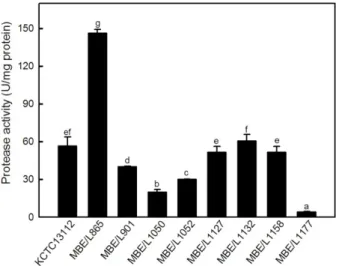
대조구및김치로부터분리한균주 8점을 37℃에서 24시 간동안배양한후원심분리(15,000 × g, 10분)하였으며회 수한상등액을이용하여단백질분해효소활성을측정하였 다(Fig. 1). MBE/L1177 균주의 효소활성은 4.08±0.34 U/
mg protein으로가장낮은 효소활성을나타내었다. MBE/
L865 균주의효소활성은 146.20±3.09 U/mg protein으로 대조구로사용한 B. subtilis KCTC13112 균주의효소활성 (56.34±7.18 U/mg protein)의약 2.6배에해당하는높은효 소활성을나타내어최종균주로선정하였다. MBE/L865 균 주는김치유래의 B. stearothermophilus 균주에비해우수한 Fig. 1. Determination protease activity for the isolated
strains. Extracellular culture supernatant harvested from 24-h shake flask cultivation was used for activity assay performed at 37℃ and pH 7.5. Different letters indicate significant difference between means. B. subtilis KCTC13112 was used as control.
Table 1. Characteristics of carbohydrate utilization by B. subtilis KCTC13112 and KCCM43059.
Characteristics KCTC13112 KCCM43059 Characteristics KCTC13112 KCCM43059
Control - - Esculine + +
Glycerol + - Salicine - -
Erythritol - - Cellobiose + -
D-Arabinose - - Maltose + +
L-Arabinose + - Lactose - -
Ribose + + Melibiose - -
D-Xylose + - Saccharose - +
L-Xylose - - Trehalose + +
Adonitol - - Inuline - -
β-Methyl-xyloside - - Melezitose - -
D-Galactose - - D-Raffinose + -
D-Glucose + + Amidon - -
D-Fructose + + Glycogen + -
D-Mannose + - Xylitol - -
L-Sorbose - - β-Gentiobiose - -
Rhamnose - - D-Turanose + -
Dulcitol - - D-Lyxose - -
Inositol + - D-Tagatose - -
Mannitol + - D-Fucose - -
Sorbitol + - L-Fucose - -
α-Methyl- D-mannoside - - D-Arabitol - -
α-Methyl- D-glucoside + - L-Arabitol - -
N-Acetyl-glucosamine - - Gluconate - -
Amygdaline + - 2-Keto-gluconate - -
Arbutine - - 5-Keto-gluconate - -
+, positive; -, negative
단백질분해효소활성을나타내었다[36]. MBE/L865 균주의 16S rRNA 유전자염기서열을분석한결과 B. subtilis KFP- 17 (GenBank Accession No. KT380826.1) 균주와가장 높
은 상동성(99%)을 나타내어 한국미생물보존센터에 B.
subtilis KCCM43059로기탁하였다.
대조구및 B. subtilis KCCM43059 균주의탄소원대사능 및균주가보유한효소계의특성을조사하였다. 대조구및 KCCM43059 균주모두 ribose, glucose, fructose, esculine, maltose, saccharose, trehalose 등의탄소원을대사하는것 으로 나타났다(Table 1). 그러나 대조구 균주는 glycerol, arabinose, xylose, mannose, inositol, mannitol, sorbitol 등을탄소원으로이용할수있는것으로나타나김치에서분
리된 KCCM43059 균주에비해상대적으로더많은종류의
탄소원을대사하는것으로판단되었다. 김치로부터분리된 Bacillus sp. JK-43 균주[37]는 glucose, fructose, esculine,
maltose 등의 탄소원을 대사하여 본 연구에서 분리된
KCCM43059 균주와유사한탄소원대사특성을나타내었다.
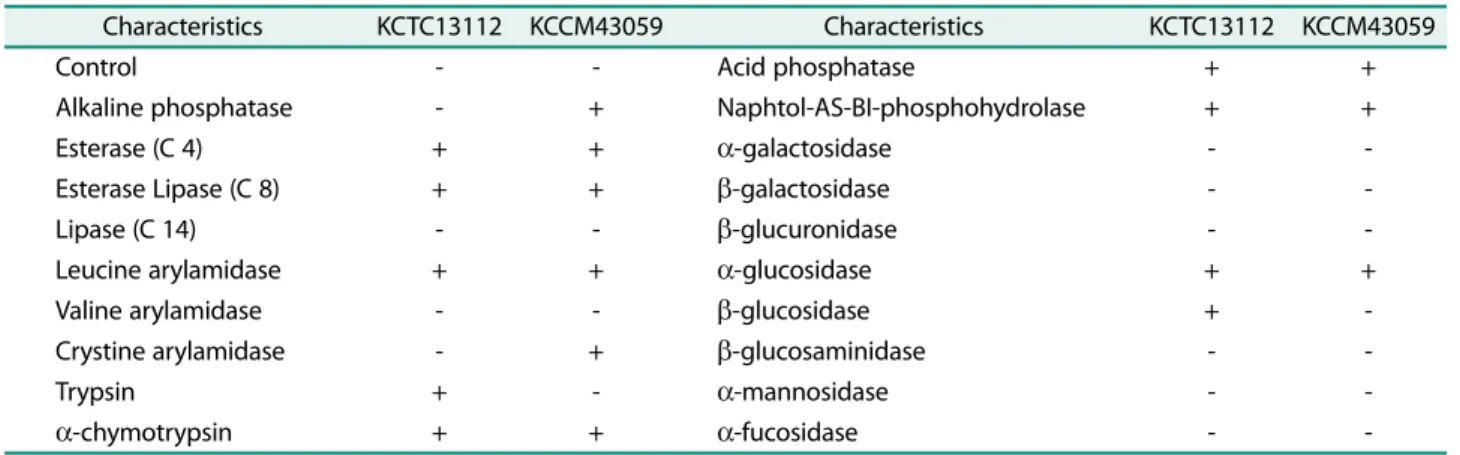
대조구및 KCCM43059 균주가보유한효소활성을조사
한결과 esterase, lipase, acid phosphatase, α-glucosidase 등의효소활성을보유하고있는것으로나타났다(Table 2).
KCCM43059 균주는 alkaline phosphatase, crystine
arylamidase 등의효소활성을보유하는것으로나타내었으
며, 대조구균주는 trypsin, β-glucosidase 등의효소활성을 나타내어두균주가서로다른특성을나타내었다. 따라서
김치에서분리된 KCCM43059 균주는 16S rRNA 유전자의
염기서열은 B. subtilis 균주와높은상동성을나타내었으나 탄소원대사특성과균주가보유한효소계는상이한것으로 판단되었다.
효소활성 평가
대조구및 KCCM43059 균주를 37℃에서 24시간동안배
양하여원심분리한후얻은상등액을이용하여다양한반응 온도및 pH에서효소활성을측정하였다. 완충용액의 pH를 7.5로고정하고반응온도를달리하여효소활성을측정한결 과대조구및 KCCM43059 균주는 25℃에서각각 33.41± 8.38, 58.61±9.80 U/mg protein 으로가장낮은단백질분 해효소활성을나타내었다(Fig. 2A). 반응온도가증가할수록
KCCM43059 균주의효소활성이유의적으로증가하였으며
Table 2. Evaluation of enzyme activity of B. subtilis KCTC13112 and KCCM43059.
Characteristics KCTC13112 KCCM43059 Characteristics KCTC13112 KCCM43059
Control - - Acid phosphatase + +
Alkaline phosphatase - + Naphtol-AS-BI-phosphohydrolase + +
Esterase (C 4) + + α-galactosidase - -
Esterase Lipase (C 8) + + β-galactosidase - -
Lipase (C 14) - - β-glucuronidase - -
Leucine arylamidase + + α-glucosidase + +
Valine arylamidase - - β-glucosidase + -
Crystine arylamidase - + β-glucosaminidase - -
Trypsin + - α-mannosidase - -
α-chymotrypsin + + α-fucosidase - -
+, positive; -, negative
Fig. 2. Influences of temperature (A, pH 7.5) and pH (B, 60℃) on protease activity of B. subtilis KCTC13112 (■) and KCCM43059 (□). Different letters indicate a significant differ- ence between means, ND: not detected.
60℃에서가장높은효소활성(367.64±33.07 U/mg protein) 을나타내었다. 반응온도 60℃에서 pH에따른효소활성의
변화를측정한결과 KCCM43059 균주의효소활성은 pH 6
에서 429.37±18.65 U/mg protein로대조구균주(313.74± 11.41 U/mg protein)보다높은효소활성을나타내었다(Fig.
2B). 그러나 pH 7부터효소활성이현저히감소하여 pH 10
에서 63.59±3.12 U/mg protein으로대조구인 KCTC13112 균주(72.51±7.56 U/mg protein)보다유의적으로낮은효소 활성을나타내었다. 이러한결과로부터 B. subtilis KCCM43059
균주는반응온도 60℃, pH 6 조건에서가장높은단백질분
해효소활성을나타내는것으로판단되었다.
Bacillus sp. JE 375 균주가생산하는단백질분해효소의 경우최적반응조건은 65℃, pH 6.5로[38], 본연구의단백 질분해효소와유사한특성을나타내었다. Bacillus sp.이 생산하는단백질분해효소들의온도에대한활성은알칼리 효소가 60℃, 중성효소는 30−37℃에서최적활성을나타낸
다고보고되어[38], 본연구에서분리한 KCCM43059 균주
가생산하는단백질분해효소경우 60℃에서최적활성을나 타내는알칼리효소라고판단하였다.
균주의 생육특성
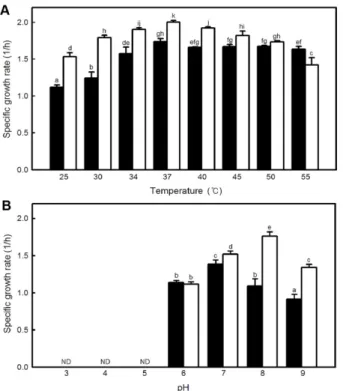
배지 pH 7.3에서 배양온도를 달리하여 대조구 및
KCCM43059 균주의비성장속도를측정한결과, KCCM43059
균주의비성장속도는 2.00±0.02(1/h) 로대조구인 KCTC13112
균주(1.74±0.04(1/h))보다 높은비성장속도를나타내었다
(Fig. 3A). 배양온도 40℃부터 KCCM43059 균주의비성장 속도가감소하였으며 55℃에서의비성장속도는 1.42±0.10 (1/h)로 대조구인 KCTC13112 균주(1.63±0.03 (1/h))보다 낮은비성장속도를나타내었다.
배양온도 37℃에서완충용액으로배지의 pH를조정하여 균주의비성장속도를측정한결과 pH 3, 4 및 5조건에서두
균주모두성장하지못하였다(Fig. 3B). KCCM43059 균주
는 pH 8에서 1.76±0.06(1/h)로대조구균주에비하여높은 비성장속도를나타내었다. 결과적으로 KCCM43059 균주는 배양온도 37℃, pH 8에서가장높은비성장속도를나타내었다.
NaCl 농도에따른대조구와 KCCM43059 균주의균체성
장을비교하여내염성을평가하였다(Fig. 4). KCCM43059 균
주는 1%의 NaCl이함유된 TSA 평판배지에서가장우수한
성장을나타내었으며, 2%의 NaCl이함유된 TSA 평판배지 에서도성장이확인되었다. 그러나대조구균주는 NaCl의 첨가에의하여성장이현저히감소하였으며, 3%의 NaCl이 함유된배지에서는두균주모두성장이어려운것으로나 타났다. 결과적으로 KCCM43059 균주가대조구균주에비 하여상대적으로내염성이우수한것으로판단하였다.
메주에서분리된 B. licheniformis NH20 균주는 NaCl 농 도 0−5%에서생육이가능하였으며, 최적농도는 2−3%이었 Fig. 3. Effects of temperature (A, pH 7.3) and pH (B, 37℃) on
specific growth rate of B. subtilis KCTC13112 (■) and KCCM43059 (□). Cells were grown in TSB at an indicated tem- perature and pH. Different letters indicate a significant difference between means, ND: not detected.
Fig. 4. Tolerance of B. subtilis KCTC13112 (■) and KCCM43059 (□) to NaCl. Cultures were grown to exponential phase in TSB and diluted to an OD600 of 0.1 with the same medium and spotted on TSA plate supplemented with NaCl. Cells were incubated at 37℃ and photographed after 24 h.
다[39]. 본연구에서분리한 KCCM43059 균주의성장을위 한최적 NaCl 농도가 1−2%인것을고려하면유사한결과라 고판단되었다. 장류, 젓갈등고염도의발효식품에서분리
된고초균은10%의 NaCl 농도에서도성장하는특성을나타
내었는데[19, 40], 이는분리원의특성이균주의내염성에영
향을미치는것으로추정되었다.
본연구에서는김치유래의 B. subtilis 균주의단백질분 해효소활성및균주의성장특성을구명하였다. 최근에도고 초균의생육특성및단백질분해효소활성특성에관한연 구가지속적으로보고되고있으며[1, 41, 42], 추가연구를통 하여산업적으로활용이가능한균주로서개발이기대된다.
요 약
전국에서수집한발효식품으로부터단백질분해효소활성 을보유한균주를분리하였다. Skim milk를첨가한 TSA 평 판배지에서투명환을형성한 8점의균주중김치에서분리 된 MBE/L865 균주가대조구인 KCTC13112 균주에비하여 약 2.6배의효소활성을나타내었으며 Bacillus subtilis로동 정하여한국미생물보존센터에 KCCM43059 균주로기탁하 였다. B. subtilis KCCM43059 균주의최적배양조건은 37℃,
pH 8으로대조구인 KCTC13112 균주의비성장속도보다우
수하였다. 반응조건 60℃, pH 6에서 429.37±18.65 U/mg
protein의최적효소활성을나타내었으며동일조건에서대
조구 균주보다 효소활성이 우수하였다. 또한 B. subtilis
KCCM43059 균주는대조구균주에비하여 NaCl에상대적
으로높은내성을나타내었다.
Acknowledgments
This work was carried out with the support of “Cooperative Research Program for Agriculture Science & Technology Develop- ment (Project No. PJ009993)” Rural Development Administration, Republic of Korea.
References
1. Kim MN, Si JB, Wee YJ. 2016. Identification of a newly isolated protease-producing bacterium, Bacillus subtilis FBL-1, from soil. Korean J. Microbiol. Biotechnol. 44: 185-193.
2. Lee JH, Bai DH. 2004. A thermostable protease produced from Bacillus sp. DF 218. Korean J. Food Sci. Technol. 36: 105-110.
3. Bang SH, Jeong IS. 2011. Characterization of an alkaline prote- ase from an alkalophilic Bacillus pseudofirmus HS-54. Korean J.
Microbiol. 47: 194-199.
4. Yang SJ, Kang EJ, Lee RH, Jung HK, Park CS, Hong JH. 2014.
Characterization of amylase produced by Bacillus subtilis KMKW4 isolated from Kimchi. J. Chitin Chitosan. 19: 21-28.
5. Lee SK, Heo S, Bae DH, Choi KH. 1998. Medium optimization for fibrinolytic enzyme production by Bacillus subtilis KCK-7 isolated from Korean traditional Chungkookjang. Korean J.
Appl. Microbiol. Biotechnol. 26: 226-231.
6. Kim HK, Kim GT, Kim DK, Choi WA, Park SH, Jeong YK, et al.
1997. Purification and characterization of a novel fibrinolytic enzyme from Bacillus sp. KA38 originated from fermented fish.
J. Ferment. Bioeng. 84: 307-312.
7. Yoshihiro O, Hiroki T, Seiji M, Yutaka I, Kohji M, Atsuhi M, et al.
1990. Secretion of Aspergillus oryzae alkaline protease in an osmophilic yeast, Zygosaccharomyces rouxii. Agric. Biol. Chem.
54: 2521-2519.
8. Banerjee R, Bhattarcharyya BC. 1993. Kinetic properties of extracellular alkaline protease of Rhizopus oryzae. J. Ferment.
Bioeng. 75: 380-382.
9. Nelson G, Young TW. 1987. Extracellular acid and alkaline pro- teases from Candida olea. J. Gen. Microbiol. 133: 1461-1469.
10. Yoon KH, Lee MS, Park BW, Park YH, Kim HI, Kim JH, et al. 2006.
Enzyme production of a protease-producing strain, Bacillus sp.
SH-8 isolated from insect-eating plant. Korean J. Microbiol. Bio- technol. 34: 323-328.
11. Horikoshi K. 1971. Production of alkaline enzymes by alkalo- philic microorganisms. Agric. Biol. Chem. 35: 1407-1414.
12. Yi HK, Chun YJ, Kim HB. 1999. Characterization of Bacillus cereus SH-7 extracellular protease. J. Microbiol. 37: 213-217.
13. Banerjee U, Sani R, Azmi W, Soni R. 1999. Thermostable alka- line protease from Bacillus brevis and its characterization as a laundary detergent additive. Process. Biochem. 35: 213-219.
14. Dhandapani R, Vijayaragavan R. 1994. Production of a thermo- philic, extracellular alkaline protease by Bacillus stearothermo- philus AP-4. World. J. Microbiol. Biotechnol. 10: 33-35.
15. Banik R, Prakash M. 2004. Laundry detergent compatibility of the alkaline protease from Bacillus cereus. Microbiol. Res. 159:
135-140.
16. Lee HJ, Yoo JS, Park YS, Bai DH. 2015. Identification of an alka- lophilic bacterium producing an alkaline protease from soil.
Food Eng. Prog. 19: 414-419.
17. Prasanth M, Nitin M, Shubham J, Saharika S, Ramankannan A, Shanthini T, et al. 2016. Potential of Bacillus subtilis to produce acidic protease under mutagenic condition. Int. J. Pure App.
Biosci. 4: 126-132.
18. Kim HK, Kim KH, Lee JK, Kim YO, Nam HS, Oh TK. 1995. Charac- terization of a thermostable protease from thermophilic Bacil- lus amyloliquefaciens NS 15-4. Korean J. Appl. Microbiol.
Biotechnol. 23: 322-328.
19. Kim EY, Kim DG, Kim YR, Choi SY, Kong IS. 2009. lsolation and identification of halotolerant Bacillus sp. SJ-10 and characteri- zation of its extracellular protease. Korean J. Microbiol. 45: 193- 199.
20. Jeong SC, Hyun KW, Kim JH, Lee JS. 2001. Isolation of a halotol- erant yeast and the production of extracellular protease.
Korean J. Biotechnol. Bioeng. 16: 158-162.
21. Lee NK, Kim SY, Choi SY, Paik HD. 2013. Probiotic Bacillus subti-
lis KU201 having antifungal and antimicrobial properties iso- lated from Kimchi. Food Sci. Biotechnol. 22: 1375-1379.
22. Fujita M, Nomura K, Hong K, Ito Y, Asada A, Nishimuro S. 1993.
Purification and characterization of a strong fibrinolytic enzyme (nattokinase) in the vegetable cheese natto, a popular soybean fermented food in Japan. Biochem. Biophys. Res. Com- mun. 197: 1340-1347.
23. Yang SJ, Lee DH, Park HM, Jung HK, Park CS, Hong JH. 2014.
Amylase activity and characterization of Bacillus subtilis CBD2 isolated from Doenjang. Korean J. Food Preserv. 21: 286-293.
24. Kim DY, Lee ET, Kim SD. 2003. Purification and characterization of fibrinolytic enzyme produced by Bacillus subtilis K7 isolated from Korean traditional soy sauce. J. Korean Soc. Agric. Chem.
Biotechnol. 46: 176-182.
25. Eiggert T, Brockmeier U, Droge MJ, Quax WJ, Jaeqer KE. 2003.
Extracellular lipases from Bacillus subtilis: regulation of gene expression and enzyme activity by amino acid supply and external pH. FEMS Microbiol. Lett. 225: 319-324.
26. Ahn MJ, Ku HJ, Lee SH, Lee JH. 2015. Chracterization of a novel fibrinolytic enzyme, BsfA, from Bacillus subtilis ZA400 in Kimchi reveals its pertinence to thrombosis treatment. J. Microbiol.
Biotechnol. 25: 2090-2099.
27. Jeong SJ, Yang HJ, Jeong SY, Jeong DY. 2015. Identification of characterization and statistical optimization of constituent for Bacillus subtilis SCJ4 isolated from Korean traditional fer- mented food. Korean J. Microbiol. 51: 48-60.
28. Park CS, Min DK, Ahn YS, Lee JH, Hong SK, Kim JH, et al. 2002.
Isolation and characteristics of soy protein-degrading strain, Bacillus subtilis EB464. Korean J. Appl. Microbiol. Biotechnol. 30:
210-215.
29. Cupp-Enyard C. 2008. Sigma's non-specific protease acivity assay - casein as a substrate. J. Vis. Exp. 17: 899.
30. Muyan C, Xiumei Z, Tianxiang G, Chao C. 2006. Effects of tem- perature pH and NaCl on protease activity in digestive tract of young turbot, Scophthalmus maximus. Chin. J. Oceanol. Limnol.
24: 300-306.
31. Sim HS, Kim MD. 2016. Antipathogenic activity of Bacillus amy- loliquefaciens isolated from Korean traditional rice wine.
Korean J. Microbiol. Biotechnol. 44: 98-105.
32. Hongoh Y, Yuzawa H, Ohkuma M, Kudo T. 2003. Evaluation of primers and PCR conditions for the analysis of 16S rRNA genes from a natural enviroment. FEMS Microbiol. Lett. 221: 299-304.
33. Moon SW, Park SH, Kang BS, Lee MK. 2014. Fermentation char- acteristics of low-salt Kimchi with starter on fermentation tem- perature and salt concentration. Korean J. Food Nutr. 27: 785- 795.
34. Ko MS, Hur SW, Kim MR, Jung SJ, Lee H, Cho MS. 2015. The quaility properties of rapidly fermented Mukeun (long-term fermented) kimchi with different salinity and fermented tem- perature. Korean J. Food Nutr. 28: 335-342.
35. Dunkan DB. 1955. Multiple range and multiple F tests. Biomet- rics. 11: 1-42.
36. Min SG, Kim JH, Kim TW, Kim KN. 2003. Isolation and identifica- tion of protease producing bacteria in kimchi. Korean J. Food Sci. Technol. 35: 666-670.
37. Jun HK, Bae KM, Kim YH, Baik HS. 2000. Production and chractrization of cyclodextrin glucanotransferase from Bacilus sp. JK-43 isolated from Kimchi. J. Korean Soc. Food Sci. Nutr. 29:
41-48.
38. Kim JE, Bai DH. 2006. A thermostable protease produced from Bacillus sp. JE 375 isolated from Korean soil. Korean J. Food. Sci.
Technol. 38: 419-426.
39. Choi KK, Cui CB, Ham SS, Lee DS. 2003. Isolation, identification and growth characteristics of main strain related to Meju fer- mentation. J. Korean Soc. Food Sci. Nutr. 32: 818-824.
40. Lee SY, Kim JY, Baek SY, Yeo SH, Koo BS, Park HY, et al. 2011. Iso- lation and characterization of oligotrophic strains with high enzyme activity from buckwheat Sokseongjang. Korean J.
Food. Sci. Technol. 43: 735-741.
41. Lee HJ, Yoo JS, Bai DH. 2016. Purification and characterization of an alkaline protease produced by alkalophilic Bacillus sp.
DK122. Korean J. Microbiol. Biotechnol. 44: 333-340.
42. Wang C, Yu S, Song T, He T, Shao H, Wang H. 2016. Extracellular proteome profiling of Bacillus pumilus SCU11 producing alka- line protease for dehairing. J. Microbiol. Biotechnol. 26: 1993- 2005.