http://dx.doi.org/10.7841/ksbbj.2012.27.6.352
연구논문
Chromosomal Integration에 의해 제조한 Bacillus clausii C5 유래의 alkaline protease의 세제 첨가제 응용성
주한승2, 최장원1*
Feasibility as a Laundry Detergent Additive of an Alkaline Protease from
Bacillus clausii C5 Transformed by Chromosomal IntegrationHan-Seung Joo2 and Jang Won Choi1*
접수: 2012년 12월 13일 / 게재승인: 2012년 12월 23일
© 2012 The Korean Society for Biotechnology and Bioengineering
Abstract:1)Bacillus clausii I-52 which produced SDS- and H2O2-tolerant extracellular alkaline protease (BCAP) was isolated from heavily polluted tidal mud flat of West Sea in Incheon, Korea and stable strain (transformant C5) of B. clausii I-52 harboring another copy of BCAP gene in the chromosome was developed using the chromosome integration vector, pHPS9-fuBCAP. When investigated the production of BCAP using B. clausii transformant C5 through pilot-scale submerged fermentation (500 L) at 37℃ for 30 h with an aeration rate of 1 vvm and agitation rate of 250 rpm, protease yield of approximately 105,700 U/mL was achieved using an optimized medium (soybean meal 2%, wheat flour 1%, sodium citrate 0.5%, K2HPO4 0.4%, Na2HPO4 0.1%, NaCl 0.4%, MgSO4 · 7H2O 0.01%, FeSO4 · 7H2O 0.05%, liquid maltose 2.5%, Na2CO3 0.6%). The enzyme stability of BCAP was increased by addition of polyols (10%, v/v) and also, the stabilities of BCAP towards not only the thermal-induced inactivation at 50℃ but also the SDS and H2O2-induced inactivation at 50℃
were enhanced. Among the polyols examined, the best result was obtained with propylene glycol (10%, v/v). The BCAP
1대구대학교 바이오산업학과
1Dept. of Bioindustry, Daegu University, Gyeongsan, Gyeongbuk 712-714, Korea
Tel: +82-53-850-6756, Fax: +82-53-850-6769 e-mail: [email protected]
2씨앤제이바이오텍(주)
2C & J Biotech. Jinju Bio21 Center, Jinju, Gyeongnam 660-844, Korea
supplemented with propylene glycol exhibited extreme stability against not only the detergent components such as α-orephin sulfonate (AOS) and zeolite but also the commercial detergent preparations. The granulized enzyme of BCAP was prepared with approximately 1,310,000 U/g of granule. Wash performance analysis using EMPA test fabrics revealed that BCAP granule exhibited high efficiency for removal of protein stains in the presence of anionic surfactants as well as bleaching agents. When compared to Savinase 6TⓇ and Everlase 6TⓇ manufactured by Novozymes, BCAP under this study probably showed similar or higher efficiency for the removal of protein stains. These results suggest that the alkaline protease produced from B. clausii transformant C5 showing high stability against detergents and high wash performance has significant potential and a promising candidate for use as a detergent additive.
Keywords: Washing performance, stability, alkaline protease, Bacillus clausii I-52
1. 서론
단백질 분해효소는 전체 산업용 효소 시장의 약 60%를 차 지하고 있어 산업적 관점에서 볼 때 가장 중요한 효소 중의 하나이다. 단백질 분해효소 중에서 알칼리성 단백질 분해효 소는 세제, 식품, 사료, 가죽 산업, peptide 합성 등의 다양한 산업적 응용성을 가지고 있으며 사용량이 매년 증가하고 있다 [1-3]. 비록 몇 가지 Aspergillus 같은 곰팡이 유래의
단백질 분해효소가 사용되고 있지만 [4-6], 1960년대에 B. licheniformis에서 생산된 ‘Subtilisin Carlsberg’가 세제 에서 최초로 사용된 이래로, 대부분 B. amyloliquefaciens, B. licheniformis 및 B. clausii와 같은 Bacillus strain 유래의 단백질 분해효소가 개발되어 상용화되었다 [7-16]. Bacillus 속 미생물들은 높은 pH 및 온도에서 효소 안정성과 활성을 가지고 있는 알칼리성 단백질 분해효소를 생산하는 것으로 잘 알려져 있으며, 또한, 이들 미생물은 빠른 성장속도, 많은 양의 효소 분비능력, 안전성 (GRAS, generally recognized as safe) 및 유전적 background가 잘 밝혀져 있기 때문에 단백 질 분해효소를 대량 생산하기 위하여 산업적으로 매우 유용 한 것으로 알려져 있다 [2,17-21]. 예를 들면, Novozymes사 (덴마크)는 B. licheniformis로 부터 AlcalaseⓇ를, B. clausii 로 부터 SavinaseⓇ를 개발하여 상용화 하였으며, Genencor 사 (미국)는 B. lentus로부터 PurafectⓇ를, B. alkalophilus PB92로부터 ProperaseⓇ를 개발하여 상용화하였다 [15,21].
단백질 분해효소를 산업적으로 사용하기 위해서 여러 가 지 극복해야 할 제약들이 있는데, 그 중에서도 단백질 분해 효소의 생산성을 높이는 것이 가장 큰 문제인 것이다. 단백질 분해효소의 생산성을 높이기 위하여 배지 성분들과 배양 조건의 최적화가 필요하며, 미생물로부터 단백질 분해효소 를 생산하기 위한 배지 성분은 전체 생산 비용의 약 30~40%
정도를 차지한다고 보고되어 있어, 유기 질소원으로 대두박, nug meal 등과 같이 저렴하고 쉽게 구할 수 있는 성분들을 사용하게 된다 [17,22-24]. 또한 통기 및 교반속도 등과 같은 배양공정의 최적화에 의하여 단백질 분해효소의 생산성에 커다란 영향을 미치는 것으로 보고되었으며 [25-29], 산화제, 계면활성제 및 여러 가지 다양한 세제 성분들에 대한 안정성 도 중요한 요소 중의 하나이다. 일반적으로, Bacillus 유래의 단백질 분해효소는 높은 pH 및 온도에서 활성을 갖지만, 많은 경우 음이온성 계면활성제 및 peroxides와 같은 강력한 산화제의 존재 하에서는 효소 활성을 잃게 된다 [21,30].
이런 문제점을 해결하기 위하여 단백질 공학 기법을 이용하 여 극한 조건 하에서도 효소 활성을 유지하는 효소를 얻으 려는 시도가 많이 이루어지고 있다 [31]. 예를 들면, subtilisin BPN에서 oxidation-sensitive Met 잔기를 Ser 또는 Ala과 같 은 산화되지 않는 아미노산 잔기로 치환하였을 때, 효소의 산화제에 대한 안정성은 증가하지만 효소 활성이 급격하게 감소한다는 단점을 가지고 있다 [32]. 1997년 이후로, gene shuffling 방법에 의해 유기 용매, 온도 및 높은 pH에 대한 안정성이 개선된 여러 가지 subtilisin variant들이 보고되었 다 [33]. 그러나 유전공학적 방법으로 안정성이 개선된 단백 질 분해효소들이 많이 보고되어 있지만, 많은 경우 효소 활 성의 감소를 수반하는 문제점을 가지고 있다. 효소의 안정성 을 증가시키기 위한 또 다른 방법으로 화학적 수식법이 있는 데, 이는 subtilisin 계열의 단백질 분해효소에서 아미노산 잔기의 화학적 수식에 의해 효소의 특성을 변화시켜 효소의 활성 및 안정성에 영향을 주는 것으로 알려져 있어 오랫동안 연구되었지만 비용이 비싼 관계로 세제 산업에 사용할 수 있 는 경제적 가치가 낮아 지금은 사용되고 있지는 않다 [34].
현재, 세제는 환경 친화적인 zeolites, bleaching agents와
같은 non-phosphate builder를 사용하고 있으며, 세제 첨가 용 단백질 분해효소의 세제 성분들에 대한 안정성을 증가시 키기 위하여 효소를 granule에 encapsulation 한 형태로 첨가 하고 있으며, 따라서 세제 첨가용으로 이상적인 단백질 분해 효소는 세척 온도에서 계면활성제 용액에 효소가 안정해야 할 뿐만 아니라 높은 활성을 나타내야 한다 [35-38].
심하게 오염된 인천 연안 갯벌로부터 최적 활성 온도가 60℃, 최적 활성 pH가 11이며 음이온성 계면활성제 및 산 화제에 매우 안정한 알칼리성 단백질 분해효소 (B. clausii alkaline protease, BCAP)를 생산하는 B. clausii I-52를 탐색하 여, 액침 배양법 (submerged fermentation)에 의해 단백질 분 해효소를 생산하기 위한 최적조건을 보고하였으며 [13,39-40], 그 균주로부터 BCAP 유전자를 클로닝 하였고, 또한 B.
clausii I-52의 염색체 DNA에 BCAP 유전자를 결합시켜 단백질 분해효소의 생산성이 향상된 형질전환체 B. clausii I-52 C5를 보고하였다 [41-42]. 따라서 본 논문에서는 B.
clausii I-52의 염색체 DNA에 BCAP 유전자를 결합시켜 제 조한 B. clausii transformant C5로부터 생산한 단백질 분해 효소를 이용하여 세제 첨가제로 사용하기 위한 적합성 및 세척력 연구를 수행하였다.
2. 재료 및 방법 2.1. 시약 및 재료
Kanamycin 및 Antifoam A는 Sigma사 (미국)에서 구입하 였고, EMPA 116 (cotton soiled with blood/milk/ink) 및 EMPA 117 (polyester/cotton soiled with blood/milk/ink)은 EMPA사 (St. Gallen, 스위스)에서 구입하였다. Zeolite, linear alkylbenzene sulfonates (LAS), α-orephin sulfonate (AOS), 과립효소 Savinase® 6T 및 Savianse® 12T는 Nuvo사 (한국) 에서 제공 받아 사용하였다.
2.2. Bacterial strain 및 배지
본 연구에서는 심하게 오염된 인천 연안 갯벌로부터 분리 한 알칼리성 단백질 분해효소를 생산하는 B. clausii I-52 균주의 염색체 DNA 내로, -35 서열 (TCTACT), -10 서열 (TACAAT), 라이보좀 결합서열 (GGAGAGGG), 29개 아미 노산으로 이루어진 신호서열, 77개 아미노산으로 이루어진 전구체 서열 및 275개 아미노산으로 이루어진 활성형 단백 질 분해효소 서열을 갖는 총 381개 아미노산 서열을 암호화 하는 BCAP 유전자가 cloning되어 있는 pHPS9-fuBCAP plasmid를 도입하여 단백질 분해효소의 생산성을 향상시킨 형질전환체 B. clausii C5를 사용하였다 [13,41-42]. 형질전 환체 B. clausii C5는 10 ug/mL chloroamphenicol 및 0.6%
(w/v) sodium carbonate를 포함하는 tryptic soy broth (TSB) 배지에서 배양하였고, 4℃에서 보관하면서 활성화 후 실험에 사용하였다.
2.3. 단백질 분해효소 활성 측정
알칼리성 단백질 분해효소 활성은 Hammasten casein (USB
사, 미국)을 기질로 사용하여 측정하였다. 즉, 기질용액 (0.5%
casein/0.1 M glycine-NaOH buffer, pH 11) 0.5 mL에 적당 하게 희석한 효소 시료 10 uL를 가하여 잘 혼합한 다음, 60℃
에서 10분 동안 반응시키고 0.5 mL의 반응 중지 용액 (10%
trichloroacetic acid)을 가하고 잘 혼합하여 준 후, 4℃에 서 10분 동안 방치하여 반응을 중지하였다. 상기 반응액을 13,000 × g로 10분 동안 원심분리 하여 상층액을 회수하여 275 nm에서 흡광도를 측정하였다. 이때, tyrosine을 사용하 여 표준 곡선을 얻은 후 반응에 의하여 생성된 tyrosine의 양 을 계산하였다. 단백질 분해효소 활성 1 unit (U)은 최적 활 성 조건 (pH 11, 60℃) 하에서 1분 동안 1 ug의 tyrosine 생 성에 필요한 효소의 양으로 정의하였다 [13].
2.4. Pilot-scale 발효, 회수 및 농축
Pilot scale (500 L)을 이용하여 B. clausii C5로부터 생산되 는 단백질 분해효소 발현 양상을 조사하였다. 단백질 분해 효소를 생산하기 위한 배지의 조성은 다음과 같다: 대두박 2%, 밀가루 1%, 구연산나트륨 0.5%, K2HPO4 0.4%, Na2HPO4
0.1%, NaCl 0.4%, MgSO4 · 7H2O 0.01%, FeSO4 · 7H2O 0.05%, 물엿 2.5%, 탄산나트륨 0.6% (w/v). 이 때, 50% 물 엿 용액 및 30% 탄산나트륨 용액을 121℃에서 20분간 고압 멸균하여 각각 제조하고, 상기 조성의 배양배지에 균 접종 직전에 물엿과 탄산나트륨의 농도가 각각 2.5% (w/v)와 0.6% (w/v)가 되도록 하여 사용하였다 [41-42]. 상기와 동일 한 배지조성으로 37℃에서 24시간 동안 진탕 배양하여 종자 배양액으로 사용하였으며, 500 L (working volume, 300 L) 발효기 (코바이오텍사, 한국)에 각각 최종 농도가 1% 되게 접종하여 공기의 공급 속도는 1 vvm, 교반 속도는 250 rpm 으로 37℃에서 48시간 동안 배양하였다. 이 때, antifoam A 를 거품 생성을 최소화하기 위하여 사용하였다. 세포 배양액 은 연속 원심분리기 (Westfalia사, 미국)로 회수하고, molecular weight cut-off 10 kDa membrane (Dimension, 20.6 × 17.8 × 1.5 cm; 단면적 0.5 m2) 네 장을 사용하여 한외여과기 (Pall사, 미국)로 약 10배 농축하였으며, 효소의 안정성을 증가시키 기 위하여 최종 농도가 10% (v/v) 되게 propylene glycol를 첨가한 후 냉장 보관하였으며, 여러 실험을 위한 효소원으로 사용하였다 [13].
2.5. 안정화 연구
일반적으로 효소의 안정화를 위해 사용하고 있는 polyol 을 첨가하여 BCAP 효소의 활성 및 안정성에 미치는 영향 을 조사하였다. 최종 농도가 10% 되게 glycerol, mannitol, polyethyleneglycol 6000 및 propylene glycol을 효소 용액 에 처리하고 잘 혼합하여 준 후, 50℃에서 방치하고, 일정한 시간 간격으로 시료를 취한 후 표준 효소 활성 측정 방법에 따라 잔류 효소활성을 측정하여 효소의 열 안정성 증가를 측정하였다. 또한, polyol 첨가가 단백질 분해효소의 SDS 및 H2O2에 대한 안정성에 미치는 영향도 조사하였다. 즉, polyol 을 첨가한 후, 5% (w/v) SDS 및 5% (v/v) H2O2를 처리하고 잘 혼합하여 준 후, 50℃에서 방치하고, 일정한 시간 간격으 로 시료를 취한 후 표준 효소 활성 측정 방법에 따라 잔류
효소활성을 측정하여 polyol의 SDS 및 H2O2에 의한 효소활 성 보호 여부를 확인하였다.
2.6. 세제 성분에 대한 안정성
여러 가지 세제 첨가제 성분 (예: Zeolite, 상용세제 등)들이 단백질 분해효소 활성 및 안정성에 미치는 영향을 알아보기 위하여, 각 세제 성분들과 효소액을 mixing 한 후 상온에서 일정 시간 동안 방치하고, 표준 효소 활성 측정 방법에 따라 잔류 효소활성을 측정하였다.
2.7. Washing performance
형질전환체 B. clausii C5 균주로부터 유래된 단백질 분해효 소의 세척 능력은 표준 시험 천 (EMPA test fabric) EMPA111 (cotton soiled with blood), EMPA116 (cotton soiled with blood/milk/ink) 및 EMPA117 (polyester/cotton soiled with blood/milk/ink)을 사용하여 측정하였다. 액상 효소의 세척력 시험 (wash performance) control로서 Savinase 16 L EXⓇ 및 Alcalase 2.5 LⓇ (Novozymes사) 단백질 분해효소 용액 을 사용하였으며, 과립형 효소의 control은 Savinase 6TⓇ 및 Everlase 6TⓇ (Novozymes사) 단백질 분해효소를 각각 사용하였다. 즉, test fabric (7 × 7 cm2), 과립형 (또는 액상) 단백질 분해효소 (최종 농도, 100 U/mL), 각 세제 성분 및 수돗물 (200 mL)을 세척기 (Nuvo사 제조, 한국)에 넣고 40℃
에서 150 rpm으로 10분 동안 세척하였다. 세척이 끝난 후, 천을 회수하여 잘 말리고 reflectance meter (Chromameter CR-210b, 미놀타, 일본)를 이용하여 반사되는 빛 (reflectance) 을 측정하였다. 과립형으로 제조한 BCAP의 보관 안정성을 측정하기 위하여 제조한 과립 효소를 상온에서 보관한 후 일정한 시간 간격으로 시료를 취하여 효소를 포함하지 않는 detergent base를 사용하여 상기와 동일한 방법으로 세척력 을 측정하였다. 이 때, test fabric은 EMPA117을 사용하였 으며, control 과립 효소로는 Savinase 6TⓇ를 사용하였다.
3. 결과 및 고찰 3.1. Pilot-scale 발효
Pilot-scale 발효기 (500 L)를 이용하여 BCAP 유전자가 도 입되어 형질전환된 B. clausii transformant C5로부터 알칼 리성 단백질 분해효소의 발현을 조사하였다. 단백질 분해효 소를 생산하기 위한 배지의 조성은 다음과 같다: 대두박 2%, 밀가루 1%, 구연산나트륨 0.5%, K2HPO4 0.4%, Na2HPO4
0.1%, NaCl 0.4%, MgSO4 · 7H2O 0.01%, FeSO4 · 7H2O 0.05%, 물엿 2.5%, 탄산나트륨 0.6% (w/v). 상기와 동일한 배지조성으로 37℃에서 24시간 동안 C5 균주를 진탕 배양하 여 종자 배양액으로 사용하였으며, 500 L (working volume, 300 L) pilot-scale 발효기에 최종 농도가 1% 되게 접종하여 배양하였다 (공기 공급 속도, 1 vvm,; 교반 속도 250 rpm;
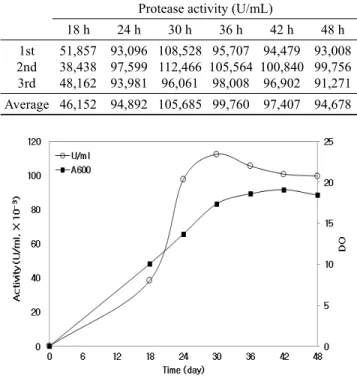
배양 온도 37℃; 배양 시간 48 h). 일정한 시간 간격으로 시 료를 채취하고 효소 활성을 측정한 결과, 휴지기 (stationary phase)인 24시간부터 단백질 분해효소의 발현이 급격하게
증가하였으며, 약 30시간 배양하였을 때 최대로 발현되었다 (평균 105,700 U/mL). 그러나, 배양 시간이 증가함에 따라 단백질 분해효소의 발현이 약간 감소하였지만 큰 변화는 나 타나지 않았다 (Table 1, Fig. 1). 발효액을 연속 원심분리기 (Westfalia사, 미국)로 회수하고, molecular weight cut-off 10 kDa membrane (Dimension, 20.6 × 17.8 × 1.5 cm;
단면적 0.5 m2) 네 장을 사용하여 한외여과기 (Pall사, 미 국)로 농축한 결과, 농축 회수율은 약 93%로 매우 높았 으며, 한외여과법이 대량 생산한 단백질 분해효소를 농축 할 때 매우 유용하게 사용되었다 (data not shown). 농축한 효소용액에 최종 농도가 10% (v/v) 되게 propylene glycol 을 첨가한 다음 냉장 보관하였으며, 여러 실험을 위한 효소 원으로 사용하였다 [14].
Table 1. Protease productivities through pilot-scale submerged fermentation (500 L). B. clausii C5 was cultivated in an optimized medium at 37℃ for 48 h with the rate of agitation and aeration of 250 rpm and 1 vvm, respectively. The cell-free supernatant was recovered by continuous centrifugation and used for determining protease activity
Protease activity (U/mL)
18 h 24 h 30 h 36 h 42 h 48 h 1st
2nd 3rd
51,857 38,438 48,162
93,096 97,599 93,981
108,528 112,466 96,061
95,707 105,564 98,008
94,479 100,840 96,902
93,008 99,756 91,271 Average 46,152 94,892 105,685 99,760 97,407 94,678
Fig. 1. Time course profile of BCAP production through pilot-scale submerged fermentation. B. clausii transformant C5 was cultivated in an optimized medium at 37℃ with the rate of agitation and aeration of 250 rpm and 1 vvm, respectively. The cell-free supernatant was recovered by centrifugation, and used for determining the protease activity.
3.2. 안정화 연구
심하게 오염된 인천 연안 갯벌로부터 최적 활성 온도가 60℃, 최적 활성 pH가 11이며, 음이온성 계면활성제인 SDS (5%, w/v) 및 강력한 산화제인 H2O2 (5%, v/v)로 72시간 처리하 여도 효소 활성을 각각 75% 및 100% 이상을 유지하는 SDS 및 H2O2에 매우 안정한 알칼리성 단백질 분해효소 (BCAP)
를 생산하는 B. clausii I-52를 탐색하여 보고하였다 [13].
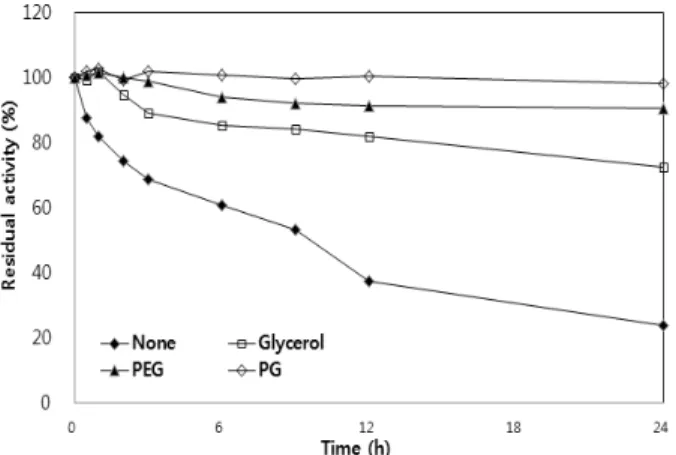
단백질 분해효소를 세제 첨가제로서 사용하기 위하여 물리적, 화학적 안정성과 특히, 산화제 및 여러 가지 계면활성제에 대한 안정성을 갖추는 것이 중요하지만 상기의 조건들을 갖 춘 단백질 분해효소는 매우 제한적이다 [2,26,30,31]. 이러한 문제점을 극복하기 위하여 여러 가지 방안들이 시도되고 있 다. 예를 들면, site-directed mutation [32], DNA shuffling [33], 또한 극한 생물로부터 안정성 및 기능성이 향상된 효소를 screening하는 방법도 이용이 되고 있다 [13,19,30]. 돌연변 이 등과 같은 유전공학적인 방법을 사용하지 않고 효소의 안정성을 높이는 대표적인 방법이 glycerol, mannitol과 같 은 polyols을 효소 용액에 첨가하는 것이다 [43]. 최종 농도 가 10% 되게 glycerol, mannitol, polyethyleneglycol 및 propylene glycol을 가하고, 50℃에서 incubation 한 후, 일정 한 시간 간격으로 시료를 취한 후 표준 효소 활성 측정 방법 에 따라 잔류 효소활성을 측정하였다. Polyol을 첨가하지 않 은 BCAP 용액은 2시간 후에 효소 활성이 약 50% 정도 감소 하였으며, 24시간 후에는 90% 이상의 활성이 감소되었다.
그러나, glycerol, mannitol, polyethyleneglycol 및 propylene glycol과 같은 polyol을 10% 농도로 첨가하였을 때, BCAP 의 heat-inactivation (50℃)으로부터 보호 효과를 나타내며, 특히 propylene glycol에 의해 효소 활성이 100% 보호되는 것으로 나타났다 (Fig. 2). 또한, polyol을 첨가 하였을 때 단백질 분해효소의 SDS 및 H2O2에 대한 안정성에 미치는 영향을 조사하기 위하여, polyol을 첨가한 후, 5% SDS 및 5% H2O2를 처리하고 잘 혼합하여 준 후, 50℃에서 방치하 고, 일정한 시간 간격으로 시료를 취한 후 표준 효소 활성 측정 방법에 따라 잔류 효소활성을 측정하여 polyol의 SDS 및 H2O2에 의한 효소 활성 보호 여부를 확인하였다. B. clausii transformant C5에서 발현된 BCAP을 50℃에서 5% SDS 로 30분 incubation 하였을 때 효소 활성은 65% 정도 감소 하였으며, 2시간 후에 효소 활성은 92% 정도 감소하였고, 3시간 후에는 거의 모든 효소 활성이 감소하였다. 그러나, 효소용액에 glycerol, polyethyleneglycol 및 propylene glycol 과 같은 polyol을 첨가하였을 때, 효소활성은 SDS에 의한 inactivation (50℃)으로부터 보호 효과를 나타내며, 특히 propylene glycol (10%, v/v) 첨가는 사용한 polyol들 중에서 효소활성 보호 효능이 가장 높았다. 10% (v/v) propylene glycol을 첨가한 BCAP 효소 용액을 50℃에서 5% SDS로 30분 incubation 하였을 때 효소 활성은 거의 잃지 않았으며 (99.6% 유지), 2시간 incubation 하여도 효소 활성은 87%
정도가 유지되며, 12시간 incubation 후에도 약 60% 정도 의 효소 활성이 유지되었다 (Fig. 3). SDS는 CMC (critical micelle concentration; 8 mM for SDS; 약 0.23%) 이상의 농도에서 단백질을 unfolding하여 단백질을 변성시키는 강 력한 변성제로서 CMC 이상의 농도에서 SDS의 음전하를 갖는 sulfate group은 단백질의 표면에 존재하는 양전하의 아미노산과 반응하여 단백질 unfolding을 시작하고, SDS의 소수성 alkyl chain과 단백질 내부의 비극성 (nonpolar)을 띠는 부분과 interaction 하여 단백질의 내부로 들어감으로써 단백질을 변성시키는 것으로 알려져 있다 [44,45].
Fig. 2. Effect of polyols on thermal stability of BCAP produced from B. clausii transformant C5. BCAP was incubated with or without 10% (v/v) polyols. After incubation at 50℃ for indicated times, the residual activities were measured under standard assay condition. PEG, polyethyleneglycol ; PG, propylene glycol.
Fig. 3. Protective effects of polyols from inactivation of BCAP produced from B. clausii transformant C5 by treatment of SDS at 50℃. BCAP solutions containing 5% SDS were incubated with and without 10% (v/v) polyols at 50℃. Aliquots were taken at regular time intervals, and then the residual activities were measured under standard assay condition.
B. clausii transformant C5에서 발현된 BCAP을 50℃에 서 5% H2O2로 2시간 incubation 하였을 때 효소 활성은 25% 정도 감소하였으며, 9시간 후에 50% 정도, 24시간 후에 76% 정도 감소하였다. 그러나 효소용액에 glycerol, polyethyleneglycol 및 propylene glycol과 같은 polyol을 첨가 하였을 때, 효소활성은 H2O2에 의한 inactivation (50℃) 으로부터 보호 효과를 나타내며, 특히 propylene glycol (10%, v/v) 첨가는 사용한 polyol들 중에서 H2O2에 의한 inactivation 으로부터 보호 효능이 가장 높았다. 10% (v/v) propylene glycol을 첨가한 BCAP 효소 용액을 50℃에서 5% H2O2
로 24시간 incubation 후에도 효소 활성을 거의 잃지 않았 다 (Fig. 4). 과산화수소 (hydrogen peroxide, H2O2)는 강력 한 산화제로 알려져 있으며, 단백질을 산화시켜 활성을 inactivation 하는 것으로 알려져 있다. 특히, 대부분의 subtilisin 계열의 단백질 분해효소는 catalytic triad의 Ser 근처에 산화적 손상을 받기 쉬운 Met residue가 존재하여
강력한 산화제에 의하여 oxidative inactivation에 의하여 효 소 활성을 잃는 것으로 알려져 있다 [46]. B. brevis, B. cereus BG1, B. licheniformis NH1 및 B. subtilis NCIM No. 64 유래의 알칼리성 단백질 분해효소는 Ca2+의 첨가에 의하여 열 안정성이 증가하며, 이는 Ca2+이 단백질 내부의 아미노산 residue와 interaction을 강화하며 autolysis site에 결합하여 열 안정성을 증가한다고 보고되었으며 [10,47-50], B. cereus BG1 유래의 알칼리성 단백질 분해효소는 glycerol, mannitol, sorbitol 및 xylitol과 같은 polyol의 첨가에 의하여 열 안정 성이 증가한다고 보고되었다 [49]. 현재 상업적으로 이용하고 있는 세제에는 peroxides나 perborates와 같은 강력한 산 화제 및 음이온성 계면활성제를 세제의 기본 성분으로 이용하 고 있어, 단백질 분해효소를 세제 첨가용으로 사용하기 위해 서는 음이온성 계면활성제 및 산화제에 안정성을 갖추어 야 한다 [15,51]. 이상의 결과로부터, B. clausii transformant C5에서 발현된 효소 용액에 polyol, 특히 propylene glycol (10%, v/v) 첨가에 의해서 열에 대한 안정성, SDS 및 H2O2
에 대한 안정성이 크게 증가하므로, BCAP을 세제 첨가제로 사용하기 위하여 효소 용액에 propylene glycol을 첨가하는 것이 바람직한 것으로 사료된다.
Fig. 4. Protective effects of polyols from inactivation of BCAP produced from B. clausii transformant C5 by treatment of H2O2
at 50℃. BCAP solutions containing 5% H2O2 were incubated with and without 10% (v/v) polyols at 50℃. Aliquots were taken at regular time intervals, and then the residual activities were measured under standard assay condition.
3.3. 세제 성분에 대한 안정성
단백질 분해효소를 세제 첨가제로 사용하기 위한 또 다른 조건은 다양한 세제 첨가제에 대한 안정성이다. 따라서, 세제 성분들이 단백질 분해효소 활성에 미치는 영향을 알아보기 위하여 여러 가지 세제 첨가제 성분들 (예: Zeolite 등)에 대한 단백질 분해효소 (BCAP)의 안정성을 조사하였다.
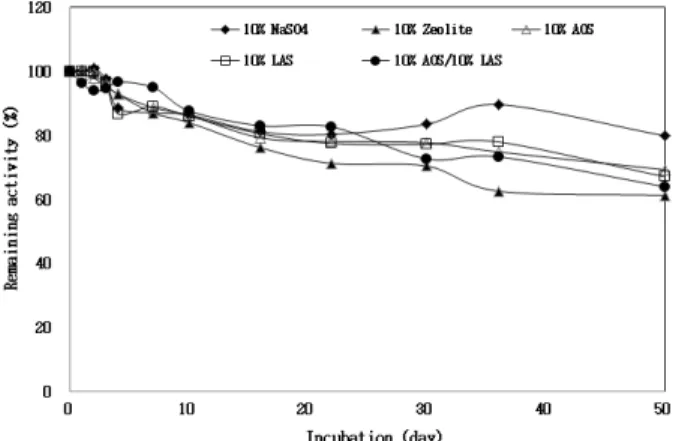
최종 농도가 10% (v/v) 되게 propylene glycol을 첨가한 후, 각 세제 성분들과 mixing 한 후 상온에서 일정한 시간 동 안 방치하고, 표준 효소 활성 측정 방법에 따라 잔류 효소 활성을 측정하였다. BCAP의 효소 활성은 10% (w/v) zeolite, 10% (w/v) sodium sulfate, 10% (v/v) linear alkylbenzene sulfonates (LAS)와 10% (v/v) α-orephin sulfonate (AOS)
를 처리한 후 상온에서 3일간 방치하였을 때, 효소 활성은 95% 이상을 유지하였으며, 30일 방치하여도 효소 활성은 80% 정도를 유지하고 있어 B. clausii transformant C5 유래 의 BCAP 효소는 세제 성분들에 매우 안정한 단백질 분해 효소임을 알 수 있었다 (Fig. 5). 또한, BCAP의 효소 활성은 현재 우리나라에서 상용화되어 있는 몇 가지 상용세제 (스 파크Ⓡ, 한스푼Ⓡ 등)를 최종 농도가 2.5% (w/v) 되게 처리한 후 상온에서 30일간 방치하여도 효소 활성은 거의 잃지 않 는 매우 안정한 단백질 분해효소임을 알 수 있었다 (Fig. 6).
현재, 세제 첨가용 단백질 분해효소의 세제 성분들에 대한 안정성을 증가시키기 위하여 효소를 granule에 encapsulation 한 형태로 첨가하고 있다. 이는 세제를 저장하는 동안 물리 적, 공간적으로 효소를 여러 가지 세제 성분들로부터 격리 시킴으로써 효소의 안정성을 증가시키는 효과를 가져 온다. 그러나, 효소가 granule로부터 해리된 후에는 음이온성 계면 활성제, 과산화수소수를 생성하게 하는 sodium perborate와 같은 산화제 및 여러 가지 세제 조성물 등에 안정성을 가져 야만 한다. 세제는 계면활성제, builder, co-builder, 표백제, 효소 및 추가 효능을 나타내기 위한 첨가제 등으로 구성되어 있다. 세제에 사용되는 가장 대표적인 음이온성 계면활성제 는 linear alkylbenzene sulfonates와 α-orephin sulfonate 이며, 일반적으로 단백질 분해효소의 안정성에 많은 영향을 주는 계면활성제로 알려져 있다 [52,53]. 계면활성제의 소 수성 부분은 oil 및 grease particles과 결합하여 micelles 내로 끌어 들이며 계면활성제의 친수성 부분은 물과 결합하 여 결과적으로 소수성 물질을 물에 녹여 주는 역할을 한다. Builder는 세제의 두 번째로 중요한 구성 성분으로, 낮은 농 도에서 물속에 존재하는 calcium 및 magnesium ion 등을 제거함으로써 계면활성제의 효능을 증진시켜 주는 역할을 한다. Zeolites는 고체 성분의 ion exchanger로서 이가 금속 이온과 결합하여 물을 부드럽게 해주는 역할을 하는 builder 로서 세제 첨가제 중에서 매우 중요한 성분으로써, 이는 phosphate-based 세제 사용에 의한 부영양화를 방지할 수 있 어 환경오염을 감소시키는 역할을 한다고 보고되어 있다 [56].
Sodium carbonate 또한 용액의 pH를 올리기 위하여 첨가 하는데, 이는 pH 상승에 의하여 zeolite의 효능을 올려 주는 역할을 한다. Sodium sulfate는 세제 성분들이 자유롭게 움직 이게 하는 역할을 하며, 세제의 부서지기 쉬운 성질을 개선 하며, 섬유에 세제의 현탁성을 개선하여 불순물이 섬유에 재 흡수를 억제하는 역할을 하는 것으로 보고되어 있다. 그 외, sodium perborate는 bleaching activator와 함께 약 35℃
정도의 낮은 온도에서 표백제 역할을 한다 [36,51,54,55].
이와 같이 세제에는 다양한 세제 성분들이 포함되어 있으며, 많은 단백질 분해효소들은 이러한 세제 성분에 대한 안정성 이 감소하는 것으로 알려져 있으며, 이러한 문제점을 극복 하기 위하여 alcohol ethoxyates 성분의 물질을 세제에 첨가 하여 줌으로써 단백질 분해효소의 안정성을 높여준다는 보고 가 있으며 [57], sucrose (0.5 M) 첨가에 의해서도 효소 활성 이 약 50% 정도 증가한다는 보고가 있다 [51]. 이상의 결과로 부터 B. clausii transformant C5 유래의 BCAP 효소는 세제 첨가제로서 사용할 수 있는 좋은 후보 효소임을 알 수 있었다.
Fig. 5. Effects of some detergent components on the protease activity of BCAP produced from B. clausii I-52 transformant C5.
Fig. 6. Effects of commercial detergents on the protease activity of BCAP produced from B. clausii I-52 transformant C5.
3.4. Washing performance
형질전환된 B. clausii transformant C5 유래의 단백질 분해 효소, BCAP의 세척 능력은 표준 시험 천 (EMPA test fabric), EMPA111 (cotton soiled with blood), EMPA116 (cotton soiled with blood/milk/ink) 및 EMPA117 (polyester/cotton soiled with blood/milk/ink) 등을 사용하여 측정하였다. 액 상 BCAP (최종 농도, 100 U/mL)과 효소를 포함하지 않은 detergent base 및 수돗물 200 mL을 세척기에 넣고 40℃에 서 150 rpm으로 10분 동안 세척하였을 때, 우유 또는 혈액 으로 오염시킨 EMPA test fabric으로 부터 효과적으로 단백 질을 제거하였다. BCAP은 현재 Novozymes사의 대표적 세제 첨가용 효소인 Savinase 16L EXⓇ와 비교하였을 때, 세 가지 test fabric에 대하여 거의 동등한 세척 능력을 나타 내었으며, Alcalase 2.5LⓇ와 비교하였을 때 세척 능력이 훨 씬 우수함을 알 수 있었다 (Fig. 7). B. clausii transformant C5 유래의 BCAP으로 과립형 효소를 제조하였으며, 건조한 과립효소로부터 단백질 분해효소를 추출한 후, 효소 활성을 측정한 결과 과립 1 g당 약 1,313,400 unit을 함유하고 있었 으며, 이는 Novozymes사의 Savinase 6TⓇ (약 1,524,500 U/g 과립)와 유사한 효소 활성을 나타내었고, 따라서 효율적으로 효소 과립을 제조하였음을 알 수 있었다. BCAP으로 제조한 과립형 단백질 분해효소 (최종 농도, 100 U/mL)와 세제에
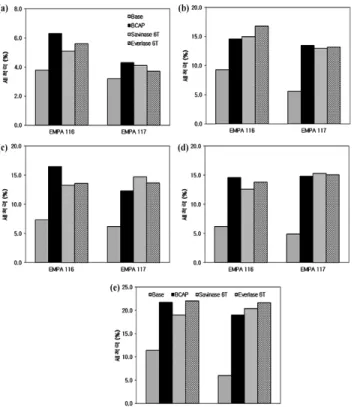
사용되는 여러 가지 계면활성제 성분 및 수돗물 200 mL 을 세척기에 넣고 40℃에서 150 rpm으로 10분 동안 세척 하여, 이들 성분들이 과립형 BCAP의 세척력에 미치는 영향을 조사하였을 때, 과립형 BCAP은 15% (v/v) LAS (Fig. 8(a)), 15% (v/v) AOS1416 (Fig. 8(b)), 15% (v/v) LA-9 (Fig. 8(c))와 같은 음이온성 계면활성제뿐만 아니라 15%
(v/v) SOFTANOL 90 (Fig. 8(d))과 같은 비이온성 계면활성 제의 존재 하에서도 뛰어난 세척 능력을 나타내었다. 이는 전 세계적으로 대표적인 세제 첨가제용 과립형 단백질 분해 효소로서 사용되고 있는 Savinase 6TⓇ 및 Everlase 6TⓇ (Novozymes사)와 동등한 세척 능력을 나타내는 것이고, 또 한, 음이온성 계면활성제 15% SLES5 (sodium lauryl ether sulfonate)와 표백제 (5% ethylene oxide)의 존재 하에서도 Savinase 6TⓇ 및 Everlase 6TⓇ와 유사한 세척 능력을 보이 는 것이다 (Fig. 8(e)). 과립형 BCAP의 보관 안정성을 측정 하기 위하여 각 과립형 효소를 상온에서 보관한 후, 일정한 시간 간격으로 시료를 취하여 EMPA117 test fabric으로 세척력을 측정한 결과, 상온에서 3주일 보관하여도 세척력 에는 큰 변화가 없었으며, 따라서 granule 내에서도 BCAP 은 매우 안정하게 효소 활성을 유지하는 것으로 보이며, Novozymes사의 Savinase 6TⓇ와도 비교해 볼 때 거의 유사 한 안정성을 나타내는 것으로 판단된다 (Fig. 9).
Fig. 7. Wash performance by BCAP solution produced from B.
clausii I-52 C5. Savinase 16L EXⓇ and Alcalase 2.5LⓇ were used as control protease solution manufactured by Novozymes (Denmark).
EMPA 111, EMPA 116 and EMPA 117 were used as the standard test fabrics. One test fabric was subjected in the laundry meter for 10 min with 150 rpm at 40℃ with the protease (100 U/mL) containing non-enzymatic detergent base in the tap water, and resulting reflectance was measured. All the experiments were performed in triplicate.
궁극적으로 B. clausii transformant C5 유래의 알칼리성 단백질 분해효소를 pilot-scale 발효를 통하여 대량 생산하는 방법 및 BCAP 효소의 안정화 방법을 확립하였다. 또한, 농 축한 BCAP 용액을 이용하여 과립효소를 제조하였으며, 전 세계적으로 세제 첨가제용 과립형 단백질 분해효소로써 대표 적으로 사용되고 있는 Savinase 6TⓇ 및 Everlase 6TⓇ와도 동등한 세척 능력 및 상온 보관 안정성을 나타내었다. 따라 서 이상의 결과로부터 판단할 때, B. clausii transformant C5 유래의 알칼리성 단백질 분해효소는 충분히 안정적으로 세제
첨가용 효소로서 사용할 수 있음을 보여 주는 것이다.
Fig. 8. Effects of anionic surfactants and bleaching agent on wash performances by the granulized BCAP produced from B. clausii I-52 C5. Savinase 6TⓇ and Everlase 6TⓇ were used as control granulized protease manufactured by Novozymes (Denmark).
EMPA 116 and EMPA 117 were used as the standard test fabrics.
One test fabric was subjected in the laundry meter for 10 min with 150 rpm at 30℃ with the protease (100 U/mL) in the presence of the surfactants, and resulting reflectance was measured. All the experiments were performed in triplicate. (a) in the presence of 15%
LAS (anionic surfactant); (b) 15% AOS1416 (anionic surfactant);
(c) 15% LA-9 (anionic surfactant); (d) 15% SOFTANOL 90 (non- ionic surfactant); (e) 15% SLES 5 (SDS + 5% ethylene oxide).
Fig. 9. Storage stability of the granulized BCAP. The wash performance was measured at regular time intervals as described in washing conditions using EMPA 117 test fabric with non-enzymatic detergent base. Savinase 6TⓇ was used as control granulized protease manufactured by Novozymes (Denmark). All the experiments were performed in triplicate.
4. 결론
산화제 및 계면활성제에 안정성을 갖는 알칼리성 단백질 분 해효소 (BCAP)를 분비하는 Bacillus clausii I-52부터 BCAP 유전자를 클로닝 한 후, 염색체 DNA에 integration하여 BCAP 의 발현을 증가시킨 B. clausii transformant C5를 제조하였 고, pilot-scale (500 L) 발효를 통하여 BCAP을 대량 생산하 여 세제 첨가제로서의 응용성을 조사하였다. Pilot-scale 발효 (500 L)를 통하여 B. clausii transformant C5를 배양하였을 때, BCAP 발현은 약 30시간 경과하였을 때 최대로 발현되 는 것으로 나타났다 (105,700 U/mL). BCAP 효소 용액에 polyol의 첨가는 단백질 분해효소의 열 안정성뿐만 아니라 산화제 및 계면활성제에 대한 안정성도 증가시켰으며, polyol 들 중에서 propylene glycol을 첨가하였을 때 가장 높은 보 호 효과를 나타내었다. Propylene glycol을 첨가한 BCAP은 zeolite, linear alkylbenzene sulfonates 및 α-orephin sulfonate 등과 같은 세제 성분들 (10%, v/v) 뿐만 아니라, 상용 세제 (2.5%, w/v)들에 대한 안정성 또한 매우 높은 것으로 나타났 다. BCAP 효소 용액을 과립 효소로 제조한 후, EMPA116 및 EMPA117 test fabric을 사용하여 세척력 시험을 진행한 결과, BCAP 과립효소는 비이온성 계면활성제, 음이온성 계면활성제 및 산화제가 동시에 존재하는 조건에서도 세 척력이 우수하였으며, 대조군으로 사용한 Novozymes사의 Savinase 6TⓇ 및 Everlase 6TⓇ와 동등한 세척력을 나타내 었다. 또한 BCAP 과립 효소의 상온 보관 안정성을 측정한 결과, 상온에서 3주일 동안 보관하여도 세척력에는 큰 변화 가 없었으며 Novozymes사의 Savinase 6TⓇ와 유사한 안정 성을 나타내었다. 이상의 결과로부터, B. clausii transformant C5 유래의 BCAP은 세제 첨가제로써 아주 유용하게 사용할 수 있을 것으로 사료된다.
References
1. Layman, P. L. (1986) Industrial enzymes: battling to remain specialties. Chem. Engineer. News 64: 11-14.
2. Kumar, C. G. and H. Takagi (1999) Microbial alkaline proteases:
from a bioindustrial viewpoint. Biotechnol. Adv. 17: 561-594.
3. Kirk, O., T. V. Borchert, and C. C. Fuglsang (2002) Industrial enzyme applications. Curr. Opin. Biotechnol. 13: 345-351.
4. Samal, B. B., B. Karan, and Y. Stabinsky (1990) Stability of two novel serine proteinases in commercial laundry detergent formulations. Biotechnol. Bioeng. 28: 609-612.
5. Phadatare, S. U., V. V. Deshpande, and M. C. Srinvasan (1993) High activity alkaline protease from Conidiobolus coronatus (NCL 86.8.20): enzyme production and compatibility with commercial detergents. Enz. Microb. Technol. 15: 72-76.
6. Tunlid, A., S. Rosen, B. Ek, and L. Rask (1994) Purification and characterization of an extracellular serine protease from the nematode-trapping fungus Arthrobotrys oligospora. Microbiol.
140: 1687-1695.
7. Jacobs, M. F. (1995) Expression of the subtilisin carlsberg- encoding gene in Bacillus licheniformis and Bacillus subtilis.
Gene 152: 67-74.
8. Ito, S., T. Kobayashi, K. Ara, K. Ozaki, S. Kawai, and Y. Hatada (1998) Alkaline detergent enzymes from alkaliphiles: enzymatic properties, genetics, and structures. Extremophiles 2: 185-190 9. Manachini, P. L. and M. G. Fortina (1998) Production in sea-water
of thermostable alkaline proteases by a halotolerant strain of Bacillus licheniformis. Biotechnol. Lett. 20: 565-568.
10. Banerjee, U. C., R. K. Sani, W. Azmi, and R. Soni (1999) Thermostable alkaline protease from Bacillus brevis and its characterization as a laundry detergent additive. Process Biochem. 35: 213-219.
11. Yang, J. K., I. L. Shih, Y. M. Tzeng, and S. L. Wang (2000) Production and purification of protease from a Bacillus subtilis that can deproteinize crustacean wastes. Enz. Microb. Technol.
26: 406-413.
12. Joo, H. S., C. G. Kumar, G. C. Park, S. R. Paik, and C. S. Chang (2002) Optimization of the production of an extracellular alkaline protease from Bacillus horikoshii. Process Biochem. 38: 155-159.
13. Joo, H. S., C. G. Kumar, G. C. Park, S. R. Paik, and C. S. Chang (2003) Oxidant and SDS-stable alkaline protease from Bacillus clausii I-52: production and some properties. J. Appl. Microbiol.
95: 267-272.
14. Joo, H. S., C. G. Kumar, G. C. Park, S. R. Paik, and C. S. Chang (2004) Bleach-resistant alkaline protease produced by a Bacillus sp. isolated from the Korean polychaeta, Periserrula leucophryna.
Process Biochem. 39: 1441-1447.
15. Maurer, K. H. (2004) Detergent proteases. Curr. Opin. Biotechnol.
15: 330-334.
16. Joo, H. S. and C. S. Chang (2005a) Production of protease from a new alkalophilic Bacilus sp. I-312 grown on soybean meal: optimization and some properties. Process Biochem.
40: 1263-1270
17. Gessesse, A. (1997) The use of nug meal as low-cost substrate for the production of alkaline protease by the alkaliphilic Bacillus sp. AR-009 and some properties of the enzyme.
Bioresour. Technol. 62: 59-61.
18. Rao, M. B., A. M. Tanksale, M. S. Ghatge, and V. V. Deshpande (1998) Molecular and biotechnological aspects of microbial proteases. Microbiol. Mol. Biol. Rev. 62: 597-635.
19. Horikoshii, K. (1999) Alkalophiles: some applications of their products for biotechnology. Microbiol. Mol. Biol. Rev. 63: 735-750 20. Kumar, C. G., M. P. Tiwari, and K. D. Jany (1999) Novel alkaline serine proteases from alkalophilic Bacillus sp.: purification and characterization. Process Biochem. 34: 441-449.
21. Saeki, K., K. Ozaki, T. Kobayashi, and S. Ito (2007) Detergent alkaline proteases: enzymatic properties, genes, and crystal structures. J. Biosci. Bioeng. 103: 501-508.
22. Johnvesly, B. and G. R. Naik (2001) Studies on production of thermostable alkaline protease from thermophilic and alkaliphilic Bacillus sp. JB-99 in a chemically defined medium. Process Biochem. 37: 139-144.
23. Uyar, F. and Z. Baysal (2004) Production and optimization of process parameters for alkaline protease production by a newly isolated Bacillus sp. under solid state fermentation. Process Biochem. 39: 1893-1898.
24. Haddar, A., N. Fakhfakh-Zouari, N. Hmidet, F. Frikha, M. Nasri, and A. S. Kamoun (2010) Low-cost fermentation medium for alkaline protease production by Bacillus mojavensis A21 using hulled grain of wheat and sardinella peptone. J. Biosci.
Bioengineer. 110: 288-294.
25. Hameed, A., T. Keshavarz, and C. S. Evans (1999) Effect of dissolved oxygen tension and pH on the production of
extracellular protease from a new isolate of Bacillus subtilis K2, for use in leather processing. J. Chem. Technol. Biotechnol.
74: 5-8.
26. Christiansen, T. and J. Nielsen (2002) Production of extracellular protease and glucose uptake in Bacillus clausii in steady-state transient continuous cultures. J. Biotechnol. 97: 265-273.
27. Calik, P., E. Celik, E. T. Ilkin, C. Oktar, and E. Ozdemir (2003) Protein-based complex medium design for recombinant serine alkaline protease production. Enz. Microb. Technol. 33: 975-986.
28. Ramnani, P. and R. Gupta (2004) Optimization of medium composition for keratinase production by Bacillus licheniformis RG1 using statistical methods involving response surface methodology. Biotechnol. Appl. Biochem. 40: 191-196 29. Rai, S. K. and A. K. Mukherjee (2010) Statistical optimization
of production, purification and industrial application of a laundry detergent and organic solvent-stable subtilisin-like serine protease (Alzwiprase) from Bacillus subtilis DM-04. Biochem. Eng. J.
48: 173-180.
30. Gupta, R., Q. K. Beg, S. Khan, and B. Chauhan (2002) An overview on fermentation, downstream processing and properties of microbial alkaline proteases. Appl. Microbiol. Biotechnol.
60: 381-395.
31. Bryan, P. N. (2000) Protein engineering of subtilisin. Biochim.
Biophys. Acta. 1543: 203-222.
32. Estell, D. D., T. P. Graycar, and J. A. Wells (1985) Engineering an enzyme by site-directed mutagenesis to be resistant to chemical oxidation. J. Biol. Chem. 260: 6518-6521.
33. Ness, J. E., M. Welch, L. Giver, M. Bueno, J. R. Cherry, T. V, Borchert, W. P. C. Stemmer, and J. Minshull (1999) DNA shuffling of subgenomic sequences of subtilisin. Nat. Biotechnol.
17: 893-896.
34. Davis, B. G., K. Khumtaveeporn, R. R. Bott, and J. B. Jones (1999) Altering the specificity of subtilisin Bacillus lentus through the introduction of positive charge at single amino acid sites. Bioorg. Med. Chem. 7: 2303-2311.
35. Bhosale, S. H., M. B. Rao, V. V. Deshpande, and M. C. Srinivasan (1995) Thermostability of high activity alkaline protease from Conidiobolus coronatus (NCL 86.8.20). Enz. Microb. Technol.
17: 136-139.
36. Becker, T., G. Park, and A. L. Gaertner (1997) Formulating of detergent enzymes. Surfactant Sci. Ser. 69: 299-325.
37. Kumar, C. G., R. K., Malik, and M. P. Tiwari (1998) Novel enzyme-based detergents: an Indian perspective. Curr. Sci. 75:
1312-1318.
38. Joo, H. S., Y. M. Koo, J. W. Choi, and C. S. Chang (2005) Stabilization method of an alkaline protease from inactivation by heat, SDS and hydrogen peroxide. Enz. Microb. Technol.
36: 766-772.
39. Joo, H. S. and C. S. Chang (2005b) Oxidant and SDS-stable alkaline protease from a halo-tolerant Bacillus clausii I-52:
enhanced production and simple purification. J. Appl. Microbiol.
98: 491-497.
40. Joo, H. S. and C. S. Chang (2006) Production of an oxidant and SDS-stable alkaline protease from an alkaophilic Bacillus clausii I-52 by submerged fermentation: feasibility as a laundry detergent
additive. Enz. Microb. Technol. 38: 176-183.
41. Joo, H. S. and J. W. Choi (2011) Cloning and expression of a alkaline protease from Bacillus clausii I-52. J. Agri. Life Sci.
45: 201-212.
42. Joo, H. S., D. C. Park, and J. W. Choi (2012) Increased production of an alkaline protease from Bacillus clausii I-52 by chromosomal integration. J. Agri. Life Sci. 46: 163-176.
43. Gonzalez, G., C. Gonzalez, and P. Merino (1992) Thermotabilization of Cucurbita ficifolia protease in the presence of additives.
Biotechnol. Lett. 14: 919-924.
44. Han, X. Q. and S. Damodran (1997) Stability of protease Q against autolysis and in sodium dodecyl sulfate and urea solutions. Biochem. Biophys. Res. Comm. 240: 839-843.
45. Otzen, D. E. (2002) Protein unfolding in detergents: effect of micelle structure, ionic strength, pH, and temperature. Biophys.
J. 83: 2219-2230.
46. Siezen, R. J. and J. A. M. Leunissen (1997) Subtilases: the superfamily of subtilisin like serine proteases. Protein Sci.
6: 501-523.
47. Kembhavi, A. A., A. Kulkarni, and A. Pant (1993) Salt-tolerant and thermostable alkaline protease from Bacillus subtilis NCIM No. 64. Appl. Biochem. Biotechnol. 38: 83-92.
48. Lee, S. and D. J. Jang (2001) Progressive rearrangement of subtilisin carlsberg into orderly and inflexible conformation with Ca2+ binding. Biophys. J. 81: 2972-2978.
49. Ghorbel, B., A. Sellami-Kamoun, and M. Nasri (2003) Stability studies of protease from Bacillus cereus BG1. Enz. Microbial Technol. 32: 513-518.
50. Hajji, M., S. Kanoun, M. Nasri, and N. Gharsallah (2007) Purification and characterization of an alkaline serine-protease produced by a new isolated Aspergillus clavatus ES1. Process Biochem. 42: 791-797.
51. Stoner, M. R., D. A. Dale, P. J. Gualfetti, T. Becker, M. C.
Manning, and J. F. Carpenter (2004) Protease autolysis in heavy- duty liquid detergent formulations: effect of thermodynamic stabilizers and protease inhibitors. Enz. Microb. Technol. 34:
114-125.
52. Kravetz, L. and K. F. Guin (1985) Effect of surfactant structure on stability of enzymes formulated into laundry liquids. J. Am.
Oil Chem. Soc. 62: 943-949.
53. Lalonde, J., E. J. Witte, and M. L. Oconnell (1995) Protease stabilization by highly concentrated anionic surfactant mixtures.
J. Am. Oil Chem. Soc. 52: 53-59.
54. Kotomin, A. A., M. B. Petelskii, A. A. Abramzon, A. E. Punin, and O. D. Yakimchuk (2001) Optimization of the component concentrations in solutions of synthetic detergents. Russ. J. Appl.
Chem. 74: 2038-2042.
55. Kumar, D., S. N. Thakur, R. Verma, and T. C. Bhalla (2008) Microbial proteases and application as laundry detergent additive.
Res. J. Microbiol. 3: 661-672.
56. Sekhon, B. S. and M. K. Sangha (2004) Detergents-zeolites and enzymes excel cleaning power. Resonance 9: 35-45.
57. Russell, G. L. and L. M. Britton (2002) Use of certain alcohol ethoxyates to maintain protease stability in the presence of anionic surfactants. J. Surfact. Detergent 5: 5-10.