Copyright ⓒ 2012, The Microbiological Society of Korea
재래식 된장에서 분리된 Bacillus licheniformis의 내열성 Protease 특성과 생산성
배영은․윤기홍*
우송대학교 식품생물과학과
Production and Characterization of Thermostable Protease from Bacillus licheniformis Isolated from Korean Traditional Soybean Paste
Young Eun Bae and Ki-Hong Yoon*
Department of Food Science & Biotechnology, Woosong University, Daejeon 300-718, Republic of Korea (Received October 16, 2012 / Accepted November 16, 2012)
Among 63 Bacillus strains grown at 60℃ from sixteen samples of homemade Korean soybean paste, one strain was selected for producing the thermostable protease. The isolate has been identified as Bacillus licheniformis on the basis of its 16S rDNA sequence, morphology and biochemical properties. Culture filtrate of the isolate showed maximal protease activity at the reaction condition of 60–65℃ and pH 11. The culture filtrate retained more than 87% of initial protease activity after incubation for 30 min at 60℃ without substrate. In order to develop the medium composition, effects of ingredients including nitrogen sources, carbon sources, metal ions and phosphate were examined for protease production of the isolate. Lactose and soytone peptone were the most effective carbon and nitrogen source for the enzyme production. After the late logarithmic growth phase the isolate began to produce the protease, and the maximum protease productivity was reached to 550 unit/ml in the optimized medium consisting of lactose (3%), soytone peptone (1.5%), MgSO4 (0.1%), K2HPO4 (0.03%), and KH2PO4 (0.03%) at 28 h of incubation.
Keywords: Bacillus licheniformis, properties, protease productivity, soybean paste
*For correspondence. E-mail: [email protected]; Tel.: +82-42-630-9742;
Fax: +82-42-636-2676
Protease는 동물, 식물과 미생물을 포함하는 모든 생물에서 생 산되며 세제, 식품, 농약, 제약, 피혁, 섬유, 사료산업 등에 널리 이용 되고 있는 산업용 효소이다. Protease를 생산하는 미생물이 다수 보 고되었으나, Bacillus속 균주가 산업적 생산을 위해 사용되고 있다 (Gupta et al., 2002). 특히 serine protease에 속하는 알칼리성 protease 는 효소 시장에서 차지하는 비중이 높으며 B. licheniformis가 생 산하는 Subtilisin Carlsberg와 B. amyloliquefaciens가 생산하는 Subtilisin Novo가 잘 알려져 있다(Horikoshi, 1990). 알칼리성 protease 생산균으로 여러 종류의 B. licheniformis가 분리가 되 었으며(Hadj-Ali et al., 2007; Sellami-Kamoun et al., 2008), 이 외에도 B. cereus (Prakash et al., 2005; Nilegaonkar et al., 2007), B. mojavensis (Haddar et al., 2010)와 B. pseudofirmus (Bang and Jeong, 2011) 등이 보고되었다. 산업용 효소로 이용되기 위 해서는 열안정성이 매우 중요한 요소이므로 내열성이 있으면서 알칼리성 protease를 생산하는 Bacillus sp. JB-99 (Johnvesly and Naik, 2001), B. licheniformis YP1A (Li et al., 2009), Bacillus
sp. B001 (Deng et al., 2010), Bacillus sp. APR-4 (Kumar and Bhalla, 2004), B. alcalophilus (Kanekar et al., 2002)와 B.
pumilus MK6-5 (Kumar, 2002)가 분리되었으며, 알칼리성은 아니 지만 내열성이 있는 protease 생산균 B. licheniformis LBBL-11 (Juyigbe and Ajele, 2008), B. subtilis Rand (Abusham et al., 2009), B. stearothermophilus TLS33 (Sookkheo et al., 2000)과 B. stearothermophilus HY-69 (Sun et al., 1999)가 보고되었다.
특히 B. stearothermophilus TLS33는 3종류의 내열성 proteases 를 균체외로 생산하며 이들은 각기 다른 온도와 pH에서 최대활 성을 보이고 Bacillus속의 다른 균주 유래 protease에 비해 내열 성이 매우 우수한 것으로 알려졌다. 한편 낫또 또는 아프리카 발 효식품인 iru로부터 protease 생산균으로 분리된 Bacillus속 균 주는 새우 양식을 위한 생균제(Liu et al., 2009)나 발효 종균으 로의 가능성이 제시된 바 있다(Juyigbe and Ajele, 2008).
Protease의 산업적 이용을 위해서는 생산단가를 낮추는 것이 중요하므로 이를 위해 탄소원, 질소원 및 무기염류를 포함하는 배지조성과 접종량, 배양액 pH, 배양온도, 배양시간 및 교반속도 등의 배양조건을 최적화하여 Bacillus sp. JB-99 (Johnvesly and Naik, 2001), B. cereus MCM B-326 (Nilegaonkar et al., 2007),
B. aquimaris VITP4 (Shivanand and Jayaraman, 2009), B.
subtilis Rand (Abusham et al., 2009)의 protease 생산성을 높이 거나 폐수처리 고형물, 농축산부산물과 같은 저가의 배지원료를 사용하여 B. licheniformis NH1 (Hmidet et al., 2010)와 B.
mojavensis A21 (Haddar et al., 2010)로부터 protease를 생산하 였다. 한편 B. licheniformis ATCC 21415는 옥수수유를 계면활 성제로 첨가하였을 때 protease 생산성이 증가되는 것으로 보고 되었다(Mabrouk et al., 1999).
국내외에서 콩을 발효한 식품으로부터 protease를 생산하는 Bacillus속 균주가 분리되었으며 이들의 protease 기능은 casein 분해능 뿐 아니라 케라틴 분해능, 혈전 용해능, 젤라틴 분해능과 같은 다양한 기능을 갖는 것으로 보고되었다(Lee et al., 2001;
Kim et al., 2003). 본 연구에서는 된장에서 분리된 Bacillus속 균 주를 대상으로 내열성이 있는 protease 생산균을 탐색하고 분리 균이 생산하는 효소의 반응특성과 효소 생산성에 미치는 배지성 분의 영향을 검토하였다.
재료 및 방법
배지와 시약
Protease 생산균으로는 가정에서 제조된 된장으로부터 분리 한 B. licheiformis YB-1205 균주를 사용하였으며, protease 활 성측정을 위한 기질로 사용된 Hammarsten casein은 Merck 회 사로부터 구입하였고, L-tyrosine, trichloroacetic acid (TCA), sodium carbonate, anhydrous sodium acetate, acetic acid와 Folin-Ciocalteus phenol은 Sigma 회사 제품을 사용하였다.
분리균의 동정
분리균의 형태를 관찰하기 위해 그람염색과 포자염색을 실시 하였고, 생화학적 특성을 조사하기 위해서는 제조사의 지침을 따 라 배양균체 현탁액을 API 20E와 API 50 CHB kit (bioMéreux사, France)에 접종하고 37℃에서 2일간 배양하면서 탄수화물 이용 능과 생화학적 특성을 판별하였다. 분리균의 16S rRNA 유전자 염기서열을 분석하기 위해서 분리균의 총 염색체 DNA를 주형 으로 하고, 세균의 16S rRNA 유전자의 보존적 지역의 염기서열 을 갖는 upper primer (5′-AGAGTTTGATCCTGGCTCAG-3′) 와 lower primer (5′-GGTTACCTTGTTACGACTT-3′)를 사용 하여 중합효소 연쇄반응(PCR)을 실시하였다. PCR 산물을 정제 하여 ABI PRISM BigDye terminator cycle sequencing kit와 373A automatic DNA sequencer (Perkin Elmer Co., USA)를 사용하여 염기서열을 결정하고 이를 NCBI database와 비교하였다.
Protease 활성측정
Protease 활성을 측정하기 위해 Hammarsten casein (0.6%) 2.5 ml, 0.2 M sodium phosphate 완충액(pH 7.5) 0.3 ml을 혼합 하여 55℃에서 10분간 예열한 후 분리균의 배양상등액을 0.2 ml 첨가하여 30분간 효소반응을 실시하였다. 반응액에 2.5 ml의 TCA 용액(18 g TCA, 18.1 g anhydrous sodium acetate, 18.8 g acetic acid per L)을 첨가하여 혼합함으로써 반응을 중지시키고
40℃에서 30분간 방치한 후 실온에서 10분간 원심분리하였다.
원심분리된 상등액을 1 ml 취하여 시험관에 옮기고 0.55 M Na2CO3 (2.5 ml)과 증류수로 2배 희석된 Folin-Ciocalteus phenol 시약(0.5 ml)을 첨가하여 교반한 후 40℃에서 30분간 방 치하였다. 이를 실온에서 일정시간 방치하여 식힌 후 660 nm의 파장에서 흡광도를 측정하였다. Protease 활성 1 unit는 반응시 간 1분 동안 1 μg tyrosine을 생성하는 효소량으로 정의하였다.
Protease 반응특성 분석
Protease 활성에 미치는 반응 온도와 pH의 영향을 조사하기 위하여 30–70℃와 pH 5.0–12.0의 범위에서 protease 활성을 각 각 측정하였다. 이때 citrate (pH 5.0–6.0), phosphate (pH 6.0–
8.0), Tris (pH 8.0–9.0), KCl-borate (pH 9.0–10.0), Na₂CO₃ -NaOH (pH 10.0–11.0), Na₂HPO₄-NaOH (pH 11.0–12.0) 완충 용액이 각각 사용되었다. 내열성을 조사하기 위해서는 배양상등 액을 30–65℃의 범위온도에 30분간 방치한 후 protease의 잔존 활성을 결정하였다.
Protease 생산성 분석
분리균의 protease 생산성에 미치는 배지성분의 영향을 조사 하기 위해서는 탄소원, 질소원, 인, 무기금속이온의 종류와 첨가 량을 달리하고 pH 7.2로 조절한 본 배양 배지에 LB 배지에서 하 룻밤 전 배양된 균액을 1% (v/v)가 되도록 접종한 후 37℃에서 25시간 동안 200 rpm으로 진탕배양 하였다. 배양용기는 baffled flask를 사용하였으며 배양액의 부피가 배양용기의 15% 이내가 되도록 하여 배양하였다. 배양액을 원심분리한 후 배양상등액을 조효소액으로 사용하여 protease 활성을 측정함으로써 protease 생산성을 조사하였다.
결과 및 고찰
재래식 된장으로부터 내열성 protease 생산균의 분리 가정에서 제조된 된장을 생리식염수로 현탁하여 적정량 희석 하고 LB 평판배지에 도말한 후 60℃에서 하룻밤 배양함으로써 된장 시료별로 콜로니 모양이 다른 균주를 2–7주씩 선발하였다.
내열성 protease 생산균을 탐색하기 위해 총 16점의 된장 시료로 부터 얻은 63주를 동일배지에 접종하여 37℃에서 24–25시간 진 탕 배양한 후 배양상등액을 65℃에서 30분간 열처리하였다.
Skim milk (1.5%), 20 mM sodium phosphate (pH 7.0)와 agar (1.5%)를 함유한 반응평판에 구멍을 내고 열처리 전후의 배양상 등액을 넣고 55℃에서 4시간 반응하여 skim milk의 분해환을 비 교하였다. 대부분의 배양상등액은 열처리 후 protease 활성이 거 의 관찰되지 않았으나, 분리균 YB-1205의 배양상등액에서는 열 처리 후에도 protease 활성이 상당량 탐지되었다.
분리균 YB-1205는 포자를 형성하는 그람양성 간균으로 확인 되었으며, API 50CHB와 20E kit를 사용하여 생화학적 특성을 조사한 결과 B. licheniformis와 유사도가 99.9%로 일치하였다 (결과 미제시). 또한 16S rRNA 유전자를 PCR로 증폭하여 1,457 bp 염기서열을 결정하였으며(GenBank accession no.
(A)
(B)
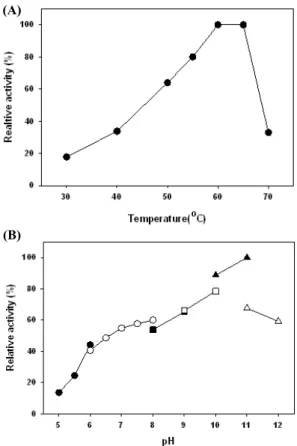
Fig. 1. Effects of reaction temperature (A) and pH (B) on the protease activity. Temperature profile was obtained by measuring the protease activities at pH 7.5 and different temperatures. The pH profile was obtained by measuring the protease activities at various pH’s and at a constant temperature of 55℃. Buffers (50 mM) used were as follows:
sodium citrate (pH 5–6; -●-), sodium phosphate (pH 6–8; -○-), Tris (pH 8–9; -■-), KCl-borate (pH 9–10, -□-), and Na2CO3-NaOH (pH 10–11, -▲-), and Na2HPO4-NaOH (pH 11–12, -△-).
Temperature (oC)
0 10 20 30 40 50 60 70
Residual relative activity (%)
0 20 40 60 80 100
Fig. 2. Thermostability of protease in the culture filtrate of B.
lichemiformis YB-1205. Thermostability was determined by measuring the residual activities after pre-incubation at different temperatures for 30 min.
JX901378) 이를 미국 NCBI의 BLAST 검색방법을 사용하여 기 존에 등록된 세균들의 상응하는 염기서열과 비교한 결과 YB-1205는 B. licheniformis Pb-WC09001 (HM006901)과 MS 5-14 (EU718490)와 한 개의 염기만이 달랐다. 따라서 분리균 YB-1205는 형태적, 생화학적 특성 및 16S rDNA 염기서열의 결 과로 볼 때 B. licheniformis로 판단되었다.
B. licheniformis 배양상등액의 protease 반응특성
B. licheniformis YB-1205를 LB 액상배지에 접종하여 37℃
에서 약 25시간 배양 후 배양상등액을 회수하여 반응액의 pH와 반응온도를 달리하면서 효소활성을 측정하였다. 그 결과 pH 11 과 60–65℃의 범위에서 최대 효소활성을 보였다(Fig. 1). 이러한 반응특성은 Bacillus sp. JB-99 (pH 11, 70℃) (Johnvesly and Naik, 2001), B. licheniformis (pH 10–11, 65–70℃) (Hadj-Ali et al., 2007), B. licheniformis RP1 (pH 10–11, 65–70℃) (Sellami-Kamoun et al., 2008), B. licheniformis NH1 (pH 10, 70℃) (Hmidet et al., 2009), B. licheniformis YP1A (pH 9.5, 60℃) (Li et al., 2009)와 Bacillus sp. B001 (pH 10, 60℃)
(Deng et al., 2010) 등이 생산하는 효소와 유사하였다. 그러나 B. licheniformis LBBL-11 (pH 8, 60℃) (Juyigbe and Ajele, 2008)과 B. pseudofirmus HS-54 (pH 10, 50℃) (Bang and Jeong, 2011) 등이 생산하는 proteases와는 차이가 있었다. 한편 버팔로 가죽에서 분리된 B. cereus MCM B-326은 pH 9.0과 pH 10.6에서 최대활성을 갖는 알칼리 protease를 2종 생산하는 것으 로 추정되고 있다(Nilegaonkar et al., 2007).
열에 대한 안정성을 조사하기 위해 배양상등액을 여러 온도 에서 30분간 방치한 후 잔존활성을 측정한 결과 50℃ 이하에서 는 거의 실활되지 않았으며, 60℃에서는 87% 이상 활성이 잔존 하였으나 65℃에서는 34% 정도가 잔존하였다(Fig. 2). 이러한 열안정성 수준은 B. licheniformis LBBL-11 (Juyigbe and Ajele, 2008)과 B. licheniformis YP1A (Li et al., 2009)의 효소에 비해 서는 낮으며, 60℃와 70℃에서 반감기가 각각 60분과 5분으로 보고된 B. licheniformis NH1의 protease와 60℃에서 60분 방치 시 잔존활성이 45% 수준으로 유지되는 B. licheniformis RP1의 protease 등(Sellami-Kamoun et al., 2008; Hmidet et al., 2009) 과는 유사하거나 높은 수준으로 판단된다. 한편 고온성 혐기성 균인 Thermoanaerobacter tengcongensis의 protease는 내열성 이 매우 우수하여 60℃에서 4시간 동안 방치한 후에 90% 이상 의 잔존활성을 보였고, 70℃에서 반감기가 4시간 이상인 것으로 보고된 바 있다(Koma et al., 2007).
탄소원과 질소원이 B. licheniformis의 protease 생산에 미치는 영향 Protease는 배지내 탄소원과 질소원의 성분에 따라 그 생산량 에 차이가 크며, Bacillus속 균주에 따라서 이들 배지성분이 protease 생산성에 미치는 영향이 다르다. 탄소원이 분리균의 protease 생산에 미치는 영향을 조사하기 위해 yeast extract (5 g/L), K2HPO4 (0.1 g/L), KH2PO4 (0.1 g/L)와 CaCl2 (1 g/L)외에 탄소원으로 포도당, 자당, 엿당, 유당과 가용성 전분을 각각 1%
(w/v)씩 달리 첨가하여 배지를 제조한 후, LB 배지에서 하룻밤 진탕배양된 균액을 접종하고 37℃에서 24–25시간동안 진탕 배 양한 후 배양상등액에 존재하는 protease 활성과 균의 성장을 측
Carbon sources (1%)
Growth (OD600)
Protease productivity (U/ml)
Nitrogen sources (0.5%)
Growth (OD600)
Protease productivity (U/ml)
None 2.0 12.0 Ammonium sulfate 1.8 2.3
Glucose 2.9 4.1 Casein 1.9 1.9
Maltose 3.3 8.8 Bacto peptone 1.1 3.0
Lactose 2.1 52.5 Tryptone 1.5 2.0
Sucrose 2.6 2.1 Soytone peptone 4.8 181.0
Soluble starch 3.0 3.4 Yeast extract 3.1 52.3
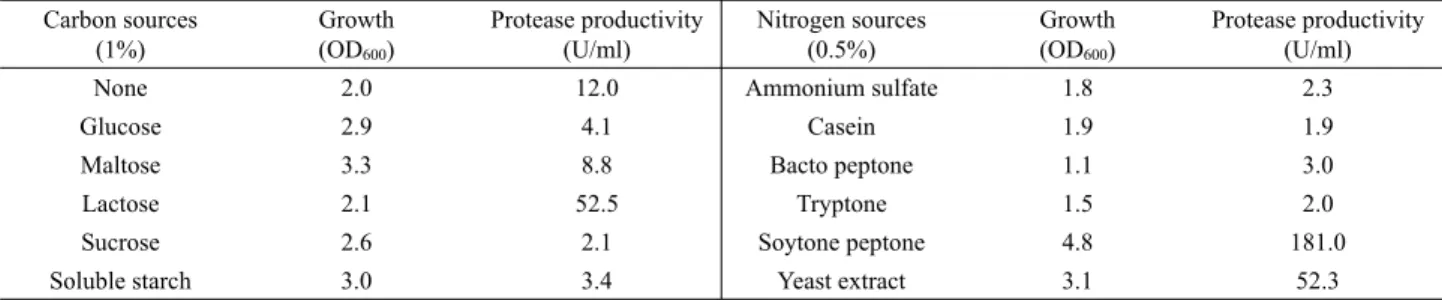
Table 1. Growth and protease productivity according to the kinds of carbon or nitrogen sources
Lactose amount (%)
Growth (OD600)
Protease productivity (U/ml)
Soytone peptone amount (%)
Growth (OD600)
Protease productivity (U/ml)
0 4.8 152 0.5 2.3 113
0.3 3.5 176 1.0 3.7 169
0.5 3.8 182 1.5 4.8 200
1.0 4.2 204 2.0 6.1 195
1.5 4.2 199 2.5 7.4 178
2.0 4.2 198 3.0 7.6 166
2.5 4.0 194 3.5 8.0 125
3.0 4.5 226 4.0 8.9 82
Table 2. Growth and protease productivity according to the amount of carbon or nitrogen sources 정하였다. 그 결과 Table 1에 보인 바와 같이 유당을 첨가한 배지
에서는 효소 생산성이 증가 되었으나 포도당을 비롯한 다른 탄 소원을 첨가한 배지에서는 생산성이 억제되었다.
포도당이 protease의 생산성을 억제하는 경우는 Bacillus sp.
JB-99 (Johnvesly and Naik, 2001), Bacillus sp. SH-8 (Yoon et al., 2006), B. licheniformis (Hmidet et al., 2010; Yoon and Shin, 2010), B. aquimaris VITP4 (Shivanand and Jayaraman, 2009)에서 이미 보고된 바 있다. B. amyloliquefaciens D4-7에서 도 포도당 또는 자당이 첨가된 배지에서 혈전용해 효소 생산성 이 저하된 것으로 알려졌다(Kim et al., 2003). B. mojavensis A21 (Haddar et al., 2010)는 포도당 뿐 아니라 자당, 엿당 또는 유당을 첨가한 배지에서 protease 생산성이 저하되었으나, 특이 하게 B. licheniformis ATCC 21415는 유당(4%)과 포도당 (1.5%)을 동시에 첨가한 배지에서 protease 생산성이 증가하였 다(Mabrouk et al., 1999). B. licheniformis NH1은 포도당, 자당 과 엿당에 의해 모두 효소 생산성이 감소되는 것으로 알려져 있 어 분리균과 유사한 특성을 보였다(Hadj-Ali et al., 2007).
질소원의 종류가 효소 생산성에 미치는 영향을 조사하기 위 해서 유당(1%)을 첨가한 배지에 질소원을 제외한 성분(K2HPO4, KH2PO4, CaCl2)은 앞과 동일한 조성으로 하고 ammonium sulfate, casein, tryptone, bacto peptone, soytone peptone과 yeast extract 를 각각 0.5%씩 배지에 첨가하여 동일한 배양조건에서 배양하 였다. 배양상등액에 존재하는 protease의 활성을 측정한 결과 yeast extract를 첨가한 배지보다는 soytone peptone을 첨가한 배 지에서 균의 성장과 protease 생산성이 높아졌으며, 이외의 질소 원을 첨가한 배지에서는 균의 성장과 효소 생산성은 모두 낮은
것으로 확인되었다(Table 1). 분리균이 된장에서 유래되었다는 점을 감안하면 soytone peptone에 의해 protease 생산성이 증가된 것으로 보아 분리균이 된장 발효시 protease 생산이 우수할 것으로 판단된다. 한편 B. mojavensis A21는 sardinella peptone (Haddar et al., 2010), B. aquimaris VITP4는 yeast extract와 peptone 혼 합물(Shivanand and Jayaraman, 2009), B. cereus MCM B-326 는 대두분이 각각 질소원으로 배지에 첨가되었을 때 효소 생산 성이 증가되었다(Nilegaonkar et al., 2007). 또한 protease 생산 성에 미치는 탄소원의 영향이 분리균 YB-1205와 유사한 것으로 보고된 B. licheniformis NH1은 yeast extract 뿐 아니라 casein에 의해서도 효소 생산성이 증가하였으나(Hadj-Ali et al., 2007), 이 와 달리 분리균 YB-1205는 casein을 질소원으로 사용하였을 때 효소 생산성이 매우 낮았다.
질소원으로 soytone peptone (1%)을 첨가한 배지에서 유당의 첨가량을 달리한 배지에서 배양한 결과 Table 2에 보인 바와 같 이 유당을 첨가하지 않은 배지에서 보다 유당을 첨가하였을 때 효소 생산성은 높았으며 유당을 3% 첨가한 배지에서 효소 생산 성이 우수하였다. 따라서 유당(3%)과 soytone peptone의 첨가량을 달리한 배지에서 효소 생산성을 조사한 결과 soytone peptone의 첨가량이 많을수록 균의 성장은 우수하였으나 2% 이상을 첨가하 였을 때는 효소 생산성이 감소하였다. 질소원으로 yeast extract 를 첨가한 배지에서 protease 생산성이 증가된 B. licheniformis YB915와 Bacillus sp. SH-8도 일정량 이상의 yeast extract를 첨 가하였을 때는 분리균과 유사하게 효소 생산성이 저하되는 것으 로 알려졌다(Yoon et al., 2006; Yoon and Shin, 2010).
Chemicals (0.1%)
Growth (OD600)
Protease productivity (U/ml)
Concentration (%) of MgSO4
Growth (OD600)
Protease productivity (U/ml)
None 4.8 182 0 5.4 184
CaCl2 4.1 125 0.05 5.4 179
CoCl2 <0.1 ND 0.1 5.3 213
ZnCl2 2.1 ND 0.15 5.2 153
CuSO4 <0.1 ND 0.2 4.9 129
MgSO4 4.8 195 0.25 5.6 134
MnSO4 2.6 64 0.3 5.5 143
ND, not detectable
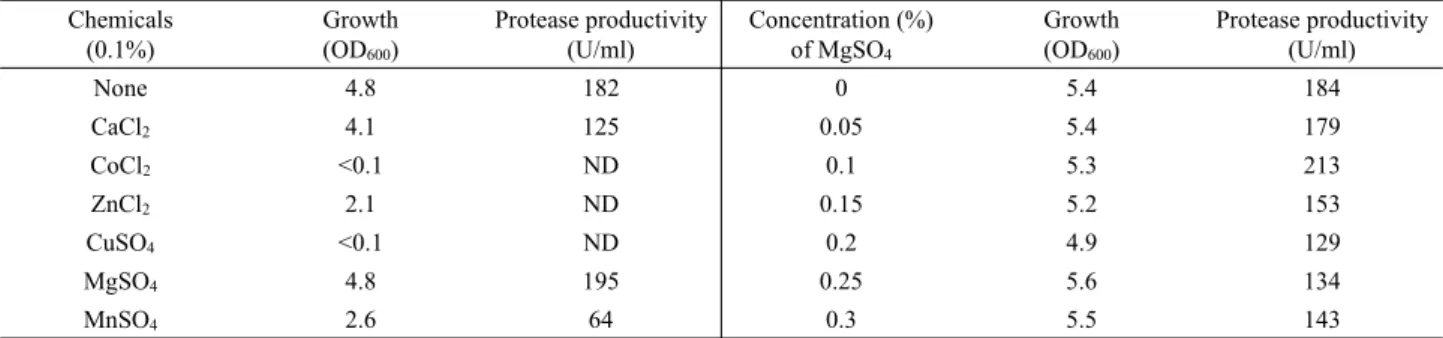
Table 3. Effects of various chemicals on growth and protease production
Concentration (%) of K2HPO4/KH2PO4
Growth (OD600)
Protease productivity (U/ml)
None 6.8 78
0.01 7.8 351
0.02 7.7 360
0.03 7.5 381
0.05 8.1 372
0.1 6.5 354
0.15 6.2 330
0.2 6.1 291
Table 4. Growth and protease production according to the amounts of potassium phosphate
인과 무기금속이온이 protease 생산에 미치는 영향
칼슘 이온을 비롯한 금속이온이 protease 생산성에 영향을 미 치는 것으로 알려져 있으므로 금속이온이 YB-1205의 protease 생산성에 미치는 영향을 조사하기 위해 유당(3%), soy peptone (1.5%), K2HPO4 (0.01%)와 KH2PO4 (0.01%)을 포함한 배지에 개별 멸균한 금속염(CaCl2, CoCl2, ZnCl2, MgSO4, CuSO4, MnSO4)을 0.1%의 농도로 첨가하여 YB-1205를 배양하였다. 그 결과 MgSO4와 CaCl2를 첨가한 배지에서는 금속염을 첨가하지 않았을 때의 균 성장도가 유사하였고 MnSO4을 첨가한 배지에 서는 균의 성장도가 낮아졌으며, 나머지 금속염이 첨가되었을 때는 성장이 거의 일어나지 않았다(Table 3). 배양액내의 protease 활성을 측정한 결과 MgSO4를 첨가한 배지에서 효소 생산성이 가장 높았으며 CaCl2와 MnSO4를 첨가한 배지에서는 첨가하지 않았을 때보다 효소 생산성이 낮았다. B. mojavensis A21 (Haddar et al., 2010)과 B. pseudofirmus Mn6 (Abdel-Fattah et al., 2009)도 YB-1205와 동일하게 마그네슘 이온이 첨가된 배지 에서 효소 생산성이 증가하는 것으로 알려졌다. MgSO4의 양을 달리 첨가하여 효소 생산성을 검토하기 위해 상기 성분의 배지 에 MgSO4를 0, 0.05, 0.1, 0.15, 0.2, 0.25, 0.3% 첨가하여 배양하 였다. 그 결과 균의 성장과 효소 생산성은 MgSO4의 첨가량에 관 계없이 큰 변화를 보이지 않았지만 MgSO4이 0.1% 첨가된 배지 에서 활성이 높은 것으로 판단되었다(Table 3).
최종적으로 인의 영향을 조사하고자 배지의 기본조성을 유당 (3%), soytone peptone (1.5%), MgSO4 (0.1%)로 하고 K2HPO4
와 KH2PO4를 각각 0%, 0.01%, 0.02%, 0.03%, 0.05%, 0.1%, 0.15%, 0.2%가 되도록 혼합하여 첨가한 배지에서 분리균을 배양한 후 균의 성장과 효소생산성을 조사하였다. 그 결과 K2HPO4/KH2PO4
를 첨가하지 않았을 때 보다 첨가하였을 때 균의 성장이 증가하 였을 뿐 아니라 protease 생산성은 이 보다 더 큰 폭으로 증가하 였으며 0.03%가 첨가된 배지에서 효소 생산성이 가장 우수하였다 (Table 4). 청국장에서 protease 생산성이 높은 균으로 분리된 B.
licheniformis YB915는 0.03%의 K2HPO4/KH2PO4를 첨가한 배지 에서 효소 생산성이 가장 높았으나 그 증가 정도는 이를 첨가하 지 않은 배지에 비해 약 1.3배 수준인데 비해(Yoon and Shin, 2010), YB-1205는 K2HPO4/KH2PO4의 첨가에 의해 protease 생 산성 증가도가 약 5배로 확인되었다. 또한 B. megaterium F7-1 도 potassium phosphate를 첨가한 배지에서 protease 생산성이 증가하는 것으로 알려졌다(Son, 2005).
균의 성장과 효소생산성
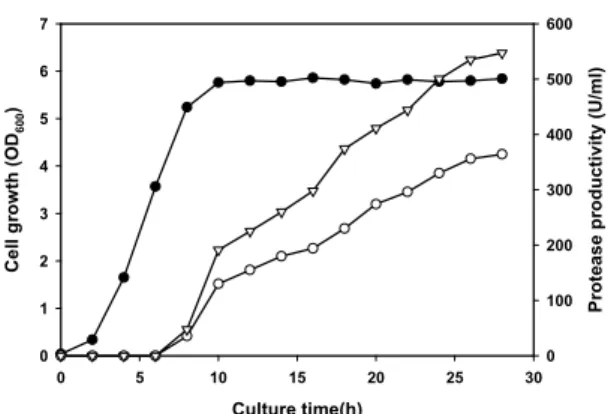
B. licheniformis YB-1205의 protease 생산에 적합한 것으로 확인된 배지(3% 유당, 1.5% soytone peptone, 0.1% MgSO4, 0.03%/0.03% K2HPO4/KH2PO4; pH 7.2)를 사용하여 배양시간 에 따른 효소 생산성과 균 성장간의 관계를 조사하였다. Bacillus 속 균주에 따라서는 알칼리성 또는 중성 protease를 동시에 생산 하는 경우도 있으므로(Brar et al., 2007) YB-1205의 배양상등 액에 존재하는 protease 활성을 측정하기 위해서 반응액 pH를 7.5와 11로 하였다. YB-1205는 중기 대수기에 이르기까지 protease를 거의 생산하지 못하였으며 말기 대수기부터 본격적 으로 생산하여 28시간 배양 후 최대활성에 이르렀다(Fig. 3). 반 응 pH에 따른 배양상등액의 protease 활성을 비교한 결과 배양 시간에 관계없이 pH 7보다 11에서 약 1.4–1.6배 정도 높은 것으 로 보아 분리균은 알칼리성 protease를 주로 생산하는 것으로 판 단된다. 따라서 반응 pH 11을 기준으로 볼 때 분리균의 protease 생산성은 최대 550 U/ml에 이르며 이는 B. licheniformis LBBL-11 (18.4 U/ml) (Juyigbe and Ajele, 2008) 보다는 높고, Bacillus sp. SH-8 (436 U/ml) (Yoon et al., 2006) 또는 B.
aquimaris VITP4 (630 U/ml) (Shivanand and Jayaraman, 2009)와는 유사하며, B. licheniformis YB915 (800 U/ml) (Yoon and Shin, 2010) 또는 B. mojavensis A21 (1,859 U/ml) (Haddar et al., 2010)보다는 낮은 것으로 확인되었다.
Culture time(h)
0 5 10 15 20 25 30
Cell growth (OD600)
0 1 2 3 4 5 6 7
Protease productivity (U/ml)
0 100 200 300 400 500 600
Fig. 3. Growth and protease production of B. licheniformis YB-2105.
B. licheniformis was grown in the optimized medium consisting of lactose (3%), soytone peptone (1.5%), MgSO4 (0.1%), K2HPO4
(0.03%), and KH2PO4 (0.03%) at 37℃ with vigorous shaking. Cell growth (closed symbols) was determined by measuring absorbance of cell culture. Protease productivities (open symbols) were determined by measuring protease activity of the culture filtrate under the reaction conditions of 55℃ and pH 7.5 (-▽-) or pH 11.0 (-○-).
적 요
가정에서 제조된 된장 16점으로부터 60℃에서 성장하는 Bacillus 속 균주 63주를 분리하였으며 이로부터 내열성 protease를 생산 하는 1개 균주를 선발하였다. 분리균의 형태적, 생화학적 특성과 16S rRNA 유전자서열을 조사한 결과 Bacillus licheniformis로 확인되었다. 분리균의 배양상등액은 반응온도 60–65℃와 pH 11에서 최대 protease 활성을 보였으며, 60℃에서 30분간 열처 리한 후에도 87%의 protease 활성을 유지하였다. 질소원, 탄소 원, 금속이온, 인 등의 배지성분이 protease 생산성에 미치는 영 향을 조사한 결과 유당과 soytone peptone이 분리균의 효소 생산 을 증가시키는 탄소원과 질소원으로 확인되었다. 분리균은 말기 대수기 이후부터 protease를 생산하기 시작하였으며, 유당 (3%), soytone peptone (1.5%), MgSO4 (0.1%), K2HPO4 (0.03%)와 KH2PO4 (0.03%)로 구성된 최적화 배지에서 배양시간이 28시간 일 때 protease의 생산성이 최대 550 U/ml에 이르렀다.
참고문헌
Abdel-Fattah, Y.R., El-Enshasy, H.A., Soliman, N.A., and El-Gendi, H.
2009. Bioprocess development for production of alkaline protease by Bacillus pseudofirmus Mn6 through statistical experimental designs. J. Microbiol. Biotechnol. 19, 378–386.
Abusham, R.A., Rahman, R.N., Salleh, A.B., and Basri, M. 2009.
Optimization of physical factors affecting the production of thermo-stable organic solvent-tolerant protease from a newly isolated halo tolerant Bacillus subtilis strain Rand. Microb. Cell Fact. 8, 20.
Bang, S.H. and Jeong, I.-S. 2011. Characterization of an alkaline protease from an alkalophilic Bacillus pseudofirmus HS-54. Kor. J. Microbiol.
47, 194–199.
Brar, S.K., Verma, M., Tyagi, R.D., Surampalli, R.Y., Barnabe, S., and Valero, J.R. 2007. Bacillus thuringiensis proteases: Production and role in growth, sporulation and synergism. Process Biochem. 42, 773–790.
Deng, A., Wu, J., Zhang, Y., Zhang, G., and Wen, T. 2010. Purification and characterization of a surfactant-stable high-alkaline protease from Bacillus sp. B001. Bioresour. Technol. 101, 7100–7106.
Gupta, R., Beg, Q.K., Khan, S., and Chauhan, B. 2002. An overview on fermentation, downstream processing and properties of microbial alkaline proteases. Appl. Microbiol. Biotechnol. 60, 381–395.
Haddar, A., Fakhfakh-Zouari, N., Hmidet, N., Frikha, F., Nasri, M., and Kamoun, A.S. 2010. Low-cost fermentation medium for alkaline protease production by Bacillus mojavensis A21 using hulled grain of wheat and sardinella peptone. J. Biosci. Bioengneer. 110, 288–294.
Hadj-Ali, N.E., Agrebi, R., Ghorbel-Frikha, B., Sellami-Kamoun, A., Kanoun, S., and Nasri, M. 2007. Biochemical and molecular characterization of a detergent stable alkaline serine-protease from a newly isolated Bacillus licheniformis NH1. Enzyme Microb.
Technol. 40, 515–523.
Hmidet, N., Ali, N.E.-H., Hadder, A., Kanoun, S., Alya, E.-K., and Nasri, M. 2009. Alkaline proteases and thermostable alpha-amylase co-produced by Bacillus licheniformis NH1: characterization and potential application as detergent additive. Biochem. Engineer. J. 47, 71–79.
Hmidet, N., Ali, N.H., Zouari-Fakhfakh, N., Haddar, A., Nasri, M., and Sellemi-Kamoun, A. 2010. Chicken feathers: a complex substrate for the co-production of alpha-amylase and proteases by B. licheniformis NH1. J. Ind. Microbiol. Biotechnol. 37, 983–990.
Horikoshi, K. 1990. Enzymes of alkalophiles. pp. 275–294. In Fogarty, W.M. and Kelly, C.T. (eds.), Microbial enzyme and biotechnology, 2nd ed. Elsevier Applied Science Publishers, Barking, UK.
Johnvesly, B. and Naik, G.R. 2001. Studies on production of thermostable alkaline protease from thermophilic and alkaliphilic Bacillus sp. JB-99 in a chemically defined medium. Process Biochem.
37, 139–144.
Juyigbe, F.M. and Ajele, J.O. 2008. Some properties of extracellular protease from Bacillus licheniformis LBBL-11 isolated from iru, a traditionally fermented African locust bean condiment. African J.
Biochem. Res. 2, 206–210.
Kanekar, P.P., Nilegaonkar, S.S., Sarnaik, S.S., and Kelkar, A.S. 2002.
Optimization of protease activity of alkaliphilic bacteria isolated from an alkaline lake in India. Bioresour. Technol. 85, 87–93.
Kim, S.S., Lee, J.-H., Ahn, Y.-S., Kim, J.-H., and Kang, D.-K. 2003. A fibrinolytic enzyme from Bacillus amyloliquefaciens D4-7 isolated from Chungkook-Jang; it’s characterization and influence of additives on thermostability. Kor. J. Microbiol. Biotechnol. 31, 271–276.
Koma, D., Yamanaka, H., Moriyoshi, K., Ohmoto, T., and Sakai, K. 2007.
Overexpression and characterization of thermostable serine protease in Escherichia coli encoded by the ORF TTE0824 from Thermoanaerobacter tengcongensis. Extremophiles 11, 769–779.
Kumar, C.G. 2002. Purification and characterization of a thermostable alkaline protease from alkalophilic Bacillus pumilus. Lett. Appl.
Microbiol. 34, 13–17.
Kumar, D. and Bhalla, T.C. 2004. Purification and characterization of a small size protease from Bacillus sp. APR-4. Indian J. Exp. Biol.
42, 515–521.
Lee, S.-K., Bae, D.-H., Kwon, T.-J., Lee, S.-B., Lee, H.-H., Park, J.-H., Heo, S., and Johnson, M.G. 2001. Purification and characterization of a fibrinolytic enzyme from Bacillus sp. KDO-13 isolated from soybean paste. J. Microbiol. Biotechnol. 11, 845–852.
Li, S., He, B., Bai, Z., and Ouyang, P. 2009. A novel organic solvent-stable alkaline protease from organic solvent-tolerant Bacillus licheniformis YP1A. J. Mol. Catal. B Enzym. 56, 85–88.
Liu, C.H., Chiu, C.S., Ho, P.L., and Wang, S.W. 2009. Improvement in the growth performance of white shrimp, Litopenaeus vannamei, by a protease-producing probiotic, Bacillus subtilis E20, from natto. J.
Appl. Microbiol. 107, 1031–1041.
Mabrouk, S.S., Hashem, A.M., El-Shayeb, N.M.A., Ismail, A.-M.S., and Abdel-Fattah, A.F. 1999. Optimization of alkaline protease productivity by Bacillus licheniformis ATCC 21415. Bioresour.
Technol. 69, 155–159.
Nilegaonkar, S.S., Zambare, V.P., Kanekar, P.P., Dhakephalkar, P.K., and Sarnaik, S.S. 2007. Production and partial characterization of dehairing protease from Bacillus cereus MCM B-326. Bioresour.
Technol. 98, 1238–1245.
Prakash, M., Banik, R.M., and Koch-Brandt, C. 2005. Purification and characterization of Bacillus cereus protease suitable for detergent industry. Appl. Biochem. Biotechnol. 127, 143–155.
Sellami-Kamoun, A., Haddar, A., Ali, N.E.-H., Ghorbel-Frikha, B., Kanoun, S., and Nasri, M. 2008. Stability of thermostable alkaline protease from Bacillus licheniformis RP1 in commercial solid laudry detergent formulations. Microbiol. Res. 163, 299–306.
Shivanand, P. and Jayaraman, G. 2009. Production of extracellular
protease from halotolerant bacterium, Bacillus aquimaris strain VITP4 isolated from Kumta coast. Process Biochem. 44, 1088–1094.
Son, H.-J. 2005. Cultural conditions for protease production by a feather-degrading bacterium, Bacillus megaterium F7-1. Kor. J.
Microbiol. Biotechnol. 33, 315–318.
Sookkheo, B., Sinchaikul, S., Phutrakul, S., and Chen, S.T. 2000.
Purification and characterization of the highly thermostable proteases from Bacillus stearothermophilus TLS33. Protein Expr.
Purif. 20, 142–151.
Sun, C., Jin, C., Yang, S., and Zhang, S. 1999. Purification and properties of genetic expressing product of thermostable protease from Bacillus stearothermophilus HY-69. Chin. J. Biotechnol. 15, 15–21.
Yoon, K.-H., Lee, M.S., Park, B.W., Park, Y.-H., Kim, H., Kim, J.H., and Kim, M.S. 2006. Enzyme production of a protease-producing strain, Bacillus sp SH-8 isolated from insect-eating plant. Kor. J. Microbiol.
Biotechnol. 34, 323–328.
Yoon, K.-H. and Shin, H.Y. 2010. Medium optimization for the protease production by Bacillus licheniformis isolated from Cheongkookjang.
Kor. J. Microbiol. Biotechnol. 38, 385–390.