Production and Characterization of an Alkaline Protease from Bacillus licheniformis MH31
Jeong-Hyeon Yu1, Hyun-Seok Jin2, Woo-Young Choi1 and Min-Ho Yoon1,*
1Department of Agricultural Chemistry, College of Agriculture and Lifesciences, Chungnam National University, 220 Gung-Dong, Yuseong-Gu, Daejeon 305-764, Korea
2Namyang Dairy Products Co., Ltd. R&D Center, Gongju, ChungNam 314-914, Korea Received August 10, 2006; Accepted November 15, 2006
A alkalophilic strain, mine soil of Boryeong in Korea. Production of a high level of alkaline protease was achieved 42 h afterBacillus licheniformis MH31 producing an alkaline protease was isolated from incubation when the bacterium was grown at pH 9.0 and 35oC in Horikoshi medium supplemented with 0.5% (w/v) starch and 1% (w/v) skim milk as carbon and nitrogen source, respectively. The molecular weight of partially purified enzyme was estimated to be 30 kDa by SDS-PAGE and its optimum pH was pH 10. The enzyme showed optimum temperature at 50oC, and was stable up to 60oC after 1 h incubation. The protease was strongly inhibited by 1 mM of PMSF which was known well as strong inhibitor of serine proteases, but almost not inhibited by 5 mM of EDTA and 1,10-phenanthroline.
When the protein hydrolysis products of 1% skim milk by partially purified protease was compared with available commercial proteases using HPLC analysis, most of hydrolysis products were detected below molecular weight of 10,000 and the hydrolysis ratio of purified enzyme was 24.8% lower than those (above 32%) of commercial proteases.
Key words: alkaline protease, Bacillus licheniformisMH31, production, characterization Proteolytic enzymes constitute one of the most important
group of industrial enzymes and especially, alkaline proteases represent one of the largest enzyme useful in the detergent industry which contribute to more than 30% of the total global enzyme market. The industrial applications of alkaline protease in detergent as well as leather tanning, pharmaceutical, and food industries have increased remarkably.1,2,3,4)
Bacteria of the genus Bacillus are known to produce a group of commercially important enzymes including proteolytic enzymes. Currently approximately 25% of the world-wide available alkaline proteases are derived from Bacillus strains.5,6) The representative species of the Bacillus group, which is B.
licheniformis, B. pumilus, and B. subtilis, were known to the major source of commercial alkaline protease production and studies on characterization and industrial application of their enzymes have been reported by investigators.7,8,9)
In this paper, we report the medium condition for the optimal production of extracellular alkaline protease from Bacillus licheniformis MH31 and the enzymatic properties of partially purified alkaline protease.
Materials and Methods
Microorganism and medium.
A genus Bacillus strain producing an alkaline protease was isolated from korea minesoil of Boryeong in Korea by selective screening on skim milk agar plate. The isolate was identified by as Bacillus licheniformis MH-31 on the basis of 16S rRNA gene alignment with GeneBank database. Horikoshi10) medium (yeast extact 5 g· l−1; peptone 5 g· l−1; glucose 10 g· l−1; K2HPO4 1 g· l−1; MgSO4· 7H2O 0.2 g· l−1; Na2CO3 10 g· l−1, pH 9) was used to the basal media for production of alkaline protease. To determine the optimal medium components for enzyme production, Bacillus licheniformis MH-31 was cultured with basal media containing skim milk, tryptone, casaamino acid, soytone and bacto peptone as nitrogen source and fructose, lactose, maltose, soluble starch, sucrose and xylose as carbon source, respectively.
Protease assay.
Extracellular protease activity was determined by Fugiwara method11) using 1.0% casein in 0.1 M Tris-HCl buffer (pH 8.0) as a substrate. The assay mixture consisted of 2 ml of substrate and 0.5 ml of enzyme solution suitably diluted with 0.1 M Tris-HCl buffer (pH 8.0). The reaction mixture was incubated at 40oC for 30 min and the reaction was terminated by the addition of 2.5 ml of 10% trichloroacetic acid (TCA), and then centrifuged at 5,000×g for 10 min to remove the resulting precipitate. Protease activity was determined by estimating the amount of tyrosine in the supernatant according to Lowry12) method. One unit of protease activity was defined as the amont of enzyme required to release 1µg of tyrosine·ml−1·min−1 under the reaction conditions.Partial purification of the enzyme.
The culture broth containing extracellular protease was precipitated with ammonium sulphate to a final concentration of 70%. The saturated solution was lefted overnight at 4oC, centrifuged and*Corresponding author
Phone:+82-42-821-6733; Fax:+82-42-823-9241 E-mail: [email protected]
ionic strength with the same buffer containing 0.5 M NaCl and monitored at A280 (GradiFracTM System, Pharmacia Ltd).
Active fractions with high protease activity were pooled, and concentrated using a Centriprep-10 (Amicon), divided into small aliquots, and stored at −70oC for further use.
Effect of Temperature and pH.
The optimal pH of partially purified protease was determined with 1% (w/v) skim milk as substrate dissolved in different buffers (citrate phosphate, pH 5~6; sodium phosphate, pH 7.0; Tris-HCl, pH 8.0; and glycine- NaOH, pH 9~12). The pH stability of alkaline protease was determined by measuring the remaining activity after incubating enzyme in different buffers pH (6~12) at 4oC for 2 h. The optimum temperature of protease activity was determined with reaction mixture incubated at different temperatures ranging from 30 to 70oC for 30 min. For determination of thermostability, 0.1 ml of enzyme was preincubated with 0.9ml of glycine-NaOH buffer, pH 9, at different temperatures ranging from 30 to 70oC for 60 min. After incubation, the residual activity was measured under standard assay condition.Effect of Inhibitiors.
The partially purified protease was preincubated with different inhibitors such as 1 mM PMSF (Phenyl Methyl Sulfonyl Fluoride), 1 mM TLCK (N-alpha-p- tosyl-L-lysine chloromethyl ketone), 5 mM 1,10-phenanthroline, 5 mM EDTA, and 5 mM of various metal ions for 1 h under optimum reaction conditions. Residual activities in the presence of the inhibitors were compared with the controls without inhibitor.Analysis of protein hydrolytes.
To compare the protein hydrolysis products by MH 30 protease and other commercial proteases which were originated from Bacillussubtilis (Neutrase), Aspergillus oryzae (Amano M), Bacillus stearothermophilus (Amano S), HPLC analysis was performed with the reaction mixtures of each enzyme and 1% skim milk as substrate. The reaction mixtures containing 2 ml of 1% substrate and 0.5 ml of each enzyme solution suitably diluted with 50 mM Tris- HCl buffer (pH 7.6) were incubated at 40oC. The aliquots of 1.0 ml were withdrawn at specified time intervals (0, 0.5, 1, 2, 6, 12, 18 and 24 h) and boiled immediately for 10 min to terminate the reaction. The hydrolysis product of aliquots were separated using HPLC column (TSK-G200SW, Japan) with 50 mM Tris-HCl buffer (pH 7.6) and were detected at A280.Results and Discussion
The organism.
A genus Bacillus producing an alkaline protease was isolated from mine soil of Boryeong in theKorea. Bacterial cell which showed the chemotaxanomic characteristics of Gram-positive, nonmotile aerobic, regular rods, nonpigment and spore forming was identified as Bacillus ligheniformis MH31 by aligning a 16S rRNA sequence with the Genebank database (Fig. 1).
Effect of carbon and nitrogen sources.
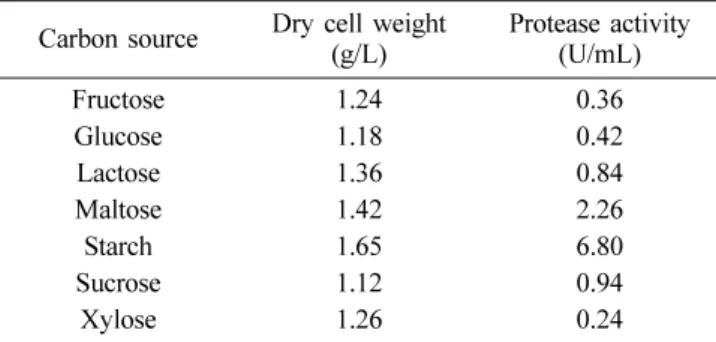
The optimal medium for protease production was investigated by comparing the effect of carbon and nitrogen components supplemented in Horikoshi medium. The maximum protease activity was obtained in presence of 1% (w/v) starch as the carbon source and the optimum concentration of starch for protease production was in the range of 0.5~1% (Table 1). However The protease production was markedly reduced by addition of 1% (w/v) glucose, lactose, and xylose. These results areFig. 1. Neighbour-joining tree showing the phylogenetic posi- tions of MH-31 and other related taxa based on 16S rRNA gene sequences. Bootstrap values (expressed as percentages of 1,000 replications) greater than 70% are shown at branch points. Bar, 0.02 substitutions per nucelotide position. This tree was constructed using the neighbour-joining method (Saitou &
Neil, 1987) with a Kimura (1983) two parameter distance matrix and pairwise deletion.13,14)
Table 1. Effects of carbon source on cell growth and pro- tease production by B. licheniformis MH-31
Carbon source Dry cell weight
(g/L) Protease activity (U/mL)
Fructose 1.24 0.36
Glucose 1.18 0.42
Lactose 1.36 0.84
Maltose 1.42 2.26
Starch 1.65 6.80
Sucrose 1.12 0.94
Xylose 1.26 0.24
The strain was grown on the alkaline medium with initial pH 9.0 supplemented 0.5% starch and each 0.2% carbon sources at 40oC for 42 h. The results are expressed as the means of three separate experiments.
somewhat different from those obtained using other Bacillus licheniformis strain15,16), in which glucose and lactose were reported as effective carbon sources for protease production.
The maximum production of protease was observed in the medium supplemented with 1% (w/v) skim milk as nitrogen source (Fig. 2) and the proteolytic activity of 12 U ml−1 was higher than approximately 20~40% as compared with those of other nitrogen components.
Enzyme production.
The growth profile of B. licheniformis MH31 is presented in Fig. 3. The extracellular protease secreted by the isolate showed the time dependent increase along with specific growth of cell mass. Maximum protease production (28.2 U mg−1) occurred at the end of the exponential phase after fermentation 42 h, and thereafter, the proteolytic activity remained constant until the end of the stationary phase when cell mass starts to decrease. During cultivation, the pH of the culture broth decreased from 9.0 to 8.0 and then remained constant during prolonged cultivation. The time at which enzyme production reached its maximum value during cultivation almost coincided with the time at which maximum cell density, as being similar result with that reported by Bacillus pumilus.8) From the obtained results, maximalproduction of alkalin protease was achieved when MH 31 strain was incubated for 42 h in the Horikoshi medium containing 0.5% starch and 1% skim milk as carbon and nitrogen sources, respectively, at pH 9.0 and 34oC.
Characeristics of alkalin protease
Partial purification of alkalin protease.
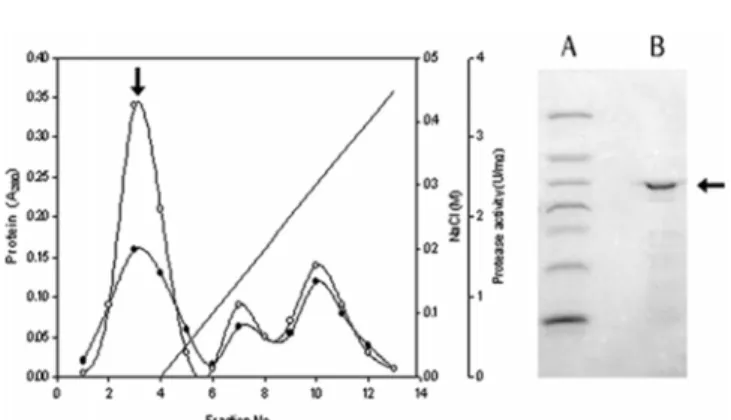
The B. lichenifirmis MH31 alkaline protease was partially purified by using single step ion-exchange chromatography on a Resource Q column with 50 mM Tris-HCl buffer (pH 7.8). The alkaline protease eluted out as unbound fractions without the interaction with anion Q-sepharose column (Fig. 4), presuming isoelectric point (pI) of the enzyme might be above pH 7.8. The protease activity in active fraction represented 243 U mg−1 of specific activity with 5.7-fold purification and the molecular weight of partially purified enzyme was estimated to be approximately 30 kDa by SDS-PAGE (Fig. 4).Effect of pH and themperature.
The partially purified protease exhibited optimum pH at pH 10. Although the enzyme activities decreased to approximately 60% of its maximal value at pH 12 after incubation for 6 h, the enzyme was stable in a broad pH range from 6.0 to 11 (Fig. 5). The enzyme showed optimum temperature at around 50oC (Fig. 6), and was stable up to 55oC after 1 h incubation. However, the activity showed a marked decrease at over 60oC within 30 min after incubation. These results prsented the protease secreted from B. lichenifomis MH31 is a typical of highly pH stable alkaline protease with moderate heat stability.Protease inhibitors.
The effect of metal ions and synthetic inhibitors on the partially purified protease was investigated.Enzyme activity was strongly inhibited above 95% by 1 mM of PMSF which was known as the serine protease inhibitors17,18), while it was not inhibited by 1mM of the trypsin selective reagent TLCK. In addition, the protease activity was resistant to inhibition by 5 mM of EDTA and 1,10-phenanthroline, indicating that the enzyme is not a metalloprotease (Table 2).
Among metal ions, Mn2+ and Ca2+ marginally stimulated the Fig. 2. Effects of nitrogen sources on alkaline protease pro-
duction by B. licheniformis MH-31. The strain was grown in alkaline medium with initial pH 9 supplimented each 1.0%
nitrogen sources at 40oC for 42 h. The results are expressed as the means S.E. from three separate experiments. p< 0.01. Dry cell weight (□), relative protease activity (■).
Fig. 3. The profile on cell growth and protease production of B. licheniformis MH-31. Cell mass (●), protease activity (○), and pH (▲).
Fig. 4. Elution profile of alkaline protease from B. licheni- formis MH-31 on Resource Q anion exchange column. The enzyme eluted with a linear gradient of NaCl (0-0.5 M) concen- tration in 50 mM Tris-HCl buffer (pH 7.8). Protein (●), pro- tease activity (○) A: Maker protein; BSA (66,000), Ovalbumin (45.000), Pepsin (34,700), Trypsinogen (24,000), Lactoglobulin (18,400), Lysozyme (14,300). B: purified protease.
protease activity up to 20% of maximum activity.
Analysis of protein hydrolysis products. Hydrolysis rates of MH 31 protease and commercially available proteases (Neutrase, Amano M, and Amano S) originated from other microorganisms were estimated by comparing the reaction products between enzyme and substrate (1% skim milk) using HPLC column. Proteolytic activity of all protease tested was not increased more than after 60 min reaction. Seven hydrolysis products were detected in the reaction mixture of MH 31 protease and 1% skim milk after 60 min and its hydrolysis ratio was 24.8% (Table 3). These results was somewhat lower
than proteases from other microorganism tested which showed 32%~39% of hydrolysis ratios and 8~10 fragments, respectively. Most of products among the hydrolysis proteins were low proteins below molecular weight of 10,000 identical Fig. 5. Effect of pH on activity and stability of alkaline pro-
tease from B. licheniformis MH-31. The protease was assayed in the pH range of 6.0-12 using different buffers. The pH stabil- ity was determinded by incubating the enzyme with equal amount of buffers of different pHs for 48 h at room tempera- ture and thereafter the relative activity was determined un der standard assay conditions. Optimal pH (●), pH stability (○).
Fig. 6. Effect of temperature on activity and stability of alkaline protease from B. licheniformis MH-31. The optimal temperature was determined by assaying protease activity at temperatures between 30 and 70oC. The temperature stability was determined by incubating enzyme at various temperature in range on 30-70oC for 2 h and the residual enzyme activity was estimated at regular intervals. Optimal temperature (●), Tem- perature stability (○).
EDTA 5 86
MnSO4 5 108
CaCl2 5 119
ZnSO4 5 96
CuSO4 5 93
Various inhibitors were mixed with enzyme and then incubated at 40oC for 1 h, and relative activity was estimated with the means of triplicate experiments under standard assay conditions.
1Phenylmethyl sulfonyl fluoride,
2N-alpha-p-tosyl-L-lysine chloromethyl ketone
3Ethylene diamine tetra acetic acid
Table 3. Comparison of hydrolysis products on B. lichenifor- mis MH-31 protease and commercial proteases using HPLC column
Sample
RT Casein* 1% skim milk
MH-31 Neutrase Amano S Amano M 6.17.1
8.39.0 10.49.8 12.211.3 13.313.8 14.214.5 15.315.8 16.918.2 18.8
37.2 23.3 8.69.0 6.09.3 3.0 2.01.6
19.6
3.2 33.48.0
8.7 5.3 3.5
21.1 3.6 6.89.0 45.84.5
0.6 8.5
16.8 1.8 3.4 29.09.7 11.9 11.9 10.35.3
18.0 1.04.0 11.07.5 38.918.2
0.95.3 2.4 Hydrolysis
ratio (%) 20.04 24.8 39.8 38.2 32.94
Enzyme
content - 0.015% 0.001% 0.001% 0.001%
Fragment
Number 9 7 8 9 10
The reaction aliquots which were incubated at 40oC for 60 min were separated using HPLC column (TSK-G200SW, Japan) with 50 mM Tris-HCl buffer (pH 7.6).
*commercial hydrolyzed αs-casein
of those from other commercial proteases.
Conclusion
An alkalophilic bacteria which showed wide clear zone on Horikoshi agar plate containing 1% skim milk was isolated from mine soil of Boryeong in korea. The isolate was identified as Bacillus lichenifirmis MH31 on the basis of analysis of chemotaxanomic and 16S rRNA sequence. MH31 strain prefers 0.5~1% (w/v) starch and 1% (w/v) skim milk as carbon and nitrogen source, respectively and the growth of cell and production of alkaline protease exhibited the time dependent increase during cultivation. Maximal enzyme production was achieved at 42 h around the end of exponential growth when the bacterium was incubated in Horikoshi medium supplemented with 0.5% starch and 1% skim milk at pH 9.0 and 34oC for 46 h. A alkaline protease of approximately 30 kDa which was partially purified by using single step of anion-exchange chromatography, exhibited optimum pH at pH 10 and was stable in a broad pH range from 6.0 to 11, indicating a typical characteristic of alkaline proteases. The protease showed optimum temperature at 50oC, and was stable up to 60oC after 1 h incubation. The protease was strongly inhibited by 1 mM PMSF, but resistant to inhibition by 5mM of EDTA and 1,10-phenanthroline, suggesting that it is a member of the serine protease family as well as non- metalloprotease. Hydrolysis ratio of MH 31 protease on 1%
skim milk as substrate was 24.8% and its hydrolysis products were seven fragments with molecular weight of below 10,000, although it was somewhat lower than proteases (Neutrase, Amano M, and Amano S) originated from other microorganism tested, which showed 32%~39% of hydrolysis ratios and 8~10 fragments, respectively. Conculusively, the protease secreted from B. lichenifirmis MH31 is a typical of alkaline serine protease, and might be a useful source of protease for industrial applications such as laundry detergent, dairy production and leather industry.
References
1. Atalo, K. and Gashe, B. A. (1993) Protease production by a thermophilic Bacillus species (P-001A) which degrades var- ious kinds fibrous protein. Biotechnol. Lett. 15, 1151-1156.
2. Lee, C. H., Kwon, T. J., Kang, S. M., Suh, H. H., Kwon, G. S., Oh, H. M. and Yoon, B. D. (1994) Production and characterization of an alkaline protease from an isolate, Xanthomonas sp. YL-37. Kor. J. Appl. Microbiol. Biotech- nol. 22, 515-521.
3. Malathi, S. and Chakraborty, R. (1991) Production of alka- line protease by a new Aspergillus flavus isolated under solid-substrate fermentation conditions for use as a depila- tion agent. Appl. Environ. Microbiol.27, 712-716.
4. Chen, S. T., Kao, C. L. and Whang, K. T. (1995) Alkaline protease catalysis of a secodary amine to form a petide bond. Int. J. Peptide Prot. Res.46, 314-319.
5. Anwar, A. and Saleemuddin, M. (1998) Alkaline protease:
A review. Bioresource Technology64, 175-183.
6. Rahman, R. N. Z. A., Kamaruzaman, C. N. R., Basri, A. M., Yunus, W. M. Z. W. and Salleh, A. B. (1994) Purification and characterization of a heat-stable alkaline protease from Bacillus stearothermophilus F1. Appl. Microbiol. Biotech- nol. 40, 822-827.
7. Jacobs, M., Eliasson, M., Uhelen, M. and Flock, J. I. (1985) Cloning, sequencing and expression of Subtilisin Carlsberg from Bacillus lichenifomis. Nucleic Acids Review. 13, 8913- 8926.
8. Johnvesly, B. and Naik, G. R. (2001) Production of Bleach- stable and halo-tolerant alkalie protease by an alkalophilic Bacillus pumilus JB05 isolated from cement industry efflu- ents. J. Microbiol. Biotechnol. 11(4), 558-563.
9. Hameed, A., Natt, M. A. and Evans, C. S. (1996) Produc- tion of alkaline protease by a Bacillus subtilis isolate for use as being enzyme in leather treatment. World Journal of Microbiol. Biotechnol. 12, 289-291.
10. Horikoshi, K. (1971a) Production of alkaline protease by alkalophilic Bacillus No. 221. Agri. Biol. Chem. 35, 1407- 1414.
11. Fujiwara, N., Masui, A. and Imanaka, T. (1993) Purifica- tion and properties of highly thermostable alkaline protease from an alkalophilic and thermophilic Bacillus sp. J. Bio- technol. 30, 245-256.
12. Lowry, O. H., Rosebrough, N. J., Farr, A. L. and Randall, R. J. (1951) Protein determination. J. Biol. Chem. 193, 265- 13. Saitou, N. and Nei, M. (1987). The neighbor-joining275.
method: a now method for reconstructing phylogenetic trees. Mol Biol Evol4, 406-425.
14. Kimura, M. (1983) The Neutral Theory of Molecular Evo- lution, pp. 41-46. Cambridge: Cambridge University Press.
15. Calik, P., Tomln, G. C., Oliver, S. G. and Ozdamar, T. H.
(2003) Overexpression of a serine alkaline protease gene in Bacillus licheniformis and its impact on the metabolic reac- tion network. Enzyme and Microbial Technology. 32, 706- 16. Ferrero, M. A., Cstro, G. R., Abate, C. M., Baigori, M. D.720.
and Sineriz, F. (1996) Themostable alkaline protease of Bacillus licheniformis MIR-29: Isolation, production and characterization. Appl. Microbiol. Biotechnol. 45, 327-332.
17. Kumar C. G., Tiwari M. P. and Jany K. D. (1999) Novel alkaline serine proteases from aklophlic Bacillus spp.: puri- fication and some properties. Process Biochem. 34, 441- 18. Margesin. R., Palma, N., Knauseder, F. and Schinner, F.449.
(1992) Purification of an alkaline protease produced by a psychrotrophic Bacillus sp. J. Biotechnol. 24, 203-206.