Abstract (J. Kor. Oral Maxillofac. Surg. 2009;35:502-506)
Ⅰ. 서 론
융모결절성 활막염(villonodular synovitis)은 색소 융모결 절성 활막염(pigmented villonodular synovitis)이라고도 불 리며 단핵 조직세포와 거대세포가 국소적으로 공격적 성 장을 하는 양성 병소이다1,2). 전형적으로 하나의 관절에 발 생하며, 80% 이상이 무릎관절에서 발생한다2). 측두하악관 절에서는 융모결절성 활막염이 매우 드물게 나타난다. 융 모결절성 활막염의 적절한 치료 방법은 종괴, 활막, 이환골 을 완전히 제거하는 것이다1).
Ⅱ. 증례보고
62세 여자 환자가 교합의 변화와 개구 및 저작시 좌측 측 두하악관절의 통증을 주소로 내원하였다. 특이할 만한 전 신적인 과거력은 없었으며, 초진 임상 검사시 좌측 최후방 구치부만 교합되는 상태였고(Fig. 1A) 개구시 좌측 측두하 악관절의 통증과 염발음이 나타났다. 최대 개구량은 44mm
였으며, 개구시 좌측으로 편위가 관찰되었다(Fig. 1B). 초 진 파노라마 방사선 사진상에서 좌측 하악 과두의 심한 흡 수와 좌측 과두가 우측에 비하여 다소 전방으로 위치되어 있는 소견이 관찰되었으며, 후전방 두부 방사선 사진에서 하악골이 좌측으로 편향된 소견이 보였다(Fig. 2A,B). 자기 공명영상(MRI)에서는 좌측 관절강이 많이 팽창 되어 있는 소견을 보였고, 관절강 내부는 T1 강조영상에서 근육과 비 슷하거나 다소 높은 신호강도를 보이고 T2 강조영상에서 는 고강도 신호를 보이고 있으며 내부에 T1, T2 모두에서 일부 저강도 신호를 보이는 부분들이 관찰되었다. 또한 하 악 과두는 심한 골 흡수 소견과 함께 다소 전방으로 위치되 어 있었고 관절원판도 전방으로 변위되어 있었다. 상방의 측두골 또한 흡수되고 재형성된 소견이 보였다(Fig. 3). 이 와 같은 검사 결과를 토대로 좌측 측두하악관절의 활액막 연골종증(synovial chondromatosis) 혹은 골관절염 가진 하 에 수술을 시행하기로 하였다.
비인두 삽관을 통한 전신마취 하에 좌측 측두하악관절에 대한 악관절 성형술(arthroplasty)이 시행되었다. 전이개 접 근법을 통하여 안면신경을 확인하면서 관절낭(capsule)부 위를 노출시켰다. 관절낭은 약간 부풀어 있는 양상이었고, 눌러 보았을 때 파동성이 느껴졌다. 상관절강의 개방을 위 해 관절낭에 절개를 가하자 상관절강 내부에서 점액성의 맑은 활액이 상당량 흘러 나왔으며, 관절강 내부를 노출시 키자 흡수가 상당히 진행되어 표면이 거칠고 편평해진 하 악 과두가 관찰되었고 과두 내측과 후방으로 작은 결절 형 허 종 기
135-720 서울시 강남구 언주로712
연세대학교 강남세브란스병원 구강악안면외과 Jong-Ki Huh
Department of Oral and Maxillofacial Surgery, Gangnam Severance Hospital, Yonsei University, 712 Eonju-ro, Gangnam-Gu, Seoul 135-720, Korea Tel: +82-2-2019-3560 Fax: +82-2-3463-4052
E-mail: [email protected]
연세대학교 강남세브란스병원 구강악안면외과, *연세대학교 치과대학 구강악안면방사선학교실
VILLONODULAR SYNOVITIS OF THE TEMPOROMANDIBULAR JOINT : A CASE REPORT
Jun-Young Hur, Jong-Yoon Kim, Jae-Hyung Lim, Kug-Jin Jeon*, Hyung-Gon Kim, Jong-Ki Huh Department of Oral and Maxillofacial Surgery, Gangnam Severance Hospital, Yonsei University
*Department of Oral and Maxillofacial Radiology, College of Dentistry, Yonsei University
Villonodular synovitis, also called pigmented villonodular synovitis, is the benign lesion with the characteristic of locally aggressive proliferation of mononuclear histiocyte and giant cell. Typically it involves single joint, especially about 80% of disease occurs in the knee joint. Villonodular synovi- tis of the temporomandibular joint is very rare disease. Differential diagnosis includes synovial chondromatosis and tumors of the temporomandibular joint. Optimal treatment consists of complete excision of the mass and removal of the synovium including adjacent affected bony structures.
This is a case report of villonodular synovitis developed in the temporomandibular joint.
Key words: Villonodular synovitis, Pigmented villonodular synovitis, Temporomandibular joint
[원고접수일 2009. 10. 19 / 1차수정일 2009. 11. 10 / 2차수정일 2009. 11. 20 / 게재확정일 2009. 12. 1]
Fig. 1. Photographs at first visit. Disclusion except only one occlusal contact on tooth #27 and #37 (A) is observed. Mandible deflects to the left side during mouth opening (B).
Fig. 2. (A) Pre-operative panoramic view. Resorption and anterior position of left condyle is observed (arrow).
(B) Pre-operative cephalo- metric view. Left deviation of chin is observed.
Fig. 3. On pre-surgical T1-weighted MR images of the left temporo- mandibular joint (A: closed mouth, B:
open mouth), expansion of the joint space and resorption of temporal bone and condylar head are observed. High signal intensity with small nodule-like masses (low signal intensity) in the joint space is observed on T2-weighted images (C:
sagittal image, D: coronal image).
Arrow: articular disc.
A B
A B
A B
C D
두 내측과 후방의 결절성 병소를 소파하여 제거하였다 (Fig. 4A). 병소의 제거 후 과두와 하악와 표면을 부드럽게 다듬은 후, 0.030 인치 실라스틱(Silastic�, Dow corning cor- poration, USA)을 과두와 하악와 사이에 위치시키고 봉합 을 시행하였다.
관절원판과 함께 제거된 활막의 일부는 황색의 결절형태 를 나타내었으며, 과두 후방과 내방에 있던 병소는 갈색과 투명한 색이 섞인 결절형태를 나타내었다(Fig. 4B, C).
조직학적으로 관절원판과 함께 제거된 활막부위의 병소 는 손가락 혹은 융모와 같은 형태를 보였으며(Fig. 5A), 거대
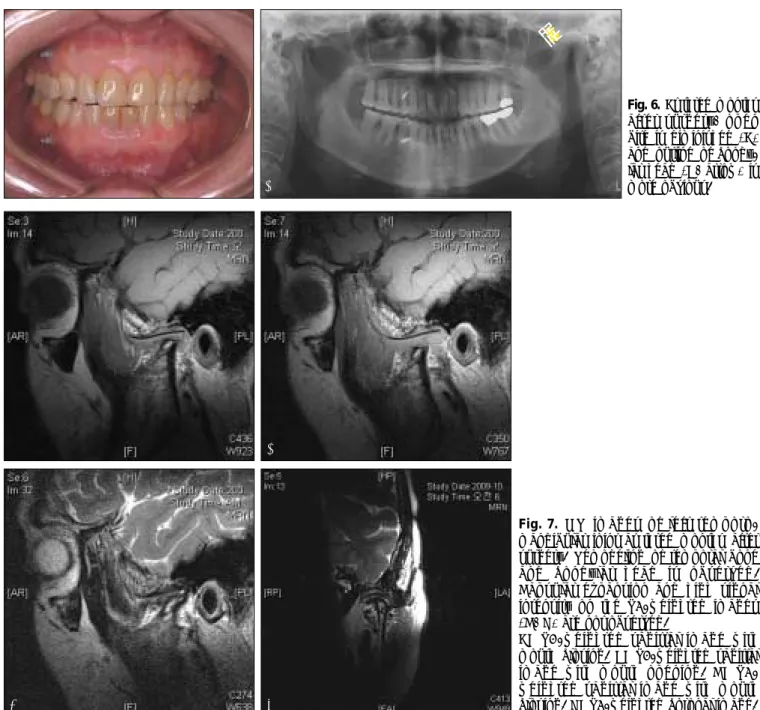
하였을 때, 개구량은 36mm였으며, 측두하악관절의 통증은 해소된 상태였다. 수술 전에도 존재하였던 개방교합의 개 선을 위해 우측 상하악 소구치부 치조골에 골내 고정 나사 를 식립하여 고무줄을 이용한 악간 견인을 시작하였다. 또 한 저작시 좌측 측두하악관절에 가해지는 교합력을 줄이 기 위해 교합안정장치 치료와 약물치료를 병행하였다. 수 술 후 3개월 경과 관찰시 개구량은 42mm였으며, 측두하악 관절의 통증은 호소하지 않았다. 개방교합은 우측 구치부 에서 미약하게 존재하는 정도로 감소되었으며, 파노라마 방사선 사진과 자기공명영상에서 팽창되었던 좌측 관절강
Fig. 5. Histopathologic findings (H-E stain). A: ×40, villous proliferation of synovium is observed.
B: ×200, giant cells are observed (arrow). C,D: ×100, chondroid metaplasia are observed (arrow).
Fig. 4. Intra-operative photo- graph (A) and removed tissues (B, C). A: Condylar resorption and nodules (arrow) are observed. B: Perforated disc and a part of attached synovi- um, C: Removed nodules and inflamed tissues.
A B C
이 감소된 소견 및 좌측 하악과두와 측두골의 재형성 소견 을 관찰할 수 있었다(Fig. 6A, B, Fig. 7).
Ⅲ. 총괄 및 고찰
융모결절성 활막염은 원인이 정확히 밝혀지지 않은 활막 기원의 양성 병소이다. 혈철소(hemosiderin) 착색이 되어 있 는 경우가 흔하며, 이 경우 색소 융모 결절성 활막염(pig- mented villonodular synovitis)이라고 불린다. 병인론에 대해 서는 여전히 논란이 있지만, 활막의 만성적인 염증성 반응 이라는 주장과 진성 종양이라는 주장이 대체적으로 받아 들여지고 있다1). 역학적으로 성별에 따른 호발 정도의 차 이는 거의 없으며, 연령별로는 30~40대에서 가장 호발하는
것으로 알려져 있다1,6). 임상적으로 측두하악관절의 통증, 관절음, 개구제한 등과 같은 일반적인 측두하악장애의 증 상이 나타날 수 있으며3), 느리게 진행하여 측두하악관절부 의 부종 혹은 촉지되는 종괴의 형태로 나타날 수도 있다1,4,6). 병소의 크기는 0.5cm에서 4cm까지 다양하게 보고되고 있 으며, 병소가 매우 커진 경우, 이하선의 병소로 오인될 수 있고5), 두개저를 침범한 경우도 보고된 바 있다2).
평면 방사선 사진에서 융모 결절성 활막염은 과두 부위 의 피질골 흡수 양상과 이에 따른 관절 공간의 증가가 나타 날 수 있고, 관절 공간 내부의 석회화 양상이 나타날 수도
있다8). 전산화 단층촬영 영상에서 융모결절성 활막염은 철
침착으로 측두하악관절부의 고음영(high attenuation) 부위 로 나타날 수 있는데, 병소가 인접 근육보다는 더 낮은 밀
Fig. 6. At three months after surgery, open bite is diminished (A) and outline of condy- lar head (B, arrow) is more obvious.
Fig. 7. MR images of left temporo- mandibular joint at three months after surgery. Remodeling of temporal bone and condylar head is observed.
Capsular expansion and high signal intensity on the T2-weighted images (C, D) are not observed.
A: T1-weighted sagittal image with mouth closing. B: T1-weighted sagittal image with mouth opening. C: T2- weighted sagittal image with mouth closing. D: T2-weighted coronal image.
A B
C D
A B
도 신호를 나타나는 관절낭 내의 결절형 종괴로 나타난다6-8). 그러나 지질(lipid), 혈철소, 섬유성 기질, 판누스(pannus), 활액, 세포성 성분의 상대적 비율에 따라 그 신호의 강도가 다양하게 나타날 수 있다. T2 강조영상에서는 관절강액의 엽상(loculated) 낭으로 인해 고강도 신호를 보일 수 있고, T1 강조영상에서 거품세포(foam cell) 내부에 축적된 지방 으로 인해 피하지방과 유사한 정도의 고강도 신호를 나타 낼 수도 있다9). 본 증례는 병소내에 혈철소 침착이 거의 없 어 T1, T2 강조영상에서 상대적으로 고강도 신호를 보인 것으로 사료된다.
조직병리학적으로 특징적인 소견은 저배율에서 중층의 활 막 세포가 특징적인 융모 혹은 결절 형태의 변화를 보인다는 것이다. 조직구, 거품세포(foam cell), 거대세포(giant cell) 등 이 나타나며, 혈철소 색소 침착이 나타나는 경우가 많다10,11). 또한 병소 내부에 연골양 화생을 보이는 경우도 있다10).
본 증례에서 초진시 좌측 과두의 흡수 양상과 관절의 통 증 및 염발음으로 미루어 측두하악관절의 골관절염을 의 심하였으나, 자기공명영상 소견으로 미루어 관절강 내를 팽창시키는 양성 병소를 생각할 수 있었다. T2 강조영상에 서 고강도 신호에 부분적인 저강도 신호 부위가 나타나 활 액막 연골종증의 가능성을 고려하였으나 T1 강조영상에서 도 T2 강조영상과 유사한 정도의 고강도 신호를 나타내었 다는 점에서 차이가 있었다. 수술 소견에서도 활액의 삼출 이 증가한 것은 활액막 연골종증에서 나타날 수 있는 소견 이지만 관절강 내에 유리체(loose body)가 발견되지 않아 활액막 연골종증이 아닐 수도 있겠다는 판단을 하였다.
관절강 내에는 유리체와 비슷한 결절형태의 병소가 존재 하였는데, 병리조직학적으로 이것의 내부에는 연골양 화 생을 하는 부분이 많이 관찰되었다. 융모결절성 활막염에 서 이러한 연골양 화생의 소견은 흔치 않으며, 이러한 소견 은 연골모세포종에서도 나타날 수 있어 감별을 요한다. 이 에 대해 Oda 등10)은 이러한 연골양 화생으로 미루어 볼 때, 활액막 연골종증의 반응성 활막 병소로서 결절성 활막염 이 발생하였을 가능성도 완전히 배재할 수는 없다고 기술 하였다. Shapiro 등12)은 세침흡인세포검사(FNAB)가 융모결 절성 활막염의 진단에 도움이 될 수 있다고 하였는데, 융모 결절성 활막염의 세침흡인세포검사시 거대세포가 관찰되 며, 이것으로 활액막 연골종증과 감별이 가능할 것이다.
융모결절성 활막염의 적절한 치료 방법은 종괴, 활막, 이 환골을 완전히 제거하는 것이다1).
측두하악관절에 발생한 융모결절성 활막염의 경우, 보고 된 증례가 많지 않아 장기적 연구를 통해 재발율이 보고된 바는 없으나, Herman 등1)은 그들의 종설 연구에서 7.5%의 재발율을 보인다고 보고하였다. 타 관절 부위에 발생한 융
막의 일부 절제를 시행한 경우는 20증례였다고 보고하였 다. 본 증례는 술전에 골관절염 혹은 활액막 연골종증으로 가진 하에 수술을 시행하였으나, 최종 진단에서 융모결절 성 활막염이 확인된 경우로, 병소의 양상 또한 염증성 병소 와 같이 경계가 명확하지 않아, 활막 및 이환골의 완전한 제거 여부를 명확히 확인하기 어렵기 때문에 향후 긴밀한 경과관찰을 요하리라 사료된다.
참고문헌
1. Herman CR, Swift JQ, Schiffman EL. Pigmented villonodular synovitis of the temporomandibular joint with intracranial exten- sion: a case and literature review. Int J Oral Maxillofac Surg 2009;38:795-801.
2. Day JD, Yoo A, Muckle R. Pigmented villonodular synovitis of the temporomandibular joint: a rare tumor of the temporal skull base. J Neurosurg 2008;109:140-3.
3. Church CA, Rowe M, Llaurado R, Liwnicz BH, Martin PA.
Pigmented villonodular synovitis of the temporomandibular joint:
A report of two cases. Ear Nose Throat J 2003;82:692-5.
4. Kisnisci RS, Tuz HH, Gunhan O, Onder E. Villonodular synovi- tis of the temporomandibular joint: case report. J Oral Maxillofac Surg 2001;59:1482-4.
5. Stryjakowska KK, Martel M, Sasaki CT. Pigmented villonodular synovitis of the temporomandibular joint: Differential diagnosis of the parotid mass. Auris Nasus Larynx 2005;32:309-14.
6. Lee JH, Kim YY, Seo BM, Baek SH, Choi JY, Choung PH, et al.
Extra-articular pigmented villonodular synovitis of the temporo- mandibular joint: case report and review of the literature. Int J Oral Maxillofac Surg 2000;29:408-15.
7. Kim KW, Han MH, Park SW, Kim SH, Lee HJ, Jae HJ, et al.
Pigmented villonodular synovitis of the temporomandibular joint:
MR findings in four cases. Eur J Radiol 2004;49:229-34.
8. Song MY, Heo MS, Lee SS, Choi SC, Park TW, Lim CY, et al.
Diagnostic imaging of pigmented villonodular synovitis of the temporomandibular joint associated with condylar expansion.
Dentomaxillofac Radiol 1999;28:386-90.
9. Bemporad JA, Chaloupka JC, Putman CM, Roth TC, Tarro J, Mitra S, et al. Pigmented villonodular synovitis of the temporo- mandibular joint: diagnostic imaging and endovascular therapeu- tic embolization of a rare head and neck tumor. Am J Neuroradiol 1999;20:159-62.
10. Oda Y, Izumi T, Harimaya K, Segawa Y, Ishihara S, Komune S, et al. Pigmented villonodular synovitis with chondroid metapla- sia, resembling chondroblastoma of the bone: a report of three cases. Mod Pathol 2007;20:545-51.
11. Aoyama S, Iwaki H, Amagasa T, Kino K, Okada N, Kishimoto S. Pigmented villonodular synovitis of the temporomandibular joint: differential diagnosis and case report. Br J Oral Maxillofac Surg 2004;42:51-4.
12. Shapiro SL, McMenomey SO, Alexander P, Schmidt WA. Fine- needle aspiration biopsy diagnosis of ‘invasive’temporo- mandibular joint pigmented villonodular synovitis Clinical, imaging, and cytopathologic correlation. Arch Pathol Lab Med.
2002;126:195-8.
13. Schwartz HS, Unni KK, Pritchard DJ. Pigmented villonodular synovitis: a retrospective review of affected large joint. Clin Orthop 1989;247:243-55.