Reliability of cone-beam computed tomography for temporomandibular joint analysis
Objective: The aim was to assess the intraobserver and interobserver reliabilities of temporomandibular joint linear measurements and condylar shape classifi- cations performed with cone-beam computed tomography (CBCT). Methods:
CBCT images of 30 patients were measured at two different time points by two orthodontists using the Dolphin 3D program (n = 60). Anterior, posterior, and superior joint space measurements and sagittal joint morphology classification in the sagittal view and medial and lateral joint space and mediolateral width mea- surements and coronal joint morphology classification in the coronal view were recorded. Intraclass-interclass correlation coefficients (ICC) and kappa statistics were used to assess intraobserver and interobserver reliability for the measure- ments and morphology classifications, respectively. Results: The ICC values were good for measurements of the posterior joint space by observer I and for mea- surements of the posterior, medial, and lateral joint spaces by observer II, while the other intraobserver measurements were excellent. Only the mediolateral width measurements showed excellent interobserver ICC values, while the other mea- surements showed good interobserver ICC values. Intraobserver agreement for the sagittal morphology classifications was moderate (k = 0.479) and almost perfect (k
= 0.858) for observers I and II, respectively, while the corresponding agreement for the coronal morphology classifications was substantial for both observers.
The interobserver agreement values for sagittal and coronal morphology clas- sifications were slight (k = 0.181) and fair (k = 0.265), respectively. Conclusions:
Linear temporomandibular joint measurements were reproducible and reliable in both intraobserver and interobserver evaluations. However, interobserver agree- ment for assessments of condylar shape was low.
[Korean J Orthod 2019;49(2):81-88]
Key words: Temporomandibular joint measurement, Condyle shape, Reliability, Cone-beam computed tomography
Hande Gorucu-Coskuner Ezgi Atik
Hakan El
Department of Orthodontics, School of Dentistry, Hacettepe University, Ankara, Turkey
Received March 29, 2018; Revised May 14, 2018; Accepted June 22, 2018.
Corresponding author: Hande Gorucu-Coskuner.
Assistant Professor, Department of Orthodontics, School of Dentistry, Hacettepe University, Sıhhıye, 6100 Ankara, Turkey.
Tel +90-312-305-22-90 e-mail [email protected]
How to cite this article: Gorucu-Coskuner H, Atik E, El H. Reliability of cone-beam computed tomography for temporomandibular joint analysis. Korean J Orthod 2019;49:81-88.
© 2019 The Korean Association of Orthodontists.
This is an Open Access article distributed under the terms of the Creative Commons Attribution Non-Commercial License (http://creativecommons.org/licenses/by-nc/4.0) which permits unrestricted non-commercial use, distribution, and reproduction in any medium, provided the original work is properly cited.
pISSN 2234-7518 • eISSN 2005-372X
https://doi.org/10.4041/kjod.2019.49.2.81
INTRODUCTION
Condylar position and morphology are important fea- tures that are mostly underestimated and should be tak- en into account during orthodontic treatment planning.
Considering the importance of harmony between the dentition and the associated musculoskeletal structures in ensuring stability of the occlusion, temporomandibu- lar joint (TMJ)-oriented treatment planning has gained popularity recently.
1The condylar position has been suggested to be an important factor in providing or re- establishing temporomandibular harmony with the den- tition and is important for achieving a stable occlusion after orthodontic treatment.
2Therefore, orthodontists should not only correct tooth alignment and occlusal interferences, but also create harmonious condylar posi- tions with respect to the dentition.
3The TMJ has a complex anatomy composed of the mandibular condyle, temporal bone, and articular disk.
Additionally, the TMJ is surrounded by bony structures.
Because of these characteristics, the TMJ cannot be easily visualized with traditional 2-dimensional radiog- raphy. For 3-dimensional (3D) evaluation of the TMJ, computed tomography (CT) and magnetic resonance imaging (MRI) have been suggested previously.
4,5MRI is commonly used for assessment of soft tissue structures, whereas CT is used to assess the osseous components of the TMJ.
6Cone-beam computed tomography (CBCT) can overcome the limitations of conventional CT, such as high cost, difficulties in access to equipment, and relatively high radiation dose.
6However, CBCT has lim- ited low-contrast resolution due to various physical and technical factors, which can limit its usefulness in soft tissue evaluations.
7The highly scattered radiation dur- ing image acquisition adversely affects the contrast in the projection data and the final reconstructed images.
8Despite these limitations, CBCT has become a highly preferred imaging modality for evaluation of the osseous structures of the TMJ.
3,9-11One of the main advantages of CBCT is its ability to produce scans with varying fields of view (FOVs).
Therefore, direct scans from the required region can be obtained according to the clinical indication.
8Although CBCT with a large FOV has limited utility in most condi- tions, the American Academy of Oral and Maxillofacial Radiology suggests that image acquisition with a medi- um-sized or large FOV can be indicated for evaluation of anteroposterior, vertical and transverse discrepancies, asymmetries, and signs and symptoms of temporoman- dibular disorder (TMD).
12The goals of TMJ imaging by CBCT are to assess the integrity of the bony structures in case of disorders, verify the extent and stage of the disorders, and evalu- ate the effects of treatment.
6The condylar positions and
shapes in different malocclusions
3,9,11,13-15and the ef- fects of orthodontic treatment on condylar positions
10,16have recently become topics of interest. Although sev- eral studies have dealt with the aforementioned top- ics,
3,9-11,13-16to our knowledge, there is no study solely evaluating the reliability of TMJ space measurements and condylar shape classifications performed using CBCT. Therefore, the null hypothesis of this study was that TMJ linear measurements and condylar shape clas- sifications obtained using CBCT with sagittal and coro- nal sections are reliable in intraobserver and interob- server evaluations.
MATERIALS AND METHODS
Ethical approval for this investigation was granted by Hacettepe University Ethical Committee (approval number, GO 16/591-23). CBCT images of 30 patients were selected from the digital archives of Department of Orthodontics, School of Dentistry, Hacettepe Uni- versity. These images were taken from the patients for presurgical evaluation and no other extra radiologic examinations were performed. CBCT scans were selected irrespective of the patients’ sex by applying the follow- ing inclusion criteria: (1) no history of TMDs, (2) no sys- temic diseases that could affect TMJ, (3) no congenital diseases or syndromes, (4) CBCT scans taken with i-CAT Cone Beam 3D Imaging System (Imaging Sciences Inter- national, Hatfield, PA, USA) at maximum intercuspation, (5) both right and left condyles fully contained in the images, and (6) no deficient image quality or artifacts.
The selected subjects’ ages ranged between 15 and 22 years. The subjects were in an upright sitting position with the Frankfurt horizontal plane parallel to the floor.
The scanning settings for the CBCT machine were as follows: FOV, 23 × 17 cm (voxel size, 0.30 mm); tube voltage, 120 kVp; tube current, 2 mA; and scan time, 17.8 seconds. CBCT data were exported in the Digital Imaging and Communications in Medicine (DICOM) for- mat.
Before obtaining the measurements, two orthodontists
with 9 years’ experience (HGC and EA) were trained to
perform TMJ linear measurements and condyle shape
classifications using the teaching material from Dalili et
al.
13and Kinzinger et al.
17The training included a de-
tailed explanation of the hand-drawn illustrations and
a calibration exercise conducted at the beginning of the
study. The calibration protocol included an explanation
of the 3D measurement tools in the Dolphin Imaging
software and a demonstration of the measurements to
be made for this research. To allow blinded assessments,
the images were randomly analyzed and the examiners
did not have access to their previous measurements in
the second analysis.
The images were exported to the Dolphin 3D pro- gram (version 11.8; Dolphin Imaging & Management Solutions, Chatsworth, GA, USA) for the measurements.
Initially, all radiographs were oriented in the coronal, sagittal, and axial planes for standardization. The sagit- tal plane was adjusted to reflect the midsagittal plane as bisecting symmetric midfacial structures. The axial plane was constructed as a line passing through the most superior point of the meatus acusticus externus and the most inferior point of the orbital rim on the right and left sides, to reflect the Frankfurt horizontal plane.
Finally, the coronal plane was adjusted by using the transporionic line. After the orientation, all radiographs were saved; subsequently, the two observers performed the following procedures separately for all measure- ments and classifications.
The center and the long axes of the condyles were selected from the sagittal and axial views to create the TMJ images. The axial slice thickness was set to 1 mm and circular direction settings were applied in order to identify the largest and most pronounced condyle image for the right and left joints separately (Figure 1). After creation of the TMJ images, coronal and sagittal mea- surements were performed from 90
oto 270
oand 0
oto 180
operspectives, respectively. The following measure- ments for right and left joints were performed twice by two calibrated orthodontists within 15-day intervals (n = 60).
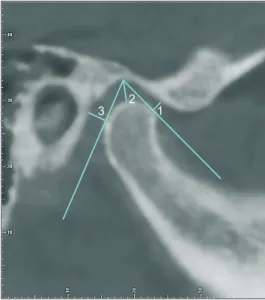
From the sagittal view (Figure 2);
1. Anterior joint space (AJS): The line tangential to the anterior aspect of the condyle was drawn from the most superior point of the glenoid fossa. The perpendicular distance from the anterior tangential plane to the glenoid fossa was measured as the
AJS.
2. Superior joint space (SJS): The distance from the most superior point of the glenoid fossa to the most superior aspect of the condyle was measured as the SJS.
3. Posterior joint space (PJS): The line tangential to the posterior aspect of the condyle was drawn from the most superior point of the glenoid fossa. The perpendicular distance from the posterior tangen- tial plane to the glenoid fossa was measured as the PJS.
4. Sagittal condyle morphology classification: The sagittal condyle morphology was classified as (A) rounded, (B) anteriorly flattened, or (C) posteriorly flattened, in accordance with the recommendations by Kinzinger et al.
17From the coronal view (Figure 3);
1. Medial joint space (MJS): A tangent line was drawn from the deepest point to the medial slope of the glenoid fossa. The perpendicular line from the most prominent point of the medial pole of the condyle to the tangent line was measured as the MJS.
2. Lateral joint space (LJS): A tangent line was drawn from the deepest point to the lateral slope of the glenoid fossa. The perpendicular line from the most prominent point of the lateral pole of the condyle to the tangent line was measured as the LJS.
3. Mediolateral width (MLW): The distance from the most prominent point of the medial pole to the most prominent point of the lateral pole was mea- sured as the MLW.
4. Coronal condyle morphology classification: The coronal condyle morphology was classified as (A) round, (B) convex, or (C) angulated, in accordance
Figure 1. Arrangement of the left condyle’s long axis.
3 2
1
Figure 2. Measurement of the anterior (1), superior (2),
and posterior (3) joint spaces.
with the scheme outlined by Kinzinger et al.
17The data were analyzed using IBM SPSS Statistics version 21.0 (IBM Corp., Armonk, NY, USA). Using intraclass-interclass correlation coefficients (ICC) with 95% confidence intervals, intraobserver reliability was assessed as the agreement between the first and second measurements by each observer (HGC, EA) and interob- server reliability was assessed as the agreement between the first measurements by both observers. ICC values were classified in accordance with the study by Mattos et al.
18as follows: excellent, above 0.9; good, between 0.75 and 0.9; moderate, between 0.5 and 0.75; and poor, below 0.5. The intraobserver and interobserver reli- abilities of the morphology classifications were evaluated with kappa statistics. Kappa values were categorized in accordance with the study by Landis and Koch
19as fol- lows: almost perfect, above 0.8; substantial, between 0.6 and 0.8; moderate, between 0.4 and 0.6; fair, between
0.2 and 0.4; and slight, between 0 and 0.2.
RESULTS
The ICC values for the measurements (AJS, SJS, PJS, MJS, LJS, and MLW) are shown in Table 1. The AJS, SJS, MJS, LJS, and MLW measurements by observer I and the AJS, SJS, and MLW measurements by observer II showed excellent ICC values (> 0.9). The PJS measurement by observer I and the PJS, MJS, and LJS measurements by observer II showed good ICC values (between 0.75 and 0.9). The only excellent interobserver ICC value (> 0.9) was obtained for the MLW measurement, while the re- maining values were in the good range (between 0.75 and 0.9).
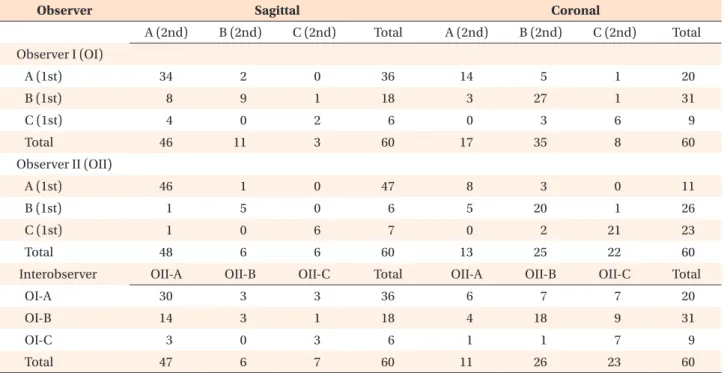
The sagittal and coronal morphology classifications by the observers and the intraobserver/interobserver com- parisons are shown in Table 2. The kappa values
19for intraobserver and interobserver agreements are shown in Table 3. In evaluations of the morphological clas- sifications, observer I showed moderate (k = 0.479) and substantial (k = 0.629) intraobserver agreement for the sagittal and coronal classifications, respectively. Observer II showed almost perfect (k = 0.858) and substantial (k
= 0.713) intraobserver agreement for the sagittal and coronal classifications, respectively. The interobserver agreement values were slight (k = 0.181) and fair (k = 0.265) for the sagittal and coronal classifications, re- spectively.
DISCUSSION
Appropriate evaluation of the TMJ is vital for accurate diagnosis and treatment planning before orthodontic treatment. Therefore, consistency across TMJ evalua- tions performed by different clinicians is an essential criterion for any evaluation technique. Considering these factors, the null hypothesis of this study was that TMJ linear measurements and condylar shape classifications performed using CBCT are reliable.
Table 1. Analysis of the anterior, superior, posterior, medial, and lateral joint space and mediolateral width measurements
Variable Observer I Observer II*** Interobserver***
ICC 95% CI ICC 95% CI ICC 95% CI
Anterior joint space 0.914 0.856–0.949 0.924 0.873–0.955 0.899 0.832–0.940
Superior joint space 0.931 0.885–0.959 0.915 0.858–0.949 0.856 0.759–0.914
Posterior joint space 0.894 0.823–0.937 0.895 0.824–0.937 0.848 0.746–0.909
Medial joint space 0.917 0.862–0.951 0.815 0.690–0.889 0.891 0.818–0.935
Lateral joint space 0.904 0.840–0.943 0.897 0.828–0.939 0.853 0.753–0.912
Mediolateral width 0.992 0.986–0.995 0.975 0.957–0.985 0.993 0.988–0.996
ICC, Intraclass-interclass correlation coefficient; 95% CI, 95% confidence interval.
***p < 0.001.
Figure 3. Measurement of the medial (1) and lateral (2) joint spaces and the mediolateral width (3).
3 1 2