• 검색 결과가 없습니다.

A Case of Synovial Chondromatosis in the Temporomandibular Joint Accompanied by Progressive Occlusal Changes JOMP

N/A
N/A
Protected

Academic year: 2021

Share "A Case of Synovial Chondromatosis in the Temporomandibular Joint Accompanied by Progressive Occlusal Changes JOMP"

Copied!
5
0
0

로드 중.... (전체 텍스트 보기)

전체 글

(1)

pISSN 2288-9272 eISSN 2383-8493 J Oral Med Pain 2019;44(2):69-73 https://doi.org/10.14476/jomp.2019.44.2.69

A Case of Synovial Chondromatosis in the Temporomandibular Joint Accompanied by Progressive Occlusal Changes

Mi-Ju Park, Jin-Seok Byun, Jae-Kwang Jung, Jae-Kap Choi

Department of Oral Medicine, School of Dentistry, Kyungpook National University, Daegu, Korea

Received March 22, 2019 Revised April 15, 2019 Accepted April 15, 2019

Synovial chondromatosis (SC) is an uncommon progressive cartilaginous metaplasia of re- sidual mesenchymal cells in synovial tissue. This disorder usually affects large joints and is rarely observed in the temporomandibular joint (TMJ). SC in TMJ is difficult to diagnose early owing to non-specific clinical symptoms. In this article, we report a patient with SC on the right TMJ, who presented with pain in the right TMJ and progressive occlusal chang- es, not responsive to conventional conservative temporomandibular disorder treatment for several months. This case emphasizes the importance of an accurate specific diagnosis for TMJ problems before the delivery of any treatment.

Key Words: Synovial chondromatosis; Temporomandibular joint

Correspondence to:

Jae-Kap Choi

Department of Oral Medicine, School of Dentistry, Kyungpook National University, 2177 Dalgubeol-daero, Jung-gu, Daegu 41940, Korea

Tel: +82-53-600-7321 Fax: +82-53-426-2195 E-mail: [email protected]

https://orcid.org/0000-0001-6773-7507

JOMP

Journal of Oral Medicine and Pain

Copyright Ⓒ 2019 Korean Academy of Orofacial Pain and Oral Medicine. All rights reserved.

CC This is an open-access article distributed under the terms of the Creative Commons Attribution Non-Commercial License (http://creativecommons.org/licenses/by-nc/4.0/), which permits unrestricted non-commercial use, distribution, and reproduction in any medium, provided the original work is properly cited.

INTRODUCTION

Synovial chondromatosis (SC) is an uncommon, generally benign metaplastic condition characterized by the forma- tion of cartilaginous nodules [1]. It is mainly found in large joints, such as the hip, knee, and shoulder. However, it very rarely affects the temporomandibular joint (TMJ), as under- stood from more than 200 cases that have been reported since Axhausen first reported in 1933 [2,3].

The pathology and the etiology of SC still remain un- clear. However, some authors have reported a possible re- lationship with past trauma history [1]. Therefore, SC was commonly classified into the primary and secondary forms according to its cause. While primary SC has no obvious etiological factors, secondary SC is associated with obvious causes including internal derangement, inflammatory joint disease, repetitive microtrauma, and past trauma [4].

It is characterized mainly by non-specific clinical signs and symptoms, namely arthralgia, preauricular swelling, mouth opening limitation, joint noise and progressive oc- clusal change, which makes it challenging to achieve an

accurate diagnosis [4,5]. Especially, occlusal change pre- sented with progressive accumulation of loose bodies and a subsequent displacement of condyle [6].

In this case report, we describe a patient with SC in the right TMJ, who presented with limited mouth opening and progressive occlusal change.

CASE REPORT

A 54-year-old female visited the Department of Oral

Medicine, Kyungpook National University Hospital, with

the chief complaints of pain in her right TMJ and mouth

opening limitation. Especially, she presented with such a

progressive occlusal alteration that she had experienced dif-

ficulty in chewing food on the right side. She described that

she had to position her mandible toward the right side in

order to occlude her right posterior teeth. Her past history

revealed that her pain and discomfort started 3-4 years ago

without any known cause and gradually worsened despite

of conservative treatments including physiotherapy, medi-

cation, and occlusal splint therapy, administered at a local

(2)

dental clinic, based on the clinical impression of internal derangement in her right TMJ. Moreover, she described a slight swelling on the right preauricular area (Fig. 1). Pain severity fluctuated during the day, but her pain score on a 100-mm visual analogue scale was usually around 30.

Despite investigating her history thoroughly, no specific medical and dental history that could be linked with onset and progression of her symptoms was noted.

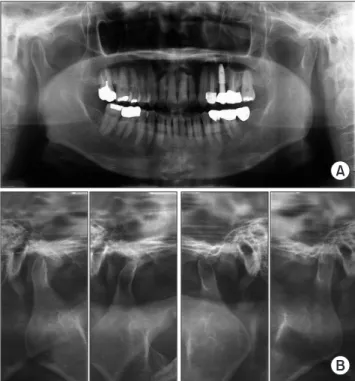
Clinical examination revealed slight disocclusion of the right posterior teeth with premature contact, when deter- mined using shimstock occlusion foils (Fig. 2). It was also observed that the mandibular midline was slightly shifted toward the left. The maximum mouth opening range was 34 mm with deflection to the right side, as measured be- tween maxillary and mandibular incisors. She reported ten- derness on digital palpation in the right TMJ. However, no joint noise was detected on the right TMJ. Conventional radiograph views including the panoramic and TMJ pan- oramic views did not demonstrate any significant patholog- ical bony changes on her right TMJ (Fig. 3). Therefore, for

further evaluation, magnetic resonance imaging (MRI) was performed after careful consultation with her. MRI revealed that there were multiple small loose bodies within the ar- ticular cavity of the right TMJ, which present with a dis- tinct dark signal. In addition, excessive joint effusion was also found in the right TMJ, which was sufficiently bulging to displace the right condyle anterior-inferiorly within the mandibular fossa. However, the discal position and the con- dylar shape were evaluated to be normal (Fig. 4).

Based on clinical and diagnostic imaging findings, it was suggested that the occlusal changes might be caused by excessive joint effusion surrounding multiple loose bod- ies within the right TMJ, and premature contacts on the right posterior teeth might be associated with anterior dis- placement of the right condyle; subsequently, this causes a

Fig. 1. Right preauricular swelling in the patient (arrowheads).

Fig. 2. Photographs showing pre- treatment occlusion: (A) right, (B) front, and (C) left.

A B C

Fig. 3. Radiographic images show no remarkable pathologic findings except that the sliding movement of the right condyle is insufficient: (A) panoramic view and (B) temporomandibular joint panoramic view.

A

B

(3)

disturbance in the cusp–fossa occlusal relationship.

For surgical intervention on the affected joint, she was re- ferred to the Department of Oral and Maxillofacial Surgery, Kyungpook National University Dental Hospital. Surgical removal of the intra-articular bodies was performed by adopting a preauricular approach under general anesthesia (Fig. 5). Based on tissue biopsy specimens, the histopatho- logical examination confirmed SC diagnosis. Postoperative panorama showed no morphologic changes in the right condyle. At 1-month follow-up, occlusion was found to be normalized with simultaneous occlusal contacts on both sides while her mouth opening was preserved with inter- incisor distance of approximately 4 cm without any feeling of pain.

DISCUSSION

SC is a rare progressive cartilaginous metaplasia of the residual mesenchyme in the synovial tissue of the joints.

The cartilaginous nodules tend to protrude from the synovi- al membrane as they grow in size and eventually lose their attachment, so called “loose bodies” [7]. SC was known to mainly affect the large joints, but rarely TMJ. Some differ- ences in demographic features are known to exist between SCs in TMJ and those occurring in large joints. While the mean age of its onset in other joints was approximately 25 years, SCs were known to occur in TMJ during the age range of 39-55.4 years [8,9]. Furthermore, there was the predilection of SC for females, with a sex distribution of 1:2 ratio (male:female) [10]. Therefore, these findings indicat- ed that SC in TMJ had a high predilection for middle-aged women.

The clinical symptoms of SC include impaired mandibu- lar movement, joint pain, crepitation, joint swelling. These symptoms are similar to those caused by temporomandibu- lar disorders and other TMJ benign tumors. It was known that such a clinical non-specificity frequently made the ear- ly and accurate diagnosis of SC difficult for clinicians. SC in TMJ may occasionally cause progressive occlusal chang- es owing to condylar shift. A previous study reported that occlusal changes occurred in 11 of 43 SC cases, mainly with a posterior open bite on the ipsilateral side [11]. It was also described that posterior cross bite could be induced when large SCs developed in the medial part of the condyle. In this case, our patient presented with a posterior open bite and premature contact on the ipsilateral side affected by SC. These occlusal changes are different from those stated by Mupparapu [12]. They described ipsilateral open bite and contralateral premature contact as typical occlusal changes

Fig. 4. Proton density-weighted magnetic resonance imaging T2 images of the right temporomandibular joint in a closed jaw position. The white arrow indicates a large amount of joint effusion that bulge into the joint cavity. Three white arrowheads indicate multiple small intra-articular cartilaginous bodies.

Fig. 5. (A) Preauricular incision and ex- posure of a cartilaginous loose body.

(B) A number of loose bodies (appro- ximately 50) were observed.

A B

(4)

in patients with SC lesions. However, occlusal changes could vary depending on the altered pattern of condy- lar position determining the occlusal change. When the amount of joint effusion and loose bodies would be exces- sive enough to displace the condyle even slightly, the cusp–

fossa relationship could be disturbed at the premature con- tact on the slope of the cusp rather than the fossa.

For SC diagnosis, the American Academy of Orofacial Pain suggested a diagnostic guideline comprising four cat- egories: history taking, clinical finding, imaging findings, and histological findings [6]. The past month history of the patient should be positive for at least one of the follow- ing: report of preauricular swelling, arthralgia, progressive mouth opening limitation, and joint noise. Furthermore, clinical examination must confirm at least one of the fol- lowing: preauricular swelling, arthralgia, maximum as- sisted opening of <40 mm including the vertical incisal overlap, and crepitus. Diagnostic imaging should demon- strate the following: multiple chondroid nodules, joint effu- sion, and amorphous iso-intensity signal tissues within the joint space and capsule in MRI or loose calcified bodies in the soft tissues of the TMJ in computed tomography (CT).

Finally, histologic examination should confirm cartilagi- nous metaplasia.

For the stage classification, Milgram [13] suggested three stages for SC based on histopathological studies. Stage 1 is the initial stage presenting with active metaplasia of the in- trasynovial tissue, but without the formation of any loose bodies. Stage 2 is a proliferative stage in which metaplasia in the synovium and loose bodies including active chondro- cyte appear simultaneously. In the Stage 3, there are multi- ple calcified or ossified detached loose bodies with no more active metaplastic activity. Therefore, early stages includ- ing stage 1 or 2 was seldom detected on plain radiographs, which make it difficult for many clinicians to make an early and accurate diagnosis. This was because plain radiographs had some limitations in showing the presence of lesion when cartilaginous loose bodies were not sufficiently cal- cified or overlapped by the condyle or cranial bone. Some authors reported that there was no significant finding in the initial plain radiographs taken for 37% to 47% of SC cases [14,15]. This case also corresponded to stage 2, when based on the findings that the joint effusion was excessive enough

to displace the condyle anterior-inferiorly, while the loose bodies were not fully ossified without any radiographic de- tection in plain radiography. In our case, the patient was also treated with conservative treatments alone over several months after being initially misdiagnosed as disc displace- ment on the right TMJ.

As for treatments for SC, surgical interventions were rec- ommended for the cases causing functional disturbances, including those that reported joint pain and mouth opening limitation. However, recurrence was not common even after surgical removal [16]. Previous researchers proposed that the metaplastic activity of synovium was a major risk fac- tor for recurrence, which was relatively higher in stage 1 or 2. Accordingly, more careful removal of the SC-affected tis- sue area has been recommended for stage 1 or 2 patients. In addition, it was known that early stage SC had the tenden- cy of not responding to conservative treatments [17]. More importantly, it is fundamental to diagnose it early for fa- cilitating prompt and accurate treatment. CT and MRI were regarded as better diagnostic tools than plain radiograph.

MRI is the most useful diagnostic image because it allows the identification of less ossified tissues such as hypodense semi-calcified loose bodies [18].

Furthermore, it was optimized to exhibit the structural changes in entire TMJ components including joint capsule, synovial membrane, disc, joint cavity, and joint effusion.

Such comprehensive imaging makes it possible for the cli- nicians to determine the extent of surgical enucleation.

In conclusion, CT or MRI imaging should be performed to distinguish SC in patients who do not respond to conserva- tive therapy, especially in cases of preauricular swelling or occlusal changes. MRI is a useful tool for detecting the early stage of SC, which is mainly characterized by the presence of less calcified loose bodies and joint effusion.

CONFLICT OF INTEREST

No potential conflict of interest relevant to this article

was reported.

(5)

ORCID

Mi-Ju Park

https://orcid.org/0000-0002-7604-5219 Jin-Seok Byun

https://orcid.org/0000-0002-6182-1238 Jae-Kwang Jung

https://orcid.org/0000-0003-3099-8097 Jae-Kap Choi

https://orcid.org/0000-0001-6773-7507

REFERENCES

1. Pau M, Bicsák A, Reinbacher KE, Feichtinger M, Kärcher H.

Surgical treatment of synovial chondromatosis of the temporo- mandibular joint with erosion of the skull base: a case report and review of the literature. Int J Oral Maxillofac Surg 2014;43:600- 605.

2. Goizueta-Adame CC, González-García R. Synovial chondroma- tosis of the temporomandibular joint: report of 2 patients whose joints were reconstructed with costochondral graft and alloplastic prosthesis. Br J Oral Maxillofac Surg 2010;48:374-377.

3. Reed LS, Foster MD, Hudson JW. Synovial chondromatosis of the temporomandibular joint: a case report and literature review.

Cranio 2013;31:309-313.

4. Guarda-Nardini L, Piccotti F, Ferronato G, Manfredini D. Synovial chondromatosis of the temporomandibular joint: a case descrip- tion with systematic literature review. Int J Oral Maxillofac Surg 2010;39:745-755.

5. Droguett C, Fumeaux JE, Skármeta NP. A case report of a primary synovial chondromatosis of temporomandibular joint, producing medial displacement of the articular disc. Oral Surg 2014;7:92- 96.

6. de Leeuw R, Klasser GD. Orofacial pain : guidelines for assess- ment, diagnosis, and management. 5th ed. Chicago: Quintessence

Publishing; 2013. pp. 145.

7. Testaverde L, Perrone A, Caporali L, et al. CT and MR findings in synovial chondromatosis of the temporo-mandibular joint: our experience and review of literature. Eur J Radiol 2011;78:414- 418.

8. von Lindern JJ, Theuerkauf I, Niederhagen B, Bergé S, Appel T, Reich RH. Synovial chondromatosis of the temporomandibular joint: clinical, diagnostic, and histomorphologic findings. Oral Surg Oral Med Oral Pathol Oral Radiol Endod 2002;94:31-38.

9. Orden A, Laskin DM, Lew D. Chronic preauricular swelling. J Oral Maxillofac Surg 1989;47:390-397.

10. Peng LW, Yan DM, Wang YG, Li YD. Synovial chondromatosis of the temporomandibular joint: a case report with bilateral occur- rence. J Oral Maxillofac Surg 2009;67:893-895.

11. Poveda-Roda R, Bagán JV, Sanchis JM, Margaix M. Pseudotu- mors and tumors of the temporomandibular joint: a review. Med Oral Patol Oral Cir Bucal 2013;18:e392-e402.

12. Mupparapu M. Synovial chondromatosis of the temporomandib- ular joint with extension to the middle cranial fossa. J Postgrad Med 2005;51:122-124.

13. Milgram JW. Synovial osteochondromatosis: a histopathological study of thirty cases. J Bone Joint Surg Am 1977;59:792-801.

14. Blankestijn J, Panders AK, Vermey A, Scherpbier AJ. Synovial chondromatosis of the temporo-mandibular joint. Report of three cases and a review of the literature. Cancer 1985;55:479-485.

15. Forssell K, Happonen RP, Forssell H. Synovial chondromatosis of the temporomandibular joint. Report of a case and review of the literature. Int J Oral Maxillofac Surg 1988;17:237-241.

16. Cho BY, Choi BJ, Lee BS, et al. Synovial chondromatosis of the temporomandibular joint: a case report. J Korean Dent Sci 2013;6:87-95.

17. Aydin MA, Kurtay A, Celebioglu S. A case of synovial chondro- matosis of the TMJ: treatment based on stage of the disease. J Craniofac Surg 2002;13:670-675.

18. Chen MJ, Yang C, Cai XY, Jiang B, Qiu YT, Zhang XH. Synovial

chondromatosis in the inferior compartment of the temporoman-

dibular joint: different stages with different treatments. J Oral

Maxillofac Surg 2012;70:e32-e38.

수치

Fig. 1. Right preauricular swelling in the patient (arrowheads).
Fig. 5. (A) Preauricular incision and ex- ex-posure of a cartilaginous loose body.

참조

관련 문서

An Articulator is a device that can imitate inferior half of face and reproduce mandibular movement, so it can use in diagnosis, decision of treatment plan and education

This study the changes in structure and mechanical characteristics by the analysis on mechanical characteristics of the welding part and the post weld

Moreover, the paper analyzes the policy changes caused by the relationship between the government and congress in the process of making foreign policy in

Thirdly, it appeared that social support had meaningful effect on self-efficacy and the quality of life, and in the case of the difference analysis by

Generally, in case that we predict the vibration by blasting, we compute it on the basis of the charge weight per delay but in case of shocking

The torque analysis was performed acting on the joint of robot by modeling the kinematics and dynamics of the robot.. Load torque of the joint

In this paper, it was examined whether there is a possibility that the medical institution might be mistaken as a specialized hospital designated by the Ministry of Health

In conclusion, it was confirmed that the winter training program is an effective exercise program by inducing positive changes in the physical fitness and