The family Agonidae from Korea comprises 15 species belonging to 10 genera until now (Kim et al., 2005). They distribute mainly in the coast above mid-northern area, of East Sea in the Korean peninsula. As they are very similar in their morphological characters, therefore their taxonomy was under troublesome. There are 3 species that are known as the genus Hypsagonus in Korea: H. quadricornis, H. proboscidalis and H. jordani (Kim et al., 2005). Recently, Ministry of Environment of Korea has promoting the projects for investigation and excavation of wild animals from the Korean peninsula. At a link in the chain of these projects, an unrecorded species identified as a member of the genus Hypsagonus of the family Agonidae was collected from Ju- munjin port in Kangwon-do, Korea. It was iden- tified as H. cornige which has not been recorded into Korean fish fauna. In this study, we des- cribe H. corniger as the first record from Korea based on the specimen.
Counts and measurements were followed those of Hubbs and Lagler (1964), and the number of fin rays and vertebrae were counted by radio- graphs of soft x-ray. The examined specimen was deposited in the Department of Biology, Kunsan
National University (BKNU), Korea.
Hypsagonus corniger Taranetz, 1933
(New Korean name: Ga-si-jul-go-gi) (English name: thorny-fish; Japanese name:
Tongari-shachi-uo) (Figs. 1~2, Table 1)
Hypsagonus corniger Taranetz, 1933: 72, fig. 4, Bering Sea; Kanayama, 1991: 19; Nakabo, 2002: 660.
Material examined. BKNU 2042, 77.5 mm in standard length (SL), off Jumunjin, Kangneung- shi, Kangwon-do, Korea, 15 September, 2006.
Korean J. Ichthyol. 19(1), 70~72, 2007
First Record of Hypsagonus corniger (Agonidae) from Korea
Chung Lyul Lee* and Byung Il Jeon
Department of Biology, Kunsan National University, Kunsan 573-701, Korea
A single specimen of the family Agonidae was collected from the coastal waters of the East Sea, Korea. It was identified as Hypsagonus corniger Taranetz by having the first dorsal fin with seven spines, long supraoccipital spine, sharp spines of body plate, no process on the supralateral bony plates, the broader distance between the first and the second dorsal fins than base of the second dorsal fin, and longer second spine of the first dorsal fin than the first spine. A key to the genus Hypsagonus from Korea is provided. We propose a new Korean name, “Ga-si-jul-go-gi” for the species.
Key words : Agonidae, Hypsagonus corniger, first record, East Sea, Korea
*Corresponding author: [email protected]
─
─ 70 ──
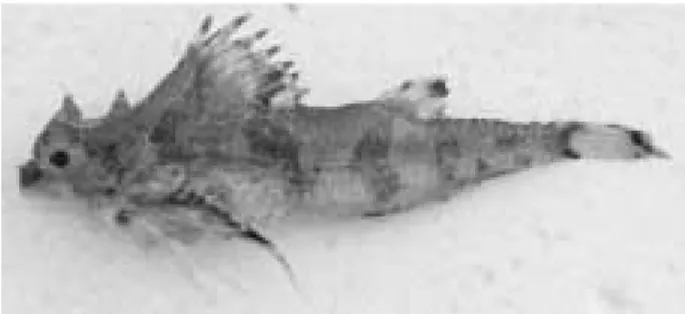
Fig. 1. Hypsagonus corniger Taranetz, BKNU 2042, 77.5 mm SL.
Description. Dorsal fin rays VII-6; anal fin rays 10; pectoral fin rays 12 (lower 7 rays free);
ventral fin rays I, 2; vertebrae 35; gill raker ab- sent.
In percentage of SL, body depth 29.0, head length 27.7, caudal pedungcle length 23.0, caudal pedungcle depth 7.6, distance of first predorsal fin 37.0, distance of prepectoral fin 22.2, distance of preventral fin 26.6, distance of preanal fin 54.5, distance of second predorsal fin 66.7. In percentage of head length, body depth 104.7, snout length 28.8, eye diameter 33.5, interorbital width 46.5, caudal peduncle length 82.8, caudal peduncle depth 27.4, length of cirrus on snout 26.7.
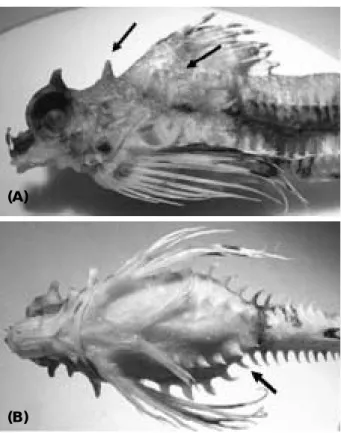
Body compressed, elongate, and covered with bony plates. Bony plates of surface of body sharp process except supralateral plates. Supraorbital and supraoccipital region with pairs of well de- veloped and sharp bony process, respectively.
Spines of the first dorsal fin sharp and strong.
Eye large and interorbital width region wide.
Bony plates on head developed. Nasal spines sharp and supraorbital spine long. Supraoccipi- tal spines developed. A spine of posto-infraorbit well developed. Tip of snout with a long cirrus.
Anterior nostril was small, without nasal tube, with posterior had a long tube.
Lateral line distinct, sensory pores indistinct. 2 to 3 bony scales were placed in lateral line. 5 bony processes in preopercular margin, and its uppermost one large and sharp, absent in oper- culum.
Mouth subterminal and moderate in size. Pre- maxilla and mandible with cilia-like teeth in 2 to 3 rows irregularly, and without teeth on pala- tines. End of tongue rounded. Inside of mouth pale.
All fin rays unbranched. Distance between the first and the second dorsal fin wider than basal length of second dorsal fin.
Color in fresh specimen. Dorsal and lateral surfaces of head and body brownish black with about 6 vertical blackish bands, however lower part and ventral surface of body showing some bright or slight yellowish color. End of the first and the second dorsal and caudal fins had some black bands or spots. Anal fin pale, but with an- terior and posterior with two crossed black bands.
Free rays of pectoral and ventral fins pale, ex- cept upper part of pectoral fin black.
Distribution. East Sea of Korea. Okhotsk Sea, Hokkaido, Yamato Bank, Sakhalin (Nakabo, 2002).
Remarks. Hypsagonus corniger is very similar to H. quadricornis in exomorphology generally.
However, the former distinguished from the lat- ter by having 7 spines of the first dorsal fin (vs 8~9 for H. quadricornis), no process on the supr- alateral plates (vs present), long supraoccipital spine (vs short), sharp spine of lateral body (vs blunt) (Kanayama, 1991; Nakabo, 2002; Kim et al., 2005) (Table 1) (Fig. 2). The taxonomic cha- racters of this specimen from Korea were in ac- cord with descriptions of Taranetz (1933), Kana- yama (1991) and Nakabo (2002) generally.
Key to the genus Hypsagonus (Family Agonidae) from Korea
1a. Lower lobe of pectoral fin with free rays
∙∙∙∙∙∙∙∙∙∙∙∙∙∙∙∙∙∙∙∙∙∙∙∙∙∙∙∙∙∙∙∙∙∙∙∙∙∙∙∙∙∙∙∙∙∙∙∙∙∙∙∙∙∙∙∙∙∙∙∙∙∙∙∙∙∙∙∙∙∙∙∙∙∙∙∙∙∙∙∙∙∙∙∙∙∙
2 1b. No free rays in lower lobe of pectoral fin
∙∙∙∙∙∙∙∙∙∙∙∙∙∙∙∙∙∙∙∙∙∙∙∙∙∙∙∙∙∙∙∙∙∙∙∙∙∙∙∙∙∙∙∙∙∙∙∙∙∙∙∙∙∙∙∙∙∙∙∙∙∙∙∙∙∙∙∙∙∙∙∙∙∙∙∙∙∙∙∙∙∙∙∙∙∙
3 2a. Each supralateral plates with process. Supra- occipital spine short
∙∙∙∙∙∙∙∙∙∙∙∙∙∙∙∙∙∙∙∙∙∙∙∙∙∙∙∙∙∙∙∙∙∙∙∙∙∙∙∙∙∙∙∙First Record of Hypsagonus corniger from Korea 71
Table 1. Comparisons of taxonomic characters among Hypsagonus corniger, H. quadricornis and specimen
Present H. corniger H. quadricornis
Characters specimen Taranetz Kanayama Kanayama
(1933) (1991) (1991)
Standard length (mm) 77.5 - 79.0 68.0
Dorsal fin rays VII-6 VII~VIII-6~7 VII-7 VIII~XI-5~7
(IX-I, 5*)
Anal fin rays 10 - 11 10~11(10*)
Vertebrae 35 - 37 35~37
Supraoccipital spines long slender long** short**
Spines of body plates sharp sharp sharp blunt
Process of supralateral plates absent absent absent present
*: Cuvier and Valenciennes, 1829. **: Nakabo, 2002.
72 C. L. Lee and B. I. Jeon
∙∙∙∙∙∙∙∙∙∙∙∙∙∙∙∙∙∙∙∙∙∙∙∙∙∙∙∙∙∙∙∙∙
(뿔줄고기) H. quadricornis 2b. Each supralateral plates without process, su- praoccipital spine long
∙∙∙∙∙∙∙∙∙∙∙∙∙∙∙∙∙∙∙∙∙∙∙∙∙∙∙∙∙∙∙∙∙∙∙∙∙∙∙∙∙∙∙∙∙∙∙∙∙∙∙∙∙∙∙∙∙∙∙∙∙∙
(가시줄고기, 국명신칭) H. corniger
3a. No longitudinal black stripe on lateral line.
Spines on head blunt, and large supraocular
spine with extra spine posteriorly
∙∙∙∙∙∙∙∙∙∙∙∙∙∙∙∙∙∙∙∙∙∙∙∙∙∙∙∙∙∙∙∙∙∙∙∙∙∙∙∙∙∙∙∙∙∙∙∙∙
(곱추줄고기) H. proboscidalis 3b. Longitudinal black stripe on lateral line.
Spines on head pointed, and large supraocu- lar spine without extra spine posteriorly.
∙∙∙∙∙∙∙∙∙∙∙∙∙∙∙∙∙∙∙∙∙∙∙∙∙∙∙∙∙∙∙∙∙∙∙∙∙∙∙∙∙∙∙
(고양이줄고기) H. jordani
Acknowlegement
This research was supported by a grant(no.
2006-421) from the Ministry of Environment of the Korean Government.
References
Cuvier, M.B. and M. Valencienes. 1829. Histoire naturelle des poissons. Tome trroisienme Suite du Livre troisie- me. Paris, pp. 162~163.
Hubbs, C.L. and K.F. Lagler. 1964. Fishes of the Great Lakers region. Univ. Michigan Press, Ann Arbor, pp.
XV++213.
Kanayama, T. 1991. Taxonomy and phylogeny of the family Agonidae (Pisces: Scorpaeniformes). Mem. Fa- culty of Fisheries, Hokkaido Univ., 38(1-2), pp. 19~21.
Kim, I.S, Y. Choi, C.L. Lee, Y.J. Lee, B.J. Kim and J.H.
Kim. 2005. Illustrated Book of Korean Fishes. Kyo-Hak Pub. Seoul, pp. 256~261. (in Korean)
Nakabo, T. 2002. Agonidae. In: Nakabo, T. (ed.). Fishes of Japan with pictorial keys to the species. English edi- tion I. Tokai University Press, Tokyo, pp. 654~661.
Taranetz, A. 1933. New data on the ichthyofauna of the Bering Sea. Bull. Far Eastern Branch Acad. Sci. U.S.
S.R. 1933. (nos 1-2-3) : 72~73. (In Russian, English Su- mmary)
Fig. 2. Lateral view (A) and ventral view (B) of Hypsa- gonus corniger.
Received : February 2, 2007 Accepted : March 15, 2007
한국산 뿔줄고기속
(
날개줄고기과)
어류1
미기록종, Hypsagonus corniger
이 충 렬*∙전 병 일군산대학교 자연과학대학 생물학과
우리나라의 동해 연안에서 출현하는 날개줄고기과 어류1개체를 동정한 결과 지금까지 우리나 라에서는 기록되지 않은 Hypsagonus corniger Taranetz로 확인되었다. 본종은 형태적으로 뿔줄 고기와 유사하지만, 제1등지느러미 가시는 7개이고, 후두부 가시가 길고, 체측 상부 골질판에는 가시가 없고, 체측 가시 끝이 예리하며, 제1등지느러미와 제2등지느러미 사이는 제2등지느러미 기저 길이보다 크고, 제1등지느러미의 제1가지와 제2가시의 길이 차이가 큰 점 등이 특징적이다. 본 종의 신한국명은 몸에 예리한 가시가 많아서“가시줄고기”라고 명명하였다.
(A)
(B)