• 검색 결과가 없습니다.

Identification of Differentially Expressed Genes in Papillary Thyroid Cancers

N/A
N/A
Protected

Academic year: 2022

Share "Identification of Differentially Expressed Genes in Papillary Thyroid Cancers"

Copied!
8
0
0

로드 중.... (전체 텍스트 보기)

전체 글

(1)

Identification of Differentially Expressed Genes in Papillary Thyroid Cancers

Ki-Young Lee,

1

Song Mei Huang,

2

Shengjin Li,

2

and Jin-Man Kim

2

1

Department of Anesthesiology and Pain Medicine, Anesthesia and Pain Research Institute, Yonsei University College of Medicine, Seoul;

2

Department of Pathology, Cancer Research Institute, Chungnam National University College of Medicine, Daejeon, Korea.

Received September 3, 2007 Accepted June 10, 2008

Reprint address: requests to Dr. Jin-Man Kim, Department of Pathology, Cancer Research Institute, Chungnam National University College of Medicine, Daejeon 301-131, Korea. Tel: 82-42-580-8237, Fax: 82-42-581-5233, E-mail: [email protected]

Purpose: Techniques designed to identify differentially ex- pressed genes (DEGs) in tumors have become important in modern pathology. Genefishing technique

TM

using the anne- aling control primer (ACP) system has recently been devel- oped to screen for DEG transcripts. We tried to identify DEGs involved in papillary thyroid cancer (PTC) by using Gene- fishing technique

TM

. Materials and Methods: We utilized a new differential display method, designated with Genefishing technique

TM

, to analyze DEGs in 21 cases of PTCs. Results:

Comparing the gene expression profiles between PTC and normal thyroid, we detected 17 genes that were differentially expressed in PTCs and performed cloning with sequencing in 10 genes. We confirmed the expression patterns of 2 DEGs by RT-PCR assay and identified the same results in 17 out of 21 (81%) PTCs. The 2 DEGs over-expressed in PTCs were identified as DC-STAMP and type I collagen A1. They are novel genes identified first in PTCs. Conclusion: We confirmed 2 DEGs in PTCs as DC-STAMP and type I collagen A1 by using Genefishing technique

TM

. Although the detailed functions of those 2 genes and their products remain to be determined, the genes will provide insights into mechanisms of carcinogenesis or tumor progression in PTCs.

Key Words: Papillary thyroid cancer, differentially expressed genes, dendritic cell-specific transmembrane protein, type I collagen A1

INTRODUCTION

Papillary thyroid cancer (PTC) is the most com- mon thyroid malignancy.

1

The biological behavior of PTC varies widely, from indolent micro-car-

cinomas to invasive tumors that can metastasize.

Although the etiology of PTC is not well defined, a strong association with exposure to ionizing radia- tion exists in a minority of cases.

2

Many attempts have been made to identify markers for thyroid carcinoma that can distinguish between benign and malignant lesions. However, most of them were proven to be not specific enough, including Galectin-3, BRAF, Met, hTERT, and HBME-1.

3-7

Techniques designed to identify differentially expressed genes (DEGs) in tumors have become pivotal in modern pathology. Genefishing tech- nique

TM

using the annealing control primer (ACP) system has recently been developed by Hwang et al. to screen for DEG transcripts.

8

It uses primers that anneal specifically to the template and allows only genuine products to be amplified, thus elimi- nating false-positive results.

We adapted the ACP system for the identi- fication of DEGs involved in PTCs. Differential display was performed by using kits which incor- porated an ACP. We confirmed the expression patterns of 10 DEGs, and quantified their expres- sion by RT-PCR. These results suggest that this new PCR-based technique is a very useful tool for identification of novel genes differentially ex- pressed in PTCs.

MATERIALS AND METHODS Patient population

Twenty-one patients diagnosed with PTC were

included in this study. The frozen tissues from

(2)

patients were used for RNA isolation. And the frozen tissue from only one subject was used for the differential display analysis.

All PTCs were analyzed according to various clinical-pathological parameters. Clinical staging of PTC was classified according to the Tumor Node Metastasis (TNM) classification of the Inter- national Union Against Cancer (UICC).

GeneFishing

TM

reverse transcription-polymerase chain reaction

First-strand cDNA synthesis

Total RNAs extracted from frozen samples were used for the synthesis of first-strand cDNAs by reverse transcriptase. Reverse transcription was performed for 1.5 hours at 42ºC in a final reaction volume of 20 μL containing 3 μg of the purified total RNA, 4 μL of 5' reaction buffer (Promega, Madison, WI, USA), 5 μL of dNTPs (2 mM each), 2 μL of 10 μM dT-ACP1 (5'-CGTGAATGCTGCGA CTACGATIIIIIT(18)-3'), 0.5 μL of RNasin

RNase Inhibitor (40 U/μL; Promega), and 1 μL of Moloney murine leukemia virus reverse transcriptase (200 U/μL; Promega). First-strand cDNAs were diluted by the addition of 80 μL of ultra-purified water for the GeneFishing

TM

PCR and stored at -20ºC until use.

ACP (Annealing Control Primer)-based GeneFishing

TM

PCR

DEGs were screened by ACP-based PCR method using the GeneFishingTM DEG kits (Seegene, Seoul, South Korea). Briefly, second-strand cDNA was synthesized at 50ºC during one cycle of first- stage PCR in a final reaction volume of 20 μL con- taining 3 - 5 μL (about 50 ng) of diluted first-strand cDNA, 1 μL of dT-ACP2 (10 μM), 1 μL of 10 μM arbitrary ACP, and 10 μL of 2 × Master Mix (Seegene, Seoul, South Korea). The PCR protocol for second-strand synthesis was one cycle at 94ºC for 1 minute, followed by 50ºC for 3 minutes, and 72ºC for 1 minute. After second-strand DNA syn- thesis was completed, the second-stage PCR amplification protocol was 40 cycles of 94ºC for 40 seconds, followed by 65ºC for 40 seconds, 72ºC for 40 seconds and 5 minutes final extension at 72ºC.

The amplified PCR products were separated in 2%

agarose gel and stained with ethidium bromide.

Cloning and sequencing

The differentially expressed bands were ex- tracted from the gel by using the GENCLEAN

II Kit (Q-BIO gene, Carlsbad, CA, USA), and directly cloned into a TOPO TA cloning vector (Invitrogen, Carlsbad, CA, USA) according to the manufacturer's instructions. The cloned plasmids were sequenced with ABI PRISM

3100 Genetic Analyzer (Applied Biosystems, Foster City, CA, USA).

The DNA sequence of each gene was confirmed by comparison with sequences in GenBank (NIH, MD, USA). The primer sequence of each gene was designed using the PRIMER 3 program (MIT, Boston, MA, USA). The synthesis of primers was performed by Bioneer Company.

RT-PCR confirmation

The differential expression of DEGs was confir- med by RT-PCR using each gene specific primer pair. The first-strand cDNA was normalized by the human beta-actin gene. The normalized cDNA was used as a template. The PCR reaction was conducted in a final reaction volume of 20 μL con- taining 2 - 4 μL (about 50 ng) of diluted first- strand cDNA, 1 μL of primer 5 (10 μM), 1 μL of primer 3 (10 μM), and 10 μL of 2 × Master Mix (Seegene, Seoul, South Korea). The PCR am- plification protocol was an initial 3 minutes denaturation at 94ºC, followed by 20 - 25 cycles of 94ºC for 40 seconds, 60ºC for 40 seconds, 72ºC for 40 seconds, and a 5 minutes final extension at 72ºC. The amplified PCR products were separated in 2% agarose gel and stained with ethidium bromide.

RESULTS

Clinicopathologic features

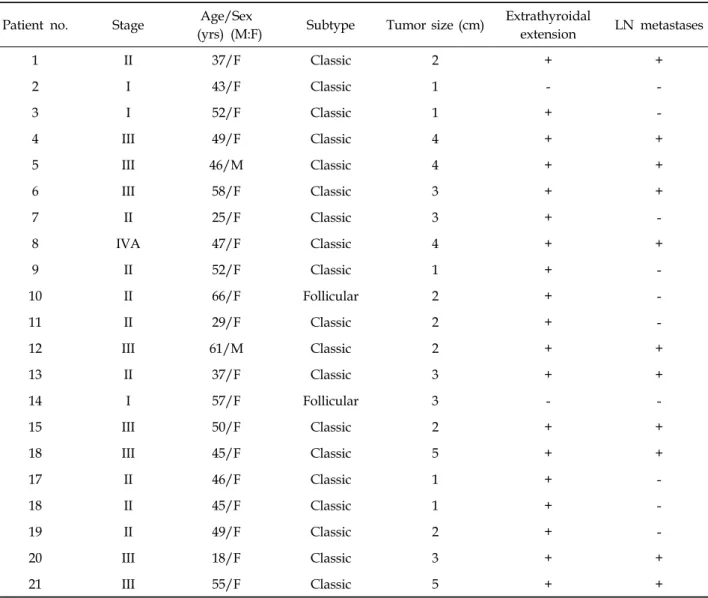
The ages of 21 patients (2 men and 19 women)

ranged between 18 and 66 years (mean age, 46

years). Clinical staging according to the TNM

classification showed stage I in 3, stage II in 9,

stage III in 8, and stage IVA in 1 patient(s). His-

tologically, 19 cases showed classic findings of

(3)

Table 1. Clinicopathologic Features of Twenty-One Papillary Thyroid Cancers Patient no. Stage Age/Sex

(yrs) (M:F) Subtype Tumor size (cm) Extrathyroidal

extension LN metastases

1 II 37/F Classic 2 + +

2 I 43/F Classic 1 - -

3 I 52/F Classic 1 + -

4 III 49/F Classic 4 + +

5 III 46/M Classic 4 + +

6 III 58/F Classic 3 + +

7 II 25/F Classic 3 + -

8 IVA 47/F Classic 4 + +

9 II 52/F Classic 1 + -

10 II 66/F Follicular 2 + -

11 II 29/F Classic 2 + -

12 III 61/M Classic 2 + +

13 II 37/F Classic 3 + +

14 I 57/F Follicular 3 - -

15 III 50/F Classic 2 + +

18 III 45/F Classic 5 + +

17 II 46/F Classic 1 + -

18 II 45/F Classic 1 + -

19 II 49/F Classic 2 + -

20 III 18/F Classic 3 + +

21 III 55/F Classic 5 + +

M, male; F, female; LN, lymph node.

PTC, and 2 cases (No. 10 and 14) were follicular variant of PTC (Table 1).

Differentially expressed genes (DEGs) in papillary thyroid cancers

To identify genes that are specifically or pre- dominantly expressed in PTC, we compared the mRNA expression profiles of PTC with those of normal thyroid. To do this, the mRNAs from both samples were extracted and subjected to ACP RT -PCR analysis using a combination of 120 arbi- trary primers and 2 anchored oligo(dT) primers (dT-ACP 1 and dT-ACP 2). The expression levels

of certain mRNAs were compared between

normal thyroid tissue and PTC tissue of same

patients. The expression levels of certain mRNAs

were either lower or higher in PTCs than in the

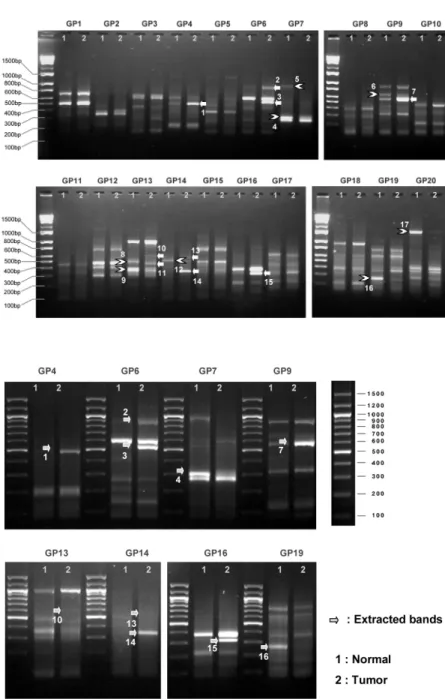
normal thyroid. The analysis generated about 800

amplicons. There are 8 genes over-expressed in

normal thyroid and 9 genes over-expressed in

PTC (Fig. 1). Among the 17 DEGs differentially

expressed, 10 DEGs isolated were cloned, sequ-

enced, and searched with GeneBank (Fig. 2). These

differential display patterns between normal

thyroid and PTC, as assessed by ACP RT-PCR,

were very reproducible.

(4)

Fig. 1. GeneFishing

TM

DEG screening results.

There are 8 genes overexpressed in normal thyroid (arrowhead) and nine genes over- expressed in PTC (arrow). 1. normal, 2. PTC.

DEG, differentially expressed gene; PTC, papillary thyroid cancer.

Fig. 2. The mRNAs of the 10 DEGs showing distinct results were extracted, amplified using the TOPO

TA Cloning kit and were sequenced. DEGs, differentially expressed genes; TA, Taq-amplified.

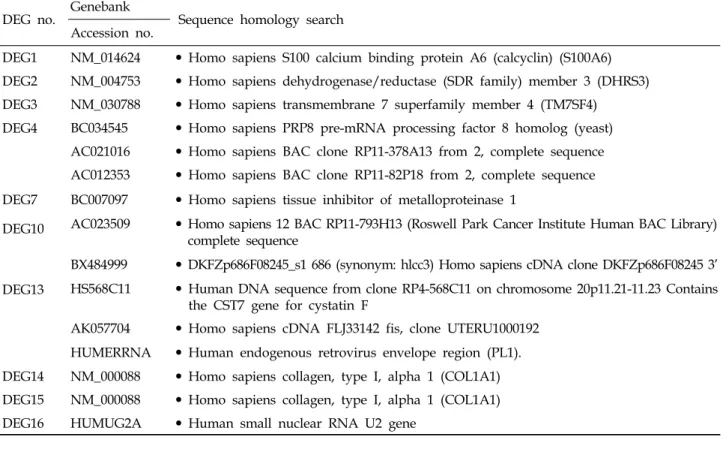
Detection of gene from cloning and sequencing The mRNAs of the DEGs showing distinct results were extracted, amplified using the TOPO TA Cloning kit (Invitrogen, K4500-01, CA, USA) and were sequenced.

The DNA sequence of each gene was confirmed by comparison with sequences in GenBank (NIH, MD, USA). Table 2 shows 10 DEGs accessed by GeneBank and their homologies.

Confirmation of ACP observations by RT-PCR

To confirm the efficacy of the ACP system, the

differential expression of DEG was confirmed by

RT-PCR using each gene specific primer pair. The

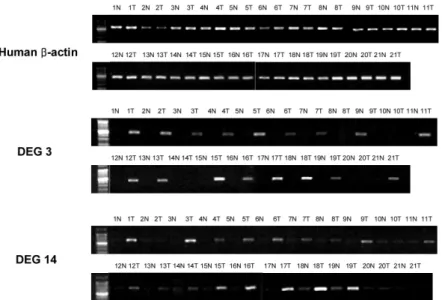
DEG3 and DEG14 were subjected to confirmation

with RT-PCR, because they were distinctively high

in tumor tissue. The primers which we designed

are shown in Fig. 3. With RT-PCR, we confirmed

ACP observation, as shown in Fig. 4. Addition-

ally, we analyzed 21 PTC samples by RT-PCR for

(5)

Table 2. The 10 DEGs Isolated were Cloned, Sequenced, and Searched with GeneBank. DEGs, Differentially Expressed Genes DEG no. Genebank

Sequence homology search Accession no.

DEG1 NM_014624 • Homo sapiens S100 calcium binding protein A6 (calcyclin) (S100A6) DEG2 NM_004753 • Homo sapiens dehydrogenase/reductase (SDR family) member 3 (DHRS3) DEG3 NM_030788 • Homo sapiens transmembrane 7 superfamily member 4 (TM7SF4)

DEG4 BC034545 • Homo sapiens PRP8 pre-mRNA processing factor 8 homolog (yeast) AC021016 • Homo sapiens BAC clone RP11-378A13 from 2, complete sequence AC012353 • Homo sapiens BAC clone RP11-82P18 from 2, complete sequence DEG7 BC007097 • Homo sapiens tissue inhibitor of metalloproteinase 1

DEG10 AC023509 • Homo sapiens 12 BAC RP11-793H13 (Roswell Park Cancer Institute Human BAC Library) complete sequence

BX484999 • DKFZp686F08245_s1 686 (synonym: hlcc3) Homo sapiens cDNA clone DKFZp686F08245 3’

DEG13 HS568C11 • Human DNA sequence from clone RP4-568C11 on chromosome 20p11.21-11.23 Contains the CST7 gene for cystatin F

AK057704 • Homo sapiens cDNA FLJ33142 fis, clone UTERU1000192 HUMERRNA • Human endogenous retrovirus envelope region (PL1).

DEG14 NM_000088 • Homo sapiens collagen, type I, alpha 1 (COL1A1) DEG15 NM_000088 • Homo sapiens collagen, type I, alpha 1 (COL1A1) DEG16 HUMUG2A • Human small nuclear RNA U2 gene

RT-PCR Primer set

DEG3 (470 bp) D3-5

AGC CGC TGG GAG AAG TCA A D3-3

GCT TGT GAG GCT GTG GTA GAG

DEG14 (590 bp) D14-5

AGA CCT GCG TGT ACC CCA CT D14-3

GGT TCA GTT TGG GTT GCT TGT

Human β-actin (510 bp) hβ-actin 5

GAC TAT GAC TTA GTT GCG TTA Hβ-actin 3

GCC TTC ATA CAT CTC AAG TTG

Fig. 3. RT-PCR primer sets of DEG3 and DEG14. RT-PCR, reverse transcriptase-polymerase chain reaction; DEG, differentially expressed gene.

Fig. 4. The DEG3 and DEG14 were subjected to confir- mation with RT-PCR and confirmed ACP observation.

RT-PCR, reverse transcriptase-polymerase chain reaction;

ACP, annealing control primer.

DEG3 and DEG14, and observed up-regulated ex- pression in 17 out of 21 (81%) tumors (Fig. 5).

Overexpressed genes not previously associated with PTC

Genes that we found to be over-expressed in

PTCs have previously been associated with other

cells, tumor cells, stromal cells, or cell cycle con-

trol. Examples include type 1 Collagen, A1

(COL1A1),

9,10

which has frequently been shown to

be over-expressed, as determined by quantitative

(6)

Fig. 5. In 21 PTC samples by RT-PCR, DEG3 and DEG14 were observed to be up-regulated in most tumors. Bothe DEGs in 2 cases of follicular subtype (No. 10 and No. 14) were not up-regulated. PTC, papil- lary thyroid cancer; RT-PCR, reverse tran- scriptase-polymerase chain reaction; DEG, differentially expressed gene.

RT-PCR. Although COL1A1 expression has been demonstrated in tumor cells and tumor-associated stromal cells in multiple cancers,

11

COL1A1 has been reported to be elevated in tumor endothe- lium, compared with normal endothelium,

12

sug- gesting that they play an important role in angio- genesis and formation of desmoplasia in PTC.

Dendritic cell-specific transmembrane protein (DC-STAMP)

13-17

is preferentially expressed by DC in vitro and ex vivo. DC-STAMP was originally isolated from a cDNA library of human monocyte- derived dendritic cells and encodes a protein with putative 7-transmembrane domains.

DISCUSSION

Thyroid cancer is the most common endocrine malignancy, and the biological behavior of PTC varies widely. Although the etiology of PTC is not well defined, a strong association with exposure to ionizing radiation exists in a minority of cases.

2

Also, it has been suggested the involvement of specific genes, including tumor suppressor genes, oncogenes, apoptosis-associated genes and other predisposing genes. However, genes, signaling pathways, and other basic mechanisms are cur- rently not well characterized. Another issue is the diagnostic and prognostic biomarkers of PTC. The classical oncogenic alterations commonly seen in

thyroid cancer include Ras mutations,

18,19

RET/

PTC rearrangements,

20-22

and BRAF mutation.

4

The recently discovered activating mutation in BRAF represents the most common genetic alteration in thyroid cancer. Most of the genetic alterations in thyroid cancer exert their oncogenic actions through the activation of the MAP kinase pathway. When constitutively activated, the MAP kinase pathway leads to tumorigenesis.

23,24

The discovery of the BRAF mutation in PTC represents one of the most important recent achievement in thyroid cancer research and is of significant clinical potential.

Many attempts have been made to identify markers for thyroid carcinoma that can distinguish between benign and malignant lesions. Most have been proven to be not specific enough, including Galectin-3, BRAF, Met, and Cyclin-D1.

3,4,7,25

Techniques designed to identify DEGs in tumors

have become critical in modern pathology. Dif-

ferential display, a screening method described by

Liang et al.,

26

requires PCR using short arbitrary

primers. Although this method is simple, rapid,

and requires only small amounts of total RNA,

many investigators have experienced signifi-

cantly high false-positive rates and poor repro-

ducibility of results,

27,28

because of non-specific

annealing by short arbitrary primers. The use of

longer primers (18 - 20 bp) makes it possible to

increase the annealing temperature to 60°C after

1 - 4 initial cycles at 40 - 45°C.

29

However, the

(7)

additional tail sequences of longer primers are involved in nonspecific annealing to the cDNA template during PCR cycles at low annealing temperatures.

8

Genefishing technique

TM

using the ACP system, has recently been developed by Hwang et al.

8

to screen for DEG transcripts. It uses primers that anneal specifically to the tem- plate and allows only genuine products to be amplified, thus eliminating false-positive results.

In the present study, we used the ACP system for the identification of DEGs involved in PTC tumo- rigenesis, and confirmed the expression patterns of 10 DEGs and quantified their expression by RT- PCR. We found type 1 Collagen A1, DC-STAMP and other novel genes in PTCs.

Collagen type 1 (COL1A1)

9,10

has frequently been found to be over-expressed, as determined by quantitative RT-PCR in 17 out of 21 (81%) PTCs.

Although COL1A1 expression was demonstrated in tumor cells and tumor-associated stromal cells in multiple cancers,

11

COL1A1 was reported to be elevated in tumor endothelium, compared with normal endothelium,

12

suggesting that they play an important role in angiogenesis and formation of desmoplasia. Since a dense demoplastic reaction and matrix remodeling induced by tumor are prominent components of most PTCs, over-ex- pression of COL1A1 can be associated with inva- sive process.

Dendritic cell-specific transmembrane protein (DC-STAMP)

13-16

is preferentially expressed by DC in vitro and ex vivo. DC-STAMP was originally isolated from a cDNA library of human monocyte- derived dendritic cells and encodes a protein with putative seven-transmembrane domains. The pathologic significance of this novel gene in PTC can not currently be explained. Further investiga- tions using immunohistochemistry or in situ hybri- dization is mandatory for this interesting mole- cule in PTC.

The expression of calcyclin (DEG1) was studied for in various benign and malignant thyroid lesions by Nagy et al.

30

However, its expression in PTC still remains to be evaluated in large series of PTCs.

The other genes differentially expressed in PTCs include SDR member 3 (DEG2),

31

PRP8 (DEG4), TIMP1 (DEG7),

32

and Cystatin F (DEG13). They have not been studied in PTCs so far, and need further

evaluation.

With extensive study for the differential gene expression patterns of PTCs using GeneFishing

TM

with ACP primers, we conclude as follows;

1) The ACP-based strategy which we used to identify DEGs in PTCs is easy, and produces no false positive and yields reproducible re- sults.

2) With this method, we detected 17 genes that are differentially expressed in PTCs and cloned with sequences of 10 genes.

3) We confirmed the expression patterns of 2 DEGs by RT-PCR assay, and identified con- sistent results in 81% (17/21) of PTCs.

4) The two DEGs overexpressed in PTCs were confirmed to be DC-STAMP and type I collagen A1. They are novel genes, identified first in PTCs.

5) Although the detailed functions of these two genes and their products remain to be deter- mined, the genes presently identified are expected to provide insights into mechanisms of carcinogenesis or tumor progression in PTCs.

REFERENCES

1. Choi YJ, Park YL, Koh JH. Prevalence of thyroid cancer at a medical screening center: pathological features of screen-detected thyroid carcinomas. Yonsei Med J 2008;

49:748-56.

2. Inskip PD. Thyroid cancer after radiotherapy for child- hood cancer. Med Pediatr Oncol 2001;36:568-73.

3. Inohara H, Honjo Y, Yoshii T, Akahani S, Yoshida J, Hattori K, et al. Expression of galectin-3 in fine-needle aspirates as a diagnostic marker differentiating benign from malignant thyroid neoplasms. Cancer 1999;85:

2475-84.

4. Davies H, Bignell GR, Cox C, Stephens P, Edkins S, Clegg S, et al. Mutations of the BRAF gene in human cancer. Nature 2002;417:949-54.

5. Kroll TG, Sarraf P, Pecciarini L, Chen CJ, Mueller E, Spiegelman BM, et al. PAX8-PPARgamma1 fusion onco- gene in human thyroid carcinoma [corrected]. Science 2000;289:1357-60.

6. Ippolito A, Vella V, La Rosa GL, Pellegriti G, Vigneri R, Belfiore A. Immunostaining for Met/HGF receptor may be useful to identify malignancies in thyroid lesions classified suspicious at fine-needle aspiration biopsy.

Thyroid 2001;11:783-7.

7. Casey MB, Lohse CM, Lloyd RV. Distinction between

papillary thyroid hyperplasia and papillary thyroid

(8)

carcinoma by immunohistochemical staining for cyto- keratin 19, galectin-3, and HBME-1. Endocr Pathol 2003;

14:55-60.

8. Hwang IT, Kim YJ, Kim SH, Kwak CI, Gu YY, Chun JY.

Annealing control primer system for improving speci- ficity of PCR amplification. Biotechniques 2003;35:1180- 4.

9. Yasui W, Oue N, Ito R, Kuraoka K, Nakayama H. Search for new biomarkers of gastric cancer through serial an- alysis of gene expression and its clinical implications.

Cancer Sci 2004;95:385-92.

10. Nakoman C, Resmi H, Ay O, Acikel U, Atabey N, Güner G. Effects of basic fibroblast factor (bFGF) on MMP-2, TIMP-2, and type-I collagen levels in human lung carcinoma fibroblasts. Biochimie 2005;87:343-51.

11. Ryu B, Jones J, Hollingsworth MA, Hruban RH, Kern SE. Invasion-specific genes in malignancy: serial an- alysis of gene expression comparisons of primary and passaged cancers. Cancer Res 2001;61:1833-8.

12. St Croix B, Rago C, Velculescu V, Traverso G, Romans KE, Montgomery E, et al. Genes expressed in human tumor endothelium. Science 2000;289:1197-202.

13. Eleveld-Trancikova D, Triantis V, Moulin V, Looman MW, Wijers M, Fransen JA, et al. The dendritic cell- derived protein DC-STAMP is highly conserved and localizes to the endoplasmic reticulum. J Leukoc Biol 2005;77:337-43.

14. Hartgers FC, Vissers JL, Looman MW, van Zoelen C, Huffine C, Figdor CG, et al. DC-STAMP, a novel multi- membrane-spanning molecule preferentially expressed by dendritic cells. Eur J Immunol 2000;30:3585-90.

15. Kukita T, Wada N, Kukita A, Kakimoto T, Sandra F, Toh K, et al. RANKL-induced DC-STAMP is essential for osteoclastogenesis. J Exp Med 2004;200:941-6.

16. Yagi M, Miyamoto T, Sawatani Y, Iwamoto K, Hosogane N, Fujita N, et al. DC-STAMP is essential for cell-cell fusion in osteoclasts and foreign body giant cells. J Exp Med 2005;202:345-51.

17. Hartgers FC, Looman MW, van der Woning B, Merkx GF, Figdor CG, Adema GJ. Genomic organization, chromosomal localization, and 5' upstream region of the human DC-STAMP gene. Immunogenetics 2001;53:

145-9.

18. Fagin JA. Perspective: lessons learned from molecular genetic studies of thyroid cancer-insights into patho- genesis and tumor-specific therapeutic targets. Endo- crinology 2002;143:2025-8.

19. Bongarzone I, Pierotti MA. The molecular basis of

thyroid epithelial tumorigenesis. Tumori 2003;89:514-6.

20. Nikiforova MN, Caudill CM, Biddinger P, Nikiforov YE.

Prevalence of RET/PTC rearrangements in Hashimoto's thyroiditis and papillary thyroid carcinomas. Int J Surg Pathol 2002;10:15-22.

21. Santoro M, Papotti M, Chiappetta G, Garcia-Rostan G, Volante M, Johnson C, et al. RET activation and clinico- pathologic features in poorly differentiated thyroid tumors. J Clin Endocrinol Metab 2002;87:370-9.

22. Tallini G. Molecular pathobiology of thyroid neoplasms.

Endocr Pathol 2002;13:271-88.

23. Peyssonnaux C, Eychène A. The Raf/MEK/ERK path- way: new concepts of activation. Biol Cell 2001;93:53- 62.

24. Hilger RA, Scheulen ME, Strumberg D. The Ras-Raf- MEK-ERK pathway in the treatment of cancer. Onkologie 2002;25:511-8.

25. Timler D, Tazbir J, Matejkowska M, Gosek A, Czyz W, Brzeziński J. Expression of proteins: D1 cyclin and Ki- 67 in papillary thyroid carcinomas. Folia Histochem Cytobiol 2001;39 Suppl 2:201-2.

26. Liang P, Averboukh L, Keyomarsi K, Sager R, Pardee AB. Differential display and cloning of messenger RNAs from human breast cancer versus mammary epithelial cells. Cancer Res 1992;52:6966-8.

27. Wan JS, Sharp SJ, Poirier GM, Wagaman PC, Chambers J, Pyati J, et al. Cloning differentially expressed mRNAs.

Nat Biotechnol 1996;14:1685-91.

28. Liang P, Pardee AB. Recent advances in differential display. Curr Opin Immunol 1995;7:274-80.

29. Zhao S, Ooi SL, Pardee AB. New primer strategy im- proves precision of differential display. Biotechniques 1995;18:842-6, 848, 850.

30. Nagy N, Decaestecker C, Dong X, Kaltner H, Schüring MP, Rocmans P, et al. Characterization of ligands for galectins, natural galactoside-binding immunoglobulin G subfractions and sarcolectin and also of the expres- sion of calcyclin in thyroid lesions. Histol Histopathol 2000;15:503-13.

31. Parmar DV, Khandkar MA, Pereira L, Bangur CS, Katyare SS. Thyroid hormones alter Arrhenius kinetics of succinate-2,6-dichloroindophenol reductase, and the lipid composition and membrane fluidity of rat liver mitochondria. Eur J Biochem 1995;230:576-81.

32. Huang Y, Prasad M, Lemon WJ, Hampel H, Wright FA,

Kornacker K, et al. Gene expression in papillary thyroid

carcinoma reveals highly consistent profiles. Proc Natl

Acad Sci U S A 2001;98:15044-9.

수치

Table 1. Clinicopathologic Features of Twenty-One Papillary Thyroid Cancers Patient no
Fig. 1. GeneFishing TM  DEG screening results.
Table 2. The 10 DEGs Isolated were Cloned, Sequenced, and Searched with GeneBank. DEGs, Differentially Expressed Genes DEG no
Fig. 5. In 21 PTC samples by RT-PCR,  DEG3 and DEG14 were observed to be  up-regulated in most tumors

참조

관련 문서

roid mass was performed, and the pathologic examination revealed PTC. Thyroid function test was normal and thyroid autoantibodies were negative. Priority was given

In this study, we screened for differentially exp- ressed genes (DEGs) in periodontitis compared with normal tissue using an annealing control primer (ACP) system.. By

Identification of Differentially Expressed Genes in Improved Rainbow Trout Growth by Treatment with a Fish Myostatin Prodomain Using the Annealing Control Primer System.. By

Venn diagram of differentially expressed genes in senescent and non-senescent CD8+ T cells of Behçet’s disease patients compared to healthy controls ...10 Figure 3..

Proteomic Analysis of Differentially Expressed Proteins in Human Lung Cells Following Formaldehyde Treatment... levels of the corresponding proteins in a cell, even if

Genes expressed during conidial germination of the pepper anthracnose fungus Colletotrichum acutatum were identified by sequencing the 5’ end of unidirectional cDNA clones prepared

To evaluate the expression rate of RET/PTC rearrangement and CK19 in PTCs in a Korean population, we studied 115 papillary thyroid carcinomas in 3 mm-core tissue microarray

In this study, we performed GEP analysis using oligo- nucleotide microarray and identified 79 differentially-ex- pressed genes (70 up-regulated and 9 down-regulated) be- tween PTCs