Identification of Genes Expressed during Conidial Germination of the Pepper Anthracnose Pathogen, Colletotrichum acutatum
Jeong-Hwan Kim
1, Jong-Hwan Lee
1,2and Woobong Choi
1,2*
1
Department of Biotechnology and Bioengineering/Biomaterial Control, Dong-Eui University, Busan 614-714, Korea
2
Blue-Bio Industry RIC, Dong-Eui University, Busan 614-714, Korea
Received November 13, 2012 /Revised November 22, 2012 /Accepted November 22, 2012
Genes expressed during conidial germination of the pepper anthracnose fungus Colletotrichum acutatum were identified by sequencing the 5’ end of unidirectional cDNA clones prepared from the conidial germination stage. A total of 983 expressed sequence tags (ESTs) corresponding to 464 genes, 197 con- tigs and 267 singletons, were generated. The deduced protein sequences from half of the 464 genes showed significant matches (e value less than 10
-5) to proteins in public databases. The genes with known homologs were assigned to known functional categories. The most abundantly expressed genes belonged to those encoding the elongation factor, histone protein, ATP synthease, 14-3-3 protein, and clock controlled protein. A number of genes encoding proteins such as the GTP-binding protein, MAP kinase, transaldolase, and ABC transporter were detected. These genes are thought to be involved in the development of fungal cells. A putative pathogenicity function could be assigned for the genes of ATP citrate lyase, CAP20 and manganese-superoxide dismutase.
Key words : Expressed sequence tag, conidial germination, pepper anthracnose
*Corresponding author
*Tel:+82-51-890-2279, Fax:+82-51-890-2632
*E-mail : [email protected]
This is an Open-Access article distributed under the terms of the Creative Commons Attribution Non-Commercial License (http://creativecommons.org/licenses/by-nc/3.0) which permits unrestricted non-commercial use, distribution, and reproduction in any medium, provided the original work is properly cited.
Journal of Life Science 2013 Vol. 23. No. 1. 8~14 DOI : http://dx.doi.org/10.5352/JLS.2013.23.1.8
Introduction
Pepper (Capsicum annuum L) is an important crop because of its high consumption as seasoning vegetable in Korea and many other countries. Anthracnose disease is one of the ma- jor limiting factors in pepper production [17]. Anthracnose causes lesions on immature green fruits, mature red fruits, leaves, and seedlings. Especially the yield loss is serious since pepper fruits with anthracnose have no value to mar- ket [18]. A number of different species of Colletotrichum such as C. gloeosporioides, C. dematium, C. cocodes, and C. acutatum were described to be involved in anthracnose symptom. C.
gloeosporioides has been reported as the most dominant spe- cies as it represents 90% of the isolates associated with the disease [21]. Recently, however, a number of surveys on the composition of Colletotrichum species involved in pepper an- thracnose indicate that C. acutatum is a major species in- volved [18].
Control of the pepper anthracnose has been dependent
on the fungicide application due to the lack of resistance sources against the disease in Korea [18]. As the disease caused by C. acutatum increases in the fields, it needs to fig- ure out the biological aspects of the species. There is little knowledge on the molecular events that occur during patho- genesis related development of C. acutatum. Identification of genes of plant pathogenic fungi provides the resources to understand the genetic basis of mechanisms involved during infection and development of the pathogen. The analysis of expressed sequence tags (ESTs) can provide a global scope of information on the genes expressed at certain conditions.
EST technique was first introduced for human brain research [1]. Recently, ESTs are available with many phytopathogens [2, 3, 6, 7, 13-16, 19, 20, 22, 23, 25]. ESTs identified from pathogenic fungi have offered an efficient way to identify genes involved in pathogenicity in genome wide scale. C.
acutatum has not been touched by genomic approaches yet for gene identification.
In this study, we describe a pilot-scale cDNA sequencing
that provides the first opportunity for inspection of the gene
expression during conidial germination of pepper an-
thracnose fungus C. acutatum. We have produced 983 ESTs
from conidial germination stage cDNA library, resulting 464
genes. The result shows that sequencing of ESTs from a con-
idial germination cDNA library provides a view of gene ac-
tivities during germination related differentiation and pro-
vides a powerful way to identify new genes likely involved in fungal development and pathogenesis.
Materials and Methods Culture conditions and RNA preparation
A virulent isolate of C. acutatum JC24 was isolated from pepper field. The isolate was maintained on Potato dextrose agar (Difco, USA) at 25±1
oC under day/night lighting. Total RNA was prepared from 24 hr germinating conidia grinded in liquid nitrogen followed by Trizol based extraction meth- od according to manufacturer manual (Sigma Chemical, St.
Louis, MO, USA). To check integrity in a quick way, RNA was separated through a 1% agarose-TAE gel containing ethidium bromide. Poly(A) RNA was isolated using oli- go(dT)-cellulose chromatography (Life Technologies, USA) following the manufacturer’s recommendations.
cDNA library construction
cDNA synthesis and size selection were done using the cDNA synthesis kit (Stratagene) according to the manu- facturer’s instructions. Reverse transcription of the poly(A) mRNA was primed with a XhoI primer (5’-GAGAGAGA GAGAGAGAGAGAACTAGTCTCGAGT
18-3’) and, after sec- ond strand synthesis, a EcoRI adapter (5’-AATTCGG CACGAG-3’) was added (the underlined region was double stranded). The size-selected (1~3 kb) cDNA fragments were ligated unidirectionally into EcoRI-XhoI sites of pBluescript II SK+ (Stratagene), with the 3’ end of the cDNA adjacent to the XhoI site. Recombinant plasmid ligate then was trans- formed into Escherichia coli (DH10B, Gibco BRL) by electroporation. Individual white colonies were transferred to freezing media (36 mM K
2HPO
4.3H
2O, 13.2 mM KH
2PO
4, 1.7 mM Na
3C
6H
5O
7.2H
2O, 0.4 mM MgSO
4, 6.8 mM (NH
4)
2SO
4, and 4.4% glycerol) in 384-well microtiter plates and grown overnight at 37
oC. The plates then were stored at -80
oC after incubation.
Large scale DNA preparation
Plasmid DNA from cDNA clones were purified using a modified alkali lysis procedure. Clones were added to 1.2 ml of Terrific Broth (12 g of bacto-tryptone, 24 g of bac- to-yeast extract, 4 ml of glycerol, 2.31 g of KH
2PO
4, and 12.54 g of K
2HPO
4per liter) with ampicillin (100 mg/l) in 96-deep-well culture plates and cultured overnight at 37
oC with shaking (300 rpm). Cells were separated by cen-
trifugation (3,000 rpm for 10 min.) and resuspended in 100 μ l of solution I (50 mM Tris-HCl, pH 8,0; 10 mM EDTA;
100 mg/ml RNase A). Cells were lysed with 200 μl of sol- ution II (200 mM NaOH; 1% SDS) with gentle mixing.
Solution III (3 M potassium acetate, pH 5.5) was added with- in 5 min. of solution II treatment. After gentle mixing, the lysed cells were removed by centrifugation (3,000 rpm for 10 min.). Supernatant was transferred into a Polyfiltronics Unifilter 800 (Cat. No. 7770-0062, Whatman) and collected by centrifugation in a receiver plate. DNA was precipitated by adding 0.6x volume of isopropanol and collected by cen- trifugation (3,000 rpm for 30 min.). After the pellet was washed with 70% ethanol and air dried, the DNA was dis- solved in 50 μl of dH
2O. The quality and quantity of DNA for the cycle sequencing reaction was determined by agarose gel electrophoresis. The average insert size was determined by gel electrophoresis analysis after digestion with EcoRI and XhoI with randomly selected cDNA clones.
DNA sequencing
Partial nucleotide sequences of the cDNA inserts were de- termined using the dideoxy chain termination method.
Purified plasmid DNA was sequenced using Applied Biosystems (ABI) Big Dye terminator kits (Perkin-Elmer) and the ABI model 3700 DNA sequencers in the NICEM (National Instrumentation Center for Environmental Management) of Seoul National University. T3 sequencing primers were used for 5’ end reading. Cycle sequencing re- actions were performed as followed; DNA 200 ng, 3 μl of reaction buffer (200 mM Tris-HCl, 5 mM MgCl
2, pH 9.0), 1 μl of Big Dye, 1 μl of primer (3.2 pmole), and dH
2O up to 10 μl.
Nucleotide and protein sequence analyses
Raw sequence data were processed with the software programs, Phred-Phrap and Crossmatch [8, 9], to mask the vector sequences and to assemble the overlapping clones into contigs. Individual ESTs and consensus sequences of each contig in batch files were searched against the GenBank protein database using the BlastX algorithm through the web site of the National Center for Biotechnology Information (NCBI, www.ncbi.nlm.nih.gov).
Data access
Access to the sequence data is available at GenBank with
accession numbers from GO613482 to GO614484.
Results Generation of C. acutatum cDNA library
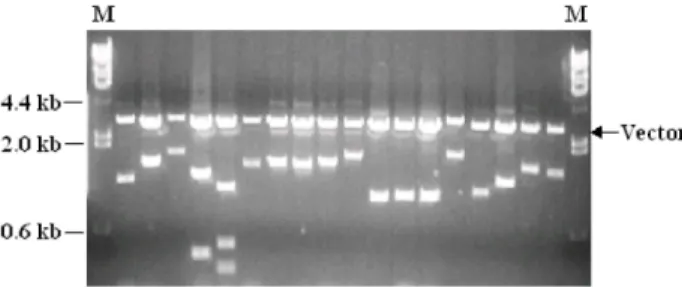
A conidial germination stage was selected since it is basal for further development in fungal growth. The cDNA library was constructed using mRNA isolated from germinated con- idia of C. acutatum. At the time of harvest, ~90% of conidia were germinated. More than 95% of the cDNA clones con- tained inserts with an average insert size of 1.5 kb, ranging mainly from 1 kb to 2 kb (Fig. 1).
Sequencing and contig assembly
T3 primer was used to generate 5’ end sequence in- formation from 1,032 randomly selected cDNA clones.
Sequencing outputs were examined for quality with the Phred software program. A successful sequencing run was defined as a sequence containing at least 50 bp with a Phred score of 20 or higher. A total of 983 ESTs were considered successful based on these criteria. Contig assembly gen- erated a set of 464 unique sequences (genes) including 716 ESTs in 197 contigs and 267 singletons. Number of ESTs in contigs ranged from 2 to 29 (Fig. 2). The redundancy of the library was determined to be 72.8%.
Homology search and functional annotation
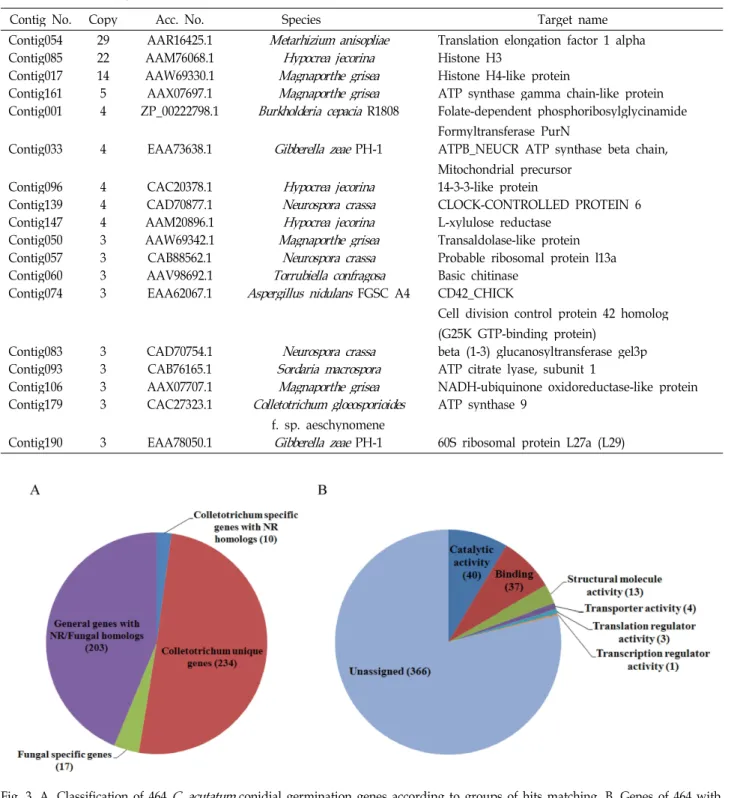
The most redundantly detected genes with over 3 copies showed homology to genes encoding an elongation factor with a frequency of 3% (29/983), followed by histone protein H3, histone protein H4, ATP synthase, folate-dependent phosphoribosylglycinamide formyltransferase, 14-3-3 protein, clock-controlled protein 6, xylulose reductase, transaldolase, ribosomal protein, chitnase, cell division control protein,
Fig. 1. Gel analysis of insert size of the
C. acutatum
conidial germination cDNA library. Randomly selected cDNA clones were analyzed by digesting plasmid DNA with EcoRI and XhoI to excise the insert DNA, and sepa- rated on 1% agarose gel with molecular marker DNA indicated by M. DNA fragments for vector, pBluescriptIISK+, are located at 2.9 kb position.beta-1-3-glucanosyltransferase, ATP citrate lyase, NADH- ubiquinone oxidoreductase, ATP synthase 9, and 60s ribosomal protein (Table 1).
To understand the putative function of the genes ex- pressed, 464 genes, unique sequence sets, were queried against GenBank using the BLASTX algorithm through the web site of the NCBI. Consequently, homology search re- vealed that 230 genes (49.6%) matched significantly (E < 10
-5) to non-redundant protein sequences in the GenBank (Fig.
3A). The number of 27 genes showed match against fungal originated homologs. A number of 10 genes matched to known Colletotrichum ones encoding proteins such as ATP synthase, actin, alpha-tubulin, 60s ribosomal protein, man- ganese-superoxide dismutase and MAP kinase kinase. The 464 genes including 230 genes matching to known protein sequences were categorized by molecular function (Fig. 3B).
A molecular function assignment scheme was devised based on the Gene Ontology classification system (http://gen- eontology.org). The most major functional categories were represented by catalytic activity, binding and structural mo- lecular activity. A total of 363 genes (78%) with matches that could not be fit easily to any category were classified to the unassigned.
Discussion
Conidial germination is the start point of pathogenic development of C. acutatum as fungal pathogen. The morphological and biochemical aspects of germination have not been well studied for this destructive fungal species. In the study here, numerous genes potentially involved in
Fig. 2. Redundancy in ESTs from
C. acutatum
cDNA library from conidial germination stage. The occurrence of multiple sequences is given.Table 1. Genes with putative identification of described function and redundantly expressed in the conidial germinating stage cDNA library of
C. acutatum
Contig No. Copy Acc. No. Species Target name
Contig054 29 AAR16425.1
Metarhizium anisopliae
Translation elongation factor 1 alphaContig085 22 AAM76068.1
Hypocrea jecorina
Histone H3Contig017 14 AAW69330.1
Magnaporthe grisea
Histone H4-like proteinContig161 5 AAX07697.1
Magnaporthe grisea
ATP synthase gamma chain-like protein Contig001 4 ZP_00222798.1Burkholderia cepacia
R1808 Folate-dependent phosphoribosylglycinamideFormyltransferase PurN
Contig033 4 EAA73638.1
Gibberella zeae
PH-1 ATPB_NEUCR ATP synthase beta chain, Mitochondrial precursorContig096 4 CAC20378.1
Hypocrea jecorina
14-3-3-like proteinContig139 4 CAD70877.1
Neurospora crassa
CLOCK-CONTROLLED PROTEIN 6Contig147 4 AAM20896.1
Hypocrea jecorina
L-xylulose reductase Contig050 3 AAW69342.1Magnaporthe grisea
Transaldolase-like protein Contig057 3 CAB88562.1Neurospora crassa
Probable ribosomal protein l13a Contig060 3 AAV98692.1Torrubiella confragosa
Basic chitinaseContig074 3 EAA62067.1
Aspergillus nidulans
FGSC A4 CD42_CHICKCell division control protein 42 homolog (G25K GTP-binding protein)
Contig083 3 CAD70754.1
Neurospora crassa
beta (1-3) glucanosyltransferase gel3p Contig093 3 CAB76165.1Sordaria macrospora
ATP citrate lyase, subunit 1Contig106 3 AAX07707.1
Magnaporthe grisea
NADH-ubiquinone oxidoreductase-like protein Contig179 3 CAC27323.1Colletotrichum gloeosporioides
f. sp. aeschynomene
ATP synthase 9
Contig190 3 EAA78050.1
Gibberella zeae
PH-1 60S ribosomal protein L27a (L29)Fig. 3. A. Classification of 464
C. acutatum
conidial germination genes according to groups of hits matching. B. Genes of 464 with no match or significant matches to known sequences based on BlastX (E value of <10-5) were assigned into molecular function categories. The number of genes in each category is shown.fungal development and pathogenicity were identified by sequencing a conidial germination stage cDNA library of C.
acutatum. A total of 983 ESTs corresponding to 464 genes were generated in this pilot scale sequencing analysis. The
number of genes assembled is likely to be an overestimate
due to the low sequence quality for some sequences and
the potential for lack of sequence overlap among mRNA
originated form same gene.
The library used for EST sequencing was constructed by cloning the cDNA directly into a plasmid vector. Previously, the lambda phage vector was a popular choice for construct- ing cDNA libraries. Since it is now possible to obtain very high efficiency in E. coli transformation by electroporation, the library was directly ligated into the plasmid vector, pBlueScriptIISK+, which eliminates the need to use in vivo excision to create phagemids. A 96-well format plasmid DNA isolation method was established for these experiments. Several methods were evaluated including the Wizard system (Promega, USA), Polyfiltronics filter plate (Whatman, USA) and Qiagen miniprep kit (Qiagen, USA) for high-throughput DNA isolation. It was concluded that using the alkaline lysis method employing the Polyfiltronics filter plate for purification yielded DNA of acceptable qual- ity/quantity in a cost-effective way. This method is now ap- plied widely to isolate plasmid DNA or BAC DNA in a high-throughput manner. In these experiments, the amount of BigDye for EST sequencing also was evaluated. The stand- ard protocol recommends use of 8 μl of BigDye in 20 μl of cycle sequencing reaction or 4 μl of BigDye in 10 μl of re- action volume. The BigDye is a major cost of any sequencing project. It was found that 1 μl of BigDye in a 10 μl reaction was minimally acceptable for detecting signals in this EST sequencing.
Based on Phred-Phrap analysis, 197 contigs containing 716 ESTs and 267 singletons were generated. The most re- dundant contig contained 29 ESTs and showed a high degree of similarity to the elongation factor. Comparison of the unique sequences to public databases in GenBank indicated that 50% of the genes did not share significant similarity with proteins in public databases. This result implies that EST sequencing is an efficient way to identify novel genes.
Future functional analysis of these gene products may reveal previously unknown details in germination development of C. acutatum and lead to the creation of novel management strategies.
The EST approach also provides a measure of the level of expression of each gene. Therefore, it is valuable to inves- tigate genes expressed abundantly to gain an understanding of their possible roles in conidial germination and further development. Based on the BlastX analysis, genes encoding an elongation factor, histone proteins, ATP synthases and ribosomal proteins were expressed frequently during con- idial germination. These proteins are thought to have roles in general cell-maintenance and have been found to be high-
ly redundant in other fungal species like Neurospora (www.genome.ou.edu), Phytophthora [14], and Trichoderma (www.fungalgenomics.ncsu.edu). A gene encoding fo- late-dependent phosphoribosylglycinamide formyltransferase PurN is also redundantly expressed and this protein is a multifunctional and has role in synthesis of purine, which is used for DNA synthesis. Other abundantly expressed gene encodes 14-3-3 protein, which has been identified in several fungi and is known as a family of putative kinase regulators originally characterized in mammalian brain tissue [26]. The 14-3-3 protein has a wide range of potential functions and pathological relevance. It regulates intercellular signal trans- duction to bind the target molecules including transcription cofactor. Also it prevents or mediates apoptosis by control- ling potential signaling molecules. The function of this gene in C. acutatum during conidial germination and other devel- opment remains to be determined. Transaldolase detected in this EST data catalyzes the reversible transfer of a dihy- droxyacetone moiety derived from fructose-6-phosphate to D-erythrose- 4-phosphate and is a rate limiting enzyme. The lack of transaldolase in some eukaryotic cells has been shown to make them more sensitive to oxidative stress [27].
Since conidial germination is a dynamic process in the life cycle of cell and needs a system for protect the cell from oxidative damage. Conidial germination requires the for- mation of new cell membrane and cell walls. Genes encoding chitinase and beta-1-3-glucanosyltransferase are abundantly detected and regarded to be involved in cell wall regeneration.
The advantage of analysis of ESTs derived from certain developmental stage is that the putative function of each gene expressed can be connected with the development process. A number of genes in the signal transduction path- way were identified. The involvement of signaling in devel- opment is well documented in several pathogenic fungi such as Magnaporthe grisea [5]. Present study identified gene of GTP-binding protein. GTP-binding proteins are known to be involved in signal mechanisms influencing many aspects of morphogenesis and pathogenicity of fungal pathogens. The involvement of MAP kinase pathway has been well exam- ined in M. grisea [29] and a number of MAP kinase genes were also identified. The homolog of casein kinase II, alpha chain of Giberella zeae was also detected.
Germination is a dynamic stage in fungal development
and may generate a high level of reactive oxygen. For suc-
cessful growth and further development, cell must control
the effect of oxidative stress. Genes encoding man- ganese-superoxide dismutase and transaldolase protein were identified. This finding suggests that anti-oxidative stress is an important step for successful development of C.
acutatum. The finding of ABC transporter ABC4 homolog may reflect the dynamic activity in transportation of mole- cules during germination.
The identification of ESTs showing homology to the genes related to pathogenicity in other plant pathogenic fungi is extremely interesting since these genes may have similar functions in the C. acutatum. ATP citrate lyase homolog was identified and isocitrate lyase is related to pathogenicty in Leptosphaeria maculans, causal agent of blackleg disease of canola [12]. The identification of CAP20 homolog is very in- teresting since CAP20 is known to be involved in appresso- rium formation and pathogenicity in C. gloeosporioides [10]
and also detected in M. grisea during appressorium for- mation [4]. The function of CAP20 homolog is good candi- date for studying a pathogenicity factor in C. acutatum.
Manganese-superoxide dismutase homolog was also identified. Copper- and zinc- containing superoxide dis- mutase is required for the protection of human fungal patho- gen Candida albicans against oxidative stresses and for the full virulence [11].
The main objectives of this project were to identify C. acu- tatum genes expressed during early development of conidia and to investigate their expression profile (abundance) by sequence analysis. The data presented here represent a pre- liminary survey. Additional sequencing efforts will focus on using different stage cDNA libraries or stage enriched sub- tractive cDNA libraries. Future efforts to characterize the genes involved in diverse pathogen-related developmental stages include several additional approaches such as micro- array [24] and SAGE analyses [28].
Acknowledgment
This research was supported by Dong-Eui University Research Grant 2011AA196. Blue-Bio industry RIC program (RIC 08-06-07) under Ministry of Knowledge Economy con- tributed for the research processing.
References
1. Adams, M. D., Dubnick, M. A., Kerlavage, R., Moreno, R., Kelley, J. M., Utterback, T. R., Nagle, J. W., Fields, C. and
Venter, J. C. 1992. Sequence identification of 2,375 human brain genes.
Nature
355, 632-634.2. Banno, S., Kimura, M., Tokai, T., Kasahar, S., Higa-Nishiyama, A., Takahashi-Ando, N., Hamamoto, H., Fujimura, M., Staskawicz, B. J. and Yamaguchi, I. 2003.
Cloning and characterization of genes specially expressed during infection stages in the rice blast fungus.
FEMS Microbiol Lett
222, 221-227.3. Brown, D. W., Cheung, F. R., Proctor, H., Butchko, R. A.
E., Zheng, L., Lee, Y., Utterback, T., Smith, S., Feldblyum, T., Anthony, E., Glenn, A. E., Plattner, R. D., Kendra, D.
F., Town, C. D. and Whitelaw, C. A. 2005. Comparative analysis of 87,000 expressed sequence tags from the fumo- sin-producing fungus
Fusarium vertivillioides
.Fungal Genet Biol
42, 848-861.4. Choi, W. 2003. Global approaches to identify genes involved during infection structure formation in rice blast fungus,
Magnaporthe grisea
.Plant Pathol J
19, 34-42.5. Dean, R. A. 1997. Signal pathways and appressorium morphogenesis.
Annu Rev Phytopathol
35, 211-234.6. Donofrio, N. M., Oh, Y., Lundy, R., Pan, H., Brown, D. E., Jeong, J. S., Coughlan, S., Mitchell, T. K. and Dean, R. A.
2006. Global gene expression during nitrogen starvation in the rice blast fungus,
Magnaporthe grisea
.Fungal Genet Biol
43, 605-617.7. Ebbole, D. J., Jin, Y., Thon, M., Pan, H., Bhattarai, E., Thomas, T. and Dean, R. 2004. Gene discovery and gene expression in the rice blast fungus,
Magnaporthe grisea
: anal- ysis of expressed sequence tags.Mol Plant-Microbe Interact
17, 1337-1347.8. Ewing, B. and Green, P. 1998. Base-calling of automated se- quencer traces using phred. II. Error probabilities.
Genome Res
8, 186-194.9. Gordon, D., Abajian, C. and Green, P. 1998. Consed: a graphical tool for sequence finishing.
Genome Res
8, 175-185.10. Hwang, C. S., Flaishman, M. A., and Kolattukudy, P. E.
1995. Cloning of a gene expressed during appressorium for- mation by
Colletotrichum gloeosporioides
and a marked de- crease in virulence by disruption of this gene.Plant Cell
7, 183-193.11. Hwang, C. S., Rhie, G., Oh, J. H., Huh, W. K., Yim, H. S.
and Kang, S. O. 2002. Copper- and zinc-containing super- oxide dismutase (Cu/ZnSOD) is required for the protection of
Candida albicans
against oxidative stresses and the ex- pression of its full virulence.Microbiol
148, 3705-3713.12. Idnurm, A. and Howlett, B. J. 2002. Isocitrate lyaseis essen- tial for pathogenicity of the fungus
Leptosphaeria maculans
to Canola (Brassica napus
).Eukaryot. Cell
1, 719-724.13. Jakupovic, M., Heintz, M., Reichmann, P., Mendgen, K. and Hahn, M. 2006. Microarray analysis of expressed sequence tags from haustoria of the rust fungus
Uromyces fabae
.Fungal Genet Biol
43, 8-19.14. Kamoun, S., Hraber, P., Sorbal, B., Nuss, D. and Govers, F. 1999. Initial assessment of gene diversity for the oomycete pathogen
Phytophthora infestans
based on expressed sequences.Fungal Genet Biol
28, 94-106.초록:고추 탄저병균의 포자 발아 단계 발현 유전자 동정 김정환
1․이종환
1,2․최우봉
1,2*
(
1동의대학교 생명공학과/바이오물질제어학과,
2블루바이오RIC)
고추 탄저병균의 포자 발아 단계에서 발현되는 유전자를 파악하기 위해 포자 발아단계cDNA library를 제작하고, 임의로 선택된 cDNA clone들에 대한 EST sequencing을 실시하였다. 총 983개 EST를 확보하여 contig assembly를 실시 한 결과, 197개 contigs와 267개 singletons으로 조합되어, 최종적으로 464개의 유전자를 동정하였다. 464개 유전자 서열 에서 유추한 아미노산 서열을 이용한 상동유전자 검색을 통해 절반의 유전자가 GenBank에 기존 등록된 유전자와 유의 성 있는 유사성을 보였다. 가장 높은 빈도로 발현된 유전자는 elongation factor, histone protein, ATP synthease, 14-3-3 protein, clock controlled protein을 암호화하는 유전자들이었다. 그리고 고추 탄저병균의 세포 발달과정에 관여 하는것 으로 추정되는 GTP-binding protein, MAP kinase, transaldolase, ABC transporter 유전자들도 검출되었다. 또한 고추 탄저병균의 병원성에 영향을 미치는 것으로 파악되는 ATP citrate lyase, CAP20, manganese-superoxide dismutase 유 전자들도 검출되어, EST sequencing 을 통한 세포 발달 단계 발현 유전자 탐색이 효과적임을 알 수 있었다.
15. Keon, J., Antoniw, J., Rudd, J., Skinner, W., Hargreaves, J.
and Hammond-Kosack, K. 2005. Analysis of expressed se- quence tags from the wheat leaf blotch pathogen
Mycosphaerella graminicola
(anamorphSeptoria tritici
).Fungal Genet Biol
42, 376-389.16. Keon, J., Bailey, A. and Hargreaves, J. 2000. A group of ex- pressed cDNA sequences from the wheat fungal leaf blotch pathogen,
Mycophaerella graminicola
(Septoria tritici
).Fungal Genet Biol
29, 118-133.17. Kim, C. H. and Park, K. S. 1988. A predicted model of dis- ease progression of red-pepper anthracnose.
Korean J Plant Pathol
4, 325-331.18. Kim, Y. S., Min, J. Y., Kang, B. K., Bach, N. V., Choi, W., Park, E. W. and Kim, H. T. 2007. Analyses of the less benzi- midazole-senstivity of the isolates of Colletotrichum spp.
Causing the anthracnose in pepper and strawberry.
Plant Pathol J
23, 187-192.19. Lu, J. P., Liu, T. B. and Lin, F. C. 2005. Identification of mature appressorium-enriched transcripts in
Magnaporthe grisea
.FEMS Microbiol Lett
25, 131-137.20. Nugent, K. G., Choffe, K. and Saville, B. J. 2004. Gene ex- pression during
Ustilago maydis
diploid filamentous growth:EST library creation and analyses.
Fungal Genet Biol
41, 349-360.21. Park, K. S. and Kim, C. H. 1992. Identification, distribution and etiological characteristics of anthracnose fungi of red pepper in Korea.
Korean J Plant Pathol
8, 61-69.22. Qutob, D., Hraber, P. T., Sobral, B. W. S. and Gijzen, M.
2000. Comparative analysis of expressed sequences in
Phytophthora sojae
.Plant Physiol
123, 243-253.23. Sacadura, N. T. and Saville, B. J. 2003. Gene expression and EST analyses of
Ustilago maydis
germinating teliospores.Fungal Genet Biol
40, 47-64.24. Schena, M., Shalon, D., Davis, R. W. and Brown, P. O. 1995.
Quantitative monitoring of gene expression patterns with a complementary DNA microarray.
Science
270, 467-470.25. Thomas, S. W., Rasmussen, S. W., Glaring, M. A., Rouster, J. A., Christiansen, S. K. and Oliver, R. P. 2001. Gene identi- fication in the obligate fungal pathogen
Blumeria graminis
by expressed sequence tag analysis.Fungal Genet Biol
33, 195-211.26. Umahara, T., Uchihara, T., Tsuchiya, K., Nakamura, A. and Iwamoto, T. 2007. Intranuclear localization and iso- form-dependent translocation of 14-3-3 proteins in human brain with infarction.
J Neurol Sci
260, 159-166.27. Vatanaviboon, P., Varaluksit, T., Seeanukun, C. and Mongkolsuk, S. 2002. Transaldolase exhibits a protective role against menadione toxicity in
Xanthomonas campestris
pv.phaseoli
.Biochem Biophy Res Commun
297, 968-973.28. Velculescu, V. E., Zhang, L., Vogelstein, B. and Kinzler, K.
W. 1995. Serial analysis of gene expression.
Science
270, 484-487.29. Xu, J. R. 2001. MAP kinases in fungal pathogens.