서 론
당뇨는 최근 급격한 경제성장과 서구화된 식습관으로 유병률이 점차 증가하고 있는 대표적인 만성질환이다. 우리나라 당뇨 유병률 은 2015년에 발표한 국민건강영양조사 자료에 따르면 30대 이상 성 인에서 10명 중 1명으로 남자는 11%, 여자는 8%이다.1) 당뇨는 다양한
합병증을 초래하고 사망률을 높이는 요인이기 때문에, 유병률을 증 가시키는 원인을 파악하는 것이 중요할 것으로 생각된다. 지금까지 연구에서 나이, 당뇨의 가족력, 비만, 고혈압, 음주, 흡연 등이 당뇨 유 병률과 연관이 있다고 밝혀져 있다.2,3) 또한 당뇨에 식이가 영향을 미 친다고 알려져 있으며, 특히 비타민과 관련된 연구는 이전부터 많이 이루어지고 있다. 이중 비타민 B3는 니아신(niacin)과 니아신의아미
Received March 7, 2017 Revised August 8, 2017 Accepted October 8, 2017
Corresponding author Yu Ri Choe Tel: +82-61-379-7290, Fax: +82-61-379-7289 E-mail: [email protected]
ORCID: http://orcid.org/0000-0002-4557-2323
Copyright © 2018 The Korean Academy of Family Medicine
This is an open-access article distributed under the terms of the Creative Commons At- tribution Non-Commercial License (http://creativecommons.org/licenses/by-nc/4.0) which permits unrestricted noncommercial use, distribution, and reproduction in any medium, provided the original work is properly cited.
Original Article
https://doi.org/10.21215/kjfp.2018.8.1.136 eISSN 2233-9116
Korean J Fam Pract. 2018;8(1):136-141
Korean Journal of Family Practice
KJFP
한국인을 대상으로 한 니아신의 과량 섭취와 당뇨 유병률의 상관관계: 2012-2015년 국민건강영양조사 자료를 이용하여
정지연, 김진영, 김희정, 최유리*
화순전남대학교병원 가정의학과
Association between Niacin and Type 2 Diabetes Mellitus in Korean: Korean National Health and Nutrition Examination Survey 2012-2015
Ji Yun Jeong, Jin Young Kim, Hee Jeong Kim, Yu Ri Choe*
Department of Family Medicine, Chonnam National University Hwasun Hospital, Hwasun, Korea
Background: Diabetes mellitus (DM) is one of the most common chronic diseases worldwide, and its prevalence has increased rapidly with economic growth. Although many researchers have previously examined the association between niacin intake and diabetes prevalence, only a few studies have evaluated the association between dietary niacin overdose and the prevalence of diabetes. Moreover, studies involving Korean subjects are scarce. The aim of this study was to determine the effect of over-consumption of niacin on the prevalence of DM.
Methods: We analyzed data derived from the 2012–2015 Korean National Health and Nutrition Survey, which included 6,548 respondents aged >45 years, who had accurately completed a questionnaire on the frequency of their food intake. Niacin overdose was defined as an intake of ≥30 mg of niacin equivalent (NE) per day and diabetes was defined as fasting blood glucose levels of ≥126 mg/dL or hemoglobin Alc of >6.5%, or based on the diagnosis made by a physician. Propensity score-matching was used for sensitivity analysis. Multivariate logistic regression analysis was performed with significant variables, adjusted to analyze the association between the prevalence of diabetes and niacin overdose.
Results: Overall, 70 individuals (64.1 weighted %) had excessive intake of niacin of ≥30 mg NE/day. Multiple logistic regression analysis after propensity score-matching revealed that inadequate niacin intake was associated with an increased prevalence of DM. The odds ratio for diabetes with inadequate niacin intake was statistically significant at 4.995 (95% confidence interval, 1.298–19.218).
Conclusion: The prevalence of DM correlated significantly with niacin overdose.
Keywords: Dietary Supplement; Niacin; Diabetes Mellitus; Prevalence
정지연 외. 한국인 니아신의 과량 섭취와 당뇨 유병률의 상관관계 Korean Journal of Family Practice
KJFP
드 형태인 니아시나마이드(niacinamide)로 구성된 수용성 비타민이 다. 니아신은 체내에서 조효소 형태인 니코틴아미드아데닌디뉴클레 오타이드(nicotinamide adenine dinucleotide)와 니코틴아미드아데닌 디뉴클레오다티드 인(nicotinamide adenine dinucleotide phospate)으 로 변환되고, 이는 에너지(adenosine triphosphate) 생산에 필수적인 역할을 한다.4,5)
니아신은 고밀도-콜레스테롤을 증가시키고, 중성지방과 저밀도- 콜레스테롤을 감소시켜 지질대사를 개선시키지만,6-12) 혈관 확장 작 용이 있어 얼굴 홍조 및 피부가려움증을 일으키며, 과량 복용 시 간 기능 장애 및 혈당을 올린다는 보고도 있다.13-18) 최근 연구에서 정상 혈당(normoglycaemic)군과 공복혈당장애군(impaired fasting glucose) 에서 니아신 복용그룹과 위약그룹 중 제 2형 당뇨가 새롭게 진단될 확률을 비교하였을 때 두 군 모두에서 니아신 복용그룹이 위약그룹 보다 새롭게 당뇨가 진단될 확률이 높다는(6.8% vs. 4.9%; 19.8% vs.
15.2%) 연구결과가 보고된 바 있다.19)
이렇듯 니아신과 당뇨 유병률과의 상관관계가 있을 것으로 보이 나, 대부분의 기존 연구에서는 이상지질혈증 치료를 위해 약물형태 로 복용하는 니아신과 당뇨 유병률의 상관관계를 분석하였다. 이에 비해 식이로 섭취한 니아신으로 시행한 연구는 많지 않으며, 한국인 을 대상으로 시행한 연구는 부족한 상태이다. 따라서 본 연구에서는 2012–2015년 국민건강영양조사 자료를 분석하여 식이로 니아신의 과량 섭취가 당뇨 유병률에 미치는 영향을 확인해 보고자 한다.
방 법
1. 연구 대상
본 연구에 사용된 2012–2015년 국민건강영양조사는 순환표본조 사를 통해 1월부터 12월까지 연간 192조사구, 3,840가구에서 만 1세 이상 가구원 전체를 대상으로 수행되었다. 조사에 참여한 만 45세 이상 대상자 중 식품섭취빈도조사 항목의 설문에 제대로 답변한 6,548명(남자 2,542명, 여자 4,006명)을 연구 대상에 포함하였다.
2. 변수정의 1) 니아신
니아신의 섭취기준 단위는 니아신 당량(mg niacin equivalent [NE]) 을 사용하였다. 우리나라 성인 니아신 일일 평균 필요량은 남자 12 mg NE, 여자 11 mg NE이며, 권장섭취량은 평균 필요량의 150%에 해 당하는 수준으로 남자 16 mg NE/일, 여자 14 mg NE/일이다.20) 한국인 영양섭취기준에 따르면20) 하루 니아신 섭취량이 30 mg NE 이상일 때 부작용을 일으킬 수 있으며, 상한섭취량은 35 mg NE/일이다. 본
연구에서는 일일 니아신 섭취량이 30 mg NE 이상인 경우를 과량 섭 취로 정의하였다.21-23)
2) 당뇨
당뇨는 공복혈당 126 mg/dL 이상 또는 당화혈색소(hemoglobin A1c, HbA1c) 6.5% 이상으로 과거에 의사의 진단을 받았거나, 경구혈 당강하제 복용 또는 인슐린 주사 투여 중인 경우로 정의하였다.
3) 기타변수
사회인구학적 변수에는 성별, 나이, 소득 수준, 교육 수준, 결혼 상 태를 포함하였다. 소득 수준은 국민건강영양조사의 가구 소득 사분 위수를 기준으로 하, 중하, 중상, 상의 네 군으로 분류하였고, 교육 수 준은 교육 수준-학력 항목에 따라 초등학교 졸업, 중학교 졸업, 고등 학교 졸업 및 대학교 이상의 학력의 네 군으로 분류하였다. 결혼 상 태는 유배우자 및 동거로 응답한 경우를 기혼으로 간주하였으며 미 혼, 별거, 사별, 이혼 등의 나머지 경우를 비혼으로 하여 두 군으로 분류하였다. 건강 관련 요인으로 허리둘레(cm) 및 하루 에너지 섭취 량(kcal/일)과 만성질환의 유무를 포함하였다. 만성질환의 경우 과거 에 의사로부터 고혈압, 이상지질혈증을 진단 받은 적이 있는 경우로 정의하였다.
3. 통계학적 분석
2012년부터 2015년까지의 국민건강영양조사 자료를 이용하여 일 일 니아신 섭취량이 30 mg NE 이상일 때 당뇨 유병률이 증가하는지 분석하였다. 국민건강영양조사 자료는 복합표본데이터(complex sur- vey data)이므로 가중치를 고려하여 복합표본분석을 시행하였다. 본 연구에서는 니아신 과량 섭취한 연구 대상자 수가 아주 적어 적당 섭취그룹과 동떨어진 집단으로 보여 민감도 분석을 위해 유전적 매 칭 알고리즘(genetic matching algorithm)을 이용하여 성향점수매칭 (propensity score matching)을 시행하였다.
니아신 과량 섭취그룹과 적당 섭취그룹 간의 사회인구학적 변수 및 건강상태 관련 변수들의 통계적 차이를 분석하기 위해 독립표본 t-검정 및 Pearson 상관 분석을 시행하였으며, 당뇨 유병률을 높이는 데 영향을 미치는 인자를 찾기 위해 다변수 로지스틱 회귀분석을 시 행하였다. 통계적 유의 수준을 P<0.05로 설정하였고, 통계 분석은 R (ver. 3.3.2; R Foundation for Statistical Computing, Vienna, Austria), Survey package (ver. 3.31-5)을 이용하였다.
Original Article
Korean Journal of Family Practice
Ji Yun Jeong, et al. Association between Niacin and Type 2 DM in Korea
Korean Journal of Family Practice
KJFP
결 과
1. 연구 대상자들의 일반적 특성
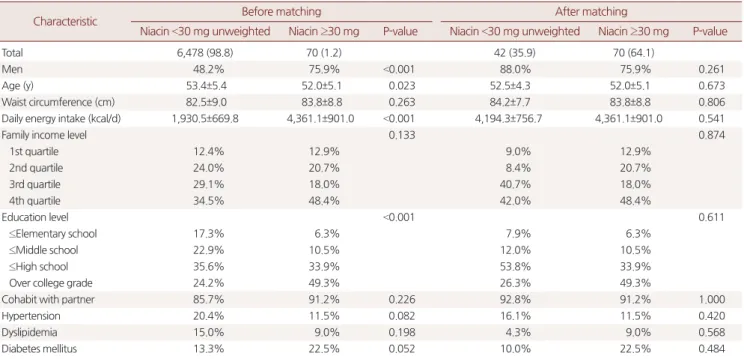
본 연구에 포함된 국내 거주 45세 이상의 성인을 대상으로 니아신 일일 섭취량을 30mg NE 이상과 미만의 두 그룹을 각각 니아신 과량 섭취그룹, 적당 섭취그룹으로 설정하여 나누었고, 가중치를 부여하 여 일반적 특성을 비교하였다(Table 1). 니아신 적당 섭취그룹의 대상 자는 전체 6,548명 중 6,478명이고, 과량 섭취그룹은 6,548명 중 70명 이었다. 니아신 과량 섭취그룹에서 남자의 비율은 75.9%이고, 평균 나이는 52.0±5.1세였다. 또한 하루 섭취 칼로리는 평균 4,361.1±901.0 kcal/일이었으며, 교육 수준은 대학교 이상이 49.3%였다.
니아신 과량 섭취그룹의 대상자 수가 매우 적어 적당 섭취그룹과 동떨어진 그룹의 특성을 보여서 민감도 분석을 위해 성향점수매칭 (propensity matching)을 추가적으로 시행하였다. 성향점수매칭 후 두 그룹 간의 일반적인 특성에 유의한 통계적 차이는 보이지 않았다 (Table 1, Figure 1).
2. 당뇨 유병률에 대한 다변량 로지스틱 회귀분석
Table 2는 당뇨 유병률에 영향을 미칠 수 있는 변수를 찾기 위해 시행한 로지스틱 회귀분석의 분석 결과이다. 성향점수매칭 후 다변 수 분석에서 성별, 나이, 허리둘레, 하루 에너지 섭취량, 소득 수준, 교 육 수준, 결혼 상태, 고혈압/이상지질혈증 유무를 보정하였고, 니아
신 과량 섭취그룹의 오즈비(odds ratio)가 4.995 (95% confidence inter- val [CI], 1.298–19.218)로 통계적으로 유의하게 당뇨 유병률을 높이는 것으로 보였다.
고 찰
본 연구는 2012년부터 2015년도 국민건강영양조사를 이용하여 45세 이상의 성인에서 식이로 섭취한 니아신과 당뇨 유병률과의 상 Figure 1. Absolute standardized differences. Y axis was baseline char- acteristics. X axis was the percentage of absolute difference “before”
(solid) matching or “after”(empty) matching.
0 3
Absolute standardized difference Men
Age
Family income level 2nd quartile 3rd quartile 4th quartile Education level
<Middle school
<High school Over college grade Marriage
Hypertension Dyslipidemia Calorie intake Waist circumference Sample weight
16 15 14 13 12 11 10 9 8 7 6 5 4 3 2 1
2 1
Table 1. Baseline characteristics of study participants
Characteristic Before matching After matching
Niacin <30 mg unweighted Niacin ≥30 mg P-value Niacin <30 mg unweighted Niacin ≥30 mg P-value
Total 6,478 (98.8) 70 (1.2) 42 (35.9) 70 (64.1)
Men 48.2% 75.9% <0.001 88.0% 75.9% 0.261
Age (y) 53.4±5.4 52.0±5.1 0.023 52.5±4.3 52.0±5.1 0.673
Waist circumference (cm) 82.5±9.0 83.8±8.8 0.263 84.2±7.7 83.8±8.8 0.806
Daily energy intake (kcal/d) 1,930.5±669.8 4,361.1±901.0 <0.001 4,194.3±756.7 4,361.1±901.0 0.541
Family income level 0.133 0.874
1st quartile 12.4% 12.9% 9.0% 12.9%
2nd quartile 24.0% 20.7% 8.4% 20.7%
3rd quartile 29.1% 18.0% 40.7% 18.0%
4th quartile 34.5% 48.4% 42.0% 48.4%
Education level <0.001 0.611
≤Elementary school 17.3% 6.3% 7.9% 6.3%
≤Middle school 22.9% 10.5% 12.0% 10.5%
≤High school 35.6% 33.9% 53.8% 33.9%
Over college grade 24.2% 49.3% 26.3% 49.3%
Cohabit with partner 85.7% 91.2% 0.226 92.8% 91.2% 1.000
Hypertension 20.4% 11.5% 0.082 16.1% 11.5% 0.420
Dyslipidemia 15.0% 9.0% 0.198 4.3% 9.0% 0.568
Diabetes mellitus 13.3% 22.5% 0.052 10.0% 22.5% 0.484
Values are presented as number (weighed %) or mean±standard deviation.
정지연 외. 한국인 니아신의 과량 섭취와 당뇨 유병률의 상관관계 Korean Journal of Family Practice
KJFP
관관계를 알아보고자 한 연구이다. 그 결과 니아신 과량 섭취가 통계 적으로 유의하게 당뇨 유병률을 높이는 것으로 나타났다.
이는 니아신이 혈당을 올리고 당뇨 유병률에 영향을 미칠 수 있다 는 기존 선행연구와 유사한 결과이다. 최근 연구에서 심혈관 질환이 있는 환자군 25,673명을 대상으로 서방형 니아신과 라로피프란트 (laropiprant) 복용그룹과 위약그룹으로 나누어 연구를 진행하였고, 그 결과 서방형 니아신과 라로피프란트 그룹에서 위약그룹보다 당 뇨조절 장애가 3.7%, 새롭게 당뇨 진단이 1.3% 높게 나타났다.24) 또한 이상지질혈증의 환자군에서 에제티미브와 심바스타틴만 복용한 그 룹과 에제미티브와 심바스타틴과 니아신을 복용한 그룹을 24주간 비교하였고, 그 결과 새롭게 진단된 당뇨가 에제미티브와 심바스타 틴과 니아신을 복용한 그룹이 4.3%로 에제티미브와 심바스타틴만 복용한 그룹의 1.3%보다 더 높게 나타났다.25) 이처럼 니아신이 당뇨 유병률을 높이는 것으로 보이지만, 대부분의 기존 연구는 이상지질 혈증의 치료제로 사용하는 니아신의 복용으로 니아신 농도를 측정 하였다.
따라서 본 연구에서는 기존 연구결과를 근거로 한국 성인에서 식 이로 섭취한 니아신 농도와 당뇨 유병률의 연관성도 유사하게 나타 날 것인지를 확인하고자 하였다. 니아신 과량 섭취의 기준은 하루 30mg NE 이상으로 정의하였을 때, 니아신 과량 섭취그룹에 해당하 는 대상자 수가 6,548명중 70명에 불과하여 적당 섭취그룹의 대상자 수보다 매우 적었고, 성별, 나이, 하루 섭취 칼로리, 교육 수준에서 두
그룹의 특성이 통계적으로 유의하게 달라서 정확한 민감도분석을 위해 성향점수매칭(propensity score matching)을 시행하였다. 성향점 수매칭 후 다변수 분석에서 니아신 과량 섭취그룹의 오즈비(odds ra- tio)가 4.995 (95% CI, 1.298–19.218)로 통계적으로 유의하게 당뇨 유병 률을 높이는 것으로 보였다.
니아신이 당뇨에 영향을 미치는 작용 기전은 아직 정확히 밝혀져 있지 않다. 일부 연구에서 니아신이 지방세포에서 니아신 수용체 역 할을 하는 G-protein receptor 109A (GPR 109A)에 작용하여 지방분해 를 억제한다고 말하고 있고,26) GPR 109A가 췌장의 베타세포에 작용 하여 인슐린 분비를 억제한다는 보고도 있다.27) 또한 니아신의 식이 섭취 증가가 비만을 초래하고 그것이 당뇨 유병률에 영향을 미칠 수 있다는 연구 결과가 있지만,28,29) 아직 관련 연구가 많이 부족하여 이 에 대해 추가적인 연구가 필요할 것으로 생각된다.
이번 연구는 몇가지 제한점이 있다. 첫째, 단면 연구로서 관련성을 제시할 뿐, 영향을 미칠 수 있는 추가적인 혼란변수를 배제할 수 없 기 때문에 인과관계를 평가할 수 없다는 점이다. 둘째, 식품섭취빈도 조사지 설문 방식은 24시간 회상방식보다 정확하지만 혈중농도를 직접적으로 반영한다고는 볼 수 없다.
이러한 제한점이 있지만 본 연구는 한국인 집단을 대표할 수 있는 국민건강영양조사를 바탕으로 복합표본분석을 시행하여 신뢰성이 높다는 강점이 있다. 또한 두 그룹의 민감도 분석을 위해 성향점수매 칭을 통해 보정하였기 때문에 결과에 대한 정확도가 높다고 말할 수 Table 2. Association between type 2 diabetes mellitus and other variables using multivariate logistic regression
Characteristic Before matching After matching
Odds ratio (95% CI) P-value Odds ratio (95% CI) P-value
Men 1.603 (1.307–1.966) <0.001 5.243 (0.191–143–944) 0.063
Age 1.049 (1.030–1.069) <0.001 1.005 (0.868–1.164) 0.111
Waist circumference 1.052 (1.041–1.063) <0.001 0.990 (0.895–1.095) 0.955
Daily energy intake 1.000 (1.000–1.000) 0.682 1.000 (0.999–1.001) 0.367
Family income level <0.001 0.315
1st quartile Reference Reference
2nd quartile 0.944 (0.718–1.240) 5.666 (0.685–46.859)
3rd quartile 0.725 (0.550–0.956) 3.225 (0.281–36.981)
4th quartile 0.640 (0.473–0.865) 6.163 (0.730–52.074)
Education level 0.411 0.025
≤Elementary school Reference Reference
≤Middle school 0.962 (0.738–1.255) 0.031 (0.001–0.666)
≤High school 1.067 (0.830–1.371) 0.039 (0.003–0.608)
Over college grade 0.927 (0.682–1.259) 0.225 (0.002–0.388)
Cohabit with partner 0.977 (0.754–1.266) 0.861 8.140 (1.605–41.287) <0.001
Hypertension 1.718 (1.406–2.100) <0.001 2.141 (0.404–11.338) 0.690
Dyslipidemia 2.236 (1.789–2.793) <0.001 1.986 (0.168–23.457) 0.574
Inadequate niacin intake (≥30 mg/d) 2.247 (1.017–4.963) 0.046 4.995 (1.298–19.218) 0.013
CI, confidence interval.
Ji Yun Jeong, et al. Association between Niacin and Type 2 DM in Korea
Korean Journal of Family Practice
KJFP
있으며, 기존의 선행연구의 대부분은 약으로 복용한 니아신을 대상 으로 시행한 반면, 식품으로 섭취된 니아신과 당뇨 유병률의 연관성 을 분석한 연구였다는 점에서 의의가 있다.
결론적으로 이번 연구로 45세 이상의 한국인에서 니아신의 과량 섭취가 통계적으로 유의하게 당뇨 유병률을 높인다는 것을 알 수 있 었다. 이를 바탕으로 니아신 섭취와 당뇨 유병률의 인과관계를 명확 히 확인할 수 있는 대규모 무작위 대조군 연구를 비롯하여 더 포괄 적인 연구가 추후 필요할 것으로 생각한다.
요 약
연구배경:
당뇨는 대표적인 만성질환 중 하나이며, 경제성장과 더불 어 최근 유병률이 급격히 증가하고 있다. 니아신과 당뇨와 관련 연구 는 많이 이루지고 있으나, 대부분 이상지질혈증 치료를 위해 약물형 태로 복용하는 니아신과 당뇨와의 연구이다. 이에 비해 니아신 섭취 와 관련 연구는 많지 않으며, 한국인을 대상으로 한 연구는 부족한 상태이다. 따라서 본 연구의 목적은 식이로 니아신의 과량 섭취가 당 뇨 유병률에 미치는 영향을 확인하는 데 있다.방법:
2012–2015년 국민건강영양조사 자료를 분석하여 45세 이상 을 대상으로 식품섭취빈도조사지 설문을 제대로 답변한 6,548명으 로 연구를 진행하였다. 니아신은 하루 섭취 30mg NE 이상을 과량 섭 취로 정의하였고, 당뇨는 공복혈당 126 mg/dL 이상 또는 당화혈색소 6.5% 이상으로 과거 의사의 진단을 받은 것으로 정의하였다. 니아신 과량 섭취한 연구 대상자 수가 매우 적고, 두 집단의 특성이 통계적 으로 유의하게 달라서 민감도분석을 위해 성향점수매칭을 시행하 였다. 성향점수매칭 후 당뇨 유병률을 높이는 인자를 찾기 위해 다 변수 로지스틱 회귀분석을 시행하였다.결과:
니아신 과량 섭취그룹이 총 70명(64.1%)이었다. 성향점수매칭 후 다변수 분석에서 성별, 나이, 허리둘레, 하루 에너지 섭취량, 소득 수준, 교육 수준, 결혼상태, 고혈압/이상지질혈증 유무를 보정하였 고, 니아신 과량 섭취그룹의 오즈비(odds ratio)가 4.995 (95% CI, 1.298–19.218)로 통계적으로 유의하게 당뇨 유병률을 높이는 것으로 보였다.결론:
니아신 과량 식이섭취는 당뇨 유병률을 높이는데 통계적으로 유의한 결과를 보였다.중심단어:
식이섭취; 니아신; 당뇨; 유병률REFERENCES
1. Korea Centers for Disease Control and Prevention. Korea National Health and Nutrition Examination Survey [Internet]. Seoul: Korea Centers for Dis- ease Control and Prevention; 2015 [cited 2016 Dec 21]. Available from:
http://www.cdc.go.kr.
2. Ha KH, Kim DJ. Trends in the diabetes epidemic in Korea. Endocrinol Metab (Seoul) 2015; 30: 142-6.
3. Lee YH, Bang H, Kim HC, Kim HM, Park SW, Kim DJ. A simple screening score for diabetes for the Korean population: development, validation, and comparison with other scores. Diabetes Care 2012; 35: 1723-30.
4. Valdés-Ramos R, Guadarrama-López AL, Martínez-Carrillo BE, Benítez- Arciniega AD. Vitamins and type 2 diabetes mellitus. Endocr Metab Im- mune Disord Drug Targets 2015; 15: 54-63.
5. O’Connell BS. Select vitamins and minerals in the management of diabetes.
Diabetes Spectrum 2001; 14: 133-48.
6. Batuca JR, Amaral MC, Favas C, Paula FS, Ames PRJ, Papoila AL, et al. Ex- tended-release niacin increases anti-apolipoprotein A-I antibodies that block the antioxidant effect of high-density lipoprotein-cholesterol: the EX- PLORE clinical trial. Br J Clin Pharmacol 2017; 83: 1002-10.
7. Pang J, Chan DC, Hamilton SJ, Tenneti VS, Watts GF, Barrett PH. Effect of niacin on high-density lipoprotein apolipoprotein A-I kinetics in statin- treated patients with type 2 diabetes mellitus. Arterioscler Thromb Vasc Biol 2014; 34: 427-32.
8. Elam MB, Hunninghake DB, Davis KB, Garg R, Johnson C, Egan D, et al. Ef- fect of niacin on lipid and lipoprotein levels and glycemic control in patients with diabetes and peripheral arterial disease: the ADMIT study: A random- ized trial. Arterial Disease Multiple Intervention Trial. JAMA 2000; 284:
1263-70.
9. Ooi EM, Watts GF, Chan DC, Pang J, Tenneti VS, Hamilton SJ, et al. Effects of extended-release niacin on the postprandial metabolism of Lp(a) and ApoB-100-containing lipoproteins in statin-treated men with type 2 diabe- tes mellitus. Arterioscler Thromb Vasc Biol 2015; 35: 2686-93.
10. Brinton EA, Triscari J, Brudi P, Chen E, Johnson-Levonas AO, Sisk CM, et al.
Effects of extended-release niacin/laropiprant on correlations between apo- lipoprotein B, LDL-cholesterol and non-HDL-cholesterol in patients with type 2 diabetes. Lipids Health Dis 2016; 15: 116.
11. Sorrentino SA, Besler C, Rohrer L, Meyer M, Heinrich K, Bahlmann FH, et al. Endothelial-vasoprotective effects of high-density lipoprotein are im- paired in patients with type 2 diabetes mellitus but are improved after ex- tended-release niacin therapy. Circulation 2010; 121: 110-22.
12. Garg A, Sharma A, Krishnamoorthy P, Garg J, Virmani D, Sharma T, et al.
Role of niacin in current clinical practice: a systematic review. Am J Med 2017; 130: 173-87.
13. Bays HE, Brinton EA, Triscari J, Chen E, Maccubbin D, MacLean AA, et al.
Extended-release niacin/laropiprant significantly improves lipid levels in type 2 diabetes mellitus irrespective of baseline glycemic control. Vasc Health Risk Manag 2015; 11: 165-72.
14. Goldie C, Taylor AJ, Nguyen P, McCoy C, Zhao XQ, Preiss D. Niacin therapy and the risk of new-onset diabetes: a meta-analysis of randomised con- trolled trials. Heart 2016; 102: 198-203.
15. Liu M, Li L, Chu J, Zhu B, Zhang Q, Yin X, et al. Serum N(1)-methylnicotin-
정지연 외. 한국인 니아신의 과량 섭취와 당뇨 유병률의 상관관계 Korean Journal of Family Practice
KJFP
amide is associated with obesity and diabetes in Chinese. J Clin Endocrinol Metab 2015; 100: 3112-7.
16. Kannt A, Pfenninger A, Teichert L, Tönjes A, Dietrich A, Schön MR, et al. As- sociation of nicotinamide-N-methyltransferase mRNA expression in hu- man adipose tissue and the plasma concentration of its product, 1-methyl- nicotinamide, with insulin resistance. Diabetologia 2015; 58: 799-808.
17. Zhou SS, Li D, Sun WP, Guo M, Lun YZ, Zhou YM, et al. Nicotinamide over- load may play a role in the development of type 2 diabetes. World J Gastro- enterol 2009; 15: 5674-84.
18. Collins PD, Sattar N. Glycaemic effects of non-statin lipid-lowering thera- pies. Curr Cardiol Rep 2016; 18: 133.
19. Sazonov V, Maccubbin D, Sisk CM, Canner PL. Effects of niacin on the inci- dence of new onset diabetes and cardiovascular events in patients with nor- moglycaemia and impaired fasting glucose. Int J Clin Pract 2013; 67: 297- 302.
20. Ministry of Health and Welfare. The Korean Nutrition Society. Dietary Ref- erence Intakes for Koreans [Internet]. Sejong: Ministry of Health and Wel- fare. The Korean Nutrition Society; 2015 [cited 2016 Nov 15]. Available from: http://www.kns.or.kr.
21. Park SH, Lee HM, Yoon EK, Min CS, Kim HJ, Jun EA, et al. Niacin upper level recommendation and exposure assessment of foods and multivitamin drugs. Journal of Food Hygiene and Safety 2005; 20: 77-82.
22. McCormick DB, Shills ME, Young VR, et al. Modern nutrition in health and
disease. Philadelphia: Lea & Felbiger; 1988. p. 370-5.
23. Scientific Committee on Food of European Commission. Opinion of the Scientific Committee on Food on the tolerable upper intake levels of nico- tinic acid and nicotinamide (niacin). European Commission 2002; 1-20.
24. HPS2-THRIVE Collaborative Group, Landray MJ, Haynes R, Hopewell JC, Parish S, Aung T, et al. Effects of extended-release niacin with laropiprant in high-risk patients. N Engl J Med 2014; 371: 203-12.
25. Guyton JR, Fazio S, Adewale AJ, Jensen E, Tomassini JE, Shah A, et al. Effect of extended-release niacin on new-onset diabetes among hyperlipidemic patients treated with ezetimibe/simvastatin in a randomized controlled trial.
Diabetes Care 2012; 35: 857-60.
26. Kei A, Elisaf MS. Nicotinic acid: clinical considerations. Expert Opin Drug Saf 2012; 11: 551-64.
27. Wang N, Guo DY, Tian X, Lin HP, Li YP, Chen SJ, et al. Niacin receptor GPR109A inhibits insulin secretion and is down-regulated in type 2 diabet- ic islet beta-cells. Gen Comp Endocrinol 2016; 237: 98-108.
28. Zhou SS, Li D, Zhou YM, Sun WP, Liu QG. B-vitamin consumption and the prevalence of diabetes and obesity among the US adults: population based ecological study. BMC Public Health 2010; 10: 746.
29. Backes JM, Padley RJ, Moriarty PM. Important considerations for treatment with dietary supplement versus prescription niacin products. Postgrad Med 2011; 123: 70-83.