서 론
전세계적으로 평균수명이 증가함에 따라 인구의 고령화가 나타 나고 있고 우리나라 역시 급속한 고령화를 경험하고 있다.1) 이 같은 현상과 맞물려 노인 인구에 대한 관심이 높아지고 그 중요성 또한 대 두되고 있지만 이러한 분위기에도 불구하고 우리나라의 노인자살
률은 평균 58.6명(OECD 표준인구 10만 명당, 2015년 기준)으로 매우 높은 편에 속한다. 이전의 연구들에서 우울증은 자살과 밀접한 관 련을 보이며 중요한 위험인자로 작용한다는 사실이 알려져 있다.2,3)
과거 미국에서 건강영양조사자료를 토대로 25세에서 74세의 남녀 1,794명을 대상으로 우울증상과 체중 변화에 대해 조사한 바 있다.
이에 따르면 55세 이하의 남녀에서는 우울증상이 체중 증가와 연관
Received April 3, 2017 Revised July 19, 2017 Accepted July 26, 2017
Corresponding author Ji-Ho Choi Tel: +82-32-890-3547, Fax: +82-32-890-2195 E-mail: [email protected]
ORCID: http://orcid.org/0000-0002-9054-7805
Copyright © 2018 The Korean Academy of Family Medicine
This is an open-access article distributed under the terms of the Creative Commons At- tribution Non-Commercial License (http://creativecommons.org/licenses/by-nc/4.0) which permits unrestricted noncommercial use, distribution, and reproduction in any medium, provided the original work is properly cited.
Original Article
https://doi.org/10.21215/kjfp.2018.8.2.281 eISSN 2233-9116
Korean J Fam Pract. 2018;8(2):281-285
Korean Journal of Family Practice
KJFP
65세 이상 한국 노인에서 객관적/주관적 우울증과 체중 변화의 연관성: 2010-2012년 국민건강영양조사 자료 이용
송현진, 최지호*, 이연지, 윤남희, 오정민, 이유림
인하대학교 의과대학 가정의학교실
The Association of Objective Depression and Subjective Depression with Weight Change among Korean Adults Aged over 65 Years: Korean National Health and Nutrition Examination Survey, 2010-2012
Hyeun Jin Song, Ji-Ho Choi*, Yeon Ji Lee, Nam Hee Youn, Jeong Min Oh, Yu Rim Lee Department of Family Medicine, Inha University College of Medicine, Incheon, Korea
Background: South Korea is rapidly becoming an aging society and elderly Koreans have been reported to have the highest suicide rate among member states of the Organisation for Economic Co-operation and Development. Since depression is one of the leading causes of suicide, it is necessary to understand depression among the elderly. Past studies have shown that the elderly with depression lost more weight than those without depression. Therefore, we analyzed the association between depression and weight change among the Korean elderly aged over 65 years.
Methods: We included 2,313 elderly Koreans who had participated in the Korean National Health and Nutrition Examination Survey from 2010 to 2012.
We assessed the association of objective depression and subjective depression with weight change. We adjusted for factors such as age, sex, body mass index, chronic disease (hypertension, diabetes, stroke, and cardiovascular disease), cancers, alcohol, smoking, living with spouse, oral health, education, and economic status, and then analyzed the association between depression and weight change with logistic regression.
Results: Among the Korean elderly, there was a significant association between depression and weight loss. Both objective depression and subjective depression increased the risk of weight loss more among women than men.
Conclusion: We found that objective depression and subjective depression were significantly associated with weight loss and the risk increases more among Korean elderly women than Korean elderly men.
Keywords: Depression; Weight Loss; Aged
Hyeun Jin Song, et al. The Association of Depresssion with Weight Change among Aged Koreans
Korean Journal of Family Practice
KJFP
되어 나타나지만 55세 이상의 남녀에서는 우울증상을 호소하는 군 에서 그렇지 않은 군보다 체중이 감소하는 것으로 나타났다.4) 문제 는 이러한 체중의 변화가 고령에서는 치명적일 수 있다는 점이다. 다 수의 연구에서 65세 이상 비의도적인 체중 감소군에서 질병 이환률 과 사망률이 증가하는 결과가 보고되었다.5-8)
때문에 높은 자살률을 보이는 한국 노인에서 우울증에 대한 연 구와 체중 변화에 대한 연관성을 살피는 일은 중요한 과제 중의 하 나라고 할 수 있다. 그러나 한국 노인을 대상으로 한 이러한 연구 조 사는 이전에 이뤄진 바 없어 본 연구에서는 대표성 있고 신뢰성 있는 자료를 바탕으로 한국의 65세 이상 노인 인구에서 객관적/주관적 우 울증과 체중 변화와의 관계에 대하여 알아보고자 한다.
방 법
1. 연구 대상
이 연구는 제5기 1, 2, 3차년도(2010–2012년) 국민건강영양조사에 참여한 65세 이상의 대한민국 노인 인구 중 체중 변화를 의도하지 않은 2,423명을 대상으로 하였다.
이 중 체질량, 체중 변화 여부, 우울감/자살사고, 현재우울증유병/
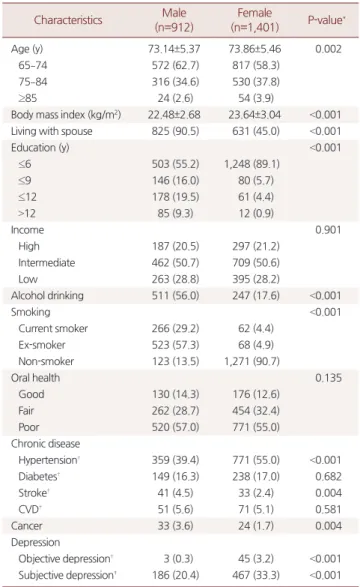
현재우울증치료여부, 음주, 고혈압/뇌졸중/심혈관계질환, 암, 구강건 강, 교육수준, 소득수준, 배우자 동거 여부에 대한 설문에 무응답 등 으로 결과 값이 없는 경우를 제외하여 남성 912명, 여성 1,401명, 총 2,313명을 연구 대상으로 하였다(Table 1).
2. 체중 감소와 체중 증가의 정의
체중의 감소는 최근 1년간 비의도적으로 3 kg 이상의 체중 감소를 보이는 경우를 국한하여 의미있는 체중 변화로 정의하였고 체중의 증가도 최근 1년간 비의도적으로 3 kg 이상의 체중 증가를 보이는 경 우를 국한하여 의미있는 체중 변화로 정의하였다.
3. 우울증의 정의
객관적 우울증의 경우 현재 우울증을 앓고 있거나 현재 치료를 받는 경우로 정의하였고, 주관적 우울증은 객관적 우울증에 해당하 지 않지만 최근 1년 동안 연속적으로 2주 이상 우울감을 느끼거나 자살사고가 있었던 경우로 정의하였다. 전체 우울증은 객관적 우울 증과 주관적 우울증을 합친 것으로 정의하였다.
4. 기타 만성질환 및 암의 정의
본 연구에서 기타 만성질환은 고혈압, 당뇨, 뇌졸중, 심혈관계 질 환으로 국한하였고, 심혈관계 질환은 심근경색과 협심증으로 정의
하였다. 암은 위암, 간암, 대장암, 유방암, 자궁경부암, 폐암, 갑상샘암 및 기타암을 모두 포함하였다. 만성질환 및 암은 현재 유병중인 경우 로 국한하였다.
5. 국민건강영양조사 자료 활용 방법
고혈압, 당뇨, 뇌졸중, 심혈관계 질환 등의 만성질환과 암, 객관적 우울증의 진단 여부 및 치료 유무, 교육 및 소득 수준에 대해서는 면 접방법으로 조사하였다. 주관적 우울증의 항목인 우울감과 자살사 고의 정신건강영역 및 흡연과 음주 등의 건강행태영역은 자기 기입
Table 1. Baseline characteristics of study population according to sex from KNHANES 2010–2012
Characteristics Male (n=912)
Female
(n=1,401) P-value*
Age (y) 73.14±5.37 73.86±5.46 0.002
65–74 572 (62.7) 817 (58.3)
75–84 316 (34.6) 530 (37.8)
≥85 24 (2.6) 54 (3.9)
Body mass index (kg/m2) 22.48±2.68 23.64±3.04 <0.001 Living with spouse 825 (90.5) 631 (45.0) <0.001
Education (y) <0.001
≤6 503 (55.2) 1,248 (89.1)
≤9 146 (16.0) 80 (5.7)
≤12 178 (19.5) 61 (4.4)
>12 85 (9.3) 12 (0.9)
Income 0.901
High 187 (20.5) 297 (21.2)
Intermediate 462 (50.7) 709 (50.6)
Low 263 (28.8) 395 (28.2)
Alcohol drinking 511 (56.0) 247 (17.6) <0.001
Smoking <0.001
Current smoker 266 (29.2) 62 (4.4)
Ex-smoker 523 (57.3) 68 (4.9)
Non-smoker 123 (13.5) 1,271 (90.7)
Oral health 0.135
Good 130 (14.3) 176 (12.6)
Fair 262 (28.7) 454 (32.4)
Poor 520 (57.0) 771 (55.0)
Chronic disease
Hypertension† 359 (39.4) 771 (55.0) <0.001
Diabetes† 149 (16.3) 238 (17.0) 0.682
Stroke† 41 (4.5) 33 (2.4) 0.004
CVD† 51 (5.6) 71 (5.1) 0.581
Cancer 33 (3.6) 24 (1.7) 0.004
Depression
Objective depression† 3 (0.3) 45 (3.2) <0.001 Subjective depression‡ 186 (20.4) 467 (33.3) <0.001 Values are presented as mean±standard error or number (%).
KNHASNES, Korean National Health and Nutrition Examination Survey; CVD, cardiovascular disease.
*P-values were obtained by Student's t-test or chi-square test. †Defined as being diagnosed and treated by a doctor at present. ‡Defined as experiencing depres- sive mood for 2 weeks or more, having suidical ideation, or attempting suicide in the past year.
송현진 외. 한국 노인에서 객관적/주관적 우울증과 체중 변화의 연관성 Korean Journal of Family Practice
KJFP
식으로 조사하였다.
흡연은 현재 흡연자, 과거 흡연자, 비흡연자로 구분하였고 음주는 한달에 1회 이상 술을 마시는 경우, 비음주는 한달에 1회 미만으로 마시는 경우로 구분하였다. 소득은 개인소득액을 삼등분하여 상, 중, 하 그룹으로 나누었고 교육수준은 6년 이하, 9년 이하, 12년 이하, 12년 이상의 그룹으로 구분하였다. 신체 계측은 이동검진차량에서 직접 계측을 하였으며, 체질량지수(body mass index, BMI)는 (체중 [kg]/신장의 제곱[m2])의 식을 이용하여 계산하였다.
6. 통계 분석
체중 감소를 보이는 65세 이상의 노인 인구 중 우울증의 세부 카 테고리(객관적/주관적)에 차이가 있어 나누어 분석하였고 성별과 나 이그룹에 따른 차이를 보고자 세분화하여 분석하였다.
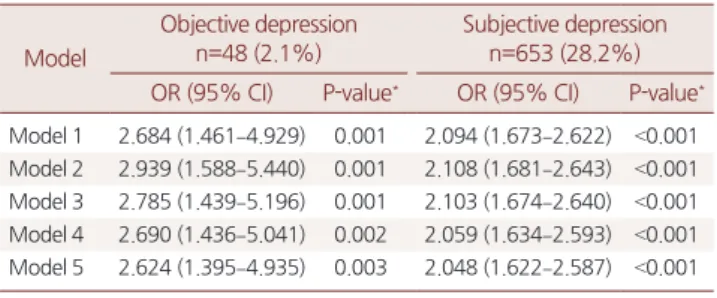
성별에 따른 연구 대상자들의 일반적 특성을 연속 변수는 독립표 본 t-검정을 이용하여 평균±표준오차로 제시하였고, 범주 변수는 카 이제곱 검정을 이용하여 빈도(백분율)로 제시하였다. 각 교란변수마 다 체중 감소에 따른 객관적/주관적 우울증의 유병률은 카이 제곱 검정을 이용하였다. 노인 인구의 체중 감소와 객관적/주관적 우울증 의 관계에 대해 로지스틱 회귀분석을 이용하여 분석하였다. 이 때 보 정 변수에 따라 보정을 하지 않은 모형(Model 1), 연령, 성별, BMI를 보정한 모형(Model 2), Model 2에 고혈압, 당뇨, 뇌졸중, 심혈관계 질 환, 암을 보정한 모형(Model 3), Model 3에 음주, 흡연, 배우자 동거, 구 강 건강을 보정한 모형(Model 4), Model 4에 교육수준과 소득수준을 보장한 모형(Model 5)를 이용하여 유의성을 확인했다. 분석 결과에 는 교차비와 95% 신뢰 구간을 제시하였다. 통계 분석은 IBM SPSS Stastistic ver. 19.0 (IBM Co., Armonk, NY, USA)을 이용하여 시행하였 고, 통계학적 유의 수준은 P-value<0.05로 하였다.
결 과
1. 연구 대상자의 일반적인 특성
Table 1에서 남성은 912명, 여성은 1,401명이고, 65–74세의 노인 남 성은 572명(62.7%), 여성은 817명(58.3%), 75–84세의 노인 남성은 316명 (34.6%), 여성은 530명(37.8%), 85세 이상은 24명(2.6%), 여성은 54명 (3.9%)이었다.
노인 남성의 평균 BMI는 22.48±2.68, 노인 여성 평균은 23.64±3.04 였다. 이 중 객관적 우울증이 남성에서 3명(0.3%), 여성에서 45명 (3.2%)이었고 주관적 우울증이 남성 186명(20.4%), 여성 467명(33.3%) 으로 주관적 우울증이 대부분을 차지했다.
2. 체중 변화와 객관적/주관적 우울증의 연관성
Table 2는 객관적/주관적 우울증에 따른 체중 변화의 연관성을 나 타낸 Table로 체중의 증가 및 감소와의 연관성을 비교하였다. 65세 이 상 전체 인구에서 객관적 우울증/주관적 우울증 모두에서 체중 감 소와 연관성을 보였고 객관적/주관적 우울증과 체중 증가의 관계에 서는 모두 의미있는 연관성을 보이지 않았다.
Table 3에서 변수를 보정한 Model 5에서 교차비가 객관적 우울증 에서 2.624 (95% confidence interval [CI], 1.395–4.935; P=0.003), 주관적 우울증에서 2.048 (95% CI; 1.622–2.587; P<0.001)로 객관적/주관적 우 울증이 있는 65세 이상 노인에서 그렇지 않은 군에 비해 체중 감소 의 위험이 2배 이상 증가하였다.
3. 성별에 따른 체중 감소와 객관적/주관적 우울증의 연관성 성별에 따라 객관적/주관적 우울증과 체중 감소와의 관계를 세분 Table 2. The association between depression and weight change (un-
adjusted OR & CI)
Weight change
Objective depression n=48 (2.1%)
Subjective depression n=653 (28.2%) OR (95% CI) P-value* OR (95% CI) P-value* Weight loss 2.565 (1.406–4.679) 0.001 2.075 (1.664–2.588) <0.001
Male NA NA 1.824 (1.247–2.670) 0.002
Female 2.957 (1.592–5.491) <0.001 2.314 (1.751–3.059) <0.001 Weight gain 0.574 (0.078–4.210) 0.580 1.120 (0.693–1.808) 0.644
Male NA NA 1.380 (0.575–3.316) 0.469
Female 0.548 (0.074–4.052) 0.550 0.927 (0.547–1.726) 0.923 OR, odds ratio; CI, confidence interval; NA, not available.
*P-value was obtained by Student’s t-test or chi–square test.
Table 3. The risk of weight loss in elderly with depression (adjusted OR
& CI) Model
Objective depression n=48 (2.1%)
Subjective depression n=653 (28.2%) OR (95% CI) P-value* OR (95% CI) P-value* Model 1 2.684 (1.461–4.929) 0.001 2.094 (1.673–2.622) <0.001 Model 2 2.939 (1.588–5.440) 0.001 2.108 (1.681–2.643) <0.001 Model 3 2.785 (1.439–5.196) 0.001 2.103 (1.674–2.640) <0.001 Model 4 2.690 (1.436–5.041) 0.002 2.059 (1.634–2.593) <0.001 Model 5 2.624 (1.395–4.935) 0.003 2.048 (1.622–2.587) <0.001 OR, odds ratio; CI, confidence interval; BMI, body mass index; DM, diabetes;
CVD, cardiovascular disease.
Model 1: adjusted for age and sex, Model 2: adjusted for BMI, Model 3: adjust- ed for covariates of model 2 plus hypertension, DM, stroke, CVD and cancer, Model 4: adjusted for covariates of model 3 plus alcohol, smoking, living with spouse and oral health, Model 5: adjusted for covariates of model 4 plus educa- tion and economic status.
*P-value was obtained by multiple logistic regression analysis.
Hyeun Jin Song, et al. The Association of Depresssion with Weight Change among Aged Koreans
Korean Journal of Family Practice
KJFP
화 하였을 때(Table 2) 주관적 우울증과 체중감소의 관계에서 남성 (odds ratio [OR], 1.824; 95% CI, 1.247–2.670; P=0.002)에 비해 여성(OR, 2.314; 95% CI, 1.751–3.059; P<0.001)에서 그 위험도가 높게 나타났다.
객관적 우울증에서는 남성의 표본 부족으로 평가가 어려웠다.
고 찰
이 연구는 국민건강영양조사에 참여한 국내 65세 이상의 노인에 서 객관적/주관적 우울증과 체중 변화의 연관성을 분석하였다.
객관적 우울증은 남성(3명, 0.3%)보다 여성(45명, 3.2%)에서 더 높았 고 주관적 우울증도 남성(186명, 20.4%)보다 여성에서(467명, 33.3%)에 서 더 높았다. 남녀 모두에서 객관적 우울증보다 주관적 우울증이 월등히 높았다.
조사 대상에서 객관적/주관적 우울증 모두에서 체중 감소와 연 관성을 보였고 변수를 보정 후 교차비가 객관적 우울증에서 2.624 (95% CI, 1.395–4.935; P=0.003), 주관적 우울증에서 2.048 (95% CI, 1.622–2.587; P<0.001)로 객관적/주관적 우울증이 있는 65세 이상 노 인에서 그렇지 않은 군에 비해 체중 감소의 위험이 2배 이상 증가하 였다. 성별에 따라 관계를 세분화하였을 때 주관적 우울증에서 남성 에서보다 여성에서 더욱 두드러진 연관성을 보였다.
고령에서의 식욕부진은 전체 인구의 20%에 이를 정도로 매우 흔 하게 일어난다.9) 나이가 들면서 미각과 후각기능이 저하되어 식욕에 제한을 받을 수 있고 스트레스 호르몬과 염증 매개 물질들(예를 들 면, tumor necrosis factor α, interleukin-1β, interleukin-6 등)의 작용은 과도한 이화작용, 악액질, 식욕 감소를 일으킬 수 있다.10,11) 더욱이 불 안이나 우울 같은 기분장애는 식욕의 강한 억제 인자로 작용한다고 알려져 있다.12) 이 같은 이유 때문에 다른 연령대에서와는 달리 고령 에서의 우울증은 체중 증가보다는 체중 감소와 연관성을 보이는 것 으로 생각된다.
2009년에 19세 이상의 한국 남녀 229,595명을 대상으로 한 단면연 구에서 여성이 남성에 비해 우울 증상이 1.9배 더 높게 조사되었다.13) 우울증은 여성에서 남성보다 더 높은 유병률을 보이는 것으로 알려 져 있는데,14-16) 그 원인은 명확히 밝혀지지 않았으나 생물학적인 차 이나 여성에게 불리한 사회 경제적 환경 등이 그 원인으로 고려되고 있다.17) 또한 시상하부-뇌하수체-부신축이 우울한 남성보다 우울한 여성에서 더욱 강하게 활성화되고 폐경 후의 에스트로겐 감소가 시 상하부-뇌하수체-부신축에 영향을 미친다고 하여 이러한 병태생리 가 여성에서 우울증의 취약성에 기여할 것이라는 보고가 있다.18) 본 논문에서 객관적/주관적 우울증에 대한 체중 감소의 위험도가 여성 에서 더 증가하는 것은 여성에서 우울증상이 더 빈번하게 나타나는
위와 같은 원인의 연장선에 있을 것으로 생각된다.
본 연구의 제한점은 첫째, 이 연구는 단면 연구이기 때문에 우울 증과 체중 감소의 시간적 선후 관계를 알 수 없어 상호간의 인과관 계를 밝히기는 어렵다. 과거 연구를 살펴보았을 때 우울증이라는 심 리적 원인 자체가 우울증상을 야기했을 가능성이 높으나,19-25) 노인 인구의 자살 동기 가운데 가장 큰 비율을 차지하는 것이 건강상태 에 대한 비관으로 알려져 있어26,27) 체중 감소라는 사실 자체가 우울 증상을 야기했을 가능성을 배제할 수 없다. 둘째, 객관적 우울증을 호소한 군의 수가 적어 평가가 불가능한 항목(Table 2에서 65세 이상 남성 노인 인구에서 객관적 우울증과 체중 변화의 관계)이 존재했 다. 셋째, 자료의 부족으로 체중 감소의 평가에 있어 개별화된 조사 (개개인의 BMI를 고려한 %로 환산 가능한 체중 감소량)를 하지 못하 였다. 그러나 노쇠한 노인 인구에서는 비록 매우 적은 체중 감소라도 (예를 들면, 1 kg이나 체중의 3%) 중요한 의미일 수 있다는 지적이 있
어28,29) 이러한 제한점이 본 연구의 의미를 퇴색시키지는 않을 것으로
생각된다.
위와 같은 약점에도 불구하고 본 연구의 장점은 첫째, 국내 자료 중 대표성과 높은 신뢰도를 가지는 국민건강영양조사 자료를 이용 하여 한국 노인인구에서의 우울증과 체중 변화의 연관성을 분석하 였다는 점이다. 둘째, 체중 감소와 관련된 위험인자의 자료를 보정하 여 Model 1에서 Model 5까지 분석하여 보다 정확한 결과를 추구했 다는 점이다. 셋째, 남녀간의 위험도 차이를 분석하여 여성에서 더 높은 위험도를 가진다는 점을 확인했다는 점이다.
고령에서의 체중 감소는 근육 기능의 손상, 낙상, 골질량 감소, 면 역 손상, 빈혈, 압박 궤양, 인지기능 저하, 상처 회복 지연, 술 후 더딘 회복, 기능 감소, 질병 이환률 및 사망률의 증가와 연관되어 있다.30) 때문에 우울증과 체중 감소는 그 각각의 변수가 노인에서 중요한 건 강 위험 인자일 뿐만 아니라 건강 상태를 예측하는 지표가 되기도 한다. 이번 연구 결과를 토대로 우울증 발병 및 체중 변화에 미치는 다양한 영향과 그 예방에 대한 연구가 필요할 것으로 생각된다.
요 약
연구배경:
우리나라는 세계에서 유래를 찾아볼 수 없을 정도로 급 속한 고령화를 경험하고 있다. 이러한 현상과 맞물려 노인 자살률이 최근 10년간 세계 60개국 중 가장 높은 수준으로 지속되고 있다. 노 인 자살의 흔한 원인 중의 하나는 우울증이다. 과거 연구에서 우울 증은 노인 인구에서 체중 감소를 일으킬 수 있으며 또한 고령에서의 체중 감소 자체가 사망률을 높인다는 다수의 연구결과가 보고되고 있다. 때문에 본 연구에서는 한국 노인을 대상으로 객관적/주관적송현진 외. 한국 노인에서 객관적/주관적 우울증과 체중 변화의 연관성 Korean Journal of Family Practice
KJFP
우울증과 체중 변화의 관계를 알아보고자 하였다.
방법:
제5기 국민건강영양조사(2010–2012년)에 참여한 65세 이상의 대한민국 노인 인구 중 체중 변화를 의도하지 않았으며 결과값이 없 는 참여자를 제외하고 최종적으로 2,313명을 대상으로 하였다. 객관 적/주관적 우울증에 따른 체중의 감소와 증가의 관계를 비교하였고 여성과 남성에서의 차이를 비교하였다. 이중 의미있는 연관성을 보 인 객관적/주관적 우울증과 체중 감소의 관계를 다시 나이, 성별, 체 질량지수, 만성질환(고혈압, 당뇨, 뇌졸중, 심혈관질환), 암, 음주, 흡 연, 배우자동거여부, 구강건강상태, 교육수준 및 소득수준을 보정하 여 분석하였다.결과:
조사 결과 객관적 우울증(2.565; 95% CI, 1.406–4.679; P=0.001) 과 주관적 우울증(2.075; 95% CI, 1.664–2.588; P<0.001) 모두 체중감 소와 유의미한 연관성을 보였고 변수 보정 후에도 이는 유의하게 나 타났다. 주관적 우울증에서 그 위험도는 남성(OR, 1.824; 95% CI, 1.247–2.670)보다 여성 (OR, 2.314; 95% CI, 1.751–3.059)에서 더 높게 나 타났다.결론:
본 연구를 통해 노인 인구에서 객관적/주관적 우울증과 체중 감소의 연관성을 확인하였고 이는 주관적 우울증의 경우 여성에서 더 높은 위험도를 가지는 것을 확인하였다.중심단어:
우울증; 체중 감소; 노인REFERENCES
1. Jang IH. Social welfare for older persons in aging society. Seoul: Seoul Na- tional University Press; 2012.
2. Brådvik L, Mattisson C, Bogren M, Nettelbladt P. Long-term suicide risk of depression in the Lundby cohort 1947-1997--severity and gender. Acta Psy- chiatr Scand 2008; 117: 185-91.
3. Isometsä ET, Henriksson MM, Aro HM, Heikkinen ME, Kuoppasalmi KI, Lönnqvist JK. Suicide in major depression. Am J Psychiatry 1994; 151: 530-6.
4. DiPietro L, Anda RF, Williamson DF, Stunkard AJ. Depressive symptoms and weight change in a national cohort of adults. Int J Obes Relat Metab Disord 1992; 16: 745-53.
5. Cornoni-Huntley JC, Harris TB, Everett DF, Albanes D, Micozzi MS, Miles TP, et al. An overview of body weight of older persons, including the impact on mortality. The National Health and Nutrition Examination Survey I- -Epidemiologic Follow-up Study. J Clin Epidemiol 1991; 44: 743-53.
6. Deeg DJ, Miles TP, Van Zonneveld RJ, Curb JD. Weight change, survival time and cause of death in Dutch elderly. Arch Gerontol Geriatr 1990; 10: 97-111.
7. Losonczy KG, Harris TB, Cornoni-Huntley J, Simonsick EM, Wallace RB, Cook NR, et al. Does weight loss from middle age to old age explain the in- verse weight mortality relation in old age? Am J Epidemiol 1995; 141: 312-21.
8. Wallace JI, Schwartz RS, LaCroix AZ, Uhlmann RF, Pearlman RA. Involun- tary weight loss in older outpatients: incidence and clinical significance. J Am Geriatr Soc 1995; 43: 329-37.
9. Donini LM, Poggiogalle E, Piredda M, Pinto A, Barbagallo M, Cucinotta D, et al. Anorexia and eating patterns in the elderly. PLoS One 2013; 8: e63539.
10. Atalayer D, Astbury NM. Anorexia of aging and gut hormones. Aging Dis 2013; 4: 264-75.
11. Ruscin JM, Page RL 2nd, Yeager BF, Wallace JI. Tumor necrosis factor-alpha and involuntary weight loss in elderly, community-dwelling adults. Pharma- cotherapy 2005; 25: 313-9.
12. Wysokiński A, Sobów T, Kłoszewska I, Kostka T. Mechanisms of the an- orexia of aging-a review. Age (Dordr) 2015; 37: 9821.
13. Oh DH, Kim SA, Lee HY, Seo JY, Choi BY, Nam JH. Prevalence and corre- lates of depressive symptoms in Korean adults: results of a 2009 Korean community health survey. J Korean Med Sci 2013; 28: 128-35.
14. Aneshensel CS. Social stress: theory and research. Annu Rev Sociol 1992;
18: 15-38.
15. Mirowsky J, Ross CE. Social patterns of distress. Annu Rev Sociol 1986; 12:
23-45.
16. Nolen-Hoeksema S. Sex differences in unipolar depression: evidence and theory. Psychol Bull 1987; 101: 259-82.
17. Elliott M. Gender differences in causes of depression. Women Health 2001;
33: 163-77.
18. Young E, Korszun A. Sex, trauma, stress hormones and depression. Mol Psy- chiatry 2010; 15: 23-8.
19. McMinn J, Steel C, Bowman A. Investigation and management of uninten- tional weight loss in older adults. BMJ 2011; 342: d1732.
20. Lankisch P, Gerzmann M, Gerzmann JF, Lehnick D. Unintentional weight loss: diagnosis and prognosis. The first prospective follow-up study from a secondary referral centre. J Intern Med 2001; 249: 41-6.
21. Metalidis C, Knockaert DC, Bobbaers H, Vanderschueren S. Involuntary weight loss. Does a negative baseline evaluation provide adequate reassur- ance? Eur J Intern Med 2008; 19: 345-9.
22. Marton KI, Sox HC Jr, Krupp JR. Involuntary weight loss: diagnostic and prognostic significance. Ann Intern Med 1981; 95: 568-74.
23. Rabinovitz M, Pitlik SD, Leifer M, Garty M, Rosenfeld JB. Unintentional weight loss. A retrospective analysis of 154 cases. Arch Intern Med 1986;
146: 186-7.
24. Wallace JI, Schwartz RS. Involuntary weight loss in elderly outpatients: rec- ognition, etiologies, and treatment. Clin Geriatr Med 1997; 13: 717-35.
25. Hernández-Díaz S. Prescription of medications during pregnancy: acci- dents, compromises, and uncertainties. Pharmacoepidemiol Drug Saf 2006;
15: 613-7.
26. Yoon HS, Heo SY. The mediating and moderating effects of social relation- ship on health status and life satisfaction of the elderly. Journal of the Korean Gerontological Society 2007; 27: 649-66.
27. Seo HL, Kim HN. Factors affecting psychological well-being of frail elderly women living alone. Korea Academy of Mental Health Social Work 2010;
35: 176-202.
28. Payette H, Coulombe C, Boutier V, Gray-Donald K. Weight loss and mortal- ity among free-living frail elders: a prospective study. J Gerontol A Biol Sci Med Sci 1999; 54: M440-5.
29. Tully CL, Snowdon DA. Weight change and physical function in older women: findings from the Nun Study. J Am Geriatr Soc 1995; 43: 1394-7.
30. MacIntosh C, Morley JE, Chapman IM. The anorexia of aging. Nutrition 2000; 16: 983-95.