인체 병원성 진균에 대한
Bacillus sp. BCNU 2002의 항진균 효과
최혜정1 ․ 안철수3 ․ 정영기4 ․ 김동완5 ․ 주우홍1,2*
1창원대학교 생물공학협동과정, 2창원대학교 생물학과, 3조아제약, 4동아대학교 생명공학과, 5창원대학교 미생물학과
Antifungal Activity of Bacillus sp. BCNU 2002 against the Human Pathogens
Hye Jung Choi1, Cheol Soo Ahn3, Young-Kee Jeong4, Dong Wan Kim5, and Woo Hong Joo1,2*
1Interdisciplinary Program in Biotechnology, Changwon National University, Changwon 641-773, Korea
2Department of Biology, Changwon National University, Changwon 641-773, Korea
3Cho-A Pharm. Co, LTD., Gyeongsangnam 637-810, Korea
4Department of Biotechnology, Dong-A University, Busan 604-714, Korea
5Department of Microbiology, Changwon National University, Changwon 641-773, Korea
Abstract An endospore-forming, rod-shaped bacterium was isolated from forest soil samples collected at the Taebaek mountain of Gangwon province, Korea, and taxonomically characterized by physiological, biochemical and phylogenetic methods. Its 16S rRNA sequences showed the maximum similarity of 97% with B. amyloliquefaciens.
In addition, the isolate BCNU 2002 was determined to have the ability to produce enzymes such as amylase, protease, gelatinase and catalase. The in vitro antifungal activity of Bacillus sp. BCNU 2002 was also examined against human pathogenic fungi such as Aspergillus niger, Candida albicans, Epidermophyton floccosum, Saccharomyces cerevisiae, Trichophyton mentagrophytes and Trichophyton rubrum. A maximum production level of antifungal substances of Bacillus sp. BCNU 2002 was achieved under aerobic incubation at 28℃ for 7 days in LB broth. BCNU 2002 showed strong antifungal activities against T. mentagrophytes and T. rubrum with the range of percentage inhibition from 56.25 to 63.23%. It was also confirmed that ethylacetate extract of cultured broth showed a strong antifungal activity against A. niger, C. albicans, S. cerevisiae and T. rubrum by agar diffusion method. The peptide fraction also exhibited broad antifungal spectrum against various pathogenic fungi. The minimum inhibitory concentration values for active extracts ranged between 125 μg/mL and 1000 μg/mL.
Keywords: Antifungal activity, Bacillus sp. BCNU 2002, human pathogenic fungi, minimum inhibitory concentration
서 론1)
항진균성 항생물질에 대한 연구는 동물이나 인체의 진균 성 질환의 치료 목적으로 1960년대 이후부터 활발히 추진 되었으며, 더불어 각종 농작물의 병충해 방제, 항생물질을
*Corresponding author
Tel: +82-55-213-3453, Fax: +82-55-213-3459 e-mail: [email protected]
이용한 농산물 가공 및 식품의 방부 보존에서도 그 유효성이 입증되어 제약관련 연구기관을 포함하여 다양한 분야에서 연구되고 있는 실정이다 [1,2]. 현재 임상용으로 사용하는 다양한 의약용 항생제들이 천연자원에서 선도물질이 분리 되었으며 [3], 그 외에도 다양한 유효성분에 대한 분석은 국내외 학계에서 꾸준히 연구되고 있는 부분이다.
진균류는 인체의 면역기능이 약화된 경우에 감염되기 쉬 우며, 항생물질 및 항암제 등의 오남용으로 인해 항균제 내성이 생겼을 때는 치료가 어려운 진균증을 유발하여 국부
또는 전신적인 피부질환을 일으키거나 호흡기 및 소화기 계통의 급만성 질환을 일으킨다 [4]. 대표적인 진균증으로 는 candidiasis, asperillosis, penicilliosis, dermatophytosis 등이 있으며, Trichophyton sp., Epidermophyton sp.와 같은 사상균은 인체에 표재성 진균감염증을 유발하는 사상균으 로 모발, 피부, 손톱과 같은 조직의 각질층에 침투하는 능 력을 가지고 있다 [5-7]. 항진균성 물질은 진균의 생육을 억 제하거나 사멸시키는 물질로 오랫동안 진균감염의 치료제로 사용되고 있는 amphotericin B, flucytosine과 griseofulvin를 포함하여, 근래에는 itraconazole, ketoconazole 및 fluconazole 등 다양한 항진균제가 개발되어 사용되고 있다 [8,9]. 최근 에는 triazoles (voriconazole, ravuconazole 및 posaconazol) 과 echinocandin제제 (caspofungin, anidulafungin 및 micafungin) 등 다양한 항진균제가 개발되고 있다 [10].
그러나 다양한 병원균의 출현 및 항생제 내성을 가진 균 주들이 지속적으로 보고됨에 따라 다양한 천연물질을 이용 한 새로운 항균물질 개발에 대한 연구는 끊임없이 진행되 고 있다 [11]. 또한 이러한 화학물질과 과도한 항생제의 사용은 부작용과 안정성에 문제를 야기시키고 있는데, amphotericin B를 비롯한 몇 종의 물질은 인체에 대한 독 성이나 물에 대한 용해성이 낮은 관계로 사용에 만족스럽 지 못한 것으로 평가되고 있다 [12-14]. 또한 griseofulvin 은 candidasis에 효과가 없으며, 후천성 면역결핍증 환자 에서 발생한 oropharyngeal candidiasis (재발성 구인두 칸디다증)의 치료를 위해 fluconazole을 장기투여한 경우 fluconazole 내성 Candida albicans의 출현이 다수 보고됨 에 [15,16] 따라 이를 대체할 만한 천연 항균물질에 대한 연구가 절실한 실정이다.
이에 본 연구에서도 독성이 적고 항진균성 활성이 강력 한 항생물질을 개발하기 위한 일환으로 토양에서 항진균 성 물질을 생산하는 균주를 선별하던 중 인체 진균증을 유발 하는 C. albicans, T. mentagrophytes 그리고 Trichophyton rubrum에 대해 효과가 있는 Bacillus sp. BCNU 2002를 분 리하였다.
Bacillus sp. 균주의 다양한 생리활성물질에 관한 연구는 이미 많이 보고되어 있으며, 항생작용에 관한 연구는 식물병 원균의 생육을 저해시키는 항진균 물질에 관한 연구 [17-20]
가 주를 이루고 있다. 또한 Bacillus 균주가 생산하는 단백 질 가수분해효소는 이미 식품공업, 의약공업 및 세제공업 등 효소 전체 시장의 60% 차지할 정도로 다방면으로 응용 되고 있는 이용가능성이 높은 균주이다. 그러나, 피부질환 원인균 저해에 대한 연구는 아직 미흡한 실정이다. 따라서 본 연구팀에서는 태백산에서 분리한 Bacillus sp. BCNU 2002의 균 배양액으로 1차 항균스펙트럼을 조사하였고, 항균물질 분리를 위해 배양액을 ethyl acetate 추출물과 펩 타이드 추출물로 나누어 각각 평판배지확산법과 액체배지 감수성 실험을 통하여 그람 양성 및 그람 음성 세균 특히 진균에 대한 항균활성을 측정하여, 항생물질 개발을 위한 기초 결과로서 보고하고자 한다.
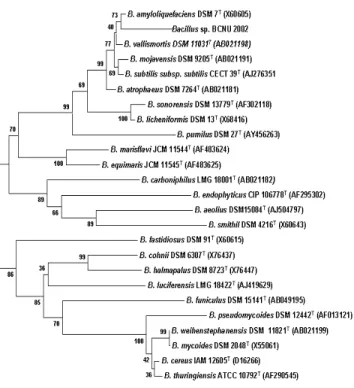
Fig. 1. Phylogenetic tree based on the 16S rRNA sequences of the Bacillus sp. BCNU 2002 and closely related species. Boostrap values expressed as a percentage of 1000 replications were given at the branching points.
재료 및 방법
분리 균주의 동정
분리균주 BCNU 2002의 분류학적 동정을 위해 Bergey’s Manual of Systematic Bacteriology를 이용하여 배양학적, 생화학적 특성을 조사하였고, 분자유전학적 분류를 위하여 16S rRNA 염기서열 분석을 실시하여 동정하였다. 16S rRNA 의 PCR sequencing을 위하여 16F (5’-AGTTTGATCCTGG CTCAG-3’)와 1492R (5’-ACGGCTACCTTGTTACGACTT -3’) primer를 사용하여, 유전자를 증폭한 후, 염기서열을 분석하였다. 분석되어진 염기서열은 Blast search를 통해 비교 분석하였으며 계통수는 neighbor joining 법과 bootstrap 분석을 기반으로 확인하였다 [21,22].
테스트 균주
항균측정을 위해 그람 양성균인 Bacillus subtilis KACC 10111 (ATCC 465), Micrococcus luteus KACC 10488 (ATCC 4698), Staphylococcus aureus IMSNU 11088 (ATCC 6538)와 그람 음성균인 Escherichia coli IMSNU 10080 (ATCC 10798), Pseudomonas aeruginosa IMSNU
10191 (ATCC 10145), Pseudomonas fluorescens KACC 10071 (ATCC 13525)를 사용하였으며, 인체병원성 진균으 로는 Aspergillus niger KACC 40280 (ATCC 4695), Candida albicans KACC 30062 (ATCC 10231), Epidermophyton floccosum KCTC 6921 (ATCC 10227), Saccharomyces cerevisiae KCTC 7968 (ATCC 8255), Trichophyton mentagrophytes KCTC 6077 (IFO 6202) 그리고 Trichophyton rubrum KCTC 6375 (ATCC 28188)를 사용하였다. 이들 균주들은 한국농업미생물자원센터, 한국생물자원센터, 서울 대학교 미생물연구소로부터 분양받았다.
항균스펙트럼 조사
그람 양성균 3종, 그람 음성균 3종 그리고 주요 인체 병원성 진균 6종에 대해 평판배지확산법 (agar diffusion method) 및 대치배양 방법을 이용하여, 순수 분리된 BCNU 2002 균주를 28℃에서 3-7일간 배양한 후 저해 정도를 측정 하였다. 사상균에 대한 저해능 측정은 Whipps의 방법 [23]
에 준하여 측정하였으며, 저해능은 증식저해율 (growth inhibition: GI)로 나타내었다.
GI = (R1-R2)/R1 × 100
GI: growth inhibition (%), R1: 배양 후 균사이의 거리, R2: 배양 전 접종 거리.
항균물질 생산균주 분리 및 항균 물질의 생산 조건 검토 본 연구에 사용된 균주는 태백산 일대의 토양을 채취하여 그람 양성균, 그람 음성균, 인체병원성 효모와 곰팡이 각 1종 에 대해 1차적으로 항균활성을 조사하였으며, 스크리닝을 통해 항균스펙트럼이 넓고, 활성이 뛰어난 균주를 분리하였 다. 항진균 물질의 생산을 위한 기본배지를 선택하기 위해 서 nutrient broth (NB), Luria-Bertani (LB) broth, tryptic soy broth (TSB)를 사용하였으며, 각종 pH, 온도조건 등을 달리하여 8일 동안 배양하면서, 24시간 간격으로 배양액을 회수하여, 전처리 후 항균활성을 조사하였다.
최소저해농도 (minimum inhibitory concentration;
MIC) 측정
BCNU 2002의 항균물질을 부분정제하기 위하여 배양 액을 각각 ethylacetate (EA) 와 6 N HCl로 추출 또는 침 전시켜 EA 추출물과 펩타이드 침전물로 나누었다. BCNU 2002 EA 추출물과 펩타이드 침전물의 최소저해농도를 측 정하기 위하여 액체배지감수성실험 (broth microdilution susceptibility test) 방법 [24,25]을 이용하였다. 즉, EA 추 출물과 펩타이드 분획을 각각 2배씩 연속희석하여 균의 최 적배양조건에서 배양한 후 관찰하였다.
결과 및 고찰
균주의 분리 및 동정
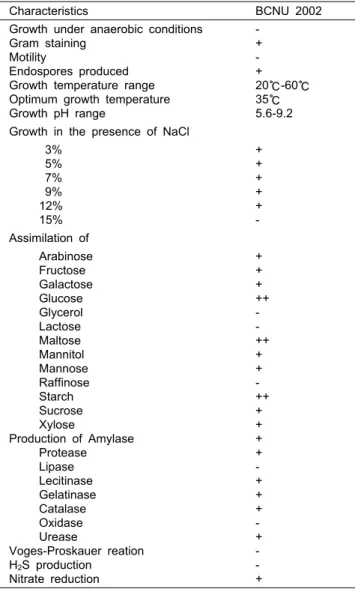
천연 항생물질의 개발을 위한 연구의 일환으로 다양한 토착미생물을 분리하는 과정에서, 태백산 일대의 토양으로부 터 항균스펙트럼이 넓고 활성이 뛰어난 Bacillus sp. BCNU 2002를 분리하였다. BCNU 2002의 생리 생화학적 특징은 Table 1에 제시되어 있다. BCNU 2002는 그람 양성 간균으 로 운동성이 없는 호기성 균주로 내생포자를 형성하였다.
Table 1. Biochemical and physiological characteristics of Bacillus sp. BCNU 2002
Characteristics BCNU 2002
Growth under anaerobic conditions Gram staining
Motility
Endospores produced Growth temperature range Optimum growth temperature Growth pH range
- + - + 20℃-60℃
35℃
5.6-9.2 Growth in the presence of NaCl
3%
5%
7%
9%
12%
15%
+ + + + + - Assimilation of
Arabinose Fructose Galactose Glucose Glycerol Lactose Maltose Mannitol Mannose Raffinose Starch Sucrose Xylose
Production of Amylase Protease Lipase Lecitinase Gelatinase Catalase Oxidase Urease
Voges-Proskauer reation H2S production
Nitrate reduction
+ + + ++
- - ++
+ + - ++
+ + + + - + + + - + - - +
최적 배양온도는 35℃로, 20℃에서 60℃에서도 생육이 가능 하며, 생육 pH 범위도 5.6에서 9.2로 비교적 넓은 pH 영역 에서 안정적으로 생육하였다. 또한 12%의 높은 염분 농도 에서도 생육이 가능하였다. 한편 각종 효소 활성 조사에서 amylase, protease, lecitinase, gelatinase, catalase 및 urease
Diameter of inhibition zones (mm)
B. subtilis M. luteus S. aureus E. coli P. aerusinosa P. fluorescens C. albicans S. cerevisiae
BCNU 2002 6.08 ± 0.03 13.8 ± 0.28 - - - - 17.5 ± 0.71 20.5 ± 0.71
Table 2. Effect of Bacillus sp. BCNU 2002 on in vitro growth of bacteria and human pathogenic yeasts
GI (%) GI category GI (%) GI category GI (%) GI category GI (%) GI categorya
A. niger Ep. floccosum T. rubrum T. mentagrophytes
BCNU 2002 46.57 ± 0.43 2 - 0 56.25 ± 2.94 3 64.23 ± 0.68 3
aPercent growth inhibition (GI) was determined after 7 days of incubation. Values were categorized on a scale from 0 to 4, where 0 = no growth inhibition, 1 = 1 to 25%, 2 = 26 to 50%, 3 = 51% to 75% and 4 = 76 to 100%. The tests are in duplicate.
Table 3. Effect of Bacillus sp. BCNU 2002 on in vitro growth of human pathogenic fungi
를 생성하여 다양한 효소를 분비하는 것으로 나타났으며, 자화능 조사에서는 다양한 탄소원을 이용하는 것으로 나타 났으며, 특히 glucose, maltose 및 starch를 첨가한 배지에서 생육이 좋은 것으로 나타났다. 16S rRNA 염기서열 분석을 실시하여 Blast search를 통해 비교 분석한 결과, Bacillus amyloliquefaciens와 97% 상동성을 나타내었고 계통적으로 는 B. amyloliquefaciens와 B. vallismortis의 subcluster에 속하는 균주로 확인되었다.
그람 양성, 음성균 및 인체병원성 균주에 대한 항균활성 측정
그람 양성균 3종, 그람 음성균 3종 및 인체병원성 진균 6종에 대해 BCNU 2002의 항균활성을 측정한 결과, 주로 그람양성균과 인체병원성 진균에 대해 넓은 항균스펙트럼을 가지고 있었다. 그람 양성균에 비해 인체병원성 진균에서 상대적으로 높은 항균활성을 나타내었으며, 그람 음성균에는 항균활성이 나타나지 않았다 (Table 2, 3). 즉, 그람 양성균인 M. luteus에 대해서 13.8 mm의 활성을 보였으며, 병원성 효모인 C. albicans와 S. cerevisiae에 대해서는 각각 17.5 mm 와 20.5 mm의 넓은 억제환을 관찰할 수 있었다 (Fig. 2).
Fig. 2. Antagonistic effect of Bacillus sp. BCNU 2002 on the growth of (a) B. subtilis, (b) M. luteus, (c) S. aureus, (d) E. coli, (e) P. aeruginosa, (f) P. flurorescens, (g) C.
albicans, (h) S. cerevisiae after 24 h of incubation.
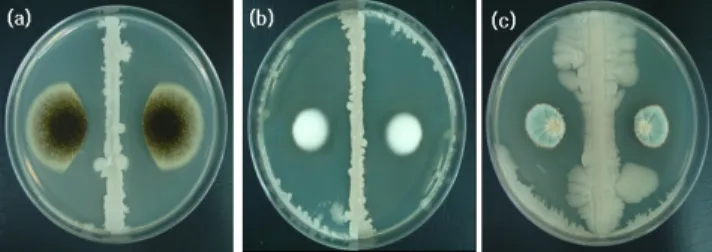
또한 Whipps의 방법에 준한 인체병원성 진균에 대한 항균 활성은 T. mentagrophytes에 대해 64.23%의 높은 저해효과를 보였으며, A. niger와 T. rubrum에 대해서도 각각 46.58%와 56.25%의 높은 저해효과를 관찰할 수 있었으며, T. rubrum 과는 서로 길항작용을 하는 것으로 나타났다 (Fig. 3).
Fig. 3. Antagonistic effect of Bacillus sp. BCNU 2002 on the mycelial growth of the dermatophyte, (a) A. niger, (b) T. mentagrophytes, (c) T. rubrum after two weeks of incubation on PDA at 25℃.
최소저해농도 측정
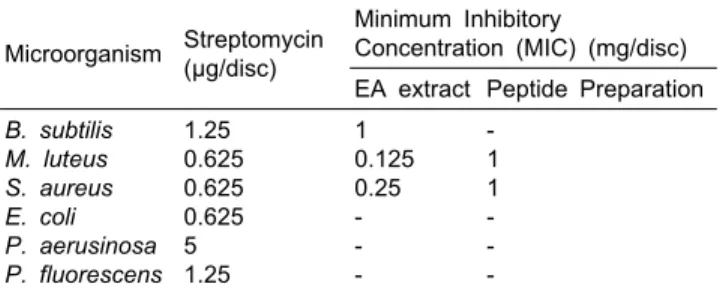
항균활성 물질의 생산 조건에 대한 기초 조사 결과, 항균 활성 물질을 가장 많이 분비한 배지는 LB broth 배지였으 며, 28℃, pH 7.2로 6일간 배양했을 때가 가장 최적 생산 조건이었다. 최적 생산 조건으로 각각 1 L를 진탕배양하였 고, 배양 상등액을 회수 (7,500 × g, 10분, 4℃)하여 EA 추 출과 HCl 침전을 통해 0.598 g의 EA 추출물과 0.308 g의 펩타이드 추출물을 얻었으며, 항균활성 시료로 사용하였다.
BCNU 2002의 EA 추출물이 그람 양성균에 대해 상대적 으로 넓은 항균스펙트럼을 나타냈으며, 각각 0.125 mg/mL, 0.25 mg/mL의 저농도에서 그람양성균인 M. luteus와 S.
aureus의 생육을 저해하였으며, B. subtilis에 대해서도 1 mg/mL 농도에서 저해하였다. 펩타이드 추출물은 1 mg/mL 농도에서 M. luteus와 S. aureus의 생육을 저해하는 것으 로 나타났다. 그리고 인체병원성 균주에 대한 활성은 EA 추출물이 A. niger에 대해 0.25 mg/mL의 저농도에서 생육을 저해하였으며, T. mentagrophytes과 T. rubrum도 1 mg/mL
농도에서 생육이 저해되었다. 펩타이드 추출물은 상대적으 로 넓은 항균스펙트럼을 나타냈으며, 0.5 mg/mL의 저농도 에서 A. niger, C. albicans 그리고 S. cerevisiae의 생육을 저해하였으며, T. rubrum에 대해서도 1 mg/mL 농도에서 저해하는 것을 관찰할 수 있었다 (Table 5, 6).
Table 4. Antibacterial susceptibility test of Bacillus sp. BCNU 2002
Microorganism Streptomycin (μg/disc)
Minimum Inhibitory
Concentration (MIC) (mg/disc) EA extract Peptide Preparation B. subtilis
M. luteus S. aureus E. coli P. aerusinosa P. fluorescens
1.25 0.625 0.625 0.625 5 1.25
1 0.125 0.25 - - -
- 1 1 - - -
Table 5. Antifungal susceptibility test of Bacillus sp. BCNU 2002
Microorganism Itraconazol (μg/disc)
Minimum Inhibitory
Concentration (MIC) mg/disc) EA extract Peptide Preparation A. niger
C. albicans Ep. floccosum S. cerevisiae T. mentagrophytes T. rubrum
0.020 0.080 1.274 0.159 2.548 2.548
0.25 - - - 1 1
0.5 0.5 - 0.5 - 1
물리화학적 성상이 다른 BCNU 2002의 EA추출물과 펩 타이드 추출물이 주요 인체병원성 진균증을 유발하는 C.
albicans, T. rubrum 그리고 T. mentagrophytes에 대해 항진 균 활성을 보였으며, 기회성 감염을 유발하는 A. niger와 S.
cerevisiae에 대해서도 뛰어난 항진균 활성을 나타냄으로 써 다양한 항균 및 항진균 기작을 가진 물질들이 BCNU 2002에는 다수 포함되어 있을 것으로 판단된다. BCNU 2002의 subcluster인 B. vallismortis의 n-butanol 추출물에서 분리한 Bacillomycin D는 식물병원성 진균에 활성이 있는 것 으로 보고되어 있으나, 인체병원성 진균에 대한 활성은 조사 되고 있지 않은 실정이다 [26]. 또한 B. amyloliquefaciens에 서 분리한 단백질인 baciamin은 식물병원성 진균에 대한 항진균 활성, HIV-1 역전사 효소에 대한 저해, 유방암 및 대 장암 등에 대한 억제 효과가 있다고 보고되어 있으며 [27], iturin A와 펩타이드 물질은 Rhizoctonia solani를 포함한 식물병원성 곰팡이에 대한 활성이 보고되어 있다 [28,29].
그러나 이들 물질에 대한 인체 병원성 진균에 대한 저해효 과는 보고되어 있지 않다.
현재 피부 질환을 유발하는 인체 병원성 진균에 대한 항 균효과에 대한 연구는 국외에서는 Microsporum fulvum와 Trichophyton sp.에 대한 B. subtilis의 항진균 활성이 보고 된 바 있으며 [31], 국내에서 자몽 등의 식물 추출물을 이용
한 연구가 보고되어 있다 [32]. C. albicans에 대한 B. subtilis 의 항진균 활성이 일부 보고되어 있으나 [33], 다양한 인체 병원균에 대한 항진균 활성에 관한 보고는 미비한 실정이 다. 그러므로 B. amyloliquefaciens의 subcluster에 속하는 균주에서의 인체 병원성 진균에 대한 항진균 활성 보고는 처음이므로 학술적으로 매우 중요한 의의가 있다고 판단된 다. 따라서 인체 병원성 진균에 대해 넓은 항균스펙트럼을 가지는 Bacillus sp. BCNU 2002의 항균활성을 나타내는 데 주된 역할을 하는 물질 분리 등 지속적인 연구를 통한 다면, 피부질환을 포함한 광범위한 치료제의 응용개발이 가능하리라 사료된다.
결 론
신규 미생물 유래 생리활성 물질의 개발을 위한 연구의 일환으로 태백산 일대의 토양에서, 인체에 진균증을 유발하 는 A. niger, C. albicans, S. cerevisiae, T. rubrum 그리고 T. mentagrophytes에 대해 강한 항진균 활성을 가진 BCNU 2002를 분리하여 항진균 활성 물질의 이용가능성에 대해 연구하였다. Bacillus sp. BCNU 2002는 계통적으로는 B.
amyloliquefaciens와 B. vallismortis의 subcluster에 속하는 균 주로 동정되었다. EA 추출물과 펩타이드 추출물로 나누어 세균 및 진균에 대한 항균활성을 측정한 결과, EA 추출물은 A. niger에 대해 높은 항진균 활성을 나타냈으며, 펩타이드 추출물 또한 A. niger를 포함한 4종의 인체병원성 진균에 대해 높은 항진균 활성을 나타내었다.
따라서 현재 의약용으로 사용되고 있는 다양한 항생제 들이 미생물에서 분리된 만큼, 다양한 인체 병원성 진균에 대해 넓은 항진균 스펙트럼을 가지는 Bacillus sp. BCNU 2002의 추가적인 연구를 통해 신규 생리활성 물질의 확보가 가능하리라 사료된다.
감 사
본 연구는 교육과학기술부와 한국산업기술진흥원의 지역 혁신인력양성사업으로 수행된 연구결과임.
접수:2009년 12월 29일, 게재승인:2010년 4월 23일
REFERENCES
1. Kumar. A., P. Saini, and J. N. Shrivastava (2009) Production of peptide antifungal antibiotic and biocontrol activity of Bacillus subtilis. Indian J. Exp. Biol. 47:
57-62.
2. Liu, Y., Z. Chen, T. B. Ng, J. Zhang, M. Zhou, F. Song, F. Lu, and Y. Liu (2007) Bacisubin, an antifungal protein with ribonuclease and hemagglutinating activities from Bacillus subtilis strain B-916. Peptides 28: 553-559.
3. Tawara, S., S. Matsumoto, T. Hirose, Y. Matsumoto, S.
Nakamoto, and M. Mitsuno (1989) In vitro antifungal synergism between pyrrolnitrin and clotrimazole. Med.
Mycol. 30: 202-210.
4. White, T., K. Marr, and R. Bowden (1998) Clinical, cellular and molecular factors that contribute to antifungal drug resistance. Clin. Microbiol. Rev. 11:
382-402.
5. Chomnawang, W. T., S. Surassmo, V. S. Nukoolkarn, and W. Gritasnapan (2005) Antimicrobial effects of Thai medicinal plants against acne-inducing bacteria.
J. Ethnopharmacol. 101: 330-333.
6. Kane, J. and R. C. Summerbel (1999) Trychophyton, Microsporm, Epidermophyton, and agents of superficial mycosis. pp. 1275-1294. In: P. R. Murray, E. J. Baron, M. A. Pfaller, F. C. Tenover, and R. H. Yolken (eds.).
Manual of Clinical Microbiology. 7nd ed., ASM Press, Washington D.C., USA.
7. Weitzman, I. and R. C. Summerbel (1995) The dermatophytes. Clin. Microbiol. Rev. 8: 240-159.
8. Favre, B., B. Hofbauer, K. S. Hildering, and N. S.
Ryder (2003) Comparison of in vitro activities of 17 antifungal drugs against a panel of 20 dermatophytes by using a microdilution assay. J. Clin. Microbiol.
41: 4817-4819.
9. Gupta, A. K., Y. Kohli, A. Ki, J. Faergemann, and R. C. Summerbell (2000) In vitro susceptibility of the seven Malassezia species to ketoconazole, voriconazol, itaconazol and terbinafine. Br. J. Dermatol. 142:
758-765.
10. Wei, Q. L., S. S. Zhang, J. Gao, W. H. Li, L. Z. Xu, and Z. G. Yu (2006) Synthesis and QSAR studies of novel triazole compounds containing thioamide as potential antifungal agents. Biol. Med. Chem. 14: 7146-7153.
11. Jo, J. H., H. S. Jang, H. C. Ko, M. B. Kim, C. K.
Oh, Y. W. Kwon, and K. S. Kwon (2005) Pustular psoriasis and the Köbner phenomenon caused by allergic contact dermatitis from zinc pyrithione- containing shampoo. Contact Dermatitis 52: 142-144.
12. Larone, D. H. (1995) Medically Important Fungi. 3rd ed., p. 9. ASM Press, Washington D.C., USA.
13. Shadomy, S., H. J. Shadomy, and G. E. Wagner (1977) Fungicides in medicine, pp. 437-461. In: M. R. Siegel, and D. S. Hugh (eds.). Antifungal Compounds. Marcel Decker, New York, USA.
14. Vikmon, M., A. Stadler-Szoke, and J. Szejtli (1985) Solubilization of amphotericin B with γ-cyclodextrin.
J. Antibiotics 38: 1822-1824.
15. Ruhnke, M., A. Schmidt-Westhausen, E. Engelmann,
and M. Trautmann (1996) Comparative evaluation of three antifungal susceptibility test methods for Candida albicans isolates and correlation with response to fluconazole therapy. J. Clin. Microbiol. 34: 3208-3211.
16. Tortorano, A. M., M. A. Viviani, F. Barchiesi, D. Arzeni, A. L. Rigoni, and M. Cogliat. (1998) Comparison of three methods for testing azole susceptibilities of Candida albicans strains isolated sequentially from oral cavities of AIDS patients. J. Clin. Microbiol.
36: 1578-1583.
17. Joo, W. H., S. J. Han, Y. L. Choi, and Y. K. Jeong (2004) Antifungal compound produced by Bacillus sp. TMB 912. J. Life Sci. 14: 193-197.
18. Kim, M. H., H. S. Ko, Y. M. Yool, and H. S. Kim (2008) Isolation and characterization of microorganisms with broad antifungal activity against phytopathogenic fungi. Kor. J. Biotechnol. Bioeng. 23: 219-225.
19. Park, S. M., J. S. Lee, C. D. Park, J. H. Lee, H. J.
Jung, and T. S. Yu (2006) Selection and antifungal activity of antagonistic bacterium Bacillus subtilits KMU-13 against cucumber scab, Cladosporium cucumerinum KACC 40576. Kor. J. Biotechnol. Bioeng.
21: 42-48.
20. Zhang, B., C. Xie, and X. Yang (2008) A novel small antifungal peptide from Bacillus strain B-TL2 isolated from tobacco stems. Peptides 29: 350-355.
21. Saito, N. and M. Nei (1987) The neighbor-joining method, a new method for reconstructing phylogenetic trees.
Mol. Biol. Evol. 79: 426-434.
22. Thompson, J. D., D. G. Higgins, and T. J. Gibson (1994) CLUSTAL W: Improving the sensitivity of progressive multiple sequence alignment through sequence weighting, position-specific gap penalties and weight matrix choice. Nucleic Acids Res. 22:
4673-4680.
23. Whipps, J. M. (1987) Effect of media on growth and interactions between a range of soil-borne glasshouse pathogens and antagonistic fungi. New Phytol. 107:
127-142.
24. National Committee for Clinical Laboratory Standards.
(2004) Methods for antimicrobial susceptibility testing of anaerobic acteria: Approved Standard. 6nd ed., Vol.
24, NCCLS Document M11-A6. Pennsylvania, USA.
25. National Committee for Clinical Laboratory Standards (2002) Reference methods for broth dilution antifungal susceptibility testing of yeasts: Approved Standard. 2nd ed., Vol. 22, NCCLS Document M27-A2. Pennsylvania.
USA.
26. Zhao, Z., Q. K. Wang, K. Brian, C. Liu, and Y. Gu (2010) Study of the antifungal activity of Bacillus vallismortis ZZ185 in vitro and identification of its antifungal components. Bioresour. Technol. 101: 292-297.
27. Wong, J. H., J. Hao, Z. Cao, M. Qiao, H. Xu, Y.
Bai, and T. B. Ng (2008) An antifungal protein from Bacillus amyloliquefaciens. J. Appl. Microbiol. 105:
1888-1898.
28. Kim, P. I. and K. C. Chung (2004) Production of an antifungal protein for control of Colletotrichum lagenarium by Bacillus amyloliquefaciens MET 0908. FEMS Microbiol. Lett. 234: 177-183.
29. Yu, G. Y., J. B. Sinclair, G. L. Hartman, and B. L.
Bertagnolli (2002) Production of iturin A by Bacillus amyloliquefaciens suppressing Rhizoctonia solani. Soil Biol. Biochem. 34: 955-963.
30. Favre, B., B. Hofbauer, K. S. Hildering, and N. S.
Ryder (2003) Comparison of in vitro activities of 17 antifungal drugs against a panel of 20 dermatophytes
by using a microdilution assay. J. Clin. Microbiol.
41: 4817-4819.
31. Lee, S. G. (2003) Antimicrobial effect of Bamboo (Phyllosrachys bambusoides) essential oil on Trichophyton and Pityrosporum. J. Food. Hyg. Safety 18: 113-117.
32. Ha, Y. M., B. B. Lee, H. J. Bae, K. M. Je, S. R.
Kim, J. S. Choi, and I. S. Choi (2009) Antimicrobial activity of grapefruit seed extract and processed sulfur solution against human skin pathogens. J. Life Sci. 19: 94-100.
33. Lee, N. W., C. S. Kim, J. H. Do, I. C. Jung, H. W.
Lee, and D. H. Yi (1998) Isolation and identification of Bacillus sp. LAM 97-44 producing antifungal antibiotics. Agric. Chem. Biotechnol. 41: 208-212.