식물 병원균에 대한 항진균 활성을 갖는 Bacillus subtilis KYS-10의 분리
강대원 ・ 류일환 ・ 한성수*
원광대학교 생명자원과학대학
(Received on January 30, 2012. Revised on April 28, 2012. Accepted on May 19, 2012)
The isolation of Bacillus subtilis KYS-10 with antifungal activity against plant pathogens
Dae-Won Kang, Il-Hwan Ryu and Seong-Soo Han*
College of Life Science and Natural Resources, Wonkwang University, Iksan 570-749, Korea
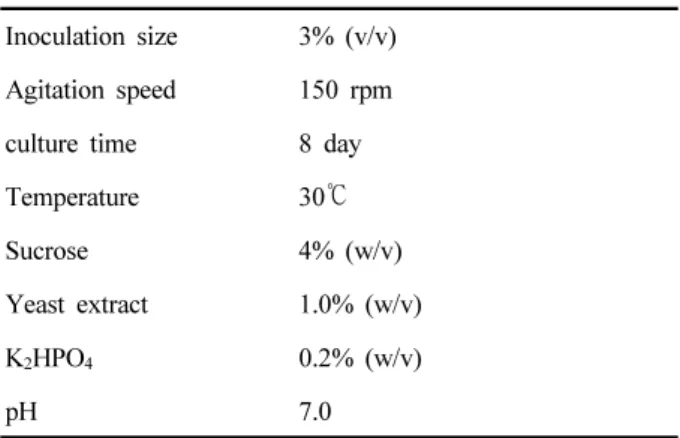
This study was investigated for the purpose of the isolation and identification of antagonistic bacteria with antifungal activity against plant pathogens. This bacteria denominated Bacillus subtilis KYS-10 and the optimum growth condition were 4% sucrose, 1% yeast extract, 0.2% K2HPO4, pH 7, 150 rpm, 30℃, 8 day. The antifungal activities against nine plant pathogens determined inhibition zone size by diffusion methods. The results, G. zeae (scab) 70 mm and P. grisea KACC 40439 (blast), P. capsici KACC 40177 (phytophthora blight) and C. destructans KACC 41077 (root rot of ginseng) 40~43 mm, and C. gloeosporioides KACC 43520 (ripe rot), C. gloesporioides KACC 40003 (anthracnose), S. shiraiana KACC 41065 (stem rot) and S. shiraiana (mulberry sclerotial disease) 35~39 mm and F. Oxysporum KACC 44452 (bulb rot of ginseng) 28 mm. From these experiment results, author suggest that Bacillus subtilis KYS-10 would be developed as a biological control agent thorough the field experimet in the near future.
Key words Bacillus subtilis KYS-10, Isolation and identification, Optimum growth condition, Plant pathogenes, Antifungal activity
Abstract
*Corresponding author: Tel. +82-63-850-6678
Fax. +82-63-850-6678, E-mail. [email protected]
서 론
유기합성농약에 대한 저항성 식물 병들이 발현되었고 화 학비료의 과용으로 토양의 산성화와 부영양화로 이어지고 있 어 이로 인한 피해는 현대 농업사회에 또 다른 문제들로 나타 나고 있다. 이러한 문제들을 해결하기 위하여 친환경 농업을 목표로 유기합성농약을 대체할 천연물 또는 미생물을 이용한 생물학적 방제의 다양한 연구들이 진행되고 있다.
생물학적 방제는 식물질병을 조절하기 위한 실용적 방법
으로 고려되고 있다. 생물학적 방제는 미생물에 의해 식물병 을 유발하는 미생물의 성장, 감염을 조절하는 방법(Heydari et al., 2007)과 비 병원성 미생물을 사용하여 환경적으로 안 전하고, 식물 면역을 증가시켜 식물병균에 대한 내성을 증가 시키는 방법이 있다(Schouten et al., 2004). 식물 병은 바이 러스, 세균, 곰팡이에 의해서 유발되며, 이 중 곰팡이에 의한 식물 병은 농업의 심각한 손실을 유발하는 가장 중요한 미생 물이다(Agrios et al., 1988). 식물 병을 유발하는 곰팡이는 Oomycetes, Ascomycetes, Basidiomycetes속에 속하는 곰 팡이류들이 주를 이룬다. 거의 모든 식물 병은 Ascomycetes 속에 의해 일어나나 lower fungi(물곰팡이)로 분류되는 178
ORIGINAL ARTICLE / CONTROL Open Access
Oomycete속의 phytophthora종과 phythium종도 일부 식물 병을 유발한다(Alexopouloos et al., 1997).
식물과 pathogen의 상호관계를 이해하는 것이 생물학적 방제의 기작을 이해하는데 매우 중요하다. 식물과 미생물의 상호작용은 공생(mutualism), 편리공생(protocooperation commensalism), neutralism, 경합(competition), amensalism, parasitism과 predation이 있다(Bankhead et al., 2004). 대 다수의 식물병은 commensalsm 과 mutualism에 의해 유발 된다. Mutualism은 Rhizobium 세균과 식물종간의 상호 유 익한 mutualism이 있는 반면(Kerry, 2000; Chisholm et al., 2006), commensalism은 식물 종에 영향을 미치는 공생관계 로 이 미생물이 존재하지 않으면 식물 병이 발병하지 않는 것 으로 보고되어 있다(Katska, 1994; Chishom et al., 2006).
따라서, 생물학적 방제는 미생물과 식물의 공생관계 및 미생 물과 병 유발 균의 관계를 어떻게 조절하느냐가 관건이 되어 진 다(Katska, 1994; Bull et al., 2002; Chishom et al., 2006).
식물과 병 유발 균간에 다양한 상호관계의 양상이 있는 관 계로 많은 연구자들이 다양한 실험의 형식으로 생물학적 방 제 효과에 대하여 연구한 결과, 모든 경우에서 병 유발 균은 다른 미생물과 길항 관계에 있음을 규명하였다(Elad and Baker, 1985; De Meyer and Hofte, 1997; Heydari et al., 1997; Van and Nelson, 2000; Audenaert et al., 2002). 길 항작용은 병 유발 균에 대한 항균 활성을 갖는 미생물에 의한 직접적 길항작용과 식물의 면역 시스템을 자극하는 간접적 길항작용으로 대별된다(Lafontaine and Benhamou, 1996;
Silva et al., 2004). 직접적인 길항작용에 의한 생물학적 방 제는 hyperparasitism으로, 이는 BCA (biocontrol agent;
bacteria, hypovirus, facultative parasite, predator)에 의해 사멸 또는 생육을 정지시켜 식물병 유발을 감소시킨다. Virus 는 진균류의 균사에 직접 작용하고(Milgroom and Cortesi, 2004), Trichoderma속의 곰팡이(Benhamou and Chet, 1997), Serratia marcescens (Ordentlich et al., 1988), Enterobacter cleacae (Howell et al., 1988) 및 Verticillum lecanii (Benhamou, 2004) 등 미생물은 식물병 유발 진균의 세포벽 을 용해시키는 효소(cellulase와 chitinase)를 생산하여 진균의 생육을 저해시킨다.
반면, 가장 직접적으로 생물 방제의 효과를 나타내는 것은 antibiotics에 의한 mechanism이다. 거의 대부분의 미생물은 적은 양으로 다른 미생물의 생육을 저해하거나 죽이는 항생 물질을 생산한다(Islam et al., 2005; Shahraki et al., 2009).
이 항생물질은 병원균 근처에서 가장 많이 생산되는 것으로 알려져 있다(Thomashow et al., 1990). Bacillus (Singh et
al., 2008; Zang et al., 2008), Penicillium (Imamura et al., 2000), Pseudomonas sp. (Lee and Kim, 2000; Jung and Kim, 2004) Streptomyces sp. (Lee et al., 1990) 등 다양한 미생물에 의해 식물 병을 유발하는 진균의 생육을 억제하는 항생물질이 생산된다.
토양 내 Bacillus sp.은 식물의 성장에 도움을 주는 plant growth promoting rhizobacteria (PGPR)로 식물 병원균에 대하여 항진균 활성을 갖는 항생물질 및 효소를 생산하며 (Glick, 1995), 항생물질 및 중금속에 대해 내성을 갖는 유용 한 세균이다(Sanjay et al., 2010). 특히, Bacillus subtilis는 그 특성이 가장 잘 규명된 rhizobacterium으로 화학 농약을 대신할 생물방제제의 가장 중요한 미생물로 주목받고 있으며 (Tjalsma et al., 2004), 의약과 농업분야에 적용되어 지고 있 는 것으로 알려져 있다. 이미 일부 Bacillus subtilis는 식물의 진균병을 감소시키는 생물 방제제로 시판되고 있다(Emmert and Handelsma, 1999). 그러나 생물 방제제는 환경적 조건 의 영향을 크게 받으므로 실험실에서의 활성이 포장에서 실 패하는 경우가 대부분이다. 이 문제를 해결하기 위하여 환경 조건에 의해 활성물질의 생육에 대한 이해가 반드시 필요하 다(Fravel, 2005). 또한, 높고 광범위한 활성을 갖는 새로운 미생물의 개발은 연구개발, 등록, 마케팅 비용의 투자가 매우 낮은 상황이다. 하지만 생물 방제에 필요한 새로운 미생물의 개발 및 육종은 반드시 필요하다.
본 연구는 식물 pathogen에 대하여 broad spectrum을 갖고 plant growth promoting 기능을 가지며 abiotic stress에 대하 여 내성 및 항진균 활성을 갖는 Bacillus subtilis를 분리하고, 항진균 활성의 증진을 위하여 최적배양조건을 설정하였다.
재료 및 방법
항진균 활성 균주의 선발
항진균 활성을 나타내는 균주를 선발하기 위하여 petri- dish 고체배지(potato dextrose agar)에 오디균핵병을 유발하 는 S. shiraiana을 도말한 후 덮개를 개방하여 원광대학교 식 품 ・ 환경학과 농약학 연구실에 두고 부유 균주가 접촉하도록 하였다. 부유 균주 중 항진균 활성을 나타내는 3종의 균주를 선발하고, 오디균핵병균 이외의 다른 식물 진균 병균에 활성 을 나타내는 미생물을 선발하여 본 연구에 사용하였다.
식물병원성 균주와 보관
항진균활성 측정을 위해 농촌진흥청 농업생명공학연구원
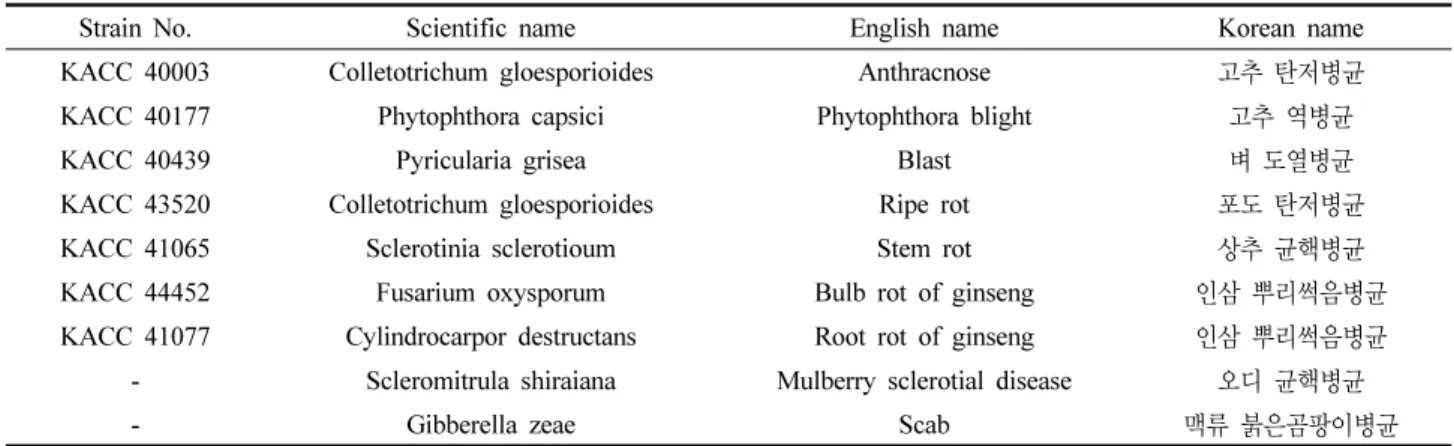
Table 1. Phytopathogenic fungi used for screening of antifungal activity of B. subtilis KYS-10
Strain No. Scientific name English name Korean name
KACC 40003 Colletotrichum gloesporioides Anthracnose 고추 탄저병균
KACC 40177 Phytophthora capsici Phytophthora blight 고추 역병균
KACC 40439 Pyricularia grisea Blast 벼 도열병균
KACC 43520 Colletotrichum gloesporioides Ripe rot 포도 탄저병균
KACC 41065 Sclerotinia sclerotioum Stem rot 상추 균핵병균
KACC 44452 Fusarium oxysporum Bulb rot of ginseng 인삼 뿌리썩음병균
KACC 41077 Cylindrocarpor destructans Root rot of ginseng 인삼 뿌리썩음병균
- Scleromitrula shiraiana Mulberry sclerotial disease 오디 균핵병균
- Gibberella zeae Scab 맥류 붉은곰팡이병균
농용미생물보존센터로 부터 7종의 병원균을 분양받았으며, 오디 균핵병균은 전라북도 농업기술원에서, 맥류 붉은곰팡이 병균은 국립식량과학원에서 분양받아 계대배양 후 피검균으 로 사용하였다(Table 1). 피검균은 22℃에서 7일간 배양하여 균의 증식정도를 확인한 후 4℃에 냉장보관하면서 사면배지 와 동일한 배지를 사용하여 3주 간격으로 계대배양하여 실험 에 사용하였다.
형태 및 배양학적 특성
분리 균주의 크기와 형태는 Gerhatdt et al. (1994) 의 방 법에 따라 그람 염색하여 광학현미경(Nikon, FK-IIA, Japan) 으로 관찰하였다. 또한 분리균주의 정밀한 외형을 관찰하기 위하여 2.0% phosphotungstin acid로 negative 염색하여 전 자현미경(Hitachi S-4800, Japan)을 이용하여 관찰하였으 며, glucose nutrient agar 배지, skim milk 배지, Luria-Bertani 배지에서 생육한 집락의 형태, 크기, 색깔 등을 관찰하였고, 반유동고체배지(tryptose 1.0%, sodium chloride 0.5%, agar 0.5%)에 배양하여 운동성을 조사하였다.
생리학적 특성
분리 균주의 생리학적 특성은 casein 분해능, 전분 분해능, gelatin 액화력, 당발효성, indole 생성능, nitrate 환원력, catalase와 oxidase 생산능을 Bergey's Manual of Determi- native Bacteriology (Leadbetter et al., 1974)에 따라 수행하 였다.
G+C mole 함량
분리한 균주의 G+C mole 함량을 조사하기 위하여 균체를 배양 후 crude DNA를 추출하여 HPLC (HITACHI, L-300,
Japan)로 분석하였다. 사용한 column은 comosil 5C18이며 0.2 M NH4H2PO4 : acetonitrile (10 : 1)로 혼합한 용매를 사용하여 1.0 mL min-1씩 융출시키면서 UV/VIS spectrophotometer (SPD-10A, Shimadzu, Japan)를 사용하여 270 nm에서 분 석하였다.
16s rDNA sequencing
16s rDNA 유전자 분석은 BigDye Terminator v3.1 Cycle Sequencing Kit (Applied Biosystems, USA)를 사용하여 PCR을 행하였다. 반응조건은 94℃에서 1분간 denaturation, 60℃에서 1분 30초간 annealing 시킨 후 72℃에서 1분간 extention 하였으며, 이 조작을 총 30 cycle을 반복하였다. 사 용한 primer는 27F (5'AGAGTTTGACMTGGCTCAG)와 1492r (5'TACGGYTACCTTGTTACGACTT)이었다. Amplified fragment (16s rDNA region)를 pGEM T easy vector에 삽 입하고, host cell로 E. coli DH5a를 사용하여 일반적인 molecular cloning방법에 의하여 transformation 시킨 후, Wiard Plus SV miniprep DNA purification system을 이용 하여 plasmid의 Mini-preparation시키고, automated DNA sequencer (Applied Biosystems, USA)를 사용하여 sequencing 하였다. Alignment는 Clustal X (ver. 1.8) software를 사용하 여 sequence를 rDNA 이차구조를 참고하여 alignment한 후 similarity 값(%)을 구하였다. 또한 advanced blast search를 통하여 염기서열을 비교하였다.
분리 균주의 최적 배양 조건의 설정
분리균주는 탄소원, 질소원, 무기질의 함량 및 pH를 변화 시키면서 최적의 배지 조건을 설정하였으며, 접종비, 교반속 도, 온도를 변화 시키면서 최적의 생육조건을 설정하였다.
Fig. 1. Cultural characteristics of B. subtilis KYS-10 on the PDA.
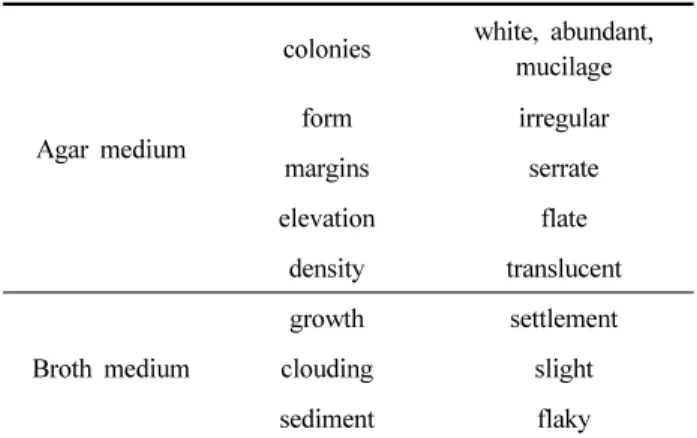
Table 2. Cultural characteristics of B. subtilis KYS-10
Agar medium
colonies white, abundant, mucilage
form irregular
margins serrate
elevation flate
density translucent
Broth medium
growth settlement
clouding slight
sediment flaky
Table 3. Morphological properties of B. subtilis KYS-10 Shape/arrangement short rod/chains
Cell size 0.2 × 1.0 ㎛
Motility non-motile
Flagella unconfirmed
Spore positive, central
Gram strain positive
Morphological properties were examined after cultivation for 192 hours of isolated B. subtilis KYS-10 at broth medium of the initial pH 8.0.
최적생육조건에서의 식물병원균에 대한 항진균 활성 분리 균주의 항균 활성은 대치배양을 통한 저해 정도 및 확산법에 의하여 측정하였다, 대치배양은 PDA배지 plate에 식물 병원균을 치상 후 약 5 cm 떨어진 곳에 항진균 활성 균 주를 획을 그어 접종하여 30℃에서 7일간 대치 배양(pairing culure)하여 분리균주와 식물 병원균 간의 억제 정도(inhibition zone)를 조사하였다. 또한, 분리 균주를 배양하여 원심분리기 (E. I. Dupont, RC-5C, U.S.A)로 5000 rpm, 40분간 원심분 리하여 균체를 제거한 여액을 미리 준비한 식물병원균 도말 PDA배지에 cup cylinder (8×8 mm)를 중앙에 올려놓고 첨 가하여 30℃, 7일간 배양 후 형성된 억제환의 직경을 측정하 여 항진균 활성을 평가하였다.
결과 및 고찰
분리 균주의 형태 및 배양학적 특성
고체배지에서의 특성은 potato-dextrose agar (PDA), glucose nutrient agar medium, skim milk medium, Luria-Bertani medium 등 중성의 배지에서는 원활한 생육을 보였으며, PDA
평판배지(pH 7.0)에서의 colony 형태는 무정이었고(Fig. 1), 색깔은 점질성이 풍부한 흰색이었으며 표면은 볼록하고 주름 이 풍부한 상태였다. 액체배지에서 생육은 좋았고 호기성이 었으며, 쉽게 박리되는 균체의 침전현상을 나타내었다(Tabe 2). 이 균주의 형태학적 특성은 단간균으로서 그 크기는 0.2
× 1.0 ㎛으로 비교적 size가 작은 편이였으며, 편모는 확인되 지 않았고(Fig. 2), 운동성도 관찰되지 않았으며, gram 양성 이었다(Table 3).
생리학적 특성
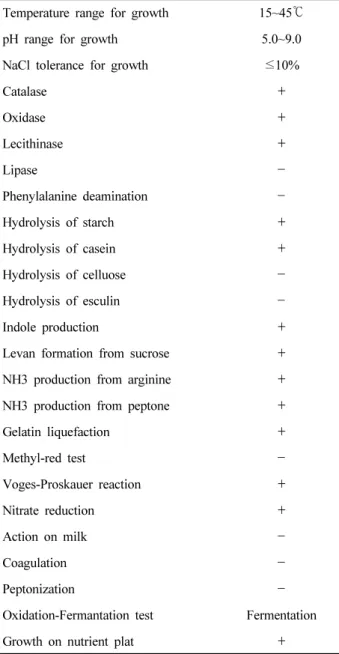
생리적 특성을 검토한 결과는 생육 pH 범위는 5.0~9.0이 었고, 생육온도 범위는 15~45℃이었다. 또한 염농도 10%까 지 생육이 가능하였으며, catalase 양성, oxidase 양성 및 starch, casein을 가수분해하였으며, cellulose 가수 분해능은 음성이었다. 또한 indole 생산능을 갖고 있었고, arginine과 peptone으로부터 NH3를 생산하였다. 당의 이용성을 검토한 결과, glucose, sucrose, raffinose를 잘 이용하였다. Glucose 를 비롯한 일부 당으로부터 산을 생산하였으나, 모든 당에서 gas는 생산되지 않았다(Table 4).
Table 4. Physiological properties of B. subtilis KYS-10
Temperature range for growth 15~45 ℃
pH range for growth 5.0~9.0
NaCl tolerance for growth ≤10%
Catalase +
Oxidase +
Lecithinase +
Lipase -
Phenylalanine deamination -
Hydrolysis of starch +
Hydrolysis of casein +
Hydrolysis of celluose -
Hydrolysis of esculin -
Indole production +
Levan formation from sucrose +
NH3 production from arginine +
NH3 production from peptone +
Gelatin liquefaction +
Methyl-red test -
Voges-Proskauer reaction +
Nitrate reduction +
Action on milk -
Coagulation -
Peptonization -
Oxidation-Fermantation test Fermentation
Growth on nutrient plat +
- : negative, + : positive
Fig. 2. Morphology of B. subtilis KYS-10 by SEM.
형태학적 및 배양학적 특성을 살펴본 결과, Bacillus종일 가능성이 높은 것으로 판단되었다. 그러나 편모에 의한 운동 성을 갖는 특성을 나타내지 않아 새로운 종 또는 변이주일 가 능성도 높은 것으로 판단된다.
분자생물학적 특성
B. subtilis KYS-10의 분자생물학적 특성조사에서 Bacillus subtilis를 비롯한 다른 표준균주와 비교 시 낮은 유사도를 나 타내어, 보다 정확한 동정을 하기 위하여 분리균주의 G+C mole 함량분석, 유전자 배열분석을 행하였다. G+C mole 함
량을 Table 5를 근거로 하여 분석한 결과 G의 함량은 약 31.4%였으며, C의 함량은 약 22.7%로 G+C mole 함량은 약 54.1%로 나타났다. 이는 일반적으로 Bacillus sp.의 특성 과 유사한 결과를 나타내었다. 이는 B. subtiis 및 B. lamtus 의 mole % G+C의 함량과 유사하였으나, B. subtilis를 비 롯한 subtilis group의 32~42%와는 상당한 차이를 보여 Bacillus 속의 새로운 균으로 판단하였다.
16s rDNA 유전자 alignment를 행한 결과, 1480bps의 염 기서열을 결정하고 그 결과를 Table 5에 나타내었다. 이 결과 로부터 이 균주는 Bacillus속에 속하는 세균으로 판명되었으 며, 실험균주는 B. subtilis의 표준균주와 98% 유사도를 나타 내어 가장 가까운 균이라 할 수 있으나 분자생물학적 유사도 시험 결과 같은 종의 균이라고 볼 수는 없다. 그러므로 본 실 험에서 분리한 항진균 활성 균주는 Bacillus 속의 새로운 종 이라 판단하여 Bacillus subtilis KYS-10이라 명명하였고, 또한 Neighbor-joining method에 의하여 계통수(phylogenetic tree)를 작성였다(Fig. 3).
Fig. 3. Phylogenetic tree for bacteria strain of B. subtilis KYS-10 on the basic of 16S rDNA sequence similarity.
Table 5. Optimum condition for antifungal activity and the cell growth of B. subtilis KYS-10
Inoculation size 3% (v/v) Agitation speed 150 rpm
culture time 8 day
Temperature 30 ℃
Sucrose 4% (w/v)
Yeast extract 1.0% (w/v)
K
2HPO
40.2% (w/v)
pH 7.0
Table 6. Antifungal activity of B. subtilis KYS-10 against phytopathogens at optimum culture condition
Scientific name Strain No. Mycerial inhibition (mm) Colletotrichum
gloesporioides KACC 40003 36.2±0.251 Phytophthora capsici KACC 40177 42.2±0.208 pyricularia grisea KACC 40439 43.1±0.100
Colletotrichum
gloesporioides KACC 43520 37.2±0.251 Sclerotinia sclerotioum KACC 41065 36.1±0.152 Fusarium Oxysporum KACC 44452 28.1±0.152
Cylindrocarpor
destructans KACC 41077 40.2±0.200
Sclerotinia sclerotioum 35.1±0.100
Gibberella zeae 70.0±0.152
최적배양조건에서의 항진균 활성
B. subtilis KYS-10을 최적배양조건(Table 5)에서 배양 후, 식물병원균에 대한 항진균 활성을 측정하였다. 식물병원 균에 대한 생육 저해환의 크기는 G. zeae(맥류붉은곰팡이병) 은 70 mm의 생육 저해환을 나타내어 가장 높은 항진균 활성 을 보였고, P. grisea KACC 40439(벼도열병), P. capsici KACC 40177(고추역병균), C. destructans KACC 41077 (인삼뿌리썩음병)은 40~43 mm의 생육 저해환을 나타냈으 며, C. gloeosporioides KACC 43520(포도탄저병균), C.
gloesporioides KACC 40003(고추탄저병균), S. shiraiana (오디균핵병균)은 35~39 mm의 생육저해환을 나타내어었다.
반면, F. Oxysporum KACC 44452(인삼뿌리썩음병균)은 28 mm 생육저해환을 보여 다른 식물병원균보다 낮은 생육 저해환을 보였다(Table 6). 이는 B. subtilis AH18 (Kim and Woo, 2008)은 고추역병균, B. subtilis B-4228 (Lee and Park, 2004)는 인삼 뿌리썩음병균에 활성을 보인다는 보 고를 하였는 바, 식물 질병을 유발하는 대다수의 곰팡이에 B.
subtilis종이 생육 저해 활성을 나타낸다는 보고와 일치하였 다. 또한, B. subtilis가 벼 도열병균의 완전세대 균인 Magnaporthe grisae PB1 및 상추, 미나리, 포도의 균핵병 을 유발하는 S. sclerotioum에 대하여 10 mm의 저해 활성을 보였다는 보고 (Zang et al., 2008)와 B. subtilis가 G. zeae (맥류붉은곰팡이병균)에 대하여 22.14 mm의 저해환을 형성 하였다는 보고(Lui et al., 2005) 및 Capsicum annum L의 Phytophythora blight에 대하여 10 mm (Lee, 2008), F.
oxysporum에 대하여 35 mm (Chebotal et al., 2009) 등의 결과에 비해 높은 저해 활성을 갖는 것을 확인하였다. B.
subtilis종 이 외의 길항미생물 B. coagulans (Katarzyna et
al., 2002), B. amyloliguetaciens (Kim et al., 2001), S.
humidus (Hwang et al., 2001), P. fluorescens (Hassan et al., 2010), T. harzianum, S. nouresi (Zivkobic et al., 2010) 등의 결과에 비해 강한 저해 활성을 갖는 것으로 확인 하였다. 따라서, 본 실험 결과는 B. subtilis KYS-10의 배양 여액에 길항 미생물이 생산하는 2차 대사물질이 존재한다는 것을 시사하는 결과로서 추후 물질의 분리와 확인에 관한 연 구가 이루어져야 할 것으로 사료된다.
감사의 글
이 논문은 2011년도 원광대학교의 교비지원에 의해서 수 행되었으며, 이에 감사드립니다.
Literature Cited
Alexopoulos, C. J., C. W. Mims, and M. Blackwell. (1997) Introductory Mycology. John Wiley & Sons, Inc., New York, NY, USA.
Arisra, R. J. K. and D. Yuwapin (2008) Optimization agitation conditions for maximum ethanol production by coculture.
Kasetsart J.(Nat. Sci.) 42:285 ~293.
Audenaert, K., T. Pattery, P. Cornelis and M. Hofte (2002) Induction of sistemic resistance to Botrytis cinerea in tomato by Pseudomonas aeruginosa 7NSK2 role of salicylic acid, pyochelin and pyocyanin. Mol. Plant-Microbe. Interact.
15:1147 ~1156.
Bankhead, S. B., B. B. Landa, E. Lutton, D. M. Weller and B.
B. McSpadden Gardener (2004) Minimal changes in rhizosphere population structure following root colonization by wild type and transgenic biocontrol strains. FEMS Microb.
Ecol., 49:307 ~318.
Benhamou, N and I. chet (1997) Cellular and molecular mechanism involved in the interaction between Trichoderma harzianum and Phythium ultimum. Applied Environ. Microbiol. 63:
2095 ~2099.
Bull, C. T., K. G. Shetty and K. V. Subbarao (2000) Interactions between mycobacteria, plant pathogenic fungi and biocontrol agent. Plant Dis. 86:889 ~896.
Chisholm, S. T., G. Coaker, B. Day and B. J. Staskawicz (2006) Host-microbe interactions: Shaping the evolution of the plant immune response. Cell 124:803 ~814.
Chebotar, V. K., N. M. Makarova, A. I. Shaposhnikov and L.
V. Kravchenko (2009) Antifungal and phytostimulating characteristics of Bacillus subtilis CH-13 rhizosphere strain, producer of bioprepations. Appl. Biochem. Microbiol. 45
(4):419 ~423.
De Meyer, G. and M. Hoften (1997) Salicylic acid produced by the rhizobacterium Pseudomonas aeruginosa 7NSK2 induces to leaf infection by Botrytis cinera on bean. Phytopathology 87:558 ~593.
Elad, Y. and R. Baker (1985) Infleuence of trace amounts of cations and siderophore-producing pseudomonas on chlam- ydiospore germination of Fusarium oxysporum. Phytopathology 75:1047 ~1052.
Emmert, E. A. and J. Handelsman (1999) Biocontrol of plant disease: a (gram-) positive perspective. FEMS Microbiol.
Lett. 171:1 ~9.
Fravel, D (2005) Commercialization and implementation of biocontrol. Annu. Rev. Phytopathol. 43:337 ~359.
Gerhardt, P., Murray, R. G. E., Wood, W. A. & Krieg, N. R.
(1994). Methods for General and Molecular Bacteriology.
Washington, DC: American Society for Microbiology Glick, B. R. (1995) The enhancement of plant growth by free-
living bacteria. Can. J. Microbiol. 41:109 ~117.
Hassan, M. N., S. Afghan and Y. H. Fauzia (2010) Suppression of red rot caused by Colletotrichum falcatum on sugarcane plants using plant growth- promoting rhizobacteria. Biocontrol 55:531 ~542.
Heydari, A., I. J. Misaghi and W. B. McCloskey (1997) Effect of three soil applied herbicide on populations of plant disease suppressing bacteria in the cotton rhizosphere. Plant Soil 195:75 ~81.
Howell, C. R., R. C. Beier and R.D. Dtipanovic (1988) Production of ammonia by Enterobacter cloacae and its possible role in the biological control of Pythium pre-emergence damping- off by the bacterium. Phytopathology 78:1075 ~1078.
Hwang, B. K., S. E. Lim, B. S. Kim, J. Y. Lee and S. S. Moon (2001) Isolation and in vivo and in vitro antifungal activity of phenylacetic acid and sodium phenylacetate from Streptomyces humidus. Appl. Environ. Microbiol. 67(8): 3739 ~3745.
Islam, M. T., H. Y. Yasuyuki, D. Abhinandan, I. Toshiaki and T. Satoshi (2005) Suppression of damping-off-disease in host plants by the rizoplane bacterium Lysobacter sp. strain SB-K88 is-linked to plant colonization and antibiosis against soilborne peronosporomycetea. Appl. Environ. Microbiol.
71:3789 ~3796.
Jung, H. K and S. D. Kim (2004) Selection and antagonistic mechanism of Pseudomonas fluarescens 4059 against phytophthora blight disease. Kor. J. Microbiol. Biotechnol. 32:312 ~316.
Katarzyna, C., T. Krystyna and M. Anna (2002) Antifungal activity of Bacillus coagulans against Fusarium sp.. Acta Microbiologica Polonica 51(3):275 ~283.
Katska, V. (1994) Interrelationship between vesicular arbuscular mycorrhiza and rhizosphre microflora in apple replant disease.
Biol. Plant 36:99 ~104.
Kerry, B. R. (2000) Rhizosphere interactions and the exploitation
of microbial agents for the biological control of plant
parasitic nematodes. Ann. Rev. Phytopathol. 38:423 ~441.
Kim, S. D., O. K. Han and E. T. Lee (2001) Chitinase of multifunctional antagonistic bacterium Bacillus amyloliquefaciens 7079 against phytophathogenic fungi. Kor. J. Appl. Microbiol.
Biotechnol. 29(3):142 ~148.
Kim, S. D. and S. M. Woo (2008) Structural identification of Siderophere
AH18from Bacillus subtilis AH18, a biocontrol agent of Phytophthora blight disease in red-pepper. Kor. J.
Microbiol. Biotechnol. 36(4):326 ~335.
Lafontaine, P. J. and N. Benhamou (1996) Chitosan treatment:
An emerging strategy for enhancing resistance of greenhouse tomato plants to infection by Fusarium oxysporum f. sp.
radicis-lycopersici. Biocont. Sci. Technol. 6:111 ~124.
Leadbetter, E. R. (1974) Order Ⅱ. Cytophagales nomen novum, p. 99. In R.E. Buchanan and N.E. Gibbons (ed.), Bergey's manual of determinative bacteriology, 8th ed. The Williams
& Wilkins Co., Baltimore, Maryland.
Lee, B. D and H. Park (2004) Control effect of bacillus subtilis B-4228 on root rot of panax ginseng. Journal of Ginseng Research. 28:1 ~70.
Lee, E. T and S. D. Kim (2000) Selection and antifungal activity of antagonistic bacterium Pseudomonas sp. 2112 against red-pepper rotting Phytophthora casici. Kor. J.
Appl. Microbiol. Biotech. 28:334 ~340.
Lui, J., M. Lui., J. Wang, J. M. Yao, R. R. Pan and Z. L. Yu (2005) Enhancement of the Gibberella zeae growth inhibitory lipopeptides from a Bacillus subtulis mutant by ion beam implantation. Appl. Mcrobiol. Biotechnol. 69:223 ~228.
Milgroom, M. G, and P. Cortesi (2004) Biological control of chestnut blight with hypovirulence: a critical analysis.
Annu. Rev. Phytopathol. 42:311 ~338.
Ordentlich, A., Y. Elad and I. Chet (1988) The role of chitinase of Serratia marcescens in biocontrol of Sclerotium rolfsii.
Phytopathology 78:84 ~87.
Sanjay, K. S., R. T. Vinayak, K. J. Rakesh, V. Surendra and K. G. Satyendra (2010) An antibiotic heavy metal resistant and halotolerant Bacillus cereus SIU1 and its thermoalkaline protease. Microbial Cell Factories 9:59.
Schouten, A., Van den Berg, G., Edel-Hermann, V., Steinberg,
C., Gautheron, N., Alabouvette, C., De Vos, C. H., Lemanceau, P., and Raaijmakers, J. M. (2004) Defense responses of Fusarium oxysporum to 2,4-DAPG, a broad spectrum antibiotic produced by Pseudomonas fluorescens. Mol. Plant-Microbe Interact. 17:1201 ~1211.
Shahraki, M., A. Hedari and N. Hassanzadeh (2009) Investigation of antibiotic, siderosphore and volatile metabolites production by Bacillus and Pseudomonas bacteria. Iran J. Biol 22:71 ~85.
Silva, H. S. A., R. D. S. Romerio, D. Macgnan, B. D. A.
Halfeld-Vieira, M. C. B. Pereira and A. Mountteer (2004) Rhizibacterial induction of systemic resistance in tomato plant: non-specific protection and increase in enzyme activities. Biol. Control 29:288 ~295.
Thomashow, L. S., D. M. Weller, R. Bonsall and L. S. Pierson (1990) Production of the antibiotic phenazine 1-carboxylic acid by fluorescent Pseudomonas species in the rhizosphere of wheat. Appl. Environ. Microbiol. 56:908 ~912.
Van Dijk, K. and E. B. Nelson (2000) Fatty acid competition as a mechanism by which Emterobacter cloacae suppresses Pythium ultimum sporangium gemination and damping-off.
App.. Environ. Microbiol 66:5340 ~5347.
Yu, T. S., S. M. Park, H. J. Jung and H. S. Kim (2006) Isolation and optimal culture conditions of Brevibacillus sp. KMU against black root pathogens caused by Didmella bryoniae.
Korean J. Microbiol. 42(2):135 ~141.
Zhang, C. X., X. Zhao, Y. X. Jing, T. Chida, H. Chen and S.
H. Shen (2008) Phenotypic and biological properties of two antagonist Bacillus subtilis strain. World J. Microbiol.
Biotechnol. 24:1669 ~1679.
Zhang, C. X., X. Zhao, Y. X. Jing, T. Chida, H. Chen and S.H.
Shen (2008) Phenotypic and biological properties of two antagonist Bacillus subtilis strain. World J. Microbiol. Biot- echnol. 24:2179~2181.
Zivkovic, S., S. Stojanovic, Z. Ivanovic, V. Gavrilovic, T. Popovic and J. Balaz (2010) Screening of antagonistic activity of microorganism against Colletotrichum acutatum and Colle- totrichum gloeosporioodes. Arch. Bio. Sci., Belgrade 62(3):
611 ~623.
식물 병원균에 대한 항진균 활성을 갖는 Bacillus subtilis KYS-10의 분리
강대원 ・ 류일환 ・ 한성수*
원광대학교 생명자원과학대학
요 약 본 연구는 9종 식물병원균에 대한 항진균 활성을 나타내는 길항세균을 분리하여 동정한 결과 Bacillus subtilis KYS-10로 명명하였고, sucrose 4%, yeast extract 1.0%, K2HPO4 0.2%, pH 7의 최적배지에서 150 rpm, 30℃, 8일간 배양 시 가장 좋은 생육을 나타냈다. B. subtilis KYS-10의 9종 식물병원균에 대한 항진균 활성을 확산법에 의해 생육저지환 의 크기를 측정한 결과 G. zeae (맥류 붉은곰팡이병) 70 mm로 가장 높았고, 35~39 mm의 생육저해환을 나타낸 식물병원균 은 P. KACC 40439(벼도열병), P. capsici KACC 40177(고추역병균), C. destructans KACC 41077(인삼뿌리썩음병) 40~43 mm, C. gloeosporioides KACC 43520(포도 탄저병균), C. gloesporioides KACC 40003(고추 탄저병균), S.
shiraiana KACC 41065(상추 균핵병균), S. shiraiana(오디 균핵병균) 있었으며, F. Oxysporum KACC 44452(인삼 부패 병균)은 28 mm로 다종의 식물병원균에 대해 높은 저해활성을 보였다. 이상의 결과들은 추후 포장실험을 통하여 친환경 미생물제제로의 개발 가능성을 시사해 주고 있다.
색인어 Bacillus subtilis KYS-10, 분리 동정, 최적생육조건, 식물병원균, 항진균 활성