Agric. Chem. Biotechnol.48(3), 151-152 (2005)
Short Communication
Antifungal Activity of Bacillus sp.
against Pepper Anthracnose Yongsub Yi
1, Hyesook Kim, Gyung Ja Choi
2, Kwang Yun Cho
2and Yoongho Lim
*Bio/Molecular Informatics Center, Konkuk University, Seoul 143-701, Korea
1Seoul University of Venture and Information, Seoul 135-090, Korea
2Screening Division, Korea Research Institute of Chemical Technology, Daejon 305-600, Korea Received August 30, 2005; Accepted September 14, 2005
Key words: Bacillus sp., pepper anthracnose, Colletotrichum coccodes, Shrimp-jeotkal
Pepper, rich in vitamins A, C, and E, and capsaicin, is the most important crop in Korea next to rice, with its production amounting to almost one billion US dollars.1) However, the occurrence of anthracnose, epidemic, and viruses, decreases the production of pepper up to 30-40%.2) Pepper anthracnose is caused by Colletotrichum spp. such as C. gloeosporioides, C. acutatum, C. dematium, and C. coccodes,3,4) which go through the winter as sclerotia. The conidia require moisture and are disseminated by rain. Although pepper anthracnose affects all growth stages of the pepper, it is predominant on the fruit and therefore attacks red pepper with a long ripening period. The infection, which causes tan in the skin color, occurs between 10 to 30oC, and wetness on the surface of the pepper fruit increases the severity. However, resistance of the pathogens against chemical pesticides requires alternative method to control the pepper anthracnose.
We attempted to isolate Bacillus genus showing antifungal activity against C. coccodes from Korean salt-fermented fishery product, Shrimp-jeotkal, because B. thuringiensis is used as one of major biopesticides.5) Shrimp-jeotkal tested in this work was manufactured and fermented for 4 years in Kangwha-do, Korea. One hundred ul of the diluted solution of Shrimp-jeotkal was spread on the nutrient agar and incubated.
Colonies of Bacillus were selected, and transferred to new nutrient agar medium. Each colony was inoculatedinto LB medium. Fermentation broths of thirteen strains isolated were centrifuged, and their supernatants were collected.6) The plant used for in vivo test was Capsicum annuum L., cv Bugang, which was grown in vinyl pots (4.5-cm diameter) in a greenhouse at 25 (±5)oC for 3 weeks. Pepper plants at the third
leaf stage were sprayed with each test solution until run-off and allowed to stand for 24 h. The solution was prepared by adding 0.25 mg Tween 20 per mL of the supernatant. Control plants were treated with Tween 20 solution (0.25 mg/ml). For the development of pepper anthracnose, the treated pepper plants were inoculated with C. coccodes by spraying a spore suspension (3×10⁵ spores/ml) of the fungus. They were incubated in a moist chamber for 2 days at 28oC and transferred to a growth chamber (25oC and 75% humidity).
The disease severity was assessed 3 days after inoculation.
Data represent the result of three trials. Analysis of data was performed as described in a previous report.7) Antifungal activity of the broth was compared with that of the chemical pesticide, dithianon (50µg/ml). Of the 13 samples tested, BA24 showed 88% inhibition and dithianon showed 91%.
Here, % control indicates that 100× [(area of infection (%) on leaves sprayed with Tween 20 solution alone-area of infection (%) on treated leaves)/area of infection (%) on leaves sprayed with Tween 20 solution alone]. Figure 1 shows the activity of BA24 against pepper anthracnose; the plants treated with
*Corresponding author
Phone: 82-2-450-3760; Fax: 82-2-453-3761 E-mail: [email protected]
Fig. 1. In vivo activity of BA24 against pepper anthracnose.
(left, control; right, BA24 treatment).
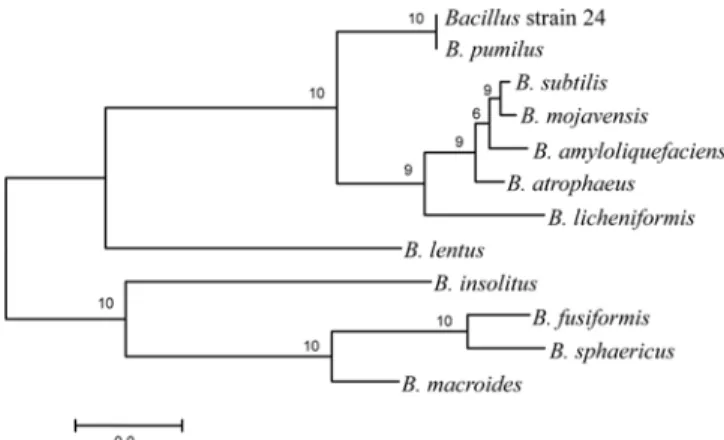
Fig. 2. Phylogenetic tree of Bacillus species 16S rDNA based on neighbor-joining method. The value at the internal nodes indicates the level of bootstrap support with 1000 replications.
152 Yongsub Yi et al.
BA24 grew well, whereas those without BA24 did not.
Because all samples except BA24 showed less antifunagal activity than 50 %, BA24 was selected for identification. To identify BA24, the partial sequences containing 16S rDNA from the strains were analyzed.8) 16S rDNA sequences of strain BA24 identified from GenBank by the BLAST program showed the highest homology (99% identity) with B.
pumilus.9)B.pumilus, found commonly on dead plant tissues or in soil, can protect the roots of soybean plants from fungi by inhibiting the germination of the spores of fungi such as Rhizoctonia and Fusarium.10) The evolutional distance was calculated by the Jukes and Cantor method, and a phylogenic tree was created using the neighbor-joining method (Fig. 3).11) Strain BA24 was found to belong to the genus Bacillus with a high bootstrap value, based on the phylogenic tree analysis.
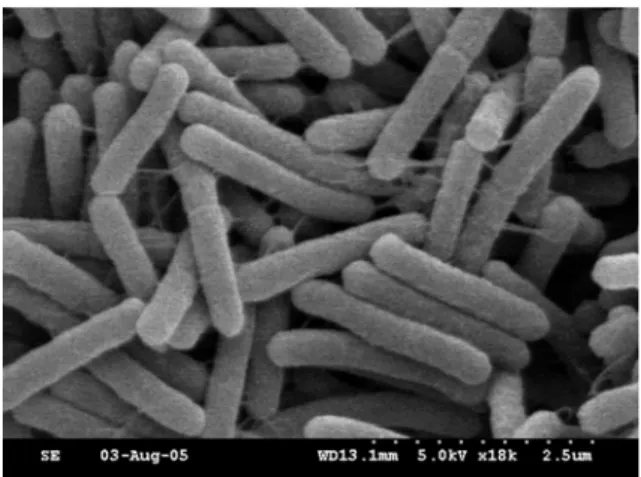
Scanning electron microscopy was applied for the morphology study of strain BA24. To obtain its image, a previously published method was applied.8) The image obtained is shown in Fig. 4.
In conclusion, BA24 isolated from Shrimp-jeotkal showed activity against pepper anthracnose caused by C. coccodes. Under the current experimental conditions, the BA24 broth showed 88% inhibition in vivo, whereas dithianon at 50µg/ml showed 91%. Therefore, BA24 appears to be a promising biopesticide that can be one of alternative methods to solve consumer rejection on chemical pesticides and environmental pollution.
Acknowledgment
This work was supported by a grant from Biogreen 21 project.
References
1. Martinez, S., Lopez, M., Gonzalez-Raurich, M. and Ber- nardo, Alvarez A. (2005) The effects of ripening stage and processing systems on vitamin C content in sweet peppers (Capsicum annuum L.). Int. J. Food Sci. Nutr. 56, 45-51.
2. Voorrips, R. E., Finkers, R., Sanjaya, L. and Groenwold, R.
(2004) QTL mapping of anthracnose ( Colletotrichum spp.) resistance in a cross between Capsicum annuum and C.
chinense. Theor. Appl. Genet. 109, 1275-82.
3. Park, K. S. and Kim, C. H. (1992) Identification, distribu- tion and etiological characteristics of anthracnose fungi of red pepper in Korea. Korean J. Plant Pathol.8, 61-69.
4. Byrne, J. M., Hausbeck, M. K. and Hammerschmidt, R.
(1997) Conidial germination and appressorium formation of Colletotrichum coccodes on tomato foliage. Plant Disease
81, 715-718.
5. Tabashnik, B. E., Finson, N., Groeters, F. R., Moar, W. J., Johnson, M. W., Luo, K. and Adang, M. J. (1994) Rever- sal of resistance to Bacillus thuringiensis in Plutella xylos- tella. Proc. Natl. Acad. Sci. U S A. 91, 4120-4124.
6. Kim, H., Yi, Y., Choi, G. J., Cho, K. Y. and Lim, Y. (2005) Antifungal activity of Bacillus sp. against Phytophthora infestans. J. Microbiol. Biotechnol. 15, in press.
7. Kim, J., Choi, G., Lee, S., Kim, J., Chung, K. and Cho, K.
(2004) Screening extracts of Achyranthes japonica and Rumex crispus for activity against various plant pathogenic fungi and control of powdery mildew. Pest. Manag. Sci. 60, 803-808.
8. Yi, Y., Kim, S., Kim, M., Choi, G., Cho, K., Song, J. and Lim, Y. (2004) Anti-fungal activity of Streptomyces sp.
against Puccinia recondita causing wheat leaf rust. J.
Microbiol. Biotechnol. 14, 422-425.
9. Heyrman, J. and Swings, J. (2001) 16S rDNA sequence analysis of bacterial isolates from biodeteriorated mural paintings in the Servilia tomb (Necropolis of carmona, Seville, Spain). Syst Appl Microbiol. 24, 417-422.
10. Munimbazi, C. and Bullerman, L. B. (1998) Isolation and partial characterization of antifungal metabolites of Bacillus pumilus. J. Appl. Microbiol. 84, 959-68.
11. Jukes, T. H. and Cantor, C. R. (1969) Evolution of protein molecules pp. 21-132. In H. N. Munro (ed.) Mammalian protein metabolism, Academic Press, New York.
Fig. 3. Morphology of BA24 observed by scanning electron microscopy.