96
Bacillus amyloliquefaciens IUB158-03이 생산하는 항진균물질의 분리와 항균활성
김혜영·이태수*
인천대학교 생물학과
Isolation of Antifungal Substances by Bacillus amyloliquefaciens IUB158-03 and Antagonistic Activity against Pathogenic Fungi
Hye Young Kim and Tae Soo Lee ∗
Department of Biology, University of Incheon, Incheon, 402-749, Korea (Received April 30, 2009. Accepted June 29, 2009)
ABSTRACT: For the control of pathogenic microorganisms, Bacillus spp. were isolated from diseased pepper fruits in Korea. Among them, Bacillus sp. IUB158-03 showed high inhibitory effect on mycelial growth and spore germination of C. gloeosporioides and Botrytis cinerea . The strain was identified as B. amyloliquefaciens IUB158-03 based on its physiological, biochemical characteristics and Microlog analysis. The highest level of antifungal substances by B. amyloliquefaciens IUB158-03 were obtained when the bacterium was cultured in medium containing 2% soluble starch, 3% yeast extract, 0.5% tryptone, 0.5% NH
4H
2PO
4, and 1% NaCl (pH 6.0) at 25
oC for 72hrs. The antifungal substances were purified by butanol extraction, silica gel column chromatography, preparative thin layer chro- matography, and high performance liquid chromatography. The purified antifungal substance was confirmed R
f0.27 by TLC. This substance exhibited antifungal activity against Fusarium solani , Rhizoctonia solani , Botrytis cineria , Alternata alternaria of plant pathogenic fungi and Trichophyton mentagrophytes , Epidermophyton floccosum , Cryp- tococcus neoformans of human pathogenic fungi.
KEYWORDS: Antifungal substances, Bacillus amyloliquefaciens , culture condition, pathogenic fungi
식물병의방제는작물의수량과품질을향상시키고
,
인구증가에 따른 식량자원의 공급량을 증가시킨다는 면에서 중요성이 부각되고 있다
.
지금까지 식물병원균의 피해를방지하기 위해 각종 농약에 의한 화학적 방제법이 널리 이용되어 왔다
(Cook et al ., 1985).
그러나 농약의 과다사용으로 인한 난분해성 물질의잔류에의한 공기
,
토양,
지하수의 오염으로환경과 생태계파괴
,
인축독성등많은문제점들이 야기되었다
.
이러한 화학적 방제법으로 인한부작용에 효과적으로 대처할수있는 방법으로 생태계에 서의미생물간의상호관계를이용한친환경적인생물학적 방제법이 모색되었다
(Burpee and Goulty, 1984; Yoshie
et al ., 1993).
자연계에서는 미생물이 생장과정에서 다른미생물생장을저해하거나죽이는
2
차대사산물인항생물질을 생산하며
(Waksman and Heinrich, 1943), 10,000
여종항생물질의 분리원을 조사한 결과 이중 방선균으로부터
분리 된것이
64%,
세균과곰팡이로부터분리된것이각각
13%, 23%
인것으로나타났다(Berdy, 1989).
식물병원균에 대한 미생물의 항균 기작으로는 진균의 세포벽을 가수분해하는 효소인
chitinase
의 생성(Lifshitz
et al ., 1986)
과 β-glucanase
를 생산하여식물병원균의 세포벽을 분해시키는용균작용
, siderophore
를분비하여 식물병원균의생장을저해하는경쟁적길항작용
(Kloeper et
al ., 1980
이있으며이중에서병원균의생장을직접적으로억제하는 항생물질의 생산에 의한 길항작용이 생물학적 방제법으로가장 널리 이용되고있다
(Huang and Chang, 1975; Mandeel and Baker, 1993).
식물병의 방제법에 이용되는 진균으로는
Trichoderma spp., Gliocladium virens , Laetisaria arvalis , Coniothyrium miniforms , Pythium ultimum , Talaromyces flavus , Sporidesmium sclerotivorum
등이 알려져있으며(Adams, 1990),
길항세균으로는
Pseudomonas spp., Bacillus spp., Agrobacterium spp.,
방선균은Streptomyces spp.
가 가장 널리 이용되고있다
(Baker et al ., 1983; Becker, 1993).
최근에는
Bacillus spp.
가항균물질과 독성물질을 세포밖으로분비하여병원성진균에길항작용을나타내는물질들을 생산한다는연구가보고되었다
(Zuber et al ., 1993).
대표적인균주로는
B. subtilis , B . cereus , B. polymixa
등이알려졌으며,
B. subtilis
는이미외국에서 인축에대한안전성이입증되어생물학적방제제로널리이용되고있다
(Backhouse and Stewart
*Corresponding author <E-mail : [email protected]>
1989; Baker et al ., 1983).
또한 부숙토양에서분리한B.
subtilis NB22
가생산하는iturin
계 물질이진균의세포막인지질에작용하여세포막의물리적특성을 변화시킴으로써 세포막의기능을파괴하여살균작용을나타내는것으로알려 졌다
(Maget-Dana et al ., 1985; Besson et al ., 1978).
현재B.
subtilis
를 이용한 미생물 제제로는Kodiak (Gustafson), Botkiller
등이상품명으로등록되어사용되고있다(Fravel et al ., 1998; Brannen and Kenney, 1997).
현재 전 세계적으로길항미생물을 이용하여 개발된미 생물제제는약
40
종류가등록되어있다.
하지만아직시장점유율이
2%
미만으로 낮은 실정이며,
최근 우리나라에서도미생물농약은농산물에대한잔류독성의염려가없 고
,
농업생태계를 교란하지 않는다는 장점이 알려지면서미생물제제를 이용한 생물학적방제법에 대한 관심이높 아지고있다
(Shen et al ., 2002).
그러나우리나라는식물병 방제에이용하는 미생물제제의 대부분을 수입에의존 하고 있어서외화 낭비가 심하고
,
이들 미생물이 우리의기후 풍토와 토양환경에적응하는 능력이결여되어 효과 를충분히발휘하지못하는경우가많다
.
이에본연구에서는우리나라의환경에적응하여토착화와 우점화가용이한항진균성
Bacillus spp.
를선발하기위하여탄저병균에감염된고추열매에서
Bacillus spp.
를순수분리한후식물병원균에대한항진균력이우수한
Bacillus spp.
균주를선발하고동정하였다
.
또한선발된균주의항진균물질의 생산을위한 최적배지와배양조건을 규명하고생 산된항진균물질을분리·정제하여식물과인체에병원성 을나타내는진균을대상으로항진균효과를검정하였다
.
재료 및 방법
시료의 채집
시료는경기도
,
인천시,
충청남·북도,
전라남·북도,
경상북도및제주도등전국
60
개지역의고추재배지에서탄저병균에감염된고추열매를채집한후실험실로옮겨
4
oC
에보관하면서
Bacillus spp.
균주를분리하여실험에이용하였다.
실험균주의 순수분리
Bacillus spp.
균주를 선택적으로분리하기 위하여 채집한 시료 중 병반주변 부위
1 g
을 도려내멸균수5 ml
를넣은살균막자사발에서마쇄하고
80 ml
의멸균수가들어있는삼각플라스크에넣어
80
oC
의항온수조에서30
분간열처리하여일반세균을제거한후
NA
배지가들어있는3
개의 샤레에각각이시료액
1 ml
를분주하여고르게접종하고
25
oC
에서48
시간배양하였다.
접종한배지에균총이형성되면획선접종방법을이용하여
2~3
회새로운배지에 옮겨 균을 순수 분리하였다
.
순수 분리한 균이Bacillus spp.
인 것을 확인하기 위하여Schaeffer-Fulton (Harold, 1990)
법을이용하여내생포자를염색한후1,000X
배율의현미경으로내생포자형성여부를검경하였다
.
항진균물질을 생산하는 Bacillus spp.의 선발
순수분리된
Bacillus spp.
의항진균물질생산여부를탐색하기위하여고추열매에병원성을나타낸
Colletotrichum gloeosporioides
균주와 고추와오이에 병원성이있고 여러종류의 살균제에대한 저항성을 나타내는
Botrytis cinerea
균주를서울대학교식물병원성곰팡이유전자은행으로부터 분양받아실험에사용하였다
.
병원진균의 균사 생장억제력 검정
균사의생장억제력을확인하기위하여
PDA(potato dextrose agar; potatoes infusion 20%, Bacto dextrose 2%, Bacto agar 1.5%, Difco, USA)
배지의중앙을Bacillus spp.
로획선접종한후
, PDA
에서7
일간배양한C. gloeosporioides
와B. cinerea
를 직경5 mm
의cork borer
로절단하여배지 중앙에획선접종된항진균
Bacillus spp.
와20mm
간격으로대치배양한다음, 25
oC
에서5
일 동안 배양하여 생장 저지대를mm
단위로측정하여 균사의 생장 억제력을 나타내는
Bacillus spp.
균주들을일차적으로선발하였다
(Schiewe and Mendgen, 1992).
병원진균의 포자발아 억제력 검정
선발된균주들을대상으로포자발아억제력을확인하기 위하여
C. gloeosporioides
과B. cinerea
를PDA
에서14
일배양하여 포자가형성되면
C. gloeosporioides
의포자 현탁액1~5 × 10
6conidia/ml, B. cinerea
의 포자현탁액1~5 × 10
10conidia/ml
로 준비하여 이 중1 ml
를PDA
배지가 들어있는 샤레에 분주하여 유리봉으로 고르게 접종하였다
.
그리고 균사 생장에 저해를 나타낸
Bacillus spp.
는LB (Luria-Bertani; tryptone 1%, yeast extract 0.5%, NaCl 0.5%, Difco, USA)
배지에접종하여25
oC
에서180 rpm
으로2
일 동안 진탕 배양한 후,
원심분리하여 회수한 상등액50
μl
를paper disc(Avantec, 8 mm, Toyo Roshi Kaisha,
Ltd. Japan)
에적신 후대조균주의포자 현탁액이접종된PDA
배지의중앙에올려놓고25
oC
에서3
일동안 배양하여paper disc
둘레에 나타난 생장 저지대의 직경을mm
로측정하였다
(Victor and Editor, 1991).
항진균물질 생산 Bacillus spp.균주의 동정
항진균물질생산균주을동정하기위하여
Bergey’s Manual
의방법에따라그람염색
,
내생포자염색,
형태,
운동성,
당분해능등의생리·생화학적특성을분석하였다
(Holt et al ., 1994).
또한, Biolog
사(Biolog, Inc. USA)
에서개발한Biolog MicroLog 3, 4.01 version kit
의 실험결과를 분석하여Bacillus
의종을동정하였다.
항진균물질 생산을 위한 최적 배지 선발
분리 동정된
B. amyloliquefaciens IUB153-03
으로부터항진균물질 생산을 위한 최적 배지를 선발하기 위하여
LB
배지100 ml
를 기본 배지로하여 탄소원에 대해서는L(+)-arabinose, dextrin, D-fructose, D(+)-galactose, glucose, glycerol, lactose, maltose, mannitol, D(+)-raffinose, sucrose, soluble starch, D-sorbitol, xylose
를각각1%
씩첨가하였으며
,
질소원은arginine, beef extract, casamino acid, casitone, malt extract, polypeptone, soytone, tryptone, yeast extract
각각1%
씩첨가하고,
인산염NH
4H
2PO
4,(NH
4)
2HPO
4,NaH
2PO
4, Na
2HPO
4,KH
2PO
4, K
2HPO
4를 각각0.5%
씩 첨가한 후각각
25
oC
에서180 rpm
으로72
시간진탕배양한후생장정도와항진균활성을조사하였다
.
항진균물질의 생산에 미치는 pH의 효과
초기
pH
가B. amyloliquefaciens IUB153-03
의 항진균물질 생산에 미치는 효과를 조사하기 위하여 최적 배지
(soluble starch 2%, yeast extract 3%, tryptone 0.5%, NaCl 1%, NH
4H
2PO
40.5%) 100 ml
에1N HCl
과1N NaOH
로pH
를4.0~10.0
으로조정하여25
oC
에서180rpm
으로72
시간진탕배양한후공시균의생장과공시균이생산한물질의 항진균활성을조사하였다
.
항진균물질 생산을 위한 최적 배양온도 및 배양시간
B. amyloliquefaciens IUB153-03
이 최적배지에서 항진균물질의생산을위한최적배양온도와배양시간을밝히기 위해 최적배지
100 ml
에B. amyloliquefaciens IUB153-03
균주를접종하여
108
시간동안25
oC
에서180 rpm
으로진탕 배양하면서
12
시간 간격으로9
차례균의 생장 정도와항진균활성을조사하였다
.
항진균물질의 분리 및 정제
B. amyloliquefaciens IUB153-03
이 생산하는 항진균물질의정제를위해이균을최적액체배지에접종하여
25
oC
에서180 rpm
으로72
시간 동안 진탕 배양한 후10,000 rpm
으로30
분간 원심 분리한 후 상등액을 회수하여butanol
과물(1 : 1)
로3
회반복분획한다음, butanol
층만을회수하여농축기
(N-1, Tokyo Rikakikai Co., Japan)
로감압 농축한후 동결건조
(Operon Co., Korea)
하여 항진균성을나타내는조추출물질을얻었다
(Fig. 1).
그리고조추출물을methanol
에용해시킨 후
1
차, 2
차column(
Φ2.5 × 70 cm)
에는silica gel column chromatography(Kiesel gel 60, 70~230 mesh, 80 g)
를이용하여butanol-acetone-water(4 : 6 : 1, v/v/v)
용출하였으며
, 3
차 분리할 때에는column (
Φ1.5 × 70 cm)
에ethyl acetate-methanol-water(50 : 18 : 5, v/v/v)
로하여각분리된 분획을 얻어 감압 농축하고
,
동결 건조한 후C.
gloeosporioides
를 대상으로 항진균 활성을 조사하였다(Fig. 2).
항진균활성을나타내는 분획을 얻어TLC plate (Kiesel gel 60 F254, Merk, Germany)
에 점적한 후butanol-acetone-water(4 : 6 : 1, v/v/v)
로 전개하여UV
Illuminator(VL-1.4, VILBER LOURMAT, France)
로254 365
에서 항진균성 활성물질을 비교 분석하였다.
항진균물질을
Preparative TLC(DE 19713, Analte, Inc., 75 Blue Hen Drice Newark, USA)
에 점적한 후ethyl acetate- methanol-water(50 : 18 : 5, v/v/v)
로전개하여UV Illuminator
를이용하여 발색되는 모든
spot
을methanol
로 용출하여Speed vac(CC-105, TOMY, Japan)
으로농축한다음80%
methanol
로 용해하여 μBondapak C18 column(3.9×300mm, Fig. 1. Extraction procedure of crude antifungal substances
produced by B. amyloliquefaciens IUB158-03.
Fig. 2. Procedure of purification of antifungal substances produced
by B. amyloliquefaciens IUB158-03.
Waters), UV detector(245 nm, Waters), 0.8 ml/min flow rate
조건으로10
μl
씩주입하여80% methanol
로 전개하여각분획을회수하여항진균활성을조사한후다시항진 균물질
peak
만을 분리하기 위하여10
μl
씩0.6 ml/min
flow rate
로여러 번HPLC
를 수행하여 정제된항진균물질을 얻었다
.
정제된항진균물질이단일물질임을 확인하기위하여
TLC
로전개한후-anisaldehyde
로발색하여R
f값의 차이를 확인하였으며
,
정제된 항진균물질의 항진균효과를액체배양액과조추출물과비교분석하였다
.
항진균물질의 항균력 시험
B. amyloliquefaciens IUB153-03
의 배양액으로부터정제된항진균물질의항균력을알아보기위하여서울대식물병 원성곰팡이유전자은행에서분양받은식물병원균
Fusarium solani , Rhizoctonia solani , Botrytis cineria , Alternata
alternaria
와 안산1
대학 임상병리과에서분양받은 인체병원성진균인
Trichophyton mentagrophytes , Epidermophyton floccosum , Cryptococcus neoformans
와인체 병원성효모인Candida albicans ,
인체병원세균인Staphylococcus aureus , Escherichia coli , Klebsiella pneumoniae , Pseudomonas
aeruginosa
를대상으로 실험을수행하였다.
식물병원균은PDA,
인체병원성진균인Trichophyton mentagrophytes
와Epidermophyton floccosum
은SDA(sabouraud dextrose agar; neopeptone 1%, dextrose 4%, agar 1.5%)
에 접종 후25
oC
에서14
일간배양, Cryptococcus neoformans
와Candida albicans
는PDB
배지에 접종하여25oC
에서2
일간 배양하였으며
,
인체병원성 세균은LB
배지에접종하여37
oC
에서
24
시간배양하였다.
실험에사용한각각의진균들의포자 현탁액은
1~5 × 10
6conidia/ml
로조절하여만들었으며
,
포자현탁액1ml
씩을취하여식물병원균은PDA,
인체병원성진균은
SDA
에도말하였으며, Cryptococcus neoformans
와
Candida albicans
는PDA
배지,
세균은Müller-Hinton (Difco, USA)
배지에도말한 후paper disc
방법을이용하여항진균활성을조사하였다
. 결과 및 고찰
항진균물질 생산균주의 선발
탄저병원균에감염된고추열매에서총
1,600
균주의Bacillus spp.
를순수분리하였으며,
이중C. gloeosporioides
와B.
cinerea
균주의균사생장을동시에억제시키는46
균주를1
차선발하였으며,
이들중포자의발아를억제시키는20
균주를
2
차로 선발하고 그 중 생장과 항균력이 가장 우수한Bacillus sp. IUB158-03
을최종선발하였다.
항진균물질 생산 균주의 동정
항진균물질생산균주로선발된
Bacillus sp. IUB158-03
을동정하기 위하여
Bergey’s Manual
방법에 의해 형태적,
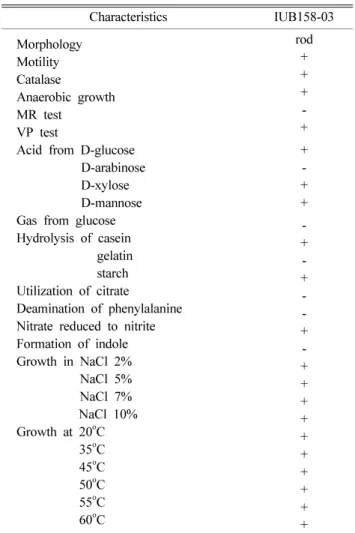
생리·생화학적특성을조사한결과는
Table 1
과같다.
이균주는
Gram
양성간균으로 운동성을보였으며, catalase
양성
, D-glucose, D-xylose, D-mannose
발효능을 보였지만
, D-arabinose
는 발효하지 않았다.
또한casein, starch
가수분해효소를 생산하며
, NaCl 2~10%
와 생장온도20~60
oC
에서생장을보였다.
그리고BioLog kit
를이용하여종을 동정한결과
Bacillus sp. IUB158-03
는Bacillus amyloliquefaciens
로동정되어B . amyloliquefaciens IUB158-03
로명명하였다
.
현재까지 국내외적으로
Bacillus spp.
가 생산하는 항진균물질에대한연구가많이보고되고있다
(Kharbande et al ., 1997).
그중B. licheniformis N1
과B. megaterium N4
는Alternaria alternata
에 의한들깨잎마름병에대한생물학적 방제효과가보고되었으며(
문등, 1997), B. licheniformis
는
C. coccides
에 의해 발생한 고추탄저병을 방제한다는보고가있었다
(Lim et al ., 2002).
또한B. amyloliquefaciens
균주는 배수확후발생하는
gray mold
를억제하는 생물Table 1. The morphological, physiological and biochemical characteristics of Bacillus sp. IUB158-03 isolated from diseased pepper fruit
Characteristics IUB158-03
Morphology Motility Catalase
Anaerobic growth MR test VP test
Acid from D-glucose D-arabinose D-xylose D-mannose Gas from glucose Hydrolysis of casein
gelatin starch Utilization of citrate
Deamination of phenylalanine Nitrate reduced to nitrite Formation of indole Growth in NaCl 2%
NaCl 5%
NaCl 7%
NaCl 10%
Growth at 20
oC 35
oC 45
oC 50
oC 55
oC 60
oC
rod + + + + - + - + + + - + - - - + - + + + + + + + + + + +, 90% or more of strain are positive
-, 90% or more of strain are negativ
학적방제효과가보고된바있으며
(Mari et al ., 1996), Wang et al ., (2002)
은B. amyloliquefaciens V656
균주가세포벽분해효소인
chitinase
를 생산하여 항진균활성이 높다고보고하였다
.
항진균물질 생산을 위한 최적배지 조성
B. amyloliquefaciens IUB158-03
이 항진균물질 생산을위한최적배지를선발하기위해
LB
배지에탄소원을각각1%
씩 첨가하여 생장 정도와항진균물질의 생산성을 조사한 결과
D(+)-raffinose
와soluble starch
가첨가된배지에서 가장높게 나타났다
.
두탄소원의 농도에따른항진균물질의생산을확인한결과
2%
의soluble starch
가첨가된배지에서
B. amyloliquefaciens IUB158-03
의생장과 항진균물질의 생산이가장 높았다
.
따라서B. amyloliquefaciens IUB158-03
의 최적 탄소영양원으로2% soluble starch
가선발되었다
(Fig. 3, 4).
이는Botrytis cinerea
에항균효과를 보인Bacillus sp. YJ-63
균주의항진균물질생산을위한최적배지조건에서탄소원으로
1.5% soluble starch
를사용한 결과와 유사하였다
(Jeong et al ., 2002).
이 결과는탄소영양원의종류에따라미생물의생장과
2
차대사산물의생산이크게영향을받는다는연구와유사한결과로사료 된다
(Lounes et al ., 1996).
최적질소영양원을선발하기위하여
2%
의soluble starch
를첨가한 배지를 대조군의 배지로 사용하였으며
,
실험군의배지는
LB
배지에서yeast extract
와tryptone
을제거한후각각서로다른
1%
의질소영양원을첨가하여배지를제조한후균의 생장과항진균물질의생산성을 조사하였다
.
대조군과 실험군을 비교한 결과 균의 생장은
soytone
을첨가한배지에서높았으나길항력은낮았다
.
이에따라대조군 배지의 두 질소영양원의 혼합 비율을 조정하여 생장 정도와 항진균물질의 생산성을 조사한 결과
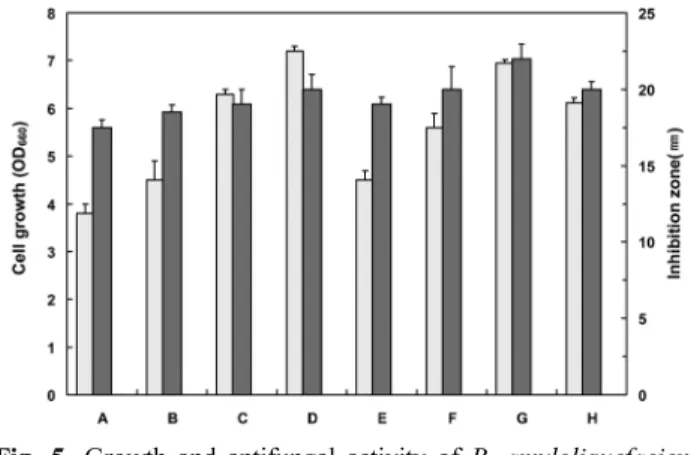
3% yeast extract
와1% tryptone
의 혼합한배지에서공시균의 생장이가장 높았으나
,
항진균물질의 생산성은3% yeast extract
와
0.5% tryptone
을 혼합한 배지에서 더 높게 나타났다.
따라서
3% yeast extract
와0.5% tryptone
을혼합한질소영양원을선발하였다
(Fig. 5).
최적의인산염을선발하기위하여
2% soluble starch, 3%
yeast extract
와0.5% tryptone, 1% NaCl
로조성된 배지를대조군으로하고여기에
NH
4H
2PO
4,(NH
4)
2HPO
4,NaH
2PO
4, Na
2HPO
4,KH
2PO
4, K
2HPO
4 등의인산염을각각0.5%
씩첨가하여공시균의생장과항진균물질의생산성을조사하 였다
.
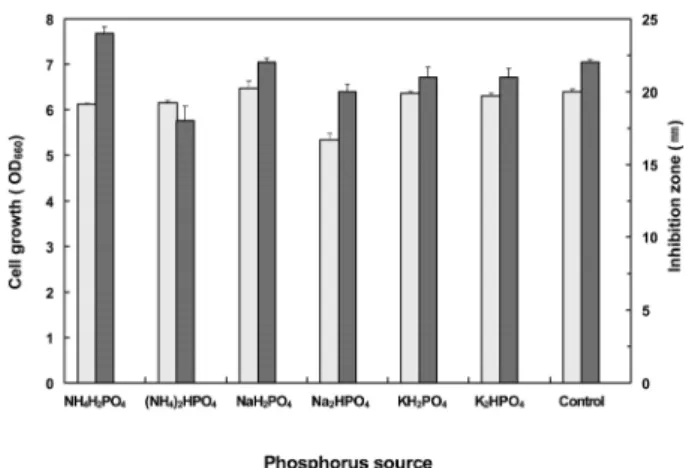
실험 결과NaH
2PO
4,Na
2HPO
4,KH
2PO
4, K
2HPO
4를 첨가한경우대조군과비슷한결과를나타냈으며, NH
4H
2PO
4를 첨가한 경우에는 대조군에 비해 생장은 낮았으나
,
항진균 활성은 높게 나타났다
(Fig. 6).
이상의 결과로B.
amyloliquefaciens IUB158-03
균주의 항진균물질생산을위한 최적 인산염으로는
NH
4H
2PO
40.5%
가 선발되었다.
따라서실험결과에따라
B. amyloliquefaciens IUB158-03
균주의항진균물질생산을위한최적배지의탄소원은
2%
soluble starch,
질소원은3% yeast extract
와0.5% tryptone,
인산원은
0.5% NH
4H
2PO
41%
의NaCl
로밝혀졌다. Fig. 3. Growth and antifungal activity of B. amyloliquefaciens
IUB158-03 cultured in the medium containing various carbon sources (1%).
: Cell growth : Inhibition zone
Fig. 4. Growth and antifungal activity of B. amyloliquefaciens IUB158-03 in the medium containing various concen- trations of soluble starch. Control was grown in LB medium.
: Cell growth : Inhibition zone
Fig. 5. Growth and antifungal activity of B. amyloliquefaciens IUB158-03 in the medium containing various concentrations of yeast extract and tryptone.
: Cell growth : Inhibition zone
항진균물질 생산의 최적 pH, 온도 및 배양시간 항진균물질생산에미치는
pH
의영향을알아보기위하여최적 배지에
1N HCl
과1N NaOH
로pH 4.0~10.0
까지7
단계로 조정하여 공시균을 접종하여 균의 생장 정도와항진균물질의생산성을조사하였다
.
실험결과pH 6.0
에서생장과항진균물질의생산이가장높게나타났다
(Fig. 7).
공시균의 항진균물질 생산 최적 배양온도와시간을알 아보기 위해 선발된 최적배지의
pH
를6.0
으로 조정하여B. amyloliquefaciens IUB158-03
를접종하고20
oC, 25
oC, 30
oC, 35
oC, 40
oC
등5
단계온도로조정된배양기에서배양하면서
12
시간 간격으로108
시간까지 총9
차에 걸쳐균의생장정도와항진균활성을조사하였다
.
실험결과균의생장은
25
oC
에서48
시간 배양할 때 가장 높게 나타났으며
,
항진균물질의생산은25
oC
에서72
시간배양할때가장높았다
.
즉,
항진균물질의 생산은균이 균의 정지기후인72
시간배양후증가되는 것을확인할수있었다(Fig. 8).
따라서
B. amyloliquefaciens IUB158-03
균주의항진균물질생산을위한최적배지는
2% soluble starch, 3% yeast extract, 0.5% tryptone, 0.5% NH
4H
2PO
4, 1%
의NaCl
이었으며
,
배양조건은pH 6.0,
배양온도25
oC
및배양시간72
시간으로결정되었다.
항진균물질의 분리 및 정제
항진균물질의추출을위해
B. amyloliquefaciens IUB158-03
균주를선발된최적배지에접종하여배양한후상층액을 취해
butanol
과물(1 : 1)
로혼합하여butanol
층을회수하여동결 건조하여 조추출물을 얻었다
.
조추출물을 정제하기위하여
silica gel column chromatography
를이용하여각분획을 얻어감압농축하여
TLC plate
로분획을 조사하고항진균력을 확인하였으며
,
항진균 물질을 좀더 정제하기위하여
Preparative TLC
로전개한후항진균활성을나타낸spot
을얻어HPLC
를수행하였다. Preparative TLC
로얻은물질에서는
retention time
이2.6
분, 3.1
분, 3.9
분, 4.4
분인4
개의peak
가혼합되어있었으며,
이들중retention time
이4.4
분인peak
가항진균물질을함유하고있는것으로확인되었다
.
정제된항진균물질을TLC
로전개한후-anisaldehyde
로발색하여
R
f값이0.27
인것을확인하였다(Fig. 9).
또한배양액
,
조추출물및정제된항진균물질의항균활성을비교한 결과
Fig. 10
과 같이 정제된항진균물질은 높은 항진균력을나타내었다
.
항진균물질의 항균력 시험
B. amyloliquefaciens IUB158-03
이 생산한 항진균물질의항균력을
Table 9
와 같이식물병원진균인Fusarium solani , Rhizoctonia solani , Botrytis cinerea , Alternaria alternata
와인체 병원성진균인Trichophyton mentagrophytes , Epidermophyton floccosum
에 높은항진균활성을 나타냈으나Cryptococcus neoformans
에는낮게나타났다.
또한병원성효모인Candida albicans
과병원성세균인Staphylococcus aureus , Escherichia coli , Klebsiella pneumoniae , Pseudomonas aeruginosa
에는항균활성을전혀나타내지못하였다
.
따라서B. amyloliquefaciens Fig. 6. Growth and antifungal activity of B. amyloliquefaciens
IUB158-03 in the medium containing various phosphorus sources (0.5%) Control was consisted of 2% soluble starch, 3% yeast extract, 1% tryptone and 1% NaCl.
: Cell growth : Inhibition zone
Fig. 7. Effect of initial pH on the growth and production of antifungal activity by B. amyloliquefaciens IUB158-03 under optimal conditions.
: Cell growth : Inhibition zone
Fig. 8. Effect of temperature and time courses on the production
of antifungal substances from B. amyloliquefaciens
IUB158-03 in the optimized medium.
IUB158-03
균주가생산한항균물질의항균활성은진균에만선택적으로나타내었다
(Table 2).
이는기존에Bacillus
spp.
가 생산하는iturin
이 식물병원곰팡이와 세균에 효과가있다는 연구보고와는 다르게 세균에는 전혀 길항작용을
나타내지 못하고 있기 때문에
iturin
과는 다른 계열의물질일가능성이있다고판단되었다
(Gueldner et al ., 1988).
따라서 본 연구를 통해 분리된
B. amyloliquefaciens
IUB158-03
이 생산하는 항진균물질은 식물병원성 진균에대한생물학적방제제로사용될수있는잠재성이있다고 판단되었으며
,
앞으로정제된항진균물질의 화학적특성과구조를규명하고기작을밝히고자한다
.
또한 세포및동물실험을통해인체에대한독성여부도파악하고안정성을 확인하여미생물제제로서의개발가능성을확인할예정이다
.
적요
병원성미생물을 방제하기 위하여 국내의고추 재배지 에서탄저병균에감염된고추로부터
Bacillus
속균주를분 리하였다.
이들중고추탄저병균인C. gloeosporioides
균 주와 식물에 회색곰팡이병을 일으키는Botrytis cinerea
균주에대한길항작용이가장우수한
Bacillus sp. IUB158-03
을선발하였다
.
선발된균주의형태적,
생리·생화학적특성과
MicroLog
방법을 이용하여 동정된된 균주는B.
amyloliquefaciens IUB158-03
로명명하였다.
항진균물질생산을위한 최적배지조건은
2% soluble starch, 3% yeast extract, 0.5% tryptone, 0.5% NH
4H
2PO
4, 1% NaCl
의pH 6.0
에서25
oC, 72
시간배양한추출물에서가장높은항진균활성을 나타내었다
. B. amyloliquefaciens IUB158-03
이생산한 항진균물질을
butanol
로 추출한 후silica gel column chromatography, preparative thin layer chromatography,
and HPLC
을이용하여 항진균물질을정제하였다.
정제된항진균물질은
TLC plate
상에서R
f 값이0.27
인것이확인되었으며
,
이물질은식물병원균인Fusarium solani , Rhizoctonia solani , Botrytis cineria , Alternata alternaria
와인체병원성진균Fig. 9. TLC of the active fraction of the antifungal substance
purified from the crude extract of B. amyloliquefaciens IUB158-03.
TLC plates were developed by spraying with ninhydrin and heated at 110
oC.
Fig. 10. Inhibition zone of C. gloeosporioides spores by antifungal substance purified from the crude extract of B.
amyloliquefaciens IUB158-03 after 72 hr of incubation.
A; Culture filtrates of B. amyloliquefaciens IUB158-03 under optimal culture conditions (100
μg/ml) after 72 hr of incubation
B; Crude extract produced from B. amyloliquefaciens IUB158-03 (100
μg/ml) after 72 hr of incubation C; Antifungal substance purified from the crude extract of B. amyloliquefaciens IUB158-03 (50
μg/ml) after 72 hr of incubation
Table 2. Antimicrobial spectrum of the antifungal substance purified from the crude extract of B. amyloliquefaciens IUB158-03 against various pathogenic microorganisms
Microorganisms Inhibition zone (mm)
aFungi
Alternaria alternata Aspergillus niger Botrytis cinerea Fusarium solani
Cryptococcus neoformans Epidermophyton floccosum Trichophyton mentagrophyte s
19 ± 0.58 18 ± 0.62 22 ± 0.82 23 ± 0.76 13 ± 0.62 21 ± 0.58 21 ± 0.82 Yeasts
Candida albicans 0
Gram positive bacteria
Staphylococcus aureus 0
Gram negative bacteria Escherichia. coli Klebsiella pneumoniae Pseudomonas aeruginosa
0 0
0
a
Paper discs (8 mm in diameter) were treated with 50
μl of the anti-
fungal substance purified and inhibiton zone was measured against
various microorganisms after 72 hr of incubation
인
Trichophyton mentagrophytes , Epidermophyton floccosum , Cryptococcus neoformans
등에만 선택적으로 높은 항진 균활성을보였다.
참고문헌
문병주