Isolation of Bacillus sp. SW29-2 and Its Antifungal Activity against Colletotrichum coccodes
Yeong-Hwan Han*
Department of Medical Biotechnology, Dongguk University, Gyeongju 38066, Korea
Received December 16, 2016 /Revised February 8, 2017 /Accepted February 9, 2017
Antifungal bacterium against Colletotrichum coccodes causing black dot disease of potatoes and an- thracnose of tomatoes was isolated from sewage sludge. The isolate showed a 99% sequence homol- ogy of partial 16S rRNA of Bacillus methylotrophicus CBMB205 and Bacillus amyloliquefaciens subsp. plan- tarum FZB42. The isolate was identified as Bacillus sp. SW29-2, using the neighbor-joining phylogenetic tree, BlastN sequence analysis, and morphological and cultural characteristics. Bacillus sp. SW29-2 is an aerobic, Gram-positive, endospore-forming bacterium, of which the morphological and physio- logical characteristics were the same as those of type strain B. lichniformis CBMB205, except for the cell growth of over 4% NaCl. The cell growth of the temperature and the initial pH of the medium was shown at 18-47℃ (opt. ca. 38℃) and 3-9 (opt. ca. 6.0), respectively. The inhibition size (diameter) of Bacillus sp. SW29-2 against four strains of C. coccodes ranged from 23 to 29 mm. Also, the isolate showed antifungal activity against penicillium rot-causing Penicillium expansum in apples. Thus far, any report on the antifungal activity of Baciilus spp. against C. coccodes has not been found. These re- sults suggest that the Bacillus sp. SW29-2 isolate could be used as a possible biocontrol agent against C. coccodes, and further applied to other plant pathogenic fungi.
Key words : Antifungal activity, Bacillus sp., Colletotrichum coccodes, isolation
*Corresponding author
*Tel : +82-54-770-2213, Fax : +82-54-770-2386
*E-mail : [email protected]
This is an Open-Access article distributed under the terms of the Creative Commons Attribution Non-Commercial License (http://creativecommons.org/licenses/by-nc/3.0) which permits unrestricted non-commercial use, distribution, and reproduction in any medium, provided the original work is properly cited.
Journal of Life Science 2017 Vol. 27. No. 6. 688~693 DOI : https://doi.org/10.5352/JLS.2017.27.6.688
서 론
Colletotrichum coccodes는 Ascomycota문, Sordariomycetes 강, Glomerellales목, Glomerellaceae과에 속하는 진균으로, 균 사에 격막이 없으며 많은 핵을 가진 균사체를 형성하고 무성 포자에 의해 번식되는 식물병원균(phytopathogen)이다. 주로 감자의 흑점뿌리썩음병(black dot)과 토마토의 탄저병(anthrac- nose)을 유발하는 것으로 잘 알려져 왔다[3, 10, 24]. 이 병원균 은 다른 박과(cucurbitaceae), 콩과(leguminosae) 및 가지과 (solanaceae) 식물의 질병원인균으로 알려져 왔다[5]. C. gloeo- sporioides, C. acutatum, C. dematium, Glomerella cingulata 등과 더불어 탄저병 유발균으로 고추와 다른 경제적 작물의 생산에 피해를 주는 다범성 진균이다[18]. 일반적으로 분생포자 혹은 유주자(zoospore)에 의해서 전파되는데, 분생 포자는 비, 바람 등에 의해 숙주의 잎, 줄기에 접착된 후 발아된 균사가 기공 또는 각피를 통하여 식물체내에 침입하여 발병한다. 이 병원 균의 방제를 위하여 화학 농약의 연구로 maneb, thiabenda-
zole, imazalil 등의 연구[24], captafol, prochloraz, thiram에 대한 연구[13], silver nanoparticle을 이용한 연구[8]가 있어왔 고, 친환경적 방제를 위한 생물학적 연구로, 수종의 식물 잎 및 뿌리 추출물을 이용한 연구[12], Streptomyces phaeopurpur- eus를 이용한 연구[17] 등이 있어 왔다
본 연구는 감자 및 토마토의 병원성 C. coccodes에 대해 친환 경 생물학적 방제를 목적으로, 항진균 활성이 있는 길항 세균 을 분리, 동정하고, 생리학적 특성 및 항진균 활성을 조사하였 다.
재료 및 방법
사용 균주 및 시약
C. coccodes 균주는 국립농업과학원 농업유전자원정보센터 (KACC)로부터 분양받아 사용하였다. 사용된 시약은 Sigma사 제를, PDA 및 LB배지용 조성물은 MBCell (KisanBio)을 사용 하였다.
균주 분리, 배양 및 동정
안양 하수처리장의 슬러지를 입수하여 생리식염수(0.85%
NaCl)에 현탁시킨후 정치하였다. 상등액 100 μl를 C. coccodes 포자액이 도말된 PDA배지에 도말하여 25℃에서 7일간 배양 하였다. 분리균 SW29-2의 LB (Luria-Bertani)배지 100 ml이 담긴 250 ml의 삼각플라스크에 균주를 접종하고 37℃에서 진 탕배양(120 rpm)하였다. LB 배지의 초기 pH는 5.0부터 10.0까 - Note -
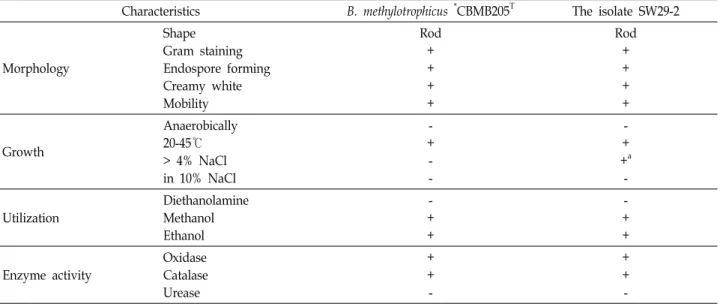
Table 1. Morphological and cultural characteristics of the isolate SW29-2 compared to the type strain of B. methylotrophicus CBMB205 [11]
Characteristics B. methylotrophicus *CBMB205T The isolate SW29-2
Morphology
Shape Gram staining Endospore forming Creamy white Mobility
Rod + + + +
Rod + + + +
Growth
Anaerobically 20-45℃
> 4% NaCl in 10% NaCl
- + - -
- + +a -
Utilization
Diethanolamine Methanol Ethanol
- + +
- + +
Enzyme activity
Oxidase Catalase Urease
+ + -
+ + -
aCell growth of the isolate was shown at 8.0% of NaCl.
Fig. 1. Neighbor-joining phylogenetic tree of Bacillus sp. SW29-2 and other related Bacillus spp. based on 16S rDNA sequences analysis (Solgent Co).
지, 배양 온도는 18℃부터 55℃의 범위에서 실험하였다. 균주 의 형태 및 생리화학적 특성[11]과 16S rRNA 염기서열분석에 따라 동정하였다(Table 1, Fig. 1).
항균활성 측정
C. coccodes 진균은 PDA배지를 이용하여 25℃에서 배양하 였다. 20 ml 생리식염수를 이용하여 한천배지 표면으로부터
Colletotrichum coccodes strains
KACC40009 KACC40010 KACC40227 KACC40802
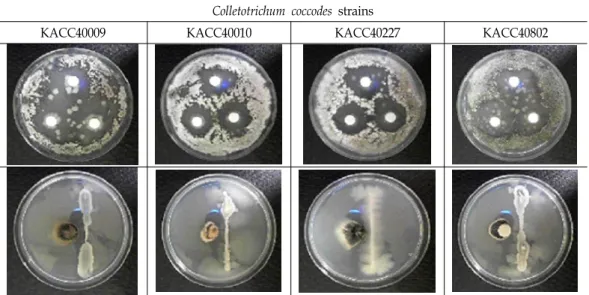
Fig. 2. Antifungal activity of Bacillus sp. SW29-2 against C. coccodes strains.
포자를 세척하여 포자액(1-4×10⁵ spores/ml)을 제조하였다. C.
coccodes 균사 생육의 억제를 관찰하기 위하여, cork borer (dia, 10 mm)로 한천배지상의 균사체를 떼어내어 정치한 후, 분리 균 SW29-2를 1 백금이를 그어 주었다(Fig. 2). 균사생육저지환 의 측정을 위하여, 분리균을 액체배지에서 24시간 배양한 후 원심분리(5,000x g)하였다. 배양액 및 상등액 각각 40 μl를 pa- per disc (Avantec, 8 mm thick, Toyo Rossi Kaiser Co.)에 점적 한 후, 기 도말된 C. coccodes 한천배지에 정치하였다. 24℃에서 5-7일간 배양한 후 생육저지환의 직경(mm)을 측정하여 항진 균 활성으로 결정하였다.
결 과
분리균의 특성 및 동정
C. coccodes 생육을 억제하는 30 균주의 세균을 1차 분리하였 다. 분리균 SW-4 (B. methylotrophicus: 13.5 mm), SW-16 (B.
subtilis: 17.0 mm), SW-28 (B. tequinensis: 17.3 mm), SW29-2 (Bacillus sp. : 25.5 mm), SW-30 (B. methylotrophicus: 18.3 mm) 균주 중 항진균 활성이 가장 우수한 SW29-2 균주를 선별 하여 사용하였다. 분리균의 특성은 호기성, 포자를 형성하는 Gram 양성, 운동성이 있는 간균(0.8-1 μm x 1.5-2 μm)으로 cat- alase 및 oxidase의 효소활성은 양성, urease는 음성이었다. 한 천배지상의 colony는 creamy white, convex, translucent이었 다. 메탄올 및 에탄올을 탄소원으로 이용할 수 있었다(Table 1). 10% NaCl 농도에서는 생육을 관찰할 수 없었으나, B. meth- ylotrophicus type strain CBMB205의 특성과 달리 4% 이상의 NaCl 농도에서도 생육이 관찰되었다(<9% NaCl). 분리균을 18-55℃ 범위의 온도에서 배양한 결과, 18-47℃ 온도에서 생육 을 보여주었으나, 55℃에서는 보여주지 못하였다(Fig. 2). 최적 온도는 약 38℃이었다. 생육을 위한 배지의 pH는 실험한 4-9
의 범위에서 생육이 관찰되었으며, 최적 pH는 약 6의 중성 pH이었다.
분리균 SW29-2의 16S rRNA 유전자 염기서열은 B. methylo- trophicus CBMB205와 99%(1422/1423), B. amyloliquefaciens subsp. plantarum FZB42과 99%(1420/1422)의 상동상을 나타 내었다. 형태 및 생리학적 특성(Table 1)과 neighbor-joining phylogenetic tree 결과(Fig. 1)를 토대로 동정하였다. 분리균 SW29-2는 B. methylotrophicus 또는 B. amyloliquefaciens subsp.
plantarum과 매우 큰 유연관계를 갖고 있어 Bacillus sp SW29-2 로 잠정적 동정하였다. 추후 배양학적, 생리화학적, API NE-32GN 분석 및 유전학적 연구를 통하여 종 동정을 확립하 고자 한다.
분리균의 C. coccodes에 대한 항진균 활성
Bacillus sp. SW29-2의 항진균 활성을 검정한 결과, 사용한 4 균주의 C. coccodes KACC40009, KACC40010, KACC40277, KACC40802에 대해 항진균 활성을 나타내었다 (Fig. 2). C.
coccodes 포자가 도말된 한천배지에 Bacillus sp. SW29-2를 정치 하여 4일간 배양한 결과, 생육저지환의 직경은 23-29 mm이었 다(Table 2). 직경이 10 mm인 cork borer로 균사체를 떼어 내 어 한천배지 중앙에 위치 후, 1 백금이의 분리균 Bacillus sp.
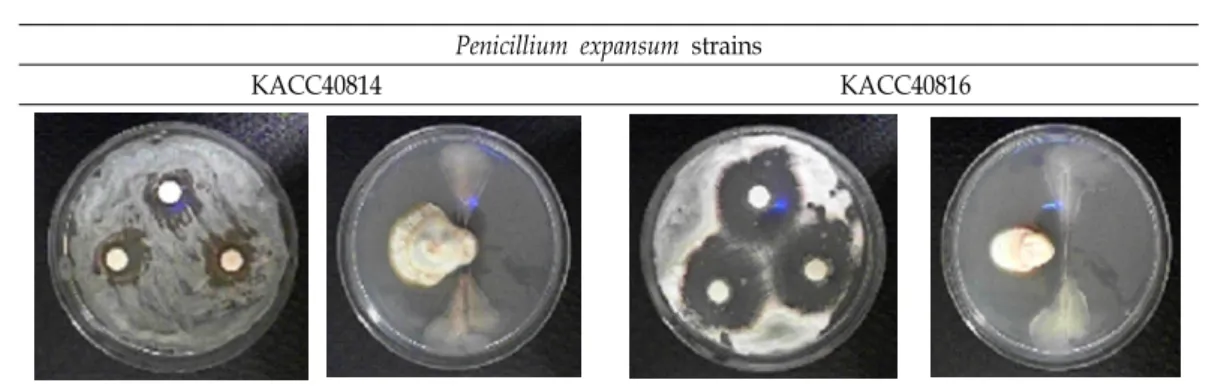
SW29-2를 그어 주었을 때, C. coccodes 균사 생육이 현저하게 억제되었다(Fig. 2). 또한, 분리균은 사과 푸른곰팡이병(peni- cillium rot)을 유발하는 Penicillium expansum에 대해 항진균 활성을 보여주었다(Fig. 3). 배양 상등액을 사용하였을 경우보 다 배양액을 사용하였을 때 항진균 활성이 더 우수하였다. C.
coccodes 균사 생육은 분리균의 한천배지상의 생육 및 운동성 정도(한천배지사의 퍼짐)에 따라 현저하게 억제됨을 보여주었 다(Fig. 2).
Table 2. Antifungal activity of Bacillus sp. SW29-2 against plant pathogenic fungus, C. coccodes Inhibition size (dia, mm) of growth of C. coccodes
KACC40009 KACC40010 KACC40227 KACC40802
29.2±3.8a 23.1±4.2 25.4±1.4 28.5±3.0
amean±SD for independent 9-10 replicates
Penicillium expansum strains
KACC40814 KACC40816
Fig. 3. Antifungal activity of Bacillus sp. SW29-2 against penicillium rot causing fungus P. expansum in apple.
고 찰
분리균 Bacillus sp. SW29-2와 유연관계가 있는 B. methylo- trophicus와 B. amyloliquefaciens의 C. coccodes에 대한 항진균 활성에 대한 연구는 확인할 수 없었다.
B. methylotrophicus의 대해 현재까지 수행된 연구로, levan- sucrase를 이용하는 levan의 생산[29], α-amylase [26], nar- inginase [15], chitosanase [6], glucanase [16] 등 세균이 생산 하는 효소를 이용하는 연구가 많이 이루어져 왔다. 이 이외에 항산화물질의 생산에 대한 연구[9], probiotic으로의 활용 가능 성을 위한 연구[22], 청국장의 PGA 생산에 관한 연구[19], 항세 균활성 연구[21] 및 항조류활성 연구[23]가 있었다. 이 세균의 식물의 생장 촉진 및 병해 방제에 적용하는 연구는 생장 촉진 을 위한 연구[14, 20]와 오이 근권에서 분리한 이 세균의 ferul- ic acid 분해에 관한 연구[30]가 있어왔다. B. methylotrophicus 의 항균활성 연구로 Magnaporthe oryzae 등 수종의 진균에 대 한 phenaminomethylacetic acid의 항진균활성 연구[20] 및 항 세균 활성 연구[4]로 매우 한정적이었다.
B. amylolquefaciens의 항진균 활성 연구는 β-glucanase의 Colletrichum lagenarium에 대한 연구[7], iturin A의 Penicillium crustosum에 대한 연구[2], iiturin A의 Rhizoctonia solani에 대 한 연구[27], cyclic lipopeptide iturin의 Sclerotinia sclerotiorum 에 대한 연구[1], volatile compound의 Fusarium oxysporum f.
sp. cubense에 대한 연구[28]와 chitinase의 Fusarium oxysporum 에 연구[25] 등 많은 연구가 이루어져 왔으나, 현재까지, 식물 병원 진균 C. coccodes에 대한 B. amyloliquefaciens의 항진균 활 성 연구를 발견할 수 없었다.
진균에 대한 항균활성 기작은 ketoconazole의 sterol 합성 억제, amphotericin의 세포막 파괴, echinocandin의 세포벽 합
성 억제, flucytosine의 핵산 합성 억제, griseofulvin의 micro- tubule 생성 억제 등에 기인하는 것으로 알려져 왔다. 분리균 Bacillus sp. SW29-2의 항진균 활성 기작을 검정하지 못하였으 나, 배양 상등액 보다 배양액 정치시 포자발아를 억제하는 결 과와 분리균의 한천배지상에서의 생육시 더 큰 항균활성을 보여준 결과로 볼 때, 항균활성이 1차 대사산물인 효소에 기인 할 것으로 유추하였다(Fig. 2).
현재까지, 분리균 Bacillus sp. SW29-2와 유연관계가 있는 B. methylotrophicus, B. amylolquefaciens를 포함하는 Bacillus속 균주의 C. coccodes에 대한 항진균 활성에 관한 연구는 파악할 수 없었다. 본 연구는 Bacillus속 균주의 C. coccodes에 대한 항 진균 활성을 수행한 기초 연구로 그 의의가 있다고 판단된다.
추후, 다른 Bacillus속 균주와의 항진균 활성 비교, 항진균 활성 의 기작, 배양 및 추출 조건에 따르는 영향, 다른 식물병원성 진균에의 적용 등에 대해 연구할 예정이다.
References
1. Alvarez, F., Castro, M., Principe, A., Borioli, G., Fischer, S., Mori, G. and Jofré, E. 2011. The plant-associated Bacillus amyloliquefaciens strains MEP218 and ARP23 capable of pro- ducing the cyclic lipopeptides iturin or surfactin and fengy- cin are effective in biocontrol of sclerotinia stem rot disease.
J. Appl. Microbiol. 112, 159-174.
2. Arrebola, E., Jacobos, R. and Korsten, L. 2009. Iturin A is the principal inhibitor in the biocontrol activity of Bacillus amyloliquefaciens PPCB004 against postharvest fungal pathogens. J. Appl. Microbiol. 108, 386-395.
3. Ben-Daniel, B., Bar-Zvi, D. and Tsror (Lahkim), L. 2009. An improved large-scale screening method for assessment of Colletotrichum coccodes aggressiveness using mature green
tomatoes. Plant Phathol. 58, 497-503.
4. Dev Sharma, S. C., Shovon, M. S., Sarowar Jahan, M. G., Asaduzzaman, A. K. M,, Rahman, M. A., Biswas, K. K., Abe, N. and Roy, N. 2013. Antibacterial and cytotoxic activity of Bacillus methylotrophicus-SCS2012 isolated from soil. J.
Microbiol. Biotechnol. Food Sci. 2, 2293-2307.
5. Dillard, H. R. 1988. Influence of temperature, pH, osmotic potential, and fungicide sensitivity on germination of con- idia and growth from sclerotia of Colletotrichum coccodes in vitro. Phytopathology 78, 1357-1361.
6. Jung, Y. H., No, H. K. and Park, C. S. 2014. Screening of microorganism producing chitosanase using trypan blue containing medium and characterization of chitosanase from Bacillus methylotrophicus CH1. J. Chitin Chitosan 19, 188-193.
7. Kim, P. I. and Chung, K. C. 2004. Production of an anti- fungal protein for control of Colletotrichum lagenarium by Bacillus amyloliquefaciens MET0908. FEMS Microbiol. Lett. 234, 177-183.
8. Lee, K. J., Park, S. H., Govrthanan, M., Hwang, P. H., Seo, Y. S., Cho, M., Lee, W. H., Lee, J. Y., Kamala-Kannan, S.
and Oh, B. T. 2013. Synthesis of silver nanoparticles using cow milk and their antifungal activity against phytopath- ogens. Materials Lett. 105, 128-131.
9. Lee, N. R., Woo, G. Y., Jang, J. H., Lee, S. M., Go, T. H., Lee, H. S., Hwan, D. Y. and Son, H. J. 2013. Antioxidant production by Bacillus methylotrophicus isolated from chung- kookjang, Korean traditional fermented food. J. Environ. Sci.
Internatl. 22, 855-862.
10. Lees, A. K. and Hilton, A. J. 2003. Black dot (Colletotrichum coccodes): an increasingly important disease of potato. Plant Pathol. 52, 3-12.
11. Madhaiyan, M., Poonguzhali, S., Kwon, S. W. and Sa, T.
M. 2010. Bacillus methylotrophicus sp. nov., a methanol-utiliz- ing, plant-growth-promoting bacterium isolated from rice rhizosphere soil. Int. J. Syst. Evol. Microbiol. 60, 2490-2495.
12. Manasi, K., Bhagwat, M. K. and Datar, A. G. 2014.
Antifungal activity of herbal extracts against plant patho- genic fungi. Arch. Phytopathol. Plant Protec. 47, 959-965.
13. Marais, L. 1990, Efficacy of fungicides against Colletotrichum coccodes on potato tubers, Potato Res. 33, 275-281.
14. Mehta, P., Walia, A., Kakkar, N. and Shirkot, C. K. 2014.
Tricalcium phosphate solubilisation by new endophyte Bacillus methylotrophicus CKAM isolated from apple root en- dosphere and its plant growth-promoting activities. Acta Physiol. Plantarum 36, 2033-2045.
15. Mukund, P., Belur, P. D. and Saidutta, M. B. 2014. Production of naringinase from a new soil isolate, Bacillus methylo- trophicus: isolation, optimization and scale-up studies.
Prepar. Biochem. Biotechnol. 44, 146-209.
16. Niu, Q., Zhang, G., Zhang, L., Ma, Y., Shi, Q. and Fu, W.
2015. Purification and characterization of a thermophilic 1,3-1,4-β-glucanase from Bacillus methylotrophicus S2 from booklice. J. Biosci. Bioeng. 121, 503-508.
17. Palaniyandi, S. A., Yang, S. H. and Suh, J. W. 2013. Extracel- lular proteases from Streptomyces phaeopurpureus ExoPro138
inhibit spore adhesion, germination and appressorium for- mation in Colletotrichum coccodes. J. Appl. Microbiol. 115, 207-217.
18. Park, K. S. and Kim, C. H. 1992. Identification, distribution and etiological characteristics of anthracnose fungi of red pepper in Korea. Kor. J. Plant Pathol. 8, 61-69.
19. Peng, Y., Bo, J., Tao, Z., Mu, W., Miao, M. and Hua, Y.
2014. High-level production of poly(γ-glutamic acid) by a newly isolated glutamate-independent strain, Bacillus meth- ylotrophicus. Proc. Biochem. 50, 1359-5113.
20. Shan, H., Zhao, M., Chen D., Cheng J., Li, J., Feng, Z., Ma, Z. and Derong, A. 2013. Biocontrol of rice blast by the phe- naminomethylacetic acid producer of Bacillus methylotrophicus strain BC79. Crop Protect. 44, 29-37.
21. Sharma, S. C. D., Shovon, M. S., Jahan, M. G. S., Asaduzza- man, A. K. M., Rahman, M. A., Biswas, K. K., Abe, N. and Roy, N. 2013. Antibacterial and cytotoxic activity of Bacillus methylotrophicus-SCS2012 isolated from soil. J. Microbiol.
Biotechnol. Food Sci. 2, 2293-2307.
22. Sim, I., Koh, J. H., Kim, D. J., Gu, S. H., Park, A. and Lim, Y. H. 2014. In vitro assessment of the gastrointestinal toler- ance and immunomodulatory function of Bacillus methylo- trophicus isolated from a traditional Korean fermented soy- bean food. J. Appl. Microbiol. 118, 718-744.
23. Sun, P., Hui, C., Wang, S., Khan, R. A., Zhang, Q. and Zhao, Y. H. 2016. Enhancement of algicidal properties of immobi- lized Bacillus methylotrophicus ZJU by coating with magnetic Fe3O4nanoparticlesandwheatbran. J. Hazard. Mater. 301, 65-73.
24. Uribe, E. and Loria, R. 1994. Response of Colletotrichum cocc- odes to fungicides in vitro. Amer. Potato J. 71, 455-465.
25. Wang, S. L., Shih, I. L., Liang, T. W. and Wang, C. H. 2002.
Purification and characterization of two antifungal chiti- nases extracellularly produced by Bacillus amyloliquefaciens V656 in a shrimp and crab shell powder medium. Agric.
Food Chem. 50, 2241-2248.
26. Xie, F., Quan, S., Liu, D., Ma, H., Li F., Zhou, F. and Chen, G. 2013. Purification and characterization of a novel α -amylase from a newly isolated Bacillus methylotrophicus strain P11-2. 2013. Proc. Biochem. 49, 47-53.
27. Yu, G. Y., Sinclair, J. B., Harman, G. L. and Bertagnolli, B.
L. 2002. Production of iturin A by Bacillus amylolquefaciens suppressing Rhizoctonia solani. Soil Biol. Biochem. 34, 955-963.
28. Yuan, J., Raza, W, Shen, Q. and Huang, Q. 2012. Antifungal activity of Bacillus amyloliquefaciens NJN-6 volatile com- pounds against Fusarium oxysporum f. sp. cubens. Appl.
Environ. Microbiol. 78, 5942-5944.
29. Zhang, T., Li, R., Qian, H., Mu, W., Miao, M. and Jiang, B. 2013. Biosynthesis of levan by levansucrase from Bacillus methylotrophicus SK 21.002. Carbohydr. Polymers 101, 975- 1056.
30. Zhang, Y., Wang, X. J., Chen, S. Y., Guo, L. Y., Song, M.
L., Feng, H., Li, C. and Bai, J. G. 2015. Bacillus methylo- trophicus isolated from the cucumber rhizosphere degrades ferulic acid in soil and affects antioxidant and rhizosphere enzyme activities. Plant Soil 392, 309-321.
초록:Bacillus sp. SW29-2의 분리 및 Colletotrichum coccodes에 대한 항진균 활성
한영환*
(동국대학교 의생명공학과)
하수 슬러지로부터 감자 뿌리썩음병 및 토마토 탄저병을 유발하는 Colletotrichum coccodes에 대해 항진균 활성 이 있는 세균을 분리하였다. 분리균의 partial 16S rRNA sequence는 Bacillus methylotrophicus CBMB205 및 Bacillus amyloliquefaciens subsp. plantarum FZB42와 각각 99%의 상동성을 보여주었다. 분리균은 neighbor-joining phylo- genetic tree, BlastN 염기서열 분석, 형태학적 및 배양학적 특성에 따라 Bacillus sp. SW29-2로 동정하였다. 분리균 Baciilus sp. SW29-2는 B. methylotrophicus CBMB205 type strain과 비교시 4% 이상 NaCl에서 생육하는 것이외에 형태학적, 생리학적 특성이 모두 동일하였다. 분리은 호기성, Gram-양성, 내생포자를 형성하는 세균이었다. 실험 한 18-47℃(최적, 약 38℃)의 온도범위에서, pH 3-9(최적, 약 6.0) 범위의 초기 배지 pH에서 모두 생육이 관찰되었 다. Baciilus sp. SW29-2의 C. coccodes에 대한 생육저지환(직경)은 23 mm에서 29 mm의 범위이었다. 분리 세균은 또한 사과 푸른곰팡이병(penicillum rot disease)을 유발하는 Penicillium expansum에 대해 우수한 항진균 활성을 보여주었다. 현재까지, Bacillus속 세균의 C. coccodes에 대한 항균활성 연구는 파악할 수 없었다. 이 결과는 분리균 Bacillus sp. SW29-2가 식물 병원성 C. coccodes에 대해 생물학적 방제제로의 활용 가능성이 있으며, 추후, 식물병을 유발하는 다른 진균에 대해서 적용할 예정이다.