Ann Hepatobiliary Pancreat Surg 2019;23:206-209
https://doi.org/10.14701/ahbps.2019.23.2.206
Case Report
Robotic assisted laparoscopic completion pancreatectomy for recurrent intraductal papillary mucinous neoplasm after previous open pancreatoduodenectomy: A case report and literature review
Pyae Pa Pa Kyaw1 and Brian K. P. Goh1,2
1Department of Hepatopancreatobiliary and Transplant Surgery, Singapore General Hospital,
2Duke-NUS Medical School, Singapore
Completion pancreatectomy (CP), is an effective, and potentially curative option for selected patients with local re- currence of pancreatic neoplasms in the remnant pancreas after initial pancreatoduodenectomy (PD). Traditionally CP has been performed via the open approach. Reports of minimally-invasive CP particularly after previous open PD are rare. We present a case of a 72-year old male who previously underwent open PD 5 years ago for intraductal papillary mucinous neoplasm (IPMN) with high grade dysplasia in the uncinate process. He had multifocal IPMN and low-risk lesions in the body and tail were managed conservatively. On routine surveillance, the cyst in the body was noted to be increasing in size with the development of a non-enhancing solid component confirmed on magnetic resonance imaging and subsequent endoscopic ultrasonography. The patient underwent successful robotic assisted laparoscopic completion pancreatectomy. Final histology confirmed a recurrent IPMN with low-to-intermediate grade dysplasia. The postoperative recovery was uneventful and he was discharged on postoperative day 9. (Ann Hepatobiliary Pancreat Surg 2019;23:206-209)
Key Words: Completion pancreatectomy; Laparoscopic pancreatectomy; Robotic pancreatectomy; Minimally invasive pancreatectomy; Total remnant pancreatectomy
Received: December 14, 2018; Revised: January 22, 2019; Accepted: January 30, 2019 Corresponding author: Brian K. P. Goh
Department of Hepatopancreatobiliary and Transplant Surgery, Singapore General Hospital, 20 College Road, 169856, Singapore Tel: +65-98156448, Fax: +65-98156448, E-mail: [email protected]
Copyright Ⓒ 2019 by The Korean Association of Hepato-Biliary-Pancreatic Surgery
This is an Open Access article distributed under the terms of the Creative Commons Attribution Non-Commercial License (http://creativecommons.org/
licenses/by-nc/4.0) which permits unrestricted non-commercial use, distribution, and reproduction in any medium, provided the original work is properly cited.
Annals of Hepato-Biliary-Pancreatic Surgery ∙ pISSN: 2508-5778ㆍeISSN: 2508-5859
INTRODUCTION
Today, completion pancreatectomy (CP) remains a rela- tively rare procedure which is technically demanding to perform and is associated with a high morbidity and mor- tality rate.1 The most common indications for CP include its use as a salvage procedure for patients who have expe- rienced severe complications from postoperative pancre- atic fistula after pancreaticoduodenectomy (PD) or for pa- tients who have developed a local recurrence of pancreatic neoplasm after previous PD.2-4
Over the past decade, the application of minimally in- vasive surgery for pancreatectomies has rapidly expanded with improvements in surgical technique and surgical equipment.5-7 Presently, laparoscopic or robotic distal pan- createctomies has become the surgical approach of choice in many expert pancreatic centers world-wide due to its
advantages over the conventional open approach such as shorter length of stay, earlier convalescence and decreased wound infection rate.6-8 Minimally-invasive DP has be- come widely accepted as opposed to PD as it is less tech- nically demanding and does not require the surgeon to perform multiple complex surgical anastomoses.8 Not sur- prisingly, the adoption of minimally-invasive PD (MIPD) remains more limited today and is only routinely per- formed by a few surgeons practicing at specialized high- volume centers.9,10
Presently, there are very limited reports in the literature on the use of laparoscopy or robotic surgery for CP partic- ularly after open PD.2 This is likely due to rarity of CP performed as an elective procedure as isolated local re- currence of pancreatic neoplasms are a rare occurrence.
Furthermore, due to the technical complexity of the proce- dure, most of these operations have been performed via
Pyae Pa Pa Kyaw and Brian K. P. Goh. Robotic laparoscopic completion pancreatectomy 207
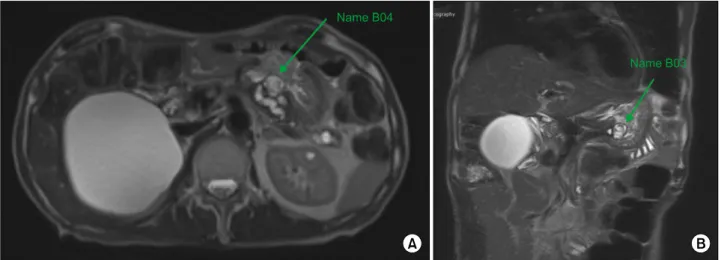
Fig. 1. Magnetic resonance of axial (A) and coronal image (B) demonstrating the worrisome-risk cystic neoplasm in the remnant pancreas with solid component.
the traditional open approach. In this study, we report a case of robotic assisted laparoscopic CP performed for re- current IPMN.
CASE
The patient is 72-year old male who underwent open PD with pancreaticogastrostomy reconstruction 5 years ago for an intraductal papillary mucinous neoplasm (IPMN) with high risk features involving the uncinate process. He also had a low risk IPMN in the body and tail which were managed conservatively. Final histology revealed IPMN with high grade dysplasia. The patient had an uneventful postoperative recovery and had regular fol- low-up at 6 months. During surveillance scan, the IPMN in the remnant pancreas was found to have increased in size. A non-enhancing solid component with and a worri- some feature of a thickened cyst wall had developed (Fig.
1). This was confirmed on endoscopic ultrasonography (EUS) to be an enhancing <5 mm solid component. The patient subsequently underwent robotic- assisted laparo- scopic CP.
Surgical procedure
A 12-mm sub-umbilical access was used initially for camera insertion and pneumoperitoneum was established.
One 12 mm working, one 5-mm trocar in the left para- umbilical, 8 mm left flank, 8 mm epigastric, and 8 mm right hypochondrium ports were placed. Diagnostic lapa-
roscopy was initially performed to determine the extent of adhesion. Laparoscopic dissection was subsequently performed using the Harmonic scalpel. Numerous adhe- sions were divided, followed by entrance into the lesser sac via the gastrocolic ligament and short gastric vessels.
The pancreatic body and tail were dissected and mobilized from the spleen to the stomach. The spleen was com- pletely mobilized and detached from its attachments. After meticulous mobilization of the pancreatic remnant, pan- creaticogastrostomy was identified at the posterior wall of the stomach. The splenic artery and vein were also identi- fied, clipped and divided. Finally, the pancreaticogas- trostomy anastomosis was then resected with a cuff of the posterior wall of the stomach and the specimen bagged.
Da Vinci Si robot (Intuitive Surgical) was then docked and the posterior gastrostomy was closed with V-loc and vicryl 3/0. A single drain was placed along the stomach bed and left sub-diaphragmatic area. The total operating time was 460 min. Intraoperative blood loss was 300 mL without blood transfusion.
The postoperative course was uneventful and the pa- tient was discharged well on postoperative day 9. The fi- nal pathological finding was compatible with recurrent IPMN with low-to-intermediate grade dysplasia. There were 14 benign lymph nodes and the final resection mar- gins were clear. The patient remained well on review at 6 months postoperatively.
208 Ann Hepatobiliary Pancreat Surg Vol. 23, No. 2, May 2019
Table 1. Previous reports on completion pancreatectomy for local recurrence in pancreatic remnant after initial pan- creaticoduodenectomy (PD)
Author,
year Case Indication Approach Previous PD
Operation time, min
Blood
loss Morbidity Length of stay, d Hiroki et al.
2014
1 Remnant
pancreatic cancer
Laparoscopic Laparoscopic 462 1,200 ml Nil 15
Mushegh et al. 2016
2 Remnant
pancreatic cancer
Laparoscopic Open 263 70 ml Nil Not recorded
3 Remnant pancreatic metastasis from underlying RCC
Laparoscopic Open 69 300 ml GIIIb-
reoperation for bleeding
7
Current study
4 IPMN Robotic
laparoscopic
Open 460 300 ml Nil 10
RCC, renal cell carcinoma; IPMN, intraductal papillary mucinous neoplasm
DISCUSSION
CP, when technically feasible, is a safe, effective, and potentially curative option in selected patients with iso- lated local recurrence of pancreatic neoplasms in the rem- nant pancreas after initial pancreatectomy.11-13 Classically, CP has been performed via the conventional open approach.11-13 Over the past decade, there has been a rapid increase in the adoption of laparoscopic and robotic pan- creatic surgery with numerous studies demonstrating its superiority especially in terms of shorter hospital stay and quicker convalescence over its traditional open counterpart.6-9 Presently, both laparoscopic and robotic approaches have been reported for the various types of pancreatectomies including DP, PD, central pancreatectomies and enucle- ations.5-7,14 More recently, 2 single-center randomized controlled trials have confirmed the superior short-term outcomes of laparoscopic PD over its open counterpart.9,10
Nonetheless, the minimally-invasive approach for CP has been rarely reported and to the best of our knowledge only 2 studies2,15 reporting on 3 cases have been published to date (Table 1). This is likely due to the combination of: 1) the rarity for the need of CP especially in the elec- tive setting as isolated local recurrence of pancreatic neo- plasms are rare and 2) the perceived technical difficulty of the procedure due to the frequent presence of dense adhesions occurring after PD. Sunagawa et al reported the first laparoscopic CP after previous LPD in 2013.15 The patient developed remnant pancreatic cancer eighteen months after LPD for distal bile duct cancer. LCP was performed successfully and the patient was discharged
without complications on postoperative day 15. Subse- quently, Sahakyan et al.2 reported 2 cases LCP after OPD in 2016. The first case was performed for pancreatic can- cer in the remnant pancreas after previous OPD for am- pullary cancer. The patient recovered uneventfully without complications. The 2nd case was performed for recurrent metastases in the remnant pancreas from renal cell carci- noma after previous OPD. The patient had to undergo re- operation for bleeding on postoperative day 1. However, the patient subsequently recovered well.
In the present case, to the best of our knowledge, we describe the first case of robotic-assisted laparoscopic CP reported in the English literature. We elected to perform a diagnostic laparoscopy initially to determine the extent of adhesions and feasibility of the minimally invasive approach. Subsequently, lysis of adhesions and dissection of the pancreas was continued laparoscopically via a com- bination of blunt and sharp dissection. In our opinion the laparoscopic approach may be superior to the robotic ap- proach for surgical dissection in this case as dense adhe- sions and distorted surgical anatomy frequently required a combination of sharp and blunt dissection whereby the presence of tactile feedback was important. The robot was docked for the final part of the procedure to close the pos- terior gastrostomy. In this case due to the presence of ad- hesions and previous gastrojejunostomy, the stomach could not be rotated and the posterior gastrostomy had to be closed “upside down” in a tight narrow space. The su- perior dexterity of the robotic endo-wrists compared to conventional laparoscopy allowed us to perform this pro- cedure easily.
Pyae Pa Pa Kyaw and Brian K. P. Goh. Robotic laparoscopic completion pancreatectomy 209
In conclusion, we demonstrated the feasibility and safe- ty of robotic assisted laparoscopic CP after open PD. This study demonstrates that the minimally-invasive approach can be considered in selected patients allowing these pa- tients to benefit from the MIS approach. Further studies with a larger patient cohort are needed to confirm these findings.
ACKNOWLEDGEMENTS
Dr Brian Goh has received travel grants and proctor fees from Transmedic, the local distributor of Da Vinci robot in Singapore.
REFERENCES
1. Bressan AK, Wahba M, Dixon E, Ball CG. Completion pan- createctomy in the acute management of pancreatic fistula after pancreaticoduodenectomy: a systematic review and qualitative synthesis of the literature. HPB (Oxford) 2018;20:20-27.
2. Sahakyan MA, Yaqub S, Kazaryan AM, Villanger O, Berstad AE, Labori KJ, et al. Laparoscopic completion pancreatectomy for local recurrence in the pancreatic remnant after pan- creaticoduodenectomy: case reports and review of the literature.
J Gastrointest Cancer 2016;47:509-513.
3. Kleeff J, Reiser C, Hinz U, Bachmann J, Debus J, Jaeger D, et al. Surgery for recurrent pancreatic ductal adenocarcinoma.
Ann Surg 2007;245:566-572.
4. Miura F, Takada T, Amano H, Yoshida M, Isaka T, Toyota N, et al. Repeated pancreatectomy after pancreatoduodenectomy. J Gastrointest Surg 2007;11:179-186.
5. Goh BKP, Low TY, Lee SY, Chan CY, Chung AYF, Ooi LLPJ.
Initial experience with robotic pancreatic surgery in Singapore:
single institution experience with 30 consecutive cases. ANZ J Surg 2019;89:206-210.
6. Goh BKP, Lee SY, Kam JH, Soh HL, Cheow PC, Chow PKH, et al. Evolution of minimally invasive distal pancreatectomies at a single institution. J Minim Access Surg 2018;14:140-145.
7. Caba Molina D, Lambreton F, Arrangoiz Majul R. Trends in ro- botic pancreaticoduodenectomy and distal pancreatectomy. J Laparoendosc Adv Surg Tech A 2019;29:147-151.
8. Joechle K, Conrad C. Cost-effectiveness of minimally invasive pancreatic resection. J Hepatobiliary Pancreat Sci 2018;25:291-298.
9. Palanivelu C, Senthilnathan P, Sabnis SC, Babu NS, Srivatsan Gurumurthy S, Anand Vijai N, et al. Randomized clinical trial of laparoscopic versus open pancreatoduodenectomy for peri- ampullary tumours. Br J Surg 2017;104:1443-1450.
10. Poves I, Burdío F, Morató O, Iglesias M, Radosevic A, Ilzarbe L, et al. Comparison of perioperative outcomes between laparo- scopic and open approach for pancreatoduodenectomy: the PADULAP randomized controlled trial. Ann Surg 2018;268:
731-739.
11. Koizumi M, Sata N, Kasahara N, Morishima K, Sasanuma H, Sakuma Y, et al. Remnant pancreatectomy for recurrent or meta- chronous pancreatic carcinoma detected by FDG-PET: two case reports. JOP 2010;11:36-40.
12. Strobel O, Hartwig W, Hackert T, Hinz U, Berens V, Grenacher L, et al. Re-resection for isolated local recurrence of pancreatic cancer is feasible, safe, and associated with encouraging survival.
Ann Surg Oncol 2013;20:964-972.
13. Miyazaki M, Yoshitomi H, Shimizu H, Ohtsuka M, Yoshidome H, Furukawa K, et al. Repeat pancreatectomy for pancreatic duc- tal cancer recurrence in the remnant pancreas after initial pan- createctomy: is it worthwhile? Surgery 2014;155:58-66.
14. Guerra F, Giuliani G, Bencini L, Bianchi PP, Coratti A.
Minimally invasive versus open pancreatic enucleation. Systematic review and meta-analysis of surgical outcomes. J Surg Oncol 2018;117:1509-1516.
15. Sunagawa H, Mayama Y, Orokawa T, Oshiro N. Laparoscopic to- tal remnant pancreatectomy after laparoscopic pancreaticoduo- denectomy. Asian J Endosc Surg 2014;7:71-74.