• 검색 결과가 없습니다.

Recent updates in transcatheter aortic valve implantation

N/A
N/A
Protected

Academic year: 2021

Share "Recent updates in transcatheter aortic valve implantation"

Copied!
10
0
0

로드 중.... (전체 텍스트 보기)

전체 글

(1)

Yeungnam Univ J Med 2018;35(1):17-26

Recent updates in transcatheter aortic valve implantation

Jeonghwan Cho

1

, Ung Kim

2

1

Division of Cardiology, Daegu Veterans Hospital;

2

Division of Cardiology, Department of Internal Medicine, Yeungnam University Medical Center, Daegu, Korea

Transcatheter aortic valve implantation (TAVI) has evolved from a challenging intervention to a standardized, simple, and streamlined procedure with over 350,000 procedures performed in over 70 countries. It is now a novel alternative to surgical aortic valve replacement in patients with intermediate surgical risk and its indications have been expanded to cohorts with bicuspid aortic valves, low surgical risk, and younger age and fewer comorbidities. Attention should be paid to further reducing remaining complications, such as para- valvular aortic regurgitation, conduction abnormalities, cardiac tamponade, and stroke. The aim of this review is to provide an overview on the rapidly changing field of TAVI treatment and to explore past achievements, current issues, and future perspectives of this treatment modality.

Keywords: Aortic valve stenosis; Transcatheter aortic valve implantation; Surgery; Indications

Copyright ©2018 Yeungnam University College of Medicine

This is an Open Access article distributed under the terms of the Creative Commons Attribution Non-Commercial License (http://creative- commons.org/licenses/by-nc/4.0/) which permits unrestricted non-commercial use, distribution, and reproduction in any medium, provided the original work is properly cited.

Received: April 18, 2018, Revised: May 8, 2018 Accepted: May 29, 2018

Corresponding Author: Ung Kim, Division of Cardiology, Department of Internal Medicine, Yeungnam University Medical Center, 170, Hyunchung-ro, Namgu, Daegu 42415, Korea

Tel: +82-53-620-3832, Fax: +82-53-654-8386 E-mail: [email protected]

INTRODUCTION

Since the first in vivo transcatheter aortic valve implantation (TAVI) performed by Alain Cribier in January 2002 [1], TAVI has been widely accepted as a method of treatment for severe aortic valve stenosis in inoperable patients, and as a reasona- ble alternative to surgical aortic valve replacement (SAVR) in moderate- and high-risk groups [2]. TAVI has undergone re- markable advances in the last 15 years, with over 350,000 pro- cedures performed in over 70 countries [3]. Simultaneously with the development of TAVI procedures and methods of transcatheter heart valve (THV) production, TAVI has been undergoing a simplification and standardization process [3].

The aim of this review is to investigate: 1) changes in the clinical and anatomical indications for TAVI; 2) trends in the

incidence of complications according to the advances and pro- gress in TAVI; and 3) synopsis, current issues, and future direc- tions in the rapidly changing field of TAVI.

Changes in TAVI indications

SAVR has improved symptoms and survival rates in most pa-

tients with severe aortic stenosis [2]. However, the 2005 Euro

Heart Survey revealed that old age and severe heart failure

were predictors of 1-year survival rate in severe aortic stenosis,

surgery and survival rates were not correlated, and 1.3 of all

patients with severe heart failure or those of old age could

not undergo surgery [4]. In the midst of this clinical situation,

TAVI emerged. The indications for TAVI have significantly

changed in the last 15 years. TAVI is now indicated for inope-

rable patients and patients at low to high risk. The indications

have been recently expanded to patients at moderate risk. In

line with the results of a study that reported excellent TAVI

outcomes [5] and a randomized comparative study on the pro-

cedure [3], the 2017 American Heart Association (AHA)/Ame-

rican College of Cardiology (ACC)/Society of Thoracic Surgery

(STS) Guideline extended the indications for TAVI to class I

(2)

(level of evidence A) for inoperable patients with high risk, and to class II (level of evidence A-B) for patients with moderate risk [2]. A recent European treatment guideline included the results of Placement of Aortic Transcatheter Valve (PARTNER) trial A(high risk group), PARTNER B(inoperable patient group), PARTNER 2 (moderate risk group), CoreValve (high risk group), and Nordic Aortic Valve Intervention (NOTION) (moderate/

low risk groups) trials, in addition to those of Surgical Replace- ment and Transcatheter Aortic Valve Implantation (SURTAVI) (moderate risk group) trial. Although the current guideline recommends SAVR for patients with severe aortic valve ste- nosis and for moderate and low risk groups, it recommends TAVI for patients deemed inoperable by the heart team (class I, level of evidence B). The guideline states that the decision between SAVR and TAVI must be made by the heart team for patients who are at increased risk during surgical treatment (moderate-risk patients and patients with STS score or Euro- SCORE II ≥4%) [6]. TAVI is preferred for patients of old age for whom the femoral artery approach (class I, level of evi- dence B) may be used [6].

TAVI indications for specific population

Attention has been given to the expansion of TAVI indica- tions for specific patient groups. Research on this topic is being actively conducted today.

1. Degenerated surgical bioprosthesis

Percutaneous valve-in-valve (ViV) insertion has been recei- ving much attention as a relatively safe and less invasive treat- ment from patients with failed surgical bioprosthetic valve insertion [7]. Based on data from registry clinical studies, self- expandable CoreValve

®

(Medtronic, Minneapolis, MN, USA), balloon expandable SAPIEN XT

®

, and SAPIEN 3

®

transca- theter heart valve (THV) (Edwards Lifesciences Corp., Irvine, CA, USA) have been approved for use in high-risk patients for whom surgical bioprosthetic valve insertion has failed. A mul- ticenter registry study has reported that failure of surgical bioprosthetic valve due to stenosis and degeneration is associ- ated with the use of a small valve size [7]. From the technical point of view, ViV TAVI reduces the incidence of paraval- vular aortic regurgitation (PAR) and the frequency of new car- diac pacemaker insertions compared to natural aortic valve

TAVI. However, it increases the risk of coronary artery obst- ruction and the frequency of patient-prosthesis mismatch.

Two prospective studies using PARTNER 2 ViV registry and CoreValve US Expanded Use have been recently published [8,9]. The former registered 96 patients in the early research period and added 265 patients under the same protocol follo- wing the primary research completion. The postoperative 30- day mortality and 1-year mortality rates were 2.7% and 12.4%

in the entire cohort. The 1-year mortality of the first 96 patie- nts was 20%, and that of follow-up patients was 9.8%, show- ing a significant improvement in the mortality rates along with improvement in clinicians’ skills [9]. The CoreValve US Ex- panded Use study included 223 patients with symptoms caused by impaired function of a surgically-treated valve. The all- cause mortality was 2.2% at 30 days after surgery and 14.6%

at 1 year. Moderate or severe PAR occurred in 3.5% of pati- ents. The predictors of high transvalvular pressure gradient at the time of discharge were the size of inserted valve at the time of surgery, the degree of stenosis of failed valve, and patient- prosthesis mismatch [8-10]. Complications related to ViV TAVI can now be significantly prevented by accurate preope- rative screening tests and through technical advance [10]. Im- portant challenges of ViV TAVI treatment in patients with a small-sized surgical bioprosthetic valve remain higher post- operative transvalvular pressure gradient and late mortality rates than those of other patients with ViV TAVI. It was re- ported that positioning the THV slightly above the aortic annulus or in the annulus can reduce this phenomenon [10].

Researchers have proposed a technique of fracturing the inser- ted bioprosthetic valve ring using a high-pressure balloon as a way to make the process of ViV TAVI easier. This strategy reduced transvalvular gradients, increased useful cross-sectio- nal area of the valve, and enabled additional THV expansion [11]. If the technique produces good results, TAVI may be- come the preferred method of treatment for patients with failed surgical bioprosthetic valve. The development of cus- tomized equipment for these patients is also anticipated.

2. Bicuspid aortic valve

Bicuspid aortic valve has high prevalence in relatively young

patients with aortic valve stenosis, and accounts for 20% of

all surgical treatments in elderly persons aged 80 years or older

[12]. In the early period after development, TAVI produced

(3)

unsatisfactory outcome in patients with bicuspid aortic valve due to the cusps that are more oval compared to those of the normal aorta, irregular, and severely calcified, as well as due to calcified raphe. In a study on first generation THVs, 15.9%

of patients with aortic stenosis and a bicuspid valve treated with TAVI showed moderate or severe PAR, and the in- cidence of THV malposition was also high [12]. Yoon et al.

[13] recently published a study on clinical outcomes of pati- ents who underwent TAVI for bicuspid and tricuspid valve stenosis. They reported a higher incidence of aortic root dam- age, second THV implantation, and PAR among patients with bicuspid valve stenosis. In their study, the incidence of com- plications caused by TAVI was the highest among patients with type 1 bicuspid valves and severely calcified raphes [13].

Based on the currently available findings, bicuspid aortic valve should not be excluded as an indication for TAVI. However, the outcomes may not be as excellent as that for tricuspid valve. Considering the variations in the aortic structure and the location of valvular calcium, the indications for TAVI must be carefully reviewed.

3. Low-risk population

Although limited data are available about the effect of TAVI on low-risk populations, publication of the results of PARTNER 3 and Low-Risk Evolut clinical trials is expected. The NOTION study is the only randomized trial on TAVI and SAVR in a low-risk population, in which 82% of 280 low-risk patients were randomly exposed to TAVI or SAVR in a 1:1 ratio [14].

The primary endpoints were combined cardiovascular events that occurred over 2 years, including all-cause death, cere- brovascular infarction, and myocardial infarction. No diffe- rence was found in these endpoints between the two groups (15.8% vs. 18.8%, p =0.43) [14]. Similar to the results of a pre- vious study on high-risk and moderate-risk populations, the ratio of cardiac pacemaker implantation and PAR was high among patients who underwent TAVI, and the risk of hemor- rhage, cardiogenic shock, acute renal failure, and preoperative and postoperative atrial fibrillation was higher among patients who underwent SAVR [14]. By applying the experience of moderate-risk populations with TAVI to low-risk populations and detecting certain anatomical and technical factors that can choose between TAVI or SAVR in low-risk populations, it may become possible to choose the best method of treatment

for these patient groups [15,16].

4. Aortic valve regurgitation

The role of TAVI in the treatment of aortic valve regurgita- tion has been extremely insignificant, and it has been used for off-label indications in extremely high-risk populations.

Currently approved TAVI instruments have been designed for the purpose of calcified aortic valve stenosis treatment. There is almost no data about the safety and efficacy of TAVI for the treatment of severe aortic valve regurgitation. JenaValve

TM

(JenaValve Technology, Munich, Germany) is the only commer- cially available THV that obtained the Conformité Européene mark for the treatment of patients with severe aortic valve regurgitation, inoperable patients, and high-risk patients, and uses the transapical approach [17]. Some studies have reported successful TAVI using THV and transfemoral approach [17].

Compared to TAVI in aortic valve stenosis, TAVI for pure aortic valve insufficiency is much more difficult to perform, and have a lower success rate, safety, and clinical efficacy. The risk of THV mobilization and migration is high in patients with pure aortic valve regurgitation, since they do not have a calcifiedaortic valve and aortic annulus. In fact, THV of the previous generation produced poor clinical outcomes due to THV embolization, migration, and PAR. However, Sawaya et al. reported that by using the new generation THV in patients with the same disease, the success rate for device installation could be increased up to 85%(54% vs. 85%, p =0.011) [18].

Preclinical and clinical studies are being conducted on a new THV(J-Valve

TM

, JieCheng Medical Technology Co., Ltd., Suzhou, China) designed for installation on non-calcified aortic valves, and the indications for TAVI might be expanded to patients with aortic valve regurgitation [19].

Procedural advances and complication trends

1. Trends of complication

Despite the remarkable advances in THV production and implantation techniques, some serious complications should be still considered.

In the early period after TAVI introduction, vascular com-

plications, neurologic events associated with the procedure,

(4)

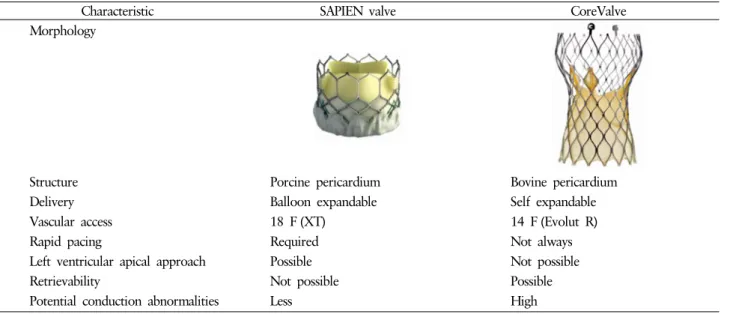
Table 1. Comparison between SAPIEN valve and CoreValve

Characteristic SAPIEN valve CoreValve

Morphology

Structure Porcine pericardium Bovine pericardium

Delivery Balloon expandable Self expandable

Vascular access 18 F (XT) 14 F (Evolut R)

Rapid pacing Required Not always

Left ventricular apical approach Possible Not possible

Retrievability Not possible Possible

Potential conduction abnormalities Less High

such as cerebral infarction, conduction abnormalities, and PAR were suggested as TAVI complications [3]. Attention on aortic rupture and coronary artery obstruction has recently been in- creasing as these complications, despite their low incidence, can be lethal [9]. Since the indications for TAVI have gradually been expanding to young and low-risk patients, long-term du- rability and intravalvular thrombosis have emerged as im- portant issues to be considered [20-22].

2. Procedure and THV advances

New TAVI THVs allow accurate positioning of THV in the aortic annulus, have reduced delivery catheter size (14 Fr) to reduce related complications, and reinforced functions to en- able intraoperative installation [23].

TAVI THVs that are currently approved for clinical use are SAPIEN 3

®

(Edwards Lifesciences Corp., Irvine, CA, USA), Evolut R

®

(Medtronic, Minneapolis, MN, USA), LOTUS

TM

(Boston Scientific, Marlborough, MA, USA), ACURATE neo

TM

(Symetis, Ecublens, Switzerland), Portico

TM

(St. Jude Medical, St. Paul, MN, USA), and Allegra

TM

(New Valve Technology, Hechingen, Germany). They can be categorized into SAPIEN 3

®

/Evolut R

®

, Portico

TM

, ACURATE neo

TM

, and Allegra

TM

/ LOTUS

TM

[24].

SAPIEN 3

®

THV is designed as a cobalt-chrome structure with three leaflets inside a cobalt-chrome structure. Compared to SAPIEN XT

®

from the previous generation, SAPIEN 3

®

has

a reduced diameter (14 Fr), and its valve cell structure was re- inforced by introducing an open upper cell and a closed lower cell. Furthermore, an external seal was added to reduce PAR.

Evolut R

®

THV consists of a tricuspid heart valve sealed inside a self-expanding nitinol structure. It has been redesig- ned from the CoreValve devices from previous generations to gain an optimized radial force during valve implantation, and to enable retrieval and repositioning. Evolut PRO

®

, which has been recently approved by the Food and Drug Administra- tion(FDA), consists of the same platform as Evolut R

®

, with addi- tional external parts added to decrease the gap between the valve and the distal aorta, and to reduce PAR. Table 1 com- pares SAPIEN THV, which is the most commonly used THV, with CoreValve.

LOTUS

TM

THV is a tricuspid valve supported by a sealed nitinol frame. It is the only THV that allows complete retrie- val and repositioning even after the valve is completely im- planted. Although it has the lowest incidence of PAR among all approved THVs (Fig. 1), it leads to conduction abnorma- lities requiring pacemaker insertion in 30% of patients follo- wing valve insertion (Fig. 1) [24]. The new generation LOTUS Edge

TM

THV (Boston Scientific, Marlborough, MA, USA) with Depth Guard

TM

release mechanism (Boston Scientific, Marl- borough, MA, USA) has been developed to lower the incidence of conduction abnormalities, and is still being tested in clinical trials with results waiting to be released.

Portico

TM

(St. Jude Medical, St. Paul, MN, USA) valve is

(5)

Fig. 1. Comparison of the incidence of permanent pacemaker implantation and more than mild PAR in patients with new-generation TAVI devices [21]. PAR, paravalvular aortic regurgitation; TAVI, transcatheter aortic valve implantation.

a self-expansive stent. The main characteristic of this THV is that it can be repositioned multiple times, and the coronary artery entrance can be easily found due to the large stent cells.

ACURATE neo

TM

(Symetis, Ecublens, Switzerland) valve is a self-expanding nitinol stent, and consists of three stabiliza- tion arches for axial alignment on the aortic annulus, an upper fixture for positioning on the aortic annulus, and an open lower body. Although this THV cannot be retrieved or repo- sitioned, it is extremely stable during implantation.

3. Access routes and vascular complications

Early TAVI procedures used the anterograde transseptal app- roach. Now, the transfemoral approach is the most preferred access route. Alternative routes (transapical, transaortic, and trans-subclavian) have additionally been developed, and their executability and reliability have been verified [25]; they must be assessed in a large number of patients. New assessment must consider clinician’s level of experience, situations within individual hospitals, and patient’s anatomical structures.

Historically, vascular complications have been important li- mitations of TAVI alongside the amount of blood loss, amount of blood transfusion required, and hemodynamic instability [26]. However, with advances leading to miniaturization of delivery systems, improved patient selection and choice, and increased clinicians’ experience, the incidence of lethal vascular complications has been reduced [26]. Today, vascular compli- cations usually occur as minimal hemorrhage or vascular in- jury that can be managed through percutaneous surgery, such

as arterial wall dissection and arterial obstruction [26].

4. Cerebrovascular events

Cerebrovascular events have shown high morbidity and mortality, and were a major topic of interest in the early pe- riod after TAVI was introduced [3]. In a large-scale meta-ana- lysis including 72,318 patients from 64 studies, the 30-day incidence of cerebrovascular events was 3.3% [27]. Many po- tential predictors of cerebrovascular events following TAVI have been identified, and most episodes of cerebral embolism that occur during TAVI were thought to occur during balloon angioplasty, manipulation of a catheter on the aortic valve, and valve implantation [3]. However, it has been revealed that about 50% of all cerebrovascular events caused by TAVI occur in the 24 hours following TAVI [28]. These cerebro- vascular events are believed to originate from thrombus for- mation (e.g., newly developed atrial fibrillation), and indicate that the patient with TAVI might develop other diseases.

Although cerebrovascular events present clear clinical symp-

toms, most patients treated with TAVI do not show clinical

symptoms. However, it has been found that patients treated

with TAVI who do not show clinical symptoms may show

new cerebral ischemic lesions on brain magnetic resonance

imaging [3]. According to the results of a recent study, the

incidence of cerebrovascular events decreased by 2.5% over

time compared to that of early TAVI procedures [23]. This

trend can be explained by improved equipment systems and

operator’s level of experience owing to technical advances.

(6)

In addition, several brain protection devices have been devel- oped to prevent cerebrovascular events that occur during or immediately after TAVI [29], including Sentinel

TM

(Claret Me- dical, Inc., Santa Rosa, CA, USA) and TriGuard

TM

(Keystone Heart, Tampa, FL, USA). They were reported to reduce the size and number of subclinical/asymptomatic cerebral embo- lisms during TAVI [29]. Although Sentinel

TM

is the only FDA- approved device, it has failed to show meaningful reduction in cerebral infarction in clinical trials.

5. Conduction abnormalities

Since the aortic valve is located proximally to the cardiac conduction system, conduction abnormalities are frequently observed in patients treated with TAVI. Left bundle branch block (LBBB) is the most common conduction abnormality following TAVI, and complete atrioventricular block is the most important conduction abnormality that requires perma- nent cardiac pacemaker insertion. The frequency of cardiac pacemaker insertion following TAVI depends on the type of THV used. Conduction abnormalities can lead to left ventri- cular dyssynchrony, reduced left ventricular ejection fraction, increased hospitalization period, and increased need for car- diac pacemaker in the early and late period [30]. Preoperative anatomical evaluation of the valve, and selection of the most appropriate device are crucial for reducing the incidence of conduction abnormalities [30]. However, the problem of con- duction abnormalities could not be completely resolved even after the development of second generation THV (Evolut R

®

, LOTUS

TM

) and addition of the possibility of THV retrieval and repositioning [24].

6. Paravalvular aortic regurgitation (PAR)

PAR is a complication of prosthetic aortic valve replace- ment that occurs more frequently following SAVAR than after TAVI [3,31]. The reported incidence of moderate or severe grade PAR following TAVI using a first generation THV was 12-21%[31]. PAR of moderate grade or above has clinical associations, and increases the risk of all-cause morta- lity [32]. The three major causes of PAR that occur during TAVI are severe valvular calcification, setting a small THV size before the procedure, and unstable THV binding within the aortic circumference due to THV displacement. A drastic

decrease in the incidence of severe PAR has been observed over time [24]. This fact is related to the possibility to measure the aortic annular size before surgery owing to the advances in medical imaging, more wide distribution of next generation THVs with higher predictability due to the valve repositioning function, and the development of structures with an external suture tape that can fill the space between THV and aortic wall The incidence of PAR, although reduced, varies among different THV systems (Fig. 1).

7. Coronary occlusion and aortic root rupture

Based on current TAVI data, the incidence of coronary ar- tery obstruction and aortic root or aortic annulus rupture is generally below 1%[10]. The obstruction of coronary arteries in the natural aortic valve occurs because of a calcified valve of large size or the external suture leaflet on the opening of coronary artery being displaced due to TAVI. Narrow Valsalva, severe cusp calcification, and low positioning of coronary arte- ries opening are major predictors of coronary obstruction dur- ing TAVI [10]. When performing aortic angiography and bal- loon angioplasty before surgery, it is necessary to check if the coronary artery opening is getting obstructed as the balloon expands. When the balloon is completely expanded, the coro- nary opening bumps into the Valsalva wall due to the calcified cusp, and may become obstructed [33]. A common strategy when the risk of coronary obstruction is high due to TAVI is to insert a wire and balloon or stent in advance, and then perform TAVI. If coronary obstruction occurs, an emergency procedure is performed.

Aortic root rupture has poor acute prognosis [10]. Two im- portant characteristics, moderate to severe LVOT/subannular calcification and THV oversizing, in which the produced valve is larger than the aortic annulus, are associated with aortic root rupture and para-aortic hematoma. These complications can be prevented by carefully choosing the THV type and size.

8. Transcatheter heart valve failure

TAVI is currently performed in relatively young patients

with low risk. The average life expectancy is gradually being

used for relatively young patients and low-risk patients, and

is expected to exceed that of patients who underwent early

TAVI procedures, which is related to long-term durability

(7)

of THV. Failure of THV implantation can present as stenosis (calcification, pannus, or thrombosis) or artificial valve regur- gitation (reduced cusp mobility, cusp ripping, or endocarditis) [20]. In PARTER I study that monitored patients for 5 years, no significant increase in the mean THV gradient or struc- tural valvular worsening was observed [20]. Three studies have reported on the 5-year progress following treatment with SAPIEN or CoreValve [20]. In two of these studies, no problem related to the durability of THV and no significant change in transprosthetic gradient were detected. The incidence of THV dysfunction was 3.4% and 4.2% in each study [20]. Although thrombosis rarely occurs as a result of failed THV implanta- tion, it has drawn clinical attention [21,22]. With a recent ob- servation of normal transannular pressure gradient in associa- tion with subclinical leaflet thrombosis, reduced cusp mobility has been reported to affect both the percutaneously-inserted cardiac valve and the surgically treated valve [22]. In RESOLVE and SAVORY studies, subclinical leaflet thrombosis could be diagnosed by computed tomography (CT) in 12% of 890 pati- ents. Five of 138 patients (3.6%) with surgically implanted valves and 101 of 752 patients treated with TAVI (13.4%) showed subclinical leaflet thrombosis [22]. Although no difference was found in the incidence of stroke between patients with re- duced valve mobility and those without, the risk of transient ischemic attack was significantly higher in patients with sub- clinical leaflet thrombosis diagnosed by CT, than in those without (6% vs. 1%; p <0.001) [22]. These data show that although dual antiplatelet therapy (DAPT) has been the stand- ard method of treatment since TAVI, anticoagulation therapy may be useful in the future. The incidence of reduced cusp mobility following TAVI was significantly lower in patients who received DAPT (3.6% vs. 14.9%, p <0.001) than in those who received oral anticoagulants, and non-vitamin K oral an- ticoagulants prevented thrombosis as effectively as warfarin [22]. A global study compared the rivaroxaban antithrombo- tic strategy to an antiplatelet-based strategy after transca- theter aortic valve replacement to optimize clinical outcomes (GALILEO), while another trial assessed the anti-thrombotic strategy after trans-aortic valve implantation for aortic steno- sis (ATLANTIS). Currently, clinical trials are being conducted in which a non-vitamin K oral anti-coagulant (Rivaroxaban

®

, Apixaban

®

) is administered to prevent valve thrombosis and other symptoms in patients who underwent TAVI. The cur- rent 2017 ACC/AHA guideline recommends the use of war-

farin for 3 months following TAVI [2].

Although the incidence of infective endocarditis is low (0.5- 3.1%) after TAVI, infective endocarditis is one of the most serious complications of TAVI [33]. In a multicenter registry study on 250 cases of postoperative infective endocarditis, the in-hospital mortality rate was 36%, and the 2-year mortality rate was 66.7% [34]. Young age, male sex, diabetes mellitus, and moderate to severe residual aortic regurgitation were asso- ciated with increased risk of infective endocarditis [34].

Although THV failure and organ durability are major topics of interest, TAVI reoperation has been found to be safe and effective based on mortality and morbidity in comparison with redo valve surgery [35].

Procedure optimization

One of the biggest issues surrounding TAVI is the standar- dization and simplification of TAVI procedure. Many rese- archers have endeavored to create a program aimed at the pre- operative, intraoperative, and postoperative standardization and simplification of TAVI in the last few years [36-38].

1. Preoperative optimization

TAVI requires several preliminary assessments and tests for confirming clinical and anatomical indications by echocardio- graphy and CT. These tests are generally to be performed with- out hospitalization. The TAVI team must think beyond the tra- ditional clinical and anatomical criteria of TAVI indications, but consider the clinical, nonclinical, and psychological factors that can affect postoperative recovery. These factors include the patient’s will to participate in heart rehabilitative therapy, likelihood of getting Alzheimer’s disease, and family support.

2. Intraoperative optimization

For the stabilization of TAVI, optimization and simplifica-

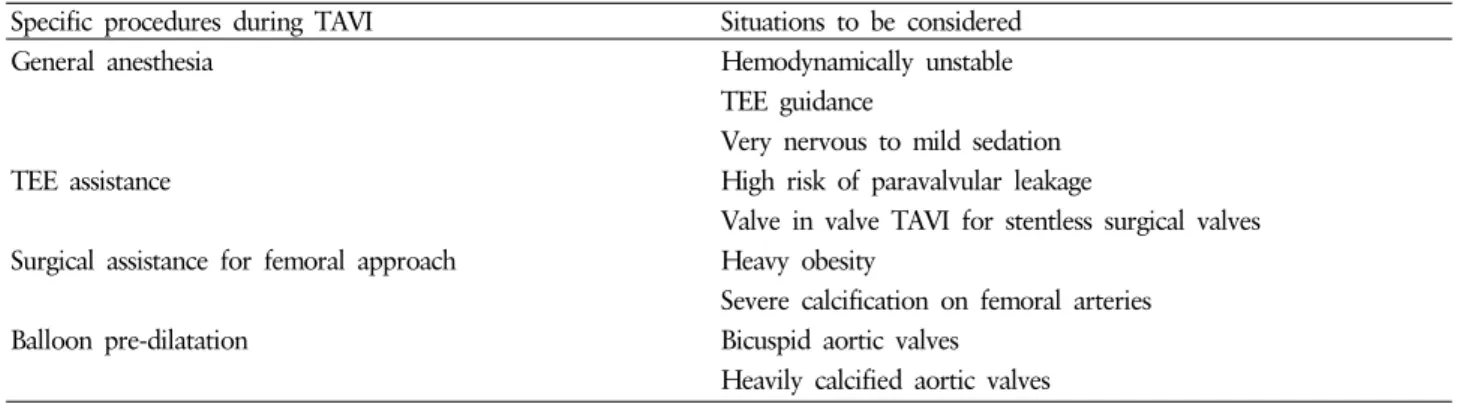
tion of the procedure are necessary (Table 2). Although many

operators perform TAVI in a hybrid operating room, TAVI

can be safely performed in a common cardiac catheterization

room. If the femoral approach is being used, the presence

of a cardiac surgeon is not required. However, it is important

that a cardiac surgeon participates in the evaluation process

and manage potentially lethal complications. Performing TAVI

(8)

Table 2. Technical considerations during TAVI procedures

Specific procedures during TAVI Situations to be considered

General anesthesia Hemodynamically unstable

TEE guidance

Very nervous to mild sedation

TEE assistance High risk of paravalvular leakage

Valve in valve TAVI for stentless surgical valves Surgical assistance for femoral approach Heavy obesity

Severe calcification on femoral arteries

Balloon pre-dilatation Bicuspid aortic valves

Heavily calcified aortic valves TAVI, transcatheter aortic valve implantation; TEE, transesophageal echocardiography.

via the femoral approach under local anesthesia, and not per- forming back-up transesophageal echocardiography and bal- loon angioplasty are one of the strategies to reduce the inva- siveness and cost of the procedure. In addition, a temporary pacemaker must be removed at the end of the procedure if there is no concern about conduction abnormalities.

3. Postoperative optimization

Following the procedure, special attention must be given to patient’s hemodynamics and heart rate. They must be care- fully monitored in the coronary intensive care unit or opera- ting room for at least 10-15 minutes. Next, the patient’s clini- cal conditions must be thoroughly assessed according to the procedure outcome, and electrocardiography and echocardio- graphy data. If there is no hematoma near the blood vessels and no bleeding problem, and the pacemaker has been tempo- rarily removed, the patient must be allowed to move after a few hours, and must be discharged as soon as possible if he/she has no complications.

Early discharge (within 24-72 hr) after TAVI has been found to improve patients’ motor function and accelerate recovery without compromising the safety of the procedure; this appro- ach has also been confirmed by the experience on patients in Europe and North America [34,35]. Based on clinical experi- ence, conduction abnormalities, hemorrhage, and acute renal injury are the factors that most frequently extend the hospital- ization period. Consistent monitoring of acute A-V block is necessary. TAVI has been actively performed in many domes- tic institutions. However, the procedure places a huge finan- cial burden on patients due to its cost. TAVI may be perfor-

med even more actively if the procedure is simplified to reduce the cost and health insurance coverage is provided for TAVI.

CONCLUSION

Although TAVI is a complex procedure, significant advan- ces have been made through the simplification and standar- dization of the procedure, while other improvements are still underway. It is anticipated that through consistent technical advances and simplification of the procedure, TAVI will be more widely used, and be accepted as a safe procedure.

CONFLICT OF INTEREST

No potential conflict of interest relevant to this article were reported.

ORCID

Ung Kim, https://orcid.org/0000-0002-6009-1843

REFERENCES

1. Cribier A, Eltchaninoff H, Bash A, Borenstein N, Tron C, Bauer F, et al. Percutaneous transcatheter implantation of an aortic valve prosthesis for calcific aortic stenosis: first human case description. Circulation 2002;106:3006-8.

2. Nishimura RA, Otto CM, Bonow RO, Carabello BA, Erwin

JP 3rd, Fleisher LA, et al. 2017 AHA/ACC focused update

of the 2014 AHA/ACC guideline for the management of pa-

tients with valvular heart disease: a report of the American

College of Cardiology/American Heart Association Task Force

on Clinical Practice Guidelines. Circulation 2017;135: e1159-95.

(9)

3. Vahl TP, Kodali SK, Leon MB. Transcatheter aortic valve replacement 2016: a modern-day “Through the Looking- Glass” adventure. J Am Coll Cardiol 2016;67:1472-87.

4. Iung B, Cachier A, Baron G, Messika-Zeitoun D, Delahaye F, Tornos P, et al. Decision-making in elderly patients with severe aortic stenosis: why are so many denied surgery? Eur Heart J 2005;26:2714-20.

5. Krasopoulos G, Falconieri F, Benedetto U, Newton J, Sayeed R, Kharbanda R, et al. European real world trans-catheter aortic valve implantation: systematic review and meta-analy- sis of European national registries. J Cardiothorac Surg 2016;

11:159.

6. Baumgartner H, Falk V, Bax JJ, De Bonis M, Hamm C, Holm PJ, et al. 2017 ESC/EACTS Guidelines for the management of valvular heart disease. Eur Heart J 2017;38:2739-91.

7. Mylotte D, Lefevre T, Søndergaard L, Watanabe Y, Modine T, Dvir D, et al. Transcatheter aortic valve replacement in bicuspid aortic valve disease. J Am Coll Cardiol 2014;64:

2330-9.

8. Yoon SH, Sharma R, Chakravarty T, Kawamori H, Maeno Y, Miyasaka M, et al. Clinical outcomes and prognostic fac- tors of transcatheter aortic valve implantation in bicuspid aortic valve patients. Ann Cardiothorac Surg 2017;6:463-72.

9. Dvir D, Webb JG, Bleiziffer S, Pasic M, Waksman R, Kodali S, et al. Transcatheter aortic valve implantation in failed bio- prosthetic surgical valves. JAMA 2014;312:162-70.

10. Webb JG, Mack MJ, White JM, Dvir D, Blanke P, Herr- mann HC, et al. Transcatheter aortic valve implantation with- in degenerated aortic surgical bioprostheses: PARTNER 2 valve-in-valve registry. J Am Coll Cardiol 2017;69:2253-62.

11. Deeb GM, Chetcuti SJ, Reardon MJ, Patel HJ, Grossman PM, Schreiber T, et al. 1-year results in patients undergoing transcatheter aortic valve replacement with failed surgical bioprostheses. JACC Cardiovasc Interv 2017;10:1034-44.

12. Barbanti M, Webb JG, Gilard M, Capodanno D, Tamburino C. Transcatheter aortic valve implantation in 2017: state of the art. EuroIntervention 2017;13(AA):AA11-21.

13. Allen KB, Chhatriwalla AK, Cohen DJ, Saxon JT, Aggarwal S, Hart A, et al. Bioprosthetic valve fracture to facilitate trans- catheter valve-in-valve implantation. Ann Thorac Surg 2017;

104:1501-8.

14. Franzone A, Piccolo R, Siontis GC, Lanz J, Stortecky S, Praz F, et al. Transcatheter aortic valve replacement for the treat- ment of pure native aortic valve regurgitation: a systematic review. JACC Cardiovasc Interv 2016;9:2308-17.

15. Sawaya FJ, Deutsch MA, Seiffert M, Yoon SH, Codner P, Wickramarachchi U, et al. Safety and efficacy of transcatheter aortic valve replacement in the treatment of pure aortic regur- gitation in native valves and failing surgical bioprostheses:

results from an international registry study. JACC Cardiovasc Interv 2017;10:1048-56.

16. Wei L, Liu H, Zhu L, Yang Y, Zheng J, Guo K, et al. A new transcatheter aortic valve replacement system for predominant aortic regurgitation implantation of the J-valve and early out- come. JACC Cardiovasc Interv 2015;8:1831-41.

17. Thyregod HG, Steinbrüchel DA, Ihlemann N, Nissen H,

Kjeldsen BJ, Petursson P, et al. Transcatheter versus surgical aortic valve replacement in patients with severe aortic valve stenosis: 1-year results from the all-comers NOTION ran- domized clinical trial. J Am Coll Cardiol 2015;65:2184-94.

18. Leon MB, Smith CR, Mack MJ, Makkar RR, Svensson LG, Kodali SK, et al. Transcatheter or surgical aortic-valve re- placement in intermediate-risk patients. N Engl J Med 2016;

374:1609-20.

19. Reardon MJ, Van Mieghem NM, Popma JJ, Kleiman NS, Søndergaard L, Mumtaz M, et al. Surgical or transcatheter aortic-valve replacement in intermediate-risk patients. N Engl J Med 2017;376:1321-31.

20. Barbanti M, Binder RK, Freeman M, Wood DA, Leipsic J, Cheung A, et al. Impact of low-profile sheaths on vascular complications during transfemoral transcatheter aortic valve replacement. EuroIntervention 2013;9:929-35.

21. Barbanti M, Buccheri S, Rodés-Cabau J, Gulino S, Généreux P, Pilato G, et al. Transcatheter aortic valve replacement with new-generation devices: a systematic review and meta-analysis.

Int J Cardiol 2017;245:83-9.

22. Pascual I, Carro A, Avanzas P, Hernández-Vaquero D, Díaz R, Rozado J, et al. Vascular approaches for transcatheter aor- tic valve implantation. J Thorac Dis 2017;9(Suppl 6): S478- 87.

23. Arsalan M, Walther T. Durability of prostheses for transca- theter aortic valve implantation. Nat Rev Cardiol 2016;13:

360-7.

24. Latib A, Naganuma T, Abdel-Wahab M, Danenberg H, Cota L, Barbanti M, et al. Treatment and clinical outcomes of trans- catheter heart valve thrombosis. Circ Cardiovasc Interv 2015;

8. pii: e001779.

25. Chakravarty T, Søndergaard L, Friedman J, De Backer O, Berman D, Kofoed KF, et al. Subclinical leaflet thrombosis in surgical and transcatheter bioprosthetic aortic valves: an observational study. Lancet 2017;389:2383-92.

26. Toggweiler S, Leipsic J, Binder RK, Freeman M, Barbanti M, Heijmen RH, et al. Management of vascular access in transcatheter aortic valve replacement: part 2: vascular com- plications. JACC Cardiovasc Interv 2013;6:767-76.

27. Auffret V, Regueiro A, Del Trigo M, Abdul-Jawad Altisent O, Campelo-Parada F, Chiche O, et al. Predictors of early cerebrovascular events in patients with aortic stenosis under- going transcatheter aortic valve replacement. J Am Coll Cardiol 2016;68:673-84.

28. Kahlert P, Al-Rashid F, Döttger P, Mori K, Plicht B, Wendt D, et al. Cerebral embolization during transcatheter aortic valve implantation: a transcranial Doppler study. Circulation 2012;126:1245-55.

29. Giustino G, Sorrentino S, Mehran R, Faggioni M, Dangas G. Cerebral embolic protection during TAVR: a clinical event meta-analysis. J Am Coll Cardiol 2017;69:465-6.

30. Barbanti M, Gulino S, Costa G, Tamburino C. Pathophysio- logy, incidence and predictors of conduction disturbances during Transcatheter Aortic Valve Implantation. Expert Rev Med Devices 2017;14:135-47.

31. Généreux P, Head SJ, Van Mieghem NM, Kodali S, Kirtane

(10)

AJ, Xu K, et al. Clinical outcomes after transcatheter aortic valve replacement using valve academic research consortium definitions: a weighted meta-analysis of 3,519 patients from 16 studies. J Am Coll Cardiol 2012;59:2317-26.

32. Athappan G, Gajulapalli RD, Sengodan P, Bhardwaj A, Ellis SG, Svensson L, et al. Influence of transcatheter aortic valve replacement strategy and valve design on stroke after trans- catheter aortic valve replacement: a meta-analysis and sys- tematic review of literature. J Am Coll Cardiol 2014;63:

2101-10.

33. Barbanti M, Sgroi C, Immè S, Aruta P, Deste W, Gulino S, et al. Usefulness of contrast injection during balloon aortic val- vuloplasty before transcatheter aortic valve replacement: a pilot study. EuroIntervention 2014;10:241-7.

34. Regueiro A, Linke A, Latib A, Ihlemann N, Urena M, Walther T, et al. Association between transcatheter aortic valve re- placement and subsequent infective endocarditis and in-hospi- tal death. JAMA 2016;316:1083-92.

35. Barbanti M, Webb JG, Tamburino C, Van Mieghem NM,

Makkar RR, Piazza N, et al. Outcomes of redo transcatheter aortic valve replacement for the treatment of postprocedural and late occurrence of paravalvular regurgitation and trans- catheter valve failure. Circ Cardiovasc Interv 2016;9. pii:

e003930.

36. Babaliaros V, Devireddy C, Lerakis S, Leonardi R, Iturra SA, Mavromatis K, et al. Comparison of transfemoral transcathe- ter aortic valve replacement performed in the catheterization laboratory (minimalist approach) versus hybrid operating room (standard approach): outcomes and cost analysis. JACC Car- diovasc Interv 2014;7:898-904.

37. Barbanti M, Capranzano P, Ohno Y, Attizzani GF, Gulino S, Immè S, et al. Early discharge after transfemoral transcathe- ter aortic valve implantation. Heart 2015;101:1485-90.

38. Barbanti M, Todaro D, Costa G, Pilato G, Picci A, Gulino

S, et al. Optimized screening of coronary artery disease with

invasive coronary angiography and ad hoc percutaneous co-

ronary intervention during transcatheter aortic valve replace-

ment. Circ Cardiovasc Interv 2017;10. pii: e005234.

수치

Table 1. Comparison between SAPIEN valve and CoreValve
Fig. 1. Comparison of the incidence of permanent pacemaker implantation and more than mild PAR in patients with new-generation TAVI devices [21]
Table 2. Technical considerations during TAVI procedures

참조

관련 문서

In patients with symptomatic severe aortic stenosis and small aortic annulus, transcatheter aortic valve replacement (TAVR) has been reported as a good alternative to surgical aortic

Infolding Distortion of Evolut R Valve after Transcatheter Aortic Valve Replacement Min Chul Kim , MD, PhD, Ju Han Kim , MD, PhD, Kyung Hoon Cho , MD, PhD, Doo Sun Sim , MD, PhD,

(D) Advance of transcatheter aortic valve replacement (TAVR) system through the left iliac artery with balloon supporting at right common artery (E) Too deep positioning of

The patient underwent an open mitroaortic valve replacement using transcatheter aortic valve im- plantation with an Edwards SAPIEN XT valve (Edwards Lifesciences

Purpose: We aimed to compare the effect of transcatheter aortic valve replacement (TAVR) and surgical aortic valve replacement (sAVR) on recovery of left ventricular (LV)

early clinical outcomes of TAVI, surgical aortic valve replacement (SAVR), and optimal medical therapy (OMT) in patients aged ≥80 years with symptomatic se- vere AS.. Results:

This case suggests transaortic approach may be an effective and safe strategy for TAVI in high risk severe AS patients without eligible femoral or subclavian access

Transcatheter aortic valve implantation is an alternative to open heart surgery in high risk patients with severe aortic stenosis.. High mortality and complications