ABSTRACT
Background and Objectives: Transcatheter aortic valve replacement (TAVR) has been reported as a good alternative for surgical aortic valve replacement in patients with small aortic annulus. Head-to-head comparisons of different transcatheter aortic valves in these patients are insufficient. We compared the outcomes after TAVR between two different types of recent transcatheter aortic valves (self-expanding vs. balloon-expandable) in patients with small aortic annulus.
Methods: A total of 70 patients with severe aortic stenosis and small annulus (mean diameter
≤23 mm or minimal diameter ≤21 mm on computed tomography) underwent TAVR with either a self-expanding valve with supra-annular location (n=45) or a balloon-expandable valve with intra-annular location (n=25). The echocardiographic hemodynamic parameters after TAVR and 1-year follow-up were compared.
Results: Between the self-expanding and balloon-expandable valve-treated patients, the clinical outcomes including permanent pacemaker implantation (11.1% vs. 8.0%), acute kidney injury stage 2 or 3 (4.4% vs. 4.0%), and major vascular complication (4.4% vs. 0.0%) were similar without all-cause mortality, stroke, and life-threatening bleeding during 30-day follow-up. Compared with the balloon-expandable valve-treated patients, the self-expanding valve-treated patients presented larger effective orifice area (EOA) (1.46±0.28 vs. 1.75±0.42 cm
2, p=0.002) and indexed EOA (0.95±0.21 vs. 1.18±0.28 cm
2/m
2, p=0.001), whereas mean aortic valve gradient (11.7±2.9 vs. 8.9±5.2 mmHg, P=0.005) and incidence of ≥moderate prosthesis-patient mismatch (36.0% vs. 8.9%, p=0.009) were lower. These hemodynamic differences were maintained at 1-year follow-up.
Conclusions: TAVR with self-expanding valves was associated with superior hemodynamic outcomes compared with balloon-expandable valves in patients with small aortic annulus.
Keywords: Transcatheter aortic valve replacement; Aortic valve stenosis
Original Research
Received: Sep 17, 2020 Revised: Oct 26, 2020 Accepted: Nov 17, 2020 Correspondence to Myeong-Ki Hong, MD, PhD
Division of Cardiology, Department of Internal Medicine, Severance Cardiovascular Hospital, Yonsei University College of Medicine, 50-1, Yonsei-ro, Seodaemun-gu, Seoul 03722, Korea.
E-mail: [email protected]
Copyright © 2021. The Korean Society of Cardiology
This is an Open Access article distributed under the terms of the Creative Commons Attribution Non-Commercial License (https://
creativecommons.org/licenses/by-nc/4.0) which permits unrestricted noncommercial use, distribution, and reproduction in any medium, provided the original work is properly cited.
ORCID iDs Yong-Joon Lee
https://orcid.org/0000-0002-5308-9120 Seung-Jun Lee
https://orcid.org/0000-0002-9201-4818 Sung-Jin Hong
https://orcid.org/0000-0003-4893-039X Chi-Young Shim
https://orcid.org/0000-0002-6136-0136 Chul-Min Ahn
https://orcid.org/0000-0002-7071-4370 Jung-Sun Kim
https://orcid.org/0000-0003-2263-3274 Byeong-Keuk Kim
https://orcid.org/0000-0003-2493-066X Geu-Ru Hong
https://orcid.org/0000-0003-4981-3304
Yong-Joon Lee , MD, Seung-Jun Lee , MD, Sung-Jin Hong , MD, Chi-Young Shim , MD, Chul-Min Ahn , MD, Jung-Sun Kim , MD, Byeong-Keuk Kim , MD, Geu-Ru Hong , MD, Young-Guk Ko , MD,
Donghoon Choi , MD, Yangsoo Jang , MD, and Myeong-Ki Hong , MD, PhD
Division of Cardiology, Department of Internal Medicine, Severance Cardiovascular Hospital, Yonsei University Health System, Seoul, Korea
Comparison of Transcatheter Aortic Valve Replacement between Self-
Expanding versus Balloon-Expandable
Valves in Patients with Small Aortic
Annulus
Young-Guk Ko
https://orcid.org/0000-0001-7748-5788 Donghoon Choi
https://orcid.org/0000-0002-2009-9760 Yangsoo Jang
https://orcid.org/0000-0002-2169-3112 Myeong-Ki Hong
https://orcid.org/0000-0002-2090-2031 Funding
This work was supported by grants from the Korea Health Technology Research &
Development Project through the Korea Health Industry Development Institute, funded by the Ministry of Health & Welfare, Republic of Korea (No. HI17C0882, HI16C2211, and HI15C2782), the Bio & Medical Technology Development Program of the National Research Foundation funded by the Korean government (No. 2015M3A9C6031514), and the Cardiovascular Research Center, Seoul, Korea.
Conflict of Interest
MK Hong and YG Ko are proctors of Medtronic.
The other authors have no financial conflicts of interest.
Author Contributions
Conceptualization: Lee YJ, Lee SJ, Hong SJ, Shim CY, Ahn CM, Kim JS, Kim BK, Hong GR, Ko YG, Choi D, Jang Y, Hong MK; Data curation:
Lee YJ, Lee SJ, Hong SJ, Shim CY, Ahn CM, Kim JS, Kim BK, Hong GR, Ko YG, Choi D, Jang Y, Hong MK; Formal analysis: Lee YJ, Hong MK; Funding acquisition: Jang Y, Hong MK;
Investigation: Lee YJ, Hong MK; Methodology:
Lee YJ, Hong MK; Resources: Lee YJ, Lee SJ, Hong SJ, Shim CY, Ahn CM, Kim JS, Kim BK, Hong GR, Ko YG, Choi D, Jang Y, Hong MK;
Supervision: Lee SJ, Hong SJ, Shim CY, Ahn CM, Kim JS, Kim BK, Hong GR, Ko YG, Choi D, Jang Y, Hong MK; Visualization: Lee YJ, Hong MK; Writing - original draft: Lee YJ, Hong MK;
Writing - review & editing: Lee YJ, Lee SJ, Hong SJ, Shim CY, Ahn CM, Kim JS, Kim BK, Hong GR, Ko YG, Choi D, Jang Y, Hong MK.
INTRODUCTION
In patients with symptomatic severe aortic stenosis and small aortic annulus, transcatheter aortic valve replacement (TAVR) has been reported as a good alternative to surgical aortic valve replacement due to superior hemodynamic outcomes, such as larger effective orifice area (EOA) and lower incidence of prosthesis-patient mismatch (PPM).
1-4)Currently, there are two TAVR technologies available for clinical practice: the self-expanding valve with supra- annular location, and the balloon-expandable valve with intra-annular location. Studies in Europe and the United States have compared the performance of these 2 devices in patients with small aortic annulus, and the self-expanding valve has shown superior hemodynamic performance compared with the balloon-expandable valve.
5)6)Although body size in Asian populations is small relative to Western populations, there have been limited studies in Asian patients with small aortic annulus who underwent TAVR.
7)8)Therefore, the aim of this study was to compare the clinical and echocardiographic hemodynamic outcomes after TAVR between 2 different types of recent transcatheter aortic valves (self-expanding vs. balloon- expandable valve) in Korean patients with small aortic annulus.
METHODS
In Korea, SAPIEN 3 valves (Edwards Lifescience, Irvine, CA, USA) were first used in April
2016, whereas Evolut R and PRO valves (Medtronitc, Minneapolis, MN, USA) were first used
in August 2015 and January 2019, respectively. Between April 2016 and March 2020, 271
patients who underwent TAVR for symptomatic severe aortic stenosis at our institute were
initially identified. Among them, a total of 70 consecutive patients with small aortic annulus
were included in the analysis. Inclusion criteria were small aortic annulus defined as an
annulus exhibiting a mean diameter of ≤23 mm or minimal diameter of ≤21 mm on computed
tomography, and TAVR with either a self-expanding 26 mm Evolut R or PRO valve or a balloon-
expandable 23 mm SAPIEN 3 valve.
9)Forty-five patients underwent TAVR with an Evolut
R (n=37) or a PRO (n=8) valve while 25 patients had a SAPIEN 3 valve. This study complied
with the principles of the Declaration of Helsinki 2013, and the study protocol was approved
by Institutional Review Board of our institute. Written informed consent was obtained
from all patients. For every patient, a multidisciplinary heart team including interventional
cardiologists, imaging cardiologists, cardiothoracic surgeons, and anesthesiologists made
decisions for eligibility for TAVR, choice of vascular approach, and type of anesthesia. The
choice of transcatheter aortic valve type was at the discretion of the operating interventional
cardiologists. Implantation technique for both valves has been described previously.
10)11)The
rate of permanent pacemaker implantation, early safety outcomes (at 30 days) and 1-year
clinical outcomes according to the Valve Academic Research Consortium (VARC)-2 consensus,
and echocardiographic hemodynamic outcomes were analyzed.
12)The early safety outcomes
included all-cause mortality, all stroke, life-threatening bleeding, acute kidney injury stage
2 or 3, coronary artery obstruction requiring intervention, major vascular complication, and
valve-related dysfunction requiring repeat procedure. The hemodynamic outcomes based
on transthoracic echocardiography included EOA, indexed EOA (iEOA), mean aortic valve
gradient, and PPM. EOA was estimated with the continuity equation and indexed to body
surface area (BSA) as calculated with the DuBois formula.
13)PPM was defined as moderate
for post-procedural 0.65 cm
2/m
2< iEOA ≤0.85 cm
2/m
2and severe for iEOA ≤0.65 cm
2/m
2in
accordance to the VARC-2 consensus.
12)In addition, doppler velocity index was calculated and
paravalvular leak was assessed and classified as none/trace, mild, moderate, or severe.
12)Statistical analysis
Continuous variables are reported as mean±standard deviation and were compared using Student's t-tests. Categorical variables are reported as number (percentage) and were compared using χ
2tests or Fisher's exact tests. Event rates at 1 year were estimated using Kaplan-Meier survival analysis and compared using log-rank tests. All tests were two-tailed, and a p<0.05 was considered statistically significant. Statistical analysis was performed using IBM SPSS, version 23.0 (IBM Corporation, Armonk, NY, USA).
Ethics statement
This study was approved by the Institutional Review Board at Severance Hospital of the Yonsei University Health System (1-2009-0018, 1-2011-0099).
RESULTS
Of 271 patients who underwent TAVR for symptomatic severe aortic stenosis between April 2016 and March 2020, a total of 70 (25.8%) consecutive patients presented with small aortic annulus and received either a 26 mm Evolut R or PRO valve (n=45) or a 23 mm SAPIEN 3 valve (n=25).
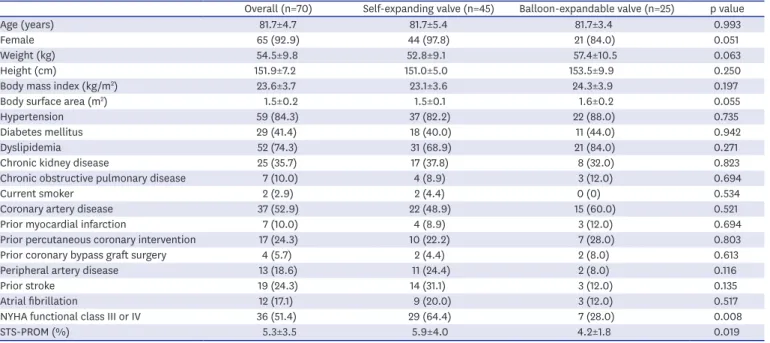
Baseline clinical characteristics are presented in Table 1. Across the overall study population, mean age was 81.7±4.7 years old and the vast majority of patients were female (92.9%). Body mass index was 23.6±3.7 kg/m
2, BSA was 1.5±0.2 m
2, and 51.4% of patients were in New York Heart Association (NYHA) functional class III or IV. The Society of Thoracic Surgeons Predicted Risk of Mortality (STS-PROM) score was 5.3±3.5%. Baseline clinical characteristics between the self-expanding and balloon-expandable valve-treated groups were similar except for presence of NYHA functional class III or IV (64.4% vs. 28.0%, respectively, p=0.008) and the STS-PROM score (5.9±4.0% vs. 4.2±1.8%, respectively, p=0.019), which showed that the patients who underwent TAVR with a self-expanding valve had more severe symptoms of heart failure and higher operative risk. Medications at discharge are presented in Supplementary Table 1.
Table 1. Baseline clinical characteristics
Overall (n=70) Self-expanding valve (n=45) Balloon-expandable valve (n=25) p value
Age (years) 81.7±4.7 81.7±5.4 81.7±3.4 0.993
Female 65 (92.9) 44 (97.8) 21 (84.0) 0.051
Weight (kg) 54.5±9.8 52.8±9.1 57.4±10.5 0.063
Height (cm) 151.9±7.2 151.0±5.0 153.5±9.9 0.250
Body mass index (kg/m
2) 23.6±3.7 23.1±3.6 24.3±3.9 0.197
Body surface area (m
2) 1.5±0.2 1.5±0.1 1.6±0.2 0.055
Hypertension 59 (84.3) 37 (82.2) 22 (88.0) 0.735
Diabetes mellitus 29 (41.4) 18 (40.0) 11 (44.0) 0.942
Dyslipidemia 52 (74.3) 31 (68.9) 21 (84.0) 0.271
Chronic kidney disease 25 (35.7) 17 (37.8) 8 (32.0) 0.823
Chronic obstructive pulmonary disease 7 (10.0) 4 (8.9) 3 (12.0) 0.694
Current smoker 2 (2.9) 2 (4.4) 0 (0) 0.534
Coronary artery disease 37 (52.9) 22 (48.9) 15 (60.0) 0.521
Prior myocardial infarction 7 (10.0) 4 (8.9) 3 (12.0) 0.694
Prior percutaneous coronary intervention 17 (24.3) 10 (22.2) 7 (28.0) 0.803
Prior coronary bypass graft surgery 4 (5.7) 2 (4.4) 2 (8.0) 0.613
Peripheral artery disease 13 (18.6) 11 (24.4) 2 (8.0) 0.116
Prior stroke 19 (24.3) 14 (31.1) 3 (12.0) 0.135
Atrial fibrillation 12 (17.1) 9 (20.0) 3 (12.0) 0.517
NYHA functional class III or IV 36 (51.4) 29 (64.4) 7 (28.0) 0.008
STS-PROM (%) 5.3±3.5 5.9±4.0 4.2±1.8 0.019
Data are presented as mean±standard deviation or number (%).
NYHA = New York Heart Association; STS-PROM = Society of Thoracic Surgeons Predicted Risk of Mortality.
Baseline echocardiographic and computed tomographic characteristics are presented in Table 2.
Across the overall study population, EOA was 0.67±0.17 cm
2and iEOA was 0.45±0.11 cm
2/m
2by transthoracic echocardiography. In addition, mean annular diameter was 22.2±1.0 mm, minimum annular diameter was 19.4±1.2 mm, mean aortic annular area was 379.0±32.0 mm
2, and mean aortic annular perimeter was 70.2±2.9 mm by computed tomography. Baseline computed tomographic characteristics between the two groups were similar, whereas the patients who underwent TAVR with a self-expanding valve had more advanced features of aortic stenosis on echocardiography. To be specific, compared with the balloon-expandable valve-treated patients, the self-expanding valve-treated patients showed smaller EOA (0.75±0.14 vs. 0.63±0.18 cm
2, p=0.007) and iEOA (0.48±0.10 vs. 0.43±0.11 cm
2/m
2, p=0.042).
Procedural characteristics and 30-day clinical outcomes are presented in Table 3. Procedural characteristics between the two groups were similar except for post-dilation, which was more frequently performed in the self-expanding valve-treated patients (64.4% vs. 8.0% in balloon- expandable valve-treated patients, p<0.001). The early safety outcomes within 30 days after TAVR were comparable between the two groups. At 1-year follow-up, no significant differences were observed in terms of all-cause mortality, stroke, myocardial infarction or hospitalization for valve-related symptoms or worsening heart failure between the two groups (Table 3).
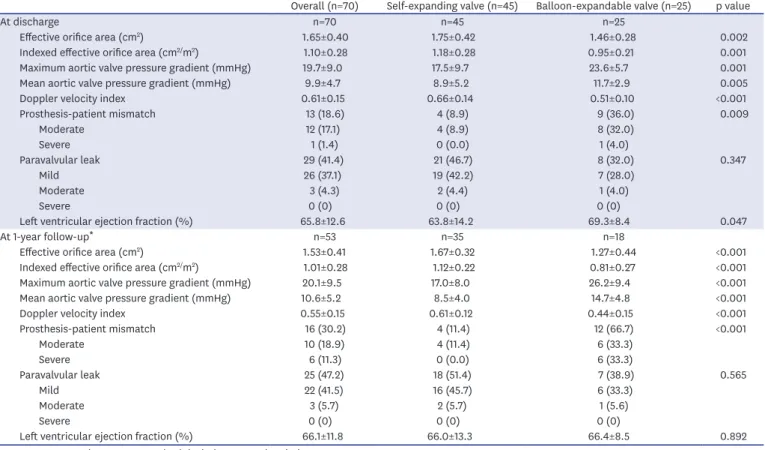
Hemodynamic outcomes by transthoracic echocardiography at discharge and 1-year follow- up are shown in Table 4. At discharge, the self-expanding valve-treated patients presented significantly larger EOA (1.75±0.42 vs. 1.46±0.28 cm
2, p=0.002) and iEOA (1.18±0.28 vs.
0.95±0.21 cm
2/m
2, p=0.001) compared with the balloon-expandable valve-treated patients (Figure 1A and B). Consequently, the incidence of PPM was significantly less frequent in the self-expanding valve-treated patients (8.9% vs. 36.0% in balloon-expandable valve- treated patients, p=0.009) (Figure 2A). The incidence of more than moderate paravalvular leak was similar: 4.4% in the self-expanding valve-treated patients and 4.0% in the balloon-expandable valve-treated patients (Figure 2B). These differences in hemodynamic outcomes between the 2 groups were maintained at 1-year follow-up. One-year follow-up echocardiography was available for 53 patients. At 1-year follow-up, the self-expanding valve-treated patients presented significantly larger EOA (1.67±0.32 vs. 1.27±0.44 cm
2, p<0.001) and iEOA (1.12±0.22 vs. 0.81±0.27 cm
2/m
2, p<0.001) compared with the balloon- expandable valve-treated patients (Figure 1A and B). The incidence of PPM was less frequent Table 2. Baseline echocardiographic and computed tomographic characteristics
Overall (n=70) Self-expanding valve (n=45) Balloon-expandable valve (n=25) p value Baseline echocardiographic characteristics
Effective orifice area (cm
2) 0.67±0.17 0.63±0.18 0.75±0.14 0.007
Indexed effective orifice area (cm
2/m
2) 0.45±0.11 0.43±0.11 0.48±0.10 0.042
Maximum aortic valve pressure gradient (mmHg) 89.1±28.8 93.9±32.6 80.5±17.7 0.029
Mean aortic valve pressure gradient (mmHg) 55.7±18.9 59.4±21.3 49.1±11.0 0.010
Aortic regurgitation (moderate to severe) 13 (18.6) 9 (20.0) 4 (16.0) 0.759
Left ventricular ejection fraction (%) 62.6±14.4 59.9±15.7 67.5±10.4 0.018
Baseline MDCT characteristics
Mean annular diameter (mm) 22.2±1.0 22.1±1.0 22.4±0.9 0.207
Minimum annular diameter (mm) 19.4±1.2 19.2±1.2 19.7±1.2 0.095
Maximum annular diameter (mm) 25.0±1.5 25.0±1.4 25.1±1.5 0.761
Mean aortic annular area (mm
2) 379.0±32.0 374.8±32.6 386.6±30.0 0.142
Mean aortic annular perimeter (mm) 70.2±2.9 69.9±3.1 70.7±2.6 0.303
Porcelain aorta 3 (4.3) 3 (6.7) 0 (0) 0.548
Data are presented as mean±standard deviation or number (%).
MDCT = multidetector computed tomographic.
in the self-expanding valve-treated patients (11.4% vs. 66.7% in balloon-expandable valve- treated patients, p<0.001) with no patients with severe PPM, while 33.3% of the balloon- expandable valve-treated patients presented severe PPM (Figure 2A). The incidence of more than moderate paravalvular leak remained similar: 5.7% in the self-expanding valve- treated patients and 5.6% in the balloon-expandable valve-treated patients (Figure 2B). The echocardiographic characteristics at baseline, discharge, and 1-year follow-up between the self-expanding 23 mm valve-treated patients and balloon-expandable 20 mm valve-treated patient are presented in Supplementary Table 2.
DISCUSSION
The main findings of this study are as follows: 1) Among Korean patients who underwent TAVR, a considerable percentage (25.8%) of patients presented with small aortic annulus.
2) TAVR in these patients was both effective and safe, and no significant difference in clinical outcomes was observed between the self-expanding and balloon-expandable valve-treated patients. 3) However, TAVR with the self-expanding valve was associated with Table 3. Procedural characteristics and clinical outcomes
Overall (n=70) Self-expanding valve
(n=45) Balloon-expandable valve
(n=25) p value
Procedural characteristics
Transfemoral approach 70 (100.0) 45 (100.0) 25 (100.0) 1.000
General anesthesia 54 (77.1) 38 (84.4) 16 (64.0) 0.098
Pre-dilation 45 (64.3) 26 (57.8) 19 (76.0) 0.206
Post-dilation 31 (44.3) 29 (64.4) 2 (8.0) <0.001
Combined percutaneous coronary intervention 6 (8.6) 5 (11.1) 1 (4.0) 0.410
Need for second valve implantation 1 (1.4) 1 (2.2) 0 (0) 1.000
30-day Clinical outcomes
Permanent pacemaker implantation 7 (10.0) 5 (11.1) 2 (8.0) 1.000
Ventricular perforation 0 (0) 0 (0) 0 (0) NA
Conversion to open surgery 0 (0) 0 (0) 0 (0) NA
Early safety outcomes
All-cause mortality 0 (0) 0 (0) 0 (0) NA
All stroke 0 (0) 0 (0) 0 (0) NA
Bleeding * 12 (17.1) 9 (20.0) 3 (12.0) 0.517
Major 2 (2.9) 1 (2.2) 1 (4.0)
Minor 10 (14.3) 8 (17.8) 2 (8.0)
Acute kidney injury 5 (7.1) 4 (8.9) 1 (4.0) 0.648
Stage 1 2 (2.9) 2 (4.4) 0 (0)
Stage 2 3 (4.3) 2 (4.4) 1 (4.0)
Stage 3 0 (0) 0 (0) 0 (0)
Coronary artery obstruction requiring intervention 0 (0) 0 (0) 0 (0) NA
Vascular complication 19 (27.1) 14 (31.1) 5 (20.0) 0.471
Major 2 (2.9) 2 (4.4) 0 (0)
Minor 17 (24.3) 12 (26.7) 5 (20.0)
Valve-related dysfunction requiring repeat procedure 0 (0) 0 (0) 0 (0) NA
One-year clinical outcomes
†All-cause mortality 2 (4.5) 0 (0) 2 (11.6) 0.070
All stroke 0 (0) 0 (0) 0 (0) NA
Myocardial infarction 1 (1.9) 1 (3.0) 0 (0) 0.448
Hospitalization for valve-related symptoms or worsening heart failure 2 (3.6) 2 (5.8) 0 (0) 0.267
NYHA functional class III or IV
‡3 (5.0) 2 (5.1) 1 (4.8) 1.000
Data are presented as number (%).
NA = not applicable; NYHA = New York Heart Association.
* There was no life-threatening bleeding event.
†One-year clinical outcome data are presented as number (% of the cumulative rates at 1 year according to
Kaplan-Meier event rates, p values are from log-rank tests).
‡One-year NYHA functional class was available in 60 (85.7%) patients.
more hemodynamic benefits with larger EOA, lower aortic valve pressure gradient, and consequently, lower incidence of PPM.
For current clinical practice, TAVR technology can be primarily classified into two types of valves: the self-expanding valve with supra-annular location or the balloon-expandable valve with intra-annular location. Although each type of valve has its own advantages and Table 4. Echocardiographic characteristics at discharge and 1-year follow-up
Overall (n=70) Self-expanding valve (n=45) Balloon-expandable valve (n=25) p value
At discharge n=70 n=45 n=25
Effective orifice area (cm
2) 1.65±0.40 1.75±0.42 1.46±0.28 0.002
Indexed effective orifice area (cm
2/m
2) 1.10±0.28 1.18±0.28 0.95±0.21 0.001
Maximum aortic valve pressure gradient (mmHg) 19.7±9.0 17.5±9.7 23.6±5.7 0.001
Mean aortic valve pressure gradient (mmHg) 9.9±4.7 8.9±5.2 11.7±2.9 0.005
Doppler velocity index 0.61±0.15 0.66±0.14 0.51±0.10 <0.001
Prosthesis-patient mismatch 13 (18.6) 4 (8.9) 9 (36.0) 0.009
Moderate 12 (17.1) 4 (8.9) 8 (32.0)
Severe 1 (1.4) 0 (0.0) 1 (4.0)
Paravalvular leak 29 (41.4) 21 (46.7) 8 (32.0) 0.347
Mild 26 (37.1) 19 (42.2) 7 (28.0)
Moderate 3 (4.3) 2 (4.4) 1 (4.0)
Severe 0 (0) 0 (0) 0 (0)
Left ventricular ejection fraction (%) 65.8±12.6 63.8±14.2 69.3±8.4 0.047
At 1-year follow-up * n=53 n=35 n=18
Effective orifice area (cm
2) 1.53±0.41 1.67±0.32 1.27±0.44 <0.001
Indexed effective orifice area (cm
2/m
2) 1.01±0.28 1.12±0.22 0.81±0.27 <0.001
Maximum aortic valve pressure gradient (mmHg) 20.1±9.5 17.0±8.0 26.2±9.4 <0.001
Mean aortic valve pressure gradient (mmHg) 10.6±5.2 8.5±4.0 14.7±4.8 <0.001
Doppler velocity index 0.55±0.15 0.61±0.12 0.44±0.15 <0.001
Prosthesis-patient mismatch 16 (30.2) 4 (11.4) 12 (66.7) <0.001
Moderate 10 (18.9) 4 (11.4) 6 (33.3)
Severe 6 (11.3) 0 (0.0) 6 (33.3)
Paravalvular leak 25 (47.2) 18 (51.4) 7 (38.9) 0.565
Mild 22 (41.5) 16 (45.7) 6 (33.3)
Moderate 3 (5.7) 2 (5.7) 1 (5.6)
Severe 0 (0) 0 (0) 0 (0)
Left ventricular ejection fraction (%) 66.1±11.8 66.0±13.3 66.4±8.5 0.892
Data are presented as mean±standard deviation or number (%).
* One-year echocardiography was available in 53 (75.7%) patients.
Self-expanding Balloon-expandable 2.0
0 1.5
1.0
2
EO A (cm ) 0.5
Baseline A
Discharge 1 year p=0.007 p=0.002 p<0.001
2.0
0 1.5
1.0
22