
Successful Use of an eSheath for Failed Introduction of the Evolut R Valve during Transfemoral Transcatheter Aortic Valve Implantation
2
0
0
전체 글
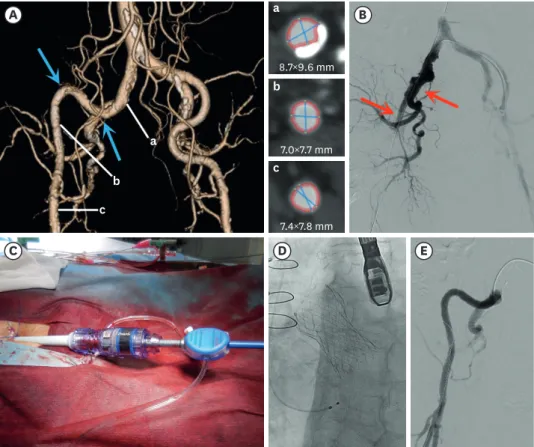
(2) Using eSheath for Failed Evolut R Introduction. Author Contributions Conceptualization: Kobayashi K, Hachinohe D; Investigation: Mitsube K; Methodology: Furugen A, Kawamura T; Supervision: Koshima R, Fujita T; Writing - original draft: Kaneko U.. a. A. B. 8.7×9.6 mm. b. a b. 7.0×7.7 mm. c. c 7.4×7.8 mm. C. D. E. Figure 1. Computed tomographic, fluoroscopic, and intraprocedural images. (A) Pre-procedural multi-detector computed tomography revealed good caliber (>7.0 mm) with little calcification (a-c), but severe tortuosity in both external iliac arteries (blue arrows). (B) After stiff wire insertion, angiography showed a severe accordion phenomenon (red arrows). (C, D) Smooth delivery and implantation of a 29 mm Evolut R through the eSheath was successful. (E) Final angiography confirmed no major vascular complications.. REFERENCES 1. Buzzatti N, Mangieri A, Cota L, et al. Use of double stiff wire allows successful transfemoral transcatheter aortic valve implantation through extreme thoracic aorta tortuosity. Circ Cardiovasc Interv 2015;8:e002331. PUBMED | CROSSREF. 2. Kaneko U, Kobayashi K, Hachinohe D, et al. Successful direct iliac transcatheter aortic valve implantation to overcome significant tortuosity of the thoracic aorta. Korean Circ J 2018;48:949-50. PUBMED | CROSSREF. 3. Naganuma T, Mitomo S, Yabushita H, Nakao T, Lazarevic A, Nakamura S. Buddy wire technique for successful transfemoral transcatheter aortic valve implantation through an extremely tortuous abdominal aorta: a basic technique in Asian patients? AsiaIntervention 2017;3:90-2. 4. Muller O, Hamilos M, Ntalianis A, Sarno G, De Bruyne B. Images in cardiovascular medicine. The accordion phenomenon: lesson from a movie. Circulation 2008;118:e677-8. PUBMED | CROSSREF. https://e-kcj.org. https://doi.org/10.4070/kcj.2019.0324. 373.
(3)
수치
관련 문서
This is the first case of TAVI in Korea using a CoreValve. The cur- rent indications for TAVI with CoreValve are the following: 1) symp- tomatic, severe, and native aortic
In this case report, we present a patient with symptomatic severe aortic stenosis and previous mechanical mitral valve replacement who was successfully treated with TAVI using
In patients with symptomatic severe aortic stenosis and small aortic annulus, transcatheter aortic valve replacement (TAVR) has been reported as a good alternative to surgical aortic
(D) Advance of transcatheter aortic valve replacement (TAVR) system through the left iliac artery with balloon supporting at right common artery (E) Too deep positioning of
the aging population. Several studies have investigated the efficacy of surgical aortic valve replacement for AS, and there is now a ge- neral consensus in the field that
Background: Analyses of the efficacy and safety of transcatheter aortic valve replacement (TAVR) in most coun- tries have been based on outcomes obtained in
Purpose: We aimed to compare the effect of transcatheter aortic valve replacement (TAVR) and surgical aortic valve replacement (sAVR) on recovery of left ventricular (LV)
In the decision-making process for aortic valve interven- tion, patients must actively participate in the final treatment decision. Patients must be informed of the upfront risk of
