• 검색 결과가 없습니다.

Successful Direct Iliac Transcatheter Aortic Valve Implantation to Overcome Significant Tortuosity of the Thoracic Aorta

N/A
N/A
Protected

Academic year: 2022

Share "Successful Direct Iliac Transcatheter Aortic Valve Implantation to Overcome Significant Tortuosity of the Thoracic Aorta"

Copied!
2
0
0

로드 중.... (전체 텍스트 보기)

전체 글

(1)Korean Circ J. 2018 Oct;48(10):949-950 https://doi.org/10.4070/kcj.2018.0129 pISSN 1738-5520·eISSN 1738-5555. Images in Cardiovascular Medicine. Successful Direct Iliac Transcatheter Aortic Valve Implantation to Overcome Significant Tortuosity of the Thoracic Aorta Umihiko Kaneko , MD1, Ken Kobayashi, MD1, Daisuke Hachinohe , MD1, Satoshi Sumino, MD2, Azusa Furugen, MD1, Takeshi Kawamura, MD3, Hirosato Doi, MD2, and Tsutomu Fujita, MD1 Department of Cardiovascular Medicine, Sapporo Cardio Vascular Clinic, Sapporo Heart Center, Sapporo, Japan 2 Department of Cardiovascular Surgery, Sapporo Cardio Vascular Clinic, Sapporo Heart Center, Sapporo, Japan 3 Department of Anesthesiology, Sapporo Cardio Vascular Clinic, Sapporo Heart Center, Sapporo, Japan 1. Received: Apr 13, 2018 Revised: Jun 27, 2018 Accepted: Jul 17, 2018 Correspondence to Umihiko Kaneko, MD Department of Cardiovascular Medicine, Sapporo Cardio Vascular Clinic, Sapporo Heart Center, North 49, East 16, 8-1 Higashi Ward, Sapporo, Hokkaido 007-0849, Japan. E-mail: [email protected] Copyright © 2018. The Korean Society of Cardiology This is an Open Access article distributed under the terms of the Creative Commons Attribution Non-Commercial License (https:// creativecommons.org/licenses/by-nc/4.0) which permits unrestricted noncommercial use, distribution, and reproduction in any medium, provided the original work is properly cited. ORCID iDs Umihiko Kaneko https://orcid.org/0000-0003-2392-5084 Daisuke Hachinohe https://orcid.org/0000-0003-4828-1836. An 87-year-old woman with symptomatic severe aortic stenosis underwent transcatheter aortic valve implantation (TAVI). Multi-detector computed tomography showed a significantly tortuous descending thoracic aorta (Figure 1A and B). Due to the high risk of coronary obstruction and a horizontal aorta, a SAPIEN 3 (Edwards LifeSciences, Irvine, CA, USA) prosthesis via transfemoral access was considered. However, the total length of the Edwards expandable introducer sheath (eSheath, 360 mm) was not sufficient to reach the acute bend in the thoracic aorta, which measured 415 mm in length. Therefore, direct right common iliac access obtained by retroperitoneal approach was chosen to insert the eSheath beyond the acute bend of the thoracic aorta (Figure 1C and D). After insertion of a single stiff wire, the tip of the eSheath was successfully placed beyond the acute bend of the thoracic aorta with no resistance (Figure 1E). Using buddy wire technique, smooth delivery and implantation of a 26-mm SAPIEN 3 was successful without vascular complication (Figure 1F-H). An extremely tortuous thoracic aorta can be a major hindrance to transfemoral access and is associated with fatal complications, such as aortic dissection or rupture.1)2) Compared with advancement of bulky TAVI device, insertion of the eSheath beyond the acute bend via a direct iliac access can be easier and less traumatic due to its tapered tip and hydrophilic coating, finally yielding an excellent result. A severely calcified aorta may not be straightened even after insertion of double stiff wires. Therefore, the calcium extent and distribution of aorta will be important factors for successful sheath insertion.. Conflict of Interest The authors have no financial conflicts of interest.. https://e-kcj.org. 949.

(2) Direct Iliac TAVI through a Tortuous Thoracic Aorta. Bend. 415 mm 315 mm. 70° 98°. Rt. CIA. Rt. CFA. B. A. F. E. D. C. G. H. Figure 1. (A-C) Pre-procedural MDCT (A) Left anterior oblique view of maximum intensity projection showing a markedly tortuous thoracic aorta and no significant calcification around the acute bend (red arrows). (B) Posterior volume-rendering image of the aorta. (C) Volume-rendering image of the aorta showing the distance from the Rt.CFA (white bidirectional arrow) and the Rt.CIA (yellow bidirectional arrow) to the acute bend in the thoracic aorta. (D) Direct iliac approach. (E-H) Fluoroscopic images during the procedure. (E) Facilitating smooth insertion of the eSheath (yellow arrow) beyond the tortuous segment of the thoracic aorta (red arrows). (F) Successful implantation of the prosthetic valve. (G) Aortography showing trivial paravalvular leak. (H) Final aortography showing no vascular complication. MDCT = multi-detector computed tomography; Rt.CFA = right common femoral artery; Rt.CIA = right common iliac artery.. Author Contributions Conceptualization: Kobayashi K, Hachinohe D, Furugen A, Sumino S; Formal analysis: Kawamura T; Supervision: Doi H, Fujita T; Writing - original draft: Kaneko U.. REFERENCES 1. Aminian A, Lalmand J, El Nakadi B. Perforation of the descending thoracic aorta during transcatheter aortic valve implantation (TAVI): an unexpected and dramatic procedural complication. Catheter Cardiovasc Interv 2011;77:1076-8. PUBMED | CROSSREF. 2. de Agustin JA, Jiménez-Quevedo P, Nombela-Franco L, et al. Descending aorta rupture during transcatheter aortic valve replacement. Circulation 2016;133:e14-7. PUBMED | CROSSREF. https://e-kcj.org. https://doi.org/10.4070/kcj.2018.0129. 950.

(3)

수치
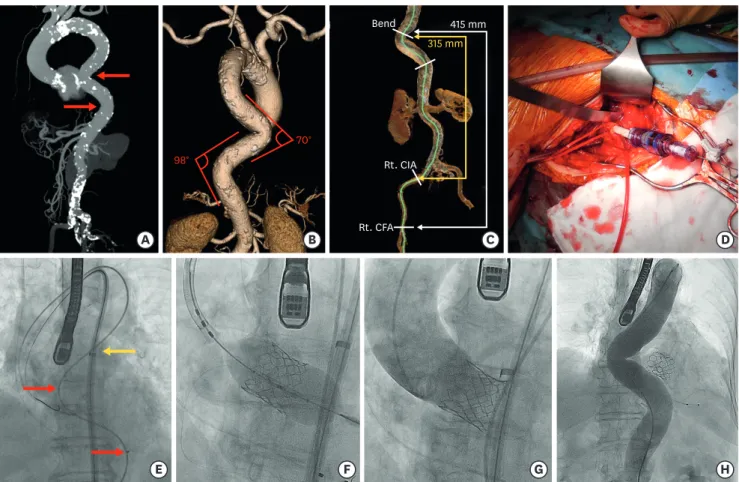
Figure 1. (A-C) Pre-procedural MDCT (A) Left anterior oblique view of maximum intensity projection showing a markedly tortuous thoracic aorta and no  significant calcification around the acute bend (red arrows)

참조

관련 문서

This is the first case of TAVI in Korea using a CoreValve. The cur- rent indications for TAVI with CoreValve are the following: 1) symp- tomatic, severe, and native aortic