• 검색 결과가 없습니다.

Successful emergency transcatheter aortic valve implantation

N/A
N/A
Protected

Academic year: 2021

Share "Successful emergency transcatheter aortic valve implantation"

Copied!
4
0
0

로드 중.... (전체 텍스트 보기)

전체 글

(1)

CASE REPORT pISSN 1225-7737/eISSN 2234-8042 http://dx.doi.org/10.12701/yujm.2014.31.2.144

Yeungnam Univ J Med 2014;31(2):144-147

144 YUJM VOLUME 31, NUMBER 2, DECEMBER 2014

Successful emergency transcatheter aortic valve implantation

Jung-Hee Lee

1

, Ah-Young Ji

1

, Young Ju Kim

1

, Changho Song

1

, Moo-Nyun Jin

1

, Sun Wook Kim

1

, Myeong-Ki Hong

2

, Geu-Ru Hong

1

1

Division of Cardiology, Yonsei University College of Medicine, Severance Cardiovascular Hospital, Yonsei University Health System;

2
Severance Biomedical Science Institute, Yonsei University College of Medicine, Seoul, Korea

Despite the necessity of surgical aortic valve replacement, many patients with symptomatic severe aortic stenosis (AS) cannot undergo surgery because of their severe comorbidities. In these high-risk patients, percutaneous transcatheter aortic valve implantation (TAVI) can be safely accomplished. However, no study has shown that TAVI can be performed for patients with severe AS accompanied by acute decompensated heart failure. In this case report, 1 patient presented a case of severe pulmonary hypertension with decom- pensated heart failure after diagnosis with severe AS, and was successfully treated via emergency TAVI.

Without any invasive treatment, acute decompensated heart failure with severe pulmonary hypertension is common in patients with severe AS, and it can increase mortality rates. In conclusion, TAVI can be considered one of the treatment options for severe as presented as acute decompensated heart failure patients with pulmonary hypertension.

Keywords: Aortic valve stenosis; Heart failure; Emergency treatment; Heart valve prosthesis implantation

Received: September 17, 2013, Revised: October 25, 2013, Accepted: October 28, 2013

Corresponding Author: Geu-Ru Hong, Division of Cardio- logy, Severance Cardiovascular Hospital, Yonsei University College of Medicine, 250 Seongsanno, Seodaemun-gu, Seoul 120-752, Korea

Tel: +82-2-2-2228-8443, Fax: +82-2-2227-7732 E-mail: [email protected]

INTRODUCTION

Symptomatic aortic stenosis (AS) usually requires aortic valve replacement (AVR) since the prognosis of medical treatment alone is generally poor. Despite the proven benefits of surgical AVR, many patients with severe AS cannot undergo surgery because of their high morbidity and mortality rates, especially elderly patients. Nowadays, transcatheter aortic valve implanta- tion (TAVI) may be an alternative therapy for high-risk patients and many studies have shown that TAVI could have more favorable outcomes than standard therapies in high-risk patients [1-3].

In patients with severe AS, there is a high prevalence of pulmonary hypertension that can be associated with increased mortality [4,5]. Surgical AVR and TAVI can be effective thera-

pies for these patients and may result in reduced pulmonary artery systolic pressure (PASP) [4]. However, no study has shown that TAVI can be one of the treatment options for patients with severe AS accompanied by acute decompensated heart failure and severe pulmonary hypertension.

We report here in a successful emergency TAVI procedure for a patient with severe AS presented as acute decompensated heart failure.

CASE

An 84-year-old man visited our hospital because of pro-

gressive dyspnea upon exertion. His condition could be

classified as the New York Heart Association (NYHA)

Functional Classification II. He had a medical history of

hypertension and old pulmonary tuberculosis. His physical

examination showed a pulse rate of 74 beats per minute

(bpm) and a blood pressure of 109/68 mmHg. There was

systolic murmur at the right upper sternal border. His electro-

cardiography showed a sinus rhythm with left ventricular (LV)

hypertrophy, and his chest X-ray, an enlarged cardiac silhou-

ette with multiple nodules and calcification throughout both

(2)

Emergency TAVI severe AS with decompensated heart failure

YUJM VOLUME 31, NUMBER 2, DECEMBER 2014 145

Fig. 1. The patient’s chest X-ray. (A) Chest X-ray at when he first visited showed cardiomegaly with multiple nodules and calcification throughout both lung suggesting old tuberculosis. (B) Chest X-ray at 1 day after re-admission showed severe aggra- vated pulmonary edema.

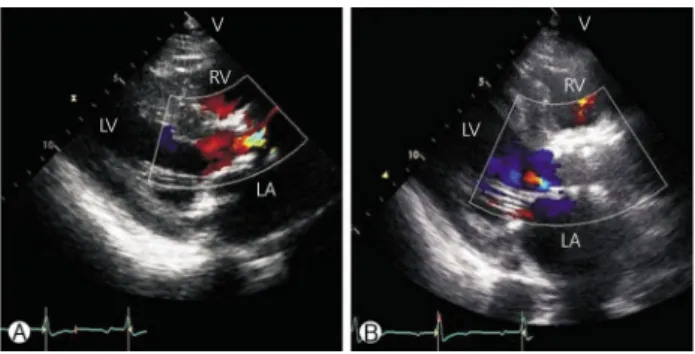
Fig. 2. The patient’s 2-D echocardiography. (A) Before TAVI pro- cedure, echocardiography showed a degenerative change of aortic valve with severe calcification. (B) After TAVI procedure, echo- cardiography revealed good motion of CoreValve and mild para- valvular aortic regurgitation. TAVI, transcatheter aortic valve im- plantation; LV, left ventricle; RV, right ventricle; LA, left atrium;

AV, aortic valve.

Fig. 4. The patient’s coronary angiography showed no significant luminal narrowing except minimal mid-right coronary artery lesion.

Fig. 3. The patient’s pressure curve on aortic valve. (A) Before TAVI procedure, pressure gradient of aortic valve showed ele- vated (peak/mean pressure gradient=117/74 mmHg). (B) After TAVI procedure, pressure curve at aortic valve showed markedly decreased pressure gradient (peak/mean pressure gradient, 25/15 mmHg). TAVI, transcatheter aortic valve implantation.

lungs, which suggested old tuberculosis sequelae (Fig. 1A).

There were no abnormal findings from his laboratory examination, except for mild anemia (hemoglobin 11.1 g/dL).

His echocardiography showed a degenerative change in his aortic valve with calcification, which suggested severe AS (aortic valve area [AVA], 0.5 cm

2

based on the continuity equation), moderate pulmonary hypertension (right ventricular systolic pressure [RVSP], 60 mmHg), and normal global LV systolic function (ejection fraction [EF], 57%) (Fig. 2A). The pressure curve on his aortic valve was also elevated (peak/mean pressure gradient, 117/74 mmHg) (Fig. 3A). His coronary angiography showed no significant luminal narrowing, except for a minimal mid-right coronary artery lesion (Fig. 4). We performed trans-esophageal echocardiography, which also

showed severe AS (AVA=0.64 cm

2

via 2D) and that he was a candidate for the TAVI procedure. However, at that time, he refused any invasive procedure such as AVR or TAVI. He was discharged with maintenance of medical therapy.

Four months after his discharge, he was readmitted because

of aggravated dyspnea. In his physical examination, moist

rale was heard at both lung fields, and his chest X-ray showed

bilateral pulmonary edema (Fig. 1B). His NT-proBNP level

was elevated at 14,328 pg/mL. Despite intravenous furose-

mide therapy, his blood pressure fell to 75/55 mmHg, his

heart rate surpassed 100 bpm, and his oxygen saturation fell

below 90%. His echocardiography revealed severe AS with

significantly decreased LV systolic function (left ventricular

ejection fraction [LVEF], from 57% to 34%), further aggra-

(3)

Jung-Hee Lee et al.

146 YUJM VOLUME 31, NUMBER 2, DECEMBER 2014

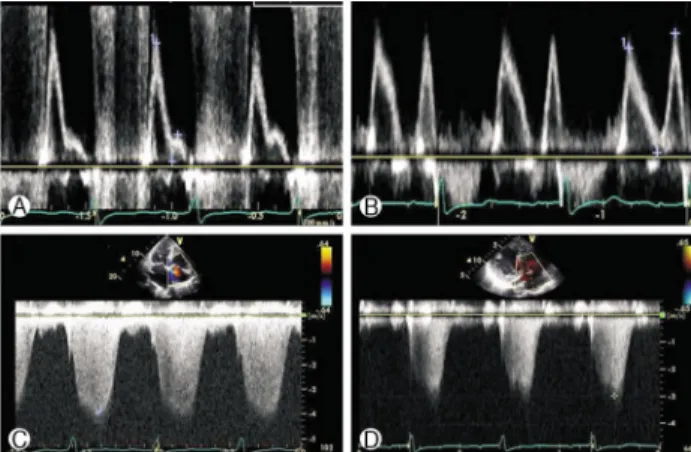
Fig. 5. The patient’s Doppler flow study. (A, C) Before TAVI procedure, echocardiography showed diastolic dysfunction and increased RVSP (DT=96 msec, pseudonormalization pattern of LV with elevated filling pressure, E/E’=37, RVSP=86 mmHg).

(B, D) After TAVI procedure, echocardiography showed improved diastolic function and reduced RVSP (DT=198 msec, relaxation abnormality of LV filling pattern with elevated LV filling pressure, E/E’=23, RVSP=45 mmHg). TAVI, transcatheter aortic valve implantation; RVSP, right ventricular systolic pressure; DT, decele- ration time; LV, left ventricle.

vated pulmonary hypertension (RVSP, from 67 to 86 mmHg), and aggravated diastolic function (deceleration time [DT]:

from 131 to 96 msec, and pseudonormalization pattern of his LV filling with elevated LV filling pressure, E/E’=37) (Fig.

5A, 5C). We assumed that his status was aggravated by acute decompensated LV systolic and diastolic function due to severe aortic stenosis, and we decided to perform an emer- gency TAVI procedure.

We performed the emergency TAVI procedure under general anesthesia. We punctured the right common femoral artery (CFA) using the standard percutaneous access techniques for vascular access in CoreValve delivery. Under rapid pacing with a temporary pacemaker, we successfully inserted and inflated a 25 mm balloon (Z-med, NuMed Inc., Hopkinton, NY, USA) at the aortic valve. Then we inserted a 29 mm CoreValve through the right CFA sheath and deployed it at the aortic valve under fluoroscopic and intra-operative trans- esophageal echocardiogram guidance to prevent a size mis- match. The immediate post-procedural transthoracic echocar- diography showed good CoreValve motion and mild paraval- vular aortic regurgitation (Fig. 2B). We performed follow-up transthoracic echocardiography 5 days after the procedure, and it showed that the patient’s global LV systolic function had normalized (LVEF, from 34% to 58%), his RVSP had

decreased (from 86 to 45 mmHg), and his diastolic function had improved from a restrictive physiology to an abnormal relaxation pattern (E/E’, from 32 to 23) (Fig. 5B, 5D). The pressure curve on his aortic valve significantly decreased compared to the pre-procedural findings (peak/mean pressure gradient, 25/15 mmHg) (Fig. 3B).

The patient’s dyspnea was relieved after the procedure, and his chest X-ray showed marked improvement. He was dis- charged 5 days after the procedure, and his 3-month follow-up echocardiography showed no significant interval change from his immediate post-procedural echocardiographic findings.

After 10 months, he visited our outpatient clinic without any symptom or major cardiovascular adverse event.

DISCUSSION

AS is one of the most common diseases of heart valves among elderly patients. Since the median survival time after the appearance of symptoms related to AS, such as angina, dyspnea or syncope, is only 2 to 3 years, patients with sympto- matic AS should be treated with AVR [6]. However, for high- risk patients with severe comorbidities, the “gold-standard”

treatment with conventional surgery cannot be the most effective treatment option. Since 2002, when TAVI was first performed [7], it has been used throughout the world as an alternative treatment option for patients with high surgical risks. A randomized trial with 358 patients with AS who were not suitable candidates for surgery demonstrated that TAVI significantly reduced the rates of death from any cause, repeat hospitalization, and cardiac symptoms, as compared with standard therapy [3].

Pulmonary hypertension is not uncommon among severe

AS patients. Ben-Dor et al. [4] had reported that in a select

study group of high-risk patients with severe AS for whom

TAVI was considered, 34% had severe pulmonary hyper-

tension defined as PASP ≥60 mmHg. As expected, these

patients had higher prevalence of NYHA III-IV, enlarged

cardiac chambers and decreased LV function [8]. There is a

positive correlation between the level of PASP and LV end-

diastolic pressure, which is also independently correlated with

pulmonary hypertension. Some studies have shown that severe

pulmonary hypertension could be one of the risk factors in

patients with AS undergoing AVR [4,5,8]. Miceli et al. [8] had

(4)

Emergency TAVI severe AS with decompensated heart failure

YUJM VOLUME 31, NUMBER 2, DECEMBER 2014 147

reported that patients with elevated PASP levels had a 400%

higher risk of in-hospital mortality and a 10.1% absolute risk of death compared with those with normal PASP.

In our case report, the patient’s age was over 80 and his logistic European System for Cardiac Operative Risk Evalua- tion was 13.5%. He also had elevated RVSP that suggested pulmonary hypertension. When he first visited our hospital, he was a high-risk patient for surgical AVR and a good candi- date for TAVI, but he refused any invasive procedure. After a few months, his status was worsened by his decompensated heart function, as expected, and surgical AVR became a more risky treatment option for him. Although RVSP may decrease soon after AVR, once pulmonary hypertension has developed in patients with severe AS, the process may not be reversible, and this may explain why late outcomes are worse in those with higher RVSP [5]. Furthermore, a significant and sustained decrease in pulmonary pressure up to 1 year after TAVI has been reported, which is comparable to that seen with surgical valve replacement [4]. We had no choice but to perform the TAVI procedure in this desperate situation.

Acute decompensated heart failure is common in patients with severe AS who have had no invasive treatment such as AVR or TAVI. If acute decompensated heart function with severe pulmonary hypertension due to severe AS occurs, sur- gery can increase the mortality rate. In conclusion, TAVI can be considered one of the treatment options for patients with severe AS who present acute decompensated heart failure with pulmonary hypertension.

CONFLICT OF INTEREST

There was no potential conflict of interest relevant to this article.

REFERENCES

1. Grube E, Schuler G, Buellesfeld L, Gerckens U, Linke A, Wenaweser P, et al. Percutaneous aortic valve replacement for severe aortic stenosis in high-risk patients using the second- and current third-generation self-expanding CoreValve pros- thesis: device success and 30-day clinical outcome. J Am Coll Cardiol 2007;50:69-76.

2. Webb JG, Altwegg L, Boone RH, Cheung A, Ye J, Lichtenstein S, et al. Transcatheter aortic valve implantation: impact on clinical and valve-related outcomes. Circulation 2009;119:

3009-16.

3. Leon MB, Smith CR, Mack M, Miller DC, Moses JW, Svensson LG, et al. Transcatheter aortic-valve implantation for aortic stenosis in patients who cannot undergo surgery. N Engl J Med 2010;363:1597-607.

4. Ben-Dor I, Goldstein SA, Pichard AD, Satler LF, Maluenda G, Li Y, et al. Clinical profile, prognostic implication, and re- sponse to treatment of pulmonary hypertension in patients with severe aortic stenosis. Am J Cardiol 2011;107:1046-51.

5. Roselli EE, Abdel Azim A, Houghtaling PL, Jaber WA, Blackstone EH. Pulmonary hypertension is associated with worse early and late outcomes after aortic valve replacement:

implications for transcatheter aortic valve replacement. J Thorac Cardiovasc Surg 2012;144:1067-74.e2.

6. Bonow RO, Carabello BA, Chatterjee K, de Leon AC Jr, Faxon DP, Freed MD, et al. 2008 Focused update incorporated into the ACC/AHA 2006 guidelines for the management of patients with valvular heart disease: a report of the American College of Cardiology/American Heart Association Task Force on Practice Guidelines (Writing Committee to Revise the 1998 Guidelines for the Management of Patients With Valvular Heart Disease): endorsed by the Society of Cardiovascular Anesthesiologists, Society for Cardiovascular Angiography and Interventions, and Society of Thoracic Surgeons. Circulation 2008;118:e523-661.

7. Cribier A, Eltchaninoff H, Bash A, Borenstein N, Tron C, Bauer F, et al. Percutaneous transcatheter implantation of an aortic valve prosthesis for calcific aortic stenosis: first human case description. Circulation 2002;106:3006-8.

8. Miceli A, Varone E, Gilmanov D, Murzi M, Simeoni S,

Concistrè G, et al. Impact of pulmonary hypertension on mor-

tality after operation for isolated aortic valve stenosis. Int J

Cardiol 2013;168:3556-9.

수치

Fig. 3. The patient’s pressure curve on aortic valve. (A) Before  TAVI procedure, pressure gradient of aortic valve showed ele-  vated (peak/mean pressure gradient=117/74 mmHg)
Fig. 5. The patient’s Doppler flow study. (A, C) Before TAVI  procedure, echocardiography showed diastolic dysfunction and  increased RVSP (DT=96 msec, pseudonormalization pattern of  LV with elevated filling pressure, E/E’=37, RVSP=86 mmHg)

참조

관련 문서

early clinical outcomes of TAVI, surgical aortic valve replacement (SAVR), and optimal medical therapy (OMT) in patients aged ≥80 years with symptomatic se- vere AS.. Results:

This case suggests transaortic approach may be an effective and safe strategy for TAVI in high risk severe AS patients without eligible femoral or subclavian access

In patients with symptomatic severe aortic stenosis and small aortic annulus, transcatheter aortic valve replacement (TAVR) has been reported as a good alternative to surgical aortic

Infolding Distortion of Evolut R Valve after Transcatheter Aortic Valve Replacement Min Chul Kim , MD, PhD, Ju Han Kim , MD, PhD, Kyung Hoon Cho , MD, PhD, Doo Sun Sim , MD, PhD,

the aging population. Several studies have investigated the efficacy of surgical aortic valve replacement for AS, and there is now a ge- neral consensus in the field that

Nonobstructive aortic valve calcification: a window to significant coronary artery dis- ease.. Thrombus formation on a calcific and severely stenotic bicuspid

The patient underwent an open mitroaortic valve replacement using transcatheter aortic valve im- plantation with an Edwards SAPIEN XT valve (Edwards Lifesciences

In the decision-making process for aortic valve interven- tion, patients must actively participate in the final treatment decision. Patients must be informed of the upfront risk of