© 2011 The Korean Academy of Medical Sciences.
This is an Open Access article distributed under the terms of the Creative Commons Attribution Non-Commercial License (http://creativecommons.org/licenses/by-nc/3.0) which permits unrestricted non-commercial use, distribution, and reproduction in any medium, provided the original work is properly cited.
pISSN 1011-8934 eISSN 1598-6357
The First Successful Transapical Aortic Valve Implant in Korea
Transcatheter aortic valve implantation is an alternative to open heart surgery in high risk patients with severe aortic stenosis. High mortality and complications related to
cardiopulmonary bypass for conventional open heart surgery can be avoided with this new less invasive technique. In case of concomitant severe arterial disease, the transapical approach is recommended rather than transfemoral access. An 80-yr-old man with symptomatic aortic stenosis and who had very high surgical risk factors such as diabetes mellitus, hypertension, a history of stroke, bronchial asthma including poor pulmonary function and hepatocellular carcinoma was treated with a transapical aortic valve replacement. The expected mortality in this patient was 25.4% by Euroscore if we performed the conventional aortic valve surgery. The patient was discharged and was well at the 45 follow-up days. We report the first case of successful transcatheter transapical aortic valve implantation which is available recently in Korea.
Key Words: Aortic Valve; Aortic Valve Stenosis; Replacement Dong Seop Jeong1, Pyo Won Park1,
Min Suk Choi1, Kiick Sung1, Wook Sung Kim1, Young Tak Lee1, Hyeon-Cheol Gwon2, Seung Hyuk Choi2, Sung-Ji Park2, and Sang Min Maria Lee3
1Department of Thoracic and Cardiovascular Surgery, 2Division of Cardiology, Department of Medicine, 3Department of Anesthesiology & Pain Medicine, Samsung Medical Center, Sungkyunkwan University School of Medicine, Seoul, Korea Received: 8 September 2010
Accepted: 27 December 2010 Address for Correspondence:
Pyo Won Park, MD
Department of Thoracic and Cardiovascular Surgery, Samsung Medical Center, Sungkyunkwan University School of Medicine, 81 Irwon-ro, Gangnam-gu, Seoul 135-710, Korea Tel: +82.2-3410-3481, Fax: +82.2-3410-0089 E-mail: [email protected]
DOI: 10.3346/jkms.2011.26.4.577 • J Korean Med Sci 2011; 26: 577-579
CASE REPORT
Cardiovascular Disorders
INTRODUCTION
Surgical aortic valve replacement (AVR) remains the gold stan- dard therapy for patients with symptomatic severe aortic steno- sis (1). But for elderly patients with symptomatic severe aortic stenosis and who have significant comorbidities, conventional open heart AVR with cardiopulmonary bypass can be related with an unacceptable high morbidity and mortality. One of the alternative techniques using endoscope was introduced as less invasive valve surgery but were not popular in terms of cost and safety (2). Over the past 5 yr, transcatheter aortic valve implan- tation (TAVI) has been performed worldwide (3-5). However, in terms of transarterial access, limitations remain due to the de- livery sheath profiles, and especially in patients with small, dis- eased or tortuous access vessels. In these cases, transapical TAVI can be preferred. Ye et al. reported the first successful off pump transapical TAVI through a left minithoracotomy and the apex of the left ventricle (1). We describe performing the first success- ful transapical TAVI for a very high risk patient in Korea.
CASE DESCRIPTION
An 80-yr-old Korean man with severe degenerative aortic ste- nosis visited our hospital for chest tightness and dyspnea on ex- ertion (NYHA functional class III). He had a past medical histo-
ry of diabetes mellitus and hypertension, a history of stroke at the right pontine 3 yr ago, bronchial asthma for over 40 yr, chron- ic obstructive pulmonary disease with severe emphysematous changes and hepatocellular carcinoma that was treated with three sessions of transarterial embolization in June 2008. The logistic EuroScore was 25.3% (Age, chronic pulmonary disease, neurologic dysfunction, and critical preoperative state) and the Society of Thoracic Surgeons (STS) score was 10.4%. The com- puterized tomographic angiogram showed extensive ascending aorta and arch calcification. The patient was recommended to undergo transcatheter aortic valve implantation due to his co- morbidities. We chose the transapical TAVI because his iliofem- oral vessels were diseased and too small for transfemoral access (diameter of left femoral artery, 8.3 mm and diameter of right femoral artery, 7.8 mm).
On echocardiography, the aortic valve area was 0.9 cm2, the maximal velocity was 4.1 m/s and the mean pressure gradient was 35 mmHg. The aortic valve consisted of three cusps and the diameter of the annulus was 20.2 mm. The left ventricular ejec- tion fraction was 65%. The coronary arteries were normal ac- cording to coronary angiography.
Informed consent was obtained from the patient and his fam- ily. The TAVI was performed in the hybrid room where open heart surgeries and interventions were possible. All the proce- dures were prechecked by anesthesiologist, cardiologists and
Jeong DS, et al. • Transapical Aortic Valve Implant
578 http://jkms.org DOI: 10.3346/jkms.2011.26.4.577
cardiac surgeons.
General anesthesia for open heart surgery was performed along with transesophageal echocardiography (TEE), placing a Swan-Ganz catheter and continuous arterial pressure monitor- ing at a radial artery. Right inguinal venous and arterial access was obtained for placing the pacing wire in the right ventricle and a pigtail catheter in the aortic root.
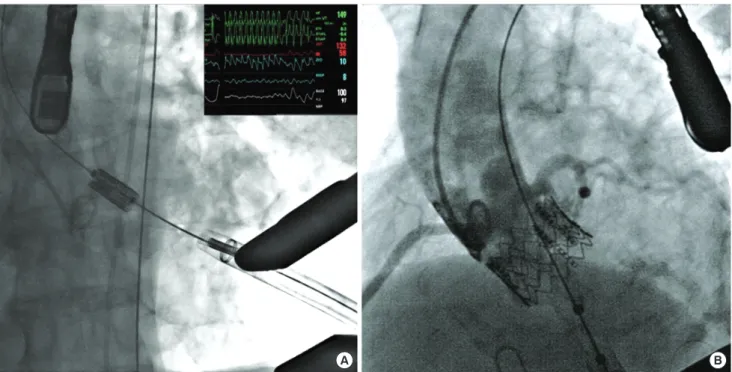
After a left anterior mini-thoracotomy, the pericardium was opened. The left ventricular apex was prepared for puncture with two pledgeted purse-string sutures. Heparin was administered to achieve an activated clotting time of 300 sec or more with an initial dose of 150 μ/kg. After heparinization, a 7 F Angiocath was inserted through the apex of the left ventricle and a guide- wire was passed through the aortic valve. This guide wire was exchanged for a 0.035-inch Amplatz Extra Stiff guide wire, which was placed across the aortic arch and the tip was positioned in the abdominal aorta for stability. The Angiocath was also ex- changed for a 14 F catheter, and then 20 mm balloon valvulo- plasty was performed. During the balloon valvuloplasty, rapid ventricular pacing of 200 beats/min was used to reduce the trans- aortic flow (Fig. 1A). A 26 F introducer sheath was subsequently introduced into the apex, and a 26 mm Sapien transcatheter heart valve (THV) (Edward Lifesciences, Irvine, CA, USA) was deployed under pacing of 200 beats/min. The position of the THV was checked with a root aortogram using a pig tail cathe- ter before and after deployment. After full deployment of the THV, the root aortogram and coronary angiography revealed the optimal position of the bioprosthesis and normal coronary perfusion (Fig. 1B). The immediate post-deployment transesoph-
ageal echocardiography showed a good position, normal leaflet motion, no paravalvular leakage and a mean pressure gradient of 9.6 mmHg. Anesthesia was reversed, but extubation was put off due to the poor preoperative pulmonary function. The pa- tient was discharged without problems on the 17th postopera- tive day after the management of asthma. The postoperative echocardiographic findings showed good prosthetic valve func- tion and good left ventricular ejection fraction. The patient was well at the 45 follow-up days and he had had an improved func- tional status of NYHA class I.
DISCUSSION
This case is the first successful transapical TAVI in Korea. Recent- ly, the clinical results of AVR are improving in elderly patients.
The early mortality for septuagenarians and octogenarians who are undergoing isolated AVR ranges from 4.0% to 16.7% (6-8).
However, the real risk of conventional AVR remains unclear in elderly high-risk patients. According to some previous reports of TAVI, the predicted operative mortality for conventional AVR was above 30% according to the logistic EuroScore (9).
The transapical TAVI is a viable alternative for high risk patients with severe aortic stenosis and who are not suitable for open heart surgery. The representative indications may be patients of aortic stenosis with severe ascending aortic calcification, previ- ous multiple coronary artery bypass surgery with patent grafts crossing sternum, or valve-in-valve implantation for degenera- tive bioprosthesis. Ye et al. (9) showed their improvement of 30- day mortality of transapical TAVI from 33.3% to 12.5% in 15 pa-
A B
Fig. 1. Aortogram showing transcatheter transapical aortic valve implant. (A) Rapid pacing of 200 beats/min was performed to reduce the transaortic flow during the deployment of prosthetic aortic valve. (B) Both coronary arteries were clearly visible after aortic valve implant.
Jeong DS, et al. • Transapical Aortic Valve Implant
http://jkms.org 579
DOI: 10.3346/jkms.2011.26.4.577
tients through the learning curve. They emphasized teamwork, meticulous apical hemostasis, the use of a well-equipped hy- brid operating room, understanding the risk factors for poten- tial fatal events and aggressive postoperative care. The predict- ed mortality in our patient was 25.3% by the logistic EuroScore and 10.4% by the STS score, which is considered a high risk. This is similar to the first Asian TAVI reported in Singapore (10). Among several risk factors, the poor pulmonary function caused by chronic obstructive pulmonary disease with severe emphyse- matous changes was the most important obstacle against per- forming conventional open heart surgery. Only brief anesthesia enabled the patient to recover without any pulmonary compli- cations, which could be easily predicted following conventional AVR and using cardiopulmonary bypass.
As for the team approach and equipment, we prepared for a long time to successfully perform transapical TAVI. The hybrid operating room that included a primed cardiopulmonary by- pass system and a full open heart surgery set were arranged.
The team consisted of one cardiac anesthesiologist, three cardi- ologists, one vascular surgeon and two dexterous interventional radiology technicians. All the team completely understood the procedure and everyone concentrated on their roles during all the process. Rehearsal for the first TAVI was performed several times.
There are two representative devices for TAVI. One is the Sapi- en THV and the other is CoreValve. The CoreValve system has an advantage over Sapien THV as it is fully retrievable as long as the introducer catheter is not released from the valve. There were several reports that showed good early results with using the CoreValve (11). However, the incidence of having to place a permanent pacemaker was increased with using the CoreValve (12). Godin et al. (13) recently reported that the Sapien THV re- vealed a low incidence of heart block. We believed these reports and we chose the Sapien THV in hope of avoiding the require- ment of implanting a permanent pacemaker. Our patient had normal sinus rhythm at the last follow up.
In summary, the transapical TAVI which is available in our country recently could be performed safely and it showed a good clinical outcome. Complete equipment, a team approach, and preparation for unwanted fatal complications were required to achieve a successful result.
REFERENCES
1. Kvidal P, Bergström R, Hörte LG, Ståhle E. Observed and relative surviv- al after aortic valve replacement. J Am Coll Cardiol 2000; 35: 747-56.
2. Shin HJ, Kim HJ, Choo SJ, Song H, Chung CH, Song MG, Lee JW. Thora- coscopic aortic valve replacement assisted with AESOP (Automated En- doscope System for Optimal Positioning). Korean J Thorac Cardiovasc Surg 2005; 38: 507-9.
3. Ye J, Cheung A, Lichtenstein SV, Carere RG, Thompson CR, Pasupati S, Webb JG. Thoracoscopic Aortic Valve Replacement assisted with AESOP (Automated Endoscope System for Optimal Positioning) 3000. J Thorac Cardiovasc Surg 2006; 131: 1194-6.
4. Chiam PT, Ruiz CE. Percutaneous transcatheter aortic valve implanta- tion: assessing results, judging outcomes, and planning trials: the inter- ventionalist perspective. JACC Cardiovasc Interv 2008; 1: 341-50.
5. Webb JG, Pasupati S, Humphries K, Thompson C, Altwegg L, Moss R, Sinhal A, Carere RG, Munt B, Ricci D, Ye J, Cheung A, Lichtenstein SV.
Percutaneous transarterial aortic valve replacement in selected high-risk patients with aortic stenosis. Circulation 2007; 116: 755-63.
6. Accola KD, Scott ML, Palmer GJ, Thompson PA, Sand ME, Suarez-Cav- alier JE, Bott JN, Ebra G. Surgical management of aortic valve disease in the elderly: A retrospective comparative study of valve choice using pro- pensity score analysis. J Heart Valve Dis 2008; 17: 355-64.
7. Kawachi Y, Arinaga K, Nakashima A, Toshima Y, Kawano H, Kosuga T.
Aortic valve replacement in patients age 70 years and older: early and late results. Artif Organs 2002; 26: 706-10.
8. Glock Y, Faik M, Laghzaoui A, Moali I, Roux D, Fournial G. Cardiac sur- gery in the ninth decade of life. Cardiovasc Surg 1996; 4: 241-5.
9. Ye J, Cheung A, Lichtenstein SV, Nietlispach F, Albugami S, Masson JB, Thompson CR, Munt B, Moss R, Carere RG, Jamieson WR, Webb JG.
Transapical transcatheter aortic valve implantation: follow-up to 3 years.
J Thorac Cardiovasc Surg 2010; 139: 1107-13.
10. Chao VT, Chua YL, Chiam PT, Lee CY, See Tho VY, Tan SY, Sin YK, Hwang NC, Lim ST, Koh TH. Percutaneous transcatheter aortic valve replace- ment: first transapical implant in Asia. Singapore Med J 2010; 51: 69-72.
11. Marcheix B, Lamarche Y, Berry C, Asgar A, Laborde JC, Basmadjian A, Ducharme A, Denault A, Bonan R, Cartier R. Surgical aspects of endo- vascular retrograde implantation of the aortic CoreValve bioprosthesis in high-risk older patients with severe symptomatic aortic stenosis. J Thorac Cardiovasc Surg 2007; 134: 1150-6.
12. Bleiziffer S, Ruge H, Hörer J, Hutter A, Geisbüsch S, Brockmann G, Mazz- itelli D, Bauernschmitt R, Lange R. dictors for new-onset complete heart block after transcatheter aortic valve implantation. JACC Cardiovasc In- terv 2010; 3: 524-30.
13. Godin M, Eltchaninoff H, Furuta A, Tron C, Anselme F, Bejar K, Sanchez- Giron C, Bauer F, Litzler PY, Bessou JP, Cribier A. Frequency of conduc- tion disturbances after transcatheter implantation of an Edwards Sapi- en aortic valve prosthesis. Am J Cardiol 2010; 106: 707-12.