Comparison of Early Clinical Outcomes Following
Transcatheter Aortic Valve Implantation versus Surgical
Aortic Valve Replacement versus Optimal Medical Therapy
in Patients Older than 80 Years with Symptomatic
Severe Aortic Stenosis
Eui Im,
1Myeong-Ki Hong,
1,2Young-Guk Ko,
1Dong-Ho Shin,
1Jung-Sun Kim,
1Byeong-Keuk Kim,
1Donghoon Choi,
1Chi Young Shim,
1Hyuk-Jae Chang,
1Jae-Kwang Shim,
3Young-Lan Kwak,
3Sak Lee,
4Byung-Chul Chang,
4and Yangsoo Jang
1,21Divisions of Cardiology, 3Anesthesiology and Pain Medicine, and 4Cardiovascular Surgery,
Severance Cardiovascular Hospital, Yonsei University College of Medicine, Seoul;
2Severance Biomedical Science Institute, Yonsei University College of Medicine, Seoul, Korea.
Received: April 25, 2012 Revised: June 27, 2012 Accepted: July 12, 2012
Corresponding author: Dr. Myeong-Ki Hong, Division of Cardiology,
Severance Cardiovascular Hospital, Yonsei University College of Medicine, 50 Yonsei-ro, Seodaemun-gu, Seoul 120-752, Korea.
Tel: 82-2-2228-8460, Fax: 82-2-2227-7943 E-mail: [email protected]
∙ The authors have no financial conflicts of interest.
© Copyright:
Yonsei University College of Medicine 2013
This is an Open Access article distributed under the terms of the Creative Commons Attribution Non-Commercial License (http://creativecommons.org/ licenses/by-nc/3.0) which permits unrestricted non-commercial use, distribution, and reproduction in any medium, provided the original work is properly cited.
Purpose: Transcatheter aortic valve implantation (TAVI) has become an attractive therapeutic strategy for severe aortic stenosis (AS) in elderly patients due to its minimally-invasive nature. Therefore, early results of its clinical outcomes in
el-derly Korean patients were evaluated. Materials and Methods: We compared
early clinical outcomes of TAVI, surgical aortic valve replacement (SAVR), and optimal medical therapy (OMT) in patients aged ≥80 years with symptomatic se-vere AS. Treatment groups were allocated as follows: TAVI (n=10), SAVR (n=14),
and OMT (n=42). Results: Baseline clinical characteristics including predicted
operative mortality were similar among the three groups. However, patients with New York Heart Association functional class III or IV symptoms and smaller aor-tic valve area were treated with TAVI or SAVR rather than OMT. In-hospital com-bined safety endpoints (all-cause mortality, major stroke, peri-procedural myocar-dial infarction, life-threatening bleeding, major vascular complication, and acute kidney injury) after TAVI or SAVR were significantly lower in the TAVI group than in the SAVR group (10.0% vs. 71.4%, respectively, p=0.005), along with an acceptable rate of symptom improvement and device success. During the follow-up period, the TAVI grofollow-up showed the lowest rate of 3-month major adverse car-diovascular and cerebrovascular events, a composite of all-cause mortality, myo-cardial infarction, major stroke, and re-hospitalization (TAVI 0.0% vs. SAVR
50.0% vs. OMT 42.9%, p=0.017). Conclusion: Treatment with TAVI was
associ-ated with lower event rates compared to SAVR or OMT. Therefore, TAVI may be considered as the first therapeutic strategy in selected patients aged ≥80 years with symptomatic severe AS.
Key Words: Aortic stenosis, transcatheter aortic valve implantation, treatment outcome
combined comorbid disease, physical performance status and echocardiographic parameters. Patients were selected for TAVI after they were considered as inoperable or high-risk patients, assessed by two independent cardiovascular surgeons. The final treatment groups included 10 patients in the TAVI group, 14 in the SAVR group, and 42 in the OMT group.
All 10 TAVI procedures were performed using the Accu-Trak CoreValve System (Medtronic Inc., Minneapolis, MN, USA) under general anesthesia. The prosthetic aortic valve was inserted in a retrograde fashion using the femoral artery (n=7), subclavian artery (n=1), or ascending aorta (n=2). Balloon valvuloplasty was performed prior to prosthetic valve deployment. All patients had transvenous temporary cardiac pacing during the procedure. Rapid ventricular pac-ing at 150 to 200 beats/min was performed to reduce cardi-ac motion and transvalvular flow during balloon dilation. Positioning and deployment of the prosthetic valve was performed under fluoroscopic guidance. Size 26 mm and 29 mm prosthetic valves were used. The 26 mm valve was selected if the aortic annulus size was 20 to 23 mm (n=6), and the 29 mm valve was selected for an aortic annulus size of 24 to 27 mm (n=4). Pre-procedural echocardiography and multi-slice computed tomography were used to mea-sure the size of the aortic annulus. Immediately after de-ployment of the prosthetic valve, transesophageal echocar-diography was performed to confirm good motion of the prosthetic valve and identify any paravalvular leakage.
We compared in-hospital and 3-month clinical outcomes of TAVI, SAVR, and OMT using medical, echocardio-graphic and angioechocardio-graphic data. Major adverse cardiovascu-lar and cerebrovascucardiovascu-lar events (MACCE) during 3-month follow-up were defined as a composite of all-cause mortali-ty, myocardial infarction, major stroke (modified Rankin score ≥2), and re-hospitalization due to severe AS or com-plications of TAVI or SAVR. Definition of each endpoint was in accordance with the Valve Academic Research
Con-sortium guidelines.23 Other clinical events including
tran-sient ischemic attack,23 major bleeding, new-onset
perma-nent atrial fibrillation, and complete atrioventricular block
were also analyzed. Life-threatening bleeding23 or bleeding
which required blood transfusion24 was considered major
bleeding. In addition, procedural burden (procedure time and length of intensive care unit stay), combined safety end-points (all-cause mortality, major stroke, peri-procedural myocardial infarction, life-threatening bleeding, major vas-cular complication, and acute kidney injury) according to
INTRODUCTION
Aortic stenosis (AS) is a progressive disease with a poor
prognosis if treated medically after symptom onset.1-4
Al-though surgical aortic valve replacement (SAVR) has been
shown to improve symptoms and survival,5-7 patients with
advanced age are at increased risk of surgical complications
or death.8-10 With aging of the population, the number of
very old patients with symptomatic severe AS has increased, and a significant portion of them are not candidates for SAVR because of advanced age and its associated
comor-bidities.11 Therefore, a less invasive treatment strategy is
desired in such patients.
Transcatheter aortic valve implantation (TAVI) is a new procedure, in which a bioprosthetic valve is inserted through a catheter and implanted within the diseased native aortic valve. TAVI is a minimally-invasive procedure that avoids median sternotomy and the need for cardiopulmonary by-pass support. After several clinical studies, including the pivotal United States placement of aortic transcatheter valve
trial,12,13 TAVI is now considered as a safe and effective
treatment modality in elderly patients with symptomatic se-vere AS.11,14-20
Therefore, this study was performed to compare 3-month clinical outcomes of TAVI, SAVR, and optimal medical therapy (OMT) in patients aged ≥80 years with symptomat-ic severe AS.
MATERIALS AND METHODS
We enrolled 66 consecutive patients aged ≥80 years who were newly diagnosed with symptomatic severe AS at our institute. Transthoracic echocardiography was used to diag-nose AS according to the guidelines of the American
Soci-ety of Echocardiography,21 using a digital ultrasound scanner.
In the apical 5-chamber view, peak and mean transvalvular pressure gradient across the aortic valve were calculated us-ing the Bernoulli equation. The effective aortic valve area
was calculated using a continuity equation.22 All 66 patients
exhibited New York Heart Association (NYHA) functional class ≥I symptoms, and their echocardiographic findings
were consistent with severe AS (aortic valve area <1 cm2
with or without transvalvular mean pressure gradient ≥40
mm Hg).1 The decision for TAVI or SAVR was made for
comparisons were performed between each two groups. p-values <0.05 were considered statistically significant.
RESULTS
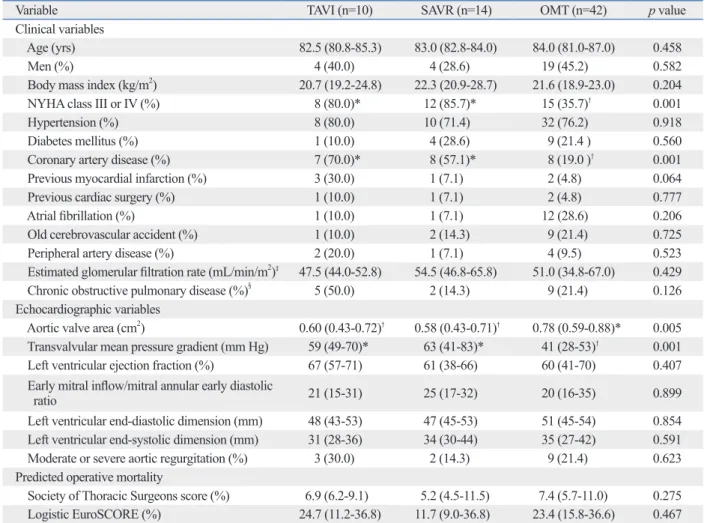
The baseline clinical and echocardiographic characteristics of the three groups are presented in Table 1. More patients in the TAVI and SAVR groups exhibited NYHA class III or IV symptoms compared to those who were treated with OMT (80.0%, 85.7% and 35.7%, p=0.001, respectively). The in-cidence of pre-existing coronary artery disease was also significantly higher in the TAVI and SAVR groups compared to the OMT group (70.0%, 57.1% and 19.0%, p=0.001, re-spectively). Smaller aortic valve area and higher mean
trans-the Valve Academic Research Consortium guidelines,23 and
procedural efficacy (improvement of clinical symptoms and echocardiographic parameters) during hospitalization were compared between the TAVI and SAVR groups. Im-provement of clinical symptoms was defined as at least one class improvement in NYHA functional class.
All statistical analyses were performed using Statistical Package for Social Sciences (SPSS) statistical software package, version 17.0 (SPSS, Chicago, IL, USA). Continu-ous variables were expressed as a median (interquartile range) and compared using Mann-Whitney test or Kruskal-Wallis test. Categorical variables were described as a num-ber (%) and analyzed using chi-square test or Fisher’s exact test, as appropriate. In case of results with a p-value <0.05 from the 3-group comparison, three additional pairwise
Table 1. Baseline Clinical and Echocardiographic Characteristics
Variable TAVI (n=10) SAVR (n=14) OMT (n=42) p value
Clinical variables
Age (yrs) 82.5 (80.8-85.3) 83.0 (82.8-84.0) 84.0 (81.0-87.0) 0.458
Men (%) 4 (40.0) 4 (28.6) 19 (45.2) 0.582
Body mass index (kg/m2) 20.7 (19.2-24.8) 22.3 (20.9-28.7) 21.6 (18.9-23.0) 0.204
NYHA class III or IV (%) 8 (80.0)* 12 (85.7)* 15 (35.7)† 0.001
Hypertension (%) 8 (80.0) 10 (71.4) 32 (76.2) 0.918
Diabetes mellitus (%) 1 (10.0) 4 (28.6) 9 (21.4 ) 0.560
Coronary artery disease (%) 7 (70.0)* 8 (57.1)* 8 (19.0 )† 0.001
Previous myocardial infarction (%) 3 (30.0) 1 (7.1) 2 (4.8) 0.064
Previous cardiac surgery (%) 1 (10.0) 1 (7.1) 2 (4.8) 0.777
Atrial fibrillation (%) 1 (10.0) 1 (7.1) 12 (28.6) 0.206
Old cerebrovascular accident (%) 1 (10.0) 2 (14.3) 9 (21.4) 0.725
Peripheral artery disease (%) 2 (20.0) 1 (7.1) 4 (9.5) 0.523
Estimated glomerular filtration rate (mL/min/m2)‡ 47.5 (44.0-52.8) 54.5 (46.8-65.8) 51.0 (34.8-67.0) 0.429
Chronic obstructive pulmonary disease (%)§
5 (50.0) 2 (14.3) 9 (21.4) 0.126
Echocardiographic variables
Aortic valve area (cm2) 0.60 (0.43-0.72)† 0.58 (0.43-0.71)† 0.78 (0.59-0.88)* 0.005
Transvalvular mean pressure gradient (mm Hg) 59 (49-70)* 63 (41-83)* 41 (28-53)† 0.001
Left ventricular ejection fraction (%) 67 (57-71) 61 (38-66) 60 (41-70) 0.407
Early mitral inflow/mitral annular early diastolic
ratio 21 (15-31) 25 (17-32) 20 (16-35) 0.899
Left ventricular end-diastolic dimension (mm) 48 (43-53) 47 (45-53) 51 (45-54) 0.854
Left ventricular end-systolic dimension (mm) 31 (28-36) 34 (30-44) 35 (27-42) 0.591
Moderate or severe aortic regurgitation (%) 3 (30.0) 2 (14.3) 9 (21.4) 0.623
Predicted operative mortality
Society of Thoracic Surgeons score (%) 6.9 (6.2-9.1) 5.2 (4.5-11.5) 7.4 (5.7-11.0) 0.275
Logistic EuroSCORE (%) 24.7 (11.2-36.8) 11.7 (9.0-36.8) 23.4 (15.8-36.6) 0.467
TAVI, transcatheter aortic valve implantation; SAVR, surgical aortic valve replacement; OMT, optimal medical therapy; NYHA, New York Heart Association; Logistic EuroSCORE, logistic European System for Cardiac Operative Risk Evaluation.
*,†In case of results with a p-value <0.05 from the 3-group comparison, three additional pairwise comparisons were performed between each two groups.
Groups with a p-value <0.05 from the pairwise comparisons were labeled with *,†representing the groups with the higher and lower rates, respectively; i.e.
The comparison between *(higher) vs. †(lower) was significant. ‡Calculated by the modification of diet in renal disease formula.
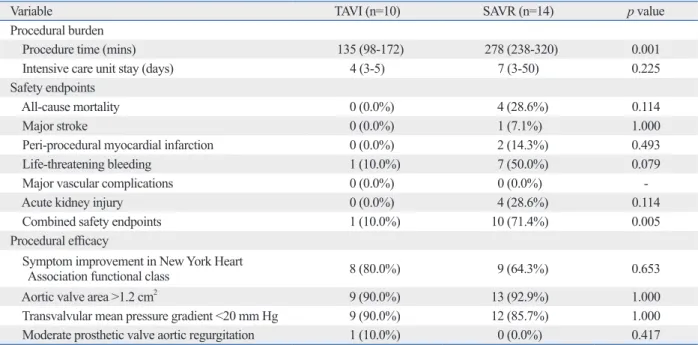
ing hospitalization were compared between the TAVI and SAVR groups (Table 4). Compared with the SAVR group, the TAVI group showed a lower rate of combined safety endpoints (71.4% vs. 10.0%, p=0.005, respectively).
DISCUSSION
The main finding of the present study is that the TAVI group showed the lowest rate of 3-month MACCE when com-pared to the SAVR and OMT groups in symptomatic pa-tients aged ≥80 years with severe AS.
valvular pressure gradient were observed in the TAVI and SAVR groups than the OMT group.
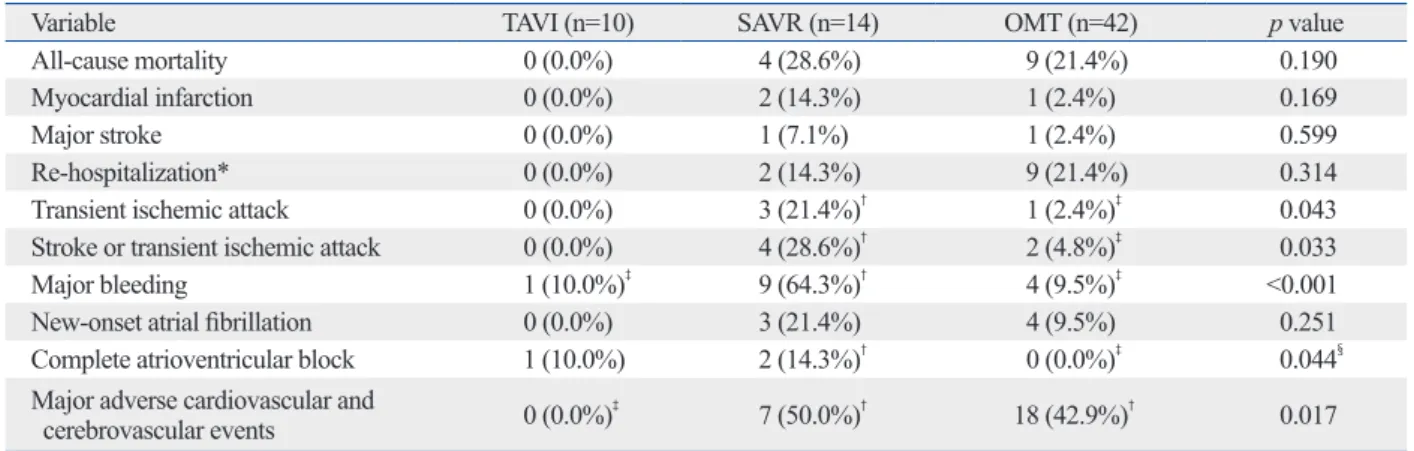
Table 2 shows the 3-month clinical outcomes among the three groups. Although there was no statistical difference in all-cause mortality among the three groups, no death oc-curred in the TAVI group, whereas the SAVR group had four (28.6%) cases of all-cause mortality and the OMT group had nine (21.4%). The rate of 3-month MACCE was signif-icantly lowest in the TAVI group (0.0% in TAVI vs. 50.0% in SAVR vs. 42.9% in OMT, p=0.017). The causes of death among the three groups are listed in Table 3.
Additionally, procedural burden, safety, and efficacy
dur-Table 2. Clinical Outcome at 3 Months
Variable TAVI (n=10) SAVR (n=14) OMT (n=42) p value
All-cause mortality 0 (0.0%) 4 (28.6%) 9 (21.4%) 0.190
Myocardial infarction 0 (0.0%) 2 (14.3%) 1 (2.4%) 0.169
Major stroke 0 (0.0%) 1 (7.1%) 1 (2.4%) 0.599
Re-hospitalization* 0 (0.0%) 2 (14.3%) 9 (21.4%) 0.314
Transient ischemic attack 0 (0.0%) 3 (21.4%)† 1 (2.4%)‡ 0.043
Stroke or transient ischemic attack 0 (0.0%) 4 (28.6%)†
2 (4.8%)‡
0.033
Major bleeding 1 (10.0%)‡ 9 (64.3%)† 4 (9.5%)‡ <0.001
New-onset atrial fibrillation 0 (0.0%) 3 (21.4%) 4 (9.5%) 0.251
Complete atrioventricular block 1 (10.0%) 2 (14.3%)† 0 (0.0%)‡ 0.044§
Major adverse cardiovascular and
cerebrovascular events 0 (0.0%)‡ 7 (50.0%)† 18 (42.9%)† 0.017
TAVI, transcatheter aortic valve implantation; SAVR, surgical aortic valve replacement; OMT, optimal medical therapy.
Major adverse cardiovascular and cerebrovascular events, a composite of all-cause mortality, myocardial infarction, major stroke and re-hospitalization. *Due to aortic stenosis or complications of TAVI or SAVR.
†,‡In case of results with a p-value <0.05 from the 3-group comparison, three additional pairwise comparisons were performed between each two groups.
Groups with a p-value <0.05 from the pairwise comparisons were labeled with †,‡representing the groups with the higher and lower rates, respectively; i.e.
The comparison between †(higher) vs. ‡(lower) was significant.
§For complete atrioventricular block, the comparison between SAVR vs. OMT was only marginally significant with p=0.059. Table 3. Detailed Causes of Death at 3 Months
Mortality Causes of death
Transcatheter aortic valve implantation (n=10)
No mortality
-Surgical aortic valve replacement (n=14)
Mortality 1 Post-operative bleeding
Mortality 2 Peri-operative myocardial infarction due to coronary embolism
Mortality 3 Acute kidney injury due to massive gastrointestinal bleeding
Mortality 4 Acute kidney injury due to massive gastrointestinal bleeding
Optimal medical therapy (n=42)
Mortality 1 Acute myocardial infarction
Mortality 2 Sudden cardiac death due to ventricular fibrillation
Mortality 3 Sudden cardiac death due to ventricular fibrillation
Mortality 4 Decompensated heart failure
Mortality 5 Decompensated heart failure
Mortality 6 Decompensated heart failure
Mortality 7 Decompensated heart failure
Mortality 8 Septic shock due to community acquired pneumonia
pressure gradient <75 mm Hg was as low as 20%. Similar-ly, in the present study, the rate of SAVR was 21.2% (14 of 66 patients), and patients with more severe symptom of dys-pnea, smaller aortic valve area, and greater transvalvular mean pressure gradient inevitably underwent SAVR.
Facing this dilemma between the need for surgery and the high surgical mortality rate in patients aged ≥80 years, TAVI with minimally-invasive nature could be an attractive alternative treatment modality. With proven safety and
effi-cacy,11-20 more patients aged ≥80 years who would have been
candidates for SAVR are now undergoing TAVI. Like the SAVR group, patients with more severe symptom of dys-pnea, higher incidence of pre-existing coronary artery dis-ease, smaller aortic valve area, and greater transvalvular mean pressure gradient underwent TAVI in this study.
The other main finding of the present study is that TAVI had a lower rate of in-hospital combined safety endpoints than SAVR. This was mainly due to a lower rate of in-hospi-tal all-cause morin-hospi-tality and life-threatening bleeding in TAVI than in SAVR. Previous publications report that a 30-day
mortality rate after TAVI ranges from 3.2% to 15.2%.12-20,27,28
Although the mean age was over 80 years in these previous studies, some of the patients were under 80 years. In the present study, in-hospital all-cause mortality rate of TAVI was 0.0%, even though all patients were over the age of 80. The excellent mortality outcomes of TAVI may be due to meticulous patient selection, pre-procedural planning, or post-procedural care in strict compliance with recommen-The prognosis in patients with symptomatic severe AS is
poor if treated medically.1-4 After symptom onset, the 1-year
mortality rate in patients with severe AS and without SAVR
is reportedly around 30%.2,4 Moreover, one could easily
ex-pect a higher mortality rate in the patients of the present
study, aged ≥80 years, than those of previous studies,2,4 even
though there are no available published data regarding the prognosis of medically treated patients in the selected popu-lations. This was also confirmed in the present study with a reported 3-month mortality rate of 21.4% in the OMT group.
SAVR is the treatment of choice for patients with
symp-tomatic severe AS.1 However, the risk of surgical mortality
increases significantly with age.8-10 Although early mortality
rate of combined valve and coronary bypass surgery was
low in some reports,25 in-hospital mortality of SAVR with
concomitant coronary bypass surgery has been reported as
high as 24% in patients aged ≥80 years.9 In the present study,
the in-hospital mortality rate of SAVR was 28.6%. Because of these high surgical mortality rates, surgeons sometimes hesitate to perform SAVR in patients aged ≥80 years, or pa-tients themselves are reluctant to undergo SAVR in real-world clinical practice. Therefore, SAVR is occasionally re-served only for patients with very small aortic valve area or high transvalvular pressure gradient whose clinical symp-toms are not stabilized by OMT alone. In a previous study
by Bouma, et al.,26 the actual rate of SAVR in patients aged
≥80 years was only 23.8%. In addition, the surgery rate in patients with NYHA class I/II dyspnea or transvalvular peak
Table 4. Procedural Burden, Safety, and Efficacy of TAVI and SAVR during Hospitalization
Variable TAVI (n=10) SAVR (n=14) p value
Procedural burden
Procedure time (mins) 135 (98-172) 278 (238-320) 0.001
Intensive care unit stay (days) 4 (3-5) 7 (3-50) 0.225
Safety endpoints
All-cause mortality 0 (0.0%) 4 (28.6%) 0.114
Major stroke 0 (0.0%) 1 (7.1%) 1.000
Peri-procedural myocardial infarction 0 (0.0%) 2 (14.3%) 0.493
Life-threatening bleeding 1 (10.0%) 7 (50.0%) 0.079
Major vascular complications 0 (0.0%) 0 (0.0%)
Acute kidney injury 0 (0.0%) 4 (28.6%) 0.114
Combined safety endpoints 1 (10.0%) 10 (71.4%) 0.005
Procedural efficacy
Symptom improvement in New York Heart
Association functional class 8 (80.0%) 9 (64.3%) 0.653
Aortic valve area >1.2 cm2 9 (90.0%) 13 (92.9%) 1.000
Transvalvular mean pressure gradient <20 mm Hg 9 (90.0%) 12 (85.7%) 1.000
Moderate prosthetic valve aortic regurgitation 1 (10.0%) 0 (0.0%) 0.417
fare & Family Affairs, Republic of Korea (nos. A085012 and A102064), a grant from the Korea Health 21 R&D Project, Ministry of Health & Welfare, Republic of Korea (no. A085136), and the Cardiovascular Research Center, Seoul, Korea.
REFERENCES
1. Bonow RO, Carabello BA, Chatterjee K, de Leon AC Jr, Faxon DP, Freed MD, et al. 2008 Focused update incorporated into the ACC/AHA 2006 guidelines for the management of patients with valvular heart disease: a report of the American College of Cardi-ology/American Heart Association Task Force on Practice Guide-lines (Writing Committee to Revise the 1998 GuideGuide-lines for the Management of Patients With Valvular Heart Disease): endorsed by the Society of Cardiovascular Anesthesiologists, Society for Cardiovascular Angiography and Interventions, and Society of Thoracic Surgeons. Circulation 2008;118:e523-661.
2. Varadarajan P, Kapoor N, Bansal RC, Pai RG. Clinical profile and natural history of 453 nonsurgically managed patients with severe aortic stenosis. Ann Thorac Surg 2006;82:2111-5.
3. Iung B, Cachier A, Baron G, Messika-Zeitoun D, Delahaye F, Tornos P, et al. Decision-making in elderly patients with severe aortic stenosis: why are so many denied surgery? Eur Heart J 2005;26:2714-20.
4. Chizner MA, Pearle DL, deLeon AC Jr. The natural history of aortic stenosis in adults. Am Heart J 1980;99:419-24.
5. O’Brien SM, Shahian DM, Filardo G, Ferraris VA, Haan CK, Rich JB, et al. The Society of Thoracic Surgeons 2008 cardiac surgery risk models: part 2--isolated valve surgery. Ann Thorac Surg 2009;88(1 Suppl):S23-42.
6. Shahian DM, O’Brien SM, Filardo G, Ferraris VA, Haan CK, Rich JB, et al. The Society of Thoracic Surgeons 2008 cardiac surgery risk models: part 3--valve plus coronary artery bypass grafting surgery. Ann Thorac Surg 2009;88(1 Suppl):S43-62. 7. Lund O. Preoperative risk evaluation and stratification of
long-term survival after valve replacement for aortic stenosis. Reasons for earlier operative intervention. Circulation 1990;82:124-39. 8. Bose AK, Aitchison JD, Dark JH. Aortic valve replacement in
oc-togenarians. J Cardiothorac Surg 2007;2:33.
9. Kolh P, Kerzmann A, Honore C, Comte L, Limet R. Aortic valve surgery in octogenarians: predictive factors for operative and long-term results. Eur J Cardiothorac Surg 2007;31:600-6.
10. Leontyev S, Walther T, Borger MA, Lehmann S, Funkat AK, Ras-tan A, et al. Aortic valve replacement in octogenarians: utility of risk stratification with EuroSCORE. Ann Thorac Surg 2009;87: 1440-5.
11. Faxon DP. Transcatheter aortic valve implantation: coming of age. Circulation 2011;124:e439-40.
12. Leon MB, Smith CR, Mack M, Miller DC, Moses JW, Svensson LG, et al. Transcatheter aortic-valve implantation for aortic steno-sis in patients who cannot undergo surgery. N Engl J Med 2010; 363:1597-607.
13. Smith CR, Leon MB, Mack MJ, Miller DC, Moses JW, Svensson LG, et al. Transcatheter versus surgical aortic-valve replacement in high-risk patients. N Engl J Med 2011;364:2187-98.
14. Ewe SH, Ajmone Marsan N, Pepi M, Delgado V, Tamborini G,
dations from TAVI experts and accumulated data. In addi-tion, they could be due to an evolving device profile, skillful operators, or the minimally-invasive nature of TAVI itself. Only one case (10.0%) of major bleeding (bloody pericar-dial effusion necessitating pericarpericar-dial window formation) oc-curred in the TAVI group, whereas nine cases (64.3%) of major bleeding (four cases of post-operative bleeding and five cases of gastrointestinal bleeding) occurred in the SAVR group. This difference may be due to the invasive nature of SAVR or anticoagulation after SAVR. Because TAVI is a catheter-based procedure, it entails a high possibility of
ma-jor vascular complication,29,30 cerebrovascular accident,31,32
or significant prosthetic valve aortic regurgitation.33
Howev-er, no major vascular complication or stroke occurred after TAVI. Only one case of prosthetic valve aortic regurgitation of moderate grade occurred without significant symptoms. These low rates of complications were able to be achieved
by a careful ‘pre-closure’ technique,34 catheter manipulation,
meticulous evaluation of peripheral vascular structure using computed tomography, and pre-procedural accurate mea-surement of annular size using computed tomography and echocardiogram. Another common concern with TAVI is a high rate of permanent pacemaker insertion due to
atrioven-tricular conduction block.35,36 We were able to avoid this
complication by accurately choosing the size and implanta-tion depth of the prosthetic valve. As a result, complete atrio-ventricular conduction block occurred in only 1 patient (10.0%) after TAVI. However, 2 patients (14.3%) in the SAVR group had complete atrioventricular conduction block after surgery and needed permanent pacemaker insertion.
The main limitation of the present study was the small sample size and short follow-up duration. Because TAVI is a relatively new procedure, long-term follow-up of a large patient population is required for more accurate comparison with SAVR and OMT. However, our results could be help-ful in choosing the best therapeutic strategy for patients aged ≥80 years with symptomatic severe AS.
In conclusion, TAVI demonstrated the best 3-month clini-cal outcomes when compared to SAVR and OMT. There-fore, TAVI might be considered as the first therapeutic strat-egy in patients aged ≥80 years with symptomatic severe AS.
ACKNOWLEDGEMENTS
This study was supported by a grant from the Korea Health-care Technology R&D Project, Ministry for Health,
Wel-326-31.
26. Bouma BJ, van Den Brink RB, van Der Meulen JH, Verheul HA, Cheriex EC, Hamer HP, et al. To operate or not on elderly patients with aortic stenosis: the decision and its consequences. Heart 1999;82:143-8.
27. Lange R, Bleiziffer S, Mazzitelli D, Elhmidi Y, Opitz A, Krane M, et al. Improvements in transcatheter aortic valve implantation out-comes in lower surgical risk patients: a glimpse into the future. J Am Coll Cardiol 2012;59:280-7.
28. Tamburino C, Capodanno D, Ramondo A, Petronio AS, Ettori F, Santoro G, et al. Incidence and predictors of early and late mortal-ity after transcatheter aortic valve implantation in 663 patients with severe aortic stenosis. Circulation 2011;123:299-308. 29. Van Mieghem NM, Nuis RJ, Piazza N, Apostolos T, Ligthart J,
Schultz C, et al. Vascular complications with transcatheter aortic valve implantation using the 18 Fr Medtronic CoreValve System: the Rotterdam experience. EuroIntervention 2010;5:673-9. 30. Tchetche D, Dumonteil N, Sauguet A, Descoutures F, Luz A,
Gar-cia O, et al. Thirty-day outcome and vascular complications after transarterial aortic valve implantation using both Edwards Sapien and Medtronic CoreValve bioprostheses in a mixed population. EuroIntervention 2010;5:659-65.
31. Rodés-Cabau J, Dumont E, Boone RH, Larose E, Bagur R, Gur-vitch R, et al. Cerebral embolism following transcatheter aortic valve implantation: comparison of transfemoral and transapical approaches. J Am Coll Cardiol 2011;57:18-28.
32. Kahlert P, Knipp SC, Schlamann M, Thielmann M, Al-Rashid F, Weber M, et al. Silent and apparent cerebral ischemia after percu-taneous transfemoral aortic valve implantation: a diffusion-weighted magnetic resonance imaging study. Circulation 2010; 121:870-8.
33. Détaint D, Lepage L, Himbert D, Brochet E, Messika-Zeitoun D, Iung B, et al. Determinants of significant paravalvular regurgitation after transcatheter aortic valve: implantation impact of device and annulus discongruence. JACC Cardiovasc Interv 2009;2:821-7. 34. Kahlert P, Eggebrecht H, Erbel R, Sack S. A modified
“preclo-sure” technique after percutaneous aortic valve replacement. Cath-eter Cardiovasc Interv 2008;72:877-84.
35. Guetta V, Goldenberg G, Segev A, Dvir D, Kornowski R, Finckel-stein A, et al. Predictors and course of high-degree atrioventricular block after transcatheter aortic valve implantation using the Core-Valve Revalving System. Am J Cardiol 2011;108:1600-5. 36. Khawaja MZ, Rajani R, Cook A, Khavandi A, Moynagh A,
Chowdhary S, et al. Permanent pacemaker insertion after CoreV-alve transcatheter aortic vCoreV-alve implantation: incidence and contrib-uting factors (the UK CoreValve Collaborative). Circulation 2011; 123:951-60.
Muratori M, et al. Impact of left ventricular systolic function on clinical and echocardiographic outcomes following transcatheter aortic valve implantation for severe aortic stenosis. Am Heart J 2010;160:1113-20.
15. Gotzmann M, Bojara W, Lindstaedt M, Ewers A, Bösche L, Germing A, et al. One-year results of transcatheter aortic valve implantation in severe symptomatic aortic valve stenosis. Am J Cardiol 2011;107:1687-92.
16. Eltchaninoff H, Prat A, Gilard M, Leguerrier A, Blanchard D, Fournial G, et al. Transcatheter aortic valve implantation: early re-sults of the FRANCE (FRench Aortic National CoreValve and Edwards) registry. Eur Heart J 2011;32:191-7.
17. Zahn R, Gerckens U, Grube E, Linke A, Sievert H, Eggebrecht H, et al. Transcatheter aortic valve implantation: first results from a multi-centre real-world registry. Eur Heart J 2011;32:198-204. 18. Rodés-Cabau J, Webb JG, Cheung A, Ye J, Dumont E, Feindel
CM, et al. Transcatheter aortic valve implantation for the treat-ment of severe symptomatic aortic stenosis in patients at very high or prohibitive surgical risk: acute and late outcomes of the multi-center Canadian experience. J Am Coll Cardiol 2010;55:1080-90. 19. Buellesfeld L, Gerckens U, Schuler G, Bonan R, Kovac J, Serruys
PW, et al. 2-year follow-up of patients undergoing transcatheter aortic valve implantation using a self-expanding valve prosthesis. J Am Coll Cardiol 2011;57:1650-7.
20. Moat NE, Ludman P, de Belder MA, Bridgewater B, Cunningham AD, Young CP, et al. Long-term outcomes after transcatheter aor-tic valve implantation in high-risk patients with severe aoraor-tic ste-nosis: the U.K. TAVI (United Kingdom Transcatheter Aortic Valve Implantation) Registry. J Am Coll Cardiol 2011;58:2130-8. 21. Lang RM, Bierig M, Devereux RB, Flachskampf FA, Foster E,
Pellikka PA, et al. Recommendations for chamber quantification: a report from the American Society of Echocardiography’s Guide-lines and Standards Committee and the Chamber Quantification Writing Group, developed in conjunction with the European As-sociation of Echocardiography, a branch of the European Society of Cardiology. J Am Soc Echocardiogr 2005;18:1440-63. 22. Otto CM. Valvular aortic stenosis: disease severity and timing of
intervention. J Am Coll Cardiol 2006;47:2141-51.
23. Leon MB, Piazza N, Nikolsky E, Blackstone EH, Cutlip DE, Kap-petein AP, et al. Standardized endpoint definitions for Transcathe-ter Aortic Valve Implantation clinical trials: a consensus report from the Valve Academic Research Consortium. J Am Coll Cardi-ol 2011;57:253-69.
24. The GUSTO investigators. An international randomized trial com-paring four thrombolytic strategies for acute myocardial infarc-tion. N Engl J Med 1993;329:673-82.
25. Lee S, Chang BC, Yoo KJ. Surgical management of coexisting coronary artery and valvular heart disease. Yonsei Med J 2010;51: