연구논문
유기용매내성세균 Bacillus sp. BCNU 5006의 유용성
최혜정1, 황민정2, 김봉수2, 정영기3, 주우홍1,2*
Potential of Organic Solvent Tolerant Bacillus sp. BCNU 5006
Hye Jung Choi1, Min Jung Hwang2, Bong Su Kim2, Yong-Kee Jeong3, and Woo Hong Joo1,2*
접수: 2012년 1월 9일 / 게재승인: 2012년 2월 10일
© 2012 The Korean Society for Biotechnology and Bioengineering
Abstract:1)In the screening process of organic solvent tolerant bacteria showing good growth in media containing several kinds of organic solvents, one strain was isolated and identified as Bacillus sp. BCNU 5006. The strain was able to tolerate many organic solvents including benzene, toluene, xylene, octane, dodecane, butanol and ethylbenzene. Likewise, it could also utilize these solvents as the sole source of carbon with significant enzyme production. The lipolytic enzyme stability of Bacillus sp. BCNU 5006 was studied in the presence of several kinds of solvents at a 25% (v/v) concentration.
The highest enzyme stability was observed in the presence of octane (107%), followed by ethylbenzene (88%), decane (86%), and chloroform (85%). Especially, BCNU 5006 lipase was determined to be more stable than immobilized enzyme (Novozyme 435) in the presence of octane, chloroform and xylene. This organic solvent tolerant Bacillus sp. BCNU 5006 could be expected as a potential bioremediation agent and biocatalyst for biodegradation and provide on organic- solvent-based enzymatic synthetic method in industrial chemical processes.
1창원대학교 생물공학협동과정
1Interdisciplinary Program for Biotechnology, Changwon National University, Changwon 641-773, Korea
2창원대학교 생물학과
2Department of Biology, Changwon National University, Changwon 641-773, Korea
Tel: +82-55-213-3453, Fax: +82-55-213-3459 e-mail: [email protected]
3동아대학교 생명공학과
3Department of Biotechnology, Dong-A University, Busan 604-714, Korea
Keywords: Bacillus sp. BCNU 5006, Organic solvent tolerant Bacillus sp., Biodegradation, Organic solvent stable lipase
1. 서론
우리나라의 산업구조가 철강, 기계, 석유화학, 조선, 전자, 펄 프 등 오염물질의 배출이 심한 중화학공업을 중심으로 급속 하게 발전함에 따라 사용되어 배출되는 각종 난분해성 화합 물의 종류와 양이 증가되면서 수질에 커다란 영향을 미치고 있다. 이들 폐수 가운데 화학제품 생산과정에서 화학반응의 매개체 또는 생산원료로 사용되는 유기용매들은 화학반응 시 반응에 참여하지 않는 안정된 화합물로서 높은 농도의 유기물을 함유하고 있기 때문에 자연에 배출되었을 때 효율 적으로 처리하기가 매우 어려운 실정이다 [1,2]. 특히 유기용매 가운데 BTEX (benzene, toluene, ethylbenzene and xylene) 는 산업분야에서 빈번하게 배출되는 오염물질로 휘발성과 물에 대한 불용성으로 인하여 생태계에 미치는 영향이 매우 크기 때문에 미국의 EPA에서도 주요 오염물질로 분류하여 그 배출량에 대해 철저히 감시하고 있다 [3,4]. 한편 대부분 의 미생물은 BTEX를 포함한 다양한 난분해성 화합물의 강 한독성으로 인해 구조적으로 파괴되거나 생물학적 활성을 잃게 된다. 그러나 고농도 유기용매에 대해 내성을 가지면서 동시에 난분해성 화합물을 분해하는 미생물이 분리 보고되 면서 국내 ․ 외의 환경, 발효 및 효소 관련 산업계에서 이들 미생물을 이용하고자 하는 연구가 활발히 이루어지고 있으 며 [5-9], 20세기에 접어들면서 생명공학의 비약적 발전과 더불어 환경에 대한 관심이 더욱더 고조되면서 친환경적인 생물전환 및 생물학적 처리기술이 절실히 요구되고 있다. 생물전환에 이용되고 있는 많은 생체촉매들은 유기용매 존재하에서 안정성과 활성이 감소되므로 산업적으로 이용
할 수 있는 효소 반응은 매우 제한적이다. 이를 해결하기 위 한 방법으로 고정화, 화학적 또는 생화학적 수식, 화합물의 첨가 및 단백질공학 기법 등이 이용되고 있다 [10-12]. 그러 나 이런 방법들은 과다한 에너지 소비, 특수설비 투자 및 유 지비용 등 효율성에 대비하여 경제성이 떨어지거나, 저급 지방산과 불순물의 생성에 따른 품질저하와 폐수발생량의 증가, 온도, pH, 금속이온농도 등 여러 환경인자에 영향을 받는 점 등 여러 측면에서 최적조건이라 할 수 없다. 그러므 로, 이러한 단점을 보완할 수 있는 효율적이면서 기능성이 뛰어난 새로운 생체촉매의 개발이 시급한 실정이다. Lipase는 물과 기름의 계면에서 triglyceide의 ester 결합 을 가수분해하여 글리세롤과 지방산을 생성하는 효소로, 이 때 생성되는 지방산은 생체고분자 물질, 바이오디젤 그리고 정밀화학의 합성 등 생물공학적으로 응용범위가 광범위하 여 화장품, 식품, 의약품, 섬유화학산업 등에서 매우 중요하 다. 유기용매 내성 세균은 그 자체로 생체촉매가 될 뿐만아 니라 내성세균이 생산하는 lipase는 소수성 기질의 용해성 을 증가시키고, 수계 반응 시스템내에서 이용할 수 없는 다 양한 화학반응에서 촉매로 사용할 수 있어 산업적으로 많은 이점이 있다. 또한, 아실기의 전이, 수산화이온의 친핵적 첨 가 등 원하지 않는 부반응을 감소시킬 수 있으며, 배지의 성 분에 따라 기질 특이성, 입체특이성, 작용기작 등의 특이성 이 다양하고 고정화시키지 않고 사용할 수 있기에 효소의 회수가 쉽고 재사용이 가능하다 [13-16].
따라서 본 연구에서 환경보전과 환경오염의 복원에 필요 한 생물복원기술과 고부가가치의 물질을 창출하는 생물전 환 기술개발에 필수적인 새로운 생물소재로써 유기용매 내 성균을 탐색하여 보고하고자 한다. 또한 분리균주의 생물 분해 특성을 조사하였으며 균주가 생산하는 유기용매 내성 lipase에 대한 온도, pH, 금속이온, 다양한 유기용매 등 여러 인자가 미치는 영향을 조사함으로써 산업적인 이용 가능성 에 대해 조사하였다.
2. 재료 및 방법
2.1. 유기용매 내성 균주 분리
유기용매 내성세균 분리를 위해 전국 각지의 공단 일대의 폐수 및 토양을 채취하였으며, nutrient broth (NB) 배지에 시료 1 g과 10% n-hexane을 첨가하고 농화배양을 실시하여 1차 내성균주를 선별하였다. 선별된 균주를 대상으로 10%
toluene을 첨가하여 28℃에서 48-72시간 배양하여, 내성이 뛰어난 균주를 2차 선별하였다.
2.2. 분리균주의 생리 ․ 생화학적 특성 및 동정
Bergey’s manual of determinative bacteriology에 준하여 분리균주의 생리, 생화학적 특성을 조사하였고, 정확한 동 정을 위하여 16S rRNA 염기서열 분석을 실시하였다. PCR sequencing을 위하여 16F (5’-AGTTTGATCCTGGCTCAG- 3’)와 1492R (5’-ACGGCTACCTTGTTACGACTT-3’) primer 를 사용하여 염기서열을 증폭, 분석하였으며, blast search
를 통해 16S rRNA를 비교 분석하였고 계통수는 neighbor joining법과 bootstrap 분석을 기반으로 작성하였다 [17,18].
2.3. 유기용매 내성 및 분해능 조사
유기용매에 대한 내성 조사를 위해 NA 평판배지에 균을 도말하고 11종의 다양한 유기용매를 overlay하여 37℃에서 72-120시간 동안 정치배양하였다. 유기용매에 대한 분해능 조사는 최소배지인 minimum salts medium (MSM; 0.715 g Na2HPO4 ․ 2H2O, 0.365 g KH2PO4, 0.5 g (NH4)2SO4, 0.1 g MgSO4 ․ 7H2O, 15 g agar and 0.5% trace elements solution (0.88 g Ca(NO3)2 ․ 4H2O, 0.2 g FeSO4 ․ 7H2O, 0.01 g ZnSO4
․ 7H2O, 0.01 g H3BO3, 0.01 g CoSO4 ․ 7H2O, 0.01 g CuSO4 ․ 5H2O, 0.004 g MnSO4 ․ H2O, 0.004 g Ni(NO3) 26H2O, 0.003 g Na2MoO4 ․ 2H2O, 0.002 g Na2WO4 ․ 2H2O, 0.05 N H2SO4)) 에 균을 도말하고 듀람관을 이용하여 다양한 유기용매 및 난분해성 물질을 각각 증기상태로 공급하면서 37℃에서 48- 72시간 동안 정치배양한 뒤 집락을 관찰하여 분해능 여부를 확인하였다. 또한 액체 최소배지에 유기용매를 첨가하여 분 해능을 재확인하였다.
2.4. Lipase 생서능 조사 및 조효소액 조제
lipase 생산을 확인하기 위해 nutrient agar (NA) 배지에 기 질로서 1% (w/v) tributyrin을 첨가하여 28℃에서 24-48시간 배양하였으며, 투명환의 생성여부로 효소생성균을 선별하였 으며 본 실험에 사용하였다. NB 배지에 전배양된 배양액을 접종하여 37℃에서 24시간 동안 진탕 배양하였으며, 원심분 리 (10000 × g, 15 min)한 후, 균체를 제거한 상등액을 cellulose acetate membrane filter (0.22 μm)를 이용해 여과한 후 조효 소액으로 사용하였다 [19].
2.5. Lipase 활성도 측정
Lipase의 활성은 p-nitrophenyl palmitate (pNPP)을 기질로 사용하여 분광광도계로 측정하였다 [20]. 즉, 100 μL의 조 효소액에 10 μL의 용액 A (50 mM pNPP in acetonitrile)와 900 μL의 Tris-HCl 완충액 (0.1 M, pH 8)을 첨가하여 37℃
에서 5분간 반응시킨 후 410 nm에서의 흡광도를 측정하였 다. 이때 조효소액을 첨가하지 않은 용액을 대조구로 사용 하였다. 효소활성은 pNPP를 이용하여 1분 동안 1 μmol의 p-nitrophenol (pNP)을 생산하는데 관여하는 효소의 양을 1 unit로 정의하였다.
2.6. 효소의 온도 및 pH 안정성 조사
조효소액에 기질인 pNPP 그리고 Tris-HCl (pH 8) 완충액 을 첨가한 뒤 30, 40, 50, 60, 70℃에서 정치시킨 후 410 nm에 서 잔존 효소 활성을 측정함으로써 온도에 따른 영향을 조사 하였다. 양성대조군으로는 고정화 리파아제인 novozyme 435 를 사용하였다. 또한 pH 안정성을 조사하기 위하여 pH 4 에서 10까지 넓은 범위의 완충액을 조제하여 사용하였으 며, 각 pH에서 효소를 반응시킨 후 410 nm에서 효소의 잔존 활성을 측정하였다. 양성대조군으로 novozyme 435 (Sigma, Denmark)를 사용하여 pH에 대한 안정성을 비교하였다.
2.7. 다양한 유기용매에 대한 효소의 안정성 조사
유기용매에 대한 안정성을 조사하기 위해 조효소액에 25%
(v/v) 농도의 다양한 유기용매를 첨가하여 37℃에서 150 rpm 으로 2시간 진탕시킨 후 조효소액을 채취하여 잔존 효소활성 을 측정하였다 [21]. 음성대조군으로 유기용매를 첨가하지 않은 실험구와 양성대조군으로 novozyme 435를 사용하여 비교하였다.
2.8. 금속이온의 효소활성에 미치는 영향 조사
금속이온이 효소활성에 미치는 영향을 조사하기 위해 조 효소액과 Tris-HCl (pH 8)완충액에 1 mM 농도의 다양한 금속이온 (CaCl2, FeCl3, CuCl2, MgSO4, BaCl2, HgCl2, N iCl2, ZnSO4, MnCl2, KCl, NH4Cl, NaCl)을 첨가하여 37℃에서 전반응시켰다. 1시간 반응 후 pNPP을 첨가하고 37℃에서 5분간 추가 반응 후 410 nm에서 잔존 효소활성을 조사하였다 [2].
3. 결과 및 고찰
3.1. 유기용매 내성 세균 분리
유기용매에 대한 내성 균주 선별을 위해 전국각지의 공단 폐수 및 토양을 채취하여 n-hexane에 내성을 가진 균주 30여 종을 1차로 분리하였다. 분리균주를 대상으로 NA 평판배 지에 toluene을 overlay하고 28℃에서 48시간 배양한 뒤 세균집락 형성능이 뛰어난 균주를 2차 선별하였다. 이들 중 내성이 뛰어난 BCNU 5006 균주를 선발하여 이하 유용 성을 검토하였다.
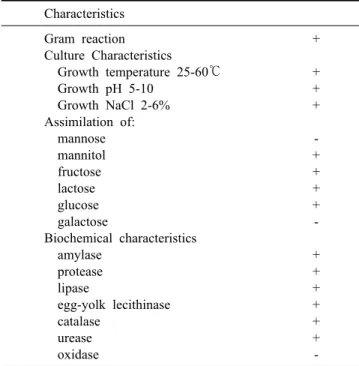
Table 1. Physiological and biochemical characteristics of strain Bacillus sp. BCNU 5006
Characteristics Gram reaction Culture Characteristics Growth temperature 25-60℃
Growth pH 5-10 Growth NaCl 2-6%
Assimilation of:
mannose mannitol fructose lactose glucose galactose
Biochemical characteristics amylase
protease lipase
egg-yolk lecithinase catalase
urease oxidase
+
+ + +
- + + + + -
+ + + + + + - +: growth, -: not growth.
3.2. 생리 ․ 생화학적 특성 및 동정
BCNU 5006 균주의 생리 ․ 생화학적 특성을 조사한 결과, 그람양성세균으로 25℃에서 60℃까지의 온도에서 생육 가능 하였으며, pH 범위도 5에서 10까지 비교적 넓은 생육범위를 가진 것으로 확인되었다. 또한 자화능 조사에서는 mannitol, fructose, glucose 및 lactose를 첨가한 배지에서 생육이 좋 은 것으로 나타났으며, lipase 외에 amylase, protease, egg- yolk lecithinase 등 다양한 효소를 생산하는 것으로 확인 되었다 (Table 1). 16S rRNA 염기서열 분석결과 Bacillus vallismortis, Bacillus amyloliquefaciene와 각각 99%, 98%
상동성을 나타냄으로써 계통학적으로도 같은 그룹에 속함이 확인되었다 (Fig. 1).
Fig. 1. A phylogenetic tree of the 16S rRNA sequences of the organic solvent tolerant Bacillus sp. BCNU 5006.
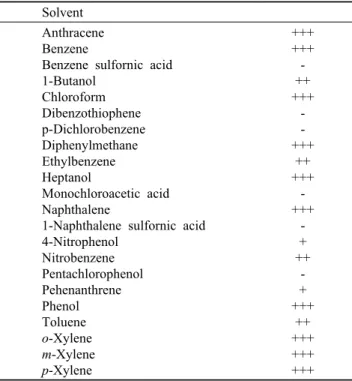
3.3. Bacillus sp. BCNU 5006의 유기용매 내성 및 분해능 유기용매에 대한 내성을 조사한 결과, n-butanol, benzene, toluene, o-, m-, p-xylene 그리고 propylbenzene을 포함한 다양한 유기용매에 대해 내성을 나타냈다 (Table 2). 각종 유기용매 및 난분해성 물질의 분해능 조사에서는 anthracene, chloroform, naphthalene, m-, p-xylene을 탄소원으로 첨가했 을 때 균의 생육이 우수함을 확인할 수 있었다. 또한 benzene, diphenylmethane, heptanol, phenol o-xylene 및 toluene 등 다양한 유기용매를 이용하는 것으로 확인되었다 (Table 3).
유기용매 내성 세균에 관한 연구는 대부분이 그람음성세 균으로 특히 Pseudomonas 속 균주에 대한 연구가 주를 이 루고 있다. 그람음성세균은 유기용매 존재하에서 유기용매 의 투과성을 감소시키기 위해 세포막 구성성분을 변화시키 거나 유기분자 수송체에 의해 세포내막 축적을 감소시키는 등 [22-24] 그 작용메커니즘이 잘 알려져 있다. 현재 Bacillus, Rhodococcus, Staphylococcus 그리고 Arthrobacter 속 균주 등 그람양성 세균의 유기용매 내성에 관한 연구가 보고되어 있으나 [25-28], 아직까지 국내에서는 연구가 미흡한 실정이
며, 더 다양한 유기용매에 대한 내성 및 분해능을 가지는 그람양성세균을 분리하고 그 작용메커니즘에 대한 연구가 필요하다고 판단된다.
Table 2. Organic solvent tolerance of Bacillus sp. BCNU 5006
Solvent log Pow
n-Hexane Propylbenzene Cyclohexane o-Xylene m-Xylene p-Xylene Toluene Benzene Chloroform Phenol n-Butanol
3.9 3.6 3.2 3.1 3.1 3.1 2.5 2.0 2.0 1.5 0.8
+ + + + + + + + - - - +: growth, -: not growth
Table 3. Biodegradation potential of Bacillus sp. BCNU 5006 Solvent
Anthracene Benzene
Benzene sulfornic acid 1-Butanol
Chloroform Dibenzothiophene p-Dichlorobenzene Diphenylmethane Ethylbenzene Heptanol
Monochloroacetic acid Naphthalene
1-Naphthalene sulfornic acid 4-Nitrophenol
Nitrobenzene Pentachlorophenol Pehenanthrene Phenol Toluene o-Xylene m-Xylene p-Xylene
+++
+++
- ++
+++
- - +++
++
+++
- +++
- + ++
- + +++
++
+++
+++
+++
Observation was done after 7 days incubation at 37℃.
Growth was visually determined: (+) acceptable; (++) moderate;
(+++) good.
3.4. 유기용매 내성 세균이 생산하는 lipase의 다양한 온도 와 pH에서의 lipase 활성
BCNU 5006의 lipase 생성을 확인하기 위해 tributyrin 첨가 배지에서 배양한 결과, lipase 생성능도 우수함이 확인되었다.
온도가 lipase에 미치는 영향을 조사하기 위해서 다양한 온도 범위에서 효소활성을 측정한 결과 37℃에서 활성이 가장 높 은 것으로 나타났고, novozyme 435가 60℃ 이상에서 급격 하게 효소활성이 감소한데 반해 BCNU 5006은 고온에서도 60% 이상의 활성을 보여 30℃의 낮은 온도보다 50-70℃의
높은 온도에서 상대적으로 높은 활성을 가진고 있는 것으로 나타났다 (Fig. 2). 또한 pH 변화에 따른 lipase의 활성은 pH 8에서 가장 높은 활성을 보였고, pH 6-7에서 80% 이상 의 활성을 유지하는 것으로 밝혀졌으며, pH 9에서도 60%
이상의 활성을 보여 비교적 넓은 범위의 pH 변화에서도 효소 활성이 우수함을 확인할 수 있었다 (Fig. 3). 따라서 Bacillus sp. BCNU 5006 균주가 생산하는 lipase는 37℃, pH 8에서 효소 활성이 가장 뛰어난 것으로 확인되었으며, 이는 Bacillus sp. BCNU 5005, Bacillus sp. FH5, Bacillus clausii SKAL-16가 생산하는 lipase와 고정화 lipase인 novozyme 435와 유사한 것으로 확인되었다 [29-31]. 한편 Bacillus sp. RN2와 B. cereus C71은 각각 45℃, 55℃, pH 9에서 효소활성이 가장 높은 것으로 보고되어 있으며, B. thermoloeovorans IHI-91는 65℃, pH 6.0에서 활성이 좋 은 것으로 보고되었다 [32,33]. 그러므로 이전의 보고에서와 비교하여도 온도와 pH에서의 안정성이 우수함이 확인되었다.
Fig. 2. Effect of temperature on lipase activity. The diluted cell-free supernatant was incubated with the substrate at different temperatures.
The activity (7.39 U/mL) at 37℃ was taken as 100%.
Fig. 3. Effect of pH on the lipase stability. The remaining activity was measured by incubating enzyme with the substrate at different pH values. The buffers used were 0.1 M sodium acetate buffer (pH 4-5), 0.1 M potassium phosphate buffer (pH 6-7), and 0.1 M Tris HCl buffer (pH 8-10).
3.5. Lipase의 안정성 및 활성에 미치는 유기용매의 영향 25% (v/v) 고농도의 다양한 유기용매하에서 BCNU 5006이 생산하는 lipase의 안정성을 조사한 결과, octane을 첨가했 을 때 107%로 효소활성이 증가했으며, chloroform, decane, ethylbenzne 첨가시 잔존효소활성이 80% 이상으로 높은 것 으로 나타났다. 또한 chloroform, cyclohexane, xylene을 첨가
했을 때는 고정화 lipase인 novozyme 435보다 더 안정함을 확인할 수 있었다 (Fig. 4). Bacillus sp.와 Acinetobacter sp.
는 각각 acetone과 n-hexadecane을 첨가했을 때 효소활성이 증가됨을 확인하였고, n-hexane과 benzene 첨가시 효소활성 에 저해를 받는다는 결과와 비교하여 BCNU 5006은 decane 과 ethylbenzne 첨가했을 때도 80% 이상의 효소 활성도를 보여 독성이 강한 유기용매하에서도 비교적 안정한 효소활성 을 가진 것을 확인할 수 있었다 [34,35]. 또한 고정화 효소와 비교하여도 손색없는 유기용매 안정성을 보여 별도의 고정 화 과정없이 바로 유기용매계 또는 소수계에서의 효소반응에 적용가능한 것으로 판단된다.
Fig. 4. Effect of organic solvent on the lipase stability. An aliquot of 3 mL enzyme solution (cell-free supernatant or novozyme 435 solution) was incubated with 1 mL organic solvent at 37℃ for 2 h with shaking and the remaining activity was measured. The lipase activity of the non-solvent containing control was taken as 100%.
3.6. Lipase 활성에 미치는 금속이온의 영향
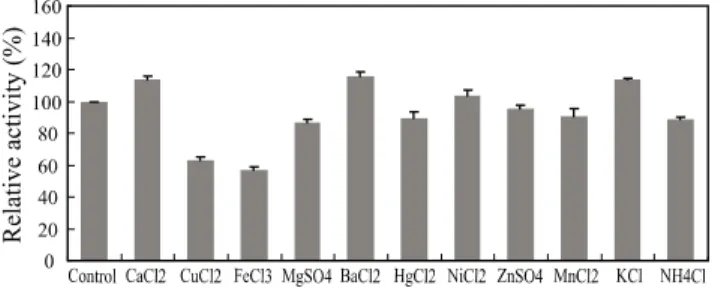
폐수에 유기물이나 유기물과 착염을 형성하고 있는 금속이 효소 활성에 많은 영향을 미치고 있다. 그러므로 본 연구에 서 다양한 유기물과 착염을 형성하고 있는 금속을 첨가하여 잔존활성을 측정하였다. CaCl2, BaCl2, NiCl2, KCl를 첨가했 을 때 100-110% 이상으로 효소활성이 증가하였으며, MgSO4, HgCl2, ZnSO4, MnCl2, NH4Cl를 첨가했을 때도 80% 이상으 로 높은 효소활성을 나타내었다 (Fig. 5). B. thermoleovorans ID-1은 Ca2+와 Zn2+이 활성인자로 작용했으며, Bacillus sp.
FH5 균주는 Ba2+, Fe2+, Mn2+, Ca2+, Mg2+, Hg2+가 활성인자 로, Cu2+, Co2+, Na+, Zn2+가 효소활성을 저해하는 것으로 보고 되었다 [31,36]. 그러므로 본 연구에서 조사한 lipase도 Ca2+, Zn2+, Mg2+, Hg2+이 활성인자로 작용하는 것으로 확인되었다.
Fig. 5. Effect of metal ion on the lipase activity of BCNU 5006. The enzyme was incubated with various metal ions at the concentration of 1 mM at 37℃ for 1 h, and the remaining activity was measured by the spectrophotometer assay.
4. 결론
미생물을 이용한 생물전환 및 생물학적 처리 기술개발의 선 행연구로써 필수적인 유기용매 내성균을 탐색하기 위하여 시화공단 일대의 토양에서 각종 유기용매를 분해하는 동시 에 유기용매 내성 lipase를 생성하는 유기용매 내성 Bacillus sp. BCNU 5006을 분리하였다. 산업적으로의 적용가능성을 확인하기 위하여 각종 유기용매의 분해활성을 조사하였고, lipase 활성에 영향을 미치는 각종인자에 대해 조사하였다.
BCNU 5006 균주는 B. vallismortis와 B. amyloliquefaciene 의 subcluster에 속하는 균주로서 다양한 유기용매 및 난분 해성물질에 대한 내성 및 분해능을 가진 것으로 나타났다. 균주가 생산하는 lipase는 37℃, pH 8에서 효소 활성이 가장 뛰어난 것으로 확인되었으며, 이는 산업적으로 사용되는 고정화 lipase인 novozyme 435와 유의한 것으로 확인되었 다. 또한 Bacillus sp. BCNU 5006 균주가 생산하는 lipase는 37℃, pH 8 조건에서 고농도의 octane 첨가시 효소활성이 오히려 증가하였으며, chloroform, cyclohexane, xylene을 첨가했을 때는 novozyme 435보다 더 안정한 것으로 나타 났다. 각종 금속이온에 대한 영향은 대부분의 금속이온에 대해 높은 효소활성을 보였으며 특히, CaCl2, BaCl2, NiCl2, KCl을 첨가했을 때 효소활성이 100% 이상으로 증가하였 고, CuCl2, FeCl3을 첨가하였을 때 효소활성이 61%, 54%로 다소 저해되는 것으로 나타났다.
본 연구에서 선별된 유기용매 내성 Bacillus sp. BCNU 5006 균주는 산업단지에서 배출되는 다양한 유기용매 및 난분해성 물질에 대해 뛰어난 분해능을 가지고 있었으며, 고온에서도 일정한 효소활성을 유지하였고 넓은 pH 범위 에서 안정함이 확인되었다. 또한 현재 상업적으로 생산되어 이용되고 있는 고정화 lipase와 비교했을 때 고농도의 다양 한 유기용매하에서도 안정적인 효소활성을 유지하였고, 각종 중금속에 대해서도 안정함이 확인되었다. 그러므로 본 연구 에 사용한 균주는 환경 및 화학산업 등 다양한 산업분야에 적용될 수 있는 기능성을 갖춘 새로운 균주로 사료된다.
감사
본 연구는 한국연구재단 기본연구지원사업 (과제번호: 2010- 0009141)에 의해 지원되었으므로 이에 감사드립니다.
References
1. Zilli, M., A. Converti, A. Lodi, M. Del Borghi, and G. Ferraiolo (1993) Phenol removal from waste gases with a biological filter by Pseudomonas putida. Biotechnol. Bioeng. 41: 693-671.
2. Ji, Q., S. Xiao, B. He, and X. Liu (2010) Purification and characterization of an organic solvent-tolerant lipase from Pseudomonas aeruginosa LK1 and its application for biodiesel production. J. Mol. catal. B: Enzyme 66: 264-269.
3. Lee, S. K. and S. B. Lee (2001) Isolation and characterization of a thermotolerant bacterium Ralstonia sp. strain PHS1 that
degrades benzene, toluene, ethylbenzene, and o-xylene. Appl.
Microbiol. Biotechnol. 61: 1-12.
4. Stensel, H. D. and S. Reiber (1983) Industrial wastewater treatment with a new biological fixed film system. Environ.
Prog. 2: 110-114.
5. Pinkart, H. C., J. W. Wolfram, R. Rogers, and D. C. White (1996) Cell envelope changes in solvent-tolerant and solvent sensitive Pseudomonas putida strains following exposure to o-xylene. Appl. Environ. Microbiol. 62: 1129-1132.
6. Pandey, A., S. Benjamin, C. R. Soccol, P. Nigam, N. Krieger, and U. T. Soccol (1999) The realm of microbial lipases in biotechnology. Biotechnol. Appl. Biochem. 29: 119-131.
7. Fang, Y., Z. Lu, F. Lv, X. Bie, S. Liu, Z. Ding, and W. Xu (2006) A newly isolated organic solvent tolerant Staphylococcus saprophyticus M36 produced organic solvent stable lipase.
Curr. Microbiol. 53: 510-515.
8. Hasan, F., A. A. Shah, and A. Hameed (2006) Industrial applications of microbial lipase. Enzyme Microb. Technol.
39: 235-251.
9. Yogita, N., Y. Sardessai, and S. Bhosle (2004) Industrial potential of organic solvent tolerant bacteria. Biotechnol.
prog. 20: 655-660.
10. Dandavate, V., J. Jinjala, H. Keharia, and D. Madamwar (2009) Production, partial purification and characterization of organic solvent tolerant lipase from Burkholderia multivorans V2 and its application for ester synthesis. Bioresour. Technol. 100:
3374-3381.
11. Magnusson, A. O., J. C. Rotticci-Mulder, A. Santagostino, and K. Hult (2005) Creating space for large secondary alcohols by rational redesign of Candida antarctica lipase B. Chem. Biochem.
6: 105-1056.
12. Laane, C. (1987) Medium engineering for bioorganic synthesis.
Biocatalysis 30: 80-87.
13. Doukyu, N. and H. Ogino (2010) Organic solvent-tolerant enzymes. J. Biochem. Bioeng. 48: 270-282.
14. Ogino, H., K. Miyamoto, and H. Ishikawa (1994) Organic solvent-tolerant bacterium which secretes an organic solvent- stable lipolytic enzyme. Appl. Environ. Microbiol. 60: 3884-3885.
15. Castro, G. R. and T. Knubovets (2003) Homogeneous biocatalysis in organic solvents and water-organic mixtures. Crit. Rev.
Biotechnol. 23: 195-231.
16. Khmelnitsky, Y. L., A. V. Levashov, N. L. Klyachko, and K.
Martinek (1988) Engineering biocatalytic systems in organic media with low water content. Enzyme Microb. Technol. 10: 710-724.
17. Saito, N. and M. Nei (1987) The neighbor-joining method, a new method for reconstructing phylogenetic trees. Mol. Biol. Evol.
79: 426-434.
18. Thompson, J. D., D. G. Higgins, and T. J. Gibson (1994) CLUSTAL W: Improving the sensitivity of progressive multiple sequence alignment through sequence weighting, position- specific gap penalties and weight matrix choice. Nucleic Acids Res. 22: 4673-4680.
19. Gaur, R., A. Gupta, and S. K. Khare (2008) Lipase from solvent tolerant Pseudomonas aeruginosa strain: production optimization by response surface methodology and application. Bioresour.
Thehnol. 99: 4796-4802.
20. Winkler, U. K., A Gupta, and M. Stuckmann (1979) Glycoen, hyalurinate, and some other polysaccharides greatly enhance the formation of exolipase by Serratua narcescens. J. Bacteriol.
138: 663-670.
21. Ogino, H., K. Miyamoto, M. Yasuda, K. Ishimi, and H. Ishikawa (1999) Growth of organic solvent-tolerant Pseudomonas aeruginosa LST-03 in the presence of various organic solvents and production of lipolytic enzym e in the presence of cyclohexane. Biochem. Eng. J. 4: 1-6.
22. Pinkart C, J. W. Wolfram, R. Rogers, and D. White (1996) Cell envelope changes in solvent tolerant and solvent sensitive Pseudomonas putida strains following exposure to o-xylene.
Appl. Environ. Microbiol. 62: 1129-1132.
23. Tsubata, T., T. Tezuka, and R. Kurane (1997) Change of cell membrane hydrophobicity in a bacterium tolerant to toxic alcohols. Can. J. Microbiol. 43: 295-299.
24. Heipieper, H. J., F. Meinhardt, and A. Segura (2003) The cis-, trans isomerase of unsaturated fatty acids in Pseudomonas and Vibrio: biochemistry, molecular biology and physiological function of a unique stress adaptive mechanism. FEMS Microbiol. Lett. 229: 1-7.
25. Baigorí, M. D., G. R. Castro, and F. Siñeriz (1996) Purification and characterization of an extracellular esterase from Bacillus subtilis MIR-16. Biotechnol. Appl. Biochem. 24: 7-11.
26. Na, K. S., A. Kuroda, N. Takiguchi, T. Ikeda, H. Ohtake, and J.
Kato (2005) Isolation and characterization of benzene-tolerant Rhodococcus opaccus strains. J. Biosc. Bioeng. 99: 378-382.
27. Nielsen, L. E., D. R. Kadavy, S. Rajagopal, R. Drijber, and K. W. Nickerson (2005) Survey of extreme solvent tolerance in Gram-positive cocci: membrane fatty acid changes in Staphylococcus haemolyticus grown in toluene. Appl. Environ.
Microbiol. 71: 5171-5176.
28. Zahir, Z., K. D. Seed, and J. J. Dennis (2006) Isolation and characterization of novel organic solventtolerant bacteria.
Extremophiles 10:129-138.
29. Hasan, F., A. A. Shah, and A. Abul-Hameed (2006) Influence of culture conditions on lipase production by Bacillus sp. FH5.
Ann. Microbiol. 56: 247-252.
30. Lee, S. H. and D. H. Park (2008) An alkaliphilic bacterium isolation and physiological characterization of Bacillus clausii SKAL-16 isolated from wastewater. J. Microbiol. Biotechnol.
18: 1908-1914.
31. Choi, H. J., M. J. Hwang, Y. K. Jeong, and W. H. Joo (2011) Evaluation of the Potential of Organic Solvent Tolerant Bacillus sp. BCNU 5005. J. Life Sci. 21: 700-705.
32. Kanjanavas, P., S. Khuchareontaworn, P. Khawsak, A.
Pakpitcharoen, K. Pothivejkul, S. Santiwatanakul, K. Matsui.
T. K ajiw ara, and K . C hansiri (2010) Purification and characterization of organic solvent and detergent tolerant lipase from thermotolerant Bacillus sp. RN2. Int. J. Mol. Sci.
11: 3783-3792.
33. Shaoxin, C., Q. Lilia, and S. Bingzhao (2007) Purification and properties of enantioselective lipase from a newly isolated Bacillus cereus C71. Process Biochem. 42: 988-994.
34. Sugihara, A., T. Tani, and Y. Tominaga (1991) Purification and characterization of a novel thermostable lipase from Bacillus sp. J. Biochem. 109: 211-216.
35. Chen, S. J., C. Y. Cheng, and T. L. Chen (1998) Production of an alkaline lipase by Acinetobacter radioresistens. J. Ferment Bioeng. 86: 308-312.
36. Lee, D. W., Y. S. Koh, K. J. Kim, B. C. Kim, H. J. Choi, and D.
S. Kim (1999) Isolation and characterization of a thermophilic lipase from Bacillus thermoleovorans ID-1. FEMS Microbiol.
Lett. 179: 393-400.