Veterinary Science
DOI: 10.4142/jvs.2011.12.1.57
Received: 23 Mar. 2010, Accepted: 05 Jun. 2010
Original Article
*Corresponding author
Tel: +82-31-467-1783; Fax: +82-31-467-1797 E-mail: [email protected]
Molecular characterization of Korean rabies virus isolates
Dong-Kun Yang
1,*, Young-Nam Park
2, Gyeong-Soo Hong
2, Hee-Kyung Kang
1, Yoon-I Oh
1, Soo-Dong Cho
1, Jae-Young Song
11
National Veterinary Research and Quarantine Service, Anyang 430-824, Korea
2
Gangwon-do Veterinary Service Laboratory, Chuncheon 200-822, Korea
The nucleoprotein (N) and glycoprotein (G) of 11 Korean rabies virus (RABV) isolates collected from animals diagnosed with rabies between 2008 and 2009 were subjected to molecular and phylogenetic analyses. Six isolates originated from domestic animals (cattle and dogs) and five were obtained from wild free-ranging raccoon dogs. The similarities in the nucleotide sequences of the N gene among all Korean isolates ranged from 98.1 to 99.8%, while those of the G gene ranged from 97.9 to 99.3%. Based on the nucleotide analysis of the
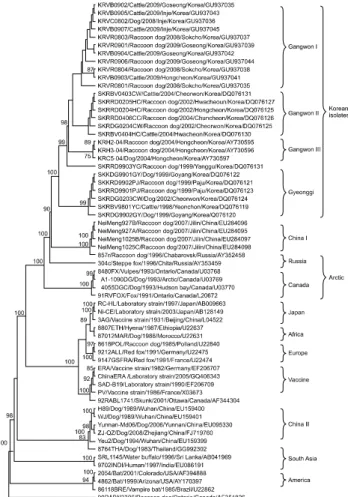
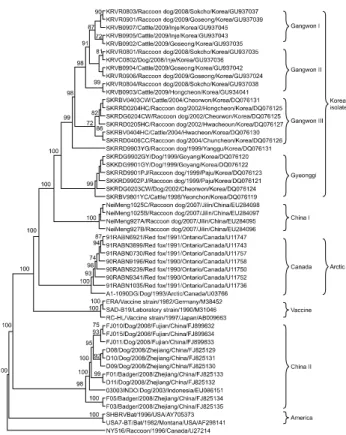
N and G genes, the Korean RABV isolates were confirmed asgenotype I of Lyssavirus and classified into four distinct subgroups with high similarity. Phylogenetic analysis showed that the Korean isolates were most closely related to the non-Korean NeiMeng1025B and 857r strains, which were isolated from rabid raccoon dogs in Eastern China and Russia, respectively. These findings suggest that the Korean RABV isolates originated from a rabid raccoon dog in Northeastern Asia. Genetic analysis of the Korean RABV isolates revealed no substitutions at several antigenic sites, indicating that the isolates circulating in Korea may be pathogenic in several hosts.
Keywords: characterization, genotype I, molecular epidemiology, rabies virus
Introduction
Rabies is an almost invariably fatal viral disease in animals and humans. According to the World Health Organization, rabies infections result in approximately 55,000 human deaths worldwide annually [23]. More than 29,000 human deaths from rabies were reported in Far East Asia including Thailand and China in 2006. However, there were no cases of human rabies reported in some countries such as Japan, Singapore, Korea, Malaysia and Taiwan in 2006 [5]. Rabies
is transmitted by vector species such as bats, red foxes, skunks, raccoon dogs, dogs, wolves, and mongooses, depending on the country [9,12]. Dogs were known to be the main vectors for the transmission of rabies virus (RABV) to humans or other animals in Korea prior to 1980. Raccoons such as Nyctereutes procyonoide and Procyon lotor have been involved in RABV circulation in eastern Europe and the eastern United States since the late 1990s [2,13,23].
RABV belongs to the genus Lyssavirus in the family Rhabdoviridae and consists of a non-segmented negative single-stranded RNA genome that encodes five structural proteins: nucleoprotein (N), phosphoprotein, matrix protein, glycoprotein (G), and large protein [12]. Recent advances in technology have contributed to better understanding of the molecular epidemiology and geographic relationships of RABV isolates [20,21,26]. The nucleoprotein, which contains antigenic sites such as NI and NIII, is associated with encapsidation of the genomic RNA and the formation of an active cytoplasmic ribonucleoprotein complex that is essential for viral replication [25]. The N gene or protein has been targeted for diagnosing wild rabies using RT-PCR or indirect fluorescent antibody tests because the gene is highly conserved and the protein is produced in large quantities in infected brain tissue. Moreover, the nucleotide sequence of the N gene has been used extensively as a molecular marker to explain the patterns of the geographic distribution of RABV at the regional and global levels [20]. The glycoprotein plays an important role in attachment of the virus to the host cell surface, pathogenicity, immunogenicity, and neurovirulence [6,14,19]. Additionally, the RABV G gene has been used as another target for studying genetic diversity and antigenic typing because it contains several major antigenic sites designated as I∼VI, ‘a’, and G1 on the ectodomain (1∼439 amino acids) and is related to pathogenicity.
In Korea, the first case of rabies was reported in 1907, and
a number of rabies cases were identified nationwide until
1945 [8]. After implementing an effective RABV control
program using live and inactivated vaccine, the number of
rabies cases decreased dramatically to an average of 32 cases
per year by 1984, and there were no reports of rabies between
Fig. 1. Map of Far East Asia and Korea showing the geographical location from which the rabies viruses were obtained. The isolates circled in Far East Asia showed high nucleotide similarity.
1985 and 1992 [7,11]. However, rabies was identified in a dog in Gyeonggi-do Province in 1993. Since then, a few rabies cases have been reported annually. Although a renewed national RABV control program involving the distribution of bait vaccine was implemented in early 2000, rabies still occurs in some regions of Korea. Korean RABV isolates collected between 1998 and 2004 have been identified as genotype I and found to be closely related to the Arctic lineage virus, but distantly related to other Asian strains including Chinese and Sri Lanka strains [8,16].
Therefore, we analyzed the N and G gene diversity of the recent strain of RABV circulating in Korea as well as the correlation among rabies genes and phylogenetic relationships. The genetic characterization of RABV is considered important for developing diagnostic and preventive measures, including a more effective vaccine. In this study, we cloned and sequenced the N and G genes of 11 RABV isolates obtained between 2008 and 2009 in Korea and analyzed the phylogenetic relationships of the isolates with other available sequences retrieved from GenBank.
Materials and Methods Samples
Eleven RABV isolates were obtained from brain samples that had tested positive for rabies using indirect immunofluorescence with monoclonal antibody against the N gene in Gangwon-do Province of Korea between 2008 and 2009. Five isolates (KRVR0801, KRVR0803, KRVR0804, KRVR0901, and KRVR0906) originated from raccoon dogs (Nyctereutes procyonoides koreensis), while another five isolates (KRVB0902, KRVB0903, KRVB0904,
KRVB0905, and KRVB0907) were from cattle, and one (KRVC0802) was from a dog. These Korean RABV isolates are described in Fig. 1 and Table 1.
Extraction of viral RNA and RT-PCR
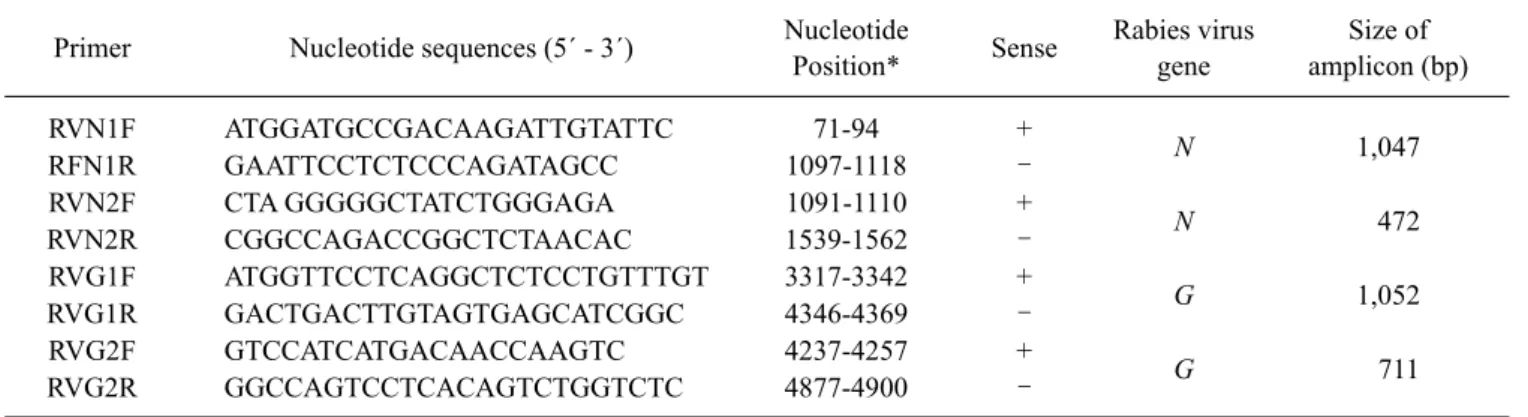
Viral RNA was extracted from the 11 isolates using an RNA extraction kit (Qiagen, Germany) according to the manufacturer’s instructions. The extracted RNA was eluted in 50 μ L of RNase- and DNase-free water. RT-PCR was conducted using primers specific for the N and G regions of RABV (RVN1F, RVN1R, RVN2F, RVN2R, RVG1F, RVG1R, RVG2F, and RVG2R; Table 2). RT-PCR was conducted in a reaction mixture containing 10 μ L of denatured RNA, 1 μ L of each primer (50 pmol), 10 μ L of 5 × buffer (12.5 mM MgCl
2), 2 μ L of dNTP mix, 2 μ L of enzyme mix (reverse transcriptase and Taq polymerase), and 24 μ L of distilled water (Qiagen, Germany). The cycling profile consisted of cDNA synthesis at 42
oC for 30 min, followed by 35 cycles of 95
oC for 45 sec, 50
oC for 45 sec, and 72
oC for 1 min, with a final extension at 72
oC for 5 min.
The PCR products were visualized using electrophoresis on 1.8% agarose gels containing ethidium bromide.
Cloning and sequencing
All of the PCR products that were purified using the gel extraction kit were ligated with pGEM-T easy vector (Promega, USA) according to the manufacturer’s protocol.
Plasmid DNA was isolated from amplified Escherichia coli
(DH5 α ), and recombinant plasmids were identified by
EcoRI enzyme digestion (Bioneer, Korea). The sequences
of the purified plasmids were analyzed using an MJ
Research PTC-225 Peltier Thermal Cycler and ABI PRISM
Table 1. The Korean rabies virus isolates analyzed in this study
Isolates Locality Species Year of isolation Accession number
N* gene G†
gene
KRVR0801 Sokcho Raccoon dog 2008 GU937035 GU937024
KRVC0802 Inje Dog 2008 GU937036 GU937025
KRVR0803 Sokcho Raccoon dog 2008 GU937037 GU937026
KRVR0804 Sokcho Raccoon dog 2008 GU937038 GU937027
KRVR0901 Goseong Raccoon dog 2009 GU937039 GU937028
KRVB0902 Goseong Cattle 2009 GU937040 GU937029
KRVB0903 Hongcheon Cattle 2009 GU937041 GU937030
KRVB0904 Goseong Cattle 2009 GU937042 GU937031
KRVB0905 Inje Cattle 2009 GU937043 GU937032
KRVR0906 Goseong Raccoon dog 2009 GU937044 GU937033
KRVB0907 Inje Cattle 2009 GU937045 GU937034
SKRBV9801YC Yeoncheon Cattle 1998 DG076119 DQ076105
SKRRD9901PJ Paju Raccoon dog 1999 DQ076123 DQ076103
SKRRD9902PJ Paju Raccoon dog 1999 DQ076121 DQ076102
SKRRD9903YG Yanggu Raccoon dog 1999 DQ076131 DQ076099
SKRDG9901GY Goyang Dog 1999 DQ076122 DQ076100
SKRDG9902GY Goyang Dog 1999 DQ076120 DQ076101
SKRRD0204CW Cheorwon Raccoon dog 2002 DQ076125 DQ076094
SKRRD0205HC Hwacheoun Raccoon dog 2002 DQ076127 DQ076096
SKRDG0203CW Cheorwon Dog 2002 DQ076124 DQ076104
SKRDG0204HC Hwacheon Dog 2002 DQ076128 DQ076093
SKRRD0406CC Chuncheon Raccoon dog 2004 DQ076126 DQ076098
SKRBV0403CW Cheorwon Cattle 2004 DQ076129 DQ076095
SKRBV0404HC Hwacheon Cattle 2004 DQ076130 DQ076097
KRH2-04 Hongcheon Raccoon dog 2004 AY730595 -
KRH3-04 Hongcheon Raccoon dog 2004 AY730596 -
KRC5-04 Hongcheon Dog 2004 AY730597 -
*N: nucleoprotein, †G: glycoprotein.
Table 2. List of the oligonucleotide primers used for RT-PCR of rabies virus Primer Nucleotide sequences (5´ - 3´) Nucleotide
Position* Sense Rabies virus gene
Size of amplicon (bp)
RVN1F ATGGATGCCGACAAGATTGTATTC 71-94 +
N
1,047
RFN1R GAATTCCTCTCCCAGATAGCC 1097-1118 –
RVN2F CTA GGGGGCTATCTGGGAGA 1091-1110 +
N
472
RVN2R CGGCCAGACCGGCTCTAACAC 1539-1562 –
RVG1F ATGGTTCCTCAGGCTCTCCTGTTTGT 3317-3342 +
G
1,052
RVG1R GACTGACTTGTAGTGAGCATCGGC 4346-4369 –
RVG2F GTCCATCATGACAACCAAGTC 4237-4257 +
G
711
RVG2R GGCCAGTCCTCACAGTCTGGTCTC 4877-4900 –
*The positions of primers are based on the ERA strain (GenBank accession no. EF206707).