Chinese yam (Dioscorea opposita Thunb.) is a perennial crop consumed as a vegetable and as a source of herbal medicines in East Asia. In Korea, two virus species including Broad bean wilt virus 2 (BBWV2), and Chinese yam necrotic mosaic virus (CYNMV) have been reported to infect Chinese yam (Kang et al., 2003;
Kwon et al., 2016). Infection of Chinese yam with CYNMV was the first report in Japan in 1978 (Fukumoto and Tochihara, 1978).
Since then, CYNMV has been considered of important virus in Chinese yam because of serious yield loss (Kondo, 2001a; Kondo and Fujita, 2012; Kondo et al., 2007). While BBWV2 infection of Chinese yam was identified very recently in Korea, the infection of Chinese yam with CYNMV was reported in 2003 in Korea (Kang et al., 2003).
CYNMV, a member of the genus Macluravirus in the Family Po- tyviridae, is a flexuous, filamentous virus with 660 nm in length (Fukumoto and Tochihara, 1978). CYNMV is easily transmitted by aphids in a nonpersistent manner but its host range is restricted to Dioscorea spp. (Fukumoto and Tochihara, 1978; Kondo et al., 2015). The size of the complete genome of CYNMV is approxi- mately 8,230 nucleotides (nt). Currently, only two complete genome sequences of the CYNMV isolates (one from Japan and another from China) are available in the GenBank database. A previous study reported the 3’-proximal partial sequences of a CYNMV Korean isolate but no complete genome sequence of CYNMV isolated in Korea has been determined yet (Kondo et al., 2003). Therefore, we decided to determine the complete genome sequence of a CYNMV Korean isolate to examine mo- lecular characteristics of the Korean isolate and to generate mo- lecular detection primers specific for CYNMV Korean isolates.
©The Korean Society of Plant Pathology
ccThis is an open access article distributed under the terms of the Creative Commons Attribution Non-Commercial License (http://creativecommons.org/
licenses/by-nc/4.0/), which permits unrestricted non-commercial use, distribution, and reproduction in any medium, provided the original work is properly cited.
Open Access
Res. Plant Dis. 22(3): 194-197 (2016)
http://dx.doi.org/10.5423/RPD.2016.22.3.194
Complete Sequence Analysis of a Korean Isolate of Chinese Yam Necrotic Mosaic Virus and Generation of the Virus Specific Primers for Molecular Detection
*Corresponding author Tel: +82-63-238-6323 Fax: +82-63-238-6305 E-mail: [email protected]
Sun-Jung Kwon*, In-Sook Cho, Seung-Kook Choi, Ju-Yeon Yoon, and Gug-Seoun Choi
Department of Horticultural Environment, National Institute of Horticultural and Herbal Science, Rural Development Administration, Wanju 55365, Korea
Received June 8, 2016 Revised August 3, 2016 Accepted September 8, 2016
Chinese yam necrotic mosaic virus (CYNMV) is one of the most widespread viruses in Chinese yam (Dioscorea opposita Thunb.) and causes serious yield losses. Currently, genetic information of CYNMV is very restricted and complete genome sequences of only two isolates (one from Japan and another from China) have been reported. In this study, we determined complete genome sequence of the CYNMV isolate AD collected from Andong, Korea. Genetic analysis of the polyprotein amino acid sequence revealed that the Korean isolate AD has high similarity with the Japanese isolate PES3 (97%) but relatively low similarity with the Chinese isolate FX1 (78%). Phylogenetic analysis using the CYNMV 3’ proximal nucleotide sequences harboring the coat protein and 3’ untranslated region further supported genetic relationship among the CYNMV isolates. Based on comparative analysis of the CYNMV genome sequences determined in this study and other previous studies, we generated molecular detection primers that are highly specific and efficient for CYNMV diagnosis.
Keywords: Chinese yam, Chinese yam necrotic mosaic virus, Complete genome, Genetic analysis
Research in Plant Disease pISSN 1598-2262, eISSN 2233-9191 www.online-rpd.org
식물병연구 Note
194
To collect CYNMV Korean isolates, we performed a field survey in Andong in June 2015. We collected some Chinese yam leaf samples showing viral symptoms including necrotic mosaic, mottle and yellowing (Fig. 1A). The collected samples were subjected first to transmission electron microscopy to examine existence of virus particles. A few samples contained filamen- tous virus particles, suggesting that the samples infected with a virus belonging to the family Potyviridae, possibly CYNMV (Fig.
1B). Indeed, CYNMV infection of the samples was confirmed by reverse transcription (RT)-polymerase chain reaction (PCR) using the specific primers designed based on the 3’ partial sequences of the CYNMV Japanese isolates (data not shown) (Kondo, 2001b; Kondo et al., 2007). One CYNMV sample, which was named as AD, was further processed to determine its full- length genome sequence. Total RNA was extracted from the CYNMV-infected leaf and subjected to synthesize cDNAs using the Superscript III reverse transcriptase (Thermo Fisher Scien- tific, Waltham, MA, USA), a specific primer designed based on the full genome sequences of the CYNMV Japanese isolates (5’-TCGGCTCTTAGCAGCATACCTT-3’, which is complementary to nt 4,390–4,411), and a tagged oligo (dT) primer (5’-GACTAGCTG- GAATTCGCGGTTAAATTTTTTTTTTTTTTTT-3’, the tag sequence is italicized). Two large fragments covering the CYNMV full-length genome were amplified using Phusion DNA polymerase (New England Biolabs, Ipswich, MA, USA) and appropriate primer pairs (5’-CGAATCGAACGCAAAGCAATCAAA-3’ and 5’-TCGGCTCTTAG- CAGCATACCTT-3’, for 5’ fragment PCR; 5’-TGGTTGTTGTGGGAT- GATGATG-3’ and 5’-GACTAGCTGGAATTCGCGGTTAAA-3’, for 3’
fragment PCR). Adjacent regions of these PCR fragments were overlapped each other by at least 200 bp to ensure that the am- plified fragments were from the same genome. The amplified PCR fragments were subjected directly to Sanger DNA sequenc-
ing using appropriate sequencing primers (Primer sequences are available upon request.). The 5’ terminal sequence of CYNMV was analyzed by the 5’ rapid amplification of cDNA ends method as described previously (Kwon et al., 2014).
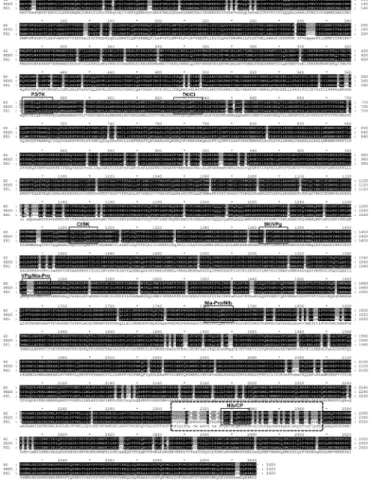
The complete genome sequence of the CYNMV isolate AD was 8,224 nt, excluding the 3’ poly(A) tail and deposited in Gen- Bank under the accession No. KX352243. The genome has the untranslated regions (UTRs) of 130 and 231 nt at the 5’ and 3’ ter- mini, respectively, and reveals the typical genome structure of CYNMV that contains one large open reading frame consisting of 9 mature proteins (HC-Pro, P3, 7K, CI, 9K, VPg, NIa-Pro, NIb, and coat protein [CP]). Currently, two complete genome sequences of the CYNMV isolates PES3 (GenBank accession No. AB710145) and FX1 (GenBank accession No. KJ789135) that were isolated from Japan and China, respectively, are available from the GenBank database. Comparative analysis of the polyprotein sequence of the CYNMV Korean isolate AD was conducted with those of the isolates PES3 and FX1 using the ClustalX2 and GeneDoc programs (Fig. 2). The comparison of amino acid sequence identity of polyprotein region of AD revealed high similarity with PES3 (97%) but relatively low similarity with FX1 (78%). The alignment of thee CYNMV isolates indicated that the region harboring the C-terminus of NIb and the N-terminus of CP (marked as the dotted box in Fig. 2) is the most variable re- gion.
To examine the phylogenetic position of the CYNMV Korea isolate AD, we sought to perform phylogenetic analyses using the CYNMV 3’ proximal nt sequences (approximately 1,098 bp) containing the CP and 3’ UTR because the sequences of the corresponding region of various Japanese isolates of CYNMV are available in the GenBank database. The isolate YS of Yam chlorotic necrotic mosaic virus (YCNMV; GenBank accession
Research in Plant Disease Vol. 22 No. 3 195
A B
Fig. 1. (A) Symptoms on a Chinese yam plant infected with Chinese yam necrotic mosaic virus (CYNMV). (B) Observation of a filamentous virus particle of CYNMV that belongs to the genus Macluravirus in the Family Potyviridae under transmission electron microscopy. Scale bar=200 nm.
No. KT724961) was included as an outgroup for the phyloge- netic analysis. The phylogenetic tree was reconstructed by the neighbor-joining methods and Kimura 2-parameter method with bootstrap (1,000 replicates) using MEGA 6 (Tamura et al., 2013). Phylogenetic analysis showed that the CYNMV isolate AD is more closely related to four Japanese isolates IW1, TT1, TT5, and IB4 and one Korean isolate KR1 than other Japanese isolates (YS117, HD12, NN9, NN12, PES3, HD9, NS2, MD3, YTW1, KM3, KK1, and HK61) (Fig. 3). As expected from the comparison of the polyprotein amino acid sequences, the Chinese isolate FX1 formed a separate branch in the phylogenetic tree (Fig.
3). Although the isolate IW5 was found to be distantly related to the isolate IW1, in general, the phylogenetic tree showed a geographical relationship among the analyzed isolates. This might be correlated with the cultivation method and vegetative
propagation of Chinese yam in each regional area.
Based on the sequence comparison among the reported CYNMV isolates, we generated CYNMV-specific detection prim- ers that bind to the highly conserved motifs at the 3’ proximal region of the CYNMV genome: CYNMV-Det-Fw, 5’-GTGTGCTAA- CAATGGTACATCATC-3’ (corresponding to nt 7,534–7,557) and CYNMV-Det-Rv, 5’-GTGCGTTGAGGGTTGCTGAGC-3’ (comple- mentary to nt 8,123–8,143). To test the detection specificity of the primers, 10 symptomatic Chinese yam samples were sub- jected to RT-PCR. Because BBWV2 infection was found to be fre- quent in Chinese yam in Korea (Kwon et al., 2016), the samples were also subjected for BBWV2 detection using the specific primers (5’-AAACAAACAGCTTTCGTTCCG-3’ and 5’-GCCATCT- Research in Plant Disease Vol. 22 No. 3
196
Fig. 2. Alignment of the polyprotein amino acid sequences of three Chinese yam necrotic mosaic virus (CYNMV) isolates. The iso- lates AD (KX352243), PES3 (AB710145), and FX1 (KJ789135) were collected in Korea, Japan, and China, respectively. Sequences were aligned by ClustalX2. Viral mature protein cleavage sites were indicated by solid-line boxes. The highly variable region among the isolates was indicated by a dotted-line box.
Andong, Korea Iwate, Japan Tottori, Japan Tottori, Japan
Andong, Korea Aomori, Japan
Aomori, Japan Hokkaido, Japan Nagano, Japan Nagano, Japan
Hokkaido, Japan Aomori, Japan Aomori, Japan Aomori, Japan Aomori, Japan Aomori, Japan Aomori, Japan Aomori, Japan Iwate, Japan
Chengwu, China YCNMV (outgroup) AD
IW1 TT5 TT1 IB4 KR1
YS117 HD12 NN12 NN9
HD9 NS2 PES3 MD3 YTW1 KM3 KK1 HK61 IW5 62
97
69 68 90
74
100
100 64
76
80
FX1
0.05
Fig. 3. Phylogenetic analysis of the Chinese yam necrotic mosaic virus (CYNMV) 3’ proximal nucleotide sequences containing the coat protein and 3’ untranslated region. The isolate YS of Yam chlorotic necrotic mosaic virus (YCNMV; GenBank accession No.
KT724961) was included as an outgroup. The phylogenetic trees were reconstructed by the neighbor-joining method applying Kimura’s two-parameter method. The numbers on the branches indicate bootstrap percentages based on 1,000 replications (Only values >60% are shown.). GenBank accession numbers of the CYNMV isolate sequences included in the analysis: AD (KX352243), FX1 (KJ789135), HD9 (AB098348), HD12 (AB098349), HK61 (AB098346), IB4 (AB098344), IW1 (AB098350), IW5 (AB098351), KK1 (AB098341), KM3 (AB255747), KR1 (AB098356), MD3 (AB098342), NN9 (AB098352), NN12 (AB098353), NS2 (AB098343), PES3 (AB710145), TT1 (AB098354), TT5 (AB098355), YS117 (AB098345), and YTW1 (AB098347). The collection site was indicated on the right side of each isolate.
CATTGGCATGGA-3’). The RT-PCR reaction was performed in two- steps. RT reaction was performed as follows in a total of 20 μl of reaction volume. One μg of total/mixed RNA was denatured at 70oC for 5 minutes with 10 μM of the reverse primers. The RT reaction was incubated at 42oC for 1 hour with 30 U of AMV Reverse Transcriptase (Promega, Fitchburg, WI, USA), followed by heat inactivation at 80oC for 5 minutes. Three μl of the result- ing cDNA was amplified by PCR using GoTaq® DNA polymerase (Promega) and a set of the foreword and reverse primers (each 10 μM) in a total of 50 μl of reaction volume. The optimized PCR condition is as follows: initial denaturation at 94oC for 2 minutes and 35 cycles consisted of 20 seconds at 94oC, 30 seconds at 55oC, and 30 seconds at 72oC. CYNMV-specific RT-PCR resulted in clear and high amplification of the expected size of bands (Fig. 4), indicating that the designed primers are highly specific and efficient. The result also showed that, among 10 samples, 7 and 1 samples were singly infected with BBWV2 and CYNMV, respectively, while 2 samples were coinfected with both viruses.
This suggested that BBWV2 is more prevalent than CYNMV in Chinses yam in Korea. Because both BBWV2 and CYNMV are easily transmitted by aphids, continuous investigations of viral incidences will be required to prevent a significant of the viruses that infect Chinese yam in Korea.
Conflicts of Interest
No potential conflict of interest relevant to this article was re- ported.
Acknowledgement
This work was supported by a grant from the Basic Research Program (PJ010878) of National Institute of Horticultural and Herbal Science, Rural Development Administration, Republic of Korea.
References
Fukumoto, F. and Tochihara, H. 1978. Chinese yam necrotic mosaic virus. Ann. Phytopathol. Soc. Jpn. 44: 1-5.
Kang, D. K., Kondo, T., Shin, J. H., Shin, H. Y., Sung, J. H., Kang, S. G.
and Chang, M. U. 2003. Chinese yam necrotic mosaic virus isolated from Chinese yam in Korea. Res. Plant Dis. 9: 107-115. (In Korean) Kondo, T. 2001a. The 3'-terminal sequence of Chinese yam necrotic
mosaic virus genomic RNA: a close relationship with macluravi- rus. Arch. Virol. 146: 1527-1535.
Kondo, T. 2001b. Detection of Chinese yam necrotic mosaic virus by RT-PCR. Jpn. J. Phytopathol. 66: 263.
Kondo, T. and Fujita, T. 2012. Complete nucleotide sequence and construction of an infectious clone of Chinese yam necrotic mosaic virus suggest that macluraviruses have the smallest genome among members of the family Potyviridae. Arch. Virol.
157: 2299-2307.
Kondo, T., Kang, D. K., Fuji, S. and Chang, M. U. 2003. Sequence diversity in the coat protein and 3”-untranslated region of Chi- nese yam necrotic mosaic virus RNA. J. Gen. Plant Pathol. 69: 397- 399.
Kondo, T., Kasai, K., Yamashita, K. and Ishitani, M. 2007. Selection and discrimination of an attenuated strain of Chinese yam ne- crotic mosaic virusfor cross-protection. J. Gen. Plant Pathol. 73:
152-155.
Kondo, T., Kogawa, K. and Ito, K. 2015. Evaluation of cross protec- tion by an attenuated strain of Chinese yam necrotic mosaic virus in Chinese yam. J. Gen. Plant Pathol. 81: 42-48.
Kwon, S. J., Cho, I. S., Yoon, J. Y., Choi, S. K. and Choi, G. S. 2016. First report of Broad bean wilt virus 2 in Dioscorea opposita Thunb. in Korea. Plant Dis. 100: 538.
Kwon, S. J., Tan, S. H. and Vidalakis, G. 2014. Complete nucleotide sequence and genome organization of an endornavirus from bottle gourd (Lagenaria siceraria) in California, U.S.A. Virus Genes 49: 163-168.
Tamura, K., Stecher, G., Peterson, D., Filipski, A. and Kumar, S. 2013.
MEGA6: molecular evolutionary genetic analysis version 6.0.
Mol. Biol. Evol. 30: 2725-2729.
Research in Plant Disease Vol. 22 No. 3 197
Symptomatic samples
M P N 1 2 3 4 5 6 7 8 9 10
bp 600500 400300 200 100
600500 400300 200 100
CYNMV detection
BBWN2 detection
Fig. 4. RT-PCR detection of Chinese yam necrotic mosaic virus (CYNMV) and Broad bean wilt virus 2 (BBWV2) in the symptomatic Chinese yam plants. Ten symptomatic Chinese yam samples were subjected to RT-PCR detection of CYNMV and BBWV2, indepen- dently. PCR amplicons were visualized under ultraviolet light in 1% agarose gel (0.5× Tris-borate-EDTA [TBE]) containing 1 μg/ml ethidium bromide. M, 100 bp DNA ladder marker (New England Biolabs, Ipswich, MA, USA); P, positive control; N, negative control.