J. Fish Pathol., 34(1) : 105~110 http://dx.doi.org/10.7847/jfp.2021.34.1.105
볼락(Sebastes inermis)은 쏨뱅이목 (Order Scor- paeniformes) 볼락과 (Family Sebastidae) 볼락속 (Genus Sebastes) 에 속하는 난태생 어류이며 일본 북해도 연안에서부터 우리나라의 동해안과 제주 도 연안을 포함한 해역에 서식한다 (Masuda et al., 1984). 볼락은 해조가 무성한 연안 암반 해역에서 무리지어 서식하는 연안 정착성 어종으로 우리나 라 남해안 연안에서는 연중 채집이 가능하다. 또
한, 볼락은 양식 대상 어종으로 경제성이 높으며, 연안 자원조성용 어종으로도 주목받고 있다(Choi et al., 2005; Gwak and Park, 2006).
우리나라에서는 2000년대 초반 볼락의 종묘 생 산 기술이 보급되면서 연안해역의 자원 조성을 위 해 방류용으로 종묘가 생산되고 있으며, 남해안 연 안의 소규모 가두리 양식 시설에서 양식되고 있다 (Oh and Noh, 2006; Kim et al., 2007). 볼락의 종묘 생산 및 양식 과정에서 볼락의 생물학적 특성 및 생리학적 특성 등에 관해서는 연구정보가 비교적 축적되어 있으나 (Gwak and Park, 2006), 양식 과정
볼락(Sebastes inermis)에서 분리된 비브리오속 세균의 동정
남우화 ・ 박재린 ・ 표지혜 ・ 김정호†
강릉원주대학교 해양자원육성학과
Identification of Vibrio species isolated from dark-banded rockfish (Sebastes inermis)
U-Hwa Nam, Jae-Rin Park, Ji-Hye Pyo and Jeong-Ho Kim†
Department of Marine Bioscience, Gangneung-Wonju National University, Gangneung 25457, Korea
We experienced mortality of dark-banded rockfish (Sebastes inermis) maintained in the rearing facility located in Gangneung, after transportation. Moribund fish showed various symptoms such as exophthalmia, skin ulcers, tail rots, gill rots, discoloration of liver with petechiae, yellowish fluid in intestines and ascites. Two different colonies were dominantly appeared after spreading the lesions on the agar plates and incubation. One isolate (SI_1) showed swarming movement on TSA, and formed yellow colonies on TCBS agar. The other (SI_2) showed no swarming motility and green colonies on TCBS agar. Both of them were Gram-negative. All of these results are similar with those of Genus Vibrio. They were identified as V. harveyi and V. gigantis by PCR with subsequent sequencing of 3 different genes (16 rDNA, recA, rpoA). V. harveyi is well-known as a serious pathogen of marine fish and invertebrates, while V. gigantis is known to be often isolated from marine invertebrates, but the pathogenicity is still unknown. We suspect V. harveyi as the cause of the mortality of dark-banded rockfish, but challenge experiments with these 2 Vibrio species are thought to be necessary to make a clear conclusion.
Key words: Sebastes inermis, Vibrio harveyi, Vibrio gigantis, dark-banded rockfish
†Corresponding author: Jeong-Ho Kim Tel: +82-33-640-2851 , Fax: +82-33-640-2340 E-mail: [email protected]
단 보
에서 발생하여 폐사의 원인이 될 수 있는 감염성 질병에 관한 연구는 거의 수행되어 있지 않다. 볼 락과 함께 동일한 볼락 속 (Genus Sebastes)에 포함 되며 우리나라에서 대규모로 양식하고 있는 조피 볼락(Sebastes schlegeli)의 경우, 연쇄구균증, 비브 리오증 등 여러 세균성 질병에 의한 피해가 보고되 어 있다 (Choi et al., 2010). 볼락의 경우, 경상남도 양식산 어류의 병원체 모니터링 조사에서 Vibrio harveyi, Vibrio spp.의 존재가 확인된 바 있다 (Kang and Cha, 2019). 본 연구에서는 양식산 볼락을 사육 하는 과정에서 체표의 궤양을 나타내며 지속적으 로 폐사하는 개체들이 출현하여 세균 감염을 의심, 세균 분리를 시도하였으며, 분리된 균주를 종 수준 까지 명확히 동정하여 볼락의 질병 관리를 위한 자료를 제공하고자 하였다.
2020년 8월 27일 통영에서 양식산 볼락 50마리 (평균 체장 17.6 cm, 평균 체중 89.7 g)를 채집하여, 강릉원주대학교 해양과학교육원의 사육시설로 운 반하였다. 채집한 시료는 두 개의 FRP 원형 수조에 각각 25마리씩 분리 수용하였으며 사육 수온은 20
℃ 내외로 유지되었다. 사육 6일 차 이후 지속적인 폐사가 발생하였으며, 폐사 혹은 빈사 상태의 개체 에서 공통적으로 꼬리지느러미의 충혈, 부식, 아가 미 및 체표의 부식, 궤양, 안구 돌출 등의 외관 증상 이 관찰되었다 (Fig. 1A, B). 또한, 해부 소견으로서 간장의 퇴색, 점상 출혈, 소화관의 황색 점액 및 복수 등이 확인되었다 (Fig. 1C). 이상의 증상을 나 타내는 빈사 상태의 볼락을 총 11마리 채집하여 즉시 실험실로 운반, 세균 분리에 사용하였다. 또 한, 공시어의 해당 병변은 현미경 관찰을 통해 기 생충 감염 여부를 확인하였으며, 세균 분리에 사용 한 장기의 일부는 Viral Hemorrhagic Septicemia Virus (VHSV) 및 Marine Birnavirus (MBV) 검출용 PCR 시료로도 사용하였다.
공시어는 과량의 마취제 (2-phenoxyethanol, Sig- ma, USA)를 투여하여 안락사를 유도한 다음 방혈, 개복하여 비장과 신장을 노출시킨 후, 멸균된 백금 이를 깊숙이 찔러 1.5% NaCl을 첨가한 TSA (Tryp- ticase soybean agar, Difco, USA)배지 및 TCBS (Thiosulfate citrate bile salts sucrose, Difco, USA)에 각각 도말하였다. 복수가 형성된 개체는 복수 10
㎕를 멸균된 PBS 90 ㎕에 희석하여 세균 분리에 사용하였다. 도말한 배지는 20℃에서 24~48시간 배양한 다음 배지에 형성된 집락들 중에서 육안으 로 관찰하여 가장 우점하고 있는 집락을 선택하여 계대 배양하였다.
TCBS 배지에 생성된 집락 중 가장 우점하는 두 종류의 집락을 선택하여 생화학적 테스트를 진행 하였다. 그람염색을 통해 각각의 집락을 형성한 균 주의 형태를 관찰한 후, 장내세균 및 그람음성 간 균의 동정에 사용되는 API 20E test (Biomerieux, France) 와 oxidase test를 실시하였다. 또한, TSB (Trypticase soybean broth, Difco, USA) 배지에 균주 Fig. 1. Moribund dark-banded rockfish showing clinical signs. A. Exophthalmia (black arrow), skin ulcers (white arrows) and tail hyperemia (black arrowheads); B. gill rot (white arrow), excessive mucus (white arrowhead) and tail rot (black arrow); C. discoloration of liver (white arrow), yellowish fluids in intestines (black ar- row) and ascites (black arrowhead).
를 배양하여 염분 농도별 (0.5, 3, 6, 8, 10% NaCl) 및 온도 조건별 (4, 10, 22, 25, 30℃) 성장 여부를 확인하였으며, 이상의 결과를 이미 알려진 Vibrio 속 세균의 특성과 비교하였다.
상기의 2개 균주를 각각 1.5% NaCl이 첨가된 TSB 배지에 20℃, 18시간 배양하였다. TSB 배지에 배양된 균주를 3,000 rpm에서 10분간 원심분리한 후 상층액을 제거하고 세균 pellet을 취하였다. 세 균 pellet은 microtube에 옮겨 멸균된 PBS로 2-3차 례 washing한 후, 12,000 rpm에서 5분간 원심분리 하고 상층액을 제거하여 QIAamp DNA mini kit (QIAGEN, France) 매뉴얼에 따라 핵산을 추출하였다.
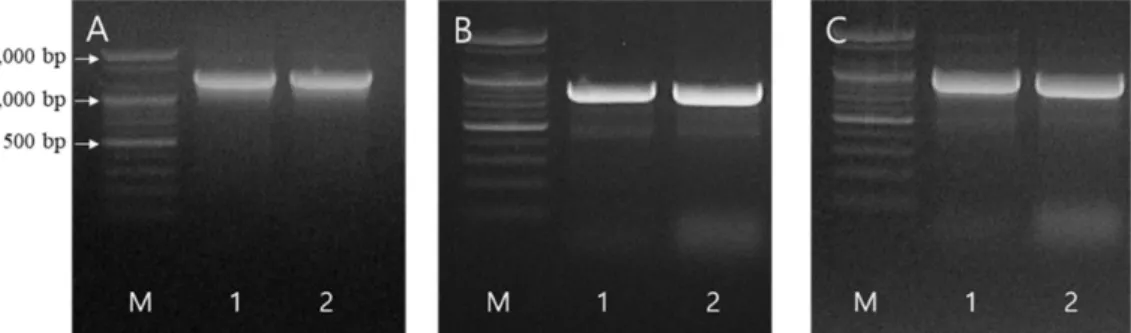
세균의 종 동정을 위해 16S rDNA 및 recA (DNA recombination and repair protein) gene과 rpoA (RNA polymerase, alpha subunit) gene을 target으로 PCR을 실시하였다. 세균의 종 동정에 사용한 primer set의 정보 및 PCR 조건은 Table 1에 나타내었다. 증폭된 PCR산물은 1.5% agarose gel을 사용해 전기영동을 한 후, UV transilluminator상에서 target band를 확인 하였다. 생성된 band는 잘라내어 gel purification kit(bioneer, korea)를 이용하여 정제한 다음, se- quencing을 실시하였다. 분리된 균주의 염기서열 은 GeneBank에 등재되어 있는 다른 Vibrio 속 세균 의 염기서열과 함께 MEGA 7.0을 사용하여 계통수 제작 및 균주들간의 상동성을 조사하였다.
빈사 개체의 비장, 신장 및 복수를 TSA배지 (NaCl 1.5% 첨가)에 도말, 배양한 결과, 모든 시료 에서 공통적으로 swarming movement를 보이는 집 락(SI_1)과 크림색의 원형 집락 (SI_2)이 압도적으 로 우점하였다 (Fig. 2A, B). 이들 집락은 TCBS 배 지에서 노란색의 단일 집락(SI_1)과 초록색의 단일
집락 (SI_2)을 각각 형성하였다 (Fig. 2C, D). 이들 두 분리균주는 모두 그람 음성이었으며, 해당 병변 으로부터 기생충과 VHSV, MBV는 검출되지 않았다.
분리균주 SI_1은 3~10%의 염분조건 및 20~35℃
의 온도 조건에서 성장하였다. 또한, LDC, ODC, CIT, IND, MAN 등의 test에서 양성 반응을 보여 V. harveyi나 V. alginolyticus와 가장 유사하게 나타 났다. 반면, 분리균주 SI_2는 3%와 6%의 염분조건 에서 성장하였으며, CIT, IND, MAN 등의 test에서 음성반응을 보여 V. gigantis와 가장 유사하였다 (Table 2).
Table 1. Oligonucleotide primers used for PCR identification of isolated bacteria
Target gene Primer Sequence(5′-3′) PCR condition Size
(bp) References
16S rDNA 20F
1500R
AGAGTTTGATCATGGCTCAG GGTTACCTTGTTACGACTT
95℃(30sec)-51℃(1min)
-72℃(2min), 30 cycles 1,481 Weisburg et al., 1991
recA recA-01F
recA-02R
TGARAARCARTTYGGTAAAGG
TCRCCNTTRTAGCTRTACC 95℃(30sec)-52℃(1min)
-72℃(1min), 35 cycles 819
Thompson et al., 2005
rpoA rpoA-03F
rpoA-03R
ATGCAGGGTTCTGTDACAG
GHGGCCARTTTTCHARRCGC 951
Fig. 2. Culture characteristics of Vibrio isolates, SI_1 and SI_2 originating from dark-banded rockfish. A. SI_1 isolate on TSA (1.5% NaCl); B. SI_2 isolate on TSA (1.5% NaCl); C. SI-1 isolate on TCBS medium; D. SI_2 isolate on TCBS. The arrows indicate swarming move- ments.
Table 2. Differential biochemical and physiological characteristics of Vibrio species isolated in this study (SI_1, 2) and other Vibrio species. Data of other Vibrio species were adopted from Noguerola and Blanch (2008).
1, V. harveyi; 2,V. gigantis; 3, V. anguillarum; 4, V. alginolyticus; 5,V. cholerae; 6, V. ichthyoenteri; 7, V. ordalii;
8, V. salmonicida; 9,V. splendidus; 10, V. vulnificus. +, ≥ 75% of strain positive; –, < 25% of strain negative;
V, Variable; ND, Not Detected.
SI_1 SI_2 1 2 3 4 5 6 7 8 9 10
Growth in NaCl
0.5%
3%
6%
8%
10%
- + + + +
- + + - -
- + + + -
- + + - -
v + v - -
- + + + +
+ + - - -
- + + - -
- + + - -
- v - - -
- v v v -
- + + - - Growth at
4℃
20℃
30℃
35℃
40℃
- + + + -
- + + - -
+ + + + v
ND ND ND ND ND
v + + + -
v + + + +
- + + + +
- + + - -
v + - - -
+ + - - -
v + + v -
- + + + + API 20E
ONPG ADH LDC ODC CIT H2S URE TDA IND VP GEL GLU MAN INO SOR RHA SAC MEL AMY ARA OX
- - + + + - - - + - - + + - + - + - + - +
- - - - - - - - - - - + - - - - - - - - +
v - + + v ND
v ND
+ - + - + - - - - - - - +
- + - - - ND
- ND
+ - - - + - - - - + + - +
+ + - - + ND
- ND
+ + + - + - + - + - - + +
- - + + + ND
- ND
+ + + - + - - - + - - - +
+ - + + v ND
- ND
+ + + - + - - - + - - - +
- - - - - ND
v ND
- - - - - - - - + - v - +
- - - - + ND
- ND
- - + - - - - - + - - - +
- - - - - ND
- ND
- - - - + - - - - - ND
- +
+ + - - v ND
- ND
+ - + - + - - - + - - - +
+ - + + + ND
- ND
+ - + - + - - - - - + - + ONPG, b-galactosidase; ADH, arginine dihydrolase; LDC, lysine decarboxylase; ODC, ornithine decarboxylase;
CIT, citrate utilization; URE, urease; TDA, tryptophane deaminase; IND, indole production; VP, Voges–Proskauer;
GEL, gelatinase; GLU, glucose; MAN, mannitol; INO, inositol; SOR, sobitol; RHA, rhamnose; SAC, saccharose;
MEL, melibiose; AMY, amygdalin; ARA, arabinose; OX, cytochrome oxidase.
이들 두 균주의 16S rDNA 및 recA, rpoA gene을 타겟으로 한 PCR에서 각각 ~1600bp, 819bp, 951bp 위치에 band가 형성되었다 (Fig. 3). 이 band로부터 확보한 염기서열은 계통수를 작성하여 분석한 결 과, 16S rDNA 유전자의 경우, SI_1은 V. harveyi와 clustering되었으며 SI_2는 V. gigantis와 clustering 되었다 (Fig. 4). recA, rpoA 유전자도 동일하게 각 각 V. harveyi, V. gigantis와 clustering되었다 (Data not shown). 각 gene에 대해 SI_1은 V. harveyi와 98.4~100%의 상동성을 보였으며, SI_2은 V. gigan- tis와 99.9~100%의 상동성을 보였다 (Data not shown). 따라서, 각각의 균주를 Vibrio harveyi와
Vibrio gigantis로 동정하였다.
V. harveyi는 다양한 해산 어류 및 무척추 동물에 감염하여 안구, 소화관, 체표, 근육, 꼬리 등에 병변 을 형성, 폐사를 유발하는 것으로 알려져 있으며, 아시아, 남유럽, 남아메리카 등의 온대 해역에서 발생, 양식 산업에 큰 피해를 주고 있다 (Zhang et al., 2020). 우리나라에서도 넙치, 조피볼락 등에서 V. harveyi가 분리, 보고된 바 있으며 (Sohn et al., 2020; Won et al., 2006), 볼락에서도 V. harveyi가 분리된 바 있어(Kang and Cha, 2019) 본 연구에서 분리된 V. harveyi는 양식 현장에서 볼락에게 이미 감염되어 있는 상태로 운반되었을 가능성이 있다.
Fig. 3. PCR profiles targeting 16S rDNA gene (A), recA gene (B) and rpoA gene (C) (M. 100bp Marker; Lane 1. SI_1 isolate; Lane 2. SI_2 isolate).
Fig. 4. Molecular phylogenetic tree showing the genetic relationships among Vibrio species based on 16S rRNA genes sequences, including the isolates (SI_1, SI_2) in this study. This tree was constructed based on neighbor-joining method. Numbers at nodes denote the level of bootstrap based on 1,000 replicates.
분리된 V. harveyi는 TSA 배지에서 한천 배지의 표 면을 따라 집락이 넓게 퍼지는 swarming movement 현상을 나타내었으며, 이는 Proteus 속 및 Vibrio 속 세균 (e.g., V. alginolyticus, V. parahaemolyticus, V. harveyi)에서 나타나는 현상으로서 Won et al.
(2007)이 V. harveyi에서도 이미 보고하였다. 또한, Ortigosa et al. (1994)은 V. harveyi는 0.5~7%의 염분 조건에서 성장 가능하며, 균주에 따라 8%에서도 성장이 가능하다고 보고하였다. 본 연구에서 분리 된 V. harveyi는 10%의 염분 조건에서도 성장하여 다른 V. harveyi 분리주에 비해 염분 내성이 상대적 으로 강한 것으로 생각된다. 한편, V. gigantis는 지 중해에서 양식되는 굴에서 처음으로 보고되었으 며 (Le Roux et al., 2005), 일반적으로 패류에서 분 리되는 것으로 알려져 있다. 최근 Sohn et al. (2020) 은 양식산 넙치에서 V. gigantis를 분리하였으며, 넙 치에 대한 병원성 여부는 알 수 없다고 언급하였다.
본 연구에서도 V. harveyi와 V. gigantis가 우점적 으로 분리되었으며, 볼락에서 관찰된 임상 증상은 V. harveyi 감염시 나타나는 증상과 유사하여 V.
harveyi가 볼락의 폐사 원인일 가능성이 높은 것으 로 생각되었다. 하지만 폐사의 원인을 좀더 명확하 게 밝히기 위해서는 인위 감염 시험 등 추가 연구 가 필요하다고 생각된다.
References
Choi H. J., Hong K. P., Oh S. Y., Noh C. H., Park Y.
J., Myoung J. G., Kim J. M., Hur J. W., Zhang C.
I. and Park I. S.: Growth characteristics of cultured dark-banded rockfish, Sebastes inermis Cuvier. J.
Aquaculture, 18: 147-153, 2005.
Choi H. S., Jee B. Y., Cho M. Y. and Park M. A.:
Monitoring of pathogens on the cultured Korean rockfish Sebastes schlegeli in the marine cages farms of south sea area from 2006 to 2008. J. Fish Pathol., 23: 27-35, 2010.
Gwak W. S. and Park D. W.: Developmental changes in digestive enzymes activity of black rockfish Sebastes inermis. J. Aquaculture, 19: 125-132, 2006.
Kang G. H. and Cha S. J.: Monitoring of pathogens de- tected in cultured fishes of Gyeongnam in 2018.
Kor. J. Fish. Aquat., 52: 539-546, 2019.
Kim S. R., Kim J. H., Jung S. J. and Oh M. J.: Bacterial
flora and antibiotics resistance of intestinal bacteria in the wild and cultured black rockfish Sebastes inermis. J. Fish Pathol., 20: 221-227, 2007.
Le Roux F., Goubet A., Thompson F. L., Faury N., Gay M., Swings J. and Saulnier D.:Vibrio gigantis sp.
nov., isolated from haemolymph of cultured oysters (Crassostrea gigas). Int. J. Syst. Evol. Microbiol., 55: 2251-2255, 2005.
Masuda, H., Amaoka, K., Araga, C., Uyeno, T. and Yoshino, T. The fishes of the Japanese Archipelago, Vol. 1. Tokai University Press, Tokyo, Japan, 437 p. 1984.
Noguerola I. and Blanch A.R.: Identification of Vibrio spp. with a set of dichotomous keys. J. Appl. Micro- biol., 105: 175-185, 2008.
Oh S.Y. and Noh S.H.: Changes of water quality during the seed production period of dark-banded rockfish Sebastes inermis in large scale tanks. J. aquaculture.
19: 25-32, 2006.
Ortigosa, M., Garay, E and Pujalte, M. J.: Numerical taxonomy of Vibrionaceae isolated from oysters and seawater along an annual cycle. System. Appl.
Microbiol., 17: 216-225, 1994.
Sohn H. C., Kim, J. G., Jin, C. N. and Lee J. H.: Identifi- cation of Vibrio species isolated from cultured olive flounder (Paralichthys olivaceus) in Jeju Island, South Korea. Fish. Aquat. Sci., 22:14, 2020.
Thompson F. L., Gevers D., Thompson C. C., Dawyndt P., Naser S., Hoste B., Munn C. B. and Swings J.:
Phylogeny and molecular identification of Vibrios on the basis of multilocus sequence analysis. Appl.
Environ. Microbiol. 71: 5107-5115, 2005.
Weisburg W.G., Barns S.M., Pelletier D.A. and Lane D.J.: 16S ribosomal DNA amplification of phyloge- netic study. J. Bacteriol., 173: 697-703, 1991.
Won K.M., Choi J.H., Kim Y.C. and Park S.I.: Microbi- ological characteristics of Vibrio harveyi. J. Fish Pathol., 20: 237-247, 2007.
Won K. M., Kim S. M. and Park S. I.: Characterization of Vibrio harveyi, the causal agent of vibriosis in cultured marine fishes in Korea. J. Fish. Sci. Technol., 9: 123-138, 2006.
Zhang X. H., He X. X. and Austin, B.: Vibrio harveyi:
A serious pathogen of fish and invertebrates in mar- iculture. Mar. Life Sci. Technol., 2: 231-245, 2020.
Manuscript Received : May 15, 2021 Revised : May 25, 2021 Accepted : May 28, 2021